

Diagnostic metagenomics: potential applications to bacterial, viral and parasitic infections
Open accessThe DOI matches its Crossref record; 55 of the 56 references it cites were found in a registry or an index.
Abstract
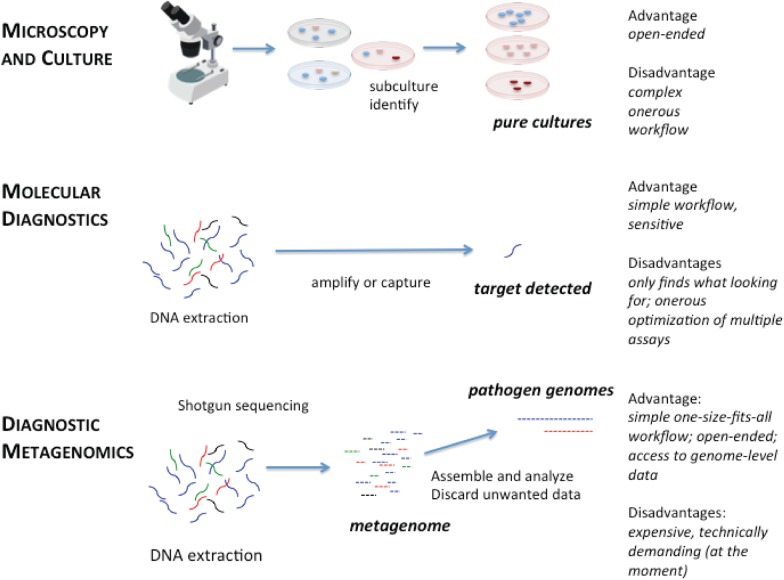
SUMMARY: The term ‘shotgun metagenomics’ is applied to the direct sequencing of DNA extracted from a sample without culture or target-specific amplification or capture. In diagnostic metagenomics, this approach is applied to clinical samples in the hope of detecting and characterizing pathogens. Here, I provide a conceptual overview, before reviewing several recent promising proof-of-principle applications of metagenomics in virus discovery, analysis of outbreaks and detection of pathogens in contemporary and historical samples. I also evaluate future prospects for diagnostic metagenomics in the light of relentless improvements in sequencing technologies.
Overview
The claims and statistics of this paper haven’t been checked yet.
Free: it reads the open-access text and checks the first 5 claims that cite a source we can check. Create a free account to check every claim.
Integrity signals
Registry
Cites
Statistics
Figures
Verification
Claims the paper makes
The claims and statistics of this paper haven’t been checked yet.
Free: it reads the open-access text and checks the first 5 claims that cite a source we can check. Create a free account to check every claim.
Claims other papers make about this one
Each is checked against this paper’s own text: does it say what the citing paper says it does?
In the citing paper
“Moreover, defining specific microbial profiles that are diagnostic or predictive of disease development can be difficult, especially from nonsterile sites that harbour a complex microbiome, such as respiratory secretions or stool6.”
From Clinical metagenomics (2019) · cites this paper as [6]
Self-check
Percentages, sums and reported differences re-computed from the paper’s own numbers.
The self-check needs the paper’s full text.
Citations
Cites
A human gut microbial gene catalogue established by metagenomic sequencing
MetaHIT Consortium, Qin, J., Li, R., Raes, J., Arumugam, M., Burgdorf, K. S., Manichanh, C., Nielsen, T., Pons, N., Levenez, F., et al. (2010) · Nature · doi:10.1038/nature08821 · Cited by 11,624 · cited 1×
“…micro-biome studies, there have now been several shotgun metagenomic studies of human-derived samples, chie fl y focused on the characterization of such communities and their genes in healthy volunteers and non-infectious diseases (Qin et al. 2010, 2012; Arumugam et al. 2011; Karlsson et al. 2013).”
Enterotypes of the human gut microbiome
MetaHIT Consortium (additional members), Arumugam, M., Raes, J., Pelletier, E., Le Paslier, D., Yamada, T., Mende, D. R., Fernandes, G. R., Tap, J., Bruls, T., et al. (2011) · Nature · doi:10.1038/nature09944 · Cited by 7,548
A metagenome-wide association study of gut microbiota in type 2 diabetes
Qin, J., Li, Y., Cai, Z., Li, S., Zhu, J., Zhang, F., Liang, S., Zhang, W., Guan, Y., Shen, D., et al. (2012) · Nature · doi:10.1038/nature11450 · Cited by 6,762
Turnbaugh, P. J., Ley, R. E., Hamady, M., Fraser-Liggett, C. M., Knight, R., & Gordon, J. I. (2007) · Nature · doi:10.1038/nature06244 · Cited by 6,091
Diversity, stability and resilience of the human gut microbiota
Lozupone, C. A., Stombaugh, J. I., Gordon, J. I., Jansson, J. K., & Knight, R. (2012) · Nature · doi:10.1038/nature11550 · Cited by 5,533 · cited 1×
“…that di ff erences in host-associated microbial communities can in fl u-ence the balance between health and disease in conditions not normally thought of as microbial or infectious in origin: for example, in fl ammatory bowel disease, cancer or obesity (Kinross et al. 2011; Lozupone et al. 2012).”
Richness of human gut microbiome correlates with metabolic markers
Le Chatelier, E., Nielsen, T., Qin, J., Prifti, E., Hildebrand, F., Falony, G., Almeida, M., Arumugam, M., Batto, J.-M., Kennedy, S., et al. (2013) · Nature · doi:10.1038/nature12506 · Cited by 4,662
Environmental genome shotgun sequencing of the sargasso sea
Venter, J. C., Remington, K., Heidelberg, J. F., Halpern, A. L., Rusch, D., Eisen, J. A., Wu, D., Paulsen, I., Nelson, K. E., Nelson, W., et al. (2004) · Science · doi:10.1126/science.1093857 · Cited by 4,376 · cited 1×
“In 2004, Venter and his colleagues described a landmark study on the metagenomics of the Sargasso Sea that established the utility of this approach in exploring not just microbial communities but also taxonomic and sequence space (Venter et al. 2004).”
Gut metagenome in European women with normal, impaired and diabetic glucose control
Karlsson, F. H., Tremaroli, V., Nookaew, I., Bergström, G., Behre, C. J., Fagerberg, B., Nielsen, J., & Bäckhed, F. (2013) · Nature · doi:10.1038/nature12198 · Cited by 3,115 · cited 3×
“Although community pro fi ling using molecular barcodes still predominates in the fi eld of micro-biome studies, there have now been several shotgun metagenomic studies of human-derived samples, chie fl y focused on the characterization of such communities and their genes in healthy volunteers and non-infectious diseases…”
The NIH Human Microbiome Project
The NIH HMP Working Group, Peterson, J., Garges, S., Giovanni, M., McInnes, P., Wang, L., Schloss, J. A., Bonazzi, V., McEwen, J. E., Wetterstrand, K. A., et al. (2009) · Genome Research · doi:10.1101/gr.096651.109 · Cited by 2,066
The Uncultured Microbial Majority
Rappé, M. S., & Giovannoni, S. J. (2003) · Annual Review of Microbiology · doi:10.1146/annurev.micro.57.030502.090759 · Cited by 2,017
Research works printed but not linked: 1
- Gram H. C. (1884). Über die isolierte Färbung der Schizomyceten in Schnitt- und Trockenpräparaten. Fortschritte der Medizin 2, 185– 189.
Cited by
Chiu, C. Y., & Miller, S. A. (2019) · Nature Reviews Genetics · doi:10.1038/s41576-019-0113-7 · Cited by 1,620
The Oxford Nanopore MinION: delivery of nanopore sequencing to the genomics community
Jain, M., Olsen, H. E., Paten, B., & Akeson, M. (2016) · Genome Biology · doi:10.1186/s13059-016-1103-0 · Cited by 1,588
“Analysis of infectious agents at point-of-care Next-generation sequencing can detect viruses, bacteria, and parasites present in clinical samples and in a hospital environment [11, 14, 27, 34].”
Greninger, A. L., Naccache, S. N., Federman, S., Yu, G., Mbala, P., Bres, V., Stryke, D., Bouquet, J., Somasekar, S., Linnen, J. M., et al. (2015) · Genome Medicine · doi:10.1186/s13073-015-0220-9 · Cited by 558
“Metagenomic next-generation sequencing (NGS) is 44 particularly attractive for diagnosis and public health surveillance of febrile illness 45 because the approach can broadly detect viruses, bacteria, and parasites in 46 clinical samples by uniquely identifying sequence data [1, 2].”
BackgroundLiu, P., Chen, W., & Chen, J.-P. (2019) · Viruses · doi:10.3390/v11110979 · Cited by 388
“Unbiased sequencing of nucleic acids from environmental samples has great potential for the discovery and identification of diverse microorganisms [12] [13] [14] [15] .”
BackgroundAn Update on Zoonotic Cryptosporidium Species and Genotypes in Humans
Ryan, U., Zahedi, A., Feng, Y., & Xiao, L. (2021) · Animals · doi:10.3390/ani11113307 · Cited by 244
Metadata
- Authors
- PALLEN, M. J.
- Affiliations
- University of Warwick (GB)
- Corresponding author
- PALLEN, M. J.
- ORCID
- PALLEN, M. J.
- Venue
- Parasitology
- Publisher
- Cambridge University Press (CUP)
- Published
- 2014-02-27
- Volume
- 141
- Issue
- 14
- Pages
- 1856-1862
- ISSN
- 0031-1820 (ISSN-L)
- 1469-8161
- PMC
- PMC4255322
- OpenAlex
- W2056379010
- Cited by
- 126
- References
- 56
- Citations by year
- 2026: 5 · 2025: 9 · 2024: 5 · 2023: 5 · 2022: 9 · 2021: 15 · 2020: 13 · 2019: 11 · 2018: 10 · 2017: 18 · 2016: 10 · 2015: 9 · 2014: 7
- FWCI
- 1.38
- Type
- journal article
- Language
- en
- Open access
- hybrid
- doi.org
- Licence
- Locations
- Parasitology (publishedVersion, cc-by-nc-sa)
- PubMed Central (publishedVersion, cc-by-nc-sa)
- PubMed (publishedVersion)
- Warwick Research Archive Portal (University of Warwick) (acceptedVersion)
- Funders
- Biotechnology and Biological Sciences Research Council (BB/E011179/1)
- Topics
- Life Sciences › Biochemistry, Genetics and Molecular Biology › Molecular Biology › Genomics and Phylogenetic Studies
- Health Sciences › Medicine › Microbiology (medical) › Bacterial Identification and Susceptibility Testing
- Life Sciences › Immunology and Microbiology › Virology › Bacteriophages and microbial interactions
- Keywords
- shotgun metagenomics, pathogen detection, bacterial infection, viral infection, parasitic infection, virus discovery, outbreak analysis, historical samples, clinical samples, sequencing technologies
- MeSH terms
- Animals, Bacteria, Bacterial Infections, Humans, Parasites, Parasitic Diseases, Virus Diseases, Viruses, Sequence Analysis, DNA, Metagenomics, High-Throughput Nucleotide Sequencing
About these checks
Registry, retraction, Cites and statistics results are computed, not judged, with one exception: a printed reference that no index lists is read once by a model before it counts as a citation error. Claims are extracted by a model and kept only when their quote appears verbatim in the text; each cited source is then checked, with a model’s help, for whether it says what the claim relies on. Those verdicts can be wrong — read the claim’s quote and the cited source before relying on one.
Statistics and arithmetic are recomputed, not judged.
Confidence bands are shown only for fields calibrated on our annotated test set. None is calibrated yet, so no band is shown.
What counts as a claim ›How we measure confidence ›How we check this ›
Are you an author, or do you see a problem with this page? Request a review
How to cite
Cite CoChat for the checks on this page, and the paper for its own findings.
- This page
- CoChat. (2026). Citation check: Diagnostic metagenomics: potential applications to bacterial, viral and parasitic infections. https://app.cochat.ai/papers/10.1017/s0031182014000134
- The paper
- PALLEN, M. J. (2014). Diagnostic metagenomics: potential applications to bacterial, viral and parasitic infections. Parasitology. https://doi.org/10.1017/s0031182014000134
Data sources
Bibliographic data: Semantic Scholar, OpenAlex, Crossref.
Contains information from the Semantic Scholar Academic Graph Datasets, made available under the ODC Attribution License (ODC-BY 1.0).
Semantic Scholar’s data is described in: Kinney, R., et al. (2023). The Semantic Scholar Open Data Platform. arXiv:2301.10140.
