

Effects of stressor controllability on psychophysiological, cognitive and behavioural responses in patients with major depression and dysthymia
Open accessThe DOI matches its Crossref record; 38 of the 38 references it cites were found in a registry or an index.
Abstract
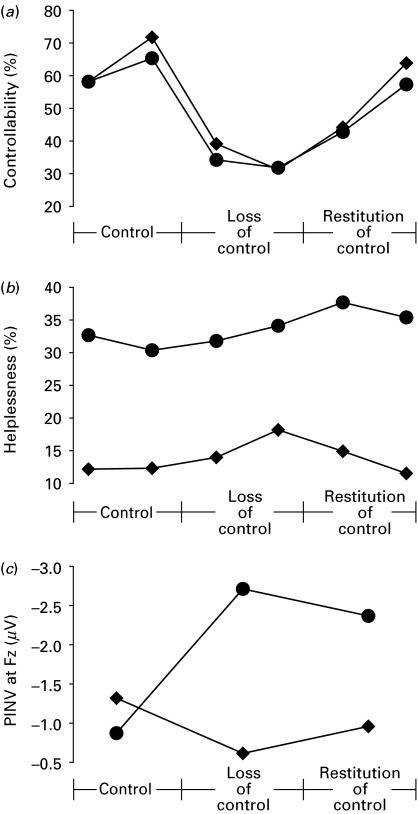
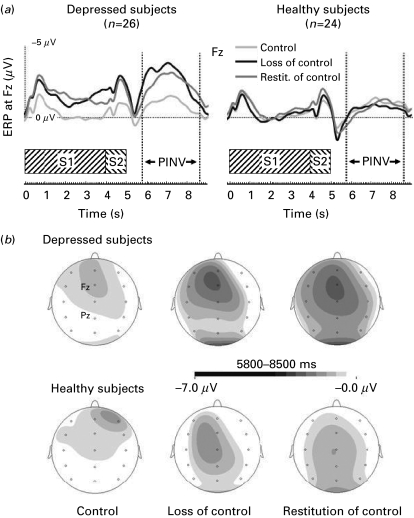
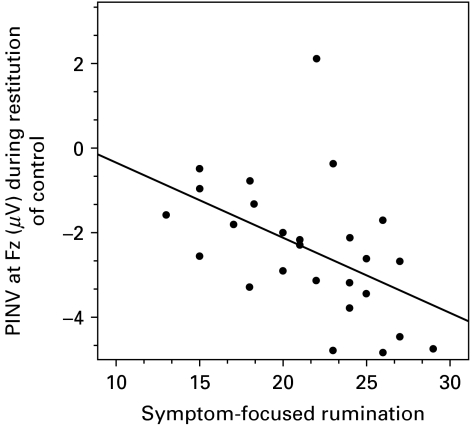
Background: The experience of uncontrollability and helplessness in the face of stressful life events is regarded as an important determinant in the development and maintenance of depression. The inability to successfully deal with stressors might be linked to dysfunctional prefrontal functioning. We assessed cognitive, behavioural and physiological effects of stressor uncontrollability in depressed and healthy individuals. In addition, relationships between altered cortical processing and cognitive vulnerability traits of depression were analysed. Method: A total of 26 unmedicated depressed patients and 24 matched healthy controls were tested in an expanded forewarned reaction (S1–S2) paradigm. In a factorial design, stressor controllability varied across three consecutive conditions: (a) control, (b) loss of control and (c) restitution of control. Throughout the experiment, error rates, ratings of controllability, arousal, emotional valence and helplessness were assessed together with the post-imperative negative variation (PINV) of the electroencephalogram. Results: Depressed participants showed an enhanced frontal PINV as an electrophysiological index of altered information processing during both loss of control and restitution of control. They also felt more helpless than controls. Furthermore, frontal PINV magnitudes were associated with habitual rumination in the depressed subsample. Conclusions: These findings indicate that depressed patients are more susceptible to stressor uncontrollability than healthy subjects. Moreover, the experience of uncontrollability seems to bias subsequent information processing in a situation where control is objectively re-established. Alterations in prefrontal functioning appear to contribute to this vulnerability and are also linked to trait markers of depression.
Overview
The claims and statistics of this paper haven’t been checked yet.
Free: it reads the open-access text and checks the first 5 claims that cite a source we can check. Create a free account to check every claim.
Integrity signals
Registry
Cites
Statistics
Figures
Verification
Claims the paper makes
The claims and statistics of this paper haven’t been checked yet.
Free: it reads the open-access text and checks the first 5 claims that cite a source we can check. Create a free account to check every claim.
Claims other papers make about this one
Each is checked against this paper’s own text: does it say what the citing paper says it does?
The source backs part of the claim, not all of it — or backs it for a different population, condition or comparison.
In the citing paper
“Additionally, higher levels of perceived helplessness and PINV magnitude correlated with rumination.”
From Prefrontal cortex and depression (2022) · cites this paper as [208]
Experimental — accuracy not yet measuredThe cited source says what the claim attributes to it.
In the citing paper
“Diener et al. reported that, relative to controls, unmedicated individuals with MDD had potentiated frontal PINV during settings in which control over an aversive outcome was removed and then restored [208].”
From Prefrontal cortex and depression (2022) · cites this paper as [208]
In the citing paper
“Furthermore, exposure to uncontrollable stressors biases this process assessed by the explore-and-predict task, hence establishing its relevance for the study of neuropsychiatric disorders involving altered perceptions of controllability 9,12,13,35 .”
From Stress-sensitive inference of task controllability (2022) · cites this paper as [13]
Self-check
Percentages, sums and reported differences re-computed from the paper’s own numbers.
The self-check needs the paper’s full text.
Citations
Cites
Diagnostic and Statistical Manual of Mental Disorders
Williams, J. B. W., & First, M. (2013) · Encyclopedia of Social Work · doi:10.1093/acrefore/9780199975839.013.104 · Cited by 109,519
Hamilton, M. (1960) · Journal of Neurology, Neurosurgery & Psychiatry · doi:10.1136/jnnp.23.1.56 · Cited by 32,817
A new method for off-line removal of ocular artifact
Gratton, G., Coles, M. G. H., & Donchin, E. (1983) · Electroencephalography and Clinical Neurophysiology · doi:10.1016/0013-4694(83)90135-9 · Cited by 5,055 · cited 1×
“Each segment was corrected for eye movements (Gratton et al. 1983) and semi-automatically rejected when corrupted by artifacts (i.e. voltage step/sampling point o50 mV, minimal amplitude”
Berti, A. (1992) · Neuropsychologia · doi:10.1016/0028-3932(92)90076-x · Cited by 4,162
Nolen-Hoeksema, S., & Morrow, J. (1991) · Journal of Personality and Social Psychology · doi:10.1037/0022-3514.61.1.115 · Cited by 3,276
Spherical splines for scalp potential and current density mapping
Perrin, F., Pernier, J., Bertrand, O., & Echallier, J. F. (1989) · Electroencephalography and Clinical Neurophysiology · doi:10.1016/0013-4694(89)90180-6 · Cited by 2,706 · cited 1×
“There was neither a significant main effect for condition [F(2, 47)=2.33, N.S.] nor a significant conditionrgroup interaction [F(2, 47)=0.41, N.S.].”
BackgroundInfluentialLearned helplessness: Theory and evidence
Maier, S. F., & Seligman, M. E. (1976) · Journal of Experimental Psychology: General · doi:10.1037/0096-3445.105.1.3 · Cited by 2,494 · cited 2×
“Consequences of stressor uncontrollability in humans range from cognitive, motivational and emotional alterations (Maier & Seligman, 1976) to neuroendocrinological, neurochemical and functional as well as structural brain changes (Breier, 1989) that are in line with core features of depression.”
Background(2012) · SpringerReference · doi:10.1007/springerreference_179754 · Cited by 2,089
Limbic-cortical dysregulation: a proposed model of depression
(1997) · The Journal of Neuropsychiatry and Clinical Neurosciences · doi:10.1176/jnp.9.3.471 · Cited by 1,585 · cited 1×
“Neuroimaging studies of depression point to dysfunctions in the limbic–thalamic–cortical network, indicating hypoactivity in prefrontal brain areas including the cingulate gyrus during resting states (Mayberg, 1997 ; Pizzagalli et al. 2005).”
BackgroundCzéh, B., Michaelis, T., Watanabe, T., Frahm, J., de Biurrun, G., van Kampen, M., Bartolomucci, A., & Fuchs, E. (2001) · Proceedings of the National Academy of Sciences · doi:10.1073/pnas.211427898 · Cited by 1,091
Research works printed but not linked: 2
- Kuehner C Huffziger S Nolen-Hoeksema S 2007b German Version of the Response Styles Questionnaire (RSQ-D). Manual Hogrefe Göttingen, Germany
- First MB Spitzer RL Gibbon M Williams JBW 1997 Structured Clinical Interview for DSM-IV Axis I Disorders – Clinical Version American Psychiatric Press Washington, DC
Cited by
Prefrontal cortex and depression
Pizzagalli, D. A., & Roberts, A. C. (2022) · Neuropsychopharmacology · doi:10.1038/s41386-021-01101-7 · Cited by 667
Pryce, C. R., Azzinnari, D., Spinelli, S., Seifritz, E., Tegethoff, M., & Meinlschmidt, G. (2011) · Pharmacology & Therapeutics · doi:10.1016/j.pharmthera.2011.06.006 · Cited by 241
Intergenerational Trauma: Convergence of Multiple Processes among First Nations peoples in Canada
Bombay, A., Matheson, K., & Anisman, H. (2009) · International Journal of Indigenous Health · doi:10.18357/ijih53200912337 · Cited by 218
Sensorimotor brain dynamics reflect architectural affordances
Djebbara, Z., Fich, L. B., Petrini, L., & Gramann, K. (2019) · Proceedings of the National Academy of Sciences · doi:10.1073/pnas.1900648116 · Cited by 184
Neurobiology and systems biology of stress resilience
Kalisch, R., Russo, S. J., & Müller, M. B. (2024) · Physiological Reviews · doi:10.1152/physrev.00042.2023 · Cited by 166
Altered neural reward and loss processing and prediction error signalling in depression
Ubl, B., Kuehner, C., Kirsch, P., Ruttorf, M., Diener, C., & Flor, H. (2015) · Social Cognitive and Affective Neuroscience · doi:10.1093/scan/nsu158 · Cited by 165
“This is in line with the literature providing striking evidence for reduced responsiveness to rewards and an enhanced sensitivity to punishments in depression (Diener et al., 2009a,b; Eshel and Roiser, 2010).”
BackgroundResultSelf-citationLaborde, S., Dosseville, F. E. M., García, F. G., & Chávez, E. (2014) · Psychology of sport and exercise · doi:10.1016/j.psychsport.2014.05.001 · Cited by 160
Social support and adaptation to the disease in men and women with psoriasis
Janowski, K., Steuden, S., Pietrzak, A., Krasowska, D., Kaczmarek, L. D., Gradus, I., & Chodorowska, G. (2012) · Archives of Dermatological Research · doi:10.1007/s00403-012-1235-3 · Cited by 109
Azzinnari, D., Sigrist, H., Staehli, S., Palme, R., Hildebrandt, T., Leparc, G., Hengerer, B., Seifritz, E., & Pryce, C. R. (2014) · Neuropharmacology · doi:10.1016/j.neuropharm.2014.05.039 · Cited by 109
Empathic behavioral and physiological responses to dynamic stimuli in depression
Schneider, D. A., Regenbogen, C., Kellermann, T., Finkelmeyer, A. E., Kohn, N., Derntl, B., Schneider, F. W., & Habel, U. (2012) · Psychiatry Research · doi:10.1016/j.psychres.2012.03.054 · Cited by 105
Chronic psychosocial stressors in adulthood: Studies in mice, rats and tree shrews
Pryce, C. R., & Fuchs, E. (2017) · Neurobiology of Stress · doi:10.1016/j.ynstr.2016.10.001 · Cited by 91
Dai, Q., & Feng, Z. (2012) · Clinical Neurophysiology · doi:10.1016/j.clinph.2012.04.018 · Cited by 86
A two-factor model of relapse/recurrence vulnerability in unipolar depression
Farb, N. A. S., Irving, J. A., Anderson, A. K., & Segal, Z. V. (2015) · Journal of Abnormal Psychology · doi:10.1037/abn0000031 · Cited by 75
Building Resilience: The Stress Response as a Driving Force for Neuroplasticity and Adaptation
Hermans, E. J., Hendler, T., & Kalisch, R. (2024) · Biological Psychiatry · doi:10.1016/j.biopsych.2024.10.016 · Cited by 73
Havranek, M. M., Bolliger, B., Roos, S., Pryce, C. R., Quednow, B. B., & Seifritz, E. (2015) · Stress · doi:10.3109/10253890.2015.1117449 · Cited by 68
Stress‐Induced Depression: Is Social Rank a Predictive Risk Factor?
Larrieu, T., & Sandi, C. (2018) · BioEssays · doi:10.1002/bies.201800012 · Cited by 64
Stress-sensitive inference of task controllability
Ligneul, R., Mainen, Z. F., Ly, V., & Cools, R. (2022) · Nature Human Behaviour · doi:10.1038/s41562-022-01306-w · Cited by 60
“…events, especially stressful ones, constitutes a well-established correlate and a potential predictor of prevalent psychiatric disorders involving an increased influence of reactive and habitual behaviours, such as depression, anxiety, post-traumatic stress or obsessive–compulsive disorders 9–13 .”
Pryce, C. R., & Seifritz, E. (2010) · Psychoneuroendocrinology · doi:10.1016/j.psyneuen.2010.05.003 · Cited by 52
Huffziger, S., & Kühner, C. (2012) · Zeitschrift für Klinische Psychologie und Psychotherapie · doi:10.1026/1616-3443/a000118 · Cited by 51
Dai, Q., Feng, Z., & Koster, E. H. W. (2010) · International Journal of Psychophysiology · doi:10.1016/j.ijpsycho.2010.10.016 · Cited by 46
Laborde, S., Dosseville, F. E. M., & Kinrade, N. P. (2014) · Psychology of sport and exercise · doi:10.1016/j.psychsport.2014.01.004 · Cited by 38
Differentiation of Self Inventory - short form: creation and Initial evidence of construct validity
Drake, J. R. (2011) · MOspace Institutional Repository (University of Missouri) · Cited by 34
Do stressful life events predict medical treatment outcome in first episode of depression?
Bock, C., Bukh, J. D., Vinberg, M., Gether, U., & Kessing, L. V. (2009) · Social Psychiatry and Psychiatric Epidemiology · doi:10.1007/s00127-008-0491-1 · Cited by 30
Michaels, E. K., Reeves, A. N., Thomas, M. D., Price, M. M., Hasson, R. E., Chae, D. H., & Allen, A. M. (2019) · International Journal of Environmental Research and Public Health · doi:10.3390/ijerph16234759 · Cited by 30
Wanke, N., & Schwabe, L. (2020) · Cerebral Cortex · doi:10.1093/cercor/bhz298 · Cited by 28
Loss of control during instrumental learning: A source localization study
Diener, C., Kuehner, C., & Flor, H. (2010) · NeuroImage · doi:10.1016/j.neuroimage.2009.12.094 · Cited by 27
Self-citationElectrophysiological changes in late life depression and their relation to structural brain changes
Köhler, S., Ashton, C. H., Marsh, R., Thomas, A. J., Barnett, N. A., & O'Brien, J. T. (2010) · International Psychogeriatrics · doi:10.1017/s1041610210001250 · Cited by 22
Löchner, J., Ulrich, S. M., & Lux, U. (2024) · Stress and Health · doi:10.1002/smi.3400 · Cited by 21
Behavioral and neural mechanisms underlying cognitive vulnerability models of depression.
Auerbach, R. P., Webb, C. A., Gardiner, C. K., & Pechtel, P. (2013) · Journal of Psychotherapy Integration · doi:10.1037/a0031417 · Cited by 19
“Anatomy of an Illness”: Control from a caregiver’s perspective
Laudenslager, M. L. (2013) · Brain Behavior and Immunity · doi:10.1016/j.bbi.2013.08.012 · Cited by 19
Konradt, U., Heblich, F., Krys, S., Garbers, Y., & Otte, K. (2020) · Journal of Occupational Health Psychology · doi:10.1037/ocp0000161 · Cited by 18
Werner, J., Weisbrod, M., Resch, F., Roessner, V., & Bender, S. (2011) · Behavioral and Brain Functions · doi:10.1186/1744-9081-7-38 · Cited by 14
Kropp, P. A., Brecht, I.-B., Niederberger, U., Kowalski, J. T., Schröder, D., Thome, J., Meyer, W. T., Wallasch, T., Hilgendorf, I., & Gerber, W. (2012) · Journal of Neural Transmission · doi:10.1007/s00702-012-0843-6 · Cited by 14
Ruiz‐Martínez, F. J., Ortíz, M. M., & Gómez, C. M. (2022) · Journal of Neurophysiology · doi:10.1152/jn.00313.2021 · Cited by 12
Wang, S., Djebbara, Z., de Oliveira, G. S., & Gramann, K. (2024) · European Journal of Neuroscience · doi:10.1111/ejn.16461 · Cited by 12
Wyatt, K. P., Eberle, J. W., Ruork, A. K., & Neacsiu, A. D. (2023) · Clinical Psychology & Psychotherapy · doi:10.1002/cpp.2879 · Cited by 11
Why Depressive Symptoms Cause Distress: The Clients’ Perspective
Hanson, B., & Young, M. A. (2012) · Journal of Clinical Psychology · doi:10.1002/jclp.21872 · Cited by 9
Psychiatric Disorders - New Frontiers in Affective Disorders
Schoepf, D. (2013) · InTech eBooks · doi:10.5772/2039 · Cited by 8
Altered Associative Learning and Learned Helplessness in Major Depression
Diener, C. (2013) · InTech eBooks · doi:10.5772/51787 · Cited by 8
Self-citationLe, L., Moulds, M. L., & Nickerson, A. (2018) · Journal of Behavior Therapy and Experimental Psychiatry · doi:10.1016/j.jbtep.2018.05.001 · Cited by 7
Kuehner, C., Diener, C., Ubl, B., & Flor, H. (2010) · Psychological Medicine · doi:10.1017/s0033291710002424 · Cited by 4
Self-citationSeeds, P. M. (2012) · Scholarship@Western (Western University) · Cited by 4
Stress, monoamines, and cognitive flexibility
Snyder, K. P. (2013) · Scholarly Commons (University of Pennsylvania) · Cited by 3
The controllability of aversive and neutral pictures: an event-related potential study
Bauer, E., Thomas, G. B., & MacNamara, A. (2021) · Behavioural Brain Research · doi:10.1016/j.bbr.2021.113265 · Cited by 3
Nataraj, M., Kumble, C. N., Ganjekar, S., & Desai, G. (2022) · Oxford University Press eBooks · doi:10.1093/med/9780198861478.003.0037 · Cited by 2
Depression Detection in Hospitalized Cardiac Patients
Geddes, M. S. (2010) · Digital Commons - USU (Utah State University) · doi:10.26076/33c8-c2fa · Cited by 2
Dudziak, M., Franssen, M., Vervliet, B., & Beckers, T. (2025) · Behaviour Research and Therapy · doi:10.1016/j.brat.2025.104842 · Cited by 2
Screening and monitoring of stress using biofeedback equipment
Maré, I. (2012) · UpSpace Institutional Repository (University of Pretoria) · Cited by 2
Alizadeh, A., Azizi, M., Barati, M., Soleimani, F., Morad, R., Rahnejat, A. M., & Donyavi, V. (2014) · Journal of Archives in Military Medicine · doi:10.5812/jamm.25015 · Cited by 1
Soares, A. R., Fai, C., Mineur, Y. S., & Picciotto, M. R. (2025) · Pharmacology Biochemistry and Behavior · doi:10.1016/j.pbb.2025.174130 · Cited by 1
The resource elasticity of control
Solomyak, L., Emanuel, A., & Eldar, E. (2026) · eLife · doi:10.1101/2024.12.16.628674 · Cited by 1
The resource elasticity of controlPreprint
Solomyak, L., Emanuel, A., & Eldar, E. (2026) · eLife · doi:10.7554/elife.105507 · Cited by 1
Perchtold‐Stefan, C. M., Rominger, C., & Fink, A. (2026) · BMC Psychology · doi:10.1186/s40359-026-04975-8 · Cited by 1
VALIDASI DAN PENGEMBANGAN PARADIGMA EKSPERIMEN LEARNED HELPLESSNESS PADA ETNIS DOMINAN DI INDONESIA
Lufityanto, G. (2018) · PSIKODIMENSIA · doi:10.24167/psidim.v17i1.1459 · Cited by 1
Bauer, E. (2023) · OakTrust (Texas A&M University Libraries) · Cited by 1
Havranek, M. M. (2016) · Zurich Open Repository and Archive (University of Zurich) · doi:10.5167/uzh-204541 · Cited by 1
The impact of a loss of control over threat on stress reactivity
Dudziak, M., Smeets, T., Vervliet, B., & Beckers, T. (2026) · Biological Psychology · doi:10.1016/j.biopsycho.2026.109284
Alterations in adult behavior as a result of early life manipulations
Scott, K. A. (2012) · OhioLink ETD Center (Ohio Library and Information Network)
The resource elasticity of controlPreprint
Solomyak, L., Emanuel, A., & Eldar, E. (2025) · eLife · doi:10.7554/elife.105507.1
The resource elasticity of controlPreprint
Solomyak, L., Emanuel, A., & Eldar, E. (2025) · eLife · doi:10.7554/elife.105507.2
The resource elasticity of controlPreprint
Solomyak, L., Emanuel, A., & Eldar, E. (2025) · eLife · doi:10.7554/elife.105507.3
Author response: The resource elasticity of control
Solomyak, L., Emanuel, A., & Eldar, E. (2025) · eLife · doi:10.7554/elife.105507.1.sa0
Prediction and Explanation in Disorders of Mood & Anxiety
Roberts, C. (2023) · Apollo (University of Cambridge) · doi:10.17863/cam.106855
Corrigan, M. D. (2023) · Memorial University Research Repository (Memorial University) · doi:10.48336/21pd-x076
Wang, S. (2025) · bioRxiv (Cold Spring Harbor Laboratory) · doi:10.1101/2025.01.05.631377
Ruiz‐Martínez, F. J. (2023) · Deposito de Investigacion Universidad de Sevilla (University of Seville)
Thomas, G. B. (2018) · OakTrust (Texas A&M University Libraries)
Carrozzo, E. (2013) · DSpaceUnipr (University of Parma)
Impact of Acute Stress Exposure on Reactivity to Loss of Control Over ThreatPreprint
Dudziak, M., Smeets, T., Vervliet, B., & Beckers, T. (2024) · PsyArXiv (OSF Preprints) · doi:10.31234/osf.io/j5kgt
Metadata
- Authors
- Diener, C., Kuehner, C., Brusniak, W., Struve, M., & Flor, H.
- Affiliations
- Heidelberg University (DE)
- Central Institute of Mental Health (DE)
- Corresponding author
- Diener, C.
- Venue
- Psychological Medicine
- Publisher
- Cambridge University Press (CUP)
- Published
- 2008-05-09
- Volume
- 39
- Issue
- 1
- Pages
- 77-86
- ISSN
- 0033-2917 (ISSN-L)
- 1469-8978
- PMC
- PMC2830060
- OpenAlex
- W2002103661
- Cited by
- 59
- References
- 38
- Citations by year
- 2026: 2 · 2025: 7 · 2024: 5 · 2023: 1 · 2022: 4 · 2021: 3 · 2020: 1 · 2019: 4 · 2018: 3 · 2016: 1 · 2015: 3 · 2014: 4 · 2013: 5 · 2012: 6
- FWCI
- 1.72
- Type
- journal article
- Language
- en
- Open access
- bronze
- doi.org
- Locations
- Psychological Medicine (publishedVersion)
- Europe PMC (PubMed Central) (publishedVersion, cc-by-nc-sa)
- PubMed Central (publishedVersion, cc-by-nc-sa)
- PubMed (publishedVersion)
- Funders
- Deutsche Forschungsgemeinschaft (SFB 636)
- Topics
- Life Sciences › Neuroscience › Cognitive Neuroscience › Neural and Behavioral Psychology Studies
- Social Sciences › Psychology › Experimental and Cognitive Psychology › Anxiety, Depression, Psychometrics, Treatment, Cognitive Processes
- Life Sciences › Neuroscience › Behavioral Neuroscience › Stress Responses and Cortisol
- Keywords
- stressor controllability, major depressive disorder, dysthymia, helplessness, rumination, prefrontal cortex, EEG, cognitive vulnerability, cognitive biases, emotional valence, arousal, loss of control
- MeSH terms
- Adult, Analysis of Variance, Anxiety Disorders, Behavior, Cognition, Major Depressive Disorder, Electroencephalography, Emotions, Female, Helplessness, Learned, Humans, Internal-External Control, Male, Middle Aged, Psychiatric Status Rating Scales, Psychophysiology, Reaction Time, Social Behavior, Stress, Psychological, Comorbidity, Sex Distribution, Dysthymic Disorder, Young Adult
About these checks
Registry, retraction, Cites and statistics results are computed, not judged, with one exception: a printed reference that no index lists is read once by a model before it counts as a citation error. Claims are extracted by a model and kept only when their quote appears verbatim in the text; each cited source is then checked, with a model’s help, for whether it says what the claim relies on. Those verdicts can be wrong — read the claim’s quote and the cited source before relying on one.
Statistics and arithmetic are recomputed, not judged.
Confidence bands are shown only for fields calibrated on our annotated test set. None is calibrated yet, so no band is shown.
What counts as a claim ›How we measure confidence ›How we check this ›
Are you an author, or do you see a problem with this page? Request a review
Data sources
Bibliographic data: Semantic Scholar, OpenAlex, Crossref.
Contains information from the Semantic Scholar Academic Graph Datasets, made available under the ODC Attribution License (ODC-BY 1.0).
Semantic Scholar’s data is described in: Kinney, R., et al. (2023). The Semantic Scholar Open Data Platform. arXiv:2301.10140.
