

The DOI matches its Crossref record; 21 of the 22 references it cites were found in a registry or an index.
Randomized controlled trial of computerized cognitive behavioural therapy for depressive symptoms: effectiveness and costs of a workplace intervention
Open accessAbstract
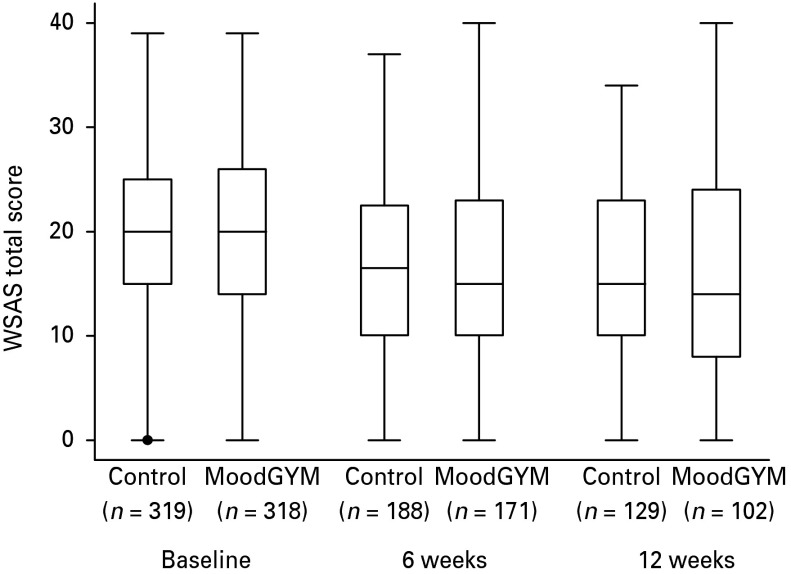
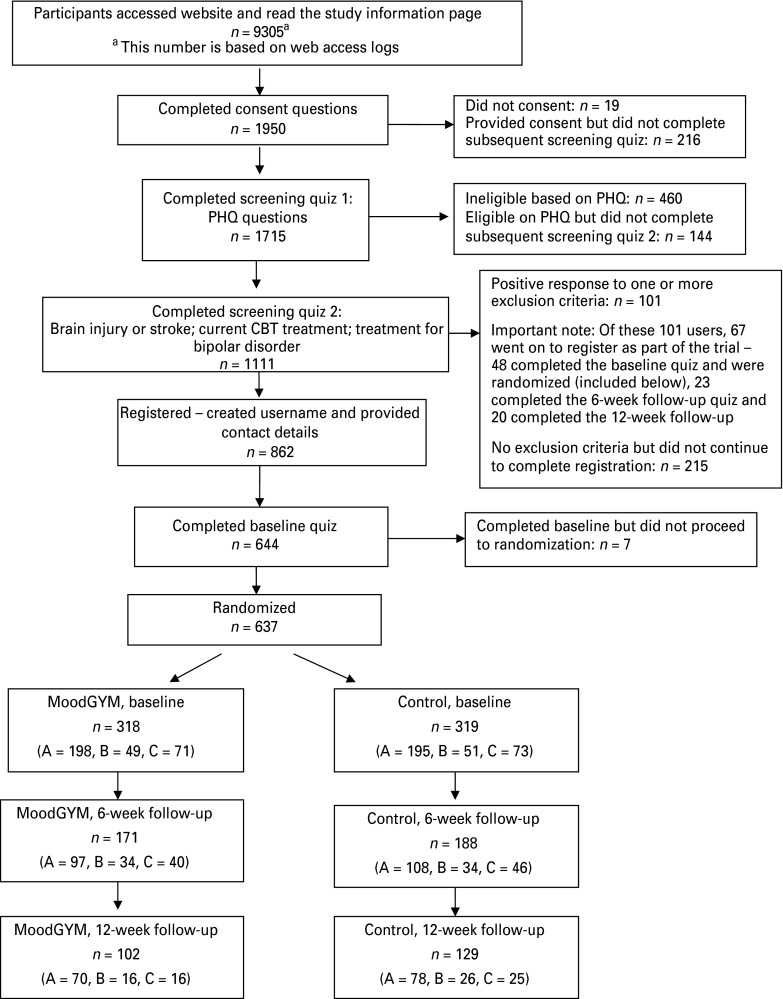
Background: Depression and anxiety are major causes of absence from work and underperformance in the workplace. Cognitive behavioural therapy (CBT) can be effective in treating such problems and online versions offer many practical advantages. The aim of the study was to investigate the effectiveness of a computerized CBT intervention (MoodGYM) in a workplace context. Method: The study was a phase III two-arm, parallel randomized controlled trial whose main outcome was total score on the Work and Social Adjustment Scale (WSAS). Depression, anxiety, psychological functioning, costs and acceptability of the online process were also measured. Most data were collected online for 637 participants at baseline, 359 at 6 weeks marking the end of the intervention and 251 participants at 12 weeks post-baseline. Results: In both experimental and control groups depression scores improved over 6 weeks but attrition was high. There was no evidence for a difference in the average treatment effect of MoodGYM on the WSAS, nor for a difference in any of the secondary outcomes. Conclusions: This study found no evidence that MoodGYM was superior to informational websites in terms of psychological outcomes or service use, although improvement to subthreshold levels of depression was seen in nearly half the patients in both groups.
Overview
The claims and statistics of this paper haven’t been checked yet.
Run the check — free, no account needed. It reads the open-access text and checks the sources it cites.
Integrity signals
Registry
Cites
Statistics
Figures
Verification
Claims the paper makes
The claims and statistics of this paper haven’t been checked yet.
Run the check — free, no account needed. It reads the open-access text and checks the sources it cites.
Claims other papers make about this one
Each is checked against this paper’s own text: does it say what the citing paper says it does?
In the citing paper
“but this evidence does not translate to online CBT-based stress management programmes delivered within a workplace context”
In the citing paper
“The large improvements on depressive symptoms in the CAU group were also found in 2 studies with comparable target groups of non-sick-listed employees [28,66].”
From Long-Term Results of a Web-Based Guided Self-Help Intervention for Employees With Depressive Symptoms: Randomized Controlled Trial (2014) · cites this paper as [66]
In the citing paper
“Both studies did not report significant effects in favor of the intervention at follow-up (either 3 or 6 months) and showed the same pattern of improvement as was found in this study: substantial improvements between baseline and posttreatment which sustained at follow-up in both groups.”
From Long-Term Results of a Web-Based Guided Self-Help Intervention for Employees With Depressive Symptoms: Randomized Controlled Trial (2014) · cites this paper as [66]
In the citing paper
“One study of web-based CBT52) reported no significant improvement compared with controls on scores of health, quality of life, or subjective work-related performance.”
From Web-based interventions for the management of stress in the workplace: Focus, form, and efficacy (2017) · cites this paper as [52]
Self-check
Percentages, sums and reported differences re-computed from the paper’s own numbers.
The self-check needs the paper’s full text.
Citations
Cites
A Brief Measure for Assessing Generalized Anxiety Disorder: The GAD-7
Spitzer, R. L., Kroenke, K., Williams, J. B. W., & Löwe, B. (2006) · Archives of Internal Medicine · doi:10.1001/archinte.166.10.1092 · Cited by 31,765 · cited 2×
“Secondary outcomes rated were: depression, using the PHQ-9 (Kroenke & Spitzer, 2002); Clinical Outcomes in Routine Evaluation (CORE10; Evans et al. 2002); and generalized anxiety disorder (GAD; Spitzer et al. 2006).”
BackgroundMethodThe PHQ-9: A New Depression Diagnostic and Severity Measure
Kroenke, K., & Spitzer, R. L. (2002) · Psychiatric Annals · doi:10.3928/0048-5713-20020901-06 · Cited by 5,898 · cited 7×
“Online screening of potential participants offered the option of joining the trial if they were aged over 18 years and met the following criterion: on the Patient Health Questionnaire-9 (PHQ-9; Kroenke & Spitzer, 2002) the employee scored 2 or more on five of the nine items, including 2 or more on item 1 (little inter…”
BackgroundMethodInfluentialThe Work and Social Adjustment Scale: a simple measure of impairment in functioning
Mundt, J. C., Marks, I. M., Shear, M. K., & Greist, J. M. (2002) · British Journal of Psychiatry · doi:10.1192/bjp.180.5.461 · Cited by 2,515 · cited 4×
“Besides having face validity in relation to employers ’ concerns, given the workplace focus of this trial, the WSAS is a brief, reliable and valid test, which has high correlations between clinician and self-report versions (Mundt et al. 2002).”
BackgroundMethodInfluentialTowards a standardised brief outcome measure: Psychometric properties and utility of the CORE–OM
Evans, C., Connell, J., Barkham, M., Margison, F., McGrath, G., Mellor-Clark, J., & Audin, K. (2002) · British Journal of Psychiatry · doi:10.1192/bjp.180.1.51 · Cited by 934 · cited 2×
“Secondary outcomes rated were: depression, using the PHQ-9 (Kroenke & Spitzer, 2002); Clinical Outcomes in Routine Evaluation (CORE10; Evans et al. 2002); and generalized anxiety disorder (GAD; Spitzer et al. 2006).”
Delivering interventions for depression by using the internet: randomised controlled trial
Christensen, H. (2004) · BMJ · doi:10.1136/bmj.37945.566632.ee · Cited by 928 · cited 3×
“…merely receiving a weekly telephone call concerning one ’ s service use and symptoms had bene fi cial effects, irrespective of whether participants used the online resources, although Christensen et al. (2004) found a difference between telephone-only controls and a self-selected intervention group.”
BackgroundInfluentialPsychiatric morbidity among adults living in private households, 2000
Singleton, N., Bumpstead, R., O'Brien, M. S., Lee, A., & Meltzer, H. (2003) · International Review of Psychiatry · doi:10.1080/0954026021000045967 · Cited by 896
Generation of allocation sequences in randomised trials: chance, not choice
Schulz, K. F., & Grimes, D. A. (2002) · The Lancet · doi:10.1016/s0140-6736(02)07683-3 · Cited by 774
Costing psychiatric interventions.
Beecham, J. K., & Knapp, M. R. J. (1992) · Kent Academic Repository (University of Kent) · Cited by 710
Slade, M., & Thornicroft, G. (2025) · doi:10.1093/med/9780198898818.003.0007 · Cited by 679
Self-citationA social tariff for EuroQol: results from a UK general population surveyPreprint
Dolan, P., Gudex, C. M., Kind, P., & Williams, A. (1995) · RePEc: Research Papers in Economics · Cited by 611
Proudfoot, J., Ryden, C., Everitt, B., Shapiro, D. A., Goldberg, D., Mann, A., Tylee, A., Marks, I., & Gray, J. A. (2004) · British Journal of Psychiatry · doi:10.1192/bjp.185.1.46 · Cited by 516 · cited 2×
“In a general practice-based study of Beating the Blues, Proudfoot et al. (2004) retained 74% of their sample between baseline and post-intervention assessment, and in a smaller primary care sample ( n =48) Grime (2004) retained 90% at follow-up.”
Grosser, R. C. (1994) · The Journal of Nervous and Mental Disease · doi:10.1097/00005053-199407000-00029 · Cited by 311
Online randomized controlled trial of brief and full cognitive behaviour therapy for depression
CHRISTENSEN, H., GRIFFITHS, K. M., MACKINNON, A. J., & BRITTLIFFE, K. (2006) · Psychological Medicine · doi:10.1017/s0033291706008695 · Cited by 249 · cited 1×
“Nonetheless, our sample showed greater commitment than the community-based participants in a MoodGYM trial by Christensen et al. (2006), which found that only 30% of those individuals who complied with the baseline assessment completed even one module of the programme.”
BackgroundEuroQol: health-related quality of life measurement. Results of the Swedish questionnaire exercise
Brooks, R. G., Jendteg, S., Lindgren, B., Persson, U., & Björk, S. (1991) · Health Policy · doi:10.1016/0168-8510(91)90142-k · Cited by 204 · cited 2×
“Health-related quality of life was measured with the five-domain EuroQol (EQ-5D; Brooks et al. 1991).”
MethodWhich presenteeism measures are more sensitive to depression and anxiety?
Sanderson, K. A., Tilse, E., Nicholson, J. M., Oldenburg, B. F., & Graves, N. (2006) · Journal of Affective Disorders · doi:10.1016/j.jad.2006.10.024 · Cited by 204 · cited 1×
“Depression and anxiety are recognized as major causes of work underperformance and absence (Sanderson et al. 2007).”
BackgroundLerner, D., Adler, D. A., Chang, H., Berndt, E. R., Irish, J. T., Lapitsky, L., Hood, M. Y., Reed, J., & Rogers, W. H. (2004) · Journal of Occupational and Environmental Medicine · doi:10.1097/01.jom.0000126684.82825.0a · Cited by 202
Mackinnon, A. J., Griffiths, K. M., & Christensen, H. M. (2008) · The British Journal of Psychiatry · doi:10.1192/bjp.bp.106.032078 · Cited by 182 · cited 1×
“Based on estimates of withdrawal, refusal and loss to the study on a previous large trial of MoodGYM (Mackinnon et al. 2008) it was anticipated that 60% of those eligible to participate would be retained over 6 months.”
BackgroundMeta-review of the effectiveness of computerised CBT in treating depression
Foroushani, P. S., Schneider, J., & Assareh, N. (2011) · BMC Psychiatry · doi:10.1186/1471-244x-11-131 · Cited by 132
Self-citationGrime, P. R. (2004) · Occupational Medicine · doi:10.1093/occmed/kqh077 · Cited by 104 · cited 7×
“the National Health Service (NHS) of Beating the Blues (Grime, 2004), at the outset of the present trial we could find no published studies of cCBT in workplace settings.”
BackgroundResultInfluentialSelf-citationPittaway, S., Cupitt, C., Palmer, D., Arowobusoye, N., Milne, R., Holttum, S., Pezet, R., & Patrick, H. (2009) · PubMed Central · Cited by 34
Case with a Lesion involving Broca's Convolution without Broca's Aphasia
Tuke, J. B., & Fraser, J. (1872) · Journal of Mental Science · doi:10.1192/bjp.18.81.46 · Cited by 5
Research works printed but not linked: 2
- 2006, Computerised Cognitive Behaviour Therapy for Depression and Anxiety: Review of Technology Appraisal 51
- Curtis, 2010, Unit Costs of Health and Social Care
Cited by
Sorted by citations
Andrews, G., Basu, A., Cuijpers, P., Craske, M. G., McEvoy, P., English, C. L., & Newby, J. M. (2018) · Journal of Anxiety Disorders · doi:10.1016/j.janxdis.2018.01.001 · Cited by 922
Karyotaki, E., Efthimiou, O., Miguel, C., Maas genannt Bermpohl, F., Furukawa, T. A., Cuijpers, P., Individual Patient Data Meta-Analyses for Depression (IPDMA-DE) Collaboration, Riper, H., Patel, V., Mira, A., et al. (2021) · JAMA Psychiatry · doi:10.1001/jamapsychiatry.2020.4364 · Cited by 866
Self-citationKaryotaki, E., Riper, H., Twisk, J., Hoogendoorn, A., Kleiboer, A., Mira, A., Mackinnon, A., Meyer, B., Botella, C., Littlewood, E., et al. (2017) · JAMA Psychiatry · doi:10.1001/jamapsychiatry.2017.0044 · Cited by 691
“However, recent large trials foundarangeofeffects,varying from small to moderate effect sizes(12,13) to no effect.(14,15) These contradicting findings drewmuch attention and raised concerns about the benefits of these interventions.”
BackgroundInfluentialSelf-citationMeta-analysis of dropout from cognitive behavioral therapy: Magnitude, timing, and moderators.
Fernandez, E., Salem, D., Swift, J. K., & Ramtahal, N. (2015) · Journal of Consulting and Clinical Psychology · doi:10.1037/ccp0000044 · Cited by 551
Carolan, S., Harris, P. R., & Cavanagh, K. (2017) · Journal of Medical Internet Research · doi:10.2196/jmir.7583 · Cited by 385
“Seventeen (81%) of the interventions included in the studies used a website as their primary means of delivering the intervention [42-54,56-59], 2 (10%) delivered the intervention via a computer application [41,60], 1 (5%) via email [39], and one (5%) through a standalone computer [55].”
Influential
Metadata
- Authors
- Phillips, R., Schneider, J., Molosankwe, I., Leese, M., Foroushani, P. S., Grime, P., McCrone, P., Morriss, R., & Thornicroft, G.
- Affiliations
- King's College London (GB)
- University of Nottingham (GB)
- UNSW Sydney (AU)
- Cambridge University Hospitals NHS Foundation Trust (GB)
- Corresponding author
- Schneider, J.
- Venue
- Psychological Medicine
- Publisher
- Cambridge University Press (CUP)
- Published
- 2013-06-24
- Volume
- 44
- Issue
- 4
- Pages
- 741-752
- ISSN
- 0033-2917 (ISSN-L)
- 1469-8978
- PMC
- PMC3898729
- OpenAlex
- W2141180159
- Cited by
- 110
- References
- 22
- Citations by year
- 2026: 2 · 2025: 6 · 2024: 7 · 2023: 4 · 2022: 18 · 2021: 17 · 2020: 8 · 2019: 12 · 2018: 7 · 2017: 14 · 2016: 8 · 2015: 3 · 2014: 3 · 2013: 1
- FWCI
- 7.64
- Type
- journal article
- Language
- en
- Open access
- hybrid
- doi.org
- Locations
- Psychological Medicine (publishedVersion, cc-by)
- Europe PMC (PubMed Central) (publishedVersion, other-oa)
- PubMed Central (publishedVersion, cc-by)
- PubMed (publishedVersion)
- Research Portal (King's College London) (publishedVersion, other-oa)
- Repository@Nottingham (University of Nottingham) (publishedVersion, other-oa)
- London School of Economics and Political Science Research Online (London School of Economics and Political Science) (acceptedVersion)
- Nottingham ePrints (University of Nottingham) (submittedVersion, cc-by)
- Repository@Nottingham (University of Nottingham) (submittedVersion, cc-by)
- Spiral (Imperial College London) (submittedVersion, cc-by)
- Funders
- National Institute for Health and Care Research (NF-SI-0611-10053, MET-08-08-101)
- British Occupational Health Research Foundation
- Topics
- Social Sciences › Psychology › Applied Psychology › Digital Mental Health Interventions
- Social Sciences › Psychology › Experimental and Cognitive Psychology › Anxiety, Depression, Psychometrics, Treatment, Cognitive Processes
- Health Sciences › Medicine › Public Health, Environmental and Occupational Health › Workplace Health and Well-being
- Keywords
- MoodGYM, work-related depression, depressive symptoms, online intervention, Work and Social Adjustment Scale, treatment effectiveness, cost-effectiveness, informational websites, attrition, subthreshold depression, psychological functioning, anxiety, service utilization
- MeSH terms
- Adult, Costs and Cost Analysis, Depression, Female, Follow-Up Studies, Humans, Male, Middle Aged, Patient Education as Topic, Social Adjustment, Stress, Psychological, Reproducibility of Results, Cognitive Behavioral Therapy, Occupational Health, Treatment Outcome, Workplace, Internet
About these checks
Registry, retraction, Cites and statistics results are computed, not judged, with one exception: a printed reference that no index lists is read once by a model before it counts as a citation error. Claims are extracted by a model and kept only when their quote appears verbatim in the text; each cited source is then checked, with a model’s help, for whether it says what the claim relies on. Those verdicts can be wrong — read the claim’s quote and the cited source before relying on one.
Statistics and arithmetic are recomputed, not judged.
Confidence bands are shown only for fields calibrated on our annotated test set. None is calibrated yet, so no band is shown.
What counts as a claim ›How we measure confidence ›How we check this ›
Are you an author, or do you see a problem with this page? Request a review
