

The DOI matches its Crossref record; 36 of the 37 references it cites were found in a registry or an index.
Life events and escape in conversion disorder
Open accessAbstract
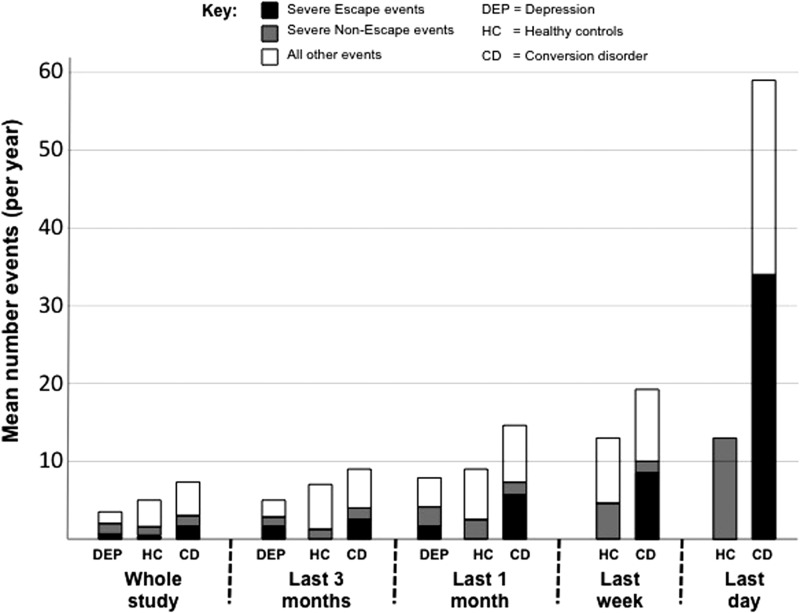
BACKGROUND: Psychological models of conversion disorder (CD) traditionally assume that psychosocial stressors are identifiable around symptom onset. In the face of limited supportive evidence such models are being challenged. METHOD: Forty-three motor CD patients, 28 depression patients and 28 healthy controls were assessed using the Life Events and Difficulties Schedule in the year before symptom onset. A novel 'escape' rating for events was developed to test the Freudian theory that physical symptoms of CD could provide escape from stressors, a form of 'secondary gain'. RESULTS: CD patients had significantly more severe life events and 'escape' events than controls. In the month before symptom onset at least one severe event was identified in 56% of CD patients - significantly more than 21% of depression patients [odds ratio (OR) 4.63, 95% confidence interval (CI) 1.56-13.70] and healthy controls (OR 5.81, 95% CI 1.86-18.2). In the same time period 53% of CD patients had at least one 'high escape' event - again significantly higher than 14% in depression patients (OR 6.90, 95% CI 2.05-23.6) and 0% in healthy controls. Previous sexual abuse was more commonly reported in CD than controls, and in one third of female patients was contextually relevant to life events at symptom onset. The majority (88%) of life events of potential aetiological relevance were not identified by routine clinical assessments. Nine per cent of CD patients had no identifiable severe life events. CONCLUSIONS: Evidence was found supporting the psychological model of CD, the Freudian notion of escape and the potential aetiological relevance of childhood traumas in some patients. Uncovering stressors of potential aetiological relevance requires thorough psychosocial evaluation.
Overview
The claims and statistics of this paper haven’t been checked yet.
Run the check — free, no account needed. It reads the open-access text and checks the sources it cites.
Integrity signals
Registry
Cites
Statistics
Figures
Verification
Claims the paper makes
The claims and statistics of this paper haven’t been checked yet.
Run the check — free, no account needed. It reads the open-access text and checks the sources it cites.
Claims other papers make about this one
Each is checked against this paper’s own text: does it say what the citing paper says it does?
The source backs part of the claim, not all of it — or backs it for a different population, condition or comparison.
In the citing paper
“Therefore, PNES are supposed to be not only a neuropsychiatric symptom, but an unconscious psychological defense mechanism to protect the affected individuals from unwanted and overwhelming emotions in order to maintain their intrapsychic balance (14, 16).”
From Combined Fainting and Psychogenic Non-epileptic Seizures as Significant Therapy Hurdles in Blood-Injury-Injection Phobia: A Mini-Review and Case Report (2022) · cites this paper as [16]
Experimental — accuracy not yet measured
Self-check
Percentages, sums and reported differences re-computed from the paper’s own numbers.
The self-check needs the paper’s full text.
Citations
Cites
The Hospital Anxiety and Depression Scale
Zigmond, A. S., & Snaith, R. P. (1983) · Acta Psychiatrica Scandinavica · doi:10.1111/j.1600-0447.1983.tb09716.x · Cited by 47,139
The Standard Edition of the Complete Psychological Works of Sigmund Freud
Freud, S. (1953) · Cited by 17,730
Diagnostic and Statistical Manual of Mental Disorders(DSM)
Leong, F. T. L. (2008) · Sage eBooks · doi:10.4135/9781412963978.n182 · Cited by 10,861
Spitzer, R. L. (1978) · Archives of General Psychiatry · doi:10.1001/archpsyc.1978.01770300115013 · Cited by 6,946
Social Origins of Depression: A Study of Psychiatric Disorder in Women.
Schnitzer, P. K., Brown, G. W., & Harris, T. (1980) · Contemporary Sociology A Journal of Reviews · doi:10.2307/2065631 · Cited by 3,053
Social Origins of Depression: A Study of Psychiatric Disorder in Women
McDaniel, E. G. (1980) · The Journal of Nervous and Mental Disease · doi:10.1097/00005053-198009000-00013 · Cited by 1,894
Binder, E. B. (2008) · JAMA · doi:10.1001/jama.299.11.1291 · Cited by 1,362
Avison, W. R., Brown, G. W., & Harris, T. (1990) · Contemporary Sociology A Journal of Reviews · doi:10.2307/2072630 · Cited by 1,148
Freud, S., Breuer, J., Luckhurst, N., & Bowlby, R. (2000) · Medical Entomology and Zoology · Cited by 381
Childhood abuse in patients with conversion disorder
Roelofs, K., Keijsers, G. P. J., Hoogduin, K. A. L., Näring, G. W. B., & Moene, F. C. (2002) · American Journal of Psychiatry · doi:10.1176/appi.ajp.159.11.1908 · Cited by 276
Research works printed but not linked: 5
- Wing, 1974, The Measurement and Classification of Psychiatric Symptoms: An Instruction Manual for the Present State Examination and CATEGO Programme
- Brown, 1989, Life Events and Illness
- Rosenthal, 1963, The Genian Quadruplets, 505
- Nelson, 1991, National Adult Reading Test Manual
- 1992, The ICD-10 Classification of Mental and Behavioural Disorders
Cited by
Sorted by citations
Current Concepts in Diagnosis and Treatment of Functional Neurological Disorders
Espay, A. J., Aybek, S., Carson, A., Edwards, M. J., Goldstein, L. H., Hallett, M., LaFaver, K., LaFrance, W. C., Lang, A. E., Nicholson, T., et al. (2018) · JAMA Neurology · doi:10.1001/jamaneurol.2018.1264 · Cited by 786
Ludwig, L., Pasman, J. A., Nicholson, T., Aybek, S., David, A. S., Tuck, S., Kanaan, R. A., Roelofs, K., Carson, A., & Stone, J. (2018) · The Lancet Psychiatry · doi:10.1016/s2215-0366(18)30051-8 · Cited by 495
Pathogenesis and pathophysiology of functional (psychogenic) movement disorders
Baizabal-Carvallo, J. F., Hallett, M., & Jankovic, J. (2019) · Neurobiology of Disease · doi:10.1016/j.nbd.2019.02.013 · Cited by 163
Stress and functional neurological disorders: mechanistic insights
Keynejad, R. C., Frodl, T., Kanaan, R., Pariante, C., Reuber, M., & Nicholson, T. R. (2019) · Journal of Neurology, Neurosurgery & Psychiatry · doi:10.1136/jnnp-2018-318297 · Cited by 151
Perez, D. L., Aybek, S., Popkirov, S., Kozlowska, K., Stephen, C. D., Anderson, J., Shura, R. D., Ducharme, S., Carson, A. J., Hallett, M., et al. (2020) · Journal of Neuropsychiatry · doi:10.1176/appi.neuropsych.19120357 · Cited by 134
Metadata
- Authors
- Nicholson, T. R., Aybek, S., Craig, T., Harris, T., Wojcik, W., David, A. S., & Kanaan, R. A.
- Affiliations
- King's College London (GB)
- University of Geneva (CH)
- The University of Melbourne (AU)
- Corresponding author
- Nicholson, T. R.
- Venue
- Psychological Medicine
- Publisher
- Cambridge University Press (CUP)
- Published
- 2016-07-05
- Volume
- 46
- Issue
- 12
- Pages
- 2617-2626
- ISSN
- 0033-2917 (ISSN-L)
- 1469-8978
- PMC
- PMC4988265
- OpenAlex
- W2474723969
- Cited by
- 110
- References
- 37
- Citations by year
- 2026: 6 · 2025: 13 · 2024: 6 · 2023: 7 · 2022: 14 · 2021: 8 · 2020: 17 · 2019: 14 · 2018: 14 · 2017: 9 · 2016: 2
- FWCI
- 11.40
- Type
- journal article
- Language
- en
- Open access
- hybrid
- doi.org
- Locations
- Psychological Medicine (publishedVersion, cc-by)
- PubMed Central (publishedVersion, cc-by)
- PubMed (publishedVersion)
- UCL Discovery (University College London) (submittedVersion)
- Minerva Access (University of Melbourne) (submittedVersion, cc-by)
- Research Portal (King's College London) (submittedVersion, cc-by)
- Funders
- National Institute for Health and Care Research
- King's College London
- Medical Research Council
- Topics
- Health Sciences › Medicine › Psychiatry and Mental health › Psychosomatic Disorders and Their Treatments
- Life Sciences › Neuroscience › Cognitive Neuroscience › Pain Management and Placebo Effect
- Social Sciences › Psychology › Clinical Psychology › Psychoanalysis and Psychopathology Research
- Keywords
- conversion disorder, life events, escape, secondary gain, Freudian theory, psychosocial stressors, depression, child sexual abuse, symptom onset, psychosocial assessment
- MeSH terms
- Adult Survivors of Child Adverse Events, Adult, Conversion Disorder, Female, Humans, Life Change Events, Male, Middle Aged, Sex Offenses
About these checks
Registry, retraction, Cites and statistics results are computed, not judged, with one exception: a printed reference that no index lists is read once by a model before it counts as a citation error. Claims are extracted by a model and kept only when their quote appears verbatim in the text; each cited source is then checked, with a model’s help, for whether it says what the claim relies on. Those verdicts can be wrong — read the claim’s quote and the cited source before relying on one.
Statistics and arithmetic are recomputed, not judged.
Confidence bands are shown only for fields calibrated on our annotated test set. None is calibrated yet, so no band is shown.
What counts as a claim ›How we measure confidence ›How we check this ›
Are you an author, or do you see a problem with this page? Request a review
