

Childhood interleukin-6, C-reactive protein and atopic disorders as risk factors for hypomanic symptoms in young adulthood: a longitudinal birth cohort study
Open accessThe DOI matches its Crossref record; 60 of the 60 references it cites were found in a registry or an index.
Abstract
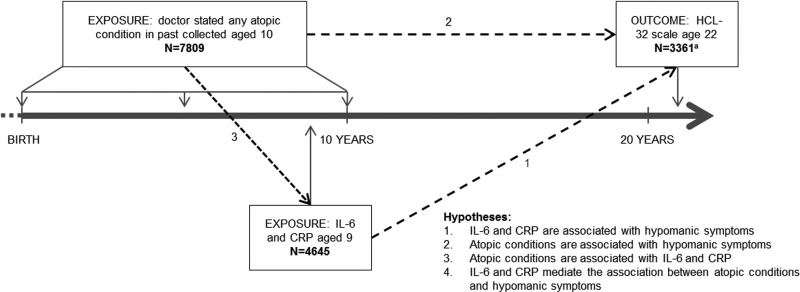
Background: There are no existing longitudinal studies of inflammatory markers and atopic disorders in childhood and risk of hypomanic symptoms in adulthood. This study examined if childhood: (1) serum interleukin-6 (IL-6) and C-reactive protein (CRP); and (2) asthma and/or eczema are associated with features of hypomania in young adulthood. Method: Participants in the Avon Longitudinal Study of Parents and Children, a prospective general population UK birth cohort, had non-fasting blood samples for IL-6 and CRP measurement at the age of 9 years ( n = 4645), and parents answered a question about doctor-diagnosed atopic illness before the age of 10 years ( n = 7809). These participants completed the Hypomania Checklist at age 22 years ( n = 3361). Results: After adjusting for age, sex, ethnicity, socio-economic status, past psychological and behavioural problems, body mass index and maternal postnatal depression, participants in the top third of IL-6 values at 9 years, compared with the bottom third, had an increased risk of hypomanic symptoms by age 22 years [adjusted odds ratio 1.77, 95% confidence interval (CI) 1.10–2.85, p < 0.001]. Higher IL-6 levels in childhood were associated with adult hypomania features in a dose–response fashion. After further adjustment for depression at the age of 18 years this association remained (adjusted odds ratio 1.70, 95% CI 1.03–2.81, p = 0.038). There was no evidence of an association of hypomanic symptoms with CRP levels, asthma or eczema in childhood. Conclusions: Higher levels of systemic inflammatory marker IL-6 in childhood were associated with hypomanic symptoms in young adulthood, suggesting that inflammation may play a role in the pathophysiology of mania. Inflammatory pathways may be suitable targets for the prevention and intervention for bipolar disorder.
Overview
The claims and statistics of this paper haven’t been checked yet.
Free: it reads the open-access text and checks the first 5 claims that cite a source we can check. Create a free account to check every claim.
Integrity signals
Registry
Cites
Statistics
Figures
Verification
Claims the paper makes
The claims and statistics of this paper haven’t been checked yet.
Free: it reads the open-access text and checks the first 5 claims that cite a source we can check. Create a free account to check every claim.
Claims other papers make about this one
Each is checked against this paper’s own text: does it say what the citing paper says it does?
The source backs part of the claim, not all of it — or backs it for a different population, condition or comparison.
In the citing paper
“Longitudinal studies have reported associations between elevated levels of circulating inflammatory markers at baseline and risks of psychosis (Khandaker et al., 2014), depressive (Lamers et al., 2019) and bipolar (Hayes et al., 2017) disorders at follow-up, suggesting inflammation could be a cause rather than consequence of illness.”
From Associations of Immunological Proteins/Traits with Schizophrenia, Major Depression and Bipolar Disorder: A Bi-Directional Two-Sample Mendelian Randomization Study (2021) · cites this paper as Hayes et al., 2017
Experimental — accuracy not yet measured
Self-check
Percentages, sums and reported differences re-computed from the paper’s own numbers.
The self-check needs the paper’s full text.
Citations
Cites
Asher, M. I., Montefort, S., Björkstén, B., Lai, C. K., Strachan, D. P., Weiland, S. K., & Williams, H. (2006) · The Lancet · doi:10.1016/s0140-6736(06)69283-0 · Cited by 4,223
The pro- and anti-inflammatory properties of the cytokine interleukin-6
Scheller, J., Chalaris, A., Schmidt-Arras, D., & Rose-John, S. (2011) · Biochimica et Biophysica Acta (BBA) - Molecular Cell Research · doi:10.1016/j.bbamcr.2011.01.034 · Cited by 3,212 · cited 1×
“The potential effects of IL-6 in particular are complex; it is implicated in activation of the immune system (as a proinflammatory cytokine), but it is also involved in the antiinflammatory regulation of neural, regenerative and metabolic activity (Scheller et al. 2011).”
BackgroundCohort Profile: The Avon Longitudinal Study of Parents and Children: ALSPAC mothers cohort
Fraser, A., Macdonald-Wallis, C., Tilling, K., Boyd, A., Golding, J., Davey Smith, G., Henderson, J., Macleod, J., Molloy, L., Ness, A., et al. (2013) · International Journal of Epidemiology · doi:10.1093/ije/dys066 · Cited by 2,494 · cited 1×
“ALSPAC has been used for a vast array of research topics (Fraser et al. 2013).”
MethodTreatment of Childhood Atopic Dermatitis and Economic Burden of Illness in Asia Pacific Countries
Lee, B. W., & Detzel, P. R. (2015) · Annals of Nutrition and Metabolism · doi:10.1159/000370221 · Cited by 1,668
Lewis, G., Pelosi, A. J., Araya, R., & Dunn, G. (1992) · Psychological Medicine · doi:10.1017/s0033291700030415 · Cited by 1,487 · cited 4×
“Of those who completed the CIS-R at 18 years and HCL-32 at 22 years (n = 2298), 21 (1”
MethodInfluentialSelf-citationA longitudinal, population-based, cohort study of childhood asthma followed to adulthood
Sears, M. R., Greene, J. M., Willan, A. R., Wiecek, E. M., Taylor, D. R., Flannery, E. M., Cowan, J. O., Herbison, G. P., Silva, P. A., & Poulton, R. (2003) · New England Journal of Medicine · doi:10.1056/nejmoa022363 · Cited by 1,460 · cited 1×
“It is recognized that individuals who have persistent asthma through adolescence, or develop asthma in adolescence, have worse physical health outcomes than children whose asthma resolves in early adolescence (Sears et al. 2003).”
BackgroundSo depression is an inflammatory disease, but where does the inflammation come from?
Berk, M., Williams, L. J., Jacka, F. N., O’Neil, A., Pasco, J. A., Moylan, S., Allen, N. B., Stuart, A. L., Hayley, A. C., Byrne, M. L., et al. (2013) · BMC Medicine · doi:10.1186/1741-7015-11-200 · Cited by 1,423
Cytokine-Associated Emotional and Cognitive Disturbances in Humans
Reichenberg, A., Yirmiya, R., Schuld, A., Kraus, T., Haack, M., Morag, A., & Pollmächer, T. (2001) · Archives of General Psychiatry · doi:10.1001/archpsyc.58.5.445 · Cited by 1,365 · cited 1×
“Immunoactivation in mice and healthy volunteers by injection of lipopolysaccharide has been reported to increase circulating proinflammatory cytokine levels (IL-1β, IL-6) as well as producing symptoms of anxiety and reduced cognitive performance (Reichenberg et al. 2001; Rossi et al. 2012).”
BackgroundBerk, M., Kapczinski, F., Andreazza, A. C., Dean, O. M., Giorlando, F., Maes, M., Yücel, M., Gama, C. S., Dodd, S., Dean, B., et al. (2011) · Neuroscience & Biobehavioral Reviews · doi:10.1016/j.neubiorev.2010.10.001 · Cited by 1,178
Circadian control of the immune system
Scheiermann, C., Kunisaki, Y., & Frenette, P. S. (2013) · Nature Reviews Immunology · doi:10.1038/nri3386 · Cited by 1,135 · cited 2×
“It is possible that some of the differences in IL-6 and CRP levels detected are due to diurnal variation in non-fasting blood samples, which would increase chances of null findings (Scheiermann et al. 2013).”
Background
Cited by
Early Intervention in Bipolar Disorder
Vieta, E., Salagre, E., Grande, I., Carvalho, A. F., Fernandes, B. S., Berk, M., Birmaher, B., Tohen, M., & Suppes, T. (2018) · American Journal of Psychiatry · doi:10.1176/appi.ajp.2017.17090972 · Cited by 354
Fernandes, B. S., Steiner, J., Molendijk, M. L., Dodd, S., Nardin, P., Gonçalves, C.-A., Jacka, F., Köhler, C. A., Karmakar, C., Carvalho, A. F., et al. (2016) · The Lancet Psychiatry · doi:10.1016/s2215-0366(16)30370-4 · Cited by 247
Rowland, T., Perry, B. I., Upthegrove, R., Barnes, N., Chatterjee, J., Gallacher, D., & Marwaha, S. (2018) · The British Journal of Psychiatry · doi:10.1192/bjp.2018.144 · Cited by 196
Perry, B. I., Upthegrove, R., Kappelmann, N., Jones, P. B., Burgess, S., & Khandaker, G. M. (2021) · Brain, Behavior, and Immunity · doi:10.1016/j.bbi.2021.07.009 · Cited by 187
“, 2019) and bipolar (Hayes et al., 2017) disorders at follow-up, suggesting inflammation could be a cause rather than consequence of illness.”
Self-citationOsimo, E. F., Cardinal, R. N., Jones, P. B., & Khandaker, G. M. (2018) · Psychoneuroendocrinology · doi:10.1016/j.psyneuen.2018.02.031 · Cited by 124
“…with higher risk of developing symptoms of depression, psychosis and mania subsequently in adulthood (Canetta et al., 2014; Dalman et al., 2008; Hayes et al., 2017; Khandaker et al., 2014; Khandaker et al., 2012; Khandaker et al., 2013; Liang and Chikritzhs, 2012; Metcalf et al., 2017),…”
InfluentialSelf-citation
Metadata
- Authors
- Hayes, J. F., Khandaker, G. M., Anderson, J., Mackay, D., Zammit, S., Lewis, G., Smith, D. J., & Osborn, D. P. J.
- Venue
- Psychological Medicine
- Publisher
- Cambridge University Press (CUP)
- Published
- 2016-08-01
- Volume
- 47
- Issue
- 1
- Pages
- 23-33
- ISSN
- 0033-2917 (ISSN-L)
- 1469-8978
- PMC
- PMC5197925
- OpenAlex
- W2504888768
- Cited by
- 37
- References
- 60
- FWCI
- 3.62
- Type
- journal article
- Language
- en
- Open access
- hybrid
About these checks
Registry, retraction, Cites and statistics results are computed, not judged, with one exception: a printed reference that no index lists is read once by a model before it counts as a citation error. Claims are extracted by a model and kept only when their quote appears verbatim in the text; each cited source is then checked, with a model’s help, for whether it says what the claim relies on. Those verdicts can be wrong — read the claim’s quote and the cited source before relying on one.
Statistics and arithmetic are recomputed, not judged.
Confidence bands are shown only for fields calibrated on our annotated test set. None is calibrated yet, so no band is shown.
What counts as a claim ›How we measure confidence ›How we check this ›
Are you an author, or do you see a problem with this page? Request a review
Data sources
Bibliographic data: Semantic Scholar, OpenAlex, Crossref.
Contains information from the Semantic Scholar Academic Graph Datasets, made available under the ODC Attribution License (ODC-BY 1.0).
Semantic Scholar’s data is described in: Kinney, R., et al. (2023). The Semantic Scholar Open Data Platform. arXiv:2301.10140.
