

Longitudinal alterations in motivational salience processing in ultra-high-risk subjects for psychosis
Open accessThe DOI matches its Crossref record; 55 of the 56 references it cites were found in a registry or an index.
Abstract
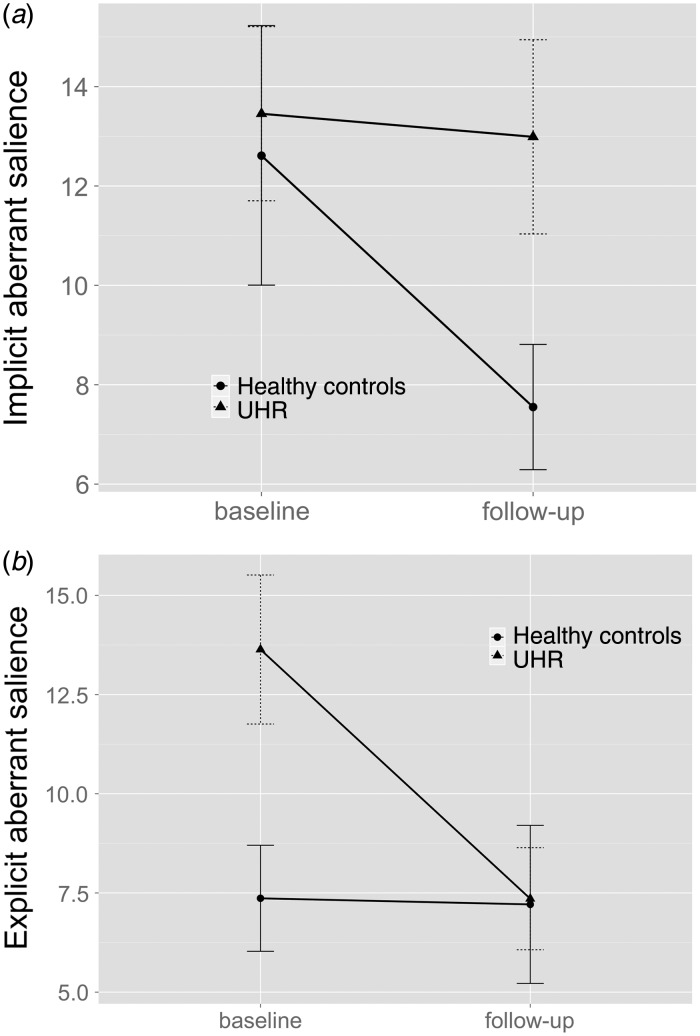
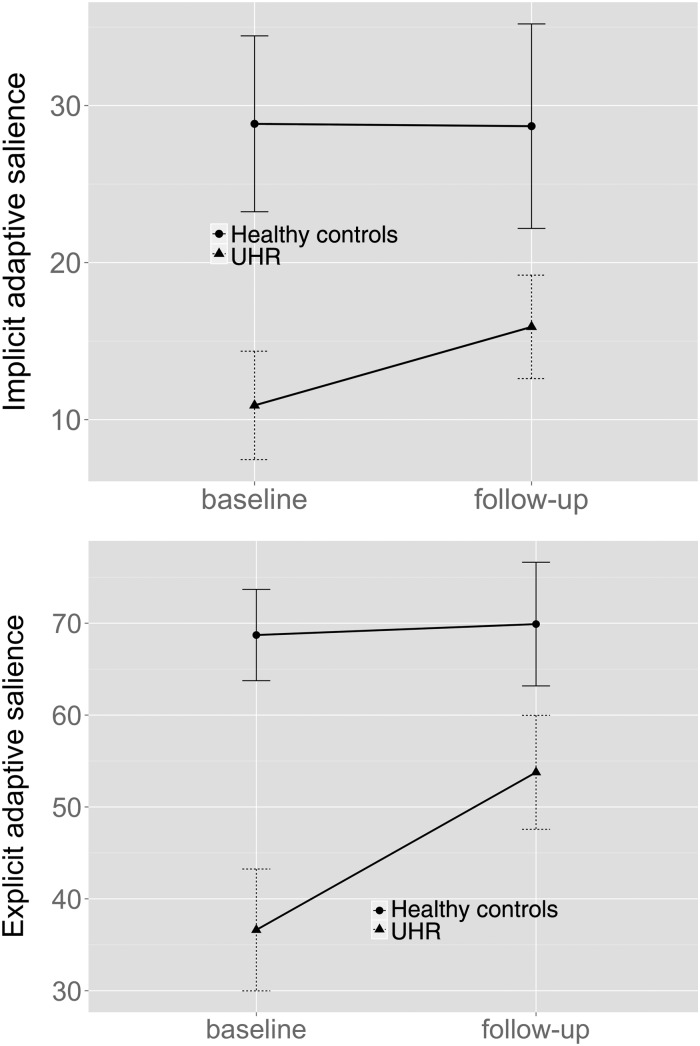
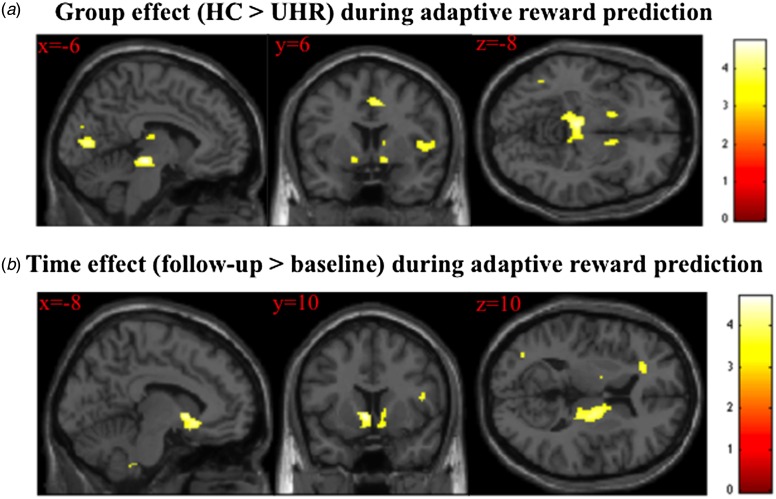
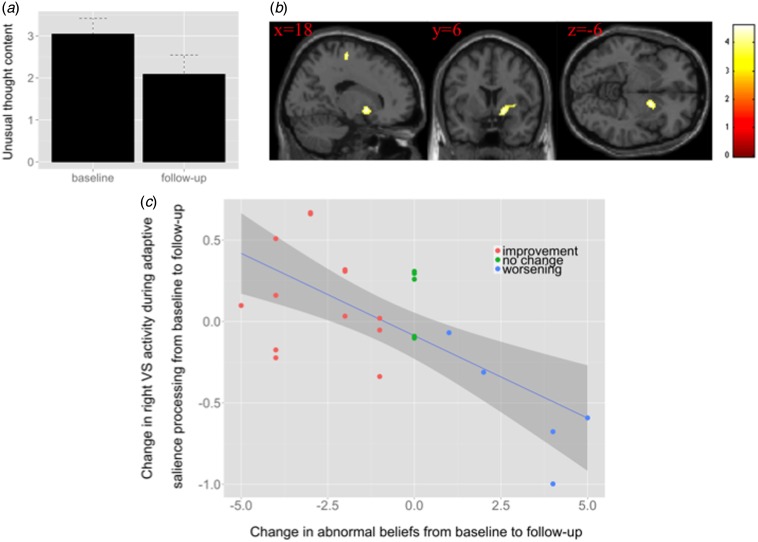
BACKGROUND: Impairments in the attribution of salience are thought to be fundamental to the development of psychotic symptoms and the onset of psychotic disorders. The aim of the present study was to explore longitudinal alterations in salience processing in ultra-high-risk subjects for psychosis. METHOD: A total of 23 ultra-high-risk subjects and 13 healthy controls underwent functional magnetic resonance imaging at two time points (mean interval of 17 months) while performing the Salience Attribution Test to assess neural responses to task-relevant (adaptive salience) and task-irrelevant (aberrant salience) stimulus features. RESULTS: At presentation, high-risk subjects were less likely than controls to attribute salience to relevant features, and more likely to attribute salience to irrelevant stimulus features. These behavioural differences were no longer evident at follow-up. When attributing salience to relevant cue features, ultra-high-risk subjects showed less activation than controls in the ventral striatum at both baseline and follow-up. Within the high-risk sample, amelioration of abnormal beliefs over the follow-up period was correlated with an increase in right ventral striatum activation during the attribution of salience to relevant cue features. CONCLUSIONS: These findings confirm that salience processing is perturbed in ultra-high-risk subjects for psychosis, that this is linked to alterations in ventral striatum function, and that clinical outcomes are related to longitudinal changes in ventral striatum function during salience processing.
Overview
The claims and statistics of this paper haven’t been checked yet.
Free: it reads the open-access text and checks the first 5 claims that cite a source we can check. Create a free account to check every claim.
Integrity signals
Registry
Cites
Statistics
Figures
Verification
Claims the paper makes
The claims and statistics of this paper haven’t been checked yet.
Free: it reads the open-access text and checks the first 5 claims that cite a source we can check. Create a free account to check every claim.
Claims other papers make about this one
Each is checked against this paper’s own text: does it say what the citing paper says it does?
The source backs part of the claim, not all of it — or backs it for a different population, condition or comparison.
In the citing paper
“Overall, the tendency is for CHR to show increased explicit (but not implicit, such as that measured with reaction time) aberrant salience compared to controls (80, 82).”
From Aberrant Salience, Information Processing, and Dopaminergic Signaling in People at Clinical High Risk for Psychosis (2020) · cites this paper as [80]
Experimental — accuracy not yet measuredThe source backs part of the claim, not all of it — or backs it for a different population, condition or comparison.
In the citing paper
“CHR subjects rate irrelevant cues as more relevant than HC do (80, 82),”
From Aberrant Salience, Information Processing, and Dopaminergic Signaling in People at Clinical High Risk for Psychosis (2020) · cites this paper as [80]
Experimental — accuracy not yet measuredThe cited source says what the claim attributes to it.
In the citing paper
“Taken together, this evidence indicates altered salience processing (80-83), reward anticipation (7577) and PE-signalling (78, 79) in CHR relative to HC.”
From Aberrant Salience, Information Processing, and Dopaminergic Signaling in People at Clinical High Risk for Psychosis (2020) · cites this paper as [80]
The cited source says what the claim attributes to it.
In the citing paper
“and VS activation to adaptive salience is decreased in CHR compared to HC (80).”
From Aberrant Salience, Information Processing, and Dopaminergic Signaling in People at Clinical High Risk for Psychosis (2020) · cites this paper as [80]
The cited source says what the claim attributes to it.
In the citing paper
“and at follow-up increased VS activation during adaptive salience correlates with a reduction of abnormal beliefs (80).”
From Aberrant Salience, Information Processing, and Dopaminergic Signaling in People at Clinical High Risk for Psychosis (2020) · cites this paper as [80]
2 more claims about this paper
Create a free account to see every claim other papers make about this one.
Self-check
Percentages, sums and reported differences re-computed from the paper’s own numbers.
The self-check needs the paper’s full text.
Citations
Cites
(1998) · The Journal of Clinical Psychiatry · Cited by 19,139
(1998) · PubMed · Cited by 10,216
A neural substrate of prediction and reward
Schultz, W., Dayan, P., & Montague, P. R. (1997) · Science · doi:10.1126/science.275.5306.1593 · Cited by 9,388 · cited 1×
“Experiments in animals suggest that stimuli become motivationally salient when the release of dopamine in the striatum coincides with their perception (Schultz et al. 1997; Kapur, 2003).”
BackgroundDissociable intrinsic connectivity networks for salience processing and executive control
Seeley, W. W., Menon, V., Schatzberg, A. F., Keller, J., Glover, G. H., Kenna, H., Reiss, A. L., & Greicius, M. D. (2007) · The Journal of Neuroscience · doi:10.1523/jneurosci.5587-06.2007 · Cited by 7,426 · cited 2×
“Together with the striatum, integration of these regions is important to sustain emotion and cognition, especially during the detection and processing of salient information (Seeley et al. 2007; Menon & Uddin, 2010).”
BackgroundSaliency, switching, attention and control: a network model of insula function
Menon, V., & Uddin, L. Q. (2010) · Brain Structure and Function · doi:10.1007/s00429-010-0262-0 · Cited by 5,592 · cited 2×
“Relationship between longitudinal changes in clinical features and brain activation”
BackgroundKapur, S. (2003) · American Journal of Psychiatry · doi:10.1176/appi.ajp.160.1.13 · Cited by 2,813 · cited 7×
“Furthermore, in accordance with the aberrant salience model (Kapur, 2003), the SAT has been designed to measure abnormal motivational (reward) salience processing in psychosis and its relation to dopamine dysregulation in the VS.”
BackgroundInfluentialThe Dopamine Hypothesis of Schizophrenia: Version III--The Final Common Pathway
Howes, O. D., & Kapur, S. (2009) · Schizophrenia Bulletin · doi:10.1093/schbul/sbp006 · Cited by 2,693 · cited 2×
“…schizophrenia (Reith et al. 1994; Laruelle et al. 1996; Breier et al. 1997; Laruelle et al. 1999; Abi-Dargham et al. 2000; Kumakura et al. 2007; Howes & Kapur, 2009; Howes et al. 2012) and UHR subjects (Howes et al. 2009b, 2011a, b; Egerton et al. 2013; Mizrahi et al. 2014) and the aberrant…”
BackgroundSelf-citationMapping the Onset of Psychosis: The Comprehensive Assessment of At-Risk Mental States
Yung, A. R., Yung, A. R., Pan Yuen, H., Mcgorry, P. D., Phillips, L. J., Kelly, D., Dell'olio, M., Francey, S. M., Cosgrave, E. M., Killackey, E., et al. (2005) · Australian & New Zealand Journal of Psychiatry · doi:10.1080/j.1440-1614.2005.01714.x · Cited by 2,196
The Psychosis High-Risk State: A Comprehensive State-of-the-Art Review
Fusar-Poli, P., Borgwardt, S., Bechdolf, A., Addington, J., Riecher-Rössler, A., Schultze-Lutter, F., Keshavan, M., Wood, S., Ruhrmann, S., Seidman, L. J., et al. (2013) · JAMA Psychiatry · doi:10.1001/jamapsychiatry.2013.269 · Cited by 1,483
Self-citationThe primate basal ganglia: Parallel and integrative networks
Haber, S. N. (2003) · Journal of Chemical Neuroanatomy · doi:10.1016/j.jchemneu.2003.10.003 · Cited by 1,479 · cited 2×
“…be that hyperactive inputs from the hippocampus to the VS in psychosis may have an impact on dopaminergic neurons that project to more dorsal (associative) striatal areas and thereby affect dorsal striatum-related salience processing (Haber, 2003; Lodge & Grace, 2011, 2012; Modinos et al. 2015).”
Background
Research works printed but not linked: 1
- American Psychiatric Association (2013). Diagnostic and Statistical Manual of Mental Disorders: DSM-5. American Psychiatric Association: Washington, DC.
Cited by
Howes, O. D., Hird, E. J., Adams, R. A., Corlett, P. R., & McGuire, P. (2020) · Biological Psychiatry · doi:10.1016/j.biopsych.2020.03.012 · Cited by 110
“7 (but not implicit, such as that measured with react ion time) aberrant salience compared to controls (80, 82).”
BackgroundResultInfluentialACEs and mental health outcomes
Sheffler, J., Stanley, I. H., & Sachs‐Ericsson, N. (2020) · Elsevier eBooks · doi:10.1016/b978-0-12-816065-7.00004-5 · Cited by 165
Fabro, L. D., Schmidt, A., Fortea, L., Delvecchio, G., D’Agostino, A., Raduà, J., Borgwardt, S., & Brambilla, P. (2021) · Neuroscience & Biobehavioral Reviews · doi:10.1016/j.neubiorev.2021.06.020 · Cited by 86
Wilson, R., Bossong, M. G., Appiah-Kusi, E., Petros, N., Brammer, M., Perez, J., Allen, P., McGuire, P., & Bhattacharyya, S. (2019) · Translational Psychiatry · doi:10.1038/s41398-019-0534-2 · Cited by 63
Gawęda, Ł., Göritz, A. S., & Moritz, S. (2019) · Schizophrenia Research · doi:10.1016/j.schres.2018.11.034 · Cited by 52
Kafadar, E., Mittal, V. A., Strauss, G. P., Chapman, H. C., Ellman, L. M., Bansal, S., Gold, J. M., Alderson‐Day, B., Evans, S., Moffatt, J. A., et al. (2020) · Schizophrenia Research · doi:10.1016/j.schres.2020.04.017 · Cited by 58
“, 2007; Corlett and Fletcher, 2012), and positive, (Roiser et al., 2009, 2013; Schmidt et al., 2017), disorganization (Silverstein et al.”
Kowalski, J., Aleksandrowicz, A., Dąbkowska, M., & Gawęda, Ł. (2021) · Journal of Clinical Medicine · doi:10.3390/jcm10184126 · Cited by 50
Toward integrated understanding of salience in psychosis
Miyata, J. (2019) · Neurobiology of Disease · doi:10.1016/j.nbd.2019.03.002 · Cited by 50
Millman, Z. B., Gallagher, K., Demro, C., Schiffman, J., Reeves, G. M., Gold, J. M., Rakhshan Rouhakhtar, P. J., Fitzgerald, J., Andorko, N. D., Redman, S., et al. (2020) · Schizophrenia Research · doi:10.1016/j.schres.2019.03.017 · Cited by 39
“…to task-relevant versus task-irrelevant stimulus dimensions (e.g., color, object type) have found that individuals at CHR are more likely to attend to irrelevant stimulus features, interpreted as an impaired ability to make adaptive salience attributions (Roiser et al., 2012; Schmidt et al., 2017).”
BackgroundInfluentialModels of persecutory delusions: a mechanistic insight into the early stages of psychosis
Diaconescu, A. O., Hauke, D. J., & Borgwardt, S. (2019) · Molecular Psychiatry · doi:10.1038/s41380-019-0427-z · Cited by 48
McCutcheon, R. A., Bloomfield, M. A. P., Dahoun, T., Mehta, M., & Howes, O. D. (2019) · Schizophrenia Research · doi:10.1016/j.schres.2018.12.011 · Cited by 35
“However, studies in un-medicated individuals at high risk of the disorder have displayed a similar pattern (Roiser et al., 2013; Schmidt et al., 2016), and somemodels suggest that although psychosis is associatedwith increased aberrant dopamine signalling (McCutcheon et al.”
Modeling subjective relevance in schizophrenia and its relation to aberrant salience
Katthagen, T., Mathys, C., Deserno, L., Walter, H., Kathmann, N., Heinz, A., & Schlagenhauf, F. (2018) · PLOS Computational Biology · doi:10.1371/journal.pcbi.1006319 · Cited by 29
Millman, Z. B., Roemer, C., Vargas, T., Schiffman, J. E., Mittal, V. A., & Gold, J. M. (2022) · Schizophrenia Bulletin · doi:10.1093/schbul/sbac031 · Cited by 35
Gawęda, Ł., Kowalski, J., Aleksandrowicz, A., Bagrowska, P., Dąbkowska, M., & Pionke‐Ubych, R. (2024) · Clinical Psychology Review · doi:10.1016/j.cpr.2024.102391 · Cited by 36
Hubl, D., Schultze‐Lutter, F., Hauf, M., Dierks, T., Federspiel, A., Kaess, M., Michel, C., SCHIMMELMANN, B. G., & Kindler, J. (2018) · Schizophrenia Research · doi:10.1016/j.schres.2018.06.018 · Cited by 30
Poletti, M., Pelizza, L., Azzali, S., Garlassi, S., Scazza, I., Paterlini, F., Chiri, L. R., Pupo, S., & Raballo, A. (2021) · Nordic Journal of Psychiatry · doi:10.1080/08039488.2021.1942547 · Cited by 24
Azzali, S., Pelizza, L., Scazza, I., Paterlini, F., Garlassi, S., Chiri, L. R., Poletti, M., Pupo, S., & Raballo, A. (2022) · Schizophrenia Research · doi:10.1016/j.schres.2021.12.025 · Cited by 24
Probabilistic Category Learning and Striatal Functional Activation in Psychosis Risk
Karcher, N. R., Hua, J. P. Y., & Kerns, J. G. (2018) · Schizophrenia Bulletin · doi:10.1093/schbul/sby033 · Cited by 25
20 Years of Aberrant Salience in Psychosis: What Have We Learned?
Corlett, P. R., & Fraser, K. M. (2025) · American Journal of Psychiatry · doi:10.1176/appi.ajp.20240556 · Cited by 28
Li, P., Jing, R., Zhao, R., Shi, L., Sun, H., Ding, Z., Lin, X., Lü, L., & Fan, Y. (2020) · Journal of Psychiatry and Neuroscience · doi:10.1503/jpn.190015 · Cited by 19
Lisi, G., Raballo, A., Ribolsi, M., Niolu, C., Siracusano, A., & Preti, A. (2020) · Early Intervention in Psychiatry · doi:10.1111/eip.13022 · Cited by 18
“predisposing factor during prodromal phases of psychosis and in ultra high-risk subjects (Roiser, Howes, Chaddock, Joyce, & McGuire, 2013; Schmidt et al., 2017; Winton-Brown et al., 2017).”
BackgroundStrauss, G. P., Datta, R., Armstrong, W. P., Raugh, I. M., Kraguljac, N. V., & Lahti, A. C. (2021) · European Neuropsychopharmacology · doi:10.1016/j.euroneuro.2021.03.014 · Cited by 15
Aberrant salience predicts psychotic-like experiences in daily life: An experience sampling study
Chun, C. A., Gross, G. M., Mielock, A. S., & Kwapil, T. R. (2020) · Schizophrenia Research · doi:10.1016/j.schres.2020.03.016 · Cited by 14
Poletti, M., Pelizza, L., Azzali, S., Scazza, I., Paterlini, F., Garlassi, S., Chiri, L. R., Pupo, S., & Raballo, A. (2022) · Scandinavian Journal of Psychology · doi:10.1111/sjop.12806 · Cited by 12
Metzak, P. D., Devoe, D. J. A., Iwaschuk, A., Braun, A., & Addington, J. (2020) · Neuroscience & Biobehavioral Reviews · doi:10.1016/j.neubiorev.2020.07.041 · Cited by 12
A Peptide Link Between Human Cytomegalovirus Infection, Neuronal Migration, and Psychosis
Lucchese, G., Flöel, A., & Stahl, B. (2020) · Frontiers in Psychiatry · doi:10.3389/fpsyt.2020.00349 · Cited by 8
Latent inhibition, aberrant salience, and schizotypy traits in cannabis users
Dawes, C., Quinn, D. M., Bickerdike, A., O’Neill, C., Granger, K. T., Pereira, S. C., Mah, S. L., Haselgrove, M., Waddington, J. L., O’Tuathaigh, C. M. P., et al. (2022) · Schizophrenia Research Cognition · doi:10.1016/j.scog.2021.100235 · Cited by 10
“task-relevant (adaptive salience) and task-irrelevant (aberrant salience) stimuli (Schmidt et al., 2017; Wilson et al., 2019).”
Luther, L., Raugh, I. M., & Strauss, G. P. (2025) · Psychological Medicine · doi:10.1017/s0033291724003416 · Cited by 8
“…in rapid RL and impaired learning from gains that are associated with greater negative symptoms and blunted prediction error signals in the ventral striatum, dorsal anterior cingulate cortex, and ventromedial prefrontal cortex (Millman et al., 2020; Schmidt et al., 2017; Waltz et al., 2015).”
Millman, Z. B., Schiffman, J. E., Gold, J. M., Akouri-Shan, L., Demro, C., Fitzgerald, J., Rouhakhtar, P. R., Klaunig, M. J., Rowland, L. M., & Waltz, J. A. (2022) · Schizophrenia Bulletin Open · doi:10.1093/schizbullopen/sgac039 · Cited by 9
Zeng, J., Yan, J., You, L., Liao, T., Luo, Y., Cheng, B., & Yang, X. (2023) · The International Journal of Neuropsychopharmacology · doi:10.1093/ijnp/pyad009 · Cited by 8
“Alterations in motivational salience processing in the VS and cortical regions (such as the prefrontal cortex and cingulate cortex) have been described in prepsychotic individuals (Bourque et al., 2017; Schmidt et al., 2017).”
Neuroimaging studies in people at clinical high risk for psychosis
Gifford, G., McCutcheon, R. A., & McGuire, P. K. (2020) · Elsevier eBooks · doi:10.1016/b978-0-12-813201-2.00009-0 · Cited by 8
Deng, W., Tuominen, L. J., Sussman, R. F., Leathem, L. D., Vinke, L. N., & Holt, D. J. (2024) · Scientific Reports · doi:10.1038/s41598-024-57746-z · Cited by 6
“Future studies which measure default network and medial temporal lobe responses using both fear conditioning and other types of tasks can determine whether the changes observed in the current study represent a specific safety signaling deficit related to impaired associative learning or another…”
BackgroundDrukker, M., Todor, T., Bongaarts, J., Broggi, E., Kelkar, M., Wigglesworth, T., Verhiel, K., van Leeuwen, K., Koster, M., Derom, C. A., et al. (2024) · BMC Psychiatry · doi:10.1186/s12888-024-06176-2 · Cited by 5
Reward anticipation in individuals with subclinical psychotic experiences: A functional MRI approach
Michielse, S., Lange, I., Bakker, J. M., Goossens, L., Verhagen, S. J. W., Papalini, S., Wichers, M., Lieverse, R., Schruers, K. R. J., van Amelsvoort, T., et al. (2019) · European Neuropsychopharmacology · doi:10.1016/j.euroneuro.2019.10.002 · Cited by 6
Karcher, N. R., Hua, J. P. Y., & Kerns, J. G. (2019) · Neuropsychopharmacology · doi:10.1038/s41386-019-0455-z · Cited by 7
Vaidya, B. P., Shenoy, S., & Praharaj, S. K. (2024) · Indian Journal of Psychiatry · doi:10.4103/indianjpsychiatry.indianjpsychiatry_521_24 · Cited by 3
“[30,33,34] These findings suggest that the resolution of psychotic symptoms is essential for attenuating aberrant salience, rather than the use of antipsychotic medication, as medicated patients with persistent symptoms continued to have high levels of aberrant salience.”
Suker, S., Mihov, Y., Wolf, A., Mueller, S., & Hasler, G. (2023) · Schizophrenia Bulletin Open · doi:10.1093/schizbullopen/sgad023 · Cited by 1
“38 In addition, this study found that reduced activation of the ventral striatum during active reward prediction, suggesting an association between dopaminergic dysfunction and attribution of abnormally heightened salience to daily-life stimuli.”
BackgroundLatent Growth Models of Longitudinal Changes in Functional Connectivity during Early Stage Psychosis
Holton, K. M., Chan, S. Y., Brockmeier, A. J., & Hall, M. (2025) · Neuroinformatics · doi:10.1007/s12021-025-09742-5
“In addition, using this data-driven approach, we found that ROIs in the Salience Networks changed over time, similar to what has been shown in ultra high-risk subjects for psychosis (Schmidt et al., 2017).”
Metadata
- Authors
- Schmidt, A., Antoniades, M., Allen, P., Egerton, A., Chaddock, C. A., Borgwardt, S., Fusar-Poli, P., Roiser, J. P., Howes, O., & McGuire, P.
- Affiliations
- King's College London (GB)
- University College London (GB)
- Corresponding author
- Schmidt, A.
- Venue
- Psychological Medicine
- Publisher
- Cambridge University Press (CUP)
- Published
- 2016-10-04
- Volume
- 47
- Issue
- 2
- Pages
- 243-254
- ISSN
- 0033-2917 (ISSN-L)
- 1469-8978
- PMC
- PMC5216461
- OpenAlex
- W2529411077
- Cited by
- 38
- References
- 56
- Citations by year
- 2025: 3 · 2024: 4 · 2023: 2 · 2022: 5 · 2021: 4 · 2020: 9 · 2019: 6 · 2018: 5
- FWCI
- 3.26
- Type
- journal article
- Language
- en
- Open access
- hybrid
- doi.org
- Locations
- Psychological Medicine (publishedVersion, cc-by)
- Europe PMC (PubMed Central) (publishedVersion, cc-by)
- PubMed Central (publishedVersion, cc-by)
- PubMed (publishedVersion)
- edoc (University of Basel) (acceptedVersion, other-oa)
- UCL Discovery (University College London) (submittedVersion)
- Research Portal (King's College London) (submittedVersion, cc-by)
- edoc (University of Basel)
- Funders
- National Science Foundation
- Eli Lilly and Company
- Sunovion
- Schweizerischer Nationalfonds zur Förderung der Wissenschaftlichen Forschung
- Servier
- H. Lundbeck A/S
- Medical Research Council (G0700995)
- Topics
- Health Sciences › Medicine › Psychiatry and Mental health › Schizophrenia research and treatment
- Life Sciences › Neuroscience › Cognitive Neuroscience › Neural and Behavioral Psychology Studies
- Social Sciences › Psychology › Clinical Psychology › Psychopathy, Forensic Psychiatry, Sexual Offending
- Keywords
- clinical high risk for psychosis, motivational salience, salience attribution, ventral striatum, aberrant salience, longitudinal change, transition to psychosis
- MeSH terms
- Adolescent, Adult, Female, Follow-Up Studies, Humans, Magnetic Resonance Imaging, Male, Motivation, Psychomotor Performance, Psychotic Disorders, Reward, Risk, Visual Perception, Young Adult, Ventral Striatum
About these checks
Registry, retraction, Cites and statistics results are computed, not judged, with one exception: a printed reference that no index lists is read once by a model before it counts as a citation error. Claims are extracted by a model and kept only when their quote appears verbatim in the text; each cited source is then checked, with a model’s help, for whether it says what the claim relies on. Those verdicts can be wrong — read the claim’s quote and the cited source before relying on one.
Statistics and arithmetic are recomputed, not judged.
Confidence bands are shown only for fields calibrated on our annotated test set. None is calibrated yet, so no band is shown.
What counts as a claim ›How we measure confidence ›How we check this ›
Are you an author, or do you see a problem with this page? Request a review
Data sources
Bibliographic data: Semantic Scholar, OpenAlex, Crossref.
Contains information from the Semantic Scholar Academic Graph Datasets, made available under the ODC Attribution License (ODC-BY 1.0).
Semantic Scholar’s data is described in: Kinney, R., et al. (2023). The Semantic Scholar Open Data Platform. arXiv:2301.10140.
