

The DOI matches its Crossref record; 204 of the 204 references it cites were found in a registry or an index; none of the 125 sources its claims cite is checked for support yet.
A trans-diagnostic perspective on obsessive-compulsive disorder
Open accessAbstract
Progress in understanding the underlying neurobiology of obsessive-compulsive disorder (OCD) has stalled in part because of the considerable problem of heterogeneity within this diagnostic category, and homogeneity across other putatively discrete, diagnostic categories. As psychiatry begins to recognize the shortcomings of a purely symptom-based psychiatric nosology, new data-driven approaches have begun to be utilized with the goal of solving these problems: specifically, identifying trans-diagnostic aspects of clinical phenomenology based on their association with neurobiological processes. In this review, we describe key methodological approaches to understanding OCD from this perspective and highlight the candidate traits that have already been identified as a result of these early endeavours. We discuss how important inferences can be made from pre-existing case-control studies as well as showcasing newer methods that rely on large general population datasets to refine and validate psychiatric phenotypes. As exemplars, we take ‘compulsivity’ and ‘anxiety’, putatively trans-diagnostic symptom dimensions that are linked to well-defined neurobiological mechanisms, goal-directed learning and error-related negativity, respectively. We argue that the identification of biologically valid, more homogeneous, dimensions such as these provides renewed optimism for identifying reliable genetic contributions to OCD and other disorders, improving animal models and critically, provides a path towards a future of more targeted psychiatric treatments.
Overview
AI snapshot
Written from the paper’s full text.
TL;DR
This review argues that obsessive-compulsive disorder (OCD) is better understood through trans-diagnostic dimensions such as anxiety and compulsivity rather than DSM categories alone. It highlights enhanced error-related negativity (ERN) as an anxiety-linked marker and impaired goal-directed control as a compulsivity-linked marker, while noting mixed specificity and the need for longitudinal, trans-diagnostic validation.
Key findings
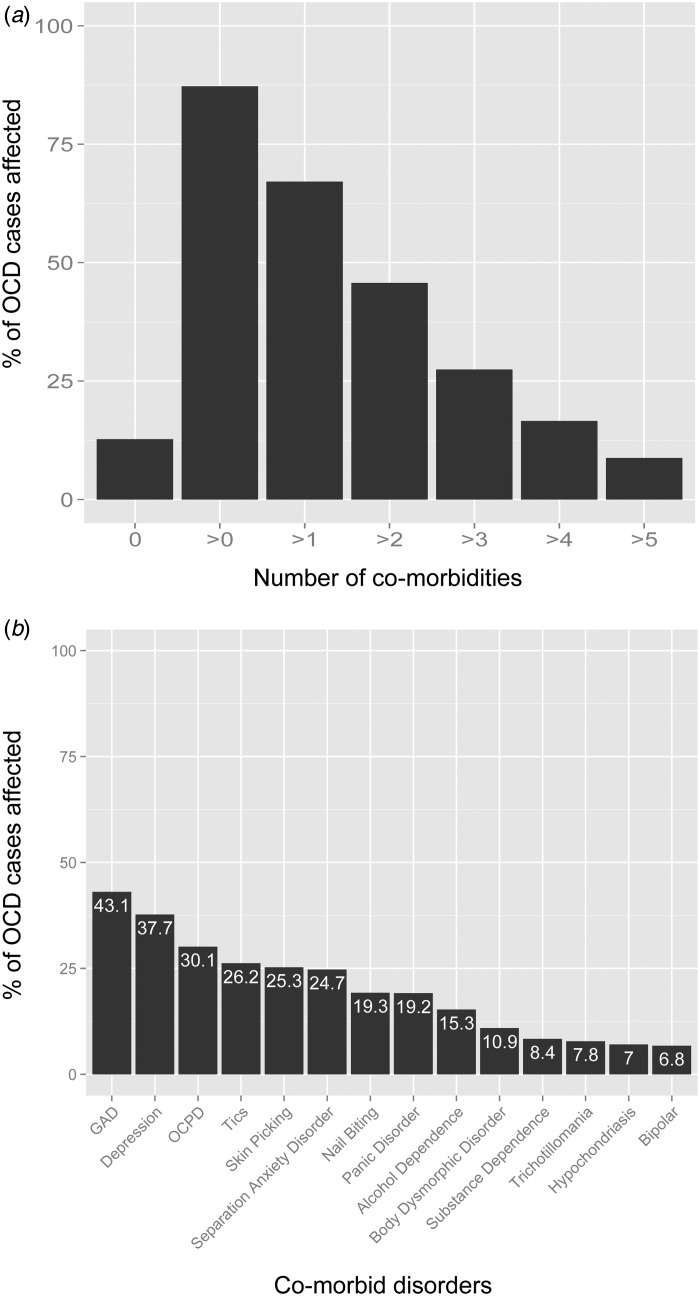
- OCD is highly comorbid and heterogeneous: in 706 OCD patients, 87.3% met criteria for another DSM diagnosis; approximately 30% of schizophrenia cases report obsessive-compulsive symptomatology and 14% have OCD; about three quarters of an epidemiological OCD sample experienced an anxiety or affective disorder.
- Enhanced ERN is associated with anxiety-related disorders including OCD, generalized anxiety disorder, and social anxiety disorder, and less consistently with depression; decreased ERN is seen in schizophrenia, bipolar disorder, autism spectrum disorders, and addiction, while ADHD results are mixed. ERN remains enhanced after successful treatment and in unaffected first-degree relatives, suggesting a possible endophenotype.
- Goal-directed control deficits are found in OCD and other compulsive/impulsive conditions such as addiction, eating disorders, and Tourette syndrome, but also in schizophrenia, autism spectrum disorder, and social anxiety disorder. In a general population sample of just under 2000 subjects, a data-driven “Compulsive Behaviour and Intrusive Thought” factor predicted goal-directed deficits better than any DSM-inspired questionnaire and was dissociable from “Anxious-Depression” and “Social Withdrawal.”
- Treatment prediction data include OFC grey-matter volume predicting SRI response in OCD with 77% sensitivity and 81% specificity, and a meta-analytic number needed to treat of 6–12 for SSRIs versus placebo. The review states that the trans-diagnostic approach has not yet facilitated gene discovery or development of new, better treatments.
Methods
- Narrative review synthesizing existing case-control and general population studies within an RDoC-style trans-diagnostic framework; no new primary data are reported.
- Evidence includes tables summarizing ERN studies across psychiatric disorders and goal-directed learning studies; one cited general population study recruited just under 2000 online subjects and used self-report questionnaires plus a web-based model-based learning task.
- Main analysis is qualitative synthesis and discussion of specificity and generalizability; no meta-analysis or formal pooled effect sizes are reported.
Limitations
- Stated in the paper: the trans-diagnostic approach has yet to facilitate gene discovery or better treatments; dismissing symptom-based approaches entirely is premature; longitudinal designs are needed; case-control designs cannot easily disentangle genuine lack of mechanistic specificity from DSM measurement error or comorbidity; publication bias and small samples/power are obstacles.
- Stated in the paper: “anxiety” is intended as a placeholder until direct comparisons across disorders and discrete symptom dimensions are complete; many candidate dimensions await empirical validation or rejection.
- Evident from the text: many cited findings are mixed or unreplicated (e.g., ERN in depression and ADHD; goal-directed deficits in social anxiety, schizophrenia, and autism), and some treatment-prediction evidence comes from very small samples, such as only 10 patients returning at post-treatment assessment.
Model-written summary. Check it against the paper before relying on it.
Integrity signals
Registry
Cites
Statistics
Figures
Verification
Claims the paper makes
74 Not checked yet · 20 Own interpretation · 1 Own method · 1 No basis given
In the paper
“Even after careful attempts at differential diagnosis of OCD, co-morbidity is present in the majority of cases (Ruscio et al. 2010).”
§ A trans-diagnostic perspective on obsessive-compulsive disorder > Introduction
What the sources say
- Not checked yetcites Ruscio et al. 2010
plaincorrelational- Asserted: passes — The authors put it forward as true.
- Checkable: passes — It can be checked against evidence.
- Load-bearing: passes — The paper’s conclusions depend on it.
- Based: passes — The paper gives a reason why it holds.
In the paper
“Approximately three quarters of individuals with OCD in an epidemiological sample experienced either an anxiety disorder or an affective disorder (Fineberg et al. 2013a).”
§ A trans-diagnostic perspective on obsessive-compulsive disorder > Introduction
What the sources say
- Not checked yetcites Fineberg et al. 2013a
plaincorrelational- Asserted: passes — The authors put it forward as true.
- Checkable: passes — It can be checked against evidence.
- Load-bearing: unclear — It is unclear whether the paper’s conclusions depend on it.
- Based: passes — The paper gives a reason why it holds.
None of the sources cited for this claim have been checked yet.
In the paper
“Progress in understanding the underlying neurobiology of obsessive-compulsive disorder (OCD) has stalled in part because of the considerable problem of heterogeneity within this diagnostic category, and homogeneity across other putatively discrete, diagnostic categories.”
§ A trans-diagnostic perspective on obsessive-compulsive disorder > Abstract
What the sources say
- Not checked yetcites Hyman, 2007
- Not checked yetcites Sanislow et al. 2010
plainconditional- Asserted: passes — The authors put it forward as true.
- Checkable: passes — It can be checked against evidence.
- Load-bearing: passes — The paper’s conclusions depend on it.
- Based: passes — The paper gives a reason why it holds.
In the paper
“In the case of OCD, there is a mosaic of diverse phenomenological manifestations (Torres, 2016).”
§ A trans-diagnostic perspective on obsessive-compulsive disorder > Introduction
What the sources say
- Not checked yetcites Torres, 2016
plain- Asserted: passes — The authors put it forward as true.
- Checkable: passes — It can be checked against evidence.
- Load-bearing: passes — The paper’s conclusions depend on it.
- Based: passes — The paper gives a reason why it holds.
A conclusion the paper draws from its own results — it cites no other source for it, so there is none to check. The quote shows it is in the paper.
In the paper
“The noisy response to treatment that remains to be bridged is likely to be a result of mechanistic heterogeneity within the OCD population that we cannot easily identify by analysing symptoms alone.”
§ A trans-diagnostic perspective on obsessive-compulsive disorder > Introduction
hedgedconditional- Asserted: passes — The authors put it forward as true.
- Checkable: passes — It can be checked against evidence.
- Load-bearing: passes — The paper’s conclusions depend on it.
- Based: unclear — It is unclear why the paper says it holds.
None of the sources cited for this claim have been checked yet.
In the paper
“A number of authors have attempted to group these phenomenological variables into a smaller number of relatively homogeneous, temporally stable symptom dimensions, using factor analysis of large symptom datasets. This has produced a multidimensional model of OCD that includes symmetry/ordering, hoarding, contamination/cleaning, and obsessions/checking) (Mataix-Cols et al. 2005; van den Heuvel et a”
§ A trans-diagnostic perspective on obsessive-compulsive disorder > Introduction
What the sources say
- Not checked yetcites Mataix-Cols et al. 2005
- Not checked yetcites van den Heuvel et al. 2009
plaindirect- Asserted: passes — The authors put it forward as true.
- Checkable: passes — It can be checked against evidence.
- Load-bearing: passes — The paper’s conclusions depend on it.
- Based: passes — The paper gives a reason why it holds.
None of the sources cited for this claim have been checked yet.
In the paper
“Can OCD be better understood and treated from a dimensional perspective? Evidence for this comes from many sources (Hyman, 2010); of these, perhaps the most compelling (and frustrating) is the lack of specificity of various neurocognitive deficits observed in OCD (Endrass & Ullsperger, 2014; Fineberg et al. 2014).”
§ A trans-diagnostic perspective on obsessive-compulsive disorder > Case-control studies point to trans-diagnostic mechanisms in OCD: error-related negativity (ERN) and anxiety
What the sources say
- Not checked yetcites Hyman, 2010
- Not checked yetcites Endrass & Ullsperger, 2014
- Not checked yetcites Fineberg et al. 2014
boostedcorrelational- Asserted: passes — The authors put it forward as true.
- Checkable: passes — It can be checked against evidence.
- Load-bearing: passes — The paper’s conclusions depend on it.
- Based: passes — The paper gives a reason why it holds.
In the paper
“In the case of selective serotonin re-uptake inhibitor (SSRI)-resistant OCD, a preferential effect for treatment with dopamine antagonists was seen for those with co-morbid tics (Bloch et al. 2006).”
§ A trans-diagnostic perspective on obsessive-compulsive disorder > Introduction
What the sources say
- Not checked yetcites Bloch et al. 2006
plaindirect- Asserted: passes — The authors put it forward as true.
- Checkable: passes — It can be checked against evidence.
- Load-bearing: unclear — It is unclear whether the paper’s conclusions depend on it.
- Based: passes — The paper gives a reason why it holds.
None of the sources cited for this claim have been checked yet.
In the paper
“A host of studies have found enhanced ERN in OCD (Gehring et al. 2000; Johannes et al. 2001b; Ruchsow et al. 2005, 2007; Endrass et al. 2008, 2010, 2014; Hajcak et al. 2008; Stern et al. 2010; Riesel et al. 2011, 2015; Xiao et al. 2011; Hanna et al. 2012; Carrasco et al. 2013a, b ; Grützmann et al. 2014; Klawohn et al. 2014; Liu et al. 2014) (but see Nieuwenhuis et al. 2005; Agam et al. 2014; Mat”
§ A trans-diagnostic perspective on obsessive-compulsive disorder > Case-control studies point to trans-diagnostic mechanisms in OCD: error-related negativity (ERN) and anxiety
What the sources say
- Not checked yetcites Gehring et al. 2000
- Not checked yetcites Endrass et al. 2008
- Not checked yetcites Hajcak et al. 2008
boostedcorrelational- Asserted: passes — The authors put it forward as true.
- Checkable: passes — It can be checked against evidence.
- Load-bearing: passes — The paper’s conclusions depend on it.
- Based: passes — The paper gives a reason why it holds.
In the paper
“Unfortunately, hoarding symptoms do not account for all of the heterogeneity of treatment response in OCD, where for example one meta-analysis determined that the number needed to treat varied from 6–12 for SSRIs compared to placebo (Soomro et al. 2008).”
§ A trans-diagnostic perspective on obsessive-compulsive disorder > Introduction
What the sources say
- Not checked yetcites Soomro et al. 2008
plain- Asserted: passes — The authors put it forward as true.
- Checkable: passes — It can be checked against evidence.
- Load-bearing: unclear — It is unclear whether the paper’s conclusions depend on it.
- Based: passes — The paper gives a reason why it holds.
None of the sources cited for this claim have been checked yet.
In the paper
“Although twin studies suggest there might be a genetic influence on dimension-specific risk (van Grootheest et al. 2008; Iervolino et al. 2011), the neurobiological validity of most of these factors has been difficult to demonstrate, owing to, for example, the lack of cross-study consistency of brain structural abnormalities associated with the various subtypes (Pujol et al. 2004; van den Heuvel”
§ A trans-diagnostic perspective on obsessive-compulsive disorder > Introduction
What the sources say
- Not checked yetcites Pujol et al. 2004
- Not checked yetcites van den Heuvel et al. 2009
- Not checked yetcites Alvarenga et al. 2012
plaincorrelational- Asserted: passes — The authors put it forward as true.
- Checkable: passes — It can be checked against evidence.
- Load-bearing: passes — The paper’s conclusions depend on it.
- Based: passes — The paper gives a reason why it holds.
In the paper
“Publication bias is an obstacle here as studies showing no difference between patient cohorts and controls, which are needed to make a case for specificity, are less likely to be published or even submitted for publication (Rosenthal, 1979).”
§ A trans-diagnostic perspective on obsessive-compulsive disorder > Case-control studies point to trans-diagnostic mechanisms in OCD: error-related negativity (ERN) and anxiety
What the sources say
- Not checked yetcites Rosenthal, 1979
plaindirect- Asserted: passes — The authors put it forward as true.
- Checkable: passes — It can be checked against evidence.
- Load-bearing: passes — The paper’s conclusions depend on it.
- Based: passes — The paper gives a reason why it holds.
In the paper
“For example, ‘response inhibition’, the ability to cancel a prepotent motor response assayed using the stop-signal reaction-time task (Logan, 1994), is reliably impaired in not just OCD, but also attention deficit hyperactivity disorder (ADHD) and schizophrenia (Lipszyc & Schachar, 2010).”
§ A trans-diagnostic perspective on obsessive-compulsive disorder > Case-control studies point to trans-diagnostic mechanisms in OCD: error-related negativity (ERN) and anxiety
What the sources say
- Not checked yetcites Lipszyc & Schachar, 2010
boostedcorrelational- Asserted: passes — The authors put it forward as true.
- Checkable: passes — It can be checked against evidence.
- Load-bearing: passes — The paper’s conclusions depend on it.
- Based: passes — The paper gives a reason why it holds.
A conclusion the paper draws from its own results — it cites no other source for it, so there is none to check. The quote shows it is in the paper.
In the paper
“Together with a qualitative examination of the symptom commonalities across these disorders, this suggests that anxiety might be a reasonable candidate for consideration as a dimensional phenotype related to these deficits.”
§ A trans-diagnostic perspective on obsessive-compulsive disorder > Case-control studies point to trans-diagnostic mechanisms in OCD: error-related negativity (ERN) and anxiety
hedgedcorrelational- Asserted: passes — The authors put it forward as true.
- Checkable: passes — It can be checked against evidence.
- Load-bearing: passes — The paper’s conclusions depend on it.
- Based: passes — The paper gives a reason why it holds.
None of the sources cited for this claim have been checked yet.
In the paper
“a large body of work has showed that a significantly decreased ERN magnitude is characteristic of a putatively distinct cluster (or clusters) of disorders, most consistently schizophrenia (Kopp & Rist, 1999; Alain et al. 2002; Bates et al. 2002, 2004; Morris et al. 2006, 2008, 2011; Mathalon et al. 2009; Foti et al. 2012; Horan et al. 2012; Perez et al. 2012; Simmonite et al. 2012; Houthoofd et al”
§ A trans-diagnostic perspective on obsessive-compulsive disorder > Case-control studies point to trans-diagnostic mechanisms in OCD: error-related negativity (ERN) and anxiety
What the sources say
- Not checked yetcites Kopp & Rist, 1999
- Not checked yetcites Minzenberg et al. 2014
- Not checked yetcites Vlamings et al. 2008
boostedcorrelational- Asserted: passes — The authors put it forward as true.
- Checkable: passes — It can be checked against evidence.
- Load-bearing: passes — The paper’s conclusions depend on it.
- Based: passes — The paper gives a reason why it holds.
What the paper did — it cites no source for this, so there is none to check. The quote shows it is in the paper.
In the paper
“However, without direct comparison across disorders and/or discrete symptom dimensions, conclusions regarding its phenomenological specificity cannot be drawn (indeed ‘anxiety’ is intended to serve as a placeholder, until such work is complete).”
§ A trans-diagnostic perspective on obsessive-compulsive disorder > Validating a trans-diagnostic mechanism: goal-directed learning and compulsivity
plain- Asserted: passes — The authors put it forward as true.
- Checkable: passes — It can be checked against evidence.
- Load-bearing: passes — The paper’s conclusions depend on it.
- Based: passes — The paper gives a reason why it holds.
None of the sources cited for this claim have been checked yet.
In the paper
“Based on convergent evidence from follow-up investigations utilizing neuroimaging and computational modelling (Gillan et al. 2014a, 2015a; Voon et al. 2014), the working model theorizes that deficits in goal-directed control, mediated by the caudate and medial orbitofrontal cortex, are responsible for the excessive habits observed in OCD in the laboratory (Gillan & Robbins, 2014).”
§ A trans-diagnostic perspective on obsessive-compulsive disorder > Validating a trans-diagnostic mechanism: goal-directed learning and compulsivity
What the sources say
- Not checked yetcites Gillan et al. 2014a
- Not checked yetcites Voon et al. 2014
- Not checked yetcites Gillan & Robbins, 2014
plaindirect- Asserted: passes — The authors put it forward as true.
- Checkable: passes — It can be checked against evidence.
- Load-bearing: passes — The paper’s conclusions depend on it.
- Based: passes — The paper gives a reason why it holds.
None of the sources cited for this claim have been checked yet.
In the paper
“The original habit hypothesis of OCD was based on a convergence of neurobiological data illustrating that the pathophysiology of OCD overlaps extensively with that supporting the balance between goal-directed behaviour and habits (Graybiel & Rauch, 2000; Dolan & Dayan, 2013).”
§ A trans-diagnostic perspective on obsessive-compulsive disorder > Validating a trans-diagnostic mechanism: goal-directed learning and compulsivity
What the sources say
- Not checked yetcites Graybiel & Rauch, 2000
- Not checked yetcites Dolan & Dayan, 2013
plaincorrelational- Asserted: passes — The authors put it forward as true.
- Checkable: passes — It can be checked against evidence.
- Load-bearing: passes — The paper’s conclusions depend on it.
- Based: passes — The paper gives a reason why it holds.
A conclusion the paper draws from its own results — it cites no other source for it, so there is none to check. The quote shows it is in the paper.
In the paper
“This model suggests that compulsions are not a search for safety; they are a result of the need to realize a link that has developed between a stimulus or context and a given set of responses.”
§ A trans-diagnostic perspective on obsessive-compulsive disorder > Validating a trans-diagnostic mechanism: goal-directed learning and compulsivity
hedgeddirect- Asserted: passes — The authors put it forward as true.
- Checkable: passes — It can be checked against evidence.
- Load-bearing: passes — The paper’s conclusions depend on it.
- Based: passes — The paper gives a reason why it holds.
None of the sources cited for this claim have been checked yet.
In the paper
“This body of research centres on the theory that an imbalance between ‘goal-directed control’ and ‘habit-learning’ drives symptoms in OCD (see Gillan & Robbins, 2014 for detailed account) (see Supplementary material), such that compulsive behaviours in OCD are not goal-directed responses to anxiety/perceived threat, but are in fact stimulus-evoked, goal-insensitive habits (Dickinson, 1985).”
§ A trans-diagnostic perspective on obsessive-compulsive disorder > Validating a trans-diagnostic mechanism: goal-directed learning and compulsivity
What the sources say
- Not checked yetcites Gillan & Robbins, 2014
- Not checked yetcites Dickinson, 1985
plaindirect- Asserted: passes — The authors put it forward as true.
- Checkable: passes — It can be checked against evidence.
- Load-bearing: passes — The paper’s conclusions depend on it.
- Based: passes — The paper gives a reason why it holds.
A conclusion the paper draws from its own results — it cites no other source for it, so there is none to check. The quote shows it is in the paper.
In the paper
“In this view, the subjective experiences that accompany habits, such as ‘not just right experience’ (Coles et al. 2005; Ecker & Gönner, 2008), or more complex obsessive thoughts are the result of the compulsive urge, not the cause.”
§ A trans-diagnostic perspective on obsessive-compulsive disorder > Validating a trans-diagnostic mechanism: goal-directed learning and compulsivity
plaindirect- Asserted: passes — The authors put it forward as true.
- Checkable: passes — It can be checked against evidence.
- Load-bearing: passes — The paper’s conclusions depend on it.
- Based: passes — The paper gives a reason why it holds.
None of the sources cited for this claim have been checked yet.
In the paper
“Empirical studies have found broad support for this idea; OCD patients show a reliable tendency to form habits excessively in both appetitive and aversive learning contexts (Gillan et al. 2011, 2014b).”
§ A trans-diagnostic perspective on obsessive-compulsive disorder > Validating a trans-diagnostic mechanism: goal-directed learning and compulsivity
What the sources say
- Not checked yetcites Gillan et al. 2011
- Not checked yetcites Gillan et al. 2014b
boostedcorrelational- Asserted: passes — The authors put it forward as true.
- Checkable: passes — It can be checked against evidence.
- Load-bearing: passes — The paper’s conclusions depend on it.
- Based: passes — The paper gives a reason why it holds.
A conclusion the paper draws from its own results — it cites no other source for it, so there is none to check. The quote shows it is in the paper.
In the paper
“Critically, the postulate that an enhanced ERN is a useful marker of an anxious phenotype rests on the specificity of this effect.”
§ A trans-diagnostic perspective on obsessive-compulsive disorder > Case-control studies point to trans-diagnostic mechanisms in OCD: error-related negativity (ERN) and anxiety
plaincorrelational- Asserted: passes — The authors put it forward as true.
- Checkable: passes — It can be checked against evidence.
- Load-bearing: passes — The paper’s conclusions depend on it.
- Based: unclear — It is unclear why the paper says it holds.
A conclusion the paper draws from its own results — it cites no other source for it, so there is none to check. The quote shows it is in the paper.
In the paper
“suggesting that this may be an important endophenotype that predisposes individuals to a range of disorders that involve anxiety.”
§ A trans-diagnostic perspective on obsessive-compulsive disorder > Case-control studies point to trans-diagnostic mechanisms in OCD: error-related negativity (ERN) and anxiety
hedgedconditional- Asserted: passes — The authors put it forward as true.
- Checkable: passes — It can be checked against evidence.
- Load-bearing: passes — The paper’s conclusions depend on it.
- Based: passes — The paper gives a reason why it holds.
A conclusion the paper draws from its own results — it cites no other source for it, so there is none to check. The quote shows it is in the paper.
In the paper
“This therefore may constitute a trans-diagnostic marker relevant for many disorders involving anxiety, including OCD.”
§ A trans-diagnostic perspective on obsessive-compulsive disorder > Case-control studies point to trans-diagnostic mechanisms in OCD: error-related negativity (ERN) and anxiety
hedgedcorrelational- Asserted: passes — The authors put it forward as true.
- Checkable: passes — It can be checked against evidence.
- Load-bearing: passes — The paper’s conclusions depend on it.
- Based: passes — The paper gives a reason why it holds.
A conclusion the paper draws from its own results — it cites no other source for it, so there is none to check. The quote shows it is in the paper.
In the paper
“Using a case-control design, it is difficult to disentangle a genuine lack of mechanistic specificity, as these data might indicate, from ‘DSM measurement error’, the confounding influence of co-morbid psychiatric disorders.”
§ A trans-diagnostic perspective on obsessive-compulsive disorder > Validating a trans-diagnostic mechanism: goal-directed learning and compulsivity
hedged- Asserted: passes — The authors put it forward as true.
- Checkable: passes — It can be checked against evidence.
- Load-bearing: passes — The paper’s conclusions depend on it.
- Based: passes — The paper gives a reason why it holds.
None of the sources cited for this claim have been checked yet.
In the paper
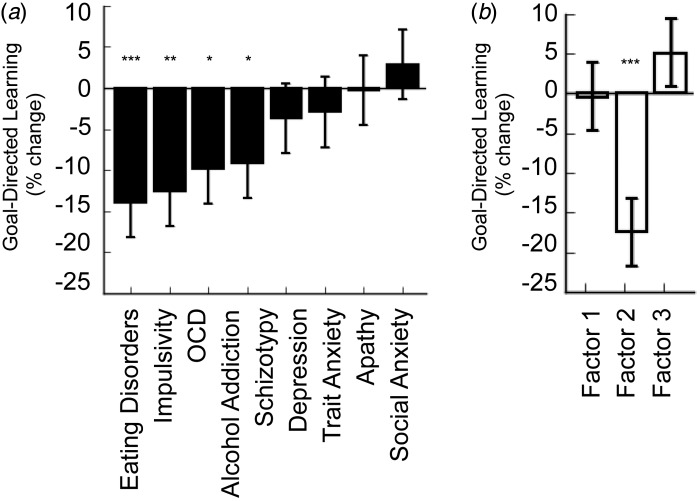
“these deficits were not associated with symptoms of trait anxiety (Spielberger et al. 1983), depression (Zung, 1965), social anxiety (Liebowitz, 1987) or apathy (Marin et al. 1991).”
§ A trans-diagnostic perspective on obsessive-compulsive disorder > Validating a trans-diagnostic mechanism: goal-directed learning and compulsivity
What the sources say
- Not checked yetcites Gillan et al. 2016b
- Not checked yetcites Spielberger et al. 1983
- Not checked yetcites Zung, 1965
plain- Asserted: passes — The authors put it forward as true.
- Checkable: passes — It can be checked against evidence.
- Load-bearing: passes — The paper’s conclusions depend on it.
- Based: passes — The paper gives a reason why it holds.
In the paper
“The association between Factor 2 (‘Compulsive Behavior and Intrusive Thought’) and deficits in goal-directed learning is greater than that of any of the nine DSM-inspired questionnaires”
- Also stated in: § Validating a trans-diagnostic mechanism: goal-directed learning and compulsivity · plain
“‘Compulsive Behaviour and Intrusive Thought’ was found to be more predictive of goal-directed deficits than any DSM-inspired questionnaire collected in this study (Fig. 2b)”
§ A trans-diagnostic perspective on obsessive-compulsive disorder > Validating a trans-diagnostic mechanism: goal-directed learning and compulsivity
What the sources say
- Not checked yetcites Gillan et al. 2016b
plaincorrelational- Asserted: passes — The authors put it forward as true.
- Checkable: passes — It can be checked against evidence.
- Load-bearing: passes — The paper’s conclusions depend on it.
- Based: passes — The paper gives a reason why it holds.
- Also stated in: § Validating a trans-diagnostic mechanism: goal-directed learning and compulsivity · plain
None of the sources cited for this claim have been checked yet.
In the paper
“eating disorders (Garner et al. 1982), impulsivity (Patton et al. 1995) and alcohol addiction (Saunders et al. 1993) were also associated with deficits in goal-directed control”
§ A trans-diagnostic perspective on obsessive-compulsive disorder > Validating a trans-diagnostic mechanism: goal-directed learning and compulsivity
What the sources say
- Not checked yetcites Gillan et al. 2016b
- Not checked yetcites Garner et al. 1982
- Not checked yetcites Saunders et al. 1993
plaincorrelational- Asserted: passes — The authors put it forward as true.
- Checkable: passes — It can be checked against evidence.
- Load-bearing: passes — The paper’s conclusions depend on it.
- Based: passes — The paper gives a reason why it holds.
In the paper
“This factor comprised select features of OCD, eating disorders, addiction and some aspects of impulsivity and schizotypy that pertain to a loss of control over repetitive behaviour and thought.”
§ A trans-diagnostic perspective on obsessive-compulsive disorder > Validating a trans-diagnostic mechanism: goal-directed learning and compulsivity
What the sources say
- Not checked yetcites Gillan et al. 2016b
plaincorrelational- Asserted: passes — The authors put it forward as true.
- Checkable: passes — It can be checked against evidence.
- Load-bearing: passes — The paper’s conclusions depend on it.
- Based: passes — The paper gives a reason why it holds.
In the paper
“of particular interest was a factor linking disorders at the level of compulsive behaviour and thought, so-called ‘Compulsive Behaviour and Intrusive Thought’.”
§ A trans-diagnostic perspective on obsessive-compulsive disorder > Validating a trans-diagnostic mechanism: goal-directed learning and compulsivity
What the sources say
- Not checked yetcites Gillan et al. 2016b
plaincorrelational- Asserted: passes — The authors put it forward as true.
- Checkable: passes — It can be checked against evidence.
- Load-bearing: passes — The paper’s conclusions depend on it.
- Based: passes — The paper gives a reason why it holds.
None of the sources cited for this claim have been checked yet.
In the paper
“antidepressants, such as paroxetine and mirtazapine, which appear to have no effect on the ERN (de Bruijn et al. 2004, 2006)”
§ A trans-diagnostic perspective on obsessive-compulsive disorder > Going deeper: ‘units of analysis’
What the sources say
- Not checked yetcites de Bruijn et al. 2004
- Not checked yetcites de Bruijn et al. 2006
hedged- Asserted: passes — The authors put it forward as true.
- Checkable: passes — It can be checked against evidence.
- Load-bearing: passes — The paper’s conclusions depend on it.
- Based: passes — The paper gives a reason why it holds.
- Rests on an assumption: Antidepressants paroxetine and mirtazapine have good efficacy for treating both OCD and GAD.
None of the sources cited for this claim have been checked yet.
In the paper
“Benzodiazepines, specifically alprazolam (Riba et al. 2005), lorazepam (de Bruijn et al. 2004) and oxazepam (Johannes et al. 2001a), reduce the amplitude of the ERN.”
§ A trans-diagnostic perspective on obsessive-compulsive disorder > Going deeper: ‘units of analysis’
What the sources say
- Not checked yetcites Riba et al. 2005
- Not checked yetcites de Bruijn et al. 2004
- Not checked yetcites Johannes et al. 2001a
plaindirect- Asserted: passes — The authors put it forward as true.
- Checkable: passes — It can be checked against evidence.
- Load-bearing: passes — The paper’s conclusions depend on it.
- Based: passes — The paper gives a reason why it holds.
None of the sources cited for this claim have been checked yet.
In the paper
“the first empirical investigations have found evidence for goal-directed deficits in these disorders (Sjoerds et al. 2013; Voon et al. 2014; Delorme et al. 2015; Ersche et al. 2016) (Table 2).”
§ A trans-diagnostic perspective on obsessive-compulsive disorder > Validating a trans-diagnostic mechanism: goal-directed learning and compulsivity
What the sources say
- Not checked yetcites Sjoerds et al. 2013
- Not checked yetcites Voon et al. 2014
- Not checked yetcites Delorme et al. 2015
plaincorrelational- Asserted: passes — The authors put it forward as true.
- Checkable: passes — It can be checked against evidence.
- Load-bearing: passes — The paper’s conclusions depend on it.
- Based: passes — The paper gives a reason why it holds.
None of the sources cited for this claim have been checked yet.
In the paper
“Schizotypy (Mason et al. 2005) sat somewhere in the middle, showing a marginal association with goal-directed deficits (Fig. 2a).”
§ A trans-diagnostic perspective on obsessive-compulsive disorder > Validating a trans-diagnostic mechanism: goal-directed learning and compulsivity
What the sources say
- Not checked yetcites Gillan et al. 2016b
- Not checked yetcites Mason et al. 2005
plaincorrelational- Asserted: passes — The authors put it forward as true.
- Checkable: passes — It can be checked against evidence.
- Load-bearing: unclear — It is unclear whether the paper’s conclusions depend on it.
- Based: passes — The paper gives a reason why it holds.
None of the sources cited for this claim have been checked yet.
In the paper
“normal variation in self-reported OCD symptomatology (Foa et al. 2002) was associated with decreases in goal-directed control in two separate samples collected in this study (also see a recent independent replication: Snorrason et al. 2016).”
§ A trans-diagnostic perspective on obsessive-compulsive disorder > Validating a trans-diagnostic mechanism: goal-directed learning and compulsivity
What the sources say
- Not checked yetcites Gillan et al. 2016b
- Not checked yetcites Snorrason et al. 2016
plaincorrelationaln = 2- Asserted: passes — The authors put it forward as true.
- Checkable: passes — It can be checked against evidence.
- Load-bearing: passes — The paper’s conclusions depend on it.
- Based: passes — The paper gives a reason why it holds.
In the paper
“these effects appear to be continuous in the general population rather than being specific to diagnosed groups.”
§ A trans-diagnostic perspective on obsessive-compulsive disorder > Validating a trans-diagnostic mechanism: goal-directed learning and compulsivity
What the sources say
- Not checked yetcites Gillan et al. 2016b
hedged- Asserted: passes — The authors put it forward as true.
- Checkable: passes — It can be checked against evidence.
- Load-bearing: passes — The paper’s conclusions depend on it.
- Based: passes — The paper gives a reason why it holds.
In the paper
“benzodiazepines are ineffective for treating OCD (e.g. clonazepam, Hollander et al. 2003).”
§ A trans-diagnostic perspective on obsessive-compulsive disorder > Going deeper: ‘units of analysis’
What the sources say
- Not checked yetcites Hollander et al. 2003
plain- Asserted: passes — The authors put it forward as true.
- Checkable: passes — It can be checked against evidence.
- Load-bearing: passes — The paper’s conclusions depend on it.
- Based: passes — The paper gives a reason why it holds.
None of the sources cited for this claim have been checked yet.
In the paper
“For example, in the aforementioned studies in social anxiety disorder patients (Alvares et al. 2014, 2016), because patients presented with multiple co-morbid disorders, one cannot know if the results are attributable to social anxiety symptoms or one or more of their co-morbid conditions.”
§ A trans-diagnostic perspective on obsessive-compulsive disorder > Validating a trans-diagnostic mechanism: goal-directed learning and compulsivity
What the sources say
- Not checked yetcites Alvares et al. 2014
- Not checked yetcites Alvares et al. 2016
plain- Asserted: passes — The authors put it forward as true.
- Checkable: passes — It can be checked against evidence.
- Load-bearing: passes — The paper’s conclusions depend on it.
- Based: passes — The paper gives a reason why it holds.
In the paper
“In reality, OCD patients recruited in this way consistently have higher levels of sub-threshold symptoms of multiple other disorders, e.g. depression and anxiety (Gillan et al. 2011).”
§ A trans-diagnostic perspective on obsessive-compulsive disorder > Validating a trans-diagnostic mechanism: goal-directed learning and compulsivity
What the sources say
- Not checked yetcites Gillan et al. 2011
plaincorrelational- Asserted: passes — The authors put it forward as true.
- Checkable: passes — It can be checked against evidence.
- Load-bearing: passes — The paper’s conclusions depend on it.
- Based: passes — The paper gives a reason why it holds.
In the paper
“This approach revealed that three factors could replace the nine original questionnaires”
§ A trans-diagnostic perspective on obsessive-compulsive disorder > Validating a trans-diagnostic mechanism: goal-directed learning and compulsivity
What the sources say
- Not checked yetcites Gillan et al. 2016b
hedgedcorrelational- Asserted: passes — The authors put it forward as true.
- Checkable: passes — It can be checked against evidence.
- Load-bearing: passes — The paper’s conclusions depend on it.
- Based: passes — The paper gives a reason why it holds.
None of the sources cited for this claim have been checked yet.
In the paper
“The only two structural MRI studies to date have both shown that decreased grey matter in the lateral OFC is also linked to SRI response (Hoexter et al. 2013, 2015).”
§ A trans-diagnostic perspective on obsessive-compulsive disorder > Precision therapeutics: insights and trans-diagnostic opportunities
What the sources say
- Not checked yetcites Hoexter et al. 2013
- Not checked yetcites Hoexter et al. 2015
plaincorrelational- Asserted: passes — The authors put it forward as true.
- Checkable: passes — It can be checked against evidence.
- Load-bearing: passes — The paper’s conclusions depend on it.
- Based: passes — The paper gives a reason why it holds.
In the paper
“amphetamine administration increases the amplitude of the ERN (de Bruijn et al. 2004)”
§ A trans-diagnostic perspective on obsessive-compulsive disorder > Going deeper: ‘units of analysis’
What the sources say
- Not checked yetcites de Bruijn et al. 2004
plaindirect- Asserted: passes — The authors put it forward as true.
- Checkable: passes — It can be checked against evidence.
- Load-bearing: unclear — It is unclear whether the paper’s conclusions depend on it.
- Based: passes — The paper gives a reason why it holds.
None of the sources cited for this claim have been checked yet.
In the paper
“antipsychotics such as haloperidol and olanzapine reduce it (Zirnheld et al. 2004; de Bruijn et al. 2006).”
§ A trans-diagnostic perspective on obsessive-compulsive disorder > Going deeper: ‘units of analysis’
What the sources say
- Not checked yetcites Zirnheld et al. 2004
- Not checked yetcites de Bruijn et al. 2006
plaindirect- Asserted: passes — The authors put it forward as true.
- Checkable: passes — It can be checked against evidence.
- Load-bearing: unclear — It is unclear whether the paper’s conclusions depend on it.
- Based: passes — The paper gives a reason why it holds.
In the paper
“the observation that these regional volumes are reduced in binge-eating disorder patients was statistically explained by their deficits of goal-directed control relative to controls (Voon et al. 2014).”
§ A trans-diagnostic perspective on obsessive-compulsive disorder > Going deeper: ‘units of analysis’
What the sources say
- Not checked yetcites Voon et al. 2014
plaindirect- Asserted: passes — The authors put it forward as true.
- Checkable: passes — It can be checked against evidence.
- Load-bearing: unclear — It is unclear whether the paper’s conclusions depend on it.
- Based: passes — The paper gives a reason why it holds.
A conclusion the paper draws from its own results — it cites no other source for it, so there is none to check. The quote shows it is in the paper.
In the paper
“morphometric predictors of SRI response in OCD already appear to be somewhat more robust than functional ones.”
§ A trans-diagnostic perspective on obsessive-compulsive disorder > Precision therapeutics: insights and trans-diagnostic opportunities
hedgedcorrelational- Asserted: passes — The authors put it forward as true.
- Checkable: passes — It can be checked against evidence.
- Load-bearing: passes — The paper’s conclusions depend on it.
- Based: passes — The paper gives a reason why it holds.
In the paper
“several studies have had early success at using functional imaging at the group level to predict treatment response within the OCD population (for review see Ball et al. 2014).”
§ A trans-diagnostic perspective on obsessive-compulsive disorder > Precision therapeutics: insights and trans-diagnostic opportunities
What the sources say
- Not checked yetcites Ball et al. 2014
plaincorrelational- Asserted: passes — The authors put it forward as true.
- Checkable: passes — It can be checked against evidence.
- Load-bearing: unclear — It is unclear whether the paper’s conclusions depend on it.
- Based: passes — The paper gives a reason why it holds.
None of the sources cited for this claim have been checked yet.
In the paper
“excessive grooming was ameliorated with chronic SSRI treatment, the first line pharmacotherapy for OCD (Fineberg et al. 2013b)”
§ A trans-diagnostic perspective on obsessive-compulsive disorder > Going deeper: ‘units of analysis’
What the sources say
- Not checked yetcites Ahmari et al. 2013
- Not checked yetcites Fineberg et al. 2013b
plaindirect- Asserted: passes — The authors put it forward as true.
- Checkable: passes — It can be checked against evidence.
- Load-bearing: passes — The paper’s conclusions depend on it.
- Based: passes — The paper gives a reason why it holds.
In the paper
“deficits in goal-directed control are associated with reductions of grey-matter volume in the caudate and mOFC in healthy individuals (Voon et al. 2014).”
§ A trans-diagnostic perspective on obsessive-compulsive disorder > Going deeper: ‘units of analysis’
What the sources say
- Not checked yetcites Voon et al. 2014
plaincorrelational- Asserted: passes — The authors put it forward as true.
- Checkable: passes — It can be checked against evidence.
- Load-bearing: passes — The paper’s conclusions depend on it.
- Based: passes — The paper gives a reason why it holds.
In the paper
“hyperactivity in the caudate nucleus is linked to failures in goal-directed behaviour observed in OCD patients (Gillan et al. 2015a).”
§ A trans-diagnostic perspective on obsessive-compulsive disorder > Going deeper: ‘units of analysis’
What the sources say
- Not checked yetcites Gillan et al. 2015a
plaincorrelational- Asserted: passes — The authors put it forward as true.
- Checkable: passes — It can be checked against evidence.
- Load-bearing: passes — The paper’s conclusions depend on it.
- Based: passes — The paper gives a reason why it holds.
In the paper
“specific drug response can be linked to easily observable symptoms, such as the presence of tics (Bloch et al. 2006).”
§ A trans-diagnostic perspective on obsessive-compulsive disorder > Combining trans-diagnostic with existing approaches
What the sources say
- Not checked yetcites Bloch et al. 2006
plaincorrelational- Asserted: passes — The authors put it forward as true.
- Checkable: passes — It can be checked against evidence.
- Load-bearing: unclear — It is unclear whether the paper’s conclusions depend on it.
- Based: passes — The paper gives a reason why it holds.
None of the sources cited for this claim have been checked yet.
In the paper
“several studies that came later failed to replicate (Saxena et al. 2003; Carey et al. 2004; Ho Pian et al. 2005; van der Wee et al. 2007), finding no significant effects or in some cases entirely different neural markers.”
§ A trans-diagnostic perspective on obsessive-compulsive disorder > Precision therapeutics: insights and trans-diagnostic opportunities
What the sources say
- Not checked yetcites Saxena et al. 2003
- Not checked yetcites Carey et al. 2004
- Not checked yetcites Ho Pian et al. 2005
plain- Asserted: passes — The authors put it forward as true.
- Checkable: passes — It can be checked against evidence.
- Load-bearing: passes — The paper’s conclusions depend on it.
- Based: passes — The paper gives a reason why it holds.
None of the sources cited for this claim have been checked yet.
In the paper
“chronic stimulation of mOFC neurons that project to the ventromedial striatum [i.e. mimicking the hyperactivity observed in human OCD patients (Gillan et al. 2015a)] induces compulsive grooming behaviour in mice (Ahmari et al. 2013).”
§ A trans-diagnostic perspective on obsessive-compulsive disorder > Going deeper: ‘units of analysis’
What the sources say
- Not checked yetcites Ahmari et al. 2013
- Not checked yetcites Gillan et al. 2015a
plaindirect- Asserted: passes — The authors put it forward as true.
- Checkable: passes — It can be checked against evidence.
- Load-bearing: passes — The paper’s conclusions depend on it.
- Based: passes — The paper gives a reason why it holds.
In the paper
“Hoexter and colleagues showed that OFC grey-matter volume had 77% sensitivity and 81% specificity at predicting SRI response in OCD.”
§ A trans-diagnostic perspective on obsessive-compulsive disorder > Precision therapeutics: insights and trans-diagnostic opportunities
What the sources say
- Not checked yetcites Hoexter et al. 2015
plaincorrelational- Asserted: passes — The authors put it forward as true.
- Checkable: passes — It can be checked against evidence.
- Load-bearing: passes — The paper’s conclusions depend on it.
- Based: passes — The paper gives a reason why it holds.
In the paper
“in the one study that adopted a trans-diagnostic approach, recruiting individuals with OCD, depression or both, the authors were able to identify dissociable neural markers of subsequent depressive v. obsessive-compulsive response to paroxetine (Saxena et al. 2003).”
§ A trans-diagnostic perspective on obsessive-compulsive disorder > Precision therapeutics: insights and trans-diagnostic opportunities
What the sources say
- Not checked yetcites Saxena et al. 2003
plaincorrelational- Asserted: passes — The authors put it forward as true.
- Checkable: passes — It can be checked against evidence.
- Load-bearing: passes — The paper’s conclusions depend on it.
- Based: passes — The paper gives a reason why it holds.
In the paper
“studies point to the involvement of the medial orbitofrontal cortex (mOFC) and caudate based on their involvement in goal-directed control across species (Dolan & Dayan, 2013) and convergent data suggesting these are critically involved in OCD and other compulsive disorders.”
§ A trans-diagnostic perspective on obsessive-compulsive disorder > Going deeper: ‘units of analysis’
What the sources say
- Not checked yetcites Dolan & Dayan, 2013
plaincorrelational- Asserted: passes — The authors put it forward as true.
- Checkable: passes — It can be checked against evidence.
- Load-bearing: passes — The paper’s conclusions depend on it.
- Based: passes — The paper gives a reason why it holds.
None of the sources cited for this claim have been checked yet.
In the paper
“One potential marker of SRI response in OCD is reduced baseline activity in the OFC and ACC (Swedo et al. 1992, 1989; Brody et al. 1998; Saxena et al. 1999).”
§ A trans-diagnostic perspective on obsessive-compulsive disorder > Precision therapeutics: insights and trans-diagnostic opportunities
What the sources say
- Not checked yetcites Swedo et al. 1992
- Not checked yetcites Brody et al. 1998
- Not checked yetcites Saxena et al. 1999
hedgedcorrelational- Asserted: passes — The authors put it forward as true.
- Checkable: passes — It can be checked against evidence.
- Load-bearing: unclear — It is unclear whether the paper’s conclusions depend on it.
- Based: passes — The paper gives a reason why it holds.
In the paper
“the authors were unable to find a relationship between baseline ERN and cognitive behaviour therapy response in a paediatric OCD sample (Hajcak et al. 2008).”
§ A trans-diagnostic perspective on obsessive-compulsive disorder > Precision therapeutics: insights and trans-diagnostic opportunities
What the sources say
- Not checked yetcites Hajcak et al. 2008
plainn = 10- Asserted: passes — The authors put it forward as true.
- Checkable: passes — It can be checked against evidence.
- Load-bearing: unclear — It is unclear whether the paper’s conclusions depend on it.
- Based: passes — The paper gives a reason why it holds.
- It may state two separate claims as one. 26
- Probably not a substantial claim. 17
In the paper
“DSM-5 acknowledges that these symptoms are not unique to OCD; outlining 14 other disorders (or disorder classes) whose symptoms also broadly fit these criteria, which the clinician must consider in the context of differential diagnosis.”
§ A trans-diagnostic perspective on obsessive-compulsive disorder > Introduction
What the sources say
- Not checked yetcites APA, 2013
plain- Asserted: passes — The authors put it forward as true.
- Checkable: passes — It can be checked against evidence.
- Load-bearing: passes — The paper’s conclusions depend on it.
- Based: passes — The paper gives a reason why it holds.
It may state two separate claims as one.
In the paper
“Obsessive-compulsive disorder (OCD), is a chronic, costly and disabling brain disorder for which existing treatments usually produce disappointing outcomes (Fineberg et al. 2014).”
§ A trans-diagnostic perspective on obsessive-compulsive disorder > Introduction
What the sources say
- Not checked yetcites Fineberg et al. 2014
plain- Asserted: passes — The authors put it forward as true.
- Checkable: passes — It can be checked against evidence.
- Load-bearing: unclear — It is unclear whether the paper’s conclusions depend on it.
- Based: passes — The paper gives a reason why it holds.
It may state two separate claims as one.
None of the sources cited for this claim have been checked yet.
In the paper
“it has been suggested that shortcomings in the use of these categories for basic research are at least partly responsible for the lack of specific and robust associations between psychopathology and underlying neurobiological processes (Hyman, 2007; Sanislow et al. 2010).”
§ A trans-diagnostic perspective on obsessive-compulsive disorder > Introduction
What the sources say
- Not checked yetcites Hyman, 2007
- Not checked yetcites Sanislow et al. 2010
hedgedconditional- Asserted: passes — The authors put it forward as true.
- Checkable: passes — It can be checked against evidence.
- Load-bearing: passes — The paper’s conclusions depend on it.
- Based: passes — The paper gives a reason why it holds.
Probably not a substantial claim.
A conclusion the paper draws from its own results — it cites no other source for it, so there is none to check. The quote shows it is in the paper.
In the paper
“In a wider context, improved nosology based on more objective tests and criteria would lead to more homogeneous populations of patients for clinical trials, more accurate phenotypes for psychiatric genetics, and the potential for detection of early vulnerability, allowing for early therapeutic interventions that prevent progression to chronic illness.”
§ A trans-diagnostic perspective on obsessive-compulsive disorder > Introduction
hedgeddirect- Asserted: passes — The authors put it forward as true.
- Checkable: fails — It may be too vague to check against evidence.
- Load-bearing: passes — The paper’s conclusions depend on it.
- Based: fails — The paper may give no reason why it holds.
Probably not a substantial claim. It may be too vague to check against evidence. The paper may give no reason why it holds. It may state two separate claims as one.
A conclusion the paper draws from its own results — it cites no other source for it, so there is none to check. The quote shows it is in the paper.
In the paper
“The issue of homogeneity across diagnostic categories is coupled with a related problem, heterogeneity within diagnostic categories.”
§ A trans-diagnostic perspective on obsessive-compulsive disorder > Introduction
plaincorrelational- Asserted: passes — The authors put it forward as true.
- Checkable: passes — It can be checked against evidence.
- Load-bearing: passes — The paper’s conclusions depend on it.
- Based: passes — The paper gives a reason why it holds.
It may state two separate claims as one.
In the paper
“It is typically measured using electroencephalogram, but functional imaging has been coupled with this technique to confirm that the ERN has its source in the anterior cingulate cortex (ACC) (Debener et al. 2005).”
§ A trans-diagnostic perspective on obsessive-compulsive disorder > Case-control studies point to trans-diagnostic mechanisms in OCD: error-related negativity (ERN) and anxiety
What the sources say
- Not checked yetcites Debener et al. 2005
plaindirect- Asserted: passes — The authors put it forward as true.
- Checkable: passes — It can be checked against evidence.
- Load-bearing: fails — The paper’s conclusions may not depend on it.
- Based: passes — The paper gives a reason why it holds.
Probably not a substantial claim. The paper’s conclusions may not depend on it. It may state two separate claims as one.
A conclusion the paper draws from its own results — it cites no other source for it, so there is none to check. The quote shows it is in the paper.
In the paper
“These findings indicate quite clearly that these and other disorders are not discrete entities, and that the lines between different DSM diagnoses are often blurred (Fig. 1).”
§ A trans-diagnostic perspective on obsessive-compulsive disorder > Introduction
boosted- Asserted: passes — The authors put it forward as true.
- Checkable: passes — It can be checked against evidence.
- Load-bearing: passes — The paper’s conclusions depend on it.
- Based: passes — The paper gives a reason why it holds.
It may state two separate claims as one.
A conclusion the paper draws from its own results — it cites no other source for it, so there is none to check. The quote shows it is in the paper.
In the paper
“What we will consider in the following sections is an admittedly well-trodden alternative: that it is our psychiatric taxonomy, not our neurocognitive models, that presents a problem for research and that the specificity of any neurocognitive model of a psychiatric diagnosis is fundamentally limited by the extent to which that diagnosis is biologically valid.”
§ A trans-diagnostic perspective on obsessive-compulsive disorder > Case-control studies point to trans-diagnostic mechanisms in OCD: error-related negativity (ERN) and anxiety
plaindirect- Asserted: passes — The authors put it forward as true.
- Checkable: fails — It may be too vague to check against evidence.
- Load-bearing: passes — The paper’s conclusions depend on it.
- Based: fails — The paper may give no reason why it holds.
Probably not a substantial claim. It may be too vague to check against evidence. The paper may give no reason why it holds.
None of the sources cited for this claim have been checked yet.
In the paper
“In response, some researchers have called for a shift away from the use of DSM categories, in favour of establishing new and biologically relevant trans-diagnostic traits that may play an important role in multiple disorders, as we currently define them (Robbins et al. 2012; Cuthbert & Kozak, 2013).”
§ A trans-diagnostic perspective on obsessive-compulsive disorder > Introduction
What the sources say
- Not checked yetcites Robbins et al. 2012
- Not checked yetcites Cuthbert & Kozak, 2013
plain- Asserted: passes — The authors put it forward as true.
- Checkable: passes — It can be checked against evidence.
- Load-bearing: passes — The paper’s conclusions depend on it.
- Based: passes — The paper gives a reason why it holds.
Probably not a substantial claim.
In the paper
“For example, agoraphobia and GAD were associated with increased OCD severity; bipolar disorder was associated with suicidal acts and panic disorder increased treatment-seeking behaviour (Fineberg et al. 2013a).”
§ A trans-diagnostic perspective on obsessive-compulsive disorder > Introduction
What the sources say
- Not checked yetcites Fineberg et al. 2013a
plaincorrelational- Asserted: passes — The authors put it forward as true.
- Checkable: passes — It can be checked against evidence.
- Load-bearing: passes — The paper’s conclusions depend on it.
- Based: passes — The paper gives a reason why it holds.
It may state two separate claims as one.
In the paper
“The ERN is a negative deflection of the event-related potential (ERP) when subjects make an error (Falkenstein et al. 1991), listed as the RDoC sub-construct ‘Performance Monitoring’.”
§ A trans-diagnostic perspective on obsessive-compulsive disorder > Case-control studies point to trans-diagnostic mechanisms in OCD: error-related negativity (ERN) and anxiety
What the sources say
- Not checked yetcites Falkenstein et al. 1991
plain- Asserted: passes — The authors put it forward as true.
- Checkable: passes — It can be checked against evidence.
- Load-bearing: fails — The paper’s conclusions may not depend on it.
- Based: passes — The paper gives a reason why it holds.
Probably not a substantial claim. The paper’s conclusions may not depend on it. It may state two separate claims as one.
In the paper
“The National Institute of Mental Health (NIMH) has been an important leader in this regard, launching its Research Domain Criteria (RDoC) initiative (Insel et al. 2010), a framework based on the premise that clinical constructs should be defined (and therefore investigated) on the basis of their neurobiological validity.”
§ A trans-diagnostic perspective on obsessive-compulsive disorder > Introduction
What the sources say
- Not checked yetcites Insel et al. 2010
plain- Asserted: passes — The authors put it forward as true.
- Checkable: passes — It can be checked against evidence.
- Load-bearing: passes — The paper’s conclusions depend on it.
- Based: passes — The paper gives a reason why it holds.
Probably not a substantial claim.
A conclusion the paper draws from its own results — it cites no other source for it, so there is none to check. The quote shows it is in the paper.
In the paper
“This particularly impactful finding has provoked a change in DSM-5, such that hoarding symptoms no longer exclusively contribute to a diagnosis of OCD, and are additionally captured by a separate category, ‘hoarding disorder’.”
§ A trans-diagnostic perspective on obsessive-compulsive disorder > Introduction
plain- Asserted: passes — The authors put it forward as true.
- Checkable: passes — It can be checked against evidence.
- Load-bearing: fails — The paper’s conclusions may not depend on it.
- Based: passes — The paper gives a reason why it holds.
Probably not a substantial claim. The paper’s conclusions may not depend on it. It may state two separate claims as one.
None of the sources cited for this claim have been checked yet.
In the paper
“studies have shown that the ERN primes defensive responses, for example by potentiating startle responses (Hajcak & Foti, 2008) and encouraging avoidance behaviour (Frank et al. 2005).”
§ A trans-diagnostic perspective on obsessive-compulsive disorder > Case-control studies point to trans-diagnostic mechanisms in OCD: error-related negativity (ERN) and anxiety
What the sources say
- Not checked yetcites Hajcak & Foti, 2008
- Not checked yetcites Frank et al. 2005
boosteddirect- Asserted: passes — The authors put it forward as true.
- Checkable: passes — It can be checked against evidence.
- Load-bearing: passes — The paper’s conclusions depend on it.
- Based: passes — The paper gives a reason why it holds.
It may state two separate claims as one.
None of the sources cited for this claim have been checked yet.
In the paper
“GAD (Ladouceur et al. 2006; Weinberg et al. 2012, 2015, 2010) (but see Xiao et al. 2011), social anxiety disorder (Endrass et al. 2014) and depression (Chiu & Deldin, 2007; Holmes & Pizzagalli, 2008, 2010; Georgiadi et al. 2011; Aarts et al. 2013; Tang et al. 2013; Mueller et al. 2015) (although less consistently than in generalized anxiety or OCD, see Ruchsow et al. 2004, 2006; Olvet et al. 2010;”
§ A trans-diagnostic perspective on obsessive-compulsive disorder > Case-control studies point to trans-diagnostic mechanisms in OCD: error-related negativity (ERN) and anxiety
What the sources say
- Not checked yetcites Ladouceur et al. 2006
- Not checked yetcites Endrass et al. 2014
- Not checked yetcites Chiu & Deldin, 2007
plaincorrelational- Asserted: passes — The authors put it forward as true.
- Checkable: passes — It can be checked against evidence.
- Load-bearing: passes — The paper’s conclusions depend on it.
- Based: passes — The paper gives a reason why it holds.
It may state two separate claims as one.
None of the sources cited for this claim have been checked yet.
In the paper
“The effect appears to be trait (rather than state) dependent; the ERN remains enhanced following successful treatment in both adult and paediatric OCD (Hajcak et al. 2008; Riesel et al. 2015), does not differ as a result of chronic medication (Stern et al. 2010) and an enhanced ERN has been observed in unaffected first-degree relatives of both adult and paediatric OCD sufferers (Riesel et al. 2011”
§ A trans-diagnostic perspective on obsessive-compulsive disorder > Case-control studies point to trans-diagnostic mechanisms in OCD: error-related negativity (ERN) and anxiety
What the sources say
- Not checked yetcites Hajcak et al. 2008
- Not checked yetcites Riesel et al. 2015
- Not checked yetcites Stern et al. 2010
hedged- Asserted: passes — The authors put it forward as true.
- Checkable: passes — It can be checked against evidence.
- Load-bearing: passes — The paper’s conclusions depend on it.
- Based: passes — The paper gives a reason why it holds.
It may state two separate claims as one.
None of the sources cited for this claim have been checked yet.
In the paper
“This thesis is supported by work in non-clinical samples, wherein the magnitude of the ERN is associated with self-reported worry (Hajcak et al. 2003; Zambrano-Vazquez & Allen, 2014), high levels of trait anxiety (Paulus et al. 2004) and OC-symptoms (Hajcak & Simons, 2002; Zambrano-Vazquez & Allen, 2014).”
§ A trans-diagnostic perspective on obsessive-compulsive disorder > Case-control studies point to trans-diagnostic mechanisms in OCD: error-related negativity (ERN) and anxiety
What the sources say
- Not checked yetcites Hajcak et al. 2003
- Not checked yetcites Paulus et al. 2004
- Not checked yetcites Hajcak & Simons, 2002
plaincorrelational- Asserted: passes — The authors put it forward as true.
- Checkable: passes — It can be checked against evidence.
- Load-bearing: passes — The paper’s conclusions depend on it.
- Based: passes — The paper gives a reason why it holds.
It may state two separate claims as one.
None of the sources cited for this claim have been checked yet.
In the paper
“These disorders include addiction (Everitt & Robbins, 2005), eating disorders (Godier & Park, 2014) and Tourette's syndrome (Groenewegen et al. 2003), and although this area of research is still in its infancy, the first empirical investigations have found evidence for goal-directed deficits in these disorders (Sjoerds et al. 2013; Voon et al. 2014; Delorme et al. 2015; Ersche et al. 2016) (Table”
§ A trans-diagnostic perspective on obsessive-compulsive disorder > Validating a trans-diagnostic mechanism: goal-directed learning and compulsivity
What the sources say
- Not checked yetcites Everitt & Robbins, 2005
- Not checked yetcites Godier & Park, 2014
- Not checked yetcites Groenewegen et al. 2003
plain- Asserted: passes — The authors put it forward as true.
- Checkable: passes — It can be checked against evidence.
- Load-bearing: passes — The paper’s conclusions depend on it.
- Based: passes — The paper gives a reason why it holds.
It may state two separate claims as one.
In the paper
“Clinically, these habits might manifest as compulsive behaviours and/or higher-order habitual needs or goals (Cushman & Morris, 2015).”
§ A trans-diagnostic perspective on obsessive-compulsive disorder > Validating a trans-diagnostic mechanism: goal-directed learning and compulsivity
What the sources say
- Not checked yetcites Cushman & Morris, 2015
hedgedconditional- Asserted: passes — The authors put it forward as true.
- Checkable: passes — It can be checked against evidence.
- Load-bearing: passes — The paper’s conclusions depend on it.
- Based: passes — The paper gives a reason why it holds.
It may state two separate claims as one.
None of the sources cited for this claim have been checked yet.
In the paper
“Moreover, the amplitude of the ERN was found to predict treatment adherence for substance abuse (Steele et al. 2014) and decreases in the ERN are associated with self-reported impulsivity (Potts et al. 2006).”
§ A trans-diagnostic perspective on obsessive-compulsive disorder > Case-control studies point to trans-diagnostic mechanisms in OCD: error-related negativity (ERN) and anxiety
What the sources say
- Not checked yetcites Steele et al. 2014
- Not checked yetcites Potts et al. 2006
plaincorrelational- Asserted: passes — The authors put it forward as true.
- Checkable: passes — It can be checked against evidence.
- Load-bearing: unclear — It is unclear whether the paper’s conclusions depend on it.
- Based: passes — The paper gives a reason why it holds.
It may state two separate claims as one.
In the paper
“Addressing the trans-diagnostic potential of this neurocognitive mechanism, goal-directed control has been suggested to play a role in a range of disorders that are clinically characterized by repetitive behaviours that persist despite negative events, or are experienced as ‘out of control’ (Gillan et al. 2016a).”
§ A trans-diagnostic perspective on obsessive-compulsive disorder > Validating a trans-diagnostic mechanism: goal-directed learning and compulsivity
What the sources say
- Not checked yetcites Gillan et al. 2016a
hedgedcorrelational- Asserted: passes — The authors put it forward as true.
- Checkable: passes — It can be checked against evidence.
- Load-bearing: passes — The paper’s conclusions depend on it.
- Based: passes — The paper gives a reason why it holds.
Probably not a substantial claim.
None of the sources cited for this claim have been checked yet.
In the paper
“Results in ADHD are mixed with some studies showing decreased ERN (Liotti et al. 2005; van Meel et al. 2007; Groen et al. 2008; Herrmann et al. 2010; Groom et al. 2013), but most reporting no differences (Wiersema et al. 2005, 2009; Groen et al. 2008; Wild-Wall et al. 2009; Zhang et al. 2009; Groom et al. 2010; Sokhadze et al. 2012) and only one study reporting an increase (Burgio-Murphy et al. 20”
§ A trans-diagnostic perspective on obsessive-compulsive disorder > Case-control studies point to trans-diagnostic mechanisms in OCD: error-related negativity (ERN) and anxiety
What the sources say
- Not checked yetcites Liotti et al. 2005
- Not checked yetcites Wiersema et al. 2005
- Not checked yetcites Burgio-Murphy et al. 2007
plain- Asserted: passes — The authors put it forward as true.
- Checkable: passes — It can be checked against evidence.
- Load-bearing: passes — The paper’s conclusions depend on it.
- Based: passes — The paper gives a reason why it holds.
It may state two separate claims as one.
In the paper
“such that compulsive behaviours in OCD are not goal-directed responses to anxiety/perceived threat, but are in fact stimulus-evoked, goal-insensitive habits (Dickinson, 1985).”
§ A trans-diagnostic perspective on obsessive-compulsive disorder > Validating a trans-diagnostic mechanism: goal-directed learning and compulsivity
What the sources say
- Not checked yetcites Dickinson, 1985
plain- Asserted: passes — The authors put it forward as true.
- Checkable: passes — It can be checked against evidence.
- Load-bearing: passes — The paper’s conclusions depend on it.
- Based: passes — The paper gives a reason why it holds.
It may state two separate claims as one.
A conclusion the paper draws from its own results — it cites no other source for it, so there is none to check. The quote shows it is in the paper.
In the paper
“Together, these data provide convergent evidence that an enhancement of the ERN is not ubiquitous in psychiatry, but rather appears to be directionally specific to disorders characterized predominantly by anxiety.”
§ A trans-diagnostic perspective on obsessive-compulsive disorder > Case-control studies point to trans-diagnostic mechanisms in OCD: error-related negativity (ERN) and anxiety
hedgedcorrelational- Asserted: passes — The authors put it forward as true.
- Checkable: passes — It can be checked against evidence.
- Load-bearing: passes — The paper’s conclusions depend on it.
- Based: passes — The paper gives a reason why it holds.
It may state two separate claims as one.
In the paper
“Indeed, like most disorders, OCD rates are higher in the social anxiety population (Grant et al. 2005).”
§ A trans-diagnostic perspective on obsessive-compulsive disorder > Validating a trans-diagnostic mechanism: goal-directed learning and compulsivity
What the sources say
- Not checked yetcites Grant et al. 2005
plaincorrelational- Asserted: passes — The authors put it forward as true.
- Checkable: passes — It can be checked against evidence.
- Load-bearing: fails — The paper’s conclusions may not depend on it.
- Based: passes — The paper gives a reason why it holds.
Probably not a substantial claim. The paper’s conclusions may not depend on it.
None of the sources cited for this claim have been checked yet.
In the paper
“However, studies have recently been published showing similar deficits in goal-directed control in schizophrenia (Morris et al. 2015), autism spectrum disorder (Alvares et al. 2016), and most problematically, social anxiety disorder (Alvares et al. 2014, 2016), which is not considered clinically to be a ‘compulsive’ disorder (Table 2).”
§ A trans-diagnostic perspective on obsessive-compulsive disorder > Validating a trans-diagnostic mechanism: goal-directed learning and compulsivity
What the sources say
- Not checked yetcites Morris et al. 2015
- Not checked yetcites Alvares et al. 2016
- Not checked yetcites Alvares et al. 2014
plaincorrelational- Asserted: passes — The authors put it forward as true.
- Checkable: passes — It can be checked against evidence.
- Load-bearing: passes — The paper’s conclusions depend on it.
- Based: passes — The paper gives a reason why it holds.
It may state two separate claims as one.
In the paper
“This approach showcases how in an appropriately powered general population sample, a neurocognitive model can be tested for both generalizability and specificity, leading to a data-driven definition of a neurobiologically validated clinical phenotype.”
§ A trans-diagnostic perspective on obsessive-compulsive disorder > Validating a trans-diagnostic mechanism: goal-directed learning and compulsivity
What the sources say
- Not checked yetcites Gillan et al. 2016b
plaindirect- Asserted: passes — The authors put it forward as true.
- Checkable: passes — It can be checked against evidence.
- Load-bearing: passes — The paper’s conclusions depend on it.
- Based: passes — The paper gives a reason why it holds.
It may state two separate claims as one.
In the paper
“the relationship exhibits excellent specificity with respect to ‘non-compulsive’ aspects of psychopathology, i.e. Factor 1 (‘Anxious Depression’) and Factor 3 (‘Social Withdrawal’).”
- Also stated in: § Validating a trans-diagnostic mechanism: goal-directed learning and compulsivity · plain
“this relationship was dissociable from other trans-diagnostic phenotypes identified in this study, ‘Anxious-Depression’ and ‘Social Withdrawal’ (which showed no relation to goal-directed deficits)”
§ A trans-diagnostic perspective on obsessive-compulsive disorder > Validating a trans-diagnostic mechanism: goal-directed learning and compulsivity
What the sources say
- Not checked yetcites Gillan et al. 2016b
boostedcorrelational- Asserted: passes — The authors put it forward as true.
- Checkable: passes — It can be checked against evidence.
- Load-bearing: passes — The paper’s conclusions depend on it.
- Based: passes — The paper gives a reason why it holds.
It may state two separate claims as one.
- Also stated in: § Validating a trans-diagnostic mechanism: goal-directed learning and compulsivity · plain
A conclusion the paper draws from its own results — it cites no other source for it, so there is none to check. The quote shows it is in the paper.
In the paper
“to date this approach has yet to facilitate gene discovery or the development of new, better treatments.”
§ A trans-diagnostic perspective on obsessive-compulsive disorder > Combining trans-diagnostic with existing approaches
plain- Asserted: passes — The authors put it forward as true.
- Checkable: passes — It can be checked against evidence.
- Load-bearing: passes — The paper’s conclusions depend on it.
- Based: passes — The paper gives a reason why it holds.
It may state two separate claims as one.
A conclusion the paper draws from its own results — it cites no other source for it, so there is none to check. The quote shows it is in the paper.
In the paper
“Thus, the question of how an ERN measurement can help inform treatment response across disorders is far from clear.”
§ A trans-diagnostic perspective on obsessive-compulsive disorder > Going deeper: ‘units of analysis’
plain- Asserted: passes — The authors put it forward as true.
- Checkable: passes — It can be checked against evidence.
- Load-bearing: passes — The paper’s conclusions depend on it.
- Based: passes — The paper gives a reason why it holds.
Probably not a substantial claim.
In the paper
“If these figures hold up to replication using the same analysis pipeline, the interpretation is that if this marker were used to determine whether or not an SRI is prescribed to a drug-naive individual, just two out of every 10 people assigned to SSRI would not respond, while another two of the 10 not assigned the treatment would have missed out on the benefits of the SSRI (Hoexter et al. 2015).”
§ A trans-diagnostic perspective on obsessive-compulsive disorder > Precision therapeutics: insights and trans-diagnostic opportunities
What the sources say
- Not checked yetcites Hoexter et al. 2015
hedgedconditional- Asserted: passes — The authors put it forward as true.
- Checkable: passes — It can be checked against evidence.
- Load-bearing: passes — The paper’s conclusions depend on it.
- Based: passes — The paper gives a reason why it holds.
It may state two separate claims as one.
In the paper
“GAD does not respond to antipsychotics (Ravindran & Stein, 2010).”
§ A trans-diagnostic perspective on obsessive-compulsive disorder > Going deeper: ‘units of analysis’
What the sources say
- Not checked yetcites Ravindran & Stein, 2010
plain- Asserted: passes — The authors put it forward as true.
- Checkable: passes — It can be checked against evidence.
- Load-bearing: fails — The paper’s conclusions may not depend on it.
- Based: passes — The paper gives a reason why it holds.
Probably not a substantial claim. The paper’s conclusions may not depend on it.
The paper states this without a source or data behind it here, so there is nothing to check it against. The quote shows it is in the paper.
In the paper
“Although antipsychotics can be useful for OCD in particularly treatment resistant cases”
§ A trans-diagnostic perspective on obsessive-compulsive disorder > Going deeper: ‘units of analysis’
plainconditional- Asserted: passes — The authors put it forward as true.
- Checkable: passes — It can be checked against evidence.
- Load-bearing: fails — The paper’s conclusions may not depend on it.
- Based: passes — The paper gives a reason why it holds.
Probably not a substantial claim. The paper’s conclusions may not depend on it.
- Rests on an assumption: Antipsychotics can be useful for OCD in particularly treatment resistant cases.
In the paper
“This means that not only is the same drug effective in treating distinct psychiatric problems, its efficacy at treating depression and OCD symptoms (sometimes in the same individual) is predicted by dissociable patterns of abnormal baseline neural activity.”
§ A trans-diagnostic perspective on obsessive-compulsive disorder > Precision therapeutics: insights and trans-diagnostic opportunities
What the sources say
- Not checked yetcites Saxena et al. 2003
plaincorrelational- Asserted: passes — The authors put it forward as true.
- Checkable: passes — It can be checked against evidence.
- Load-bearing: passes — The paper’s conclusions depend on it.
- Based: passes — The paper gives a reason why it holds.
It may state two separate claims as one.
A conclusion the paper draws from its own results — it cites no other source for it, so there is none to check. The quote shows it is in the paper.
In the paper
“breaking OCD down into orthogonal trans-diagnostic mechanisms may be of benefit for developing translational models – particularly for animal models that are crucial for causal mechanistic investigations.”
§ A trans-diagnostic perspective on obsessive-compulsive disorder > Conclusion
hedgedconditional- Asserted: passes — The authors put it forward as true.
- Checkable: fails — It may be too vague to check against evidence.
- Load-bearing: passes — The paper’s conclusions depend on it.
- Based: passes — The paper gives a reason why it holds.
Probably not a substantial claim. It may be too vague to check against evidence.
A conclusion the paper draws from its own results — it cites no other source for it, so there is none to check. The quote shows it is in the paper.
In the paper
“This research initiative has just begun for OCD, and many candidate dimensions await empirical validation or rejection.”
§ A trans-diagnostic perspective on obsessive-compulsive disorder > Conclusion
plain- Asserted: passes — The authors put it forward as true.
- Checkable: fails — It may be too vague to check against evidence.
- Load-bearing: fails — The paper’s conclusions may not depend on it.
- Based: passes — The paper gives a reason why it holds.
Probably not a substantial claim. It may be too vague to check against evidence. The paper’s conclusions may not depend on it. It may state two separate claims as one.
In the paper
“avoidance compulsions, obsessions and anxiety are the defining clinical features of OCD according to DSM-5 (APA, 2013).”
§ A trans-diagnostic perspective on obsessive-compulsive disorder > Conclusion
What the sources say
- Not checked yetcites APA, 2013
plain- Asserted: passes — The authors put it forward as true.
- Checkable: passes — It can be checked against evidence.
- Load-bearing: passes — The paper’s conclusions depend on it.
- Based: passes — The paper gives a reason why it holds.
Probably not a substantial claim.
A conclusion the paper draws from its own results — it cites no other source for it, so there is none to check. The quote shows it is in the paper.
In the paper
“As the symptom complex that this triad produces is unlikely to be underpinned by one specific cognitive/neural mechanism”
§ A trans-diagnostic perspective on obsessive-compulsive disorder > Conclusion
hedged- Asserted: passes — The authors put it forward as true.
- Checkable: passes — It can be checked against evidence.
- Load-bearing: passes — The paper’s conclusions depend on it.
- Based: fails — The paper may give no reason why it holds.
Probably not a substantial claim. The paper may give no reason why it holds.
The paper relies on this without support.
Most patient studies do not have sufficient statistical power to control for confounding variables.
“While these confounding variables could be controlled for statistically, most patient studies simply do not have the necessary power to do so.”
The paper relies on this without support.
Difficulty in recruiting sufficient sample sizes for patient research is compounded by the increasing number of possibly confounding disorders defined by DSM in every new edition.
“Indeed, the difficulty in recruiting sufficient sample sizes for research studies with patients is compounded by the increasing number of (possibly confounding) disorders defined by the DSM in every new edition.”
The paper relies on this without support.
In psychiatry, symptoms cause the suffering.
“In psychiatry, the symptoms cause the suffering and our focus should remain on understanding and reducing these symptoms, as the patient experiences them.”
The paper relies on this without support.
Antidepressants paroxetine and mirtazapine have good efficacy for treating both OCD and GAD.
“have good efficacy for treating both OCD and GAD.”
The paper relies on this without support.
Antipsychotics can be useful for OCD in particularly treatment resistant cases.
“Although antipsychotics can be useful for OCD in particularly treatment resistant cases”
The paper relies on this without support.
GABA directly inhibits ACC functioning.
“GABA (which is thought to directly inhibit ACC functioning)”
The paper relies on this without support.
Individuals with a diagnosis of OCD are aetiologically and phenotypically heterogeneous.
“Given that individuals with a diagnosis of OCD are aetiologically and phenotypically heterogeneous”
Claims other papers make about this one
Each is checked against this paper’s own text: does it say what the citing paper says it does?
In the citing paper
“Finally, OCD frequently co-occur with affective disorders (Gillan et al., 2017)”
From Inhibitory control in obsessive compulsive disorder: a systematic review and activation likelihood estimation meta-analysis of functional magnetic resonance imaging studies (2022) · cites this paper as Gillan et al., 2017
Citations
Cites
SAUNDERS, J. B., AASLAND, O. G., BABOR, T. F., DE LA FUENTE, J. R., & GRANT, M. (1993) · Addiction · doi:10.1111/j.1360-0443.1993.tb02093.x · Cited by 13,597 · cited 1×
“Speci fi cally, eating disorders (Garner et al. 1982), impulsivity (Patton et al. 1995) and alcohol addiction (Saunders et al. 1993) were also associated with de fi cits in goal-directed control, suggestive of a trans-diagnostic de fi cit linking these disorders.”
A self-rating depression scale
ZUNG, W. W. K. (1965) · Archives of General Psychiatry · doi:10.1001/archpsyc.1965.01720310065008 · Cited by 9,813
The file drawer problem and tolerance for null results.
Rosenthal, R. (1979) · Psychological Bulletin · doi:10.1037/0033-2909.86.3.638 · Cited by 9,068 · cited 2×
“Publication bias is an obstacle here as studies showing no difference between patient cohorts and controls, which are needed to make a case for specificity, are less likely to be published or even submitted for publication (Rosenthal, 1979).”
Insel, T., Cuthbert, B., Garvey, M., Heinssen, R., Pine, D. S., Quinn, K., Sanislow, C., & Wang, P. (2010) · American Journal of Psychiatry · doi:10.1176/appi.ajp.2010.09091379 · Cited by 7,067
The Eating Attitudes Test: psychometric features and clinical correlates
Garner, D. M., Olmsted, M., Bohr, Y., & Garfinkel, P. (1982) · Psychological Medicine · doi:10.1017/s0033291700049163 · Cited by 4,902
Holroyd, C. B., & Coles, M. G. H. (2002) · Psychological Review · doi:10.1037/0033-295x.109.4.679 · Cited by 4,027
Neural systems of reinforcement for drug addiction: from actions to habits to compulsion
Everitt, B. J., & Robbins, T. W. (2005) · Nature Neuroscience · doi:10.1038/nn1579 · Cited by 3,785
Self-citationThe Obsessive-Compulsive Inventory: Development and validation of a short version.
Foa, E. B., Huppert, J. D., Leiberg, S., Langner, R., Kichic, R., Hajcak, G., & Salkovskis, P. M. (2002) · Psychological Assessment · doi:10.1037/1040-3590.14.4.485 · Cited by 2,959
The epidemiology of obsessive-compulsive disorder in the National Comorbidity Survey Replication
Ruscio, A. M., Stein, D. J., Chiu, W. T., & Kessler, R. C. (2010) · Molecular Psychiatry · doi:10.1038/mp.2008.94 · Cited by 2,771
Liebowitz, M. R. (2015) · Modern Trends in Pharmacopsychiatry · doi:10.1159/000414022 · Cited by 2,266
Research works printed but not linked: 4
- Delorme, 2015, Goal-directed and habitual behaviour systems in Gilles de la Tourette syndrome, Movement Disorders, 30, S490
- Spielberger, 1983, Manual for the State-Trait Anxiety Inventory
- Logan, 1994, Inhibitory Processes in Attention, Memory and Language, 189
- 2013, Diagnostic and Statistical Manual of Mental Disorders
Cited by
Sorted by citations
Obsessive-compulsive disorder: Puzzles and prospects
Robbins, T. W., Vaghi, M. M., & Banca, P. (2019) · Neuron · doi:10.1016/j.neuron.2019.01.046 · Cited by 510
Self-citationToward a neurocircuit-based taxonomy to guide treatment of obsessive-compulsive disorder
Shephard, E., Stern, E. R., van den Heuvel, O. A., Costa, D. L. C., Batistuzzo, M. C., Godoy, P. B. G., Lopes, A. C., Brunoni, A. R., Hoexter, M. Q., Shavitt, R. G., et al. (2021) · Molecular Psychiatry · doi:10.1038/s41380-020-01007-8 · Cited by 250
Norman, L. J., Taylor, S. F., Liu, Y., Radua, J., Chye, Y., De Wit, S. J., Huyser, C., Karahanoglu, F. I., Luks, T., Manoach, D., et al. (2019) · Biological Psychiatry · doi:10.1016/j.biopsych.2018.11.010 · Cited by 189
The erring brain: Error‐related negativity as an endophenotype for OCD—A review and meta‐analysis
Riesel, A. (2019) · Psychophysiology · doi:10.1111/psyp.13348 · Cited by 170
How Local and Global Metacognition Shape Mental Health
Seow, T. X. F., Rouault, M., Gillan, C. M., & Fleming, S. M. (2021) · Biological Psychiatry · doi:10.1016/j.biopsych.2021.05.013 · Cited by 159
Self-citation
Metadata
- Authors
- Gillan, C. M., Fineberg, N. A., & Robbins, T. W.
- Affiliations
- University of Cambridge (GB)
- University of Hertfordshire (GB)
- Corresponding author
- Gillan, C. M.
- Venue
- Psychological Medicine
- Publisher
- Cambridge University Press (CUP)
- Published
- 2017-03-27
- Volume
- 47
- Issue
- 9
- Pages
- 1528-1548
- ISSN
- 0033-2917 (ISSN-L)
- 1469-8978
- PMC
- PMC5964477
- OpenAlex
- W2599804294
- Semantic Scholar
- dfa24d0ad37e36c1be754ed502b8876afa4c7425
- Cited by
- 158
- References
- 204
- Citations by year
- 2026: 11 · 2025: 12 · 2024: 12 · 2023: 20 · 2022: 17 · 2021: 37 · 2020: 16 · 2019: 22 · 2018: 10 · 2017: 1
- FWCI
- 2.05
- Type
- journal article
- Language
- en
- Open access
- hybrid
- doi.org
- Locations
- Psychological Medicine (publishedVersion, cc-by)
- Europe PMC (PubMed Central) (publishedVersion, cc-by)
- PubMed Central (publishedVersion, cc-by)
- PubMed (publishedVersion)
- University of Hertfordshire Research Archive (University of Hertfordshire) (submittedVersion)
- Funders
- Bristol-Myers Squibb
- Eli Lilly and Company
- AstraZeneca
- Teva Pharmaceutical Industries
- Wellcome Trust (106431/Z/14/Z, 101521, 104631/Z/14/Z, 101521/Z/12/Z)
- National Institute for Health and Care Research
- Shire
- European College of Neuropsychopharmacology
- Servier
- H. Lundbeck A/S
- National Institutes of Health
- Medical Research Council
- National Institute of Mental Health
- Topics
- Social Sciences › Psychology › Clinical Psychology › Obsessive-Compulsive Spectrum Disorders
- Social Sciences › Psychology › Experimental and Cognitive Psychology › Anxiety, Depression, Psychometrics, Treatment, Cognitive Processes
- Social Sciences › Psychology › Clinical Psychology › Psychoanalysis and Psychopathology Research
- Keywords
- obsessive-compulsive disorder, psychiatric classification, compulsivity, anxiety, goal-directed learning, error-related negativity, psychiatric phenotypes, clinical heterogeneity
- MeSH terms
- Humans, Obsessive-Compulsive Disorder
About these checks
Registry, retraction, Cites and statistics results are computed, not judged, with one exception: a printed reference that no index lists is read once by a model before it counts as a citation error. Claims are extracted by a model and kept only when their quote appears verbatim in the text; each cited source is then checked, with a model’s help, for whether it says what the claim relies on. Those verdicts can be wrong — read the claim’s quote and the cited source before relying on one.
A language model drew the claims from the paper on 2026-10-06, under version 3 of the claim definition (model deepseek-v4.1-flash, prompt extract-v3).
A second model labelled each claim on 2026-10-06 (model jev-1.13-20260917, definition revision gold-guideline-v0.2).
Statistics and arithmetic are recomputed, not judged.
Confidence bands are shown only for fields calibrated on our annotated test set. None is calibrated yet, so no band is shown.
What counts as a claim ›How we measure confidence ›How we check this ›
Are you an author, or do you see a problem with this page? Request a review
