

Integrating mental health and disaster preparedness in intervention: a randomized controlled trial with earthquake and flood-affected communities in Haiti
Open accessThe DOI matches its Crossref record; 46 of the 46 references it cites were found in a registry or an index; none of the 19 sources its claims cite is checked for support yet.
Abstract
BACKGROUND: Given the frequency of natural hazards in Haiti, disaster risk reduction is crucial. However, evidence suggests that many people exposed to prior disasters do not engage in disaster preparedness, even when they receive training and have adequate resources. This may be partially explained by a link between mental health symptoms and preparedness; however, these components are typically not integrated in intervention. METHODS: The current study assesses effectiveness of an integrated mental health and disaster preparedness intervention. This group-based model was tested in three earthquake-exposed and flood-prone communities (N = 480), across three time points, using a randomized controlled trial design. The 3-day community-based intervention was culturally-adapted, facilitated by trained Haitian lay mental health workers, and focused on enhancing disaster preparedness, reducing mental health symptoms, and fostering community cohesion. RESULTS: Consistent with hypotheses, the intervention increased disaster preparedness, reduced symptoms associated with depression, post-traumatic stress disorder, anxiety, and functional impairment, and increased peer-based help-giving and help-seeking. Mediation models indicated support for the underlying theoretical model, such that the effect of the intervention on preparedness was mediated by mental health, and that effects on mental health were likewise mediated by preparedness. CONCLUSIONS: The community-based mental health-integrated disaster preparedness intervention is effective in improving mental health and preparedness among community members in Haiti vulnerable to natural hazards. This brief intervention has the potential to be scaled up for use with other communities vulnerable to earthquakes, seasonal flooding, and other natural hazards.
Overview
CoChat Summary
## TL;DR
This randomized controlled trial in three earthquake-exposed and flood-prone communities in Haiti found that a 3-day integrated mental health and disaster preparedness group intervention improved preparedness and reduced several mental health symptoms. The intervention effects were mostly maintained at 7–8 months, and mediation analyses supported a bidirectional link between mental health and preparedness.
## Key findings
- In a sample of 480 community members, the intervention increased disaster preparedness and reduced depression, PTSD, anxiety, and functional impairment at Time 2 (3–4 months post-intervention), with small to moderate effect sizes; preparedness gains were described as moderate to large.
- At Time 3 (7–8 months post-intervention), nearly all primary outcomes remained significant, except functional impairment and social cohesion; disaster-related help-seeking was only borderline significant.
- Participants in the intervention group engaged in an average of four additional preparedness behaviors compared with controls.
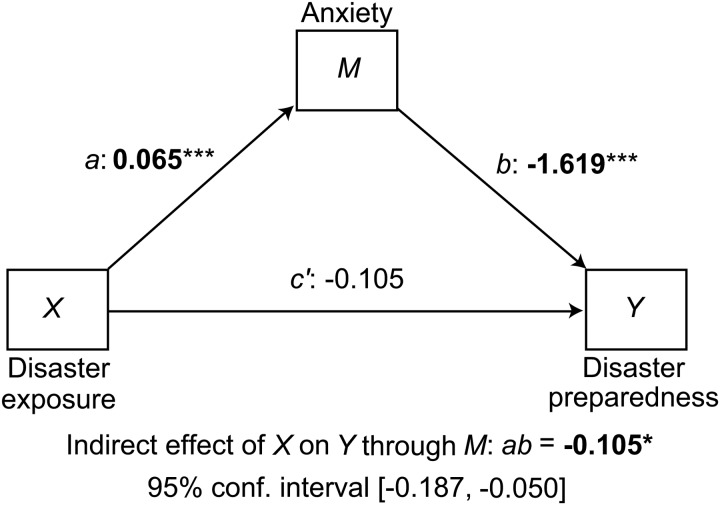
- Baseline analyses found that greater disaster exposure was associated with more mental health symptom severity, and the exposure–preparedness link was fully mediated by mental health symptoms; in intervention models, effects on preparedness were partly mediated by changes in depression, PTSD, anxiety, and effects on mental health were partly mediated by preparedness.
## Methods
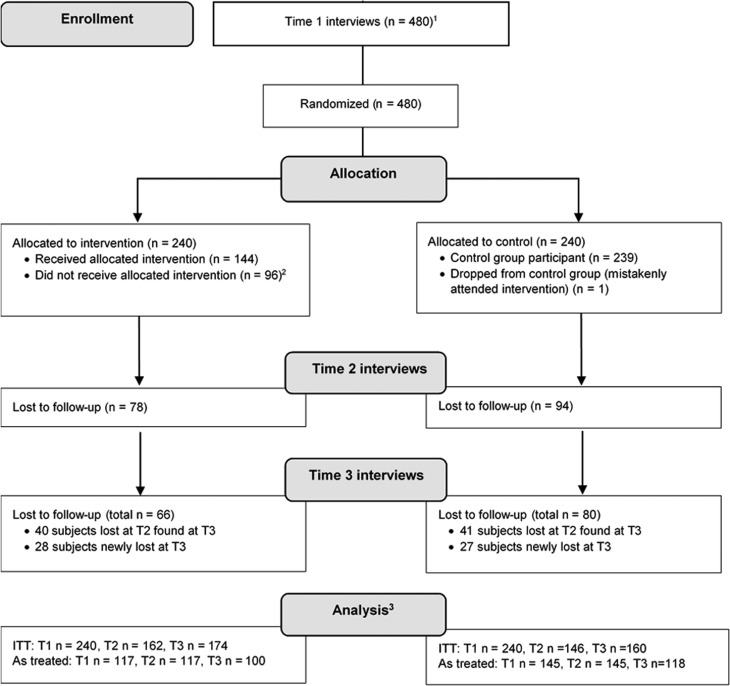
- Design: Randomized controlled trial with assessments at baseline (Time 1), 3–4 months post-intervention (Time 2), and 7–8 months post-intervention (Time 3); participants were assigned using a random number generator.
- Sample/data: 480 randomly selected community members from three disaster-affected communities in metropolitan Port-au-Prince, Haiti; 240 were randomized to the intervention, and 144 completed the intervention.
- Main analysis: The paper reports intention-to-treat analyses and mediation models testing whether disaster exposure, preparedness, mental health symptoms, and social cohesion were linked as hypothesized.
## Limitations
- The paper states that participant attrition was high, largely due to population transience and initial mistrust of service providers related to a history of low NGO follow-through.
- The paper states that interviewers were not blind to condition, because staff served as both interviewers and facilitators, creating potential for bias.
- The paper states that the study used a wait-list control group rather than comparisons to disaster preparedness as usual or mental health as usual models.
- Evident from the text: the intervention was tested only in three communities in metropolitan Port-au-Prince, so generalizability beyond this setting is not established in the paper.
Model-written summary. Check it against the paper before relying on it.
Integrity signals
Registry
Cites
Statistics
Figures
Verification
Claims the paper makes
0 Valid · 0 Not valid · 10 Not checked · 47 Own results and interpretations
A result the paper reports from its own data — it cites no other source for it, so there is none to check. The quote shows it is in the paper.
In the paper
“Disaster preparedness did not mediate the intervention's effect on functional impairment.”
§ Integrating mental health and disaster preparedness in intervention: a randomized controlled trial with earthquake and flood-affected communities in Haiti > Results > Mechanisms of intervention change
plain- Asserted: passes — The authors put it forward as true.
- Checkable: passes — It can be checked against evidence.
- Load-bearing: unclear — It is unclear whether the paper’s conclusions depend on it.
- Based: passes — The paper gives a reason why it holds.
A result the paper reports from its own data — it cites no other source for it, so there is none to check. The quote shows it is in the paper.
In the paper
“while mental health symptoms (depression, anxiety, PTSD full scale and avoidance sub-cluster of symptoms) and functional impairment significantly decreased (small to moderate effect sizes)”
§ Integrating mental health and disaster preparedness in intervention: a randomized controlled trial with earthquake and flood-affected communities in Haiti > Results > Intervention effects
plainstates a cause- Asserted: passes — The authors put it forward as true.
- Checkable: passes — It can be checked against evidence.
- Load-bearing: passes — The paper’s conclusions depend on it.
- Based: passes — The paper gives a reason why it holds.
A result the paper reports from its own data — it cites no other source for it, so there is none to check. The quote shows it is in the paper.
In the paper
“Disaster preparedness did not mediate a relationship between disaster exposure and mental health symptoms.”
§ Integrating mental health and disaster preparedness in intervention: a randomized controlled trial with earthquake and flood-affected communities in Haiti > Results > The role of disaster exposure
plain- Asserted: passes — The authors put it forward as true.
- Checkable: passes — It can be checked against evidence.
- Load-bearing: unclear — It is unclear whether the paper’s conclusions depend on it.
- Based: passes — The paper gives a reason why it holds.
A result the paper reports from its own data — it cites no other source for it, so there is none to check. The quote shows it is in the paper.
In the paper
“Disaster-related help-seeking bordered on significance at Time 3.”
§ Integrating mental health and disaster preparedness in intervention: a randomized controlled trial with earthquake and flood-affected communities in Haiti > Results > Intervention effects
hedged- Asserted: passes — The authors put it forward as true.
- Checkable: passes — It can be checked against evidence.
- Load-bearing: unclear — It is unclear whether the paper’s conclusions depend on it.
- Based: passes — The paper gives a reason why it holds.
A result the paper reports from its own data — it cites no other source for it, so there is none to check. The quote shows it is in the paper.
In the paper
“while mental health symptoms (depression, anxiety, PTSD full scale and avoidance sub-cluster of symptoms) and functional impairment significantly decreased (small to moderate effect sizes)”
§ Integrating mental health and disaster preparedness in intervention: a randomized controlled trial with earthquake and flood-affected communities in Haiti > Results > Intervention effects
plainstates a cause- Asserted: passes — The authors put it forward as true.
- Checkable: passes — It can be checked against evidence.
- Load-bearing: passes — The paper’s conclusions depend on it.
- Based: passes — The paper gives a reason why it holds.
36 more claims
Create a free account to see all 57 claims and to verify the 19 references still open.
- It may state two separate claims as one. 12
- Probably not a substantial claim. 6
Claims other papers make about this one
Each is checked against this paper’s own text: does it say what the citing paper says it does?
The source backs part of the claim, not all of it — or backs it for a different population, condition or comparison.
In the citing paper
“MHIDP intervention was evaluated in an RCT among N = 480 adults exposed to earthquakes and floods in Haiti [33].”
From Promoting Recovery from Disasters, Pandemics, and Trauma: A Systematic Review of Brief Psychological Interventions to Reduce Distress in Adults, Children, and Adolescents (2023) · cites this paper as [33]
Experimental — accuracy not yet measuredThe cited source says what the claim attributes to it.
In the citing paper
“Disaster preparedness behavior significantly increased among intervention participants”
The cited source says what the claim attributes to it.
In the citing paper
“A significant reduction in functional impairment was evident at 3–4-month follow-up but disappeared at 7–8-month follow-up.”
The cited source says what the claim attributes to it.
In the citing paper
“while depressive, anxiety, and PTSD symptoms significantly decreased at both follow-ups.”
The cited source says what the claim attributes to it.
In the citing paper
“We identified evidence for one psychosocial support program (MHIDP intervention) targeting survivors of natural hazards (i.e., earthquakes and floods) to improve depressive, anxiety, and PTSD symptoms at follow-up assessments [33].”
Citations
Cites
Neighborhoods and Violent Crime: A Multilevel Study of Collective Efficacy
Sampson, R. J., Raudenbush, S. W., & Earls, F. (1997) · Science · doi:10.1126/science.277.5328.918 · Cited by 11,999
60,000 Disaster Victims Speak: Part I. An Empirical Review of the Empirical Literature, 1981–2001
Norris, F. H., Friedman, M. J., Watson, P. J., Byrne, C. M., Diaz, E., & Kaniasty, K. (2002) · Psychiatry: Interpersonal and Biological Processes · doi:10.1521/psyc.65.3.207.20173 · Cited by 3,128
Intention-to-treat concept: A review
Gupta, S. (2011) · Perspectives in Clinical Research · doi:10.4103/2229-3485.83221 · Cited by 1,921
Psychometric Properties of the Life Events Checklist
Gray, M. J., Litz, B. T., Hsu, J. L., & Lombardo, T. W. (2004) · Assessment · doi:10.1177/1073191104269954 · Cited by 1,889
A Review of Risk Perceptions and Other Factors that Influence Flood Mitigation Behavior
Bubeck, P., Botzen, W. J. W., & Aerts, J. C. J. H. (2012) · Risk Analysis · doi:10.1111/j.1539-6924.2011.01783.x · Cited by 1,201
Mental Health Consequences of Disasters
Goldmann, E., & Galea, S. (2014) · Annual Review of Public Health · doi:10.1146/annurev-publhealth-032013-182435 · Cited by 1,082
Social Capital: A Missing Link to Disaster Recovery
Nakagawa, Y., & Shaw, R. (2004) · International Journal of Mass Emergencies & Disasters · doi:10.1177/028072700402200101 · Cited by 945 · cited 1×
“The strength of a community’s social networks and the extent to which it operates cohesively can affect the well-being of individual community members, as well as the ability of the entire community to address natural hazards through coordinated efforts (Nakagawa and Shaw, 2004; Rodriguez et al., 2006; Afifi et al., 2…”
BackgroundHogan, B. E., Linden, W., & Najarian, B. (2002) · Clinical Psychology Review · doi:10.1016/s0272-7358(01)00102-7 · Cited by 788
The Relationship Between Social Support and Subjective Well-Being Across Age
Siedlecki, K. L., Salthouse, T. A., Oishi, S., & Jeswani, S. (2014) · Social Indicators Research · doi:10.1007/s11205-013-0361-4 · Cited by 781
(1993) · Behavior Therapy · Cited by 409
Research works printed but not linked: 4
- World Health Organization (WHO), Pan American Health Organization (PAHO) (2010) Culture and Mental Health in Haiti: A Literature Review. Geneva: World Health Organization.
- James LE, Welton-Mitchell C and Khanal SN (2018) Mental health integrated disaster preparedness (MHIDP) in Nepal and Haiti. Mental Health Innovation Network. Available at http://www.mhinnovation.net/innovations/mental-health-integrated-disaster-preparedness-mhidp-nepal-and-haiti?qt-content_innovation=0#qt-content_innovation. PMC6142392 30223822
- World Health Organization (WHO), King's College (2011) The Humanitarian Emergency Settings Perceived Needs Scale (HESPER): Manual with Scale. Geneva: World Health Organization.
- Welton-Mitchell C and James L (2018) Evidence-based mental health integrated disaster preparedness in Nepal and Haiti. Special Edition of the Humanitarian Exchange on Mental Health and Psychosocial Support in Humanitarian Response. Guest editors: Wendy Fenton and Anne Harmer.
Cited by
Lu, H., Zhang, C., Jiao, L., Wei, Y., & Zhang, Y. (2022) · International Journal of Disaster Risk Reduction · doi:10.1016/j.ijdrr.2022.103167 · Cited by 135
Mental health and psychosocial interventions in the context of climate change: a scoping review
Xue, S., Massazza, A., Akhter‐Khan, S. C., Wray, B., Husain, M. I., & Lawrance, E. L. (2024) · npj Mental Health Research · doi:10.1038/s44184-024-00054-1 · Cited by 136
“The most comprehensive review to date identi fi ed 23 studies 13 , but did not differentiate between interventions implemented for a climate-related event and those for other settings (e.g., armed con fl icts) theoretically relevant to the climate change context.”
Papola, D., Purgato, M., Gastaldon, C., Bovo, C., van Ommeren, M., Barbui, C., & Tol, W. A. (2020) · Cochrane Database of Systematic Reviews · doi:10.1002/14651858.cd012417.pub2 · Cited by 85
“James 2020 delivered an experiential intervention named "Mental health integrated disaster preparedness", that included facilitated discussion, space for sharing personal experiences and exchange of peer-support, practising coping skills targeting disaster-related distress.”
BackgroundMethodResultInfluentialThe clinical implications of climate change for mental health
Crandon, T. J., Dey, C., Scott, J. G., Thomas, H. J., Ali, S., & Charlson, F. J. (2022) · Nature Human Behaviour · doi:10.1038/s41562-022-01477-6 · Cited by 88
Prevalence of Post-traumatic Stress Disorder After Flood: A Systematic Review and Meta-Analysis
Golitaleb, M., Mazaheri, E., Bonyadi, M., & Sahebi, A. (2022) · Frontiers in Psychiatry · doi:10.3389/fpsyt.2022.890671 · Cited by 118
The development of disaster preparedness education for public: a scoping review
Guo, L., Fang, M., Liu, L., Chong, H., Zeng, W., & Hu, X. (2025) · BMC Public Health · doi:10.1186/s12889-025-21664-0 · Cited by 98
Welton-Mitchell, C., James, L. E., Khanal, S. N., & James, A. S. (2018) · BMC Psychiatry · doi:10.1186/s12888-018-1863-z · Cited by 79
Self-citationStrategies for Delivering Mental Health Services in Response to Global Climate Change
Palinkas, L., O’Donnell, M., Lau, W., & Wong, M. (2020) · doi:10.20944/preprints202010.0150.v1 · Cited by 77
“On the other hand, using an RCT design, the group-based, Integrated Mental Health and Disaster Preparedness intervention was tested in three earthquake-exposed and flood-prone communities in Haiti and found to significantly increase peer-based help-giving and help-seeking, as well as reduce symptoms of PTSD, depressio…”
MethodTol, W. A., Ager, A., Bizouerne, C., Bryant, R. A., Chammay, R. E., Colebunders, R., Garcia‐Moreno, C., Hamdani, S. U., James, L. E., Jansen, S., et al. (2020) · Conflict and Health · doi:10.1186/s13031-020-00317-6 · Cited by 81
Self-citationSystematic review on the current state of disaster preparation Simulation Exercises (SimEx)
Mahdi, S. S., Jafri, H. A., Allana, R., Battineni, G., Khawaja, M., Sakina, S., Agha, D., Rehman, K., & Amenta, F. (2023) · BMC Emergency Medicine · doi:10.1186/s12873-023-00824-8 · Cited by 63
“simulation exercises [13, 25, 30, 31], computer-based simulation exercise [32], and operational-based functional exercises [33–36].”
BackgroundDisaster Preparedness Among Nurses in China: A Cross-Sectional Study
Wang, Y., Liu, Y., Mingfeng, Y. U., Wang, H., Peng, C., ZHANG, P., Xinying, N. I. A. N., Jia, Q., & Changyan, L. I. (2022) · Journal of Nursing Research · doi:10.1097/jnr.0000000000000537 · Cited by 64
Said, N. B., Molassiotis, A., & Chiang, C. L. V. (2022) · International Nursing Review · doi:10.1111/inr.12749 · Cited by 51
“The literature further reports that the presence of PTSD could negatively influence the preparedness of nurses for future disasters (James et al., 2020; WeltonMitchell et al., 2018), possibly leading to increased mental health problems.”
BackgroundGray, B., Hanna, F., & Reifels, L. (2020) · International Journal of Environmental Research and Public Health · doi:10.3390/ijerph17061900 · Cited by 62
Lotzin, A., Franc de Pommereau, A., & Laskowsky, I. (2023) · International Journal of Environmental Research and Public Health · doi:10.3390/ijerph20075339 · Cited by 36
“(2020) [33] Mental Health Integrated Disaster Preparedness (MHIDP) Intervention [33]: Community-based mental health intervention Topics: establishing safety and practicing coping skills targeting disaster-related distress, providing space for sharing personal experiences, and giving hands-on training in disaster prepa…”
BackgroundMethodInfluentialNoor, M. T. M., Shahar, H. K., Baharudin, M. R., Ismail, S. N. S., Manaf, R. A., Said, S. M., Ahmad, J., & Muthiah, S. G. (2022) · PLoS ONE · doi:10.1371/journal.pone.0271258 · Cited by 42
“According to the literature review, many interventions utilizing HBM effectively improved community members’ flood disaster preparedness [8, 17, 18, 23].”
BackgroundEffect of education based on the health belief model on earthquake preparedness in women
Amini, R., Biglari, F., Khodaveisi, M., & Tapak, L. (2020) · International Journal of Disaster Risk Reduction · doi:10.1016/j.ijdrr.2020.101954 · Cited by 39
Amberson, T., Heagele, T. N., Wyte‐Lake, T., Couig, M. P., Bell, S. A., Mammen, M. J., Wells, V., & Castner, J. (2024) · Frontiers in Public Health · doi:10.3389/fpubh.2023.1257714 · Cited by 41
Thombs, B. D., Kwakkenbos, L., Carrier, M., Bourgeault, A., Tao, L., Harb, S. I., Gagarine, M., Rice, D. B., Bustamante, L., Ellis, K. M., et al. (2020) · Journal of Psychosomatic Research · doi:10.1016/j.jpsychores.2020.110132 · Cited by 34
“0 score (SMD = 0.23 to 0.34 SMD) [65–68].”
InfluentialPurgato, M., Prina, E., Ceccarelli, C., Cadorin, C., Abdulmalik, J. O., Amaddeo, F., Arcari, L., Churchill, R., Jordans, M. J., Lund, C., et al. (2023) · Cochrane Database of Systematic Reviews · doi:10.1002/14651858.cd014722.pub2 · Cited by 27
Sripad, P., Casseus, A., Kennedy, S., Isaac, B., Vissières, K., Warren, C., & Ternier, R. (2021) · Journal of Global Health · doi:10.7189/jogh.11.07004 · Cited by 29
Flores, E. C., Brown, L. J., Kakuma, R., Eaton, J., & Dangour, A. D. (2023) · Environmental Research Letters · doi:10.1088/1748-9326/ad153f · Cited by 31
“%) investigated extreme weather events such as floods and storms [54, 63–65], three (20”
BackgroundMethodInfluentialNdlovu, J. N., Lind, J., Patlán, A. B., Upadhaya, N., Leku, M. R., Akellot, J., Skovdal, M., Augustinavicius, J., & Tol, W. A. (2024) · BMC Health Services Research · doi:10.1186/s12913-024-11704-7 · Cited by 35
“One study, conducted in Nepal [33], based their adapted intervention on a model initially developed for earthquake survivors in Haiti with promotion, prevention and treatment characteristics [35].”
InfluentialMustadi, A., & Atmojo, S. E. (2020) · İlköğretim Online · doi:10.17051/ilkonline.2020.693118 · Cited by 25
“These things are expected to improve the ability of schools in disaster prone areas to anticipate earthquake events that can occur at any time (Klein et al. 2019; James et al., 2019; Anafiah & Arief, 2018; Atmojo et al., 2018; Amri et al., 2016; Hong et al., 2015).”
BackgroundGreene, M. C., Scognamiglio, T., Likindikoki, S. L., Misinzo, L., Njau, T., Bonz, A. G., Ventevogel, P., Mbwambo, J. K. K., & Tol, W. A. (2022) · Global Public Health · doi:10.1080/17441692.2022.2029926 · Cited by 22
“Actors in various humanitarian sectors have recognized the need for multi-sectoral, integrated interventions (James et al., 2020; Logie et al., 2019; Rubenstein et al., 2020; Timshel et al., 2017; Tol et al., 2020; Welton-Mitchell et al., 2018).”
BackgroundJames, L. E., Welton‐Mitchell, C., Michael, S., Santoadi, F., Shakirah, S., Hussin, H., Anwar, M., Kilzar, L., & James, A. S. (2021) · International Journal of Environmental Research and Public Health · doi:10.3390/ijerph182111674 · Cited by 23
“Clusters were then randomized (using a random number generator in Excel, conducted by the PIs) into poster and control (no poster) conditions.”
BackgroundMethodSelf-citationDevelopment of a disaster preparedness training program for community leaders: Evidence from Taiwan
Tang, J., Chang, H., & Feng, J. (2024) · International Journal of Disaster Risk Reduction · doi:10.1016/j.ijdrr.2024.104517 · Cited by 31
Papola, D., Prina, E., Ceccarelli, C., Cadorin, C., Gastaldon, C., Ferreira, M. C., Tol, W. A., van Ommeren, M., Barbui, C., & Purgato, M. (2024) · Cochrane Database of Systematic Reviews · doi:10.1002/14651858.cd014300.pub2 · Cited by 23
Stress, Anxiety, and Depression for Chinese Residents in Japan during the COVID-19 Pandemic
Hu, Q., & Umeda, M. (2021) · International Journal of Environmental Research and Public Health · doi:10.3390/ijerph18094958 · Cited by 20
“It reduces the negative impact of disasters and prevents related mental health consequences [27,28].”
BackgroundLearning interventions and training methods in health emergencies: A scoping review
Utunen, H., Balaciano, G., Arabi, E., Tokar, A., Bhatiasevi, A., & Noyes, J. (2024) · PLoS ONE · doi:10.1371/journal.pone.0290208 · Cited by 20
Peng, M., Xiao, T., Carter, B., Chen, P., & Shearer, J. (2022) · International Journal of Environmental Research and Public Health · doi:10.3390/ijerph192315847 · Cited by 16
“(James, 2020) [46] Haiti Earthquake; hurricanes, flooding, and landslides Study design: Randomised control trial.”
BackgroundInfluentialDomingo, A., Little, M., Beggs, B., Brubacher, L. J., Lau, L. L., & Dodd, W. (2024) · Public Health · doi:10.1016/j.puhe.2024.07.023 · Cited by 20
Extreme Weather, Vulnerable Populations, and Mental Health: The Timely Role of AI Interventions
Batra, M., & Erbas, B. (2025) · International Journal of Environmental Research and Public Health · doi:10.3390/ijerph22040602 · Cited by 19
Development of the disaster anxiety scale and exploring its psychometric properties
Güzel, A. (2022) · Archives of Psychiatric Nursing · doi:10.1016/j.apnu.2022.07.028 · Cited by 14
Supporting Children’s Mental Health Needs in Disasters
Hoffmann, J. A., Pergjika, A., Burkhart, K. M., Gable, C. J., Foster, A. A., Saidinejad, M., Covington, T., Edemba, D., Mullins, S., Schreiber, M. D., et al. (2024) · PEDIATRICS · doi:10.1542/peds.2024-068076 · Cited by 14
Peng, M., Xiao, T., Carter, B., & Shearer, J. (2024) · BMJ Open · doi:10.1136/bmjopen-2023-078750 · Cited by 22
Niu, Y., Jiang, X., Ashong, Z., Hou, J., Bai, Y., Bai, G., Xu, J., Ren, W., & Geng, G. (2021) · International Journal of Disaster Risk Reduction · doi:10.1016/j.ijdrr.2021.102190 · Cited by 11
Devonald, M., Vintges, J., & Jones, N. (2022) · Intervention · doi:10.4103/intv.intv_31_21 · Cited by 13
Pike, C. E., Dohnt, H. C., Tully, P. J., Bartik, W. J., Welton‐Mitchell, C., Murray, C., Rice, K., Cosh, S., & Lykins, A. D. (2024) · JMIR Research Protocols · doi:10.2196/53454 · Cited by 18
“It is preferable for local community leaders to collaborate with community members in developing local preparedness plans and related initiatives, collectively investing in resilience building [25].”
BackgroundInfluentialSelf-citationWelton‐Mitchell, C., Dally, M. J., Dickinson, K. L., Neuberger, L., Roberts, J. D., & Blanch‐Hartigan, D. (2023) · BMC Psychology · doi:10.1186/s40359-023-01241-z · Cited by 10
Self-citationKhaira, N., Faisal, T. I., Magfirah, M., Veri, N., Usrina, N., & Rias, Y. A. (2024) · Creative Nursing · doi:10.1177/10784535241245436 · Cited by 12
“Time effects and differences between groups at 4 weeks and 8 weeks are compared with the baseline. enhancing the preparedness of community members for disasters (James et al., 2020).”
BackgroundDisaster Preparedness Education among Community: What is effective? An Integrative Literature Review
Permana, I., Said, F. M., Umar, N. S., & Budhiana, J. (2022) · Open Access Macedonian Journal of Medical Sciences · doi:10.3889/oamjms.2022.8373 · Cited by 12
“Two studies investigated the effects of combining mental health and disaster preparedness interventions [29], [33].”
BackgroundYoung people's experiences of the Northern Rivers 2017 flood and its effects on their mental health
Luk, M., & Longman, J. M. (2024) · Australian Journal of Rural Health · doi:10.1111/ajr.13095 · Cited by 11
Children and their experiences about seasonal flood disasters in Indonesia : qualitative study
Niman, S., Mustikasari, M., Daulima, N. H. C., Gayatri, D., & Rothhaar, T. W. (2023) · Vulnerable Children and Youth Studies · doi:10.1080/17450128.2023.2277169 · Cited by 14
“Disasters can affect mental health due to exposure to potentially traumatic events and ongoing stressors for those with limited resources to support recovery (James et al., 2020; Norris et al., 2002; World Health Organization WHO, Pan American Health Organization PAHO, 2010).”
BackgroundBorah, G., & Saikia, N. (2025) · Journal of Biosocial Science · doi:10.1017/s0021932025000136 · Cited by 10
“New evidence suggests that individuals ’ mental health impacts their ability to prepare for upcoming calamities (James et al., 2020).”
Liu, H., Guo, C., & Han, Z. (2023) · Journal of Homeland Security and Emergency Management · doi:10.1515/jhsem-2023-0002 · Cited by 9
Çınaroğlu, M. (2025) · Frontiers in Psychology · doi:10.3389/fpsyg.2025.1696103 · Cited by 7
On pandemics and pivots: a COVID-19 reflection on envisioning the future of medical education
Han, H., Clithero-Eridon, A. R., Costa, M. J., Dennis, C. A., Dorsey, J. K., Ghias, K. K., Hopkins, E., Jabeen, K., Klamen, D. L., de Matos, S. M. S., et al. (2021) · Korean journal of medical education · doi:10.3946/kjme.2021.207 · Cited by 7
“constantly underscored by the United Nations and humanitarian organizations [18].”
BackgroundMaulana, I., Febrianti, S., & Nugraha, B. A. (2023) · Malahayati Nursing Journal · doi:10.33024/mnj.v5i3.8019 · Cited by 6
Varker, T., Fredrickson, J., Agathos, J. A., Howlett, P., Howard, A., & O'Donnell, M. L. (2025) · Journal of Traumatic Stress · doi:10.1002/jts.23127 · Cited by 9
Shalahuddin, I., Maulana, I., Pebrianti, S., & Eriyani, T. (2022) · HOLISTIK JURNAL KESEHATAN · doi:10.33024/hjk.v16i2.2079 · Cited by 5
Noor, M. T. M., Shahar, H. K., Baharudin, M. R., Ismail, S. N. S., Manaf, R. A., Said, S. M., Ahmad, J., & Muthiah, S. G. (2022) · Pertanika journal of science & technology · doi:10.47836/pjst.31.1.10 · Cited by 5
Galvin, M., Michel, G., Saintelmond, H.-C., LESOROGOL, C. K., Trani, J., & Iannotti, L. L. (2023) · International Journal of Mental Health Promotion · doi:10.32604/ijmhp.2023.018800 · Cited by 5
Ernyasih, E., Fajrini, F., Herdiansyah, D., Aulia, L., Andriyani, A., Lusida, N., Fauziah, M., & Dihartawan, D. (2023) · ENVIRONMENTAL OCCUPATIONAL HEALTH AND SAFETY JOURNAL · doi:10.24853/eohjs.3.2.95-102 · Cited by 10
Erkan, F. M., & Budak, F. K. (2024) · Current Psychology · doi:10.1007/s12144-024-06522-3 · Cited by 5
“– Descriptive Characteristics Form : This form was prepared by the researchers upon the literature review (Kurt & Gülbahçe, 2019; James et al., 2020 ; Taşcı & Özsoy, 2021).”
MacPherson‐Krutsky, C., Brand, B. D., & Lindell, M. K. (2025) · Risk Analysis · doi:10.1111/risa.17712 · Cited by 5
Ameruddin, N. F. L., Berezina, E. B., & Yap, C. C. (2025) · F1000Research · doi:10.12688/f1000research.160231.1 · Cited by 5
Akpan, U. U., Ja’afar, I. K., & Eke, S. C. (2025) · Cambridge Prisms Global Mental Health · doi:10.1017/gmh.2024.77 · Cited by 9
“Additionally, an integrated approach to mental health and disaster preparedness, focusing on community participation and social support, has been linked to improved mental health outcomes in adults, which can also have the same impact on young people (James et al., 2020).”
Study Mitigation Disaster for Early Childhood in Indonesia: A Systematic Literature Review
Utama, W. W. I., Rahayu, W., & Hapidin (2024) · Evolutionary Studies in Imaginative Culture · doi:10.70082/esiculture.vi.725 · Cited by 4
“Studies conducted in East Nusa Tenggara and Bali have shown that these approaches not only increase awareness and preparedness but also foster a sense of community and solidarity in the face of disasters(James et al., 2019; Levac et al., 2012; Pike et al., 2024; Tang & Feng, 2018).”
BackgroundNjala, J., Balakasi, K. T., Phiri, K., Chimbaka, H., Makwaya, A., Smith, D., Songo, J., Mphande, M., Njikho, L., Chinkonde, J. R., et al. (2025) · PLOS Global Public Health · doi:10.1371/journal.pgph.0005204 · Cited by 3
“Other common mental health problems after flooding are anxiety and post-traumatic stress disorder [36], which we did not screen for.”
Muksalmina, M., Syahyana, A., Hidayatullah, F., Asyukri, T., Novita, N., & Ringga, E. S. (2025) · Indatu Journal of Management and Accounting · doi:10.60084/ijma.v3i2.371 · Cited by 4
Imtiaz, S., Khaleeq, N., Sanauddin, N., Afaq, S., Jennings, H. M., Tahir, A., Abdeali, M., Khan, Z., Khan, F., Zafar, R., et al. (2026) · Global Health Action · doi:10.1080/16549716.2025.2599011 · Cited by 6
“The majority of interventions focused on mental health issues, particularly depression and anxiety, while also incorporating intersectoral approaches such as social cohesion ( n = 01; [50]), disaster preparedness ( n = 02; [40,41]) and maternal health ( n = 02; [31,43]).”
InfluentialWambua, G. N., Corvetto, J. F., Wekesah, F. M., Bunker, A., Mthiyane, N., Muanido, A., Cumbe, V., Omondi, E., Hunt, X., & Iwuji, C. C. (2026) · Climate Risk Management · doi:10.1016/j.crm.2026.100797 · Cited by 4
“Compared to nonprogram participants, participants showed significantly fewer symptoms of depression, anxiety, and PTSD, greater intention to provide mental health–related help, and still exhibited a trend in an increase in social cohesion (James et al., 2020).”
Pike, C. E., Lykins, A. D., Bartik, W. J., Tully, P. J., & Cosh, S. (2024) · Climate · doi:10.3390/cli12050057 · Cited by 5
Yudanagara, B. B. H., Surjaningrum, E. R., Chusairi, A., Dewabrata, L. M., Wiguna, P. V., Annisa, N. S. N., & Putri, A. A. (2025) · IOP Conference Series Earth and Environmental Science · doi:10.1088/1755-1315/1479/1/012024 · Cited by 3
“At the individual level, one-third to half of the population exposed to a disaster event may experience temporary distress (7).”
Romanelli, M., Taddeo, F., Turchi, G. P., & Iudici, A. (2025) · Frontiers in Psychology · doi:10.3389/fpsyg.2025.1597897 · Cited by 5
Labaria, E. C., Acosta, A. C., & Gotangco, C. K. (2020) · Community, environment and disaster risk management · doi:10.1108/s2040-726220200000021004 · Cited by 4
Addressing risks to mental health from climate change: a policy capacity analysis of England
Turnpenny, J. R., & Alexander, M. (2024) · Climate Policy · doi:10.1080/14693062.2024.2362848 · Cited by 5
Mental Health Integrated Emergency Preparedness for the Public School Workforce
Welton‐Mitchell, C., Schwatka, N. V., Dally, M. J., Levine, S. D., & Lopez, I. (2025) · Journal of School Violence · doi:10.1080/15388220.2025.2478060 · Cited by 3
“Secondary data analysis was conducted to investigate additional potential outcomes: anxiety, PTSD, and depression, using the same full model.”
InfluentialSelf-citationEmergency Preparedness Among Community-Dwelling Older Adults: Risk and Protective Factors
Thompson, A. R., Little, K. G., & Kim, Y. K. (2024) · Activities Adaptation & Aging · doi:10.1080/01924788.2024.2336748 · Cited by 3
“Mental health plays an essential role in emergency preparedness, as it allows individuals to decipher risks, evaluate potential actions, and make decisions based on available information (James et al., 2020; Roudini et al., 2017).”
InfluentialDoherty, T. J., & Lykins, A. D. (2024) · Oxford University Press eBooks · doi:10.1093/oso/9780197683293.003.0009 · Cited by 4
Özmete, E., & Pak, M. (2024) · Journal of Social Service Research · doi:10.1080/01488376.2024.2394540 · Cited by 2
“A community-based mental health-integrated disaster preparedness intervention created in an area vulnerable to natural disasters is effective in improving mental health among community members and improving preparedness (James et al.,2020).”
Mishu, M. P., Rabbani, M. M. G., Vereeken, S., Tkach, E., Martin-Kerry, J., Chowdhury, T. F., Wahab, A., Mashreky, S. R., Huque, R., & Friend, R. (2025) · International Journal of Environmental Health Research · doi:10.1080/09603123.2025.2568035 · Cited by 2
“2022). e ) Community-based integrated mental health and disaster preparedness intervention (James et al. 2019).”
Ali, B., Ghur, A., Khan, A., Sharif, J., Siraj, S., Fatima, M., Farid, Z., Ali, N., Khan, M., & Turab, A. (2025) · BJPsych International · doi:10.1192/bji.2025.10061 · Cited by 2
A Literature Review on the Role of Paraprofessionals in Delivering Brief Psychological Interventions
Lubin, E. J., Xie, A., Chang, M., & Kim, Y. (2025) · Administration and Policy in Mental Health and Mental Health Services Research · doi:10.1007/s10488-025-01482-7 · Cited by 3
“As seen in Table 1, the majority of interventions were grounded in a cognitive-behavioral framework ( n = 31; 63.3%). cohesion (James et al., 2020 ; Lucksted et al., 2009), communication or listening skills (Nozawa et al., 2019), and disaster preparedness (James et al., 2020).”
InfluentialHusaini, D. C., Garbutt, C., Marroquin, D., & Chiroma, J. H. (2026) · Environmental Health Insights · doi:10.1177/11786302261432487 · Cited by 3
Kim, S., Palócz, E., Park, J., & Kang, S. (2026) · Cambridge Prisms Global Mental Health · doi:10.1017/gmh.2026.10249 · Cited by 3
Natural Disaster Epidemiology and Reproductive Health
Harville, E. W., & Northland, B. (2023) · Current Epidemiology Reports · doi:10.1007/s40471-023-00329-9 · Cited by 4
“Participation in the intervention was effective in increasing disaster preparedness behaviors, decreasing symptoms of depression, PTSD, anxiety, functional impairment, and increasing perceived social cohesion among participants [107].”
BackgroundCan health system be resilient in a Failed State? Lessons from a scoping review in Haiti
Louis, P. S., Wautié, A., Makali, S. L., Radix, C., & Paul, É. (2025) · Discover Health Systems · doi:10.1007/s44250-025-00262-2 · Cited by 4
Massazza, A., Eaton, J., Elshazly, M., Charlson, F., & Augustinavicius, J. (2022) · Intervention · doi:10.4103/intv.intv_30_21 · Cited by 4
Gambaran Tingkat Kecemasan Remaja Sekolah Menengah Pertama yang Tinggal di Daerah Rawan Banjir
Niman, S., Tania, H., & Wijaya, Y. M. (2022) · Bulletin of Counseling and Psychotherapy · doi:10.51214/bocp.v4i2.199 · Cited by 2
Imazu, Y., Kondo, A., Ushikubo, M., Kanbara, S., Kawahara, N., & Kondo, M. (2024) · Japan Journal of Nursing Science · doi:10.1111/jjns.12608 · Cited by 1
Navigating Group Leadership Dilemmas in Times of Mass Trauma
Kaye‐Tzadok, A., & Icekson, T. (2025) · Small Group Research · doi:10.1177/10464964251395052 · Cited by 1
“These groups, by virtue of their availability, familiarity, cohesion, and embedded trust, provide a context in which individuals can engage in supportive processes (B. Pfefferbaum et al., 2012; James et al., 2020; Kaniasty, 2012).”
sakawuna, W. A., Setiawan, B. I., & Perdinan, P. (2025) · Agromet · doi:10.29244/j.agromet.39.1.56-66 · Cited by 1
Rabbani, F., Siddiqui, A., Umer, A., & Merali, Z. (2026) · Geopsychiatry · doi:10.1016/j.geopsy.2026.100053 · Cited by 1
Borbor-Cordova, M. J., Searles, M. P., Roa-López, H., Cornejo-Rodriguez, M. D. P., Castillo, K., Orellana‐Manzano, A., & Campagna, C. D. (2026) · PLoS ONE · doi:10.1371/journal.pone.0343239 · Cited by 2
Climate change and social health
Bower, M., Filia, K., Lawrance, E. L., Card, K. G., Teesson, L., Smout, S., Gao, C., Naderpajouh, N., Donohoe‐Bales, A., Lagi, R., et al. (2026) · Nature Human Behaviour · doi:10.1038/s41562-026-02455-y · Cited by 2
“A randomized controlled trial showed that disaster preparedness improved post-disaster mental health, and both were positively associated with social cohesion 82 .”
Disaster Risk Management: A Resilient Health System
Harris, M., & Charnley, G. E. C. (2022) · Springer eBooks · doi:10.1007/978-3-030-72196-1_7 · Cited by 3
Sezgin, M., & Karagülmez, K. (2025) · Journal of Public Health · doi:10.1093/pubmed/fdaf102 · Cited by 1
Noor, M. T. M., Shahar, H. K., Baharudin, M. R., Ismail, S. N. S., Manaf, R. A., Said, S. M., Muthiah, S. G., & Ahmad, J. (2021) · JMIR Formative Research · doi:10.2196/31719
Disaster preparedness among nurses in India: A cross-sectional study
Arul Valan, P. (2023) · International Journal of Advance Research in Medical Surgical Nursing · doi:10.33545/surgicalnursing.2023.v5.i1a.110
Managing Psychological Consequences in Disaster Populations
West, J. C., Morganstein, J. C., Benedek, D. M., & Ursano, R. J. (2023) · Springer eBooks · doi:10.1007/978-3-030-42825-9_126-1 · Cited by 1
The lived experiences of mental health clinicians at a public psychiatric hospital in Haiti
Doricent, G. (2023) · Digital Repository Service (Northeastern University) · doi:10.17760/d20537512 · Cited by 1
Mental Health and Psychosocial Support (MHPSS) in the Context of the Climate and Ecological Crisis
Massazza, A., Nemiro, A., Hijazi, Z., Snider, L., Graef, V., Hill, K. X., & Augustinavicius, J. (2024) · Springer eBooks · doi:10.1007/978-3-031-56736-0_14
Managing Psychological Consequences in Disaster Populations
West, J. C., Morganstein, J. C., Benedek, D. M., & Ursano, R. J. (2024) · Springer eBooks · doi:10.1007/978-3-030-51366-5_126
Mavruk, C. (2025) · Yönetim ve Ekonomi Araştırmaları Dergisi · doi:10.11611/yead.1575134 · Cited by 1
Ndlovu, J. N., Andersen, L. S., Leku, M. R., Upadhaya, N., Skovdal, M., Augustinavicius, J., & Tol, W. A. (2025) · PLOS mental health. · doi:10.1371/journal.pmen.0000079
“There are also other studies that have successfully integrated MHPSS interventions with interventions from other sectors [47–49].”
Climate Change and Suicidal Behaviour
Kabir, R., Syed, H. Z., & Vinnakota, D. (2025) · Springer eBooks · doi:10.1007/978-981-96-4028-7_3
Alper, H., Gargano, L. M., Hamwey, M. K., Leon, L. F., & Friedman, L. (2025) · International Journal of Environmental Research and Public Health · doi:10.3390/ijerph22071082
“Similarly, other studies employing face-to-face education or group-based training reported preparedness gains of 30–44% over controls [10,12].”
Akbolat, M., Durmuş, A., & Cebeci, A. (2025) · Afet ve Risk Dergisi · doi:10.35341/afet.1420534 · Cited by 1
Post-Flood Intervention Management: A Conceptual Research
Abubakar, S. A., & Shafii, H. B. (2025) · International Journal of Academic Research in Business and Social Sciences · doi:10.6007/ijarbss/v15-i8/26394
Metadata
- Authors
- James, L. E., Welton-Mitchell, C., Noel, J. R., & James, A. S.
- Affiliations
- University of Colorado Boulder (US)
- Corresponding author
- James, Leah Emily
- ORCID
- James, Leah Emily
- Venue
- Psychological Medicine
- Publisher
- Cambridge University Press (CUP)
- Published
- 2019-02-14
- Volume
- 50
- Issue
- 2
- Pages
- 342-352
- ISSN
- 0033-2917 (ISSN-L)
- 1469-8978
- PMC
- PMC7083573
- OpenAlex
- W2912742907
- Cited by
- 115
- References
- 46
- Citations by year
- 2026: 19 · 2025: 28 · 2024: 23 · 2023: 14 · 2022: 16 · 2021: 6 · 2020: 8
- FWCI
- 15.07
- Type
- journal article
- Language
- en
- Open access
- hybrid
- doi.org
- Locations
- Psychological Medicine (publishedVersion, cc-by)
- PubMed Central (publishedVersion, cc-by)
- PubMed (publishedVersion)
- Funders
- Wellcome Trust
- Topics
- Social Sciences › Sociology and Political Science › Disaster Management and Resilience
- Social Sciences › Psychology › Clinical Psychology › Posttraumatic Stress Disorder Research
- Health Sciences › Health Professions › Emergency Medical Services › Disaster Response and Management
- Keywords
- disaster preparedness, mental health, integrated intervention, earthquakes, floods, post-traumatic stress disorder, depression, anxiety, community-based intervention, culturally tailored interventions, peer support, help-seeking, community cohesion, disaster risk reduction, Haiti
- MeSH terms
- Natural Disasters, Adolescent, Adult, Aged, Mental Disorders, Civil Defense, Female, Haiti, Humans, Male, Mental Health, Middle Aged, Surveys and Questionnaires, Young Adult, Earthquakes, Floods
About these checks
Registry, retraction, Cites and statistics results are computed, not judged, with one exception: a printed reference that no index lists is read once by a model before it counts as a citation error. Claims are extracted by a model and kept only when their quote appears verbatim in the text; each cited source is then checked, with a model’s help, for whether it says what the claim relies on. Those verdicts can be wrong — read the claim’s quote and the cited source before relying on one.
A language model drew the claims from the paper on 2026-10-11, under version 3 of the claim definition (model deepseek-v4.1-flash, prompt extract-v3).
A second model labelled each claim on 2026-10-11 (model jev-1.13-20260917, definition revision gold-guideline-v0.2).
Statistics and arithmetic are recomputed, not judged.
Confidence bands are shown only for fields calibrated on our annotated test set. None is calibrated yet, so no band is shown.
What counts as a claim ›How we measure confidence ›How we check this ›
Are you an author, or do you see a problem with this page? Request a review
Data sources
Bibliographic data: Semantic Scholar, OpenAlex, Crossref.
Contains information from the Semantic Scholar Academic Graph Datasets, made available under the ODC Attribution License (ODC-BY 1.0).
Semantic Scholar’s data is described in: Kinney, R., et al. (2023). The Semantic Scholar Open Data Platform. arXiv:2301.10140.
