

The DOI matches its Crossref record; 101 of the 101 references it cites were found in a registry or an index.
Two decades of digital interventions for anxiety disorders: a systematic review and meta-analysis of treatment effectiveness
Open accessAbstract
Abstract Background Digital interventions for anxiety disorders are a promising solution to address barriers to evidence-based treatment access. Precise and powerful estimates of digital intervention effectiveness for anxiety disorders are necessary for further adoption in practice. The present systematic review and meta-analysis examined the effectiveness of digital interventions across all anxiety disorders and specific to each disorder v. wait-list and care-as-usual controls. Methods A systematic search of bibliographic databases identified 15 030 abstracts from inception to 1 January 2020. Forty-seven randomized controlled trials (53 comparisons; 4958 participants) contributed to the meta-analysis. Subgroup analyses were conducted by an anxiety disorder, risk of bias, treatment support, recruitment, location and treatment adherence. Results A large, pooled effect size of g = 0.80 [95% Confidence Interval: 0.68–0.93] was found in favor of digital interventions. Moderate to large pooled effect sizes favoring digital interventions were found for generalized anxiety disorder ( g = 0.62), mixed anxiety samples ( g = 0.68), panic disorder with or without agoraphobia ( g = 1.08) and social anxiety disorder ( g = 0.76) subgroups. No subgroups were significantly different or related to the pooled effect size. Notably, the effects of guided interventions ( g = 0.84) and unguided interventions ( g = 0.64) were not significantly different. Supplemental analysis comparing digital and face-to-face interventions (9 comparisons; 683 participants) found no significant difference in effect [ g = 0.14 favoring digital interventions; Confidence Interval: −0.01 to 0.30]. Conclusion The precise and powerful estimates found further justify the application of digital interventions for anxiety disorders in place of wait-list or usual care.
Overview
The claims and statistics of this paper haven’t been checked yet.
Run the check — free, no account needed. It reads the open-access text and checks the sources it cites.
Integrity signals
Registry
Cites
Statistics
Figures
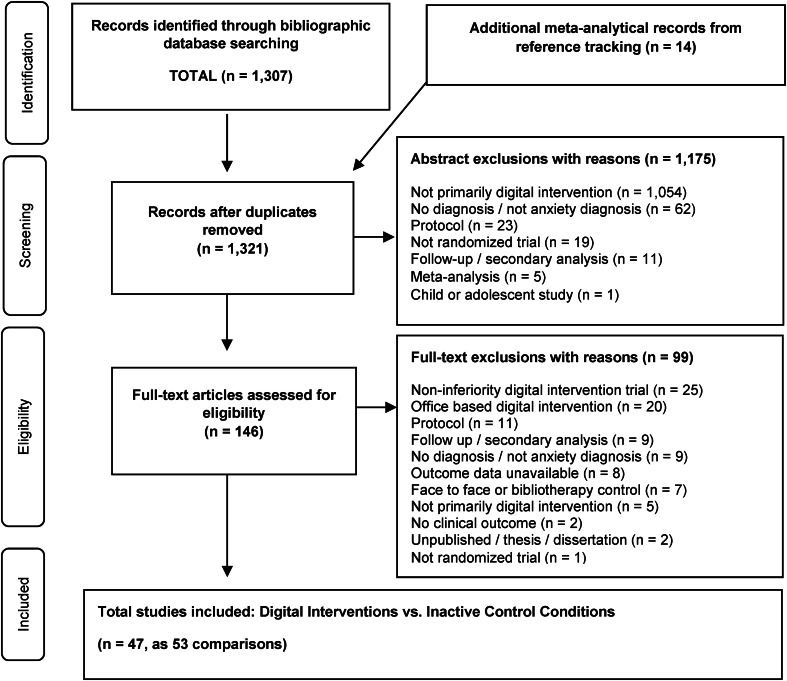
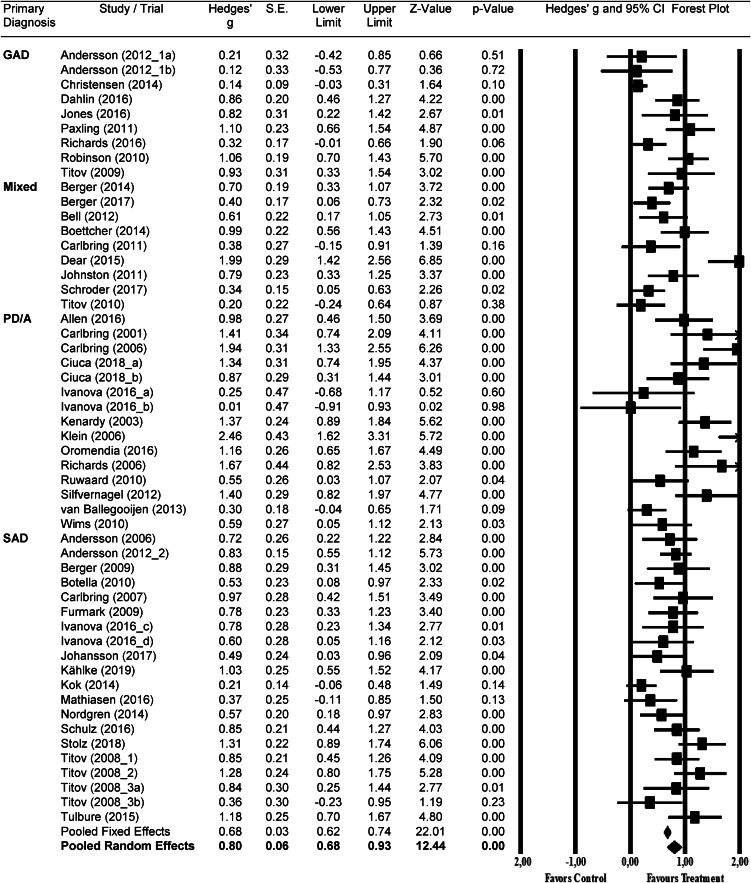
Verification
Claims the paper makes
The claims and statistics of this paper haven’t been checked yet.
Run the check — free, no account needed. It reads the open-access text and checks the sources it cites.
Claims other papers make about this one
Each is checked against this paper’s own text: does it say what the citing paper says it does?
The source backs part of the claim, not all of it — or backs it for a different population, condition or comparison.
In the citing paper
“Evidence suggests that internet-based treatments are effective for the treatment of anxiety disorders and depression [35,36].”
From Evaluation and Future Challenges in a Self-Guided Web-Based Intervention With and Without Chat Support for Depression and Anxiety Symptoms During the COVID-19 Pandemic: Randomized Controlled Trial (2024) · cites this paper as [36]
Experimental — accuracy not yet measuredThe cited source says what the claim attributes to it.
In the citing paper
“Several meta-analyses [16] show that self-guided and guided DMHIs, particularly internet CBT-based programs, significantly improve symptoms of depression (83 studies; Hedge g=0.52, 95% CI 0.43‐0.60 [15]) and anxiety (47 studies, Hedge g=0.80, 95% CI 0.68‐0.93) [18].”
In the citing paper
“For anxiety, a recent meta-analysis [16] reported that compared to inactive controls, guided and self-guided DMHIs significantly reduced anxiety symptoms across 47 studies, with a large pooled effect size (Hedges g=0.80; 95% CI 0.68-0.93).”
In the citing paper
“Digital mental health interventions (DMHIs) are effective in reducing symptoms of depression and anxiety.”
Self-check
Percentages, sums and reported differences re-computed from the paper’s own numbers.
The self-check needs the paper’s full text.
Citations
Cites
Bias in meta-analysis detected by a simple, graphical test
Egger, M., Smith, G. D., Schneider, M., & Minder, C. (1997) · BMJ · doi:10.1136/bmj.315.7109.629 · Cited by 56,722
RoB 2: a revised tool for assessing risk of bias in randomised trials
Sterne, J. A. C., Savović, J., Page, M. J., Elbers, R. G., Blencowe, N. S., Boutron, I., Cates, C. J., Cheng, H.-Y., Corbett, M. S., Eldridge, S. M., et al. (2019) · BMJ · doi:10.1136/bmj.l4898 · Cited by 34,787
A guideline of selecting and reporting intraclass correlation coefficients for reliability research
Koo, T. K., & Li, M. Y. (2016) · Journal of Chiropractic Medicine · doi:10.1016/j.jcm.2016.02.012 · Cited by 31,709
Cochrane Handbook for Systematic Reviews of Interventions: Cochrane Book Series
(2008) · doi:10.1002/9780470712184 · Cited by 25,048
Interrater reliability: The kappa statistic
McHugh, M. L. (2012) · Biochemia Medica · doi:10.11613/bm.2012.031 · Cited by 19,877
Duval, S., & Tweedie, R. (2000) · Biometrics · doi:10.1111/j.0006-341x.2000.00455.x · Cited by 14,099
Preferred reporting items for systematic reviews and meta-analyses: The PRISMA statement
Moher, D., Liberati, A., Tetzlaff, J., & Altman, D. G. (2010) · International Journal of Surgery · doi:10.1016/j.ijsu.2010.02.007 · Cited by 12,156
Weighted kappa: nominal scale agreement provision for scaled disagreement or partial credit
Cohen, J. (1968) · Psychological Bulletin · doi:10.1037/h0026256 · Cited by 8,736
Statistical Methods for Meta-Analysis
(1985) · Elsevier eBooks · doi:10.1016/c2009-0-03396-0 · Cited by 2,570
Epidemiology of anxiety disorders in the 21st century
Bandelow, B., & Michaelis, S. (2015) · Dialogues in Clinical Neuroscience · doi:10.31887/dcns.2015.17.3/bbandelow · Cited by 2,079
Research works printed but not linked: 3
- 2013, Diagnostic and statistical manual of mental disorders: DSM-5
- RevMan (2020). Review Manager Web (RevMan Web): The Cochraine Collaboration; Available at https://revman.cochrane.org.
- England, 2015, C. o. D. E.-B. S. f. P. I. f. M. Institute of Medicine, Disorders, 57
Cited by
Sorted by citations
Items 101–170 of 170
Kayahan, A., Kayahan, S. T., Hepdurgun, C., Haznedaroğlu, D. İ., Tunçel, Ö. K., & Pırıldar, Ş. (2025) · Journal of Cognitive Psychotherapy · doi:10.1891/jcp-2024-0043 · Cited by 2
Rubel, J., Quest, J., Pruessner, L., Timm, C., Hartmann, S., Barnow, S., Rittmeyer, L., Rosenbaum, D., & Lalk, C. (2023) · JMIR Research Protocols · doi:10.2196/41440 · Cited by 2
“Even though Selfapy is minimally guided, we chose this meta-analysis since the degree of guidance is not associated with the effect size [16,17].”
BackgroundCommentary: The psychological and social impact of COVID-19: New perspectives of well-being
Flores-Plata, L. A., la Rosa-Gómez, A. D., Díaz-Sosa, D. M., Valencia, P. D., & Hernández-Posadas, A. (2022) · Frontiers in Psychology · doi:10.3389/fpsyg.2022.953147 · Cited by 2
Dominguez-Rodriguez, A., Sanz-Gomez, S., González Ramírez, L. P., Herdoiza-Arroyo, P. E., Trevino Garcia, L. E., de la Rosa-Gómez, A., González-Cantero, J. O., Macias-Aguinaga, V., Arenas Landgrave, P., & Chávez-Valdez, S. M. (2024) · JMIR Formative Research · doi:10.2196/53767 · Cited by 1
“Evidence suggests that internet-based treatments are effective for the treatment of anxiety disorders and depression [35,36].”
BackgroundAffect-Sensitive System for Social Anxiety Support
Poprcova, V. (2024) · International Conference on Affective Computing and Intelligent Interaction Workshops and Demos (ACIIW) · doi:10.1109/aciiw63320.2024.00014 · Cited by 1
Erasmus, P., Borrmann, M., Ali, A. T., Herta, S., Becker, J., Moriarty, G., & Meinlschmidt, G. (2025) · Archives of Public Health · doi:10.1186/s13690-025-01597-1 · Cited by 1
Arias-Murcia, S. E., Sánchez-Castro, J. C., Hrynyschyn, R., & Stock, C. (2025) · Exploration of Digital Health Technologies · doi:10.37349/edht.2025.101161 · Cited by 1
Krokos, O., Brandhorst, I., Gawrilow, C., & Löchner, J. (2025) · Internet Interventions · doi:10.1016/j.invent.2025.100874 · Cited by 1
A Scoping Review of Digital Interventions Targeting Anxiety in Young Children
Coverdale, G., Perry, Y., Magiati, I., Badcock, N. A., Bollig, B., & Alvares, G. A. (2025) · Child & Youth Care Forum · doi:10.1007/s10566-025-09899-9 · Cited by 2
Silva, S., Magalhães, N., Salgado, J., & Cunha, C. A. C. (2025) · Journal of Contemporary Psychotherapy · doi:10.1007/s10879-025-09695-5 · Cited by 1
Peperkorn, N., Ohse, J., Fox, J., Limberg, S., Hadžić, B., Rätsch, M., Voigt‐Antons, J., Witthöft, M., & Shiban, Y. (2026) · Scientific Reports · doi:10.1038/s41598-026-39641-x · Cited by 2
Neubert, M., Sünkel, E. T., Planert, J., Hildebrand, A. S., & Klucken, T. (2026) · Internet Interventions · doi:10.1016/j.invent.2026.100915 · Cited by 1
Karlsson-Good, M., Holländare, F., Hesser, H., Östlund, B., Odén, I., Tallström, F., Stenelius, J., Kaldo, V., Forsell, E., Ljótsson, B., et al. (2026) · Cognitive Behaviour Therapy · doi:10.1080/16506073.2026.2632368 · Cited by 1
Wardęszkiewicz, J., Holas, P., & Andersson, G. (2026) · Mindfulness · doi:10.1007/s12671-026-02778-x · Cited by 4
Preferences, tailoring, and self-tailoring in internet-delivered treatments: lessons learned
Andersson, G., & Carlbring, P. (2026) · Expert Review of Neurotherapeutics · doi:10.1080/14737175.2026.2652294 · Cited by 1
Online Training in Telepsychology: A Pre-Experimental Single Group Study in Mexico
Flores-Plata, L. A., de la Rosa-Gómez, A., Díaz-Sosa, D., Esquivel-Santoveña, E., Torrija, C. S. T., García-Flores, R., Ruaro, A. L., Berra-Ruiz, E., Silvestre-Ramírez, R., Flores-Elvira, A. I., et al. (2026) · Journal of Technology in Behavioral Science · doi:10.1007/s41347-025-00589-w
Zainal, N. H., Rajendra, S. J., Doren, N. V., Salamanca-Sanabria, A., Curtiss, J. E., & Keng, S. (2025) · BMC Psychiatry · doi:10.1186/s12888-025-07372-4 · Cited by 2
Anxiety in youth at clinical high-risk for psychosis: A two-year follow-up
Santesteban‐Echarri, O., Liu, L., Cadenhead, K. S., Tsuang, M. T., Cannon, T. D., Cornblatt, B. A., McGlashan, T. H., Woods, S. W., Perkins, D. O., Seidman, L. J., et al. (2021) · Schizophrenia Research · doi:10.1016/j.schres.2021.08.014 · Cited by 1
Modern media and mental health: help or hindrance?
Wykes, T., & Guha, M. (2022) · Journal of Mental Health · doi:10.1080/09638237.2022.2143488 · Cited by 1
Karyotaki, E. (2023) · Cambridge Prisms Global Mental Health · doi:10.1017/gmh.2023.50.pr6 · Cited by 1
Self-citationMiller, R. K., O’Moore, K., Kikas, K., Matheson, J.-A. T., Whitton, A. E., Baldwin, P. A., Li, S. H., Black, M., Kampel, L., Cockayne, N. L., et al. (2024) · doi:10.2196/preprints.68789 · Cited by 1
Wardęszkiewicz, J., Holas, P., & Andersson, G. (2025) · Research Square · doi:10.21203/rs.3.rs-7166236/v1 · Cited by 1
Käll, A. (2021) · Linköping studies in behavioural science · doi:10.3384/9789179290580
Preventing Anxiety Disorders in Integrated Care
Willis, B., & Zimmermann, M. (2021) · Springer eBooks · doi:10.1007/978-3-030-83469-2_7
Karyotaki, E., Miguel, C., Panagiotopoulou, O. M., et al. (2023) · Cambridge Prisms Global Mental Health · doi:10.1017/gmh.2023.50.pr2
Karyotaki, E., Miguel, C., Panagiotopoulou, O. M., et al. (2023) · Cambridge Prisms Global Mental Health · doi:10.1017/gmh.2023.50.pr8
Karyotaki, E., Miguel, C., Panagiotopoulou, O. M., et al. (2023) · Cambridge Prisms Global Mental Health · doi:10.1017/gmh.2023.50.pr5
Karyotaki, E., Miguel, C., Panagiotopoulou, O. M., et al. (2023) · Cambridge Prisms Global Mental Health · doi:10.1017/gmh.2023.50.pr3
Karyotaki, E., Miguel, C., Panagiotopoulou, O. M., et al. (2023) · Cambridge Prisms Global Mental Health · doi:10.1017/gmh.2023.50.pr9
Karyotaki, E., Miguel, C., Panagiotopoulou, O. M., et al. (2023) · Cambridge Prisms Global Mental Health · doi:10.1017/gmh.2023.50.pr10
Karyotaki, E., Miguel, C., Panagiotopoulou, O. M., et al. (2023) · Cambridge Prisms Global Mental Health · doi:10.1017/gmh.2023.50.pr7
Karyotaki, E., Miguel, C., Panagiotopoulou, O. M., et al. (2023) · Cambridge Prisms Global Mental Health · doi:10.1017/gmh.2023.50.pr4
Karyotaki, E. (2023) · Cambridge Prisms Global Mental Health · doi:10.1017/gmh.2023.50.pr1
Self-citationSari, M., Indriati, M. R., & Septiawan, D. (2023) · Jurnal Kedokteran Syiah Kuala · doi:10.24815/jks.v23i2.33041
The Efficacy of an Online Act Intervention for Anxiety: An Outcome Randomized Control TrialPreprint
Tulbure, B. T., Tirica, Ș., Dolot, L. I., Marian, Ș., Sălăgean, N., & Rusu, A. (2023) · SSRN Electronic Journal · doi:10.2139/ssrn.4651512
We need more real-world trials like this one
Cartwright‐Hatton, S., & Dunn, A. (2024) · The Lancet Psychiatry · doi:10.1016/s2215-0366(24)00029-4
Addictive behaviors among youth and adolescents in the digital age
(2024) · Frontiers research topics · doi:10.3389/978-2-8325-4853-0 · Cited by 1
Martínez-Vispo, C., García-Huércano, C., Cerón, S. C., Morejón, A. R., & Moreno-Peral, P. (2024) · Digital Health · doi:10.1177/20552076241292418
A New Measure for an Acceptable Level of Homogeneity in Meta-Informatics
Shanmugam, R., & Singh, K. P. (2025) · Mathematics · doi:10.3390/math13091364
Dülsen, P., Barck, K., Wiegand‐Grefe, S., Leidger, A., Paumen, T., & Baumeister, H. (2025) · Frontiers in Digital Health · doi:10.3389/fdgth.2025.1526995
Baumeister, A., Schuurmans, L., & Moritz, S. (2025) · Internet Interventions · doi:10.1016/j.invent.2025.100867
Kutá, B., Novák, L., Žídková, R., Fürstová, J., Maliňáková, K., de Winter, A. F., & Hušek, V. (2025) · doi:10.2196/preprints.82642
Spies, J., Lang�, T., Gerlach, A. L., Kircher, T. T. J., Hamm, A. O., Alpers, G. W., Fydrich, T., Arolt, V., Deckert, J., Ströhle, A., et al. (2025) · Psychology and Psychotherapy Theory Research and Practice · doi:10.1111/papt.70012
Gresser, L. A., Lalgi, T. J., Wollenberg, P. J., Diel, A., Jansen, C., Robitzsch, R., Teufel, M., Bäuerle, A., & Robitzsch, A. (2025) · doi:10.2196/preprints.84009
Telepsicología: Beneficios en el proceso de intervención y consideraciones éticas
la Rosa-Gómez, A. D. (2021) · Preferencias REDES Revista de Divulgación Crisis y Retos en la Familia y Pareja · doi:10.22402/https://doi.org/10.22402/j.redes.unam.3.1.2021.370.32-38
Chiauzzi, E. J., Williams, A. A. A., Mariano, T. Y., Pajarito, S., Robinson, A. H., Kirvin-Quamme, A., & Forman‐Hoffman, V. L. (2024) · Figshare · doi:10.6084/m9.figshare.26674502
Kornacka, M., Maj, A., Szastok, M., Karkosz, S., Barnes, S., Para, M., Prescott, J., Lesnierowska, M., & Smoktunowicz, E. (2025) · Przegląd Psychologiczny · doi:10.31648/przegldpsychologiczny.11430
Exploring the link between the big five traits and sofalizing behavior among Filipino young adults
Reyes, M. E. S., Pacquing, M. C. T., Antonio, M. M. C., Cruz, F. I. A., Hernandez, M. C. T., Magdaraog, M. M. E., Ruiz, M. G. A., & Tosuntaş, Ş. B. (2026) · Current Psychology · doi:10.1007/s12144-025-08740-9
Topooco, N., Lindner, P., Andersson, C. R., Lindfors, P., Molander, O., Kraepelien, M., Sundström, C., Vlaescu, G., Andersson, G., Bendtsen, M., et al. (2026) · JMIR Formative Research · doi:10.2196/68698
Jensen, E. K., Lichtenstein, M. B., Riper, H. M., & Mathiasen, K. (2026) · International Journal of Methods in Psychiatric Research · doi:10.1002/mpr.70058
Schüller, J. S., Kujat, J., Schittenhelm, J. M., von Rechenberg, R., Čerič, A., Hoyer, J., & Stangier, U. (2026) · Clinical Psychology in Europe · doi:10.32872/cpe.15687
Phone-based intervention for anxiety management in primary health care users: A feasibility study
Pereira, C. F., de Araújo, M. P. B., de Vargas, D., Uelze, M. L. P., & Maina, G. (2026) · Revista da Escola de Enfermagem da USP · doi:10.1590/1980-220x-reeusp-2025-0255en
Pereira, C. F., de Araújo, M. P. B., de Vargas, D., Uelze, M. L. P., & Maina, G. (2026) · Revista da Escola de Enfermagem da USP · doi:10.1590/1980-220x-reeusp-2025-0255es
Sala, M., Roos, C., Ascarrunz, D., Stern, C. M., Bricker, J., Feldman, J. M., Levinson, C., Aslan, M., Hay, J. L., & Kober, H. (2026) · JMIR Research Protocols · doi:10.2196/91761
Yema, D. P. R., Nalipay, M. J. N., Simon, P. D., Liu, S., & King, R. (2026) · Psychology in the Schools · doi:10.1002/pits.70157
Pattiasina, T. J., Rosyid, H. A., Handayani, A. N., Junaedi, H., Trianto, E. M., & Chandra, W. (2026) · Journal of Enabling Technologies · doi:10.1108/jet-12-2025-0096
Bielinski, L. L., Arnold, S., Kojan, N., Staeger, L., Berger, T., Bisby, M. A., & Dear, B. F. (2026) · JMIR Research Protocols · doi:10.2196/preprints.102297
Gallois, C. B., Machado, M. M., Foppa, G. T., de Oliveira, R. A. L., de Baumont, A. C., Ebert, A. B., Zanelatto, L. A., Rangel, C. C., Lodi, B., dos Santos, L. R., et al. (2026) · Research Square · doi:10.21203/rs.3.rs-9727754/v1
Bisby, M. A., Fisher, A. C., Jervis, N., Gandy, M., Chandra, S. S., Heriseanu, A. I., Hathway, T., Correa, A. B., Titov, N., & Dear, B. F. (2026) · Cognitive Behaviour Therapy · doi:10.1080/16506073.2026.2689743
Huynh, K. L., Silverman, A. L., Beard, C., & Bullis, J. R. (2026) · Cognitive Therapy and Research · doi:10.1007/s10608-026-10763-w
Zainal, N. H. (2024) · OSF Preprints (OSF Preprints)
Couchman, A., Katangwe‐Chigamba, T., Howe, D., Flanagan, E. C., Farquhar, M. C., Gould, R. L., McCracken, L. M., Clegg, I., Anyiam-Osigwe, A., Ashford, P., et al. (2026) · Aging & Mental Health · doi:10.1080/13607863.2026.2698708
Schaeuffele, C., & Boettcher, J. (2024) · Elsevier eBooks · doi:10.1016/b978-3-437-21372-4.00033-0
Wijaya, D. A., Miharti, A., Ratnawati, M., & Dahlia, Y. (2026) · Kamali Jurnal Ilmu Agama · doi:10.64691/z7zf2859
Pareek, S., Jain, G., & Nagar, R. (2026) · Journal of Technology in Behavioral Science · doi:10.1007/s41347-026-00700-9
Murphy, R., Osborne, E. L., & Khera, C. K. (2026) · International Journal of Eating Disorders · doi:10.1002/eat.70188
Schmitz, A., Frey, S., Karimzadeh, A., Neves, A. L. (. L. )., Mayr, A., & Weltermann, B. (2026) · Scientific Reports · doi:10.1038/s41598-026-68875-y
Alonso-Olea, I., Gual-Montolio, P., Díaz-Sanahuja, L., Niño-Ruiz, L., Mira, A., Casteleyn, S., Granell, C., García‐Palacios, A., & Bretón-López, J. M. (2026) · BMJ Open · doi:10.1136/bmjopen-2026-117124
Sensing and Interventions for Social Anxiety: A Review
Poprcova, V., Lefter, I., Warnier, M., & Brazier, F. M. T. (2026) · ACM Transactions on Computing for Healthcare · doi:10.1145/3850152
Metadata
- Authors
- Pauley, D., Cuijpers, P., Papola, D., Miguel, C., & Karyotaki, E.
- Affiliations
- Amsterdam Public Health (NL)
- University of Verona (IT)
- Harvard University (US)
- Corresponding author
- Pauley, Darin
- Venue
- Psychological Medicine
- Publisher
- Cambridge University Press (CUP)
- Published
- 2021-05-28
- Volume
- 53
- Issue
- 2
- Pages
- 1-13
- ISSN
- 0033-2917 (ISSN-L)
- 1469-8978
- PMC
- PMC9899576
- OpenAlex
- W3165857807
- Cited by
- 170
- References
- 101
- Citations by year
- 2026: 29 · 2025: 46 · 2024: 45 · 2023: 33 · 2022: 9 · 2021: 8
- FWCI
- 3.82
- Type
- journal article
- Language
- en
- Open access
- hybrid
- doi.org
- Locations
- Psychological Medicine (publishedVersion, cc-by)
- PubMed Central (publishedVersion, cc-by)
- PubMed (publishedVersion)
- VU Research Portal (publishedVersion, other-oa)
- Data Archiving and Networked Services (DANS) (submittedVersion, other-oa)
- Topics
- Social Sciences › Psychology › Applied Psychology › Digital Mental Health Interventions
- Social Sciences › Psychology › Experimental and Cognitive Psychology › Anxiety, Depression, Psychometrics, Treatment, Cognitive Processes
- Health Sciences › Medicine › Psychiatry and Mental health › Mental Health Treatment and Access
- Keywords
- digital interventions, anxiety disorders, treatment effectiveness, generalized anxiety disorder, panic disorder, social anxiety disorder, agoraphobia, medication adherence, access to mental health care
- MeSH terms
- Phobia, Social, Anxiety, Anxiety Disorders, Humans, Panic Disorder, Treatment Outcome
About these checks
Registry, retraction, Cites and statistics results are computed, not judged, with one exception: a printed reference that no index lists is read once by a model before it counts as a citation error. Claims are extracted by a model and kept only when their quote appears verbatim in the text; each cited source is then checked, with a model’s help, for whether it says what the claim relies on. Those verdicts can be wrong — read the claim’s quote and the cited source before relying on one.
Statistics and arithmetic are recomputed, not judged.
Confidence bands are shown only for fields calibrated on our annotated test set. None is calibrated yet, so no band is shown.
What counts as a claim ›How we measure confidence ›How we check this ›
Are you an author, or do you see a problem with this page? Request a review
