

The DOI matches its Crossref record; 101 of the 101 references it cites were found in a registry or an index.
Two decades of digital interventions for anxiety disorders: a systematic review and meta-analysis of treatment effectiveness
Open accessAbstract
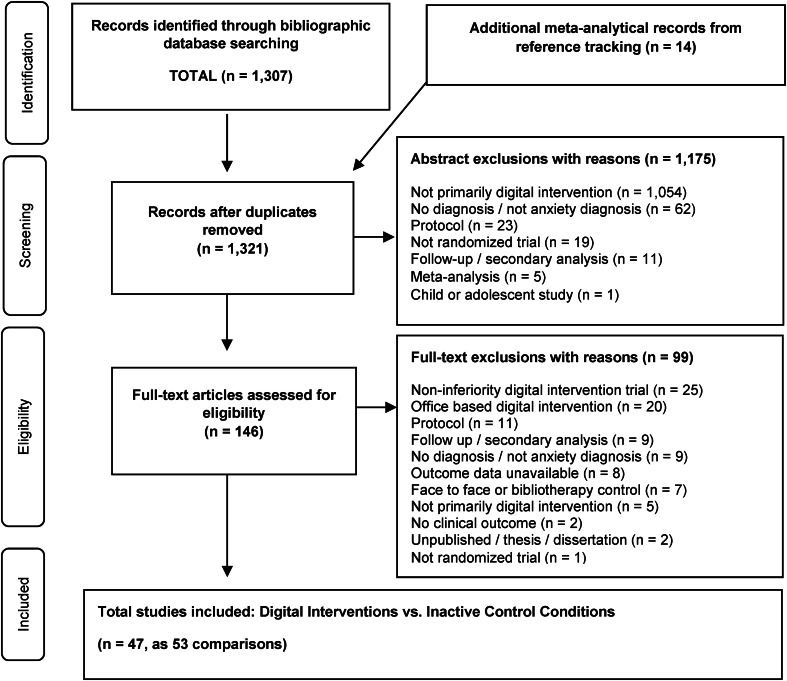
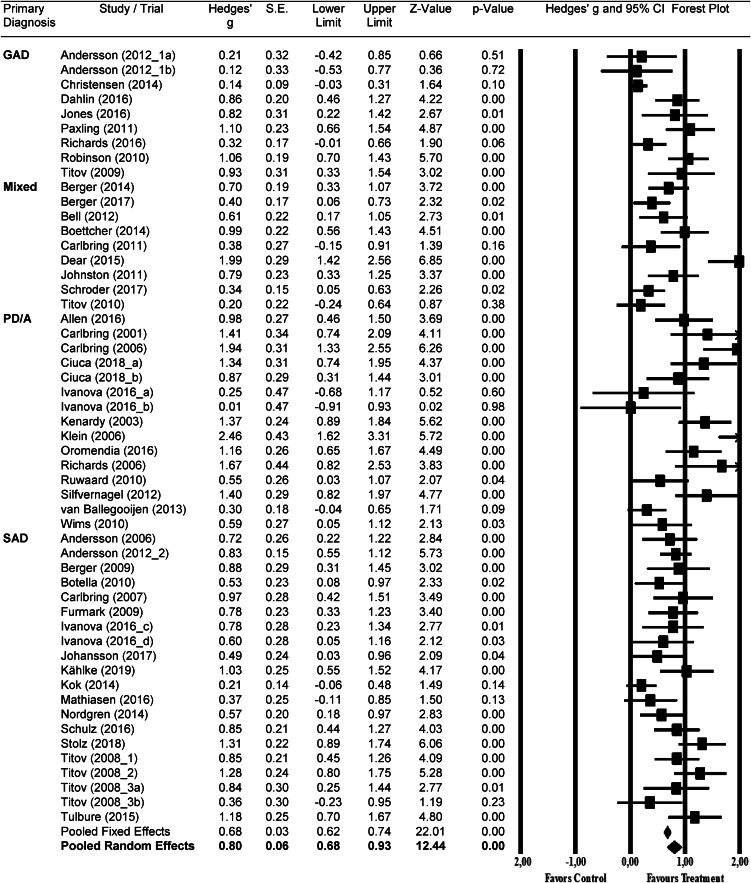
Abstract Background Digital interventions for anxiety disorders are a promising solution to address barriers to evidence-based treatment access. Precise and powerful estimates of digital intervention effectiveness for anxiety disorders are necessary for further adoption in practice. The present systematic review and meta-analysis examined the effectiveness of digital interventions across all anxiety disorders and specific to each disorder v. wait-list and care-as-usual controls. Methods A systematic search of bibliographic databases identified 15 030 abstracts from inception to 1 January 2020. Forty-seven randomized controlled trials (53 comparisons; 4958 participants) contributed to the meta-analysis. Subgroup analyses were conducted by an anxiety disorder, risk of bias, treatment support, recruitment, location and treatment adherence. Results A large, pooled effect size of g = 0.80 [95% Confidence Interval: 0.68–0.93] was found in favor of digital interventions. Moderate to large pooled effect sizes favoring digital interventions were found for generalized anxiety disorder ( g = 0.62), mixed anxiety samples ( g = 0.68), panic disorder with or without agoraphobia ( g = 1.08) and social anxiety disorder ( g = 0.76) subgroups. No subgroups were significantly different or related to the pooled effect size. Notably, the effects of guided interventions ( g = 0.84) and unguided interventions ( g = 0.64) were not significantly different. Supplemental analysis comparing digital and face-to-face interventions (9 comparisons; 683 participants) found no significant difference in effect [ g = 0.14 favoring digital interventions; Confidence Interval: −0.01 to 0.30]. Conclusion The precise and powerful estimates found further justify the application of digital interventions for anxiety disorders in place of wait-list or usual care.
Overview
The claims and statistics of this paper haven’t been checked yet.
Run the check — free, no account needed. It reads the open-access text and checks the sources it cites.
Integrity signals
Registry
Cites
Statistics
Figures
Verification
Claims the paper makes
The claims and statistics of this paper haven’t been checked yet.
Run the check — free, no account needed. It reads the open-access text and checks the sources it cites.
Claims other papers make about this one
Each is checked against this paper’s own text: does it say what the citing paper says it does?
The source backs part of the claim, not all of it — or backs it for a different population, condition or comparison.
In the citing paper
“Evidence suggests that internet-based treatments are effective for the treatment of anxiety disorders and depression [35,36].”
From Evaluation and Future Challenges in a Self-Guided Web-Based Intervention With and Without Chat Support for Depression and Anxiety Symptoms During the COVID-19 Pandemic: Randomized Controlled Trial (2024) · cites this paper as [36]
Experimental — accuracy not yet measuredThe cited source says what the claim attributes to it.
In the citing paper
“Several meta-analyses [16] show that self-guided and guided DMHIs, particularly internet CBT-based programs, significantly improve symptoms of depression (83 studies; Hedge g=0.52, 95% CI 0.43‐0.60 [15]) and anxiety (47 studies, Hedge g=0.80, 95% CI 0.68‐0.93) [18].”
In the citing paper
“For anxiety, a recent meta-analysis [16] reported that compared to inactive controls, guided and self-guided DMHIs significantly reduced anxiety symptoms across 47 studies, with a large pooled effect size (Hedges g=0.80; 95% CI 0.68-0.93).”
In the citing paper
“Digital mental health interventions (DMHIs) are effective in reducing symptoms of depression and anxiety.”
Self-check
Percentages, sums and reported differences re-computed from the paper’s own numbers.
The self-check needs the paper’s full text.
Citations
Cites
Bias in meta-analysis detected by a simple, graphical test
Egger, M., Smith, G. D., Schneider, M., & Minder, C. (1997) · BMJ · doi:10.1136/bmj.315.7109.629 · Cited by 56,722
RoB 2: a revised tool for assessing risk of bias in randomised trials
Sterne, J. A. C., Savović, J., Page, M. J., Elbers, R. G., Blencowe, N. S., Boutron, I., Cates, C. J., Cheng, H.-Y., Corbett, M. S., Eldridge, S. M., et al. (2019) · BMJ · doi:10.1136/bmj.l4898 · Cited by 34,787
A guideline of selecting and reporting intraclass correlation coefficients for reliability research
Koo, T. K., & Li, M. Y. (2016) · Journal of Chiropractic Medicine · doi:10.1016/j.jcm.2016.02.012 · Cited by 31,709
Cochrane Handbook for Systematic Reviews of Interventions: Cochrane Book Series
(2008) · doi:10.1002/9780470712184 · Cited by 25,048
Interrater reliability: The kappa statistic
McHugh, M. L. (2012) · Biochemia Medica · doi:10.11613/bm.2012.031 · Cited by 19,877
Duval, S., & Tweedie, R. (2000) · Biometrics · doi:10.1111/j.0006-341x.2000.00455.x · Cited by 14,099
Preferred reporting items for systematic reviews and meta-analyses: The PRISMA statement
Moher, D., Liberati, A., Tetzlaff, J., & Altman, D. G. (2010) · International Journal of Surgery · doi:10.1016/j.ijsu.2010.02.007 · Cited by 12,156
Weighted kappa: nominal scale agreement provision for scaled disagreement or partial credit
Cohen, J. (1968) · Psychological Bulletin · doi:10.1037/h0026256 · Cited by 8,736
Statistical Methods for Meta-Analysis
(1985) · Elsevier eBooks · doi:10.1016/c2009-0-03396-0 · Cited by 2,570
Epidemiology of anxiety disorders in the 21st century
Bandelow, B., & Michaelis, S. (2015) · Dialogues in Clinical Neuroscience · doi:10.31887/dcns.2015.17.3/bbandelow · Cited by 2,079
Cost of disorders of the brain in Europe 2010
Gustavsson, A., Svensson, M., Jacobi, F., Allgulander, C., Alonso, J., Beghi, E., Dodel, R., Ekman, M., Faravelli, C., Fratiglioni, L., et al. (2011) · European Neuropsychopharmacology · doi:10.1016/j.euroneuro.2011.08.008 · Cited by 1,723
Imputing missing standard deviations in meta-analyses can provide accurate results
Furukawa, T. A., Barbui, C., Cipriani, A., Brambilla, P., & Watanabe, N. (2006) · Journal of Clinical Epidemiology · doi:10.1016/j.jclinepi.2005.06.006 · Cited by 1,568
Scaling-up treatment of depression and anxiety: a global return on investment analysis
Chisholm, D., Sweeny, K., Sheehan, P., Rasmussen, B., Smit, F., Cuijpers, P., & Saxena, S. (2016) · The Lancet Psychiatry · doi:10.1016/s2215-0366(16)30024-4 · Cited by 1,451
Self-citationAndrews, G., Cuijpers, P., Craske, M. G., McEvoy, P., & Titov, N. (2010) · PLoS ONE · doi:10.1371/journal.pone.0013196 · Cited by 1,311
Self-citationUncertainty in heterogeneity estimates in meta-analyses
Ioannidis, J. P. A., Patsopoulos, N. A., & Evangelou, E. (2007) · BMJ · doi:10.1136/bmj.39343.408449.80 · Cited by 1,254
Carlbring, P., Andersson, G., Cuijpers, P., Riper, H., & Hedman-Lagerlöf, E. (2018) · Cognitive Behaviour Therapy · doi:10.1080/16506073.2017.1401115 · Cited by 1,232
Self-citationThe impact of guidance on Internet-based mental health interventions — A systematic review
Baumeister, H., Reichler, L., Munzinger, M., & Lin, J. (2014) · Internet Interventions · doi:10.1016/j.invent.2014.08.003 · Cited by 1,037
Beyond kappa: a review of interrater agreement measures
Banerjee, M., Capozzoli, M., McSweeney, L., & Sinha, D. (1999) · Canadian Journal of Statistics · doi:10.2307/3315487 · Cited by 976
Andrews, G., Basu, A., Cuijpers, P., Craske, M. G., McEvoy, P., English, C. L., & Newby, J. M. (2018) · Journal of Anxiety Disorders · doi:10.1016/j.janxdis.2018.01.001 · Cited by 922
Self-citationSize of Treatment Effects and Their Importance to Clinical Research and Practice
KRAEMER, H. C., & Kupfer, D. J. (2005) · Biological Psychiatry · doi:10.1016/j.biopsych.2005.09.014 · Cited by 850
Furukawa, T. A., Noma, H., Caldwell, D. M., Honyashiki, M., Shinohara, K., Imai, H., Chen, P., Hunot, V., & Churchill, R. (2014) · Acta Psychiatrica Scandinavica · doi:10.1111/acps.12275 · Cited by 521
Computer‐Aided Psychotherapy for Anxiety Disorders: A Meta‐Analytic Review
Cuijpers, P., Marks, I. M., van Straten, A., Cavanagh, K., Gega, L., & Andersson, G. (2009) · Cognitive Behaviour Therapy · doi:10.1080/16506070802694776 · Cited by 429
Self-citationTherapist-supported Internet cognitive behavioural therapy for anxiety disorders in adults
Olthuis, J. V., Watt, M. C., Bailey, K., Hayden, J. A., & Stewart, S. H. (2016) · Cochrane Database of Systematic Reviews · doi:10.1002/14651858.cd011565.pub2 · Cited by 390
Andersson, G., Carlbring, P., Holmström, A., Sparthan, E., Furmark, T., Nilsson-Ihrfelt, E., Buhrman, M., & Ekselius, L. (2006) · Journal of Consulting and Clinical Psychology · doi:10.1037/0022-006x.74.4.677 · Cited by 382
Technological innovations in mental healthcare: harnessing the digital revolution
Hollis, C., Morriss, R., Martin, J., Amani, S., Cotton, R., Denis, M., & Lewis, S. (2015) · British Journal of Psychiatry · doi:10.1192/bjp.bp.113.142612 · Cited by 375
Păsărelu, C. R., Andersson, G., Bergman Nordgren, L., & Dobrean, A. (2017) · Cognitive Behaviour Therapy · doi:10.1080/16506073.2016.1231219 · Cited by 335
Arnberg, F. K., Linton, S. J., Hultcrantz, M., Heintz, E., & Jonsson, U. (2014) · PLoS ONE · doi:10.1371/journal.pone.0098118 · Cited by 330
An Overview on Assessing Agreement with Continuous Measurements
Barnhart, H. X., Haber, M. J., & Lin, L. I. (2007) · Journal of Biopharmaceutical Statistics · doi:10.1080/10543400701376480 · Cited by 326
O'Donnell, A. J., Anderson, P., Jané‐Llopis, E., Manthey, J., Kaner, E., & Rehm, J. T. (2019) · BMJ · doi:10.1136/bmj.l5274 · Cited by 307
Carlbring, P., Gunnarsdóttir, M., Hedensjö, L., Andersson, G., Ekselius, L., & Furmark, T. (2007) · The British Journal of Psychiatry · doi:10.1192/bjp.bp.105.020107 · Cited by 299
Clinician-Assisted Internet-Based Treatment is Effective for Panic: A Randomized Controlled Trial
Wims, E., Titov, N., Andrews, G., & Choi, I. (2010) · Australian & New Zealand Journal of Psychiatry · doi:10.3109/00048671003614171 · Cited by 290
Statistical Methods in Meta-Analysis
Petitti, D. B. (1999) · Oxford University Press eBooks · doi:10.1093/acprof:oso/9780195133646.003.07 · Cited by 289
Robinson, E., Titov, N., Andrews, G., McIntyre, K., Schwencke, G., & Solley, K. (2010) · PLoS ONE · doi:10.1371/journal.pone.0010942 · Cited by 277 · cited 1×
“…merged for analysis (Berger, Boettcher, & Caspar, 2014; Christensen et al., 2014; Oromendia, Orrego, Bonillo, & Molinuevo, 2016; Richards, Klein, & Austin, 2006; Robinson et al., 2010; Schulz et al., 2016; Stolz et al., 2018), according to the recommended method of Cochrane (Higgins et al., 2008).”
Berger, T., Caspar, F., Richardson, R., Kneubühler, B., Sutter, D., & Andersson, G. (2011) · Behaviour Research and Therapy · doi:10.1016/j.brat.2010.12.007 · Cited by 265 · cited 2×
“The results are consistent with several studies on the relative efficacy of guided and unguided interventions for anxiety disorders covering GAD, SAD and PD/A, as well as a prior Cochrane systematic review, all of which found no evidence of a difference between guided and unguided interventions (Berger et al., 2011; C…”
Treatment of panic disorder via the internet: A randomized trial of a self-help program
Carlbring, P., Westling, B. E., Ljungstrand, P., Ekselius, L., & Andersson, G. (2001) · Behavior Therapy · doi:10.1016/s0005-7894(01)80019-8 · Cited by 262
Carlbring, P., Bohman, S., Brunt, S., Buhrman, M., Westling, B. E., Ekselius, L., & Andersson, G. (2006) · American Journal of Psychiatry · doi:10.1176/ajp.2006.163.12.2119 · Cited by 262
Guided and unguided self-help for social anxiety disorder: randomised controlled trial
Furmark, T., Carlbring, P., Hedman, E., Sonnenstein, A., Clevberger, P., Bohman, B., Eriksson, A., Hållén, A., Frykman, M., Holmström, A., et al. (2009) · British Journal of Psychiatry · doi:10.1192/bjp.bp.108.060996 · Cited by 256
Pompoli, A., Furukawa, T. A., Efthimiou, O., Imai, H., Tajika, A., & Salanti, G. (2018) · Psychological Medicine · doi:10.1017/s0033291717003919 · Cited by 249
Internet-based mindfulness treatment for anxiety disorders: a randomized controlled trial
Boettcher, J., Åström, V., Påhlsson, D., Schenström, O., Andersson, G., & Carlbring, P. (2014) · Behavior Therapy · doi:10.1016/j.beth.2013.11.003 · Cited by 245
Efficacy of internet therapy for panic disorder
Klein, B., Richards, J. C., & Austin, D. W. (2006) · Journal of Behavior Therapy and Experimental Psychiatry · doi:10.1016/j.jbtep.2005.07.001 · Cited by 236
Long-term disability in anxiety disorders
Hendriks, S. M., Spijker, J., Licht, C. M. M., Hardeveld, F., de Graaf, R., Batelaan, N. M., Penninx, B. W. J. H., & Beekman, A. T. F. (2016) · BMC Psychiatry · doi:10.1186/s12888-016-0946-y · Cited by 234
Dear, B. F., Staples, L. G., Terides, M. D., Karin, E., Zou, J., Johnston, L., Gandy, M., Fogliati, V. J., Wootton, B. M., McEvoy, P. M., et al. (2015) · Journal of Anxiety Disorders · doi:10.1016/j.janxdis.2015.09.003 · Cited by 230
Individually-tailored, internet-based treatment for anxiety disorders: a randomized controlled trial
Carlbring, P., Maurin, L., Törngren, C., Linna, E., Eriksson, T., Sparthan, E., Strååt, M., Marquez von Hage, C., Bergman-Nordgren, L., & Andersson, G. (2011) · Behaviour Research and Therapy · doi:10.1016/j.brat.2010.10.002 · Cited by 227
Titov, N., Andrews, G., Choi, I., Schwencke, G., & Mahoney, A. (2008) · Australian & New Zealand Journal of Psychiatry · doi:10.1080/00048670802512107 · Cited by 221 · cited 2×
“In four studies, the control group was equally split and shared between guided and unguided intervention arms (Ciuca et al., 2018; Ivanova et al., 2016; Paxling et al., 2011; Titov, Andrews, Choi, Schwencke, & Mahoney, 2008).”
Methodological Recommendations for Trials of Psychological Interventions
Guidi, J., Brakemeier, E.-L., Bockting, C. L. H., Cosci, F., Cuijpers, P., Jarrett, R. B., Linden, M., Marks, I., Peretti, C. S., Rafanelli, C., et al. (2018) · Psychotherapy and Psychosomatics · doi:10.1159/000490574 · Cited by 205
Self-citationInternet-based treatment for social phobia: A randomized controlled trial
Berger, T., Hohl, E., & Caspar, F. (2009) · Journal of Clinical Psychology · doi:10.1002/jclp.20603 · Cited by 198
Transdiagnostic Internet treatment for anxiety disorders: A randomized controlled trial
Titov, N., Andrews, G., Johnston, L., Robinson, E., & Spence, J. (2010) · Behaviour Research and Therapy · doi:10.1016/j.brat.2010.05.014 · Cited by 196
Newby, J. M., Twomey, C., Yuan Li, S. S., & Andrews, G. (2016) · Journal of Affective Disorders · doi:10.1016/j.jad.2016.03.018 · Cited by 189
Meta-analysis of technology-assisted interventions for social anxiety disorder
Kampmann, I. L., Emmelkamp, P. M. G., & Morina, N. (2016) · Journal of Anxiety Disorders · doi:10.1016/j.janxdis.2016.06.007 · Cited by 180 · cited 7×
“…Cuijpers et al., 2009; Kampmann et al., 2016; P ă s ă relu et al., 2017; Richards et al., 2015; Stech et al., 2020) The estimate for SAD can be considered more precise and powerful based on 20 comparisons v. the 11 comparisons in Andrews et al. (2018) and 16 comparisons in Kampmann et al. (2016).”
InfluentialAn internet-based self-help treatment for fear of public speaking: a controlled trial.
Botella, C., Gallego, M. J., Garcia-Palacios, A., Guillen, V., Baños, R. M., Quero, S., & Alcañiz, M. (2010) · Cyberpsychology, Behavior, and Social Networking · doi:10.1089/cyber.2009.0224 · Cited by 169
Andersson, G., Carlbring, P., Furmark, T., & on behalf of the S. O. F. I. E. Research Group (2012) · PLoS ONE · doi:10.1371/journal.pone.0037411 · Cited by 166 · cited 1×
“…mixed anxiety disorder samples (Bell, Colhoun, Carter, & Frampton, 2012) or studies on interventions other than cognitive behavioral therapy, such as internet-delivered psychodynamic therapy (Andersson, Carlbring, & Furmark, 2012) or acceptance and commitment-based therapy (Ivanova et al., 2016).”
Ivanova, E., Lindner, P., Ly, K. H., Dahlin, M., Vernmark, K., Andersson, G., & Carlbring, P. (2016) · Journal of Anxiety Disorders · doi:10.1016/j.janxdis.2016.09.012 · Cited by 165 · cited 3×
“…and unguided interventions (Berger et al., 2011; Ciuca et al., 2018; Dear et al., 2015, 2016; Fogliati et al., 2016; Gershkovich, Herbert, Forman, Schumacher, & Fischer, 2017; Ivanova et al., 2016; Olthuis, Watt, Bailey, Hayden, & Stewart, 2015; Titov, Andrews, Choi, Schwencke, & Johnston, 2009).”
Psychotherapies for depression in low- and middle-income countries: a meta-analysis
Cuijpers, P., Karyotaki, E., Reijnders, M., Purgato, M., & Barbui, C. (2018) · World Psychiatry · doi:10.1002/wps.20493 · Cited by 159 · cited 1×
“…et al., 2016), providing open-access, self-managed care as a valuable treatment strategy where healthcare systems lack the infrastructure to provide mental health services at scale, a common barrier in low-and middle-income countries (Cuijpers, Karyotaki, Reijnders, Purgato, & Barbui, 2018).”
Self-citationBerger, T., Boettcher, J., & Caspar, F. (2014) · Psychotherapy · doi:10.1037/a0032527 · Cited by 158
Kenardy, J. A., Dow, M. G. T., Johnston, D. W., Newman, M. G., Thomson, A., & Taylor, C. B. (2003) · Journal of Consulting and Clinical Psychology · doi:10.1037/0022-006x.71.6.1068 · Cited by 157
Johnston, L., Titov, N., Andrews, G., Spence, J., & Dear, B. F. (2011) · PLoS ONE · doi:10.1371/journal.pone.0028079 · Cited by 150
Therapist-supported Internet cognitive behavioural therapy for anxiety disorders in adults
Olthuis, J. V., Watt, M. C., Bailey, K., Hayden, J. A., & Stewart, S. H. (2015) · Cochrane Database of Systematic Reviews · doi:10.1002/14651858.cd011565 · Cited by 150
Paxling, B., Almlöv, J., Dahlin, M., Carlbring, P., Breitholtz, E., Eriksson, T., & Andersson, G. (2011) · Cognitive Behaviour Therapy · doi:10.1080/16506073.2011.576699 · Cited by 147
Nordgren, L. B., Hedman, E., Etienne, J., Bodin, J., Kadowaki, Å., Eriksson, S., Lindkvist, E., Andersson, G., & Carlbring, P. (2014) · Behaviour Research and Therapy · doi:10.1016/j.brat.2014.05.007 · Cited by 145
Cuijpers, P., Cristea, I. A., Karyotaki, E., Reijnders, M., & Hollon, S. D. (2019) · Psychotherapy Research · doi:10.1080/10503307.2017.1395922 · Cited by 140
Self-citationFeijt, M. A., de Kort, Y. A., Bongers, I. M., & IJsselsteijn, W. A. (2018) · Journal of Medical Internet Research · doi:10.2196/jmir.9485 · Cited by 134
Massive Open Online Interventions
Muñoz, R. F., Bunge, E. L., Chen, K., Schueller, S. M., Bravin, J. I., Shaughnessy, E. A., & Pérez‐Stable, E. J. (2015) · Clinical Psychological Science · doi:10.1177/2167702615583840 · Cited by 132
Randomized Controlled Trial of Web-Based Treatment of Social Phobia Without Clinician Guidance
Titov, N., Andrews, G., Choi, I., Schwencke, G., & Johnston, L. (2009) · Australian & New Zealand Journal of Psychiatry · doi:10.1080/00048670903179160 · Cited by 122
Dear, B. F., Staples, L. G., Terides, M. D., Fogliati, V. J., Sheehan, J., Johnston, L., Kayrouz, R., Dear, R., McEvoy, P. M., & Titov, N. (2016) · Journal of Anxiety Disorders · doi:10.1016/j.janxdis.2016.05.004 · Cited by 114
Internet and mobile interventions for depression: Opportunities and challenges: Cuijpers et al .
Cuijpers, P., Kleiboer, A., Karyotaki, E., & Riper, H. (2017) · Depression and Anxiety · doi:10.1002/da.22641 · Cited by 112
Self-citationRichards, D., Richardson, T., Timulak, L., & McElvaney, J. (2015) · Internet Interventions · doi:10.1016/j.invent.2015.07.003 · Cited by 111 · cited 10×
“Disorder specific meta-analyses are available for GAD (Richards, Richardson, Timulak, & McElvaney, 2015), SAD (Kampmann, Emmelkamp, & Morina, 2016) and PD/A (Stech, Lim, Upton, & Newby, 2020).”
InfluentialJones, S. L., Hadjistavropoulos, H. D., & Soucy, J. N. (2016) · Journal of Anxiety Disorders · doi:10.1016/j.janxdis.2015.10.006 · Cited by 110
Stolz, T., Schulz, A., Krieger, T., Vincent, A., Urech, A., Moser, C., Westermann, S., & Berger, T. (2018) · Journal of Consulting and Clinical Psychology · doi:10.1037/ccp0000301 · Cited by 102
Kählke, F., Berger, T., Schulz, A., Baumeister, H., Berking, M., Auerbach, R. P., Bruffaerts, R., Cuijpers, P. J., Kessler, R. C., & Ebert, D. D. (2019) · International Journal of Methods in Psychiatric Research · doi:10.1002/mpr.1766 · Cited by 99
Self-citationBerger, T., Urech, A., Krieger, T., Stolz, T., Schulz, A., Vincent, A., Moser, C. T., Moritz, S., & Meyer, B. (2017) · Psychological Medicine · doi:10.1017/s0033291716002270 · Cited by 98
Gloster, A. T., Sonntag, R., Hoyer, J., Meyer, A. H., Heinze, S., Ströhle, A., Eifert, G., & Wittchen, H.-U. (2015) · Psychotherapy and Psychosomatics · doi:10.1159/000370162 · Cited by 88
Dahlin, M., Andersson, G., Magnusson, K., Johansson, T., Sjögren, J., Håkansson, A., Pettersson, M., Kadowaki, Å., Cuijpers, P., & Carlbring, P. (2016) · Behaviour Research and Therapy · doi:10.1016/j.brat.2015.12.007 · Cited by 86 · cited 1×
“…review, all of which found no evidence of a difference between guided and unguided interventions (Berger et al., 2011; Ciuca et al., 2018; Dear et al., 2015, 2016; Fogliati et al., 2016; Gershkovich, Herbert, Forman, Schumacher, & Fischer, 2017; Ivanova et al., 2016; Olthuis, Watt,…”
Self-citationFogliati, V. J., Dear, B. F., Staples, L. G., Terides, M. D., Sheehan, J., Johnston, L., Kayrouz, R., Dear, R., McEvoy, P. M., & Titov, N. (2016) · Journal of Anxiety Disorders · doi:10.1016/j.janxdis.2016.03.005 · Cited by 86
HETEROGI: Stata module to quantify heterogeneity in a meta-analysis
Orsini, N., Bottai, M., Higgins, J. P. T., & Buchan, I. E. (2005) · RePEc: Research Papers in Economics · Cited by 85
Generalized anxiety disorder in primary care: Mental health services use and treatment adequacy
Roberge, P., Normand-Lauzière, F., Raymond, I., Luc, M., Tanguay-Bernard, M.-M., Duhoux, A., Bocti, C., & Fournier, L. (2015) · BMC Family Practice · doi:10.1186/s12875-015-0358-y · Cited by 85
Richards, J. C., Klein, B., & Austin, D. (2005) · Clinical Psychologist · doi:10.1080/13284200500378795 · Cited by 83
Ruwaard, J., Broeksteeg, J., Schrieken, B., Emmelkamp, P. M. G., & Lange, A. (2010) · Journal of Anxiety Disorders · doi:10.1016/j.janxdis.2010.01.010 · Cited by 83
Tulbure, B. T., Szentagotai, A., David, O., Ștefan, S., Månsson, K. N. T., David, D., & Andersson, G. (2015) · PLOS ONE · doi:10.1371/journal.pone.0123997 · Cited by 81
Schuster, R., Topooco, N., Keller, A., Radvogin, E., & Laireiter, A.-R. (2020) · Internet Interventions · doi:10.1016/j.invent.2020.100326 · Cited by 77 · cited 1×
“Nonetheless, the results position digital interventions as a promising alternative to face-to-face treatment and underscore the potential to tailor care delivery models that suit the needs of patients and providers (Schuster, Topooco, Keller, Radvogin, & Laireiter, 2020).”
Christensen, H. M., Batterham, P. J., Mackinnon, A. J., Griffiths, K. M., Hehir, K. K., Kenardy, J. A., Gosling, J., & Bennett, K. (2014) · Journal of Medical Internet Research · doi:10.2196/jmir.3507 · Cited by 74
Silfvernagel, K., Carlbring, P., Kabo, J., Edström, S., Eriksson, J., Månson, L., & Andersson, G. (2012) · Journal of Medical Internet Research · doi:10.2196/jmir.1853 · Cited by 69
Nordgreen, T., Haug, T., Öst, L.-G., Andersson, G., Carlbring, P., Kvale, G., Tangen, T., Heiervang, E., & Havik, O. E. (2016) · Behavior Therapy · doi:10.1016/j.beth.2015.10.004 · Cited by 64
Schulz, A., Stolz, T., Vincent, A., Krieger, T., Andersson, G., & Berger, T. (2016) · Behaviour Research and Therapy · doi:10.1016/j.brat.2016.07.001 · Cited by 62
Weightman, M. (2020) · Journal of International Medical Research · doi:10.1177/0300060520928686 · Cited by 62
Ciuca, A. M., Berger, T., Crişan, L. G., & Miclea, M. (2018) · Journal of Anxiety Disorders · doi:10.1016/j.janxdis.2018.03.009 · Cited by 58
An internet-based guided self-help intervention for panic symptoms: randomized controlled trial
van Ballegooijen, W., Riper, H., Klein, B., Ebert, D. D., Kramer, J., Meulenbeek, P., & Cuijpers, P. (2013) · Journal of Medical Internet Research · doi:10.2196/jmir.2362 · Cited by 56
Self-citationJohansson, R., Hesslow, T., Ljótsson, B., Jansson, A., Jonsson, L., Färdig, S., Karlsson, J., Hesser, H., Frederick, R. J., Lilliengren, P., et al. (2017) · Psychotherapy · doi:10.1037/pst0000147 · Cited by 55
Oromendia, P., Orrego, J., Bonillo, A., & Molinuevo, B. (2016) · Cognitive Behaviour Therapy · doi:10.1080/16506073.2016.1163615 · Cited by 52 · cited 1×
“…included studies, seven studies had multiple trial arms which were merged for analysis (Berger, Boettcher, & Caspar, 2014; Christensen et al., 2014; Oromendia, Orrego, Bonillo, & Molinuevo, 2016; Richards, Klein, & Austin, 2006; Robinson et al., 2010; Schulz et al., 2016; Stolz et al., 2018),…”
Effectiveness of computerised cognitive behaviour therapy for anxiety disorders in secondary care
Bell, C. J., Colhoun, H. C., Carter, F. A., & Frampton, C. M. (2012) · Australian & New Zealand Journal of Psychiatry · doi:10.1177/0004867412437345 · Cited by 50 · cited 1×
“Finally, the Andrews et al. (2018) meta-analysis did not include studies with mixed anxiety disorder samples (Bell, Colhoun, Carter, & Frampton, 2012) or studies on interventions other than cognitive behavioral therapy, such as internet-delivered psychodynamic therapy (Andersson, Carlbring, &…”
Kok, R. N., van Straten, A., Beekman, A. T. F., & Cuijpers, P. (2014) · Journal of Medical Internet Research · doi:10.2196/jmir.3429 · Cited by 49
Self-citationGershkovich, M., Herbert, J. D., Forman, E. M., Schumacher, L. M., & Fischer, L. E. (2017) · Behavior Modification · doi:10.1177/0145445517694457 · Cited by 46
Richards, D., Timulák, L., Rashleigh, C., McLoughlin, O., Colla, A., Joyce, C., Doherty, G. J., Sharry, J., Duffy, D. J., & Anderson-Gibbons, M. (2016) · Internet Interventions · doi:10.1016/j.invent.2016.10.003 · Cited by 45
Allen, A. R., Newby, J. M., Mackenzie, A., Smith, J., Boulton, M., Loughnan, S. A., & Andrews, G. (2016) · BJPsych Open · doi:10.1192/bjpo.bp.115.001826 · Cited by 43
Stech, E. P., Lim, J., Upton, E. L., & Newby, J. M. (2020) · Cognitive Behaviour Therapy · doi:10.1080/16506073.2019.1628808 · Cited by 43
Schröder, J., Jelinek, L., & Moritz, S. (2017) · Journal of Behavior Therapy and Experimental Psychiatry · doi:10.1016/j.jbtep.2016.05.002 · Cited by 32
Digitally Delivered Psychological Interventions for Anxiety Disorders: a Comprehensive Review
Stefanopoulou, E., Lewis, D., Taylor, M., Broscombe, J., & Larkin, J. (2018) · Psychiatric Quarterly · doi:10.1007/s11126-018-9620-5 · Cited by 30
Mathiasen, K., Riper, H. M., Ehlers, L. H., Valentin, J. B., & Rosenberg, N. (2016) · Internet Interventions · doi:10.1016/j.invent.2016.03.001 · Cited by 28
Meta-analyses in mental health research. A practical guide
Cuijpers, P. (2016) · VU Research Portal · Cited by 25
Self-citationStiles, J. A., Chatterton, M. L., Le, L. K., Lee, Y. Y., Whiteford, H., & Mihalopoulos, C. (2019) · Journal of Psychosomatic Research · doi:10.1016/j.jpsychores.2019.109812 · Cited by 17
Treatment adequacy of anxiety disorders among young adults in Finland
Kasteenpohja, T., Marttunen, M., Aalto-Setälä, T., Perälä, J., Saarni, S. I., & Suvisaari, J. (2016) · BMC Psychiatry · doi:10.1186/s12888-016-0766-0 · Cited by 14
Research works printed but not linked: 3
- 2013, Diagnostic and statistical manual of mental disorders: DSM-5
- RevMan (2020). Review Manager Web (RevMan Web): The Cochraine Collaboration; Available at https://revman.cochrane.org.
- England, 2015, C. o. D. E.-B. S. f. P. I. f. M. Institute of Medicine, Disorders, 57
Cited by
Sorted by citations
Musiat, P., Johnson, C., Atkinson, M., Wilksch, S., & Wade, T. (2022) · Psychological Medicine · doi:10.1017/s0033291721004621 · Cited by 166
Bhattacharya, S., Goicoechea, C., Heshmati, S., Carpenter, J. K., & Hofmann, S. G. (2023) · Current Psychiatry Reports · doi:10.1007/s11920-022-01402-8 · Cited by 82
Papola, D., Ostuzzi, G., Tedeschi, F., Gastaldon, C., Purgato, M., Giovane, C. D., Pompoli, A., Pauley, D., Karyotaki, E., Sijbrandij, M., et al. (2022) · Psychological Medicine · doi:10.1017/s0033291722003683 · Cited by 86
Self-citationMadrid‐Cagigal, A., Kealy, C., Potts, C., Mulvenna, M. D., Byrne, M., Barry, M. M., & Donohoe, G. (2025) · Early Intervention in Psychiatry · doi:10.1111/eip.70017 · Cited by 78
Evaluation of the Use of Digital Mental Health Platforms and Interventions: Scoping Review
Balcombe, L., & Leo, D. D. (2022) · International Journal of Environmental Research and Public Health · doi:10.3390/ijerph20010362 · Cited by 83
Metadata
- Authors
- Pauley, D., Cuijpers, P., Papola, D., Miguel, C., & Karyotaki, E.
- Affiliations
- Amsterdam Public Health (NL)
- University of Verona (IT)
- Harvard University (US)
- Corresponding author
- Pauley, Darin
- Venue
- Psychological Medicine
- Publisher
- Cambridge University Press (CUP)
- Published
- 2021-05-28
- Volume
- 53
- Issue
- 2
- Pages
- 1-13
- ISSN
- 0033-2917 (ISSN-L)
- 1469-8978
- PMC
- PMC9899576
- OpenAlex
- W3165857807
- Cited by
- 170
- References
- 101
- Citations by year
- 2026: 29 · 2025: 46 · 2024: 45 · 2023: 33 · 2022: 9 · 2021: 8
- FWCI
- 3.82
- Type
- journal article
- Language
- en
- Open access
- hybrid
- doi.org
- Locations
- Psychological Medicine (publishedVersion, cc-by)
- PubMed Central (publishedVersion, cc-by)
- PubMed (publishedVersion)
- VU Research Portal (publishedVersion, other-oa)
- Data Archiving and Networked Services (DANS) (submittedVersion, other-oa)
- Topics
- Social Sciences › Psychology › Applied Psychology › Digital Mental Health Interventions
- Social Sciences › Psychology › Experimental and Cognitive Psychology › Anxiety, Depression, Psychometrics, Treatment, Cognitive Processes
- Health Sciences › Medicine › Psychiatry and Mental health › Mental Health Treatment and Access
- Keywords
- digital interventions, anxiety disorders, treatment effectiveness, generalized anxiety disorder, panic disorder, social anxiety disorder, agoraphobia, medication adherence, access to mental health care
- MeSH terms
- Phobia, Social, Anxiety, Anxiety Disorders, Humans, Panic Disorder, Treatment Outcome
About these checks
Registry, retraction, Cites and statistics results are computed, not judged, with one exception: a printed reference that no index lists is read once by a model before it counts as a citation error. Claims are extracted by a model and kept only when their quote appears verbatim in the text; each cited source is then checked, with a model’s help, for whether it says what the claim relies on. Those verdicts can be wrong — read the claim’s quote and the cited source before relying on one.
Statistics and arithmetic are recomputed, not judged.
Confidence bands are shown only for fields calibrated on our annotated test set. None is calibrated yet, so no band is shown.
What counts as a claim ›How we measure confidence ›How we check this ›
Are you an author, or do you see a problem with this page? Request a review
