

The DOI matches its Crossref record; 101 of the 101 references it cites were found in a registry or an index.
Two decades of digital interventions for anxiety disorders: a systematic review and meta-analysis of treatment effectiveness
Open accessAbstract
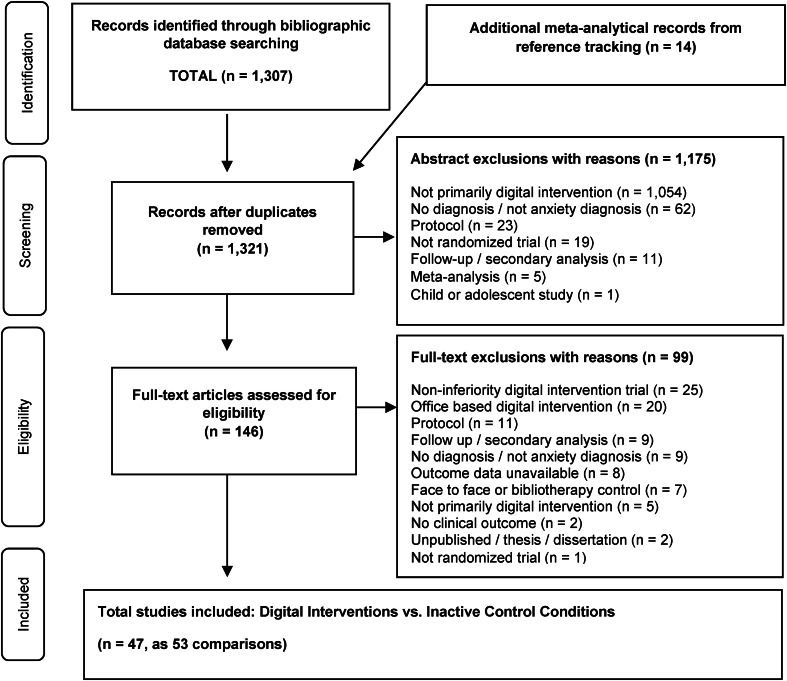
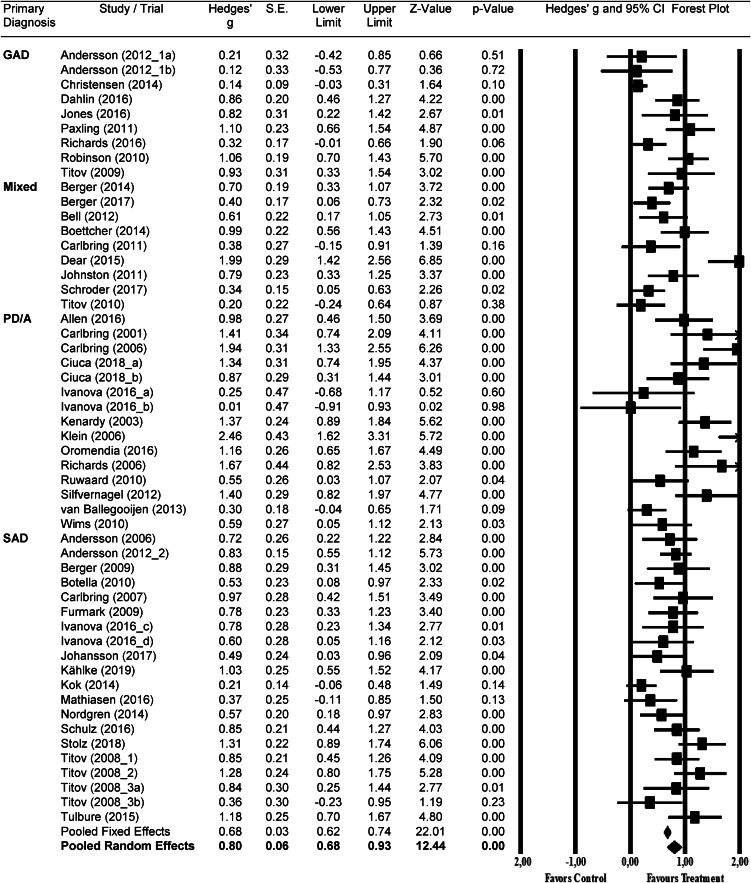
Abstract Background Digital interventions for anxiety disorders are a promising solution to address barriers to evidence-based treatment access. Precise and powerful estimates of digital intervention effectiveness for anxiety disorders are necessary for further adoption in practice. The present systematic review and meta-analysis examined the effectiveness of digital interventions across all anxiety disorders and specific to each disorder v. wait-list and care-as-usual controls. Methods A systematic search of bibliographic databases identified 15 030 abstracts from inception to 1 January 2020. Forty-seven randomized controlled trials (53 comparisons; 4958 participants) contributed to the meta-analysis. Subgroup analyses were conducted by an anxiety disorder, risk of bias, treatment support, recruitment, location and treatment adherence. Results A large, pooled effect size of g = 0.80 [95% Confidence Interval: 0.68–0.93] was found in favor of digital interventions. Moderate to large pooled effect sizes favoring digital interventions were found for generalized anxiety disorder ( g = 0.62), mixed anxiety samples ( g = 0.68), panic disorder with or without agoraphobia ( g = 1.08) and social anxiety disorder ( g = 0.76) subgroups. No subgroups were significantly different or related to the pooled effect size. Notably, the effects of guided interventions ( g = 0.84) and unguided interventions ( g = 0.64) were not significantly different. Supplemental analysis comparing digital and face-to-face interventions (9 comparisons; 683 participants) found no significant difference in effect [ g = 0.14 favoring digital interventions; Confidence Interval: −0.01 to 0.30]. Conclusion The precise and powerful estimates found further justify the application of digital interventions for anxiety disorders in place of wait-list or usual care.
Overview
The claims and statistics of this paper haven’t been checked yet.
Run the check — free, no account needed. It reads the open-access text and checks the sources it cites.
Integrity signals
Registry
Cites
Statistics
Figures
Verification
Claims the paper makes
The claims and statistics of this paper haven’t been checked yet.
Run the check — free, no account needed. It reads the open-access text and checks the sources it cites.
Claims other papers make about this one
Each is checked against this paper’s own text: does it say what the citing paper says it does?
The source backs part of the claim, not all of it — or backs it for a different population, condition or comparison.
In the citing paper
“Evidence suggests that internet-based treatments are effective for the treatment of anxiety disorders and depression [35,36].”
From Evaluation and Future Challenges in a Self-Guided Web-Based Intervention With and Without Chat Support for Depression and Anxiety Symptoms During the COVID-19 Pandemic: Randomized Controlled Trial (2024) · cites this paper as [36]
Experimental — accuracy not yet measuredThe cited source says what the claim attributes to it.
In the citing paper
“Several meta-analyses [16] show that self-guided and guided DMHIs, particularly internet CBT-based programs, significantly improve symptoms of depression (83 studies; Hedge g=0.52, 95% CI 0.43‐0.60 [15]) and anxiety (47 studies, Hedge g=0.80, 95% CI 0.68‐0.93) [18].”
In the citing paper
“For anxiety, a recent meta-analysis [16] reported that compared to inactive controls, guided and self-guided DMHIs significantly reduced anxiety symptoms across 47 studies, with a large pooled effect size (Hedges g=0.80; 95% CI 0.68-0.93).”
In the citing paper
“Digital mental health interventions (DMHIs) are effective in reducing symptoms of depression and anxiety.”
Self-check
Percentages, sums and reported differences re-computed from the paper’s own numbers.
The self-check needs the paper’s full text.
Citations
Cites
Bias in meta-analysis detected by a simple, graphical test
Egger, M., Smith, G. D., Schneider, M., & Minder, C. (1997) · BMJ · doi:10.1136/bmj.315.7109.629 · Cited by 56,722
RoB 2: a revised tool for assessing risk of bias in randomised trials
Sterne, J. A. C., Savović, J., Page, M. J., Elbers, R. G., Blencowe, N. S., Boutron, I., Cates, C. J., Cheng, H.-Y., Corbett, M. S., Eldridge, S. M., et al. (2019) · BMJ · doi:10.1136/bmj.l4898 · Cited by 34,787
A guideline of selecting and reporting intraclass correlation coefficients for reliability research
Koo, T. K., & Li, M. Y. (2016) · Journal of Chiropractic Medicine · doi:10.1016/j.jcm.2016.02.012 · Cited by 31,709
Cochrane Handbook for Systematic Reviews of Interventions: Cochrane Book Series
(2008) · doi:10.1002/9780470712184 · Cited by 25,048
Interrater reliability: The kappa statistic
McHugh, M. L. (2012) · Biochemia Medica · doi:10.11613/bm.2012.031 · Cited by 19,877
Duval, S., & Tweedie, R. (2000) · Biometrics · doi:10.1111/j.0006-341x.2000.00455.x · Cited by 14,099
Preferred reporting items for systematic reviews and meta-analyses: The PRISMA statement
Moher, D., Liberati, A., Tetzlaff, J., & Altman, D. G. (2010) · International Journal of Surgery · doi:10.1016/j.ijsu.2010.02.007 · Cited by 12,156
Weighted kappa: nominal scale agreement provision for scaled disagreement or partial credit
Cohen, J. (1968) · Psychological Bulletin · doi:10.1037/h0026256 · Cited by 8,736
Statistical Methods for Meta-Analysis
(1985) · Elsevier eBooks · doi:10.1016/c2009-0-03396-0 · Cited by 2,570
Epidemiology of anxiety disorders in the 21st century
Bandelow, B., & Michaelis, S. (2015) · Dialogues in Clinical Neuroscience · doi:10.31887/dcns.2015.17.3/bbandelow · Cited by 2,079
Research works printed but not linked: 3
- 2013, Diagnostic and statistical manual of mental disorders: DSM-5
- RevMan (2020). Review Manager Web (RevMan Web): The Cochraine Collaboration; Available at https://revman.cochrane.org.
- England, 2015, C. o. D. E.-B. S. f. P. I. f. M. Institute of Medicine, Disorders, 57
Cited by
Sorted by citations
Musiat, P., Johnson, C., Atkinson, M., Wilksch, S., & Wade, T. (2022) · Psychological Medicine · doi:10.1017/s0033291721004621 · Cited by 166
Bhattacharya, S., Goicoechea, C., Heshmati, S., Carpenter, J. K., & Hofmann, S. G. (2023) · Current Psychiatry Reports · doi:10.1007/s11920-022-01402-8 · Cited by 82
Papola, D., Ostuzzi, G., Tedeschi, F., Gastaldon, C., Purgato, M., Giovane, C. D., Pompoli, A., Pauley, D., Karyotaki, E., Sijbrandij, M., et al. (2022) · Psychological Medicine · doi:10.1017/s0033291722003683 · Cited by 86
Self-citationMadrid‐Cagigal, A., Kealy, C., Potts, C., Mulvenna, M. D., Byrne, M., Barry, M. M., & Donohoe, G. (2025) · Early Intervention in Psychiatry · doi:10.1111/eip.70017 · Cited by 78
Evaluation of the Use of Digital Mental Health Platforms and Interventions: Scoping Review
Balcombe, L., & Leo, D. D. (2022) · International Journal of Environmental Research and Public Health · doi:10.3390/ijerph20010362 · Cited by 83
Metadata
- Authors
- Pauley, D., Cuijpers, P., Papola, D., Miguel, C., & Karyotaki, E.
- Affiliations
- Amsterdam Public Health (NL)
- University of Verona (IT)
- Harvard University (US)
- Corresponding author
- Pauley, Darin
- Venue
- Psychological Medicine
- Publisher
- Cambridge University Press (CUP)
- Published
- 2021-05-28
- Volume
- 53
- Issue
- 2
- Pages
- 1-13
- ISSN
- 0033-2917 (ISSN-L)
- 1469-8978
- PMC
- PMC9899576
- OpenAlex
- W3165857807
- Cited by
- 170
- References
- 101
- Citations by year
- 2026: 29 · 2025: 46 · 2024: 45 · 2023: 33 · 2022: 9 · 2021: 8
- FWCI
- 3.82
- Type
- journal article
- Language
- en
- Open access
- hybrid
- doi.org
- Locations
- Psychological Medicine (publishedVersion, cc-by)
- PubMed Central (publishedVersion, cc-by)
- PubMed (publishedVersion)
- VU Research Portal (publishedVersion, other-oa)
- Data Archiving and Networked Services (DANS) (submittedVersion, other-oa)
- Topics
- Social Sciences › Psychology › Applied Psychology › Digital Mental Health Interventions
- Social Sciences › Psychology › Experimental and Cognitive Psychology › Anxiety, Depression, Psychometrics, Treatment, Cognitive Processes
- Health Sciences › Medicine › Psychiatry and Mental health › Mental Health Treatment and Access
- Keywords
- digital interventions, anxiety disorders, treatment effectiveness, generalized anxiety disorder, panic disorder, social anxiety disorder, agoraphobia, medication adherence, access to mental health care
- MeSH terms
- Phobia, Social, Anxiety, Anxiety Disorders, Humans, Panic Disorder, Treatment Outcome
About these checks
Registry, retraction, Cites and statistics results are computed, not judged, with one exception: a printed reference that no index lists is read once by a model before it counts as a citation error. Claims are extracted by a model and kept only when their quote appears verbatim in the text; each cited source is then checked, with a model’s help, for whether it says what the claim relies on. Those verdicts can be wrong — read the claim’s quote and the cited source before relying on one.
Statistics and arithmetic are recomputed, not judged.
Confidence bands are shown only for fields calibrated on our annotated test set. None is calibrated yet, so no band is shown.
What counts as a claim ›How we measure confidence ›How we check this ›
Are you an author, or do you see a problem with this page? Request a review
