

Somatic symptom disorder: a scoping review on the empirical evidence of a new diagnosis
Open accessThe DOI matches its Crossref record; 80 of the 80 references it cites were found in a registry or an index.
Abstract
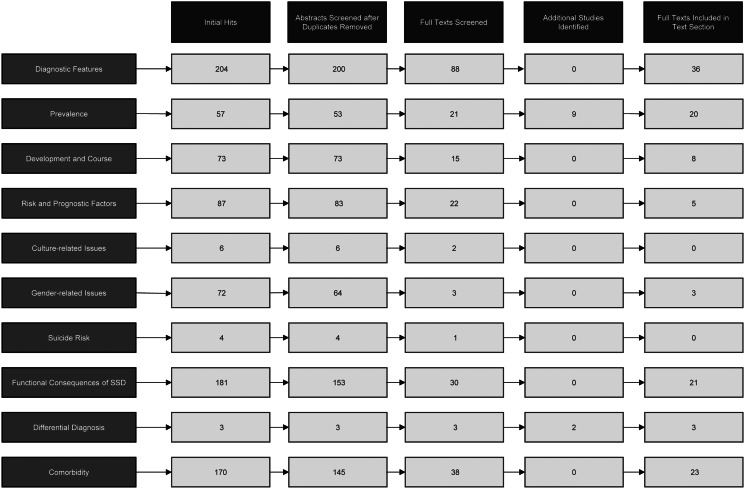
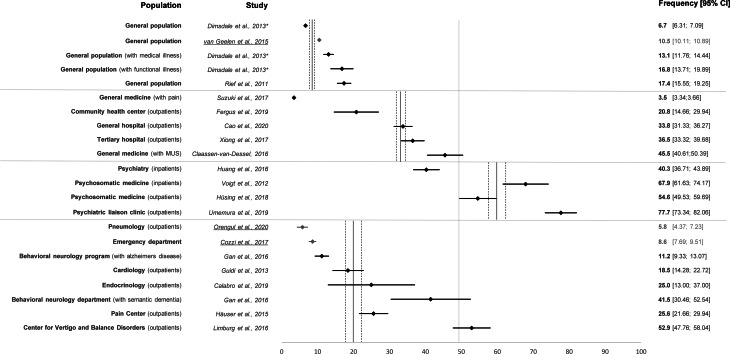
Background: In 2013, the diagnosis of somatic symptom disorder (SSD) was introduced into the Diagnostic and Statistical Manual of Mental Disorders (DSM-5). This review aims to comprehensively synthesize contemporary evidence related to SSD. Methods: A scoping review was conducted using PubMed, PsycINFO, and Cochrane Library. The main inclusion criteria were SSD and publication in the English language between 01/2009 and 05/2020. Systematic search terms also included subheadings for the DSM-5 text sections; i.e., diagnostic features, prevalence, development and course, risk and prognostic factors, culture, gender, suicide risk, functional consequences, differential diagnosis, and comorbidity. Results: Eight hundred and eighty-two articles were identified, of which 59 full texts were included for analysis. Empirical evidence supports the reliability, validity, and clinical utility of SSD diagnostic criteria, but the further specification of the psychological SSD B-criteria criteria seems necessary. General population studies using self-report questionnaires reported mean frequencies for SSD of 12.9% [95% confidence interval (CI) 12.5–13.3%], while prevalence studies based on criterion standard interviews are lacking. SSD was associated with increased functional impairment, decreased quality of life, and high comorbidity with anxiety and depressive disorders. Relevant research gaps remain regarding developmental aspects, risk and prognostic factors, suicide risk as well as culture- and gender-associated issues. Conclusions: Strengths of the SSD diagnosis are its good reliability, validity, and clinical utility, which substantially improved on its predecessors. SSD characterizes a specific patient population that is significantly impaired both physically and psychologically. However, substantial research gaps exist, e.g., regarding SSD prevalence assessed with criterion standard diagnostic interviews.
Overview
The claims and statistics of this paper haven’t been checked yet.
Free: it reads the open-access text and checks the first 5 claims that cite a source we can check. Create a free account to check every claim.
Integrity signals
Registry
Cites
Statistics
Figures
Verification
Claims the paper makes
The claims and statistics of this paper haven’t been checked yet.
Free: it reads the open-access text and checks the first 5 claims that cite a source we can check. Create a free account to check every claim.
Claims other papers make about this one
Each is checked against this paper’s own text: does it say what the citing paper says it does?
The source backs part of the claim, not all of it — or backs it for a different population, condition or comparison.
In the citing paper
“these newer diagnoses allowed for much greater diagnostic reliability and validity”
From Persistent physical symptoms: definition, genesis, and management (2024) · cites this paper as [35]
Experimental — accuracy not yet measuredThe cited source says what the claim attributes to it.
In the citing paper
“These diagnoses also require disproportionate and persistent thoughts about the seriousness of one's symptoms”
From Persistent physical symptoms: definition, genesis, and management (2024) · cites this paper as [35]
Self-check
Percentages, sums and reported differences re-computed from the paper’s own numbers.
The self-check needs the paper’s full text.
Citations
Cites
PRISMA Extension for Scoping Reviews (PRISMA-ScR): Checklist and Explanation
Tricco, A. C., Lillie, E., Zarin, W., O'Brien, K. K., Colquhoun, H., Levac, D., Moher, D., Peters, M. D. J., Horsley, T., Weeks, L., et al. (2018) · Annals of Internal Medicine · doi:10.7326/m18-0850 · Cited by 43,565 · cited 2×
“Review findings are reported according to the Preferred Reporting Items for Systematic Reviews and Meta-Analysis extension for Scoping Reviews (PRISMA-ScR) statement (Tricco et al., 2018).”
MethodKroenke, K., Spitzer, R. L., Williams, J. B. W., & Löwe, B. (2010) · General Hospital Psychiatry · doi:10.1016/j.genhosppsych.2010.03.006 · Cited by 4,057 · cited 2×
“Valid self-report instruments for the diagnosis of SSD are available for the A-criterion, e.g., with the Somatic Symptom Severity Scale-8 (SSS-8) (Gierk et al., 2014) or the Patient Health Questionnaire-15 (PHQ-15) (Kroenke, Spitzer, Williams, & Löwe, 2010), and for the B-criteria, e.g., with the Somatic Symptom Disor…”
MethodSelf-citationRegier, D. A., Narrow, W. E., Clarke, D. E., Kraemer, H. C., Kuramoto, S. J., Kuhl, E. A., & Kupfer, D. J. (2013) · American Journal of Psychiatry · doi:10.1176/appi.ajp.2012.12070999 · Cited by 1,163
The Somatic Symptom Scale–8 (SSS-8): A Brief Measure of Somatic Symptom Burden
Gierk, B., Kohlmann, S., Kroenke, K., Spangenberg, L., Zenger, M., Brähler, E., & Löwe, B. (2014) · JAMA Internal Medicine · doi:10.1001/jamainternmed.2013.12179 · Cited by 740
Self-citationDepression, anxiety and somatization in primary care: Syndrome overlap and functional impairment
Löwe, B., Spitzer, R. L., Williams, J. B. W., Mussell, M., Schellberg, D., & Kroenke, K. (2008) · General Hospital Psychiatry · doi:10.1016/j.genhosppsych.2008.01.001 · Cited by 706
Self-citationPatients presenting with somatic complaints: epidemiology, psychiatric co‐morbidity and management
Kroenke, K. (2003) · International Journal of Methods in Psychiatric Research · doi:10.1002/mpr.140 · Cited by 624 · cited 1×
“The DSM-5 diagnosis not only received a new name; its diagnostic criteria also differ radically from somatization disorder which it replaced: Following scientific evidence of over two decades (Kroenke, 2003; Voigt et al., 2012), positive psychological criteria were formulated, i.”
BackgroundInfluentialEscobar, J. I. (1987) · Archives of General Psychiatry · doi:10.1001/archpsyc.1987.01800200039006 · Cited by 428
A systematic review of the epidemiology of somatisation disorder and hypochondriasis
Creed, F., & Barsky, A. (2004) · Journal of Psychosomatic Research · doi:10.1016/s0022-3999(03)00622-6 · Cited by 421 · cited 1×
“(Creed & Barsky, 2004; Escobar, Burnam, Karno, Forsythe, & Golding, 1987), but lower than undifferentiated somatoform disorders ( ∼ 20”
Henningsen, P., Gündel, H., Kop, W. J., Löwe, B., Martin, A., Rief, W., Rosmalen, J. G. M., Schröder, A., van der Feltz-Cornelis, C., & Van den Bergh, O. (2018) · Psychosomatic Medicine · doi:10.1097/psy.0000000000000588 · Cited by 310
Self-citationon behalf of the EURONET-SOMA Group, Burton, C., Fink, P., Henningsen, P., Löwe, B., & Rief, W. (2020) · BMC Medicine · doi:10.1186/s12916-020-1505-4 · Cited by 292
Self-citation
Research works printed but not linked: 3
- World Health Organization (1992). The ICD-10 classification of mental and behavioural disorders: Clinical descriptions and diagnostic guidelines (10th ed.). Geneva: World Health Organization.
- American Psychiatric Association (2000). Diagnostic and statistical manual of mental disorders, forth edition, text revision (DSM-IV-TR). Arlington, VA: American Psychiatric Association.
- American Psychiatric Association (2013). Diagnostic and statistical manual of mental disorders, fifth edition (DSM-5). Arlington, VA: American Psychiatric Publishing.
Cited by
Persistent physical symptoms: definition, genesis, and management
Löwe, B., Toussaint, A., Rosmalen, J. G. M., Huang, W.-L., Burton, C., Weigel, A., Levenson, J. L., & Henningsen, P. (2024) · The Lancet · doi:10.1016/s0140-6736(24)00623-8 · Cited by 280
Self-citationMicai, M., Fatta, L. M., Gila, L., Caruso, A., Salvitti, T., Fulceri, F., Ciaramella, A., D'Amico, R., Del Giovane, C., Bertelli, M., et al. (2023) · Neuroscience & Biobehavioral Reviews · doi:10.1016/j.neubiorev.2023.105436 · Cited by 184
Psychological factors associated with Long COVID: a systematic review and meta-analysis
Engelmann, P., Reinke, M., Stein, C., Salzmann, S., Löwe, B., Toussaint, A. C., & Mora, M. C. S. (2024) · EClinicalMedicine · doi:10.1016/j.eclinm.2024.102756 · Cited by 106
Self-citationSmakowski, A., Hüsing, P., Völcker, S., Löwe, B., Rosmalen, J. G. M., Mora, M. C. S., & Toussaint, A. C. (2024) · Journal of Psychosomatic Research · doi:10.1016/j.jpsychores.2024.111608 · Cited by 105
Self-citationOverall comorbidities in functional neurological disorder: A narrative review
Carle, G., Goutte, J., Do-Quang-Cantagrel, N., Mouchabac, S., Joly, C., & Garcin, B. (2023) · L Encéphale · doi:10.1016/j.encep.2023.06.004 · Cited by 67
Prevalence of functional disorders across Europe: a systematic review and meta-analysis
Rometsch, C., Mansueto, G., Bermpohl, F. M. G., Martin, A., & Cosci, F. (2024) · European Journal of Epidemiology · doi:10.1007/s10654-024-01109-5 · Cited by 64
“Globally, the prevalence of FD in the general population was estimated at 12.9% (95% CI from 12.5 to 13.3%, applying the SSD criteria) [141].”
BackgroundInfluentialJoffe, A. R., & Elliott, A. (2023) · SAGE Open Medicine · doi:10.1177/20503121231194400 · Cited by 56
The overlooked burden of persistent physical symptoms: a call for action in European healthcare
Toussaint, A., Weigel, A., Löwe, B., Blanch, J., Bogaerts, K., Boye, B., Burton, C., Cosci, F., Engelmann, P., Fink, P., et al. (2025) · The Lancet Regional Health - Europe · doi:10.1016/j.lanepe.2024.101140 · Cited by 44
“50 Although somatic symptom disorder can be diagnosed alongside a somatic disease, it is rarely used outside of psychosomatic medicine or clinical psychology.”
Self-citationEngelmann, P., Löwe, B., Brehm, T. T., Weigel, A., Ullrich, F., Addo, M. M., Wiesch, J. S. Z., Lohse, A. W., & Toussaint, A. C. (2022) · Frontiers in Psychology · doi:10.3389/fpsyg.2022.1022203 · Cited by 46
“Due to the omnipresence of the topic in personal experiences and themedia, the uncertainty about the course of the pandemic, the limitations regarding social exchange and activities, and other government restrictions (Holmes et al., 2020; Hossain et al., 2020), pandemic-related distress might function as a risk factor…”
ResultSelf-citationCénat, J. M., Kouamou, L. N., Farahi, S. M. M. M., Darius, W. P., Dalexis, R. D., Charles, M., & Kogan, C. S. (2022) · Journal of Psychosomatic Research · doi:10.1016/j.jpsychores.2022.111053 · Cited by 44
Lehmann, M., Pohontsch, N. J., Zimmermann, T. P., Scherer, M., & Löwe, B. (2022) · BMC Psychiatry · doi:10.1186/s12888-022-04100-0 · Cited by 33
“Overall, regarding reliability, validity, and clinical usefulness SSD seems to surpass its predecessor [3, 7, 10].”
BackgroundSelf-citationMewes, R. (2022) · Frontiers in Public Health · doi:10.3389/fpubh.2022.1033203 · Cited by 48
“However, it is important to note that while the suggestions for additional psychological classification criteria is based on a broad evidence [see above and (41)], there is no consensus on the exact set of psychological criteria that may be relevant for a diagnosis in the field of somatoform disorders.”
BackgroundInfluentialPerros, P., Nagy, E. V., Papini, E., Van Der Feltz-Cornelis, C. M., Weetman, A. P., Hay, H. A., Abad-Madroñero, J., Tallett, A. J., Bilas, M., Lakwijk, P., et al. (2023) · Thyroid · doi:10.1089/thy.2022.0641 · Cited by 27
Axelsson, E., & Hedman‐Lagerlöf, E. (2022) · Journal of Psychosomatic Research · doi:10.1016/j.jpsychores.2022.111133 · Cited by 33
Kindermann, I., Köllner, V., Albus, C., Boer, J., Dannberg, G., Fritzsche, K., Gunold, H., Herrmann‐Lingen, C., Leithäuser, B., Meesmann, M., et al. (2024) · Die Kardiologie · doi:10.1007/s12181-024-00708-6 · Cited by 30
Shen, S., Dong, Z., Zhang, Q., Xiao, J., Zhou, D., & Li, J. (2022) · Therapeutic Advances in Neurological Disorders · doi:10.1177/17562864221138147 · Cited by 27
Mund, M., Uhlenbusch, N., Rillig, F., Weiler‐Normann, C., Herget, T., Kubisch, C., Löwe, B., & Schramm, C. (2023) · Orphanet Journal of Rare Diseases · doi:10.1186/s13023-023-02669-7 · Cited by 22
“The earlier diagnostic concepts of somatoform or psychosomatic disorders in DSM-IV and ICD-10 have been criticized for fostering a body-mind dualism as the exclusion of a medical explanation for the symptoms was a necessary precondition for diagnosis [20].”
BackgroundInfluentialSelf-citationHüsing, P., Smakowski, A., Löwe, B., Kleinstäuber, M., Toussaint, A. C., & Mora, M. C. S. (2023) · Frontiers in Psychiatry · doi:10.3389/fpsyt.2023.1142484 · Cited by 32
“The ongoing debate on DSM-5 somatic symptom disorder and the upcoming implementation of ICD-11 in health-care systems worldwide requires additional research.”
BackgroundInfluentialSelf-citationGreißel, A., Schneider, A., Donnachie, E., Gerlach, R., Tauscher, M., & Hapfelmeier, A. (2024) · Scientific Reports · doi:10.1038/s41598-024-52656-6 · Cited by 25
“…i.e. a combination of suffering from physical complaints, regardless of their origin, with psychological behavioural features of an excessive preoccupation with one’s own physical symptoms and accompanied by increased psychological distress 35 , should be considered in patient counselling 14 .”
BackgroundSchulz, A., Dierolf, A. M., Lutz, A., Voderholzer, U., Koch, S., Bach, M., Asenstorfer, C., Michaux, G., Mertens, V., & Vögele, C. (2022) · Psychiatry Research Communications · doi:10.1016/j.psycom.2022.100052 · Cited by 24
Canfora, F., Ottaviani, G., Calabria, E., Pecoraro, G., Leuci, S., Coppola, N., Sansone, M., Rupel, K., Biasotto, M., Lenarda, R. D., et al. (2023) · Biomedicines · doi:10.3390/biomedicines11123266 · Cited by 30
Setting up Functional Neurological Disorder Treatment Services
Finkelstein, S. A., Carson, A. J., Edwards, M. J., Kozlowska, K., Lidstone, S. C., Perez, D. L., Polich, G. R., Stone, J., & Aybek, S. (2023) · Neurologic Clinics · doi:10.1016/j.ncl.2023.04.002 · Cited by 19
Schneider, A., Huber, L., Lohse, J., Linde, K., Greißel, A., Sattel, H. C., Henningsen, P., & Hapfelmeier, A. (2023) · Journal of Psychosomatic Research · doi:10.1016/j.jpsychores.2023.111230 · Cited by 20
“The comparatively low prevalence of SSD in our survey could also be an indication that the new diagnosis according to DSM-5 would not lead to an overestimation of SSD, as has already been considered [12,41].”
BackgroundImplementing the Biopsychosocial Model in Clinical Medicine: A Tribute to Giovanni Fava
Zipfel, S., Löwe, B., Giel, K. E., Friederich, H., & Henningsen, P. (2022) · Psychotherapy and Psychosomatics · doi:10.1159/000528451 · Cited by 18
Self-citationScoping review update on somatic symptom disorder that includes additional Chinese data
Wu, H., Manglike, A., Chen, Y., Liu, Z., Fritzsche, K., & Lu, Z. (2023) · General Psychiatry · doi:10.1136/gpsych-2022-100942 · Cited by 25
Somatic Symptom Disorder and Health Anxiety
Sauer, K. S., Witthöft, M., & Rief, W. (2023) · Neurologic Clinics · doi:10.1016/j.ncl.2023.02.009 · Cited by 22
Perez, D. L., Finkelstein, S. A., Adams, C. N., & Saxena, A. R. (2023) · Neurologic Clinics · doi:10.1016/j.ncl.2023.02.006 · Cited by 16
Keeley, J. W., Reed, G. M., Rebello, T. J., Brechbiel, J. K., García‐Pacheco, J. Á., Adebayo, K. O., Esan, O., Majekodunmi, O. E., Ojagbemi, A., Onofa, L. E. U., et al. (2023) · Journal of Affective Disorders · doi:10.1016/j.jad.2023.04.086 · Cited by 15
Wu, C., Chen, T., Liao, S., Huang, W., & Huang, W.-L. (2023) · Psychological Medicine · doi:10.1017/s0033291723003355 · Cited by 21
Pignon, B., Wiernik, E., Kab, S., Matta, J., Toussaint, A. C., Löwe, B., Horn, M., Amad, A., Fovet, T., Gouraud, C., et al. (2023) · Journal of Psychosomatic Research · doi:10.1016/j.jpsychores.2023.111556 · Cited by 14
Self-citationReconsidering Persistent Somatic Symptoms: A Transdiagnostic and Transsymptomatic Approach
Löwe, B., Zipfel, S., den Bergh, O. V., & Henningsen, P. (2024) · Psychotherapy and Psychosomatics · doi:10.1159/000541741 · Cited by 18
“…in the literal sense, it is still very often misunderstood to be limited to functional somatic disorders, somatic symptom disorders, or so-called “ medically unexplained symptoms, ” the latter term in itself being highly problematic for both scienti fi c and stigmatization reasons [2 – 4].”
Self-citationFibromyalgia syndrome—a bodily distress disorder/somatic symptom disorder?
Häuser, W., Fitzcharles, M., & Henningsen, P. (2025) · PAIN Reports · doi:10.1097/pr9.0000000000001223 · Cited by 16
Kampling, H., Riedl, D., Lampe, A., Nolte, T., Brähler, E., Ernst, M., Fegert, J. M., Geisel, T., Hettich-Damm, N., Jud, A., et al. (2024) · Journal of Affective Disorders · doi:10.1016/j.jad.2024.12.096 · Cited by 22
Park, B., Lee, S., Jang, Y., & Park, H. Y. (2024) · Brain Behavior and Immunity · doi:10.1016/j.bbi.2024.02.017 · Cited by 12
Links, P. S., Aslam, H. M., & O’Donnell, M. (2024) · Current Psychiatry Reports · doi:10.1007/s11920-024-01571-8 · Cited by 12
“SSD was introduced into DSM-5 in 2013 as a new diagnosis replacing former concepts such as undifferentiated somato-form disorder, and hypochondriasis [49].”
Weigel, A., Hüsing, P., Junge, M., & Löwe, B. (2023) · Journal of Psychosomatic Research · doi:10.1016/j.jpsychores.2023.111419 · Cited by 13
Self-citationMigraine worsening after COVID ‐19 and COVID ‐19 vaccination: Are we facing a nocebo effect?
Melgarejo, L., Caronna, E., Rosell‐Mirmi, J., Elosua‐Bayés, I., Alpuente, A., Torres‐Ferrús, M., Gallardo, V. J., & Pozo‐Rosich, P. (2023) · European Journal of Neurology · doi:10.1111/ene.16058 · Cited by 11
“Psychological aspects could be, at least in part, involved in head-ache as they: (i) are well-recognized factors that influence migraine course [ 12 ]; (ii) may modulate health expectations (nocebo effect) [ 13 ]; or (iii) may directly contribute to somatic symptoms, including headache [14].”
BackgroundGureje, O., Guzman, M. L. R. D., Khaled, S. M., Ni, M. Y., Woodruff, P. W. R., Reed, G. M., Wong, C. S. M., Leung, C. M. C., Crisostomo, M. E., Borowski, S. C., et al. (2025) · World Psychiatry · doi:10.1002/wps.21353 · Cited by 12
“…review of studies that have examined the reliability, validity, and clinical utility of the SSD construct provides evidence for its considerable improvement over DSM IV somatoform disor ders 14 , strengthened in particular by the inclusion of criteria spec ification of psychological symptoms 5 .”
InfluentialGuthrie, A. J., Paredes-Echeverri, S., Bleier, C., Adams, C. N., Millstein, D. J., Ranford, J., & Perez, D. L. (2024) · Journal of Affective Disorders · doi:10.1016/j.jad.2024.05.029 · Cited by 16
Witthöft, M., Jasper, F., & Hennemann, S. (2022) · Elsevier eBooks · doi:10.1016/b978-0-323-91497-0.00118-1 · Cited by 10
Sattel, H. C., Häuser, W., Schmalbach, B., Brähler, E., Henningsen, P., & Hausteiner‐Wiehle, C. (2023) · Psychosomatic Medicine · doi:10.1097/psy.0000000000001187 · Cited by 13
Nestoriuc, Y., Pauls, F., Blankenburg, K., Hahn, S., Wittenbecher, H., Löwe, B., & Toussaint, A. C. (2024) · BMJ Open · doi:10.1136/bmjopen-2023-083500 · Cited by 10
Self-citationSomatic symptom disorder, psychiatric comorbidities, and suicide
Hsu, J.-W., Lin, W., Tsai, S., Cheng, C., Chang, W.-H., Bai, Y., Su, T., Chen, T., & Chen, M. (2024) · Journal of Affective Disorders · doi:10.1016/j.jad.2024.12.105 · Cited by 13
Celine Mylx, L. I., Yuan, G. F., Wang, E. K. S., Şar, V., Lam, S. K. K., Reyes, M. E. S., Jaya, E. S., Mukhtar, F., Lian, A. E. Z., Derin, G., et al. (2025) · Journal of Psychosomatic Research · doi:10.1016/j.jpsychores.2025.112181 · Cited by 12
Artificial Intelligence in Psychological Diagnosis and Intervention
Ramírez, L. Á. (2024) · LatIA · doi:10.62486/latia202326 · Cited by 18
Yap, A. U., Zheng, Y., Liu, T., Li, Y., Wo, P., Du, S., & Xiong, X. (2025) · Scientific Reports · doi:10.1038/s41598-025-19524-3 · Cited by 15
“It is a key feature of somatic symptom disorder and can mediate the relationship between pain and depression as well as anxiety 56 .”
von Schrottenberg, V., Toussaint, A. C., Hapfelmeier, A., Teusen, C., Riedl, B., Henningsen, P., Gensichen, J. S., Schneider, A., & Linde, K. (2024) · Frontiers in Psychiatry · doi:10.3389/fpsyt.2023.1289186 · Cited by 12
“Many studies estimate the prevalence of SSD using proxy diagnoses operationalized by a combination of self-report questionnaires (6).”
BackgroundSelf-citationNeuro‐11: a new questionnaire for the assessment of somatic symptom disorder in general hospitals
Zeng, S., Yu, Y., Lu, S., Zhang, S., Su, X., Dang, G., Liu, Y., Cai, Z., Chen, S., He, Y., et al. (2023) · General Psychiatry · doi:10.1136/gpsych-2023-101082 · Cited by 9
Clifford, C., Twerenbold, R., Hartel, F., Löwe, B., & Kohlmann, S. (2024) · Journal of Psychosomatic Research · doi:10.1016/j.jpsychores.2024.111848 · Cited by 7
Self-citationPsychological flexibility in somatic symptom and related disorders: A case control study
Selker, R. J. D. M., Koppert, T. Y., Houtveen, J. H., & Geenen, R. (2024) · Journal of Psychiatric Research · doi:10.1016/j.jpsychires.2024.03.036 · Cited by 9
Zegarra-López, A., Bona, G. L. V.-D., Romero-Montenegro, D., Santisteban, B. F., Prieto-Molinari, D. E., & Montoya-Cuadrao, M. (2022) · International Journal of Environmental Research and Public Health · doi:10.3390/ijerph192315576 · Cited by 14
Buck, L., Peters, L., Maehder, K., Hartel, F., Hoven, H., Harth, V., Härter, M. C., Löwe, B., & Toussaint, A. C. (2024) · Journal of Psychosomatic Research · doi:10.1016/j.jpsychores.2024.111997 · Cited by 9
Self-citationPark, H. Y., Jang, Y., Hong, A., Yoon, E., & Yoon, I. (2025) · Dialogues in Clinical Neuroscience · doi:10.1080/19585969.2025.2482123 · Cited by 6
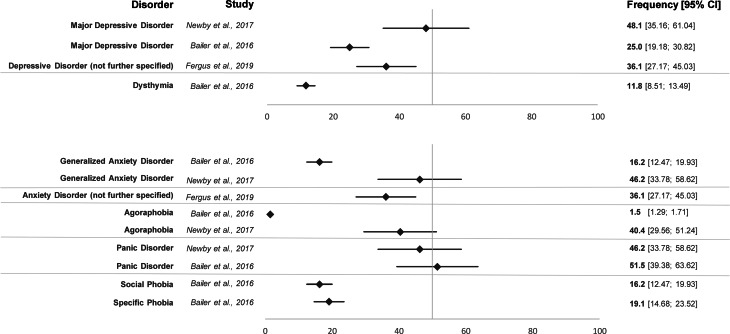
“Moreover, ssD often coexists with mood and anxiety disorders, sharing overlapping symptoms, diagnostic criteria, and similar psychobiological mechanisms (hüsing et al. 2018; löwe et al. 2022).”
Siig, E. J. P., Lykke, V.-M. H., Herrera, A. M. M., Jørgensen, T. S. H., Ferrari, A. J., & Santomauro, D. F. (2025) · The Lancet Psychiatry · doi:10.1016/s2215-0366(25)00272-x · Cited by 13
Liu, Z., Dong, L., Tang, W., & Gao, T. (2022) · Psychiatry Research Neuroimaging · doi:10.1016/j.pscychresns.2022.111563 · Cited by 7
Bresnick, S. D., Morris, S., & Lagman, C. (2024) · Plastic & Reconstructive Surgery Global Open · doi:10.1097/gox.0000000000006322 · Cited by 7
“10,11 The processes are mediated centrally such that psychological stress and anxiety affect neural circuits which control peripheral functions and create somatic symptoms.”
Huang, W.-L., Chiu, Y., Löwe, B., Wu, C., & Liao, S. (2025) · Journal of Affective Disorders · doi:10.1016/j.jad.2025.119521 · Cited by 7
Self-citationPeters, L., Matysiak, A., Hübener, S., Lohse, A. W., Nestoriuc, Y., Maehder, K., & Löwe, B. (2025) · Journal of Psychosomatic Research · doi:10.1016/j.jpsychores.2025.112395 · Cited by 7
Self-citationWu, C., Wang, W., Ji, H., Zhu, J., & Guo, C. (2024) · Current Psychology · doi:10.1007/s12144-024-05624-2 · Cited by 8
“These items, targeting on the individual perceptions of diverse symptoms regarding gastrointestinal, pain, cardiopulmonary, and fatigue, were affirmed according to the presence of somatic symptoms in health care and the statistical power in analysis (Löwe et al., 2022).”
Huang, W., Chiu, Y., Liao, S., & Wu, C. (2024) · Psychiatry Research · doi:10.1016/j.psychres.2024.116103 · Cited by 5
Zhao, H., Zhu, X., Li, W., & Lin, X. H. (2025) · International Journal of Mental Health Promotion · doi:10.32604/ijmhp.2025.062739 · Cited by 11
“The scale primarily measures depressive affect, emphasizing the emotional aspects of depression while minimizing somatic symptom evaluation [66], and it remains a widely utilized tool in both contemporary research and clinical practice, with established reliability and validity in various…”
Prevalence of somatic symptom disorder and influence of alexithymia in women with thyroid diseases
Marchetti, D., Nardo, M. D., Benedetto, S. D., & Porcelli, P. (2025) · Journal of Psychiatric Research · doi:10.1016/j.jpsychires.2025.05.047 · Cited by 5
Haun, M. W., van Eickels, D., Tönnies, J., Graue, L., Ayoub-Schreifeldt, M., Wensing, M., Hartmann, M., Szécsényi, J., Wild, B., & Friederich, H. (2024) · Journal of Psychosomatic Research · doi:10.1016/j.jpsychores.2024.111801 · Cited by 5
Huang, J., Zhong, Y., Duan, Y., & Sun, J. (2023) · Frontiers in Psychiatry · doi:10.3389/fpsyt.2023.1119938 · Cited by 6
Henningsen, P., & Löwe, B. (2024) · Psychotherapy and Psychosomatics · doi:10.1159/000542424 · Cited by 9
Self-citationPersistent Altered States: Psychological Treatment of Psychedelic Adverse Effects
Holmøy, B., & Andersen, K. A. A. (2025) · Tidsskrift for Norsk psykologforening · doi:10.52734/hgsn7664 · Cited by 4
Dietsche, S., Weeren, F., Meinlschmidt, G., Toussaint, A. C., Baenteli, I., Bahmane, S., Frick, A., Karpf, C., Studer, A., Wyss, K., et al. (2026) · General Hospital Psychiatry · doi:10.1016/j.genhosppsych.2025.12.023 · Cited by 7
Self-citationSchneider, A., Hapfelmeier, A., Greißel, A., Limbach, M., Schwarzl, G., Ebert, F., Huber, V., & Hayden, M. C. (2025) · Scientific Reports · doi:10.1038/s41598-025-96055-x · Cited by 4
Fiedorowicz, J. G., & Löwe, B. (2022) · Journal of Psychosomatic Research · doi:10.1016/j.jpsychores.2022.110995 · Cited by 4
Self-citationFränkl, E., Hasenbank, N., Dumröse, K., Löwe, B., & Kohlmann, S. (2023) · Health Expectations · doi:10.1111/hex.13931 · Cited by 5
“2 Regardless of their aetiology, PSS are highly prevalent in the general population 3 and are associated with high mental and physical burden, 4 as well as exorbitant health care utilization.”
BackgroundSelf-citationMicheli, N., Porcelli, P., Barrault-Couchouron, M., & Dantzer, C. (2022) · Frontiers in Psychology · doi:10.3389/fpsyg.2022.996559 · Cited by 3
“, 2020), which is similar to the one usually recorded in primary care patients (Löwe et al., 2022).”
ResultHahn, S., Nestoriuc, Y., Kirchhof, S., Toussaint, A. C., Löwe, B., & Pauls, F. (2025) · BMJ Open · doi:10.1136/bmjopen-2024-091032 · Cited by 8
Self-citationCerebellar microstructural abnormalities in patients with somatic symptom disorders
Tang, W., Zhang, C., Qi, Y., Zhou, Q., Li, H., Shen, X.-H., Liu, L., Wang, W., Liu, J., & Du, X. (2025) · BMC Psychiatry · doi:10.1186/s12888-025-06642-5 · Cited by 5
“In 2013, the American Psychiatric Association introduced “somatic symptom disorder” (SSD) in DSM-5 (300.82) as a new diagnostic category, characterized by distressing somatic symptoms, excessive health-related thoughts/behaviors, and persistence over 6 months [1, 2].”
InfluentialMaroti, D. (2025) · Frontiers in Psychiatry · doi:10.3389/fpsyt.2025.1481405 · Cited by 4
“FSD can present as single-system conditions which does not need to equate but can present like irritable bowel syndrome (IBS) or multi-system issues such as co-occurring IBS and fi bromyalgia, often severely impacting daily life and frequently accompanied by psychiatric comorbidities (8).”
Blanton, M. (2025) · Society and Mental Health · doi:10.1177/21568693251345117 · Cited by 5
van Eickels, D., Henning, K., Wensing, M., Friederich, H., & Haun, M. W. (2025) · General Hospital Psychiatry · doi:10.1016/j.genhosppsych.2025.09.001 · Cited by 5
Klein, E. M., Kruse, J., Löwe, B., Brähler, E., Lahmann, C., Witthöft, M., & Krakau, L. (2025) · Annals of Medicine · doi:10.1080/07853890.2025.2578726 · Cited by 4
Self-citationMaatkamp, M., Derksen, H. J., Paarlberg, A. J. C., Joosten, J. P. A., & Rovers, J. J. E. (2025) · Psychoanalytic Psychotherapy · doi:10.1080/02668734.2025.2573249 · Cited by 3
“Somatic Symptom Disorder (SSD) has an estimated prevalence of 4% in the general population, making it one of the most common mental disorders as defined by the DSM-5 (American Psychiatric Association [APA], 2013; Henningsen, 2018; Löwe, Levenson, et al., 2022).”
Lu, Y., Zhao, H., Zhu, X., & Li, W. (2025) · BMC Psychology · doi:10.1186/s40359-025-03718-5 · Cited by 7
“The present study employed the Center for Epidemiological Studies Depression Scale (CES-D) [67], a well-validated instrument designed to assess depressive affect with a primary focus on emotional experience, while deliberately downplaying somatic symptomatology [68].”
Lygre, R. B., Gjestad, R., Norekvål, T. M., Mercer, S. W., & Elgen, I. B. (2023) · BMC Health Services Research · doi:10.1186/s12913-023-10250-y · Cited by 4
“Such complaints are prevalent in both children and adolescents [2, 6–8], and several studies suggest an increasing trend [9, 10].”
BackgroundSomatic Symptom Disorder After Mild Traumatic Brain Injury
Silverberg, N. D., Rioux, M., Mikolić, A., Perez, D. L., Burke, M. J., & Howard, A. K. (2025) · Journal of Head Trauma Rehabilitation · doi:10.1097/htr.0000000000001068 · Cited by 5
Fischer, S., Ali, N., Feneberg, A. C., Mewes, R., & Nater, U. M. (2022) · Frontiers in Psychiatry · doi:10.3389/fpsyt.2022.954051 · Cited by 5
Tönnies, J., Graue, L., Ayoub-Schreifeldt, M., Wensing, M., Szécsényi, J., Friederich, H., & Haun, M. W. (2023) · PPmP - Psychotherapie · Psychosomatik · Medizinische Psychologie · doi:10.1055/a-2105-3402 · Cited by 3
“Die von SSD Betroffenen leiden unter funktionellen Einschränkun - gen, verminderter Lebensqualität sowie einhergehenden depressiven Störungen und Angststörungen [3] und stellen sich überwiegend in der Hausarztpraxis vor [4].”
BackgroundChernov, A., Shchetinina, N. A., & Негребецкий, В. А. (2023) · RESEARCH RESULTS IN BIOMEDICINE · doi:10.18413/2658-6533-2023-9-4-0-10 · Cited by 5
Salehi, C., Kershaw, K. A., Storer, B., Newby, J. M., & Murphy, M. J. (2024) · Psychiatry Research Case Reports · doi:10.1016/j.psycr.2024.100209 · Cited by 3
LoBrutto, L. R., Keeley, J. W., & Dautovich, N. D. (2024) · Journal of Clinical Psychology in Medical Settings · doi:10.1007/s10880-024-10005-9 · Cited by 5
“Overall clinical utility has improved from DSM-IV somatization disorder to DSM-5 somatic symptom disorder, and the new diagnostic category is shown to be among the most useful in DSM-5 field trials (Dimsdale et al., 2013; Löwe et al., 2022).”
BackgroundMethodInfluentialWeijters, R. M. M. M., Almela, M., Boxtel, G. J. M. V., & de Vroege, L. (2024) · Journal of Clinical and Experimental Neuropsychology · doi:10.1080/13803395.2024.2383282 · Cited by 3
“The prevalence of SSRD in the general population is approximately 12.9% (Löwe et al., 2022, 2013), and 31.7% in primary care setting (Fergus et al., 2019).”
InfluentialYuan, J., Zhong, Y., Li, Y., Liao, Y., & Tang, H. (2025) · Frontiers in Psychiatry · doi:10.3389/fpsyt.2025.1519492 · Cited by 4
Huang, W., Chiu, Y., Wu, C., Löwe, B., & Liao, S. (2025) · Psychotherapy and Psychosomatics · doi:10.1159/000545409 · Cited by 4
Self-citationBizzi, F., Tironi, M., Conte, F. P., Brusadelli, E., & Locati, F. (2025) · Research on Child and Adolescent Psychopathology · doi:10.1007/s10802-025-01347-5 · Cited by 2
“One possible explanation is that deficits in this self-polarity of mentalizing are a key component of inter-nalizing psychopathology (Ballespí et al., 2021 ), particularly among individuals with somatic problems, consistent with previous studies (see Löwe et al., 2022 for a scoping review).”
Somatic Symptom and Related Disorders and Mild Traumatic Brain Injury: A Systematic Review
Jobin, K., Wilson, A. J., King, R., Eliason, P., Galarneau, J.-M. F., Gilmour, G. S., & Debert, C. T. (2025) · Psychosomatic Medicine · doi:10.1097/psy.0000000000001427 · Cited by 2
Eid, M., Kheir, V. A., Bizri, M., Larnaout, A., & Hayek, S. E. (2025) · Frontiers in Psychiatry · doi:10.3389/fpsyt.2025.1692267 · Cited by 7
Hahn, S., Pauls, F., Wittenbecher, H., Maehder, K., Löwe, B., Blankenburg, K., Toussaint, A. C., & Nestoriuc, Y. (2026) · Journal of Psychosomatic Research · doi:10.1016/j.jpsychores.2026.112546 · Cited by 3
Self-citationNeuropsychiatric Treatment in Functional Neurological Disorder: Foundations and Future
Gonsalvez, I., Lane, C. E., & Baslet, G. C. (2026) · Seminars in Neurology · doi:10.1055/a-2786-3694 · Cited by 3
Jiang, Y., Gao, L., Liu, W., & Yurong, T. (2026) · Frontiers in Medicine · doi:10.3389/fmed.2026.1762738 · Cited by 3
Prisco, V., Donnarumma, B., & Prisco, L. (2023) · OBM Geriatrics · doi:10.21926/obm.geriatr.2301228 · Cited by 3
Zhang, Y., Baumeister, D., Spanidis, M., Engel, F., Berens, S., Gauss, A., Eich, W., & Tesarz, J. (2023) · Frontiers in Psychiatry · doi:10.3389/fpsyt.2023.1114782 · Cited by 2
“(12), SSD frequency rates, depending on the study population, sampling strategies, and diagnostic approaches applied in the single studies, varied from 3.”
MethodNevoia, M. V., Pypa, L. V., Svistilnik, R. V., & Zymak‐Zakutnia, N. (2023) · Modern pediatrics Ukraine · doi:10.15574/sp.2023.134.56 · Cited by 4
Arble, E. (2024) · International Journal of Environmental Research and Public Health · doi:10.3390/ijerph21010061 · Cited by 2
Hoheisel, M., Popkirov, S., Michaelis, R., & Rose, M. (2024) · Complex Psychiatry · doi:10.1159/000536668 · Cited by 6
“In line with this task, a recent review by Löwe et al. [4] discussed the validity of the B-criteria.”
BackgroundResultInfluential
Metadata
- Authors
- Löwe, B., Levenson, J., Depping, M., Hüsing, P., Kohlmann, S., Lehmann, M., Shedden-Mora, M., Toussaint, A., Uhlenbusch, N., & Weigel, A.
- Affiliations
- University Medical Center Hamburg-Eppendorf (DE)
- Virginia Commonwealth University (US)
- MSH Medical School Hamburg – University of Applied Sciences and Medical University (DE)
- Corresponding author
- Löwe, Bernd
- Venue
- Psychological Medicine
- Publisher
- Cambridge University Press (CUP)
- Published
- 2021-11-15
- Volume
- 52
- Issue
- 4
- Pages
- 632-648
- ISSN
- 0033-2917 (ISSN-L)
- 1469-8978
- PMC
- PMC8961337
- OpenAlex
- W3211400143
- Cited by
- 217
- References
- 80
- Citations by year
- 2026: 50 · 2025: 65 · 2024: 51 · 2023: 36 · 2022: 15
- FWCI
- 4.55
- Type
- journal article
- Language
- en
- Open access
- hybrid
- doi.org
- Locations
- Psychological Medicine (publishedVersion, cc-by)
- PubMed Central (publishedVersion, cc-by)
- PubMed (publishedVersion)
- Topics
- Health Sciences › Medicine › Psychiatry and Mental health › Psychosomatic Disorders and Their Treatments
- Social Sciences › Psychology › Experimental and Cognitive Psychology › Anxiety, Depression, Psychometrics, Treatment, Cognitive Processes
- Health Sciences › Medicine › Psychiatry and Mental health › Fibromyalgia and Chronic Fatigue Syndrome Research
- Keywords
- somatic symptom disorder, DSM-5, diagnostic criteria, prevalence, functional disability, quality of life, comorbidities, anxiety disorders, depressive disorders, suicide risk, gender differences, cultural factors, diagnostic validity
- MeSH terms
- Medically Unexplained Symptoms, Humans, Quality of Life, Surveys and Questionnaires, Somatoform Disorders, Reproducibility of Results, Diagnostic and Statistical Manual of Mental Disorders
About these checks
Registry, retraction, Cites and statistics results are computed, not judged, with one exception: a printed reference that no index lists is read once by a model before it counts as a citation error. Claims are extracted by a model and kept only when their quote appears verbatim in the text; each cited source is then checked, with a model’s help, for whether it says what the claim relies on. Those verdicts can be wrong — read the claim’s quote and the cited source before relying on one.
Statistics and arithmetic are recomputed, not judged.
Confidence bands are shown only for fields calibrated on our annotated test set. None is calibrated yet, so no band is shown.
What counts as a claim ›How we measure confidence ›How we check this ›
Are you an author, or do you see a problem with this page? Request a review
Data sources
Bibliographic data: Semantic Scholar, OpenAlex, Crossref.
Contains information from the Semantic Scholar Academic Graph Datasets, made available under the ODC Attribution License (ODC-BY 1.0).
Semantic Scholar’s data is described in: Kinney, R., et al. (2023). The Semantic Scholar Open Data Platform. arXiv:2301.10140.
