

Somatic symptom disorder: a scoping review on the empirical evidence of a new diagnosis
Open accessThe DOI matches its Crossref record; 80 of the 80 references it cites were found in a registry or an index.
Abstract
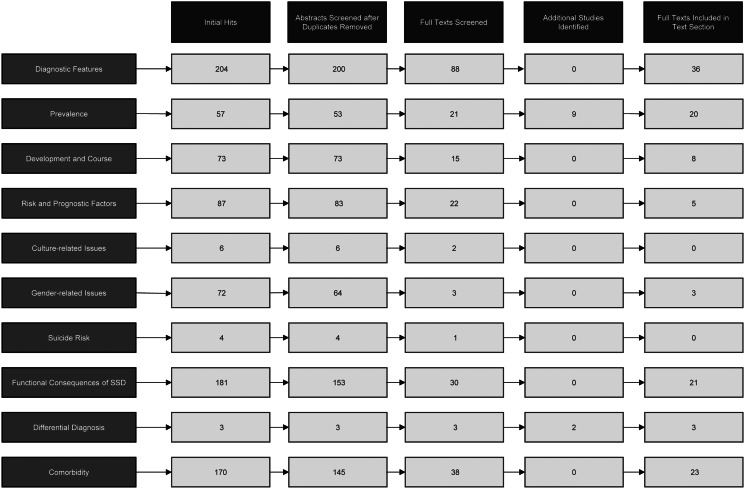
Background: In 2013, the diagnosis of somatic symptom disorder (SSD) was introduced into the Diagnostic and Statistical Manual of Mental Disorders (DSM-5). This review aims to comprehensively synthesize contemporary evidence related to SSD. Methods: A scoping review was conducted using PubMed, PsycINFO, and Cochrane Library. The main inclusion criteria were SSD and publication in the English language between 01/2009 and 05/2020. Systematic search terms also included subheadings for the DSM-5 text sections; i.e., diagnostic features, prevalence, development and course, risk and prognostic factors, culture, gender, suicide risk, functional consequences, differential diagnosis, and comorbidity. Results: Eight hundred and eighty-two articles were identified, of which 59 full texts were included for analysis. Empirical evidence supports the reliability, validity, and clinical utility of SSD diagnostic criteria, but the further specification of the psychological SSD B-criteria criteria seems necessary. General population studies using self-report questionnaires reported mean frequencies for SSD of 12.9% [95% confidence interval (CI) 12.5–13.3%], while prevalence studies based on criterion standard interviews are lacking. SSD was associated with increased functional impairment, decreased quality of life, and high comorbidity with anxiety and depressive disorders. Relevant research gaps remain regarding developmental aspects, risk and prognostic factors, suicide risk as well as culture- and gender-associated issues. Conclusions: Strengths of the SSD diagnosis are its good reliability, validity, and clinical utility, which substantially improved on its predecessors. SSD characterizes a specific patient population that is significantly impaired both physically and psychologically. However, substantial research gaps exist, e.g., regarding SSD prevalence assessed with criterion standard diagnostic interviews.
Overview
The claims and statistics of this paper haven’t been checked yet.
Free: it reads the open-access text and checks the first 5 claims that cite a source we can check. Create a free account to check every claim.
Integrity signals
Registry
Cites
Statistics
Figures
Verification
Claims the paper makes
The claims and statistics of this paper haven’t been checked yet.
Free: it reads the open-access text and checks the first 5 claims that cite a source we can check. Create a free account to check every claim.
Claims other papers make about this one
Each is checked against this paper’s own text: does it say what the citing paper says it does?
The source backs part of the claim, not all of it — or backs it for a different population, condition or comparison.
In the citing paper
“these newer diagnoses allowed for much greater diagnostic reliability and validity”
From Persistent physical symptoms: definition, genesis, and management (2024) · cites this paper as [35]
Experimental — accuracy not yet measuredThe cited source says what the claim attributes to it.
In the citing paper
“These diagnoses also require disproportionate and persistent thoughts about the seriousness of one's symptoms”
From Persistent physical symptoms: definition, genesis, and management (2024) · cites this paper as [35]
Self-check
Percentages, sums and reported differences re-computed from the paper’s own numbers.
The self-check needs the paper’s full text.
Citations
Cites
PRISMA Extension for Scoping Reviews (PRISMA-ScR): Checklist and Explanation
Tricco, A. C., Lillie, E., Zarin, W., O'Brien, K. K., Colquhoun, H., Levac, D., Moher, D., Peters, M. D. J., Horsley, T., Weeks, L., et al. (2018) · Annals of Internal Medicine · doi:10.7326/m18-0850 · Cited by 43,565 · cited 2×
“Review findings are reported according to the Preferred Reporting Items for Systematic Reviews and Meta-Analysis extension for Scoping Reviews (PRISMA-ScR) statement (Tricco et al., 2018).”
MethodKroenke, K., Spitzer, R. L., Williams, J. B. W., & Löwe, B. (2010) · General Hospital Psychiatry · doi:10.1016/j.genhosppsych.2010.03.006 · Cited by 4,057 · cited 2×
“Valid self-report instruments for the diagnosis of SSD are available for the A-criterion, e.g., with the Somatic Symptom Severity Scale-8 (SSS-8) (Gierk et al., 2014) or the Patient Health Questionnaire-15 (PHQ-15) (Kroenke, Spitzer, Williams, & Löwe, 2010), and for the B-criteria, e.g., with the Somatic Symptom Disor…”
MethodSelf-citationRegier, D. A., Narrow, W. E., Clarke, D. E., Kraemer, H. C., Kuramoto, S. J., Kuhl, E. A., & Kupfer, D. J. (2013) · American Journal of Psychiatry · doi:10.1176/appi.ajp.2012.12070999 · Cited by 1,163
The Somatic Symptom Scale–8 (SSS-8): A Brief Measure of Somatic Symptom Burden
Gierk, B., Kohlmann, S., Kroenke, K., Spangenberg, L., Zenger, M., Brähler, E., & Löwe, B. (2014) · JAMA Internal Medicine · doi:10.1001/jamainternmed.2013.12179 · Cited by 740
Self-citationDepression, anxiety and somatization in primary care: Syndrome overlap and functional impairment
Löwe, B., Spitzer, R. L., Williams, J. B. W., Mussell, M., Schellberg, D., & Kroenke, K. (2008) · General Hospital Psychiatry · doi:10.1016/j.genhosppsych.2008.01.001 · Cited by 706
Self-citationPatients presenting with somatic complaints: epidemiology, psychiatric co‐morbidity and management
Kroenke, K. (2003) · International Journal of Methods in Psychiatric Research · doi:10.1002/mpr.140 · Cited by 624 · cited 1×
“The DSM-5 diagnosis not only received a new name; its diagnostic criteria also differ radically from somatization disorder which it replaced: Following scientific evidence of over two decades (Kroenke, 2003; Voigt et al., 2012), positive psychological criteria were formulated, i.”
BackgroundInfluentialEscobar, J. I. (1987) · Archives of General Psychiatry · doi:10.1001/archpsyc.1987.01800200039006 · Cited by 428
A systematic review of the epidemiology of somatisation disorder and hypochondriasis
Creed, F., & Barsky, A. (2004) · Journal of Psychosomatic Research · doi:10.1016/s0022-3999(03)00622-6 · Cited by 421 · cited 1×
“(Creed & Barsky, 2004; Escobar, Burnam, Karno, Forsythe, & Golding, 1987), but lower than undifferentiated somatoform disorders ( ∼ 20”
Henningsen, P., Gündel, H., Kop, W. J., Löwe, B., Martin, A., Rief, W., Rosmalen, J. G. M., Schröder, A., van der Feltz-Cornelis, C., & Van den Bergh, O. (2018) · Psychosomatic Medicine · doi:10.1097/psy.0000000000000588 · Cited by 310
Self-citationon behalf of the EURONET-SOMA Group, Burton, C., Fink, P., Henningsen, P., Löwe, B., & Rief, W. (2020) · BMC Medicine · doi:10.1186/s12916-020-1505-4 · Cited by 292
Self-citationDevelopment and Validation of the Somatic Symptom Disorder–B Criteria Scale (SSD-12)
Toussaint, A., Murray, A. M., Voigt, K., Herzog, A., Gierk, B., Kroenke, K., Rief, W., Henningsen, P., & Löwe, B. (2016) · Psychosomatic Medicine · doi:10.1097/psy.0000000000000240 · Cited by 291 · cited 3×
“, 2018), and in a psychosomatic outpatient sample (Toussaint et al., 2016).”
BackgroundResultSelf-citationRief, W., & Martin, A. (2014) · Annual Review of Clinical Psychology · doi:10.1146/annurev-clinpsy-032813-153745 · Cited by 251 · cited 2×
“Further, the diagnostic specifiers included in the diagnosis (predominant pain, persistence, and severity) were addressed in only a few studies (Axelsson et al., 2016; Katz, Rosenbloom, & Fashler, 2015; Rief & Martin, 2014).”
BackgroundResultSomatic symptom disorder: an important change in DSM
Dimsdale, J. E., Creed, F., Escobar, J., Sharpe, M., Wulsin, L., Barsky, A., Lee, S., Irwin, M. R., & Levenson, J. (2013) · Journal of Psychosomatic Research · doi:10.1016/j.jpsychores.2013.06.033 · Cited by 239
Self-citationThe epidemiology of multiple somatic symptoms
Creed, F. H., Davies, I., Jackson, J., Littlewood, A., Chew-Graham, C., Tomenson, B., Macfarlane, G., Barsky, A., Katon, W., & McBeth, J. (2012) · Journal of Psychosomatic Research · doi:10.1016/j.jpsychores.2012.01.009 · Cited by 224
Clarke, D. E., Narrow, W. E., Regier, D. A., Kuramoto, S. J., Kupfer, D. J., Kuhl, E. A., Greiner, L., & Kraemer, H. C. (2013) · American Journal of Psychiatry · doi:10.1176/appi.ajp.2012.12070998 · Cited by 201
Chronic pain, psychopathology, and DSM-5 Somatic Symptom Disorder
Katz, J., Rosenbloom, B. N., & Fashler, S. (2015) · The Canadian Journal of Psychiatry · doi:10.1177/070674371506000402 · Cited by 195 · cited 1×
“Further, the diagnostic specifiers included in the diagnosis (predominant pain, persistence, and severity) were addressed in only a few studies (Axelsson et al., 2016; Katz, Rosenbloom, & Fashler, 2015; Rief & Martin, 2014).”
BackgroundToussaint, A. C., Löwe, B., Brähler, E., & Jordan, P. (2017) · Journal of Psychosomatic Research · doi:10.1016/j.jpsychores.2017.03.017 · Cited by 157 · cited 1×
“Furthermore, three studies found significant associations between the SSD-12 score and depression and anxiety levels in the general population (Toussaint et al., 2017), in a primary care setting (Toussaint et al.”
BackgroundSelf-citationToussaint, A., Hüsing, P., Kohlmann, S., & Löwe, B. (2020) · Psychological Medicine · doi:10.1017/s003329171900014x · Cited by 153
Self-citationNewby, J. M., Hobbs, M. J., Mahoney, A. E. J., Wong, S. (., & Andrews, G. (2017) · Journal of Psychosomatic Research · doi:10.1016/j.jpsychores.2017.07.010 · Cited by 148 · cited 12×
“Given that IAD is diagnosed when there are no or only minimally distressing persistent somatic symptoms, by DSM-5 definition, a patient can either be diagnosed with SSD or IAD, but not both (American Psychiatric Association, 2013).”
BackgroundInfluentialHealth anxiety and hypochondriasis in the light of DSM-5
Bailer, J., Kerstner, T., Witthöft, M., Diener, C., Mier, D., & Rist, F. (2016) · Anxiety, Stress, & Coping · doi:10.1080/10615806.2015.1036243 · Cited by 130
Rief, W., Burton, C., Frostholm, L., Henningsen, P., Kleinstäuber, M., Kop, W. J., Löwe, B., Martin, A., Malt, U., Rosmalen, J., et al. (2017) · Psychosomatic Medicine · doi:10.1097/psy.0000000000000502 · Cited by 129 · cited 1×
“Further, psychological distress was more strongly associated with patient complexity than the number of physical symptoms (van Eck van der Sluijs, de Vroege, van Manen, Rijnders, & van der Feltz-Cornelis, 2017).”
BackgroundSelf-citationThe new somatic symptom disorder in DSM-5 risks mislabeling many people as mentally ill
Frances, A. (2013) · BMJ · doi:10.1136/bmj.f1580 · Cited by 113 · cited 3×
“After publication, SSD criteria were criticized as imprecise (Mayou, 2014) and overinclu-sive, risking overdiagnosis (Frances, 2013).”
BackgroundMethodThe overlap of somatic, anxious and depressive syndromes: A population-based analysis
Kohlmann, S., Gierk, B., Hilbert, A., Brähler, E., & Löwe, B. (2016) · Journal of Psychosomatic Research · doi:10.1016/j.jpsychores.2016.09.004 · Cited by 110
Self-citationPrevalence of DSM-5 Somatic Symptom Disorder in Chinese Outpatients from General Hospital Care
Cao, J., Wei, J., Fritzsche, K., Toussaint, A. C., Li, T., Jiang, Y., Zhang, L., Zhang, Y., Chen, H., Wu, H., et al. (2019) · General Hospital Psychiatry · doi:10.1016/j.genhosppsych.2019.11.010 · Cited by 99
Self-citationSomatoform disorders: 30 years of debate about criteria!
Schulte, I. E., & Petermann, F. (2010) · Journal of Psychosomatic Research · doi:10.1016/j.jpsychores.2010.08.005 · Cited by 96 · cited 1×
“With regard to SSD in early life, SSD criteria were seen as helpful (van Geelen, Rydelius, & Hagquist, 2015) and more suitable for children and adolescents compared to prior diagnoses (Schulte & Petermann, 2011).”
BackgroundSomatic symptom burden and health anxiety in the population and their correlates
Lee, S., Creed, F. H., Ma, Y.-L., & Leung, C. M. (2015) · Journal of Psychosomatic Research · doi:10.1016/j.jpsychores.2014.11.012 · Cited by 89 · cited 1×
“Health anxiety and somatic symptom burden as predictors A large prospective general population study found health anxiety and somatic symptom burden to be independently related to functional impairment (Lee, Creed, Ma, & Leung, 2015).”
BackgroundVoigt, K., Wollburg, E., Weinmann, N., Herzog, A., Meyer, B., Langs, G., & Löwe, B. (2012) · Journal of Psychosomatic Research · doi:10.1016/j.jpsychores.2012.08.020 · Cited by 87
Self-citationDiagnostic criteria for psychosomatic research and somatic symptom disorders
Sirri, L., & Fava, G. A. (2013) · International Review of Psychiatry · doi:10.3109/09540261.2012.726923 · Cited by 85 · cited 1×
“Two studies suggested using “ diagnostic criteria for psychosomatic research ” to improve DSM-5 diagnostic criteria (Huang & Liao, 2018; Sirri & Fava, 2013).”
BackgroundLiao, S., Ma, H.-M., Lin, Y., & Huang, W. (2019) · Comprehensive Psychiatry · doi:10.1016/j.comppsych.2019.02.004 · Cited by 84 · cited 4×
“Comorbid depression was found to be associated with poorer overall functioning and quality of life (Liao et al., 2019).”
BackgroundInfluentialSpecific Somatoform Disorder in the General Population
Grabe, H. J., Meyer, C., Hapke, U., Rumpf, H., Freyberger, H. J., Dilling, H., & John, U. (2003) · Psychosomatics · doi:10.1176/appi.psy.44.4.304 · Cited by 80
Bizzi, F., Ensink, K., Borelli, J. L., Mora, S. C., & Cavanna, D. (2018) · European Child & Adolescent Psychiatry · doi:10.1007/s00787-018-1238-5 · Cited by 79
Kop, W. J., Toussaint, A. C., Mols, F., & Löwe, B. (2018) · General Hospital Psychiatry · doi:10.1016/j.genhosppsych.2018.10.004 · Cited by 76 · cited 3×
“Recent evidence also indicates that the SSD B-criteria are highly associated with depressive and anxiety symptoms (Hüsing et al., 2018; Kop et al., 2019; Toussaint et al., 2016, 2017).”
BackgroundSelf-citationvan Geelen, S. M., Rydelius, P., & Hagquist, C. (2015) · Journal of Psychosomatic Research · doi:10.1016/j.jpsychores.2015.07.012 · Cited by 70 · cited 5×
“A cross-sectional population-based study among adolescents (van Geelen et al., 2015) indicated that in those with serious psychological concerns regarding health and illness, reporting three or more persistent distressing somatic symptoms was significantly more common than reporting one or two.”
BackgroundInfluentialDessel, N. C.-V., van der Wouden, J. C., Dekker, J., & van der Horst, H. E. (2016) · Journal of Psychosomatic Research · doi:10.1016/j.jpsychores.2016.01.004 · Cited by 69 · cited 7×
“The majority of studies considered the inclusion of the B-criteria as a positive change in the diagnostic conception (Claassen-van Dessel et al., 2016; Klaus et al., 2015; Wollburg, Voigt, Braukhaus, Herzog, & Löwe, 2013).”
BackgroundResultInfluentialHüsing, P., Löwe, B., & Toussaint, A. (2018) · Journal of Psychosomatic Research · doi:10.1016/j.jpsychores.2018.08.001 · Cited by 65 · cited 9×
“Only seven studies used semi-structured clinical interviews based on DSM-5 criteria to diagnose SSD (Calabro et al., 2019; Cao et al., 2020; Fergus, Kelley, & Griggs, 2019; Guidi et al., 2013; Huang et al., 2016; Hüsing et al., 2018; Umemura et al., 2019).”
BackgroundMethodResultInfluentialSelf-citationHäuser, W., Bialas, P., Welsch, K., & Wolfe, F. (2015) · Journal of Psychosomatic Research · doi:10.1016/j.jpsychores.2015.03.151 · Cited by 61
Rief, W., Mewes, R., Martin, A., Glaesmer, H., & Brähler, E. (2011) · Psychosomatic Medicine · doi:10.1097/psy.0b013e318234eff6 · Cited by 61 · cited 5×
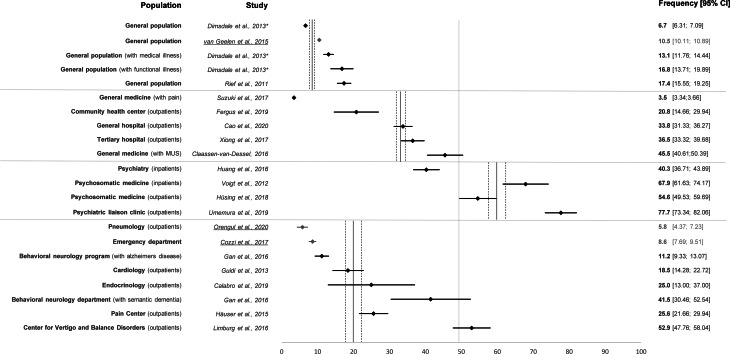
“Only two studies that used proxy estimates of SSD, reported data from adult population-based surveys (Creed et al., 2012; Dimsdale et al., 2013; Rief et al., 2011) with frequency rates of 6.7 and 17.4% being higher than DSM-IV somatization disorder ( ∼ 1 – 6”
BackgroundResultInfluentialAxelsson, E., Andersson, E., Ljótsson, B., Wallhed Finn, D., & Hedman, E. (2016) · Cognitive Behaviour Therapy · doi:10.1080/16506073.2016.1161663 · Cited by 60 · cited 5×
“However, the diagnostic distinction between SSD and IAD remains questionable: Based on present findings, IAD might be considered a milder form of SSD (Bailer et al., 2016).”
BackgroundResultInfluentialWollburg, E., Voigt, K., Braukhaus, C., Herzog, A., & Löwe, B. (2012) · Journal of Psychosomatic Research · doi:10.1016/j.jpsychores.2012.09.015 · Cited by 58 · cited 6×
“Some potential additional features of SSD have been investigated, e.g., body scanning, illness denial, and self-concept of bodily weakness (Guidi, Rafanelli, Roncuzzi, Sirri, & Fava, 2013; Klaus et al., 2015; Wollburg et al., 2013).”
BackgroundInfluentialSelf-citationBrain Functional Connectivity in Patients With Somatic Symptom Disorder
Kim, S. M., Hong, J. S., Min, K. J., & Han, D. H. (2019) · Psychosomatic Medicine · doi:10.1097/psy.0000000000000681 · Cited by 58 · cited 1×
“…frontostriatal circuit dysfunction (Ahn et al., 2017), changes in regional homogeneity values (Li et al., 2016), altered autonomic reactivity (Huang et al., 2019; Lee et al., 2018), altered pain processing (Kim, Hong, Min, & Han, 2019), and changes in autobiographical memories (Walentynowicz,”
BackgroundValidity of the Somatic Symptom Disorder–B Criteria Scale (SSD-12) in primary care
Toussaint, A., Riedl, B., Kehrer, S., Schneider, A., Löwe, B., & Linde, K. (2018) · Family Practice · doi:10.1093/fampra/cmx116 · Cited by 56 · cited 2×
“, 2017), in a primary care setting (Toussaint et al., 2018), and in a psychosomatic outpatient sample (Toussaint et al.”
BackgroundSelf-citationMeasures of Heart Rate Variability in Individuals With Somatic Symptom Disorder
Huang, W., Liao, S., Yang, C. C. H., Kuo, T. B. J., Chen, T., Chen, I., & Gau, S. S. (2016) · Psychosomatic Medicine · doi:10.1097/psy.0000000000000362 · Cited by 52
Somatization and Health Anxiety as Predictors of Health Care Use
Tomenson, B., McBeth, J., Chew-Graham, C. A., MacFarlane, G., Davies, I., Jackson, J., Littlewood, A., & Creed, F. H. (2012) · Psychosomatic Medicine · doi:10.1097/psy.0b013e31825cb140 · Cited by 51 · cited 1×
“Finally, another 640 Bernd Löwe et al. prospective study indicated that the number of somatic symptoms and health anxiety were predictors of health care use 1 year later (Tomenson et al., 2012).”
BackgroundAssessing psychological factors affecting medical conditions: comparison between different proposals
Guidi, J., Rafanelli, C., Roncuzzi, R., Sirri, L., & Fava, G. A. (2012) · General Hospital Psychiatry · doi:10.1016/j.genhosppsych.2012.09.007 · Cited by 48
Martin, A., & Rief, W. (2011) · Psychiatric Clinics of North America · doi:10.1016/j.psc.2011.05.007 · Cited by 46 · cited 1×
“Our review yielded mixed results regarding the reliability of the B-criteria (Axelsson et al., 2016; Regier et al., 2013; Rief & Martin, 2014), and several alternative psychological features have been proposed (Martin & Rief, 2011).”
ResultCozzi, G., Minute, M., Skabar, A., Pirrone, A., Jaber, M. H., Neri, E., Montico, M., Ventura, A., & Barbi, E. (2017) · Acta Paediatrica · doi:10.1111/apa.13741 · Cited by 46
Is the DSM-5 chapter on somatic symptom disorder any better than DSM-IV somatoform disorder?
Mayou, R. (2014) · British Journal of Psychiatry · doi:10.1192/bjp.bp.113.134833 · Cited by 45 · cited 1×
“After publication, SSD criteria were criticized as imprecise (Mayou, 2014) and overinclu-sive, risking overdiagnosis (Frances, 2013).”
BackgroundVoigt, K., Wollburg, E., Weinmann, N., Herzog, A., Meyer, B., Langs, G., & Löwe, B. (2013) · Journal of Psychosomatic Research · doi:10.1016/j.jpsychores.2013.08.017 · Cited by 44
Self-citationBizzi, F., Cavanna, D., Castellano, R., & Pace, C. S. (2015) · Frontiers in Psychology · doi:10.3389/fpsyg.2015.01125 · Cited by 38 · cited 3×
“Bizziand colleagues (Bizzi et al., 2015) compared inpatients with SSD v. disruptive behavior disorders and observed significant presence of insecure attachment in more than a half of the patients in both groups, but no significant differences between them in sociodemographic characteristics,…”
BackgroundInfluentialKohlmann, S., Löwe, B., & Shedden-Mora, M. C. (2018) · Frontiers in Psychiatry · doi:10.3389/fpsyt.2018.00646 · Cited by 37
Self-citationPsychopathological and psychiatric evaluation of patients affected by lipodystrophy
Calabrò, P. F., Ceccarini, G., Calderone, A., Lippi, C., Piaggi, P., Ferrari, F., Magno, S., Pedrinelli, R., & Santini, F. (2019) · Eating and Weight Disorders - Studies on Anorexia Bulimia and Obesity · doi:10.1007/s40519-019-00716-6 · Cited by 36
Somatic Symptom Disorders in Adolescent Inpatients
Gao, X., McSwiney, P., Court, A., Wiggins, A., & Sawyer, S. M. (2018) · Journal of Adolescent Health · doi:10.1016/j.jadohealth.2018.06.026 · Cited by 35
Weigel, A., Hüsing, P., Kohlmann, S., Lehmann, M., Mora, M. C. S., Toussaint, A. C., & Löwe, B. (2017) · Journal of Psychosomatic Research · doi:10.1016/j.jpsychores.2017.04.003 · Cited by 33
Self-citationLimburg, K., Sattel, H. C., Dinkel, A., Radziej, K., Becker‐Bense, S., & Lahmann, C. (2017) · Comprehensive Psychiatry · doi:10.1016/j.comppsych.2017.05.003 · Cited by 33
Klaus, K., Rief, W., Brähler, E., Martin, A., Glaesmer, H., & Mewes, R. (2015) · Journal of Abnormal Psychology · doi:10.1037/abn0000085 · Cited by 31 · cited 5×
“Some potential additional features of SSD have been investigated, e.g., body scanning, illness denial, and self-concept of bodily weakness (Guidi, Rafanelli, Roncuzzi, Sirri, & Fava, 2013; Klaus et al., 2015; Wollburg et al., 2013).”
BackgroundInfluentialSomatic Symptom Disorder in Semantic Dementia: The Role of Alexisomia
Gan, J. J., Lin, A., Samimi, M. S., & Mendez, M. F. (2016) · Psychosomatics · doi:10.1016/j.psym.2016.08.002 · Cited by 31
van Eck van der Sluijs, J. F., de Vroege, L., van Manen, A. S., Rijnders, C. A. T., & van der Feltz-Cornelis, C. M. (2017) · Psychosomatics · doi:10.1016/j.psym.2017.02.008 · Cited by 31 · cited 2×
“In another study, the complexity of SSD was associated with higher self-reported depression and anxiety (van Eck van der Sluijs et al., 2017).”
BackgroundToussaint, A. C., Hüsing, P., Kohlmann, S., Brähler, E., & Löwe, B. (2020) · Psychosomatic Medicine · doi:10.1097/psy.0000000000000903 · Cited by 31 · cited 1×
“A first attempt at operationalizing excessiveness can be found in a study (Toussaint, Hüsing, Kohlmann, Brähler, & Löwe, 2021), which describes that individuals with SSD spent an average of 4 h a day preoccupied with their somatic symptoms.”
BackgroundSelf-citationDSM-5 somatic symptom disorder in patients with vertigo and dizziness symptoms
Limburg, K., Sattel, H. C., Radziej, K., & Lahmann, C. (2016) · Journal of Psychosomatic Research · doi:10.1016/j.jpsychores.2016.10.005 · Cited by 30 · cited 18×
“Thus, a more precise definition of the content and cut-offs for the B-criteria definitely remains a task for the next edition of the DSM.”
BackgroundResultInfluentialPediatric Somatic Symptom and Related Disorders: Primary Care Provider Perspectives
Malas, N., Donohue, L. K., Cook, R. J., Leber, S. M., & Kullgren, K. A. (2017) · Clinical Pediatrics · doi:10.1177/0009922817727467 · Cited by 29
Fergus, T. A., Kelley, L. P., & Griggs, J. O. (2019) · Journal of Psychosomatic Research · doi:10.1016/j.jpsychores.2019.109839 · Cited by 29
Classifying Fibromyalgia Syndrome as a Mental Disorder?—An Ambulatory Assessment Study
Klaus, K., Fischer, S., Doerr, J. M., Nater, U. M., & Mewes, R. (2016) · International Journal of Behavioral Medicine · doi:10.1007/s12529-016-9603-6 · Cited by 28 · cited 2×
“The predictive validity of SSD ’ s diagnostic criteria was further demonstrated in psychosomatic inpatients (Voigt et al., 2013) and in patients with fibromyalgia (Klaus, Fischer, Doerr, Nater, & Mewes, 2017).”
BackgroundInfluentialSchumacher, S., Rief, W., Klaus, K., Brähler, E., & Mewes, R. (2017) · Psychological Medicine · doi:10.1017/s0033291717000149 · Cited by 28 · cited 4×
“Beyond these instruments, the recommendations of the EURONET-SOMA group for assessing core outcome domains may help to improve the comparability of results from clinical trials in the future (Rief et al., 2017).”
BackgroundMethodInfluentialLi, Q., Xiao, Y., Li, Y., Li, L., Lu, N., Xu, Z., Mou, X., Mao, S., Wang, W., & Yuan, Y. (2016) · Brain and Behavior · doi:10.1002/brb3.521 · Cited by 26 · cited 1×
“…the left inferior parietal gyri (Eken et al., 2019), frontostriatal circuit dysfunction (Ahn et al., 2017), changes in regional homogeneity values (Li et al., 2016), altered autonomic reactivity (Huang et al., 2019; Lee et al., 2018), altered pain processing (Kim, Hong, Min, & Han, 2019), and…”
BackgroundAhn, J., Han, D. H., Hong, J. S., Min, K. J., Lee, Y. S., Hahm, B., & Kim, S. M. (2017) · Psychosomatic Medicine · doi:10.1097/psy.0000000000000490 · Cited by 25
Lee, D., Kim, S. J., Cheon, J., Hwang, E. H., Jung, Y., & Kang, J. I. (2018) · Psychosomatic Medicine · doi:10.1097/psy.0000000000000622 · Cited by 24 · cited 1×
“…frontostriatal circuit dysfunction (Ahn et al., 2017), changes in regional homogeneity values (Li et al., 2016), altered autonomic reactivity (Huang et al., 2019; Lee et al., 2018), altered pain processing (Kim, Hong, Min, & Han, 2019), and changes in autobiographical memories (Walentynowicz,”
BackgroundHuang, W., Chen, I., Chang, F.-C., & Liao, S. (2016) · Journal of Psychosomatic Research · doi:10.1016/j.jpsychores.2016.07.014 · Cited by 24 · cited 3×
“Only seven studies used semi-structured clinical interviews based on DSM-5 criteria to diagnose SSD (Calabro et al., 2019; Cao et al., 2020; Fergus, Kelley, & Griggs, 2019; Guidi et al., 2013; Huang et al., 2016; Hüsing et al., 2018; Umemura et al., 2019).”
BackgroundHuang, W., & Liao, S. (2018) · Psychotherapy and Psychosomatics · doi:10.1159/000492227 · Cited by 24 · cited 1×
“Two studies suggested using “ diagnostic criteria for psychosomatic research ” to improve DSM-5 diagnostic criteria (Huang & Liao, 2018; Sirri & Fava, 2013).”
BackgroundOperationalization of diagnostic criteria of DSM-5 somatic symptom disorders
Xiong, N., Zhang, Y., Wei, J., Leonhart, R., Fritzsche, K., Mewes, R., Hong, X., Cao, J., Li, T., Jiang, J., et al. (2017) · BMC Psychiatry · doi:10.1186/s12888-017-1526-5 · Cited by 22
Hatta, K., Hosozawa, M., Tanaka, K., & Shimizu, T. (2018) · Journal of Autism and Developmental Disorders · doi:10.1007/s10803-018-3751-2 · Cited by 22
Lehmann, M., Jonas, C., Pohontsch, N. J., Zimmermann, T. P., Scherer, M., & Löwe, B. (2019) · Journal of Psychosomatic Research · doi:10.1016/j.jpsychores.2019.109734 · Cited by 21 · cited 1×
“In particular, the Somatic Symptom Disorder B-Criteria Scale (SSD-12), a self-report questionnaire assessing SSD B-criteria, has been shown to be a valid predictor of quality of life and health care use (Kop, Toussaint, Mols, & Löwe, 2019; Toussaint et al., 2016, 2017).”
BackgroundSelf-citationCarmassi, C., Dell’Oste, V., Ceresoli, D., Moscardini, S., Bianchi, E., Landi, R., Massimetti, G., Nisita, C., & Dell’Osso, L. (2018) · Neuropsychiatric Disease and Treatment · doi:10.2147/ndt.s179013 · Cited by 21
Huang, W., Liao, S., Tu, Y., Yang, C. C. H., Kuo, T. B. J., & Gau, S. S. (2019) · Journal of Psychosomatic Research · doi:10.1016/j.jpsychores.2019.05.007 · Cited by 19
Eken, A., Çolak, B., Bal, N. B., Kuşman, A., Kızılpınar, S. Ç., Akaslan, D. S., & Başkak, B. (2019) · Journal of Neural Engineering · doi:10.1088/1741-2552/ab50b2 · Cited by 15
Walentynowicz, M., Raes, F., Van Diest, I., & Van den Bergh, O. (2017) · Psychosomatic Medicine · doi:10.1097/psy.0000000000000357 · Cited by 14
Inamura, K., Shinagawa, S., Nagata, T., Tagai, K., Nukariya, K., & Nakayama, K. (2014) · Psychosomatics · doi:10.1016/j.psym.2014.10.004 · Cited by 14 · cited 1×
“A small cross-sectional study in late-life outpatients found that those with severe SSD had more cognitive impairment than those with milder SSD and healthy age-matched controls, but sampling bias prevents drawing reliable conclusions (Inamura et al., 2015).”
BackgroundPsychiatric comorbidity in children with psychogenic and functional breathing disorders
Örengül, A. C., Ertaş, E., Kahraman, F. U., Yazan, H., Çakır, E., & Nursoy, M. A. (2019) · Pediatric Pulmonology · doi:10.1002/ppul.24565 · Cited by 12
Mander, J., Schaller, G., Bents, H., Dinger, U., Zipfel, S., & Junne, F. (2017) · BMC Psychiatry · doi:10.1186/s12888-017-1400-5 · Cited by 8 · cited 1×
“Finally, in a sample of SSD inpatients, ambivalent treatment motivation was related to more negative treatment outcomes (Mander et al., 2017).”
BackgroundSuzuki, S., Ohira, Y., Noda, K., & Ikusaka, M. (2017) · Journal of Pain Research · doi:10.2147/jpr.s137482 · Cited by 7 · cited 1×
“In studies conducted in non-specialized general medicine settings, frequency rates ranged from 3.5 (Suzuki, Ohira, Noda, & Ikusaka, 2017)”
BackgroundInfluentialOral medicine psychiatric liaison clinic: study of 1202 patients attending over an 18-year period
Umemura, E., Tokura, T., Ito, M., Kobayashi, Y., Tachibana, M., Miyauchi, T., Tonoike, T., Nagashima, W., Kimura, H., Arao, M., et al. (2019) · International Journal of Oral and Maxillofacial Surgery · doi:10.1016/j.ijom.2018.12.005 · Cited by 7 · cited 1×
“Only seven studies used semi-structured clinical interviews based on DSM-5 criteria to diagnose SSD (Calabro et al., 2019; Cao et al., 2020; Fergus, Kelley, & Griggs, 2019; Guidi et al., 2013; Huang et al., 2016; Hüsing et al., 2018; Umemura et al., 2019).”
Background
Research works printed but not linked: 3
- World Health Organization (1992). The ICD-10 classification of mental and behavioural disorders: Clinical descriptions and diagnostic guidelines (10th ed.). Geneva: World Health Organization.
- American Psychiatric Association (2000). Diagnostic and statistical manual of mental disorders, forth edition, text revision (DSM-IV-TR). Arlington, VA: American Psychiatric Association.
- American Psychiatric Association (2013). Diagnostic and statistical manual of mental disorders, fifth edition (DSM-5). Arlington, VA: American Psychiatric Publishing.
Cited by
Persistent physical symptoms: definition, genesis, and management
Löwe, B., Toussaint, A., Rosmalen, J. G. M., Huang, W.-L., Burton, C., Weigel, A., Levenson, J. L., & Henningsen, P. (2024) · The Lancet · doi:10.1016/s0140-6736(24)00623-8 · Cited by 280
Self-citationMicai, M., Fatta, L. M., Gila, L., Caruso, A., Salvitti, T., Fulceri, F., Ciaramella, A., D'Amico, R., Del Giovane, C., Bertelli, M., et al. (2023) · Neuroscience & Biobehavioral Reviews · doi:10.1016/j.neubiorev.2023.105436 · Cited by 184
Psychological factors associated with Long COVID: a systematic review and meta-analysis
Engelmann, P., Reinke, M., Stein, C., Salzmann, S., Löwe, B., Toussaint, A. C., & Mora, M. C. S. (2024) · EClinicalMedicine · doi:10.1016/j.eclinm.2024.102756 · Cited by 106
Self-citationSmakowski, A., Hüsing, P., Völcker, S., Löwe, B., Rosmalen, J. G. M., Mora, M. C. S., & Toussaint, A. C. (2024) · Journal of Psychosomatic Research · doi:10.1016/j.jpsychores.2024.111608 · Cited by 105
Self-citationOverall comorbidities in functional neurological disorder: A narrative review
Carle, G., Goutte, J., Do-Quang-Cantagrel, N., Mouchabac, S., Joly, C., & Garcin, B. (2023) · L Encéphale · doi:10.1016/j.encep.2023.06.004 · Cited by 67
Metadata
- Authors
- Löwe, B., Levenson, J., Depping, M., Hüsing, P., Kohlmann, S., Lehmann, M., Shedden-Mora, M., Toussaint, A., Uhlenbusch, N., & Weigel, A.
- Affiliations
- University Medical Center Hamburg-Eppendorf (DE)
- Virginia Commonwealth University (US)
- MSH Medical School Hamburg – University of Applied Sciences and Medical University (DE)
- Corresponding author
- Löwe, Bernd
- Venue
- Psychological Medicine
- Publisher
- Cambridge University Press (CUP)
- Published
- 2021-11-15
- Volume
- 52
- Issue
- 4
- Pages
- 632-648
- ISSN
- 0033-2917 (ISSN-L)
- 1469-8978
- PMC
- PMC8961337
- OpenAlex
- W3211400143
- Cited by
- 217
- References
- 80
- Citations by year
- 2026: 50 · 2025: 65 · 2024: 51 · 2023: 36 · 2022: 15
- FWCI
- 4.55
- Type
- journal article
- Language
- en
- Open access
- hybrid
- doi.org
- Locations
- Psychological Medicine (publishedVersion, cc-by)
- PubMed Central (publishedVersion, cc-by)
- PubMed (publishedVersion)
- Topics
- Health Sciences › Medicine › Psychiatry and Mental health › Psychosomatic Disorders and Their Treatments
- Social Sciences › Psychology › Experimental and Cognitive Psychology › Anxiety, Depression, Psychometrics, Treatment, Cognitive Processes
- Health Sciences › Medicine › Psychiatry and Mental health › Fibromyalgia and Chronic Fatigue Syndrome Research
- Keywords
- somatic symptom disorder, DSM-5, diagnostic criteria, prevalence, functional disability, quality of life, comorbidities, anxiety disorders, depressive disorders, suicide risk, gender differences, cultural factors, diagnostic validity
- MeSH terms
- Medically Unexplained Symptoms, Humans, Quality of Life, Surveys and Questionnaires, Somatoform Disorders, Reproducibility of Results, Diagnostic and Statistical Manual of Mental Disorders
About these checks
Registry, retraction, Cites and statistics results are computed, not judged, with one exception: a printed reference that no index lists is read once by a model before it counts as a citation error. Claims are extracted by a model and kept only when their quote appears verbatim in the text; each cited source is then checked, with a model’s help, for whether it says what the claim relies on. Those verdicts can be wrong — read the claim’s quote and the cited source before relying on one.
Statistics and arithmetic are recomputed, not judged.
Confidence bands are shown only for fields calibrated on our annotated test set. None is calibrated yet, so no band is shown.
What counts as a claim ›How we measure confidence ›How we check this ›
Are you an author, or do you see a problem with this page? Request a review
Data sources
Bibliographic data: Semantic Scholar, OpenAlex, Crossref.
Contains information from the Semantic Scholar Academic Graph Datasets, made available under the ODC Attribution License (ODC-BY 1.0).
Semantic Scholar’s data is described in: Kinney, R., et al. (2023). The Semantic Scholar Open Data Platform. arXiv:2301.10140.
