

Results of the first randomized controlled trial of integrated cognitive-behavioral therapy for eating disorders and posttraumatic stress disorder
Open accessThe DOI matches its Crossref record; 38 of the 39 references it cites were found in a registry or an index.
Abstract
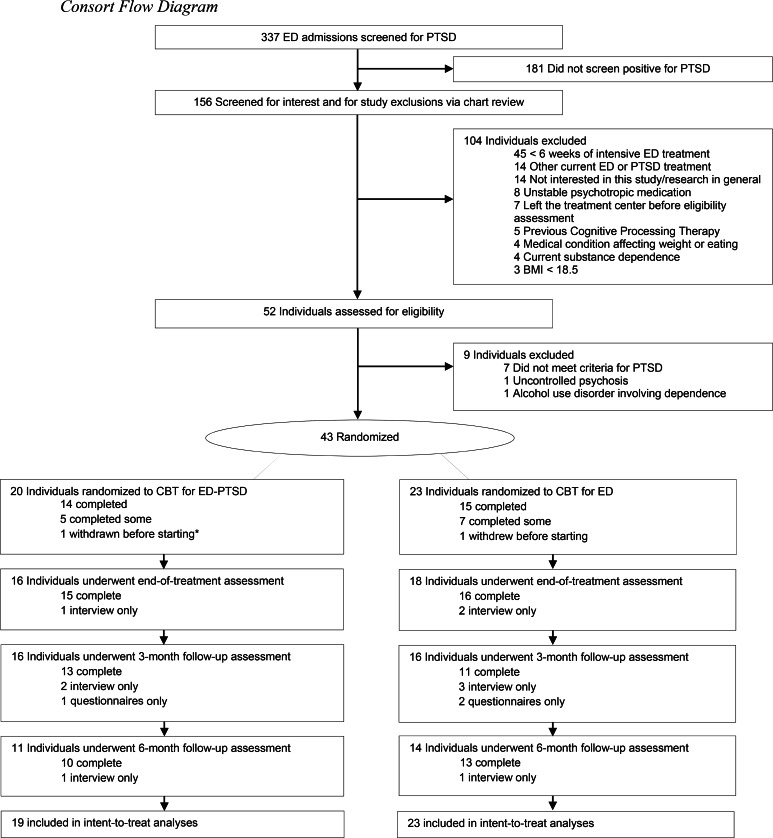
Background: Eating disorders (EDs) and posttraumatic stress disorder (PTSD) frequently co-occur and can share a functional relationship. The primary aim of this initial randomized controlled trial was to determine whether integrated cognitive-behavioral therapy (CBT) for co-occurring ED-PTSD was superior to standard CBT for ED in improving PTSD symptoms. Intervention safety and desirability, as well as the relative efficacy of the treatments in improving anxiety, depression, and ED symptomatology, were also examined. Methods: Following a course of intensive ED treatment, individuals with ED-PTSD were recruited to participate and randomized to integrated CBT for ED-PTSD or standard CBT for ED. The sample consisted of 42 individuals with a range of ED diagnoses. Outcomes were assessed at end-of-treatment, 3-, and 6-month follow-up using interview and self-report measures. Results: Mixed models revealed significant interactions of time and therapy condition on clinician-rated and self-reported PTSD symptom severity favoring Integrated CBT for ED-PTSD. Both treatments were associated with statistically significant improvements in PTSD, anxiety, and depression. Improvements were maintained at 3- and 6-month follow-up. There was good safety with both interventions, and satisfaction with both treatments was high. However, there was a stronger preference for integrated treatment. Conclusions: Integrating CBTs for PTSD and ED following intensive ED treatment is safe, desirable, and efficacious for improving PTSD symptoms. Future studies with larger sample sizes are needed to determine whether Integrated CBT for ED-PTSD provides benefits over standard CBT for ED with respect to ED outcomes.
Overview
The claims and statistics of this paper haven’t been checked yet.
Free: it reads the open-access text and checks the first 5 claims that cite a source we can check. Create a free account to check every claim.
Integrity signals
Registry
Cites
Statistics
Figures
Verification
Claims the paper makes
The claims and statistics of this paper haven’t been checked yet.
Free: it reads the open-access text and checks the first 5 claims that cite a source we can check. Create a free account to check every claim.
Claims other papers make about this one
Each is checked against this paper’s own text: does it say what the citing paper says it does?
The source backs part of the claim, not all of it — or backs it for a different population, condition or comparison.
In the citing paper
“The most researched of trauma-focuses approaches in this population is cognitive processing therapy (CPT), which arguably is very well-suited for ED + PTSD patients (29, 112, 113, 121–123).”
From The integrated treatment of eating disorders, posttraumatic stress disorder, and psychiatric comorbidity: a commentary on the evolution of principles and guidelines (2023) · cites this paper as [122]
Experimental — accuracy not yet measuredThe source backs part of the claim, not all of it — or backs it for a different population, condition or comparison.
In the citing paper
“For example, as ED symptoms abate with treatment so also can symptoms of disorders of mood, anxiety, personality, etc. (11, 112, 122, 239, 240).”
From The integrated treatment of eating disorders, posttraumatic stress disorder, and psychiatric comorbidity: a commentary on the evolution of principles and guidelines (2023) · cites this paper as [122]
Experimental — accuracy not yet measuredThe source backs part of the claim, not all of it — or backs it for a different population, condition or comparison.
In the citing paper
“Recently published outcome data indicate that integrated treatment approaches can result in significant improvement in ED, PTSD and related symptoms (11, 12, 112, 122, 127, 156).”
From The integrated treatment of eating disorders, posttraumatic stress disorder, and psychiatric comorbidity: a commentary on the evolution of principles and guidelines (2023) · cites this paper as [122]
Experimental — accuracy not yet measured
Self-check
Percentages, sums and reported differences re-computed from the paper’s own numbers.
The self-check needs the paper’s full text.
Citations
Cites
Lovibond, P. F., & Lovibond, S. H. (1995) · Behaviour Research and Therapy · doi:10.1016/0005-7967(94)00075-u · Cited by 14,523 · cited 1×
“Participants also completed the Depression Anxiety Stress Scales (DASS; Lovibond and Lovibond, 1995) which provided measures of depression (score range, 0 – 42) and anxiety (0 – 42) over the past week with higher scores reflecting greater severity.”
Posttraumatic Stress Disorder in the National Comorbidity Survey
Kessler, R. C. (1995) · Archives of General Psychiatry · doi:10.1001/archpsyc.1995.03950240066012 · Cited by 10,379
Jacobson, N. S., & Truax, P. (1991) · Journal of Consulting and Clinical Psychology · doi:10.1037/0022-006x.59.1.12 · Cited by 7,770 · cited 1×
“We also examined reliable change (Jacobson & Truax, 1991) in CAPS-5 and EDE global scores, as well as loss of diagnostic status (PTSD and ED) at each assessment point.”
The mini international neuropsychiatric interview
Lecrubier, Y., Sheehan, D., Hergueta, T., & Weiller, E. (1998) · European Psychiatry · doi:10.1016/s0924-9338(99)80239-9 · Cited by 5,872
Blevins, C. A., Weathers, F. W., Davis, M. T., Witte, T. K., & Domino, J. L. (2015) · Journal of Traumatic Stress · doi:10.1002/jts.22059 · Cited by 5,233
The prevalence and correlates of eating disorders in the National Comorbidity Survey Replication
Hudson, J. I., Hiripi, E., Pope, H. G., & Kessler, R. C. (2007) · Biological Psychiatry · doi:10.1016/j.biopsych.2006.03.040 · Cited by 4,973
Weathers, F. W., Bovin, M. J., Lee, D. J., Sloan, D. M., Schnurr, P. P., Kaloupek, D. G., Keane, T. M., & Marx, B. P. (2018) · Psychological Assessment · doi:10.1037/pas0000486 · Cited by 1,799 · cited 1×
“The Clinician-Administered PTSD Scale-5 (CAPS-5; Weathers et al., 2013) was used to make a PTSD diagnosis, and to determine PTSD remission.”
Cognitive Behavior Therapy and Eating Disorders
Ghaderi, A. (2009) · Cognitive Behaviour Therapy · doi:10.1080/16506070802473239 · Cited by 1,243
Meta-Analysis of the Efficacy of Treatments for Posttraumatic Stress Disorder
Watts, B. V., Schnurr, P. P., Mayo, L., Young-Xu, Y., Weeks, W. B., & Friedman, M. J. (2013) · The Journal of Clinical Psychiatry · doi:10.4088/jcp.12r08225 · Cited by 985
Fairburn, C. G., Cooper, Z., Doll, H. A., O’Connor, M. E., Bohn, K., Hawker, D. M., Wales, J. A., & Palmer, R. L. (2009) · American Journal of Psychiatry · doi:10.1176/appi.ajp.2008.08040608 · Cited by 829 · cited 1×
“The past month EDE global score (measuring ED psychopathology) is a transdiagnostic measure of ED outcome, and is utilized in studies with mixed ED diagnosis samples (e.g. Fairburn et al., 2009).”
Research works printed but not linked: 2
- 5. Brewerton, T. D. (2004). Eating disorders, victimization, and comorbidity: Principles of treatment. In T. D. Brewerton (Ed.), Clinical handbook of eating disorders: An integrated approach (pp. 509– 545). New York: Marcel Dekker.
- 1. American Psychiatric Association. (2013). Diagnostic and statistical manual of mental disorders (5th ed.). Washington, DC: Author.
Cited by
A Systematic Review of the Effect of PTSD and Trauma on Treatment Outcomes for Eating Disorders
Day, S., Hay, P., Tannous, K., Fatt, S. J., & Mitchison, D. (2023) · Trauma Violence & Abuse · doi:10.1177/15248380231167399 · Cited by 86
“A recent randomized controlled trial examined the effectiveness of cognitive processing therapy (CPT) integrated with CBT for eating disorders, following initial intensive eating disorder treatment (Trottier et al., 2022).”
BackgroundBrewerton, T. D. (2022) · Journal of Eating Disorders · doi:10.1186/s40337-022-00696-6 · Cited by 80
Convertino, A. D., & Mendoza, R. R. (2023) · International Journal of Eating Disorders · doi:10.1002/eat.23933 · Cited by 61
Brewerton, T. D. (2023) · Frontiers in Psychiatry · doi:10.3389/fpsyt.2023.1149433 · Cited by 46
“Recently published outcome data indicate that integrated treatment approaches can result in significant improvement in ED, PTSD and related symptoms (11, 12, 112, 122, 127, 156).”
BackgroundRossi, E., Cassioli, E., Dani, C., Marchesoni, G., Monteleone, A. M., Wonderlich, S. A., Ricca, V., & Castellini, G. (2024) · Neuroscience & Biobehavioral Reviews · doi:10.1016/j.neubiorev.2024.105619 · Cited by 44
Self-citationState of the Science of Cognitive Processing Therapy
Resick, P. A., LoSavio, S. T., Monson, C. M., Kaysen, D. L., Wachen, J. S., Galovski, T. E., Stirman, S. W., Nixon, R. D. V., & Chard, K. M. (2024) · Behavior Therapy · doi:10.1016/j.beth.2024.04.003 · Cited by 43
Self-citationBrewerton, T. D., Gavidia, I., Suro, G., & Perlman, M. M. (2023) · Journal of Eating Disorders · doi:10.1186/s40337-023-00773-4 · Cited by 38
“There is a great need to develop integrated models to treat ED-PTSD, especially in higher levels of care [3, 4, 11, 18, 19, 26, 27, 64, 79].”
BackgroundElwyn, R., Adams, M., Sharpe, S. L., Silverstein, S., LaMarre, A., Downs, J. L., & Burnette, C. B. (2024) · Journal of Eating Disorders · doi:10.1186/s40337-024-01016-w · Cited by 42
Recent Advances in Cognitive-Behavioural Therapy for Eating Disorders (CBT-ED)
Waller, G., & Beard, J. (2024) · Current Psychiatry Reports · doi:10.1007/s11920-024-01509-0 · Cited by 38
“In contrast, when considering post traumatic stress disorder (PTSD), routine CBT-ED versus an integrated CBT for eating disorders and PTSD did not differ in their outcomes, either immediately or in the longer term [68].”
BackgroundClaudat, K., Reilly, E. E., Convertino, A. D., Trim, J., Cusack, A., & Kaye, W. H. (2022) · Eating and Weight Disorders - Studies on Anorexia Bulimia and Obesity · doi:10.1007/s40519-022-01500-9 · Cited by 21
“To date, only a handful of studies exists that examine integrated CPT for EDPTSD, all by the same research group [37].”
BackgroundResultTrauma and eating disorders: an integrated umbrella and scoping review
Moroshko, I., Raspovic, A., Liu, J., & Brennan, L. (2025) · Clinical Psychology Review · doi:10.1016/j.cpr.2025.102592 · Cited by 15
Olofsson, M. E., Vrabel, K. R., Kopland, M. C. G., Eielsen, H. P., Oddli, H. W., & Brewerton, T. D. (2024) · European Eating Disorders Review · doi:10.1002/erv.3137 · Cited by 10
Zhou, C., Xue, F., Shi, Q., Xue, S., Zhang, T., Ma, X., Yu, L., Liu, C., Wang, H., & Peng, Z. (2022) · Frontiers in Molecular Neuroscience · doi:10.3389/fnmol.2022.812479 · Cited by 13
Kratzer, L., Heinz, P., Knefel, M., Weindl, D., Tschöke, S., Biedermann, S. V., Schröder, J., & Karatzias, T. (2023) · The Journal of Nervous and Mental Disease · doi:10.1097/nmd.0000000000001671 · Cited by 9
van den Berg, E. M., Pellemans, K., Planting, C. H. M., Daansen, P., van Beers, E., de Jonge, M., Christ, C., & Dekker, J. (2024) · Frontiers in Psychiatry · doi:10.3389/fpsyt.2024.1365715 · Cited by 11
Brewerton, T. D., Suro, G., Fernandez, N., Tulga, K., Gavidia, I., & Perlman, M. M. (2025) · Journal of Psychiatric Research · doi:10.1016/j.jpsychires.2025.05.022 · Cited by 10
PTSD, complex PTSD and the dissociative subtype of PTSD in patients with eating disorders
Brewerton, T. D., Nguyen, C., Bishop, N., & Dennis, K. (2025) · Journal of Eating Disorders · doi:10.1186/s40337-025-01449-x · Cited by 10
“Meanwhile, integrated, trauma-informed treatment plans can be successfully employed to relieve suffering and symptoms [3, 8, 14, 15, 15, 18, 18, 23–26, 55, 64, 83, 84].”
Snoek, A., van den End, A., Beekman, A. T. F., Dekker, J., Aarts, I., Blankers, M., Vriend, C., van den Heuvel, O. A., Lommerse, N. M., & Thomaes, K. (2025) · Psychotherapy and Psychosomatics · doi:10.1159/000544918 · Cited by 11
Liebman, R. E., Hernandez, K. M., Ip, J., Burdo, J., & Trottier, K. (2025) · European Eating Disorders Review · doi:10.1002/erv.3195 · Cited by 12
Self-citationPsychological Trauma as a Risk Factor for Eating Disorders
Burdo, J., Trottier, K., MacDonald, D. E., & Liebman, R. E. (2023) · Springer eBooks · doi:10.1007/978-3-030-97416-9_30-1 · Cited by 11
Self-citationThompson, C. J., & Martin‐Wagar, C. A. (2024) · Eating Disorders · doi:10.1080/10640266.2024.2405290 · Cited by 9
“…into ED treatments has been shown to be effective, the nature of this relationship is not well understood, and treatment for these concurrent disorders has yet to be consolidated into an evidence-based treatment protocol (Claudat et al., 2022; Mitchell et al., 2021; Trottier et al., 2022).”
Hoeboer, C. M., Kullberg, M. J., Oprel, D. A. C., Schoorl, M., van Minnen, A., Antypa, N., Mouthaan, J., de Kleine, R. A., & van der Does, W. A. J. (2024) · Cognitive Behaviour Therapy · doi:10.1080/16506073.2024.2318729 · Cited by 6
“Recently, an RCT was published which was the first study addressing the effects of cognitive behavioral therapy (CBT) on PTSD in patients with an eating disorder after intensive eating disorder treatment (Trottier et al., 2022).”
BackgroundSuro, G., Gavidia, I., Tyran, N., Perlman, M. M., & Brewerton, T. D. (2025) · Eating Disorders · doi:10.1080/10640266.2025.2465145 · Cited by 7
“For example, in a randomized control trial for CBT for PTSD-ED patients, Trottier et al. (2022) found promising evidence for integrated treatment in an outpatient population.”
Dissociative and traumatic experiences in people with eating disorders
Keski‐Rahkonen, A. (2025) · Current Opinion in Psychiatry · doi:10.1097/yco.0000000000001032 · Cited by 5
Ouyang, H., Wang, Y., & Chen, J. (2025) · Journal of Eating Disorders · doi:10.1186/s40337-025-01454-0 · Cited by 7
“A randomized controlled trial demonstrated that CBT-CPT outperformed standard ED-focused CBT in reducing PTSD, depression, and anxiety symptoms at six-month follow-up [135].”
Eating disorder symptoms and corresponding evidence-based treatments: a narrative review
Ortiz, A. M. L., Peters, A. S., Webber, K. T., Butler, R. M., Fitterman-Harris, H. F., & Levinson, C. A. (2026) · Journal of Eating Disorders · doi:10.1186/s40337-025-01485-7 · Cited by 9
“An integrated CBT protocol combining CBT-E and CPT components produced significant reductions in both PTSD and ED symptoms [288].”
Keshen, A. R., Trappenberg, N., Bartel, S. J., Harris, A. L., Taylor, V., Whitney, J., Gamberg, S., Price, C., & Trottier, K. (2025) · Eating Disorders · doi:10.1080/10640266.2025.2453258 · Cited by 8
“Preliminary research suggests integrating enhanced cognitive behavior therapy (CBT-E) for EDs with cognitive processing therapy (CPT) for PTSD may be effective for treating ED-PTSD and be preferred by patients (K. Trottier et al., 2017; K. Trottier et al., 2022).”
Self-citationGnatt, I., Mackelprang, J. L., Phillipou, A., Williamson, D., & Nedeljkovic, M. (2025) · Clinical Psychologist · doi:10.1080/13284207.2024.2437400 · Cited by 5
Tilstra-Ferrell, E. L., Salim, S. R., López, C. M., Foster, A., & Hahn, C. K. (2024) · Cognitive and Behavioral Practice · doi:10.1016/j.cbpra.2024.02.004 · Cited by 5
Treating eating disorders in the wake of trauma
Schaefer, L. M., Hazzard, V. M., & Wonderlich, S. A. (2022) · The Lancet Child & Adolescent Health · doi:10.1016/s2352-4642(22)00072-4 · Cited by 6
Self-citationGearhart, M. G., & Brewerton, T. (2023) · Case Reports in Psychiatry · doi:10.1155/2023/5539951 · Cited by 3
Fatimah, A. G. S., Hodge, R., & Cobham, V. E. (2025) · Clinical Child and Family Psychology Review · doi:10.1007/s10567-025-00548-0 · Cited by 5
“In turn, there are emerging studies in adult populations that have found integrated CBT for co-occurring ED and PTSD to be safe, desirable, and more effective in reducing PTSD symptoms than CBT for EDs alone (Trottier et al., 2022).”
Brewerton, T. D. (2023) · Journal of Psychiatry and Neuroscience · doi:10.1503/jpn.230064-l · Cited by 3
Brenner, I., Ari, L. L., Bachner‐Melman, R., Brand, I., Blondheim, A., Hirschmann, S., Sher, R., & Mintz-Malchi, K. (2025) · Child Abuse & Neglect · doi:10.1016/j.chiabu.2025.107577 · Cited by 3
Siegel, S., Ranney, R. M., Masheb, R., Huggins, J., & Maguen, S. (2024) · Eating Behaviors · doi:10.1016/j.eatbeh.2024.101851 · Cited by 3
Chen, C., Zhang, X., Jiang, H., Li, X., Kong, Q., Si, T., & Zhang, D. (2026) · Neuropsychiatric Disease and Treatment · doi:10.2147/ndt.s554645 · Cited by 2
“51 Such trauma-informed, integrative models may enhance recovery by simultaneously targeting emotion dysregulation and trauma-related cognitive distortions.”
van Beers, E., de Vries, I., Planting, C. H. M., Christ, C., de Beurs, E., & van den Berg, E. M. (2025) · Frontiers in Psychiatry · doi:10.3389/fpsyt.2025.1523269 · Cited by 3
Understanding Personalized Dynamics in Eating Disorders: A Dynamic Time Warp Analysis
Dingemans, A. E., Giltay, E. J., Rohrbach, P. J., van Furth, E. F., & Landt, M. (2025) · International Journal of Eating Disorders · doi:10.1002/eat.24407 · Cited by 3
Shahriaryfar, K., & Mohammadi, S. (2025) · The Neuroscience Journal of Shefaye Khatam · doi:10.61882/shefa.13.4.12 · Cited by 1
Managing Post traumatic Stress Disorder in Eating Disorder Treatment
Trottier, K., MacDonald, D. E., & Liebman, R. E. (2026) · Psychiatric Clinics of North America · doi:10.1016/j.psc.2025.08.007 · Cited by 1
Self-citationWiss, D. A., & Logan, A. C. (2026) · Journal of Eating Disorders · doi:10.1186/s40337-026-01618-6 · Cited by 1
“Notwithstanding, evidence exists that when CBT-E is augmented with evidence-based trauma therapies, it leads to favorable outcomes among those with EDs [33–35].”
Food Addiction and Comorbidity
Brewerton, T. D. (2024) · Oxford University Press eBooks · doi:10.1093/oso/9780190671051.003.0008 · Cited by 3
Trottier, K., Monson, C. M., Wonderlich, S. A., & Crosby, R. D. (2022) · Psychological Medicine · doi:10.1017/s0033291721005365 · Cited by 1
Self-citationDewar-Morgan, C., Nippak, P. M. D., Begum, H., Remers, S., Rosenberg-Yunger, Z. R. S., Meyer, J. M., & Nippak, A. (2024) · Cureus · doi:10.7759/cureus.74478
Psychological Trauma as a Risk Factor for Eating Disorders
Burdo, J., Trottier, K., MacDonald, D. E., & Liebman, R. E. (2024) · Springer eBooks · doi:10.1007/978-3-031-46096-8_30 · Cited by 2
Self-citationTrottier, K., Bartel, S. J., & Keshen, A. R. (2025) · Behavioral Sciences · doi:10.3390/bs15060749
“An integrated CPT and cognitive–behavioural therapy (CBT) for ED intervention has also been developed and evaluated in uncontrolled (Trottier et al., 2017) and randomized controlled research (Trottier et al., 2022).”
Self-citationFelonis, C., Convertino, A., Reilly, E., Beri, S., & Claudat, K. (2025) · Behavioral Science · doi:10.3390/bs15091173 · Cited by 1
“These eligibility criteria were based on prior eligibility criteria for DBT-PE (Harned et al., 2012) and CPT for EDs (Trottier et al., 2022).”
Influentialvan der Starre, J., de Jong, M., de Kleine, R. A., Voogt, C. V., Schoorl, M., & Hoek, H. W. (2025) · European Eating Disorders Review · doi:10.1002/erv.70073
Harkhoe, M. A., Offringa, T. M., & Vermetten, E. H. G. J. M. (2025) · Journal of Eating Disorders · doi:10.1186/s40337-025-01409-5
“Recent studies have shown this integrated treat-ment to be safe and effective in improving both ED and PTSD symptoms in patients [38–40].”
Jalali, A., Ghasemianrad, M., Khazaie, H., Jalali, R., Chavoshani, F., Khalili, M., & Kazeminia, M. (2026) · SN Comprehensive Clinical Medicine · doi:10.1007/s42399-025-02235-1 · Cited by 2
Understanding personalized dynamics in eating disorders : a dynamic time warp analysisPreprint
Rohrbach, P. J., & Dingemans, A. E. (2026) · OSF Preprints (OSF Preprints)
Jansson, M., Olsson, L., Wiberg, A.-C., Parling, T., Ghaderi, A., & Ingesson, S. (2026) · Journal of Eating Disorders · doi:10.1186/s40337-026-01576-z
“Similar work has been done in the field, for eating disorders and other complex conditions, such as post-traumatic stress disorder, which can be of guidance for further methodological development [56].”
Underdiagnosis of PTSD in eating disorders?
Brewerton, T. D. (2026) · Psychiatry Research · doi:10.1016/j.psychres.2026.117123
Complex PTSD as defined by the PTSD checklist for DSM-5 (PCL-5) in patients with eating disorders
Brewerton, T. D., Suro, G., Gavidia, I., & Perlman, M. M. (2026) · Eating Disorders · doi:10.1080/10640266.2026.2647725
Serier, K. N., Zelkowitz, R. L., Nasser, J. I., Smith, B. N., Kehle-Forbes, S., Vogt, D. S., & Mitchell, K. S. (2026) · Journal of Psychiatric Research · doi:10.1016/j.jpsychires.2026.05.039
Lubieniecki, G., SMITH, C., & Bray, M. J. (2026) · IntechOpen eBooks · doi:10.5772/intechopen.1016912
Brewerton, T. D., & Jahraus, J. (2026) · Eating Behaviors · doi:10.1016/j.eatbeh.2026.102135
Metadata
- Authors
- Trottier, K., Monson, C. M., Wonderlich, S. A., & Crosby, R. D.
- Affiliations
- University Health Network (CA)
- Toronto Metropolitan University (CA)
- Sanford Health (US)
- University of North Dakota (US)
- Corresponding author
- Trottier, Kathryn
- Venue
- Psychological Medicine
- Publisher
- Cambridge University Press (CUP)
- Published
- 2021-12-07
- Volume
- 52
- Issue
- 3
- Pages
- 587-596
- ISSN
- 0033-2917 (ISSN-L)
- 1469-8978
- PMC
- PMC8883823
- OpenAlex
- W4200192096
- Cited by
- 58
- References
- 39
- Citations by year
- 2026: 12 · 2025: 19 · 2024: 14 · 2023: 8 · 2022: 5
- FWCI
- 4.60
- Type
- journal article
- Language
- en
- Update notices
- correction (2021-12-07)
- Open access
- hybrid
- doi.org
- Locations
- Psychological Medicine (publishedVersion, cc-by)
- PubMed Central (publishedVersion, cc-by)
- PubMed (publishedVersion)
- Funders
- University of Toronto
- Topics
- Social Sciences › Psychology › Clinical Psychology › Eating Disorders and Behaviors
- Social Sciences › Psychology › Clinical Psychology › Posttraumatic Stress Disorder Research
- Social Sciences › Psychology › Clinical Psychology › Personality Disorders and Psychopathology
- Keywords
- eating disorders, post-traumatic stress disorder, PTSD symptom severity, anxiety, depression, treatment safety, treatment preferences, treatment efficacy
- MeSH terms
- Anxiety, Anxiety Disorders, Feeding and Eating Disorders, Humans, Stress Disorders, Post-Traumatic, Cognitive Behavioral Therapy, Treatment Outcome
About these checks
Registry, retraction, Cites and statistics results are computed, not judged, with one exception: a printed reference that no index lists is read once by a model before it counts as a citation error. Claims are extracted by a model and kept only when their quote appears verbatim in the text; each cited source is then checked, with a model’s help, for whether it says what the claim relies on. Those verdicts can be wrong — read the claim’s quote and the cited source before relying on one.
Statistics and arithmetic are recomputed, not judged.
Confidence bands are shown only for fields calibrated on our annotated test set. None is calibrated yet, so no band is shown.
What counts as a claim ›How we measure confidence ›How we check this ›
Are you an author, or do you see a problem with this page? Request a review
Data sources
Bibliographic data: Semantic Scholar, OpenAlex, Crossref.
Contains information from the Semantic Scholar Academic Graph Datasets, made available under the ODC Attribution License (ODC-BY 1.0).
Semantic Scholar’s data is described in: Kinney, R., et al. (2023). The Semantic Scholar Open Data Platform. arXiv:2301.10140.
