

Cost-effectiveness of psilocybin-assisted therapy for severe depression: exploratory findings from a decision analytic model
Open accessThe DOI matches its Crossref record; 24 of the 24 references it cites were found in a registry or an index.
Abstract
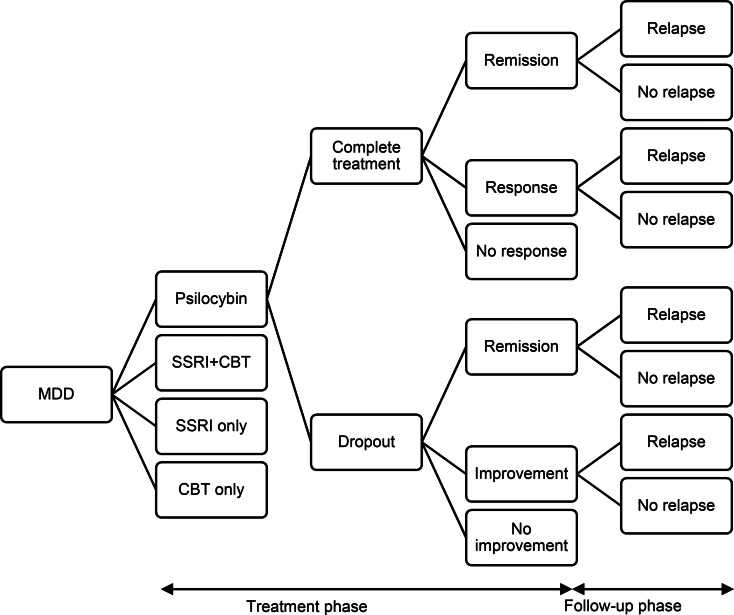
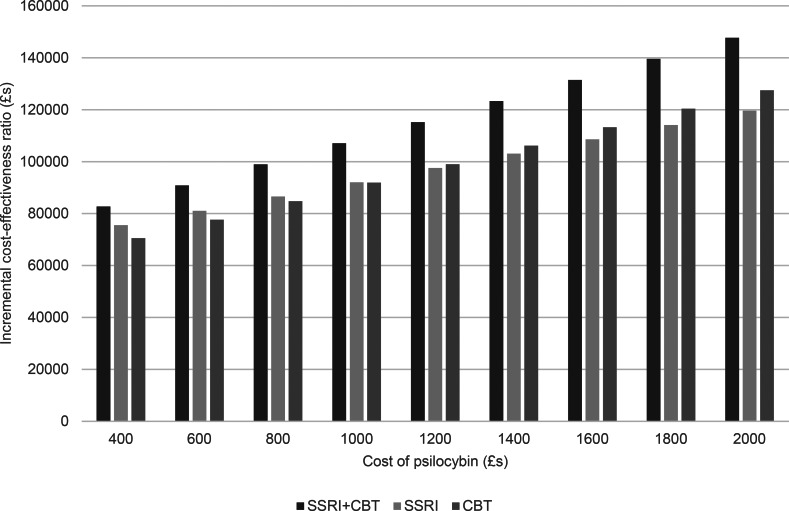
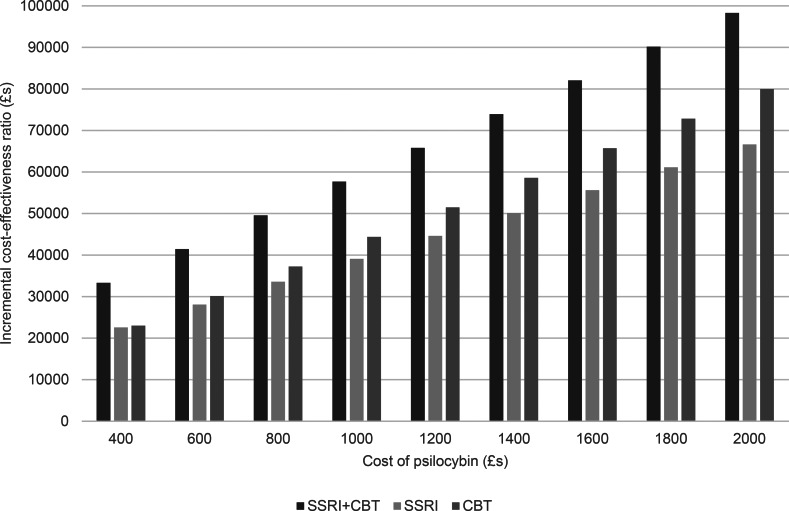
Background: There is growing evidence to support the use of the psychedelic drug psilocybin for difficult-to-treat depression. This paper compares the cost-effectiveness of psilocybin-assisted psychotherapy (PAP) with conventional medication, cognitive behavioural therapy (CBT), and the combination of conventional medication and CBT. Methods: A decision model simulated patient events (response, remission, and relapse) following treatment. Data on probabilities, costs and quality-adjusted life years (QALYs) were derived from previous studies or from best estimates. Expected healthcare and societal costs and QALYs over a 6-month time period were calculated. Sensitivity analyses were used to address uncertainty in parameter estimates. Results: The expected healthcare cost of PAP varied from £6132 to £7652 depending on the price of psilocybin. This compares to £3528 for conventional medication alone, £4250 for CBT alone, and £4197 for their combination. QALYs were highest for psilocybin (0.310), followed by CBT alone (0.283), conventional medication alone (0.278), and their combination (0.287). Psilocybin was shown to be cost-effective compared to the other therapies when the cost of therapist support was reduced by 50% and the psilocybin price was reduced from its initial value to £400 to £800 per person. From a societal perspective, psilocybin had improved cost-effectiveness compared to a healthcare perspective. Conclusions: Psilocybin has the potential to be a cost-effective therapy for severe depression. This depends on the level of psychological support that is given to patients receiving psilocybin and the price of the drug itself. Further data on long-term outcomes are required to improve the evidence base.
Overview
The claims and statistics of this paper haven’t been checked yet.
Free: it reads the open-access text and checks the first 5 claims that cite a source we can check. Create a free account to check every claim.
Integrity signals
Registry
Cites
Statistics
Figures
Verification
Claims the paper makes
The claims and statistics of this paper haven’t been checked yet.
Free: it reads the open-access text and checks the first 5 claims that cite a source we can check. Create a free account to check every claim.
Claims other papers make about this one
Each is checked against this paper’s own text: does it say what the citing paper says it does?
The cited source doesn’t support the claim as written.
In the citing paper
“whereas a British study concluded that psilocybin for treatment of depression can be cost-effective compared to established treatments of depression (selective serotonin reuptake inhibitors, cognitive behavioral therapy) only if therapist costs were reduced by 25%-50% 19”
From Innovations in group-based psilocybin-assisted therapy of major depression in patients with cancer (2024) · cites this paper as [19]
Checked by a reasoning model — may be wrong.
Experimental — accuracy not yet measured
Self-check
Percentages, sums and reported differences re-computed from the paper’s own numbers.
The self-check needs the paper’s full text.
Citations
Cites
Ross, S., Bossis, A., Guss, J., Agin-Liebes, G., Malone, T., Cohen, B., Mennenga, S. E., Belser, A., Kalliontzi, K., Babb, J., et al. (2016) · Journal of Psychopharmacology · doi:10.1177/0269881116675512 · Cited by 1,698 · cited 1×
“Some of these studies have included patients with depression with other comorbid conditions, including cancer, AIDS, eating disorders and substance abuse, with promising results (Lea et al., 2020; Ross et al., 2016; Spriggs, Kettner, & Carhart-Harris, 2021).”
BackgroundTrial of Psilocybin versus Escitalopram for Depression
Carhart-Harris, R., Giribaldi, B., Watts, R., Baker-Jones, M., Murphy-Beiner, A., Murphy, R., Martell, J., Blemings, A., Erritzoe, D., & Nutt, D. J. (2021) · New England Journal of Medicine · doi:10.1056/nejmoa2032994 · Cited by 1,391
Self-citationSingle-Dose Psilocybin for a Treatment-Resistant Episode of Major Depression
Goodwin, G. M., Aaronson, S. T., Alvarez, O., Arden, P. C., Baker, A., Bennett, J. C., Bird, C., Blom, R. E., Brennan, C., Brusch, D., et al. (2022) · New England Journal of Medicine · doi:10.1056/nejmoa2206443 · Cited by 1,167
Andrade, L., Caraveo‐anduaga, J. J., Berglund, P., Bijl, R. V., Graaf, R. D., Vollebergh, W., Dragomirecka, E., Kohn, R., Keller, M., Kessler, R. C., et al. (2003) · International Journal of Methods in Psychiatric Research · doi:10.1002/mpr.138 · Cited by 1,068 · cited 1×
“If restricted to the latter, that still represents upwards of 12% of people with depression (Andrade et al., 2003) and so the costs could be very high.”
BackgroundPsilocybin with psychological support for treatment-resistant depression: six-month follow-up
Carhart-Harris, R. L., Bolstridge, M., Day, C. M. J., Rucker, J., Watts, R., Erritzoe, D. E., Kaelen, M., Giribaldi, B., Bloomfield, M., Pilling, S., et al. (2018) · Psychopharmacology · doi:10.1007/s00213-017-4771-x · Cited by 970
Self-citationMindfulness-based cognitive therapy to prevent relapse in recurrent depression.
Kuyken, W., Byford, S., Taylor, R. S., Watkins, E., Holden, E., White, K., Barrett, B., Byng, R., Evans, A., Mullan, E., et al. (2008) · Journal of Consulting and Clinical Psychology · doi:10.1037/a0013786 · Cited by 770 · cited 1×
“Utility values for remission, response, no response, and relapse were taken from Koeser et al. (2015), who used figures originally reported by Kuyken et al. (2008).”
MethodThe Therapeutic Potential of Psychedelic Drugs: Past, Present, and Future
Carhart-Harris, R. L., & Goodwin, G. M. (2017) · Neuropsychopharmacology · doi:10.1038/npp.2017.84 · Cited by 706 · cited 1×
“There has been a recent resurgence of interest in the potential use of psychedelic substances to treat a variety of psychiatric and neurological disorders (Carhart-Harris & Goodwin, 2017; Goldberg, Pace, Nicholas, Raison, & Hutson, 2020; Shute, 2021).”
BackgroundPopulation-based study of first onset and chronicity in major depressive disorder
Eaton, W. W., Shao, H., Nestadt, G., Lee, B. H., Bienvenu, O. J., & Zandi, P. (2008) · Archives of General Psychiatry · doi:10.1001/archpsyc.65.5.513 · Cited by 612 · cited 1×
“While around one-third of people who experience MDD will recover after one episode, for others the course will be worse and many will not fully recover (Eaton et al., 2008).”
BackgroundPaying the price: the cost of mental health care in England to 2026
McCrone, P., Dhanasiri, S., Patel, A. K., Knapp, M. R. J., & Lawton-Smith, S. H. (2008) · Research Portal (King's College London) · Cited by 591
Self-citationArias-de la Torre, J., Vilagut, G., Ronaldson, A., Serrano-Blanco, A., Martín, V., Peters, M., Valderas, J. M., Dregan, A., & Alonso, J. (2021) · The Lancet Public Health · doi:10.1016/s2468-2667(21)00047-5 · Cited by 282
Research works printed but not linked: 4
- Shute, N. (2021). Rethinking psychedelics and mental health. Science News, 200(10), 2.
- National Collaborating Centre for Mental Health. (2010). Depression: The treatment and management of depression in adults (Updated Edition). Leicester (UK): British Psychological Society. 22132433
- Joint Formulary Committee. (2022). British National Formulary 2022. London: Pharmaceutical Press.
- National Institute for Health and Care Excellence (2022). British National formulary 2022. London: Pharmaceutical Press.
Cited by
Rosenblat, J. D., Meshkat, S., Doyle, Z., Kaczmarek, E. S., Brudner, R. M., Kratiuk, K., Mansur, R. B., Schulz-Quach, C., Sethi, R., Abate, A., et al. (2024) · Med · doi:10.1016/j.medj.2024.01.005 · Cited by 154
McIntyre, R. S., Kwan, A. T. H., Mansur, R. B., Oliveira-Maia, A. J., Teopiz, K. M., Maletic, V., Suppes, T. M., Stahl, S. M., & Rosenblat, J. D. (2025) · American Journal of Psychiatry · doi:10.1176/appi.ajp.20230902 · Cited by 37
Menon, V., Ramamurthy, P., Venu, S., & Andrade, C. (2024) · Acta Psychiatrica Scandinavica · doi:10.1111/acps.13778 · Cited by 28
“One economic analysis [44] has already shown that psilocybin-assisted therapies could be cost-effective in MDD, particularly when therapist costs are reduced.”
Kittur, M. E., M, L. A. B., Jones, B. D. M., Blumberger, D. M., Mulsant, B. H., Rosenblat, J. D., & Husain, M. I. (2025) · Journal of Affective Disorders · doi:10.1016/j.jad.2025.119952 · Cited by 19
Utilizing Psychedelics to Enhance Well-Being: A Systematic Review
Thomson, S., & Thomacos, N. (2025) · Journal of Psychoactive Drugs · doi:10.1080/02791072.2025.2484380 · Cited by 16
Knowledge gaps in psychedelic medicalisation: Clinical studies and regulatory aspects
McCulloch, D. E.-W., Liechti, M. E., Kuypers, K. P. C., Nutt, D. J., Lundberg, J., Stenbæk, D. S., Goodwin, G. M., Gründer, G., Butlen‐Ducuing, F., Haberkamp, M., et al. (2024) · Neuroscience Applied · doi:10.1016/j.nsa.2024.103938 · Cited by 18
Self-citationA landscape analysis of psychedelic retreat organizations advertising online
Neitzke‐Spruill, L., Beit, C. S., Robinson, J. O., Singh, N., Kambala, S., Ramesh, R., & McGuire, A. L. (2025) · PLoS ONE · doi:10.1371/journal.pone.0321648 · Cited by 15
“Psilocybin assisted therapy is estimated to cost 7747.80–9668.33 USD “depending on the price of psilocybin” [64].”
InfluentialHosein, M., Reid, M. J., Walser, S. A., Charney, S., Fonzo, G. A., Lewis, B. R., Yaden, D. B., Suppes, T. M., Cordner, Z. A., & Barrett, F. S. (2025) · EClinicalMedicine · doi:10.1016/j.eclinm.2025.103517 · Cited by 17
“…the cost of psilocybin treatment combined with therapy from one therapist would be £5239 ( ∼ $6600) if psilocybin is costed at £1200 ( ∼ $1500), 71 and psilocybin was only determined to be cost-effective compared to other modalities when the cost of therapist support was reduced by 50% and the…”
Psychedelics: The pathway to implementation in the European healthcare systems
Gründer, G., Mertens, L. J., Spangemacher, M., Meyer‐Lindenberg, A., & Jungaberle, H. (2025) · European Neuropsychopharmacology · doi:10.1016/j.euroneuro.2025.11.007 · Cited by 11
Avanceña, A. L. V., Vuong, L., Kahn, J. G., & Marseille, E. A. (2025) · Translational Psychiatry · doi:10.1038/s41398-025-03556-4 · Cited by 10
“Only one other study, to our knowledge, has explored the cost-effectiveness of PAT for MDD. McCrone et al. used a deterministic decision-tree model to compare two-dose PAT with pharma-cotherapy, psychotherapy, or combination therapies among UK individuals with “ hard to treat depression ” [22].”
Caraccio, M., Cheung, K., Mann, S. P., Bruce, L., Jacobs, E., Villiger, D., Sandbrink, J. D., Register, C., Hannikainen, I. R., Høeg, M. L., et al. (2025) · Philosophical Psychology · doi:10.1080/09515089.2025.2532761 · Cited by 11
“These sessions are bookended by substantial psychotherapeutic support in preparation and integration sessions, amounting to clinician-hour costs that vastly exceed those for mainstay first-line psychotherapeutic interventions (McCrone et al., 2023).”
Amid magic and menace: psychiatrists’ attitudes to psilocybin therapy
Gribben, A. D., Burke, T., Harrington, C., Husein, A., Murnane, K. S., Hendricks, P. S., Tobin, K., Ivers, J., Thuery, G., Harkin, A., et al. (2024) · Irish Journal of Psychological Medicine · doi:10.1017/ipm.2024.49 · Cited by 7
“These include questions around efficacy, safety, regulation, resource allocation, and broader societal and cultural concerns (BMJ, 2024, McCrone et al., 2023, McGuire et al., 2024, Metaxa and Clarke, 2024).”
Innovations in group-based psilocybin-assisted therapy of major depression in patients with cancer
Thrul, J., Kozak, Z., Carducci, M. A., Garcia‐Romeu, A., & Yaden, D. B. (2024) · Cancer · doi:10.1002/cncr.35127 · Cited by 6
Rodan, S.-C., Meez, N., Lloyd-Hurwitz, S., Bedoya‐Pérez, M. A., Suraev, A. S., Sommer, N., Greenstien, K., Maguire, S., & McGregor, I. S. (2025) · Journal of Eating Disorders · doi:10.1186/s40337-025-01328-5 · Cited by 5
“The cost of psychedelic-assisted psychotherapy is prohibitive for many patients [92] and an outpatient microdosing treatment protocol would be more feasible and affordable.”
Barber, M., Gardner, J., Liknaitzky, P., & Carter, A. (2024) · Psychology and Psychotherapy Theory Research and Practice · doi:10.1111/papt.12545 · Cited by 6
Psychedelika in der Psychiatrie: eine offene Debatte
Herwig, U., Schnell, K., Daumann, J., Jungaberle, A., Koller, G., Mertens, L. J., & Borgwardt, S. (2024) · Fortschritte der Neurologie · Psychiatrie · doi:10.1055/a-2453-0910 · Cited by 4
Ip, C.-T., Olbrich, S., de Bardeci, M., Monn, A., Ort, A., Smallridge, J. W., & Vollenweider, F. X. (2026) · Progress in Neuro-Psychopharmacology and Biological Psychiatry · doi:10.1016/j.pnpbp.2026.111626 · Cited by 5
Ziadi, Y., & Park, T. (2026) · Value in Health Regional Issues · doi:10.1016/j.vhri.2026.101605 · Cited by 3
Mertens, L. J., Betzler, F., Brand, M., Evens, R., Jungaberle, A., Jungaberle, H., Kärtner, L., Majić, T., Schmitz, C. N., Ströhle, A., et al. (2026) · Psychotherapy and Psychosomatics · doi:10.1159/000552272 · Cited by 5
Serotonergic psychedelics for depression: A comprehensive overview
Wingert, A. M., Agnorelli, C., Peill, J., Reed, S., Nutt, D. J., & Erritzoe, D. (2025) · International Review of Neurobiology · doi:10.1016/bs.irn.2025.04.009 · Cited by 3
Self-citationKruger, D. J., Mersereau, G., Sullivan, A., Barron, J., Herberholz, M., Pouyan, N., Aday, J. S., & Boehnke, K. F. (2025) · Harm Reduction Journal · doi:10.1186/s12954-025-01337-2 · Cited by 4
“Two U.S. states have legalized psychedelic therapy, though individual sessions at licensed psilocybin centers in Oregon range from $1,500 to $3,200 [16], and a full course of therapy is estimated to cost between $7,638 and $9,532 [17].”
Not a Standalone Treatment: Considerations for Psychedelic‐Assisted Therapy
Murphy, S., Stewart, E., Winship, J. R., Kampel, L., Stiel, B., & Ellis, J. (2026) · Brain and Behavior · doi:10.1002/brb3.71280 · Cited by 2
Economic Evaluation of Mental Health Interventions
Shah, S. S. (2024) · Premier journal of public health. · doi:10.70389/pjph.100014 · Cited by 1
Meshkat, S., Fang, H., Sousa-Ho, R., Zeifman, R. J., Dunkley, B. T., Reichelt, A. C., Zhang, Y., Burback, L., Winkler, O., Greenshaw, A. J., et al. (2025) · Psychedelic Medicine · doi:10.1089/psymed.2024.0039 · Cited by 3
“18 21 These doses do not typically induce signi fi cant alterations in perception or cognition.”
Psychedelic training program development: lessons from the evolution of the EMBARK program
Brennan, B., Field, M., Schon, C., Inamdar, A., & Kelman, A. R. (2025) · Frontiers in Psychology · doi:10.3389/fpsyg.2025.1637887 · Cited by 1
Trials, trips, and tribulations: pathways for implementing psychedelic therapy in Ireland
Kelly, J. R., Sheridan, C., Iusan, P., Coakley, L., Burke, L., Brennan, C., MacDonald, A. A., Ivers, J., Trépel, D., Tormey, G., et al. (2026) · The International Journal of Neuropsychopharmacology · doi:10.1093/ijnp/pyag028 · Cited by 1
Therapeutic Implications of Psilocybin in the Wake of Decriminalization
Lash, N., Tadros, G., & Tadros, E. (2024) · Integrative and Complementary Therapies · doi:10.1089/ict.2024.27206.nl · Cited by 1
Ham, R., Gardner, J., Carter, A., & Liknaitzky, P. (2026) · Psychology and Psychotherapy Theory Research and Practice · doi:10.1111/papt.70098
The shape of things to come-psychedelic assisted therapy and the role of the mental health nurse
Maile, C. (2025) · Archives of Psychiatric Nursing · doi:10.1016/j.apnu.2025.151991
Becerra, C. O., & Contreras, G. A. C. (2024) · JOURNAL OF NEUROSCIENCE AND PUBLIC HEALTH · doi:10.46363/jnph.v5i3.1
de la Cuadra-Grande, A., Oltra-Díaz, M., de Antonio, M. L., Casado, M. Á., & Oyagüez, I. (2025) · Applied Health Economics and Health Policy · doi:10.1007/s40258-025-01022-2
Deska, Ł., Kosmecki, C., Głaz, D., Kamińska, N., Sołtys, W., Stolarczyk, M., Głaz, M., Stronczyński, M., Jagura-Sukiennik, A., & Wawerska, J. (2026) · International Journal of Innovative Technologies in Social Science · doi:10.31435/ijitss.1(49).2026.4711
Abu-Ashour, W., Audas, R., Gamble, J., Hawboldt, J., & Sale, J. E. M. (2026) · Psychiatry Research · doi:10.1016/j.psychres.2026.116996
Horowitz, R. K., Rosa, W. E., Zarrabi, A. J., & Swogger, M. T. (2026) · Journal of Palliative Medicine · doi:10.1177/10966218251392787
“74”
Dorval, M., Audet-Croteau, V., Chang, S.-L., Masse-Grenier, M., Tremblay, A., Bénard, É., Chapdelaine, A., Garel, N., & Guertin, J. R. (2026) · Healthcare · doi:10.3390/healthcare14111559
“Most existing analyses rely on modeling approaches or projections derived from clinical trial data rather than on observed costs in routine practice [18,19,31–34].”
Hörnqvist, N. (2026) · Journal of Psychedelic Studies · doi:10.1556/2054.2026.00505
Jones, G. H., Gilbert, J. R., Johnston, J. N., Akula, N., Schulmann, A., Arakelian, M. H., Peng, S., Yuan, P., Winful, E. A., Yavi, M., et al. (2026) · Molecular Psychiatry · doi:10.1038/s41380-026-03777-z
Spata, A., Sturges, J. W., & Earleywine, M. (2026) · Journal of Psychoactive Drugs · doi:10.1080/02791072.2026.2710057
Kruger, D. J., Gillis‐Smith, P., Aday, J. S., Barron, J., Herberholz, M., & Boehnke, K. F. (2026) · Psychedelics · doi:10.1016/j.psyche.2026.100034
Beyond Connection: Paradoxes of Psychedelic Resonance in Late Modernity
Petrement, M. S. (2026) · Future Humanities · doi:10.1002/fhu2.70031
Florineth, G. A., Boeker, A. L., Bracht, T., Wopfner, A., Denier, N., Adorjan, K., Müller, F., & Soravia, L. M. (2026) · Journal of Psychopharmacology · doi:10.1177/02698811261490221 · Cited by 1
Lebenbaum, M., Mulsant, B. H., Parikh, S. V., Fletcher, J., Hoch, J. S., Kurdyak, P., Blumberger, D. M., Anand, A., Jha, M., & Bhat, V. (2026) · Psychiatric Services · doi:10.1176/appi.ps.20240407
Metadata
- Authors
- McCrone, P., Fisher, H., Knight, C., Harding, R., Schlag, A. K., Nutt, D. J., & Neill, J. C.
- Affiliations
- University of Greenwich (GB)
- University College London (GB)
- Imperial College London (GB)
- University of Manchester (GB)
- Corresponding author
- McCrone, Paul
- Venue
- Psychological Medicine
- Publisher
- Cambridge University Press (CUP)
- Published
- 2023-06-02
- Volume
- 53
- Issue
- 16
- Pages
- 7619-7626
- ISSN
- 0033-2917 (ISSN-L)
- 1469-8978
- PMC
- PMC10755218
- OpenAlex
- W4379095570
- Cited by
- 42
- References
- 24
- Citations by year
- 2026: 17 · 2025: 15 · 2024: 9 · 2023: 1
- FWCI
- 12.15
- Type
- journal article
- Language
- en
- Open access
- hybrid
- doi.org
- Locations
- Psychological Medicine (publishedVersion, cc-by)
- PubMed Central (publishedVersion, cc-by)
- PubMed (publishedVersion)
- Research Explorer (The University of Manchester) (publishedVersion, cc-by)
- Greenwich Academic Literature Archive (University of Greenwich) (acceptedVersion)
- Topics
- Social Sciences › Psychology › Clinical Psychology › Psychedelics and Drug Studies
- Social Sciences › Economics, Econometrics and Finance › Economics and Econometrics › Health Systems, Economic Evaluations, Quality of Life
- Health Sciences › Medicine › Pharmacology (medical) › Treatment of Major Depression
- Keywords
- psilocybin-assisted therapy, severe depression, cost-effectiveness, psychedelic therapy, cognitive behavioral therapy, antidepressants, quality-adjusted life years, health care costs, drug pricing, difficult-to-treat depression, relapse
- MeSH terms
- Cost-Benefit Analysis, Depression, Major Depressive Disorder, Humans, Psilocybin, Psychotherapy, Quality-Adjusted Life Years
About these checks
Registry, retraction, Cites and statistics results are computed, not judged, with one exception: a printed reference that no index lists is read once by a model before it counts as a citation error. Claims are extracted by a model and kept only when their quote appears verbatim in the text; each cited source is then checked, with a model’s help, for whether it says what the claim relies on. Those verdicts can be wrong — read the claim’s quote and the cited source before relying on one.
Statistics and arithmetic are recomputed, not judged.
Confidence bands are shown only for fields calibrated on our annotated test set. None is calibrated yet, so no band is shown.
What counts as a claim ›How we measure confidence ›How we check this ›
Are you an author, or do you see a problem with this page? Request a review
Data sources
Bibliographic data: Semantic Scholar, OpenAlex, Crossref.
Contains information from the Semantic Scholar Academic Graph Datasets, made available under the ODC Attribution License (ODC-BY 1.0).
Semantic Scholar’s data is described in: Kinney, R., et al. (2023). The Semantic Scholar Open Data Platform. arXiv:2301.10140.
