

Eye evolution and its functional basis
Open accessThe DOI matches its Crossref record; 117 of the 118 references it cites were found in a registry or an index.
Abstract
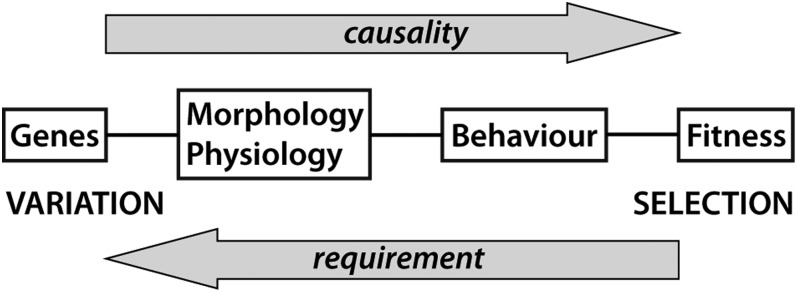
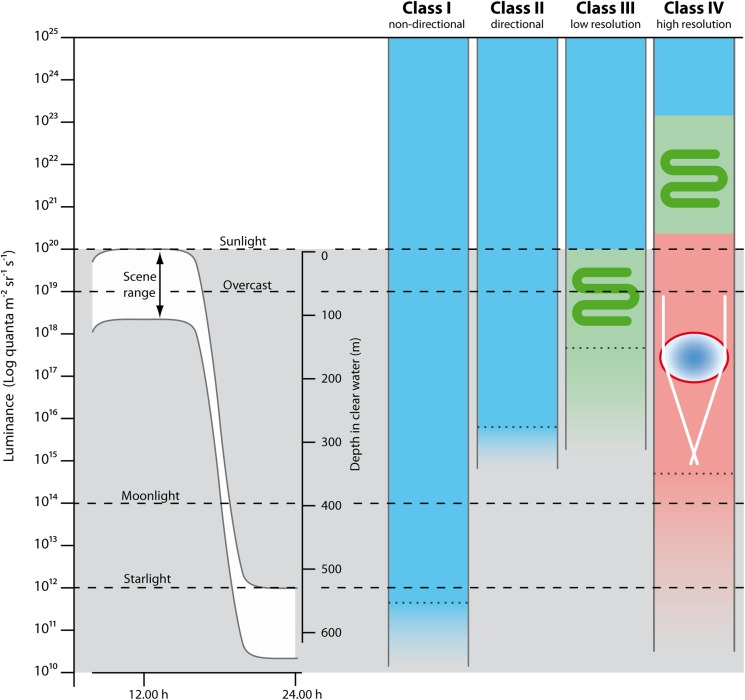
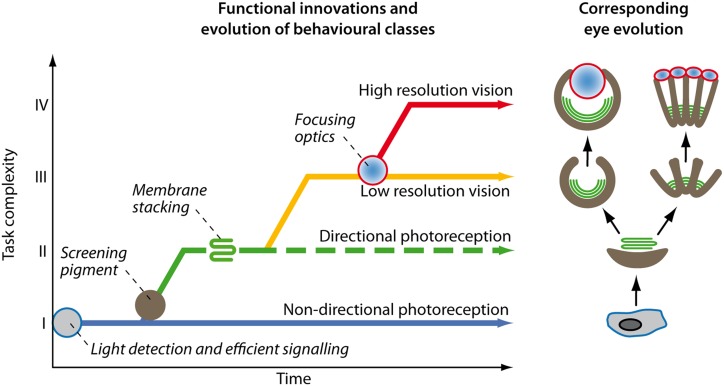
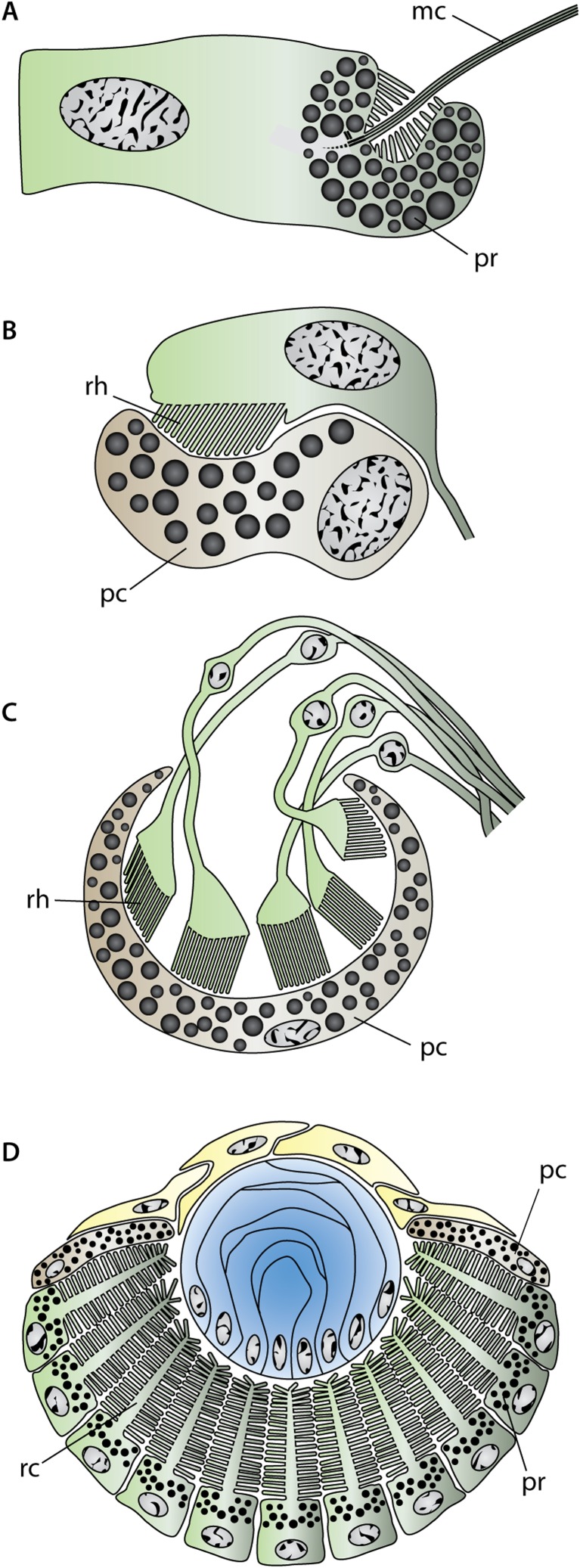
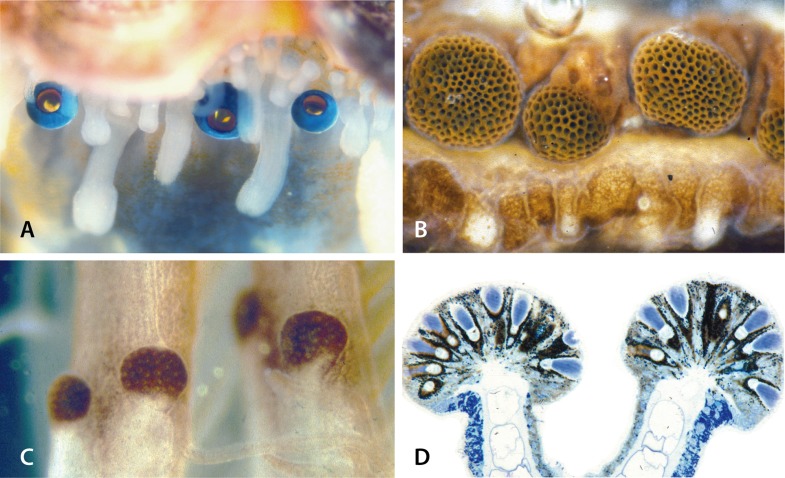
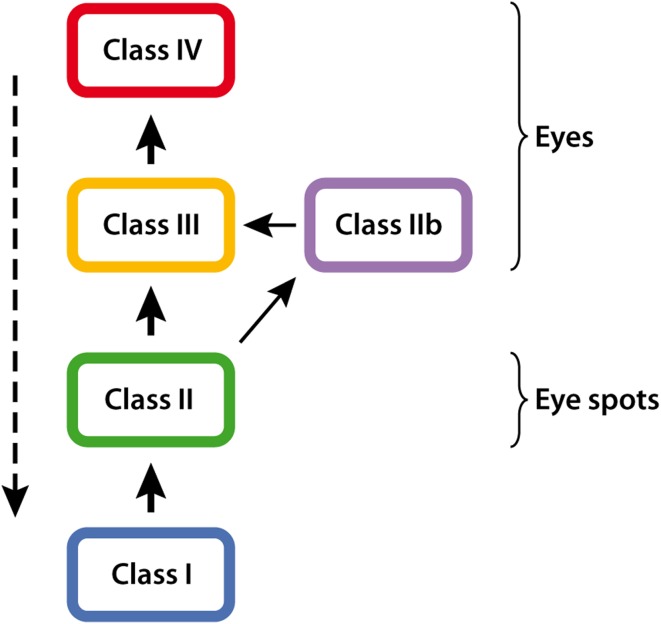
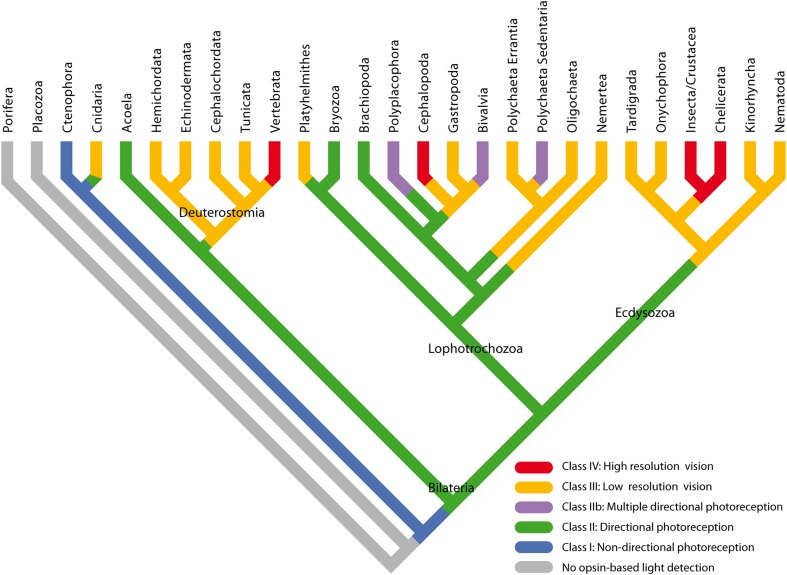
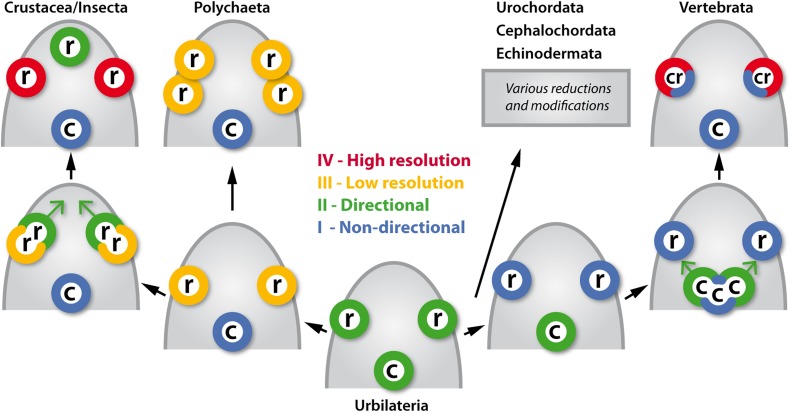
Eye evolution is driven by the evolution of visually guided behavior. Accumulation of gradually more demanding behaviors have continuously increased the performance requirements on the photoreceptor organs. Starting with nondirectional photoreception, I argue for an evolutionary sequence continuing with directional photoreception, low-resolution vision, and finally, high-resolution vision. Calculations of the physical requirements for these four sensory tasks show that they correlate with major innovations in eye evolution and thus work as a relevant classification for a functional analysis of eye evolution. Together with existing molecular and morphological data, the functional analysis suggests that urbilateria had a simple set of rhabdomeric and ciliary receptors used for directional photoreception, and that organ duplications, positional shifts and functional shifts account for the diverse patterns of eyes and photoreceptors seen in extant animals. The analysis also suggests that directional photoreception evolved independently at least twice before the last common ancestor of bilateria and proceeded several times independently to true vision in different bilaterian and cnidarian groups. This scenario is compatible with Pax -gene expression in eye development in the different animal groups. The whole process from the first opsin to high-resolution vision took about 170 million years and was largely completed by the onset of the Cambrian, about 530 million years ago. Evolution from shadow detectors to multiple directional photoreceptors has further led to secondary cases of eye evolution in bivalves, fan worms, and chitons.
Overview
The claims and statistics of this paper haven’t been checked yet.
Free: it reads the open-access text and checks the first 5 claims that cite a source we can check. Create a free account to check every claim.
Integrity signals
Registry
Cites
Statistics
Figures
Verification
Claims the paper makes
The claims and statistics of this paper haven’t been checked yet.
Free: it reads the open-access text and checks the first 5 claims that cite a source we can check. Create a free account to check every claim.
Claims other papers make about this one
Each is checked against this paper’s own text: does it say what the citing paper says it does?
The cited source doesn’t support the claim as written.
In the citing paper
“Take convergent evolution: the photoreceptor system has evolved several times independently [59]”
From The Umwelt Representation Hypothesis: rethinking Universality (2026) · cites this paper as [59]
Checked by a reasoning model — may be wrong.
Experimental — accuracy not yet measuredThe source backs part of the claim, not all of it — or backs it for a different population, condition or comparison.
In the citing paper
“This also aligns with proposed explanations that suggest that lens development coincided with an increase in eye size (59, 60).”
From What if eye...? Computationally recreating vision evolution (2025) · cites this paper as [60]
Experimental — accuracy not yet measuredThe cited source says what the claim attributes to it.
In the citing paper
“Early visual systems faced a fundamental trade-off between light collection and acuity, progressing from simple light-sensitive patches to cup-shaped eyes with smaller apertures (59, 60).”
From What if eye...? Computationally recreating vision evolution (2025) · cites this paper as [60]
The cited source says what the claim attributes to it.
In the citing paper
“The structure and function of such visual systems in non-bilaterians provides further support to the view [72] that camera-type eyes evolved several times.”
From Back to the Basics: Cnidarians Start to Fire (2017) · cites this paper as [72]
Self-check
Percentages, sums and reported differences re-computed from the paper’s own numbers.
The self-check needs the paper’s full text.
Citations
Cites
Handbook of Sensory Physiology
Sanders, M. D. (1975) · British Journal of Ophthalmology · doi:10.1136/bjo.59.2.111-c · Cited by 7,166
Fredriksson, R., Lagerström, M. C., Lundin, L.-G., & Schiöth, H. B. (2003) · Molecular Pharmacology · doi:10.1124/mol.63.6.1256 · Cited by 2,941 · cited 1×
“Several studies have indicated a common origin for opsins and melatonin receptors (Fredriksson et al., 2003 ; Plachetzki et al., 2010 ; Feuda et al., 2012 ) and this may offer a functional explanation to the evolution of opsins.”
Signals, Signal Conditions, and the Direction of Evolution
Endler, J. A. (1992) · The American Naturalist · doi:10.1086/285308 · Cited by 1,960 · cited 2×
“This is different to the view of Endler ( 1992 ), who considers sensory organs and behavior to coevolve, but the sensory organs are then seen in isolation from the rest of the morphology and physiology of the organism.”
(1945) · Annals of the Entomological Society of America · doi:10.1093/aesa/38.3.396 · Cited by 1,852
(2005) · Applying Evolutionary Archaeology · doi:10.1007/0-306-47468-9_7 · Cited by 1,644
Erwin, D. H., Laflamme, M., Tweedt, S. M., Sperling, E. A., Pisani, D., & Peterson, K. J. (2011) · Science · doi:10.1126/science.1206375 · Cited by 1,336 · cited 1×
“7 is compared with timing data for the branching points (Peterson et al., 2008 ; Erwin et al., 2011 ), the baffl ing conclusion is that nearly all fall in a period from 700 to 530 million years ago.”
LYTHGOE, J. N. (1979) · Medical Entomology and Zoology · Cited by 1,161
Predictive coding: a fresh view of inhibition in the retina
Srinivasan, M. V., Laughlin, S. B., & Dubs, A. (1982) · Proceedings of the Royal Society of London. Series B. Biological Sciences · doi:10.1098/rspb.1982.0085 · Cited by 1,042
Handbook of Sensory Physiology
Newell, F. W. (1973) · American Journal of Ophthalmology · doi:10.1016/0002-9394(73)90115-3 · Cited by 986
Melanopsin: An opsin in melanophores, brain, and eye
Provencio, I., Jiang, G., De Grip, W. J., Hayes, W. P., & Rollag, M. D. (1998) · Proceedings of the National Academy of Sciences · doi:10.1073/pnas.95.1.340 · Cited by 975 · cited 2×
“The transition from class I to class II would require a substantial reduction of the integration time (improvement of response speed) and the introduction of light shielding material close to the receptor.”
Research works printed but not linked: 3
- 10.1562/0031-8655(2004)079 · doi:10.1562/0031-8655(2004)079
- Needham A.E. (1974). The Significance of Zoochromes. Berlin: Springer
- Bennett M.F. (1979). Extraocular light receptors and circadian rhythms In Handbook of Sensory Phyiology, Vol. VII/6A, ed. Autrum H., pp. 641– 663 Berlin: Springer
Cited by
Items 201–300 of 300
Therapie zerebraler Wahrnehmungsstörungen
Moll, S. (2017) · Electronic Theses of LMU Munich (Ludwig-Maximilians-Universität München) · doi:10.5282/edoc.20565 · Cited by 1
Steck, M. (2016) · ScholarSpace (University of Hawaii at Manoa) · Cited by 1
Evolution and Molecular Mechanisms of Photoreceptor Transmutation in Reptiles
Schott, R. K. (2018) · TSpace (University of Toronto) · Cited by 1
Kershaw, G. S. (2020) · The Sydney eScholarship Repository (The University of Sydney) · Cited by 1
Light as an Ecological Resource
Leech, D. M., & Johnsen, S. (2022) · Elsevier eBooks · doi:10.1016/b978-0-12-819166-8.00110-9 · Cited by 1
Investments in photoreceptors compete with investments in optics to determine eye designPreprint
Heras, F. J. H., & Laughlin, S. B. (2024) · eLife · doi:10.7554/elife.96517.1 · Cited by 1
Investments in photoreceptors compete with investments in optics to determine eye designPreprint
Heras, F. J. H., & Laughlin, S. B. (2025) · eLife · doi:10.7554/elife.96517.2 · Cited by 1
Light-induced oocyte maturation in the hydrozoan clytia hemisphaerica
Quiroga-Artigas, G. (2017) · theses.fr (ABES) · doi:10.70675/df70f614z7812z4366z9e5bz28f0d76ac26b · Cited by 1
Liard, V. (2020) · theses.fr (ABES) · doi:10.70675/f5289477z6ed9z4f82za91fze1dd27cac193 · Cited by 1
Synthesis of the knowledge of visual systems diversity in Mollusca, with emphasis on Bivalvia
Audino, J. A., Marian, J. E. A. R., & Lopes, S. G. B. C. (2015) · Revista da Biologia · doi:10.11606/issn.1984-5154.v14p24-32
“A luz que entra pela abertura ocular passa pela córnea e lente, sendo refletida no fundo do olho pela camada refletora de modo que a imagem em baixa resolução resultante é formada na retina (Land, 1964, Nilsson, 2013).”
InfluentialAudino, J. A. (2014) · Digital Library of Theses and Dissertations (Universidade de São Paulo) · doi:10.11606/d.41.2014.tde-06032015-153816
The last common ancestor of bilaterian animals pos- sessed at least 7 opsins
Oakley, T. H. (2016)
The effect of visual priming in jumping spiders.
Scott, L. (2018) · UC Research Repository (University of Canterbury) · doi:10.26021/9132
Shakurova, N. V., & Gataullina, A. R. (2017) · Invertzool · doi:10.15298/invertzool.14.2.14
Octopus skin ‘sight’ and the evolution of dispersed, dermal light sensing in Mollusca
Ramirez, M. D. (2017) · eScholarship (California Digital Library)
Audino, J. A. (2019) · Digital Library of Theses and Dissertations (Universidade de São Paulo) · doi:10.11606/t.41.2019.tde-02082019-134345
Björn, L. O. (2014) · Springer eBooks · doi:10.1007/978-1-4939-1468-5_15
Russo, M. F. (2020) · Queensland University of Technology · doi:10.5204/thesis.eprints.203909
ANIMATED ADDITIVE MANUFACTURING Designing Dynamic Exhibits with 3D Printing & Pixel Displays
Weeratunge, L. M. (2020) · Open Access Victoria University of Wellington | Te Herenga Waka (Figshare) · doi:10.26686/wgtn.17151896
Light-Induced Stress as a Primary Evolutionary Driver of Eye OriginsPreprint
Swafford, A. J. M., & Oakley, T. H. (2019) · Preprints.org · doi:10.20944/preprints201904.0107.v1
Gutierrez, E. D. A. (2018) · TSpace (University of Toronto)
Crawford, C. S. (2021) · Cambridge University Press eBooks · doi:10.1017/9781108946339.006
Rovelli, C. (2021) · Cambridge University Press eBooks · doi:10.1017/9781108946339.005
Hackford, S. (2021) · Cambridge University Press eBooks · doi:10.1017/9781108946339.007
Blake, A., Crawford, C. S., Fletcher, P. C., Hackford, S., Hurlbert, A. C., Nilsson, D., & Rovelli, C. (2021) · Cambridge University Press eBooks · doi:10.1017/9781108946339
Self-citationSheppard, M. (2021) · Cambridge University Press eBooks · doi:10.1017/9781108946339.001
The genomics of placenta evolution in livebearing fish
van Kruistum, H. (2022) · doi:10.18174/558081
Lu, T.-H. (2022) · eDiss (Georg-August-Universität Göttingen) · doi:10.53846/goediss-9111
Jacobs, G. H. (2018) · Springer eBooks · doi:10.1007/978-3-319-47829-6_620-1
Fabian, A. C., Gibson, J., Sheppard, M., & Weyand, S. N. (2021) · Cambridge University Press eBooks · doi:10.1017/9781108946339.009
Blake, A. (2021) · Cambridge University Press eBooks · doi:10.1017/9781108946339.008
Fain, G. (2019) · Faculty Opinions – Post-Publication Peer Review of the Biomedical Literature · doi:10.3410/f.736788352.793566648
Fletcher, P. C. (2021) · Cambridge University Press eBooks · doi:10.1017/9781108946339.003
Jacobs, G. H. (2022) · Springer eBooks · doi:10.1007/978-3-319-55065-7_620
Smith, A. M., Peebles, B. A., & Spencer, H. G. (2022) · Molluscan Research · doi:10.1080/13235818.2022.2144089
Unique Gaze Control in the Box Jellyfish, Tripedalia Cystophora
Wiisbye, S. H., & Garm, A. L. (2022) · Vision Research · doi:10.1016/j.visres.2022.108159
“Cnidarian ocelli were first described more than a century ago (Hertwig & Hertwig, 1878, Romanes, 1877), and they are believed to act as non-image forming light meters (Nilsson, 2013).”
BackgroundSaad, L. D. O. (2022) · Digital Library of Theses and Dissertations (Universidade de São Paulo) · doi:10.11606/t.41.2022.tde-04012023-141508
“As a result, evolutionary modification of traits involves a dynamic process, in which selective pressures and fitness, as well as environmental factors interplay (Edwards et al., 2018; Nilsson, 2013).”
InfluentialPerez, R. C. (2022) · Digital Library of Theses and Dissertations (Universidade de São Paulo) · doi:10.11606/d.41.2022.tde-22032023-114202
Doing things: reconstructing hominin cognitive evolution from the archeological record
Seitz, F. (2023) · F1000Research · doi:10.12688/f1000research.131999.1
“Finally, descending from this stage, a compound lensed eye capable of high-resolution vision for “detection, pursuit, and communication with other animals” (Nilsson 2013, 6) evolved.”
BackgroundOrientacja przestrzenna zwierząt w warunkach ograniczonej widoczności z wykorzystaniem dźwięków.
Kwiatkowska, K. (2023) · Kosmos · doi:10.36921/kos.2022_2880
Ali, M. A., Alhasson, F. A., & Mohsin, T. A. (2023) · Advances in Animal and Veterinary Sciences · doi:10.17582/journal.aavs/2024/12.1.26.31
Critical junctions in evolution
Sumner‐Rooney, L. H. (2024) · Science · doi:10.1126/science.ado1700
Clarkson, D. (2023) · Optician · doi:10.12968/opti.2023.268.6929.20
Numerical Variations of Larval Ommatidia in Four Species of Bittacidae (Insecta: Mecoptera)Preprint
Ma, W.-R., Bai, J.-L., & Hua, B. (2025) · SSRN Electronic Journal · doi:10.2139/ssrn.5148108
Variations of larval ommatidia in four species of Bittacidae (Insecta: Mecoptera)
Ma, W.-R., Bai, J.-L., & Hua, B. (2025) · Zoology · doi:10.1016/j.zool.2025.126279
Correia, A., Chung, W., Mohinta, S., Franco-Barranco, D., Vorobyev, A., Pacureanu, A. T. J., Cardona, A., & Corrales, M. (2025) · bioRxiv (Cold Spring Harbor Laboratory) · doi:10.1101/2025.09.25.678516
Microscopic Study of Bulbus oculi in Aleppo (Damascus) goat
Uğran, R., AKSU, S. İ., & Ermutlu, D. G. (2025) · Revista Científica de la Facultad de Ciencias Veterinarias · doi:10.52973/rcfcv-e35738
Carboni, D. (2025) · SSRN Electronic Journal · doi:10.2139/ssrn.5675162
Evolution and physiology of animal visual systems
McDonald, M. S., & Porter, M. L. (2025) · Elsevier eBooks · doi:10.1016/b978-0-12-811114-7.00008-6
Alzghoul, E. A. (2024) · UNSWorks (UNSW Sydney) · doi:10.26190/unsworks/30611
Buffry, A. D., Currea, J., Franke, F. A., Palavalli‐Nettimi, R., Bodey, A. J., Rau, C., Samadi, N., Gstöhl, S. J., Schlepütz, C. M., McGregor, A. P., et al. (2024) · Figshare · doi:10.6084/m9.figshare.26695434
Buffry, A. D., Currea, J., Franke, F. A., Palavalli‐Nettimi, R., Bodey, A. J., Rau, C., Samadi, N., Gstöhl, S. J., Schlepütz, C. M., McGregor, A. P., et al. (2024) · Figshare · doi:10.6084/m9.figshare.26695446
Life, E. O. (2020) · Zenodo (CERN European Organization for Nuclear Research) · doi:10.5281/zenodo.13319314
Buffry, A. D., Currea, J., Franke, F. A., Palavalli‐Nettimi, R., Bodey, A. J., Rau, C., Samadi, N., Gstöhl, S. J., Schlepütz, C. M., McGregor, A. P., et al. (2024) · Figshare · doi:10.6084/m9.figshare.25441043
The evolution of the angiosperm plastid genome
Robbins, E. H. J. (2024) · Oxford University Research Archive (ORA) (University of Oxford) · doi:10.5287/ora-yrw8yqxna
Additional file 1 of Co-option of the limb patterning program in cephalopod eye development
Neal, S., McCulloch, K. J., Napoli, F. R., Daly, C. M. S., Coleman, J. H., & Koenig, K. M. (2022) · Figshare · doi:10.6084/m9.figshare.17870776
Buffry, A. D., Currea, J., Franke, F. A., Palavalli‐Nettimi, R., Bodey, A. J., Rau, C., Samadi, N., Gstöhl, S. J., Schlepütz, C. M., McGregor, A. P., et al. (2024) · Figshare · doi:10.6084/m9.figshare.26695452
Buffry, A. D., Currea, J., Franke, F. A., Palavalli‐Nettimi, R., Bodey, A. J., Rau, C., Samadi, N., Gstöhl, S. J., Schlepütz, C. M., McGregor, A. P., et al. (2024) · Figshare · doi:10.6084/m9.figshare.26695449
Buffry, A. D., Currea, J., Franke, F. A., Palavalli‐Nettimi, R., Bodey, A. J., Rau, C., Samadi, N., Gstöhl, S. J., Schlepütz, C. M., McGregor, A. P., et al. (2024) · Figshare · doi:10.6084/m9.figshare.26695437
Buffry, A. D., Currea, J., Franke, F. A., Palavalli‐Nettimi, R., Bodey, A. J., Rau, C., Samadi, N., Gstöhl, S. J., Schlepütz, C. M., McGregor, A. P., et al. (2024) · Figshare · doi:10.6084/m9.figshare.26695440
Buffry, A. D., Currea, J., Franke, F. A., Palavalli‐Nettimi, R., Bodey, A. J., Rau, C., Samadi, N., Gstöhl, S. J., Schlepütz, C. M., McGregor, A. P., et al. (2024) · Figshare · doi:10.6084/m9.figshare.25440887
Buffry, A. D., Currea, J., Franke, F. A., Palavalli‐Nettimi, R., Bodey, A. J., Rau, C., Samadi, N., Gstöhl, S. J., Schlepütz, C. M., McGregor, A. P., et al. (2024) · Figshare · doi:10.6084/m9.figshare.26695443
Lekuti, T. O., & Mohamed, F. I. (2025) · DiVA (University of Gävle)
(2016) · Arizona State University Library Digital Repository (Arizona State University)
Σεβαστάκη, Μ. Ξ. (2018) · University of Thessaly Institutional Repository (University of Thessaly)
Atmospheric Species and Spectral Radiation in Terrestrial Exoplanets : Implications for Astrobiology
Konatham, S. (2022) · DIGITAL.CSIC (Spanish National Research Council (CSIC))
Convergent evolution of eyes with divergent gene expression in jellyfish
Picciani de Souza, N. (2020) · eScholarship (California Digital Library)
Como Atribuir Consciência aos Animais
Barcellos, V. M. (2022) · PhilPapers (PhilPapers Foundation)
JTW 111/JTW 113/JTW 114 – Prinsip Perakaunan Kewangan
Pusat Pengajian Jarak Jauh, P. P. J. J. (2016) · Universiti Sains Malaysia Institutional Repository (Universiti Sains Malaysia)
Kelber, A., Yilmaz, A. S., & Jacobs, G. H. (2026) · Springer series in vision research · doi:10.1007/978-3-032-09457-5_12
The molecular renaissance: Navigating the biological boundaries of vision
Kumaramanickavel, G. (2026) · Indian Journal of Ophthalmology · doi:10.4103/ijo.ijo_143_26
Neural Mechanism Underlying the Formation of Light and Dark Pathways in the Vertebrate Retina
髙橋, 恭., & Takahashi, K.-I. (2022) · Institutional Repositories DataBase (IRDB) · doi:10.15097/00003148
Evolution of Eye and Origin of Myopia
Waikar, S., & Sharma, M. (2026) · Springer eBooks · doi:10.1007/978-981-95-5919-0_1
Maurinot, F. (2019) · theses.fr (ABES) · doi:10.70675/f15d5957z45d3z4384zb0dbze345ee20e930
Formalisation de la théorie de l' évolution : une approche philosophique et historique
Bertoldi, N. (2020) · theses.fr (ABES) · doi:10.70675/46deab54zdcf7z424fz98f2z3f0defa17244
Caractérisation spatiotemporelle de la rétine humaine en développement à l'échelle cellulaire
Benadjal, A. (2024) · theses.fr (ABES) · doi:10.70675/61803eafzb252z48c5z9c82zde0d70d25594
Retinal cell types: Rod and cone photoreceptors
Esh, Z., & Kefalov, V. J. (2026) · Handbook of clinical neurology · doi:10.1016/b978-0-443-22193-4.00011-1
Audino, J. A., McElroy, K. E., Serb, J. M., & Marian, J. E. A. R. (2026) · Proceedings of the Royal Society B Biological Sciences · doi:10.1098/rspb.2026.0348
Evolution of compound eye cell types shapes visual behaviors across Heliconius butterfliesPreprint
Lu, W., VanKuren, N. W., Catalano, C., Levine, M. S., Wallsten, C., & Kronforst, M. R. (2026) · bioRxiv (Cold Spring Harbor Laboratory) · doi:10.64898/2026.07.22.740151
Bio‐inspired vision: From principle, material architectures to system‐level integration
Lin, Z., Xu, M., Ma, X., Yang, W., & Shao, Y. (2026) · FlexMat. · doi:10.1002/flm2.70117
The 21 st Century Mind-Body Problem
Figdor, C. (2026) · Philosophy of Science · doi:10.1017/psa.2026.10274
Reafferent origins of image-forming vision
Englander, A., & Jablonka, E. (2026) · Frontiers in Ecology and Evolution · doi:10.3389/fevo.2026.1872222
From Motility to Mind: Why Large Language Models Lack the Architecture of Consciousness
Simón, T. G. (n.d.) · PhilPapers (PhilPapers Foundation)
Swaroop, A., Pal, S., White, N. D., Batz, Z. A., Goubet-McCall, L., & Judy, C. (2026) · Research Square · doi:10.21203/rs.3.rs-10144266/v1
“The light-sensitive cells, the photoreceptors, initiate vision and their origins can be traced to ancestral light-detecting cells in early bilaterians 9 .”
Domracheva, M., & Kosevich, I. A. (2026) · SSRN Electronic Journal · doi:10.2139/ssrn.7478250
What we can learn from nature to restore human vision
Weener, M., Khachatryan, L., & Baziyan, B. K. (2026) · Frontiers in Human Neuroscience · doi:10.3389/fnhum.2026.1968351
Overcoming the crisis of the synthetic theory of biological evolution
Vagin, Y. V. (2026) · Faktori eksperimental noi evolucii organizmiv · doi:10.7124/feeo.v39.1826
Can a Tiny Brain Plan? Reconstructing a Predatory Detour in the Jumping Spider Portia labiataPreprint
Petrie, F. J., Tan, M., Li, C., Nelson, X. J., Li, D., & MacIver, M. A. (2026) · bioRxiv (Cold Spring Harbor Laboratory) · doi:10.64898/2026.11.04.763773
Instantaneousness: The Fundamental Consciousness Primitive
Howard, J. (n.d.) · PhilPapers (PhilPapers Foundation)
Garm, A., Svaerke, J.-E., Pontieri, D., & Oakley, T. H. (2022) · doi:10.3389/fnana.2022.916510.s002
Metadata
- Authors
- NILSSON, D.-E.
- Affiliations
- Lund University (SE)
- Corresponding author
- NILSSON, DAN-E.
- Venue
- Visual Neuroscience
- Publisher
- Maximum Academic Press
- Published
- 2013-03
- Volume
- 30
- Issue
- 1-2
- Pages
- 5-20
- ISSN
- 0952-5238 (ISSN-L)
- 1469-8714
- PMC
- PMC3632888
- OpenAlex
- W2151644530
- Cited by
- 267
- References
- 118
- Citations by year
- 2026: 15 · 2025: 24 · 2024: 33 · 2023: 23 · 2022: 27 · 2021: 29 · 2020: 21 · 2019: 13 · 2018: 14 · 2017: 18 · 2016: 23 · 2015: 12 · 2014: 13 · 2013: 2
- FWCI
- 11.29
- Type
- journal article
- Language
- en
- Open access
- hybrid
- doi.org
- Licence
- Locations
- Visual Neuroscience (publishedVersion, cc-by-nc-sa)
- Europe PMC (PubMed Central) (publishedVersion, cc-by-nc-sa)
- PubMed Central (publishedVersion, cc-by-nc-sa)
- PubMed (publishedVersion)
- Lund University Publications (Lund University) (submittedVersion)
- Funders
- Knut och Alice Wallenbergs Stiftelse
- Vetenskapsrådet
- Topics
- Life Sciences › Agricultural and Biological Sciences › Animal Science and Zoology › Marine Invertebrate Physiology and Ecology
- Life Sciences › Biochemistry, Genetics and Molecular Biology › Molecular Biology › Developmental Biology and Gene Regulation
- Life Sciences › Neuroscience › Cognitive Neuroscience › Visual perception and processing mechanisms
- Keywords
- eye evolution, visual perception, rhabdomeric photoreceptors, ciliary photoreceptors, opsin, low-resolution vision, Urbilateria, Pax genes, eye development, Bivalvia, Sabellidae, chitons, Cambrian, bilaterians, Cnidaria
- MeSH terms
- Animals, Biological Evolution, Eye, Humans, Photoreceptor Cells, Vision, Ocular, Visual Pathways, Signal Detection, Psychological
About these checks
Registry, retraction, Cites and statistics results are computed, not judged, with one exception: a printed reference that no index lists is read once by a model before it counts as a citation error. Claims are extracted by a model and kept only when their quote appears verbatim in the text; each cited source is then checked, with a model’s help, for whether it says what the claim relies on. Those verdicts can be wrong — read the claim’s quote and the cited source before relying on one.
Statistics and arithmetic are recomputed, not judged.
Confidence bands are shown only for fields calibrated on our annotated test set. None is calibrated yet, so no band is shown.
What counts as a claim ›How we measure confidence ›How we check this ›
Are you an author, or do you see a problem with this page? Request a review
Data sources
Bibliographic data: Semantic Scholar, OpenAlex, Crossref.
Contains information from the Semantic Scholar Academic Graph Datasets, made available under the ODC Attribution License (ODC-BY 1.0).
Semantic Scholar’s data is described in: Kinney, R., et al. (2023). The Semantic Scholar Open Data Platform. arXiv:2301.10140.
