

Eye evolution and its functional basis
Open accessThe DOI matches its Crossref record; 117 of the 118 references it cites were found in a registry or an index.
Abstract
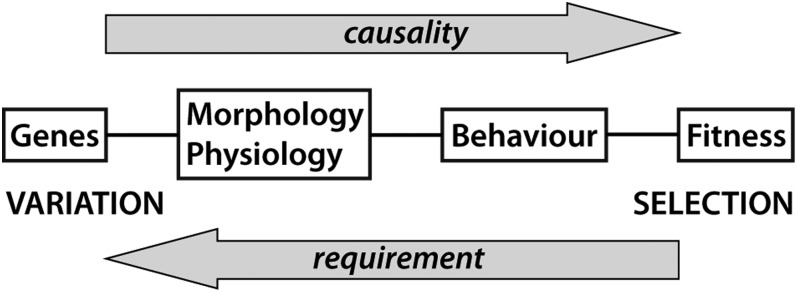
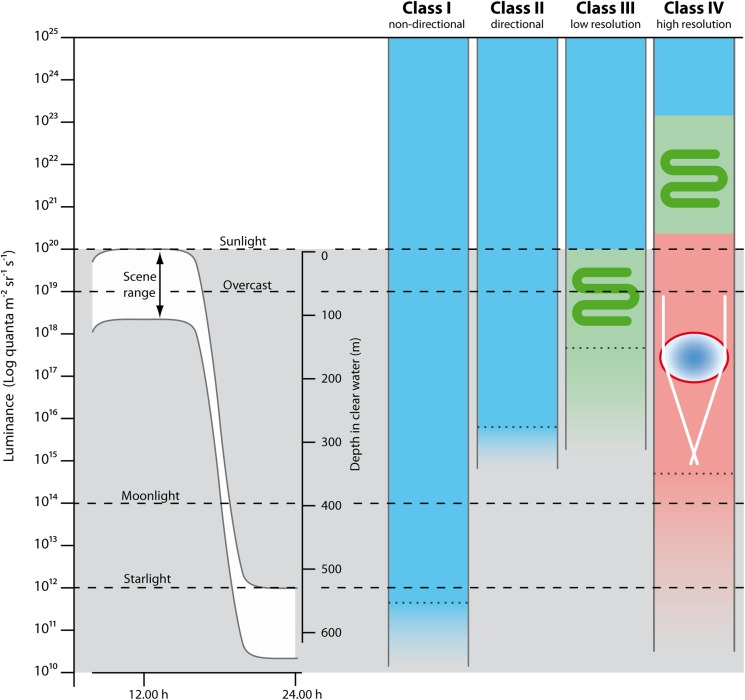
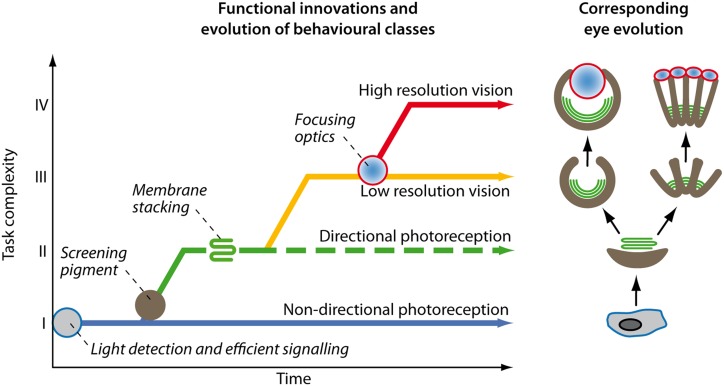
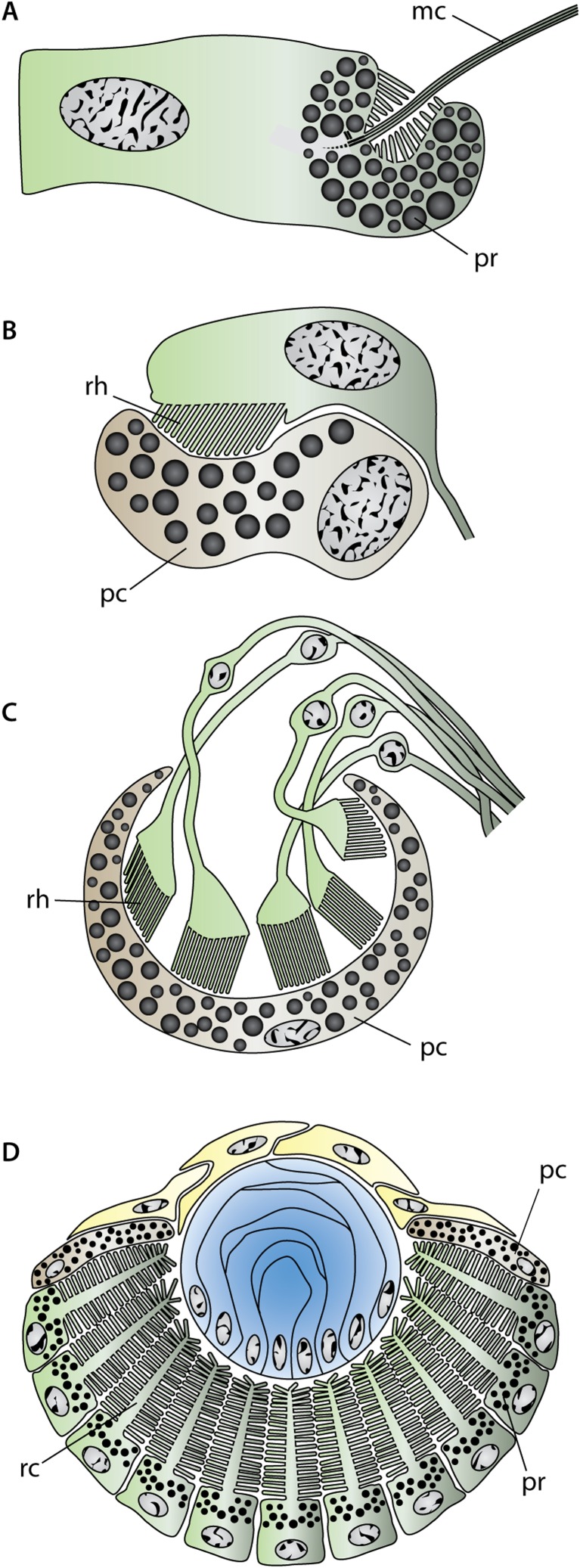
Eye evolution is driven by the evolution of visually guided behavior. Accumulation of gradually more demanding behaviors have continuously increased the performance requirements on the photoreceptor organs. Starting with nondirectional photoreception, I argue for an evolutionary sequence continuing with directional photoreception, low-resolution vision, and finally, high-resolution vision. Calculations of the physical requirements for these four sensory tasks show that they correlate with major innovations in eye evolution and thus work as a relevant classification for a functional analysis of eye evolution. Together with existing molecular and morphological data, the functional analysis suggests that urbilateria had a simple set of rhabdomeric and ciliary receptors used for directional photoreception, and that organ duplications, positional shifts and functional shifts account for the diverse patterns of eyes and photoreceptors seen in extant animals. The analysis also suggests that directional photoreception evolved independently at least twice before the last common ancestor of bilateria and proceeded several times independently to true vision in different bilaterian and cnidarian groups. This scenario is compatible with Pax -gene expression in eye development in the different animal groups. The whole process from the first opsin to high-resolution vision took about 170 million years and was largely completed by the onset of the Cambrian, about 530 million years ago. Evolution from shadow detectors to multiple directional photoreceptors has further led to secondary cases of eye evolution in bivalves, fan worms, and chitons.
Overview
The claims and statistics of this paper haven’t been checked yet.
Free: it reads the open-access text and checks the first 5 claims that cite a source we can check. Create a free account to check every claim.
Integrity signals
Registry
Cites
Statistics
Figures
Verification
Claims the paper makes
The claims and statistics of this paper haven’t been checked yet.
Free: it reads the open-access text and checks the first 5 claims that cite a source we can check. Create a free account to check every claim.
Claims other papers make about this one
Each is checked against this paper’s own text: does it say what the citing paper says it does?
The cited source doesn’t support the claim as written.
In the citing paper
“Take convergent evolution: the photoreceptor system has evolved several times independently [59]”
From The Umwelt Representation Hypothesis: rethinking Universality (2026) · cites this paper as [59]
Checked by a reasoning model — may be wrong.
Experimental — accuracy not yet measuredThe source backs part of the claim, not all of it — or backs it for a different population, condition or comparison.
In the citing paper
“This also aligns with proposed explanations that suggest that lens development coincided with an increase in eye size (59, 60).”
From What if eye...? Computationally recreating vision evolution (2025) · cites this paper as [60]
Experimental — accuracy not yet measuredThe cited source says what the claim attributes to it.
In the citing paper
“Early visual systems faced a fundamental trade-off between light collection and acuity, progressing from simple light-sensitive patches to cup-shaped eyes with smaller apertures (59, 60).”
From What if eye...? Computationally recreating vision evolution (2025) · cites this paper as [60]
The cited source says what the claim attributes to it.
In the citing paper
“The structure and function of such visual systems in non-bilaterians provides further support to the view [72] that camera-type eyes evolved several times.”
From Back to the Basics: Cnidarians Start to Fire (2017) · cites this paper as [72]
Self-check
Percentages, sums and reported differences re-computed from the paper’s own numbers.
The self-check needs the paper’s full text.
Citations
Cites
Handbook of Sensory Physiology
Sanders, M. D. (1975) · British Journal of Ophthalmology · doi:10.1136/bjo.59.2.111-c · Cited by 7,166
Fredriksson, R., Lagerström, M. C., Lundin, L.-G., & Schiöth, H. B. (2003) · Molecular Pharmacology · doi:10.1124/mol.63.6.1256 · Cited by 2,941 · cited 1×
“Several studies have indicated a common origin for opsins and melatonin receptors (Fredriksson et al., 2003 ; Plachetzki et al., 2010 ; Feuda et al., 2012 ) and this may offer a functional explanation to the evolution of opsins.”
Signals, Signal Conditions, and the Direction of Evolution
Endler, J. A. (1992) · The American Naturalist · doi:10.1086/285308 · Cited by 1,960 · cited 2×
“This is different to the view of Endler ( 1992 ), who considers sensory organs and behavior to coevolve, but the sensory organs are then seen in isolation from the rest of the morphology and physiology of the organism.”
(1945) · Annals of the Entomological Society of America · doi:10.1093/aesa/38.3.396 · Cited by 1,852
(2005) · Applying Evolutionary Archaeology · doi:10.1007/0-306-47468-9_7 · Cited by 1,644
Erwin, D. H., Laflamme, M., Tweedt, S. M., Sperling, E. A., Pisani, D., & Peterson, K. J. (2011) · Science · doi:10.1126/science.1206375 · Cited by 1,336 · cited 1×
“7 is compared with timing data for the branching points (Peterson et al., 2008 ; Erwin et al., 2011 ), the baffl ing conclusion is that nearly all fall in a period from 700 to 530 million years ago.”
LYTHGOE, J. N. (1979) · Medical Entomology and Zoology · Cited by 1,161
Predictive coding: a fresh view of inhibition in the retina
Srinivasan, M. V., Laughlin, S. B., & Dubs, A. (1982) · Proceedings of the Royal Society of London. Series B. Biological Sciences · doi:10.1098/rspb.1982.0085 · Cited by 1,042
Handbook of Sensory Physiology
Newell, F. W. (1973) · American Journal of Ophthalmology · doi:10.1016/0002-9394(73)90115-3 · Cited by 986
Melanopsin: An opsin in melanophores, brain, and eye
Provencio, I., Jiang, G., De Grip, W. J., Hayes, W. P., & Rollag, M. D. (1998) · Proceedings of the National Academy of Sciences · doi:10.1073/pnas.95.1.340 · Cited by 975 · cited 2×
“The transition from class I to class II would require a substantial reduction of the integration time (improvement of response speed) and the introduction of light shielding material close to the receptor.”
Handbook of Sensory Physiology
Holden, A. L. (1979) · British Journal of Ophthalmology · doi:10.1136/bjo.63.7.528 · Cited by 956
Pax 6: mastering eye morphogenesis and eye evolution
Gehring, W. J., & Ikeo, K. (1999) · Trends in Genetics · doi:10.1016/s0168-9525(99)01776-x · Cited by 758 · cited 1×
“The employment of Pax-6 genes for controlling eye development in both protostome and vertebrate lateral eyes has been taken as evidence that eyes only evolved once (Gehring & Ikeo, 1999 ; Gehring, 2005 , 2011 ).”
Land, M. F., & Nilsson, D.-E. (2012) · doi:10.1093/acprof:oso/9780199581139.001.0001 · Cited by 739
Self-citationPhylogenomics Revives Traditional Views on Deep Animal Relationships
Philippe, H., Derelle, R., Lopez, P., Pick, K., Borchiellini, C., Boury-Esnault, N., Vacelet, J., Renard, E., Houliston, E., Quéinnec, E., et al. (2009) · Current Biology · doi:10.1016/j.cub.2009.02.052 · Cited by 695 · cited 1×
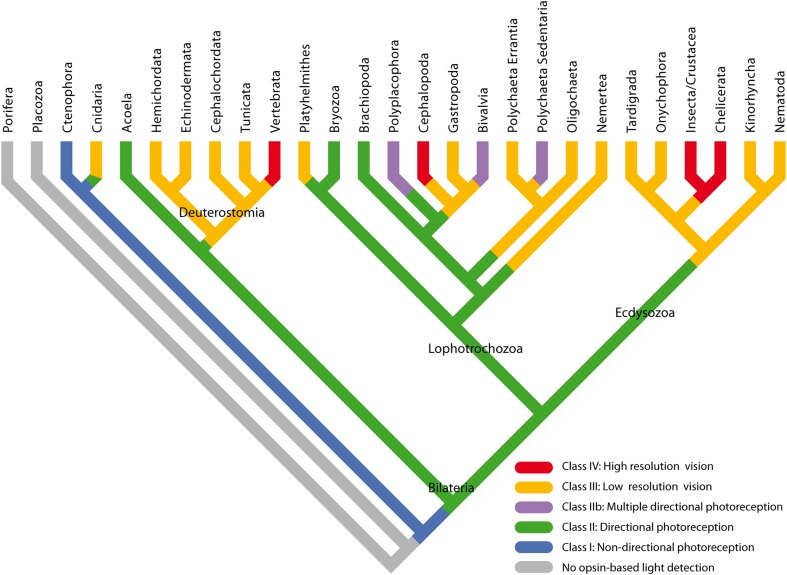
“…exact pattern of transitions should be interpreted with caution because it is sensitive to the choice of phylogenetic tree, which is here based on Philippe et al. ( 2009 ), with the placement of the Acoela according to Philippe et al. ( 2007 ). https://doi.org/10.1017/S0952523813000035 Published…”
InfluentialCould information theory provide an ecological theory of sensory processing?
Atick, J. J. (2011) · Network: Computation in Neural Systems · doi:10.3109/0954898x.2011.638888 · Cited by 679 · cited 1×
“In fact, one of the distinguishing features of animals, as compared to plants, fungi, and unicellular organisms, is their ability to process vast quantities of external information and generate complex behaviors in response to the information (Atick, 1992 ).”
Calcitic microlenses as part of the photoreceptor system in brittlestars
Aizenberg, J., Tkachenko, A., Weiner, S., Addadi, L., & Hendler, G. (2001) · Nature · doi:10.1038/35090573 · Cited by 656
The evolution of cell types in animals: emerging principles from molecular studies
Arendt, D. (2008) · Nature Reviews Genetics · doi:10.1038/nrg2416 · Cited by 525 · cited 2×
“Such light sensitive cells are indeed known from many corners of the animal kingdom (e.g., Provencio et al., 1998 , Gotow & Nishi, 2007 , 2008 ; Peirson et al., 2009 ; Ramirez et al., 2011 ; Backfi sch et al., 2013 ).”
Ciliary photoreceptors with a vertebrate-type opsin in an invertebrate brain
Arendt, D., Tessmar-Raible, K., Snyman, H., Dorresteijn, A. W., & Wittbrodt, J. (2004) · Science · doi:10.1126/science.1099955 · Cited by 458 · cited 7×
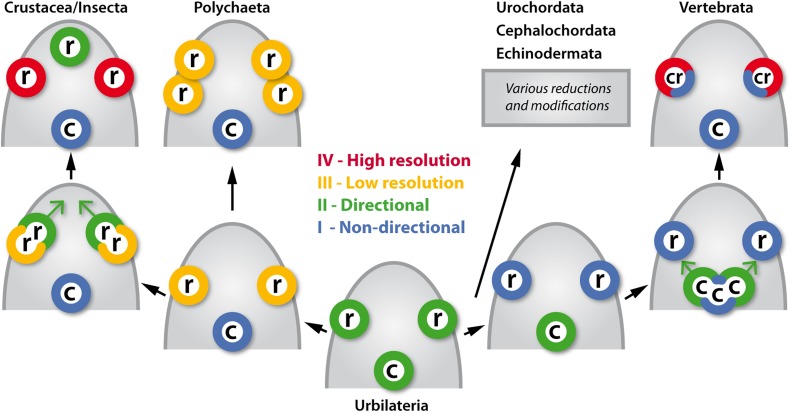
“…of rhabdomeric receptors is clearly that in vertebrates ( Fig 4 ), where the rhabdomeric photoreceptors appear to have merged with ciliary ocelli to form a composite organ performing class IV tasks with the ciliary receptors and class I tasks with the rhabdomeric receptors (Arendt et al., 2004 ).”
InfluentialEvolution of the vertebrate eye: Opsins, photoreceptors, retina and eye cup
Lamb, T. D., Collin, S. P., & Pugh, E. N. (2007) · Nature Reviews Neuroscience · doi:10.1038/nrn2283 · Cited by 454 · cited 1×
“Vertebrate pineal and parietal photoreceptors are also of the same type and it seems clear that these median photoreceptors share a common past with our lateral eyes (Lamb et al., 2007 ).”
Could information theory provide an ecological theory of sensory processing?
Atick, J. J. (1992) · Network: Computation in Neural Systems · doi:10.1088/0954-898x_3_2_009 · Cited by 446
Ecological roles of solar UV radiation: towards an integrated approach
Paul, N. D., & Gwynn-Jones, D. (2003) · Trends in Ecology & Evolution · doi:10.1016/s0169-5347(02)00014-9 · Cited by 443 · cited 1×
“Warning for harmful levels of UV radiation is another task that is essential for many animals (Paul & Gwynn-Jones, 2003 ; Leech et al., 2005 ).”
On the Evolution of Photoreceptors and Eyes
v. Salvini-Plawen, L., & Mayr, E. (1977) · Evolutionary Biology · doi:10.1007/978-1-4615-6953-4_4 · Cited by 426 · cited 3×
“The sensory structures related to class III tasks (low resolution vision) are pit and cup eyes that are widely spread across many different animal phyla but often poorly studied (Eakin, 1972 ; Vanfl eteren & Coomans, 1976 ; Salvini-Plawen & Mayr 1977 ; Vanfl eteren, 1982 ; Arendt & Wittbrodt, 2001 ).”
Warrant, E. J. (1999) · Vision Research · doi:10.1016/s0042-6989(98)00262-4 · Cited by 391 · cited 3×
“The fi ring of cnidarian nematocysts is controlled by nearby neurons expressing opsins (Plachetzki et al., 2012 ), and squid photophores contain opsin-expressing cells that monitor the animal’s own bioluminescence (Tong et al., 2009 ).”
InfluentialTHE RENEWAL OF ROD AND CONE OUTER SEGMENTS IN THE RHESUS MONKEY
Young, R. W. (1971) · The Journal of Cell Biology · doi:10.1083/jcb.49.2.303 · Cited by 375 · cited 2×
“This said, there are many cases where photoreception have reverted back to lower functional classes when changes in life style have altered or removed selection for good visual performance.”
Handbook of sensory physiology
Thinès, G. (1982) · Behavioural Processes · doi:10.1016/0376-6357(82)90013-4 · Cited by 338
Phototransduction and the Evolution of Photoreceptors
Fain, G. L., Hardie, R., & Laughlin, S. B. (2010) · Current Biology · doi:10.1016/j.cub.2009.12.006 · Cited by 318 · cited 1×
“…bilaterians or in a bilaterian–cnidarian ancestor (Feuda et al., 2012 ; Mason et al., 2012 ), and it may be that they took over functions from older ciliary receptor because rhabdomeric receptors have a better signal-to-noise ratio, faster signaling, and a larger dynamic range (Fain et al., 2010 ).”
Peterson, K. J., Cotton, J. A., Gehling, J. G., & Pisani, D. (2008) · Philosophical Transactions of the Royal Society B: Biological Sciences · doi:10.1098/rstb.2007.2233 · Cited by 313 · cited 1×
“7 is compared with timing data for the branching points (Peterson et al., 2008 ; Erwin et al., 2011 ), the baffl ing conclusion is that nearly all fall in a period from 700 to 530 million years ago.”
General physiology of cell specialization
Mazia, D., & Tyler, A. (1963) · McGraw-Hill eBooks · Cited by 313
Mechanism of phototaxis in marine zooplankton
Jékely, G., Colombelli, J., Hausen, H., Guy, K., Stelzer, E., Nédélec, F., & Arendt, D. (2008) · Nature · doi:10.1038/nature07590 · Cited by 298 · cited 6×
“The obvious behaviors guided by directional photoreception are photo-taxis based on scanning body movements (Jékely et al., 2008 ).”
InfluentialThe Morphology and Optics of Spider Eyes
Land, M. F. (1985) · Neurobiology of Arachnids · doi:10.1007/978-3-642-70348-5_4 · Cited by 285
(1985) · Springer eBooks · doi:10.1007/978-3-642-70348-5 · Cited by 281
Physics of Vision in Compound Eyes
Snyder, A. W. (1979) · Handbook of Sensory Physiology · doi:10.1007/978-3-642-66999-6_5 · Cited by 271 · cited 2×
“Applying the Shannon–Hartley theorem to an eye (see Snyder, 1979 ), the information capacity, H , can be expressed in bits/s if we use a base 2 logarithm: where n is the number of pixels and snr is the signal-to-noise ratio of a photoreceptor, here set to 100.”
Advanced optics in a jellyfish eye
Nilsson, D.-E., Gislén, L., Coates, M. M., Skogh, C., & Garm, A. (2005) · Nature · doi:10.1038/nature03484 · Cited by 270 · cited 2×
“At least in box jellyfi sh, it is known that the lenses are too weak to focus a sharp image on the retina (Nilsson et al., 2005 ; O’Connor et al., 2009 ), and it is likely that the same is true for polychaete eyes, most gastropod eyes and other small cup-eyes with a lens-like structure fi lling the…”
Self-citationHardeland, R., Balzer, I., Poeggeler, B., Fuhrberg, B., Una, H., Behrmann, G., Wolf, R., Meyer, T. J., & Reiter, R. J. (1995) · Journal of Pineal Research · doi:10.1111/j.1600-079x.1995.tb00147.x · Cited by 268 · cited 1×
“Melatonin is involved in circadian control not only in animals but also in unicellular eukaryotes (Hardeland et al., 1995 ).”
Shedding new light on opsin evolution
Porter, M. L., Blasic, J. R., Bok, M. J., Cameron, E. G., Pringle, T., Cronin, T. W., & Robinson, P. R. (2012) · Proceedings of the Royal Society B: Biological Sciences · doi:10.1098/rspb.2011.1819 · Cited by 268 · cited 5×
“…relationship between the basic opsin-classes appears diffi cult to resolve (Plachetzki et al., 2007 , 2010 ; Kozmik et al., 2008 ; Suga et al., 2008 ; Porter et al., 2011 ; Feuda et al., 2012 ; Schnitzler et al., 2012) and this may indicate that there was a rapid initial divergence, possibly refl…”
InfluentialThe evolution of eyes and visually guided behaviour
Nilsson, D.-E. (2009) · Philosophical Transactions of the Royal Society B: Biological Sciences · doi:10.1098/rstb.2009.0083 · Cited by 258 · cited 15×
“Trials with a photometer with a Lambertian detector angle (cosine detector) revealed that a 10% accuracy in the intensity reading corresponds to an angular accuracy of about 7° (measured by the author between an overcast sky and a green lawn).”
InfluentialSelf-citationThe evolution of irradiance detection: melanopsin and the non-visual opsins
Peirson, S. N., Halford, S., & Foster, R. G. (2009) · Philosophical Transactions of the Royal Society B: Biological Sciences · doi:10.1098/rstb.2009.0050 · Cited by 257 · cited 3×
“The photosensitive retinal ganglion cells in vertebrate eyes are irradiance-detecting interneurons that are thought to have such a modulating function (Peirson et al., 2009 ), but they differ from typical class I detectors because their position in the eye makes them highly directional.”
McGraw, K. J. (2005) · Animal Behaviour · doi:10.1016/j.anbehav.2004.06.022 · Cited by 248 · cited 2×
“Melanin cannot only sustain photon absorption, but it also acts as an anti-oxidant that can prevent damage by photon-generated free radicals (Meredith & Riesz, 2004 ; McGraw, 2005 ).”
New Perspectives on Eye Development and the Evolution of Eyes and Photoreceptors
Gehring, W. J. (2005) · Journal of Heredity · doi:10.1093/jhered/esi027 · Cited by 244 · cited 1×
“The employment of Pax-6 genes for controlling eye development in both protostome and vertebrate lateral eyes has been taken as evidence that eyes only evolved once (Gehring & Ikeo, 1999 ; Gehring, 2005 , 2011 ).”
Reconstructing the eyes of Urbilateria
Arendt, D., & Wittbrodt, J. (2001) · Philosophical Transactions of the Royal Society of London. Series B: Biological Sciences · doi:10.1098/rstb.2001.0971 · Cited by 233 · cited 2×
“The sensory structures related to class III tasks (low resolution vision) are pit and cup eyes that are widely spread across many different animal phyla but often poorly studied (Eakin, 1972 ; Vanfl eteren & Coomans, 1976 ; Salvini-Plawen & Mayr 1977 ; Vanfl eteren, 1982 ; Arendt & Wittbrodt, 2001 ).”
VISUAL MOTOR COMPUTATIONS IN INSECTS
Srinivasan, M. V., & Zhang, S. (2004) · Annual Review of Neuroscience · doi:10.1146/annurev.neuro.27.070203.144343 · Cited by 207 · cited 1×
“In crustaceans, the median eyes (nauplius eyes or frontal eyes) are in most cases directional receptors, possibly working as optical statocysts, and in insects, the same eyes have become the dorsal ocelli, which are essential for fl ight stabilization (Srinivasan & Zhang, 2004 ).”
Absorption of white light in photoreceptors
Warrant, E. J., & Nilsson, D.-E. (1998) · Vision Research · doi:10.1016/s0042-6989(97)00151-x · Cited by 204 · cited 2×
“For absorption of white light (Warrant & Nilsson, 1998 ), this becomes (Nilsson, 2009 ): where k u is the absorption at peak wavelength of a single membrane layer, u is the number of membrane layers, and the factor 0.4 is the product of assumed values of 0.5 for the quantum effi ciency of…”
InfluentialSelf-citationA novel Go-mediated phototransduction cascade in scallop visual cells
Kojima, D., Terakita, A., Ishikawa, T., Tsukahara, Y., Maeda, A., & Shichida, Y. (1997) · Journal of Biological Chemistry · doi:10.1074/jbc.272.37.22979 · Cited by 198
Metazoan opsin evolution reveals a simple route to animal vision
Feuda, R., Hamilton, S. C., McInerney, J. O., & Pisani, D. (2012) · Proceedings of the National Academy of Sciences · doi:10.1073/pnas.1204609109 · Cited by 194 · cited 5×
“The majority of recent opsin phylogenies indicate that the cnidar-ians split from bilaterians before the three opsin-families c-opsin, r-opsin, and RGR/G o diverged, but two recent studies suggest that also cnidarians have similar opsin families (Feuda et al., 2012 ; Mason et al., 2012 ).”
InfluentialAcute vision in the giant Cambrian predator Anomalocaris and the origin of compound eyes
Paterson, J. R., García-Bellido, D. C., Lee, M. S. Y., Brock, G. A., Jago, J. B., & Edgecombe, G. D. (2011) · Nature · doi:10.1038/nature10689 · Cited by 176 · cited 2×
“Because there are only two options for effi cient membrane stacking available, it may be wise to leave room for alternative explanations for the presence of ciliary or microvillar membrane extensions in specifi c cases: if it has evolved more than twice, we will still only see two solutions!”
Opsins and clusters of sensory G-protein-coupled receptors in the sea urchin genome
Raible, F., Tessmar-Raible, K., Arboleda, E., Kaller, T., Bork, P., Arendt, D., & Arnone, M. I. (2006) · Developmental Biology · doi:10.1016/j.ydbio.2006.08.070 · Cited by 170 · cited 2×
“And the membrane stacking structures, cilia and microvilli are present also in sponges, suggesting that the ability to form these organelles evolved for other reasons long before they became useful in photo-reception.”
Underwater Observations on Scallop (Placopecten magellanicus) Behaviour and Drag Efficiency
Caddy, J. F. (1968) · Journal of the Fisheries Research Board of Canada · doi:10.1139/f68-189 · Cited by 167 · cited 2×
“Scallops differ from the other clams because they can swim by clapping their shells (Caddy, 1968 ), and image information may thus be extracted from the eyes.”
The fine structure of the eye of the mollusc Pecten maximus
Barber, V. C., Evans, E. M., & Land, M. F. (1967) · Zeitschrift f�r Zellforschung und Mikroskopische Anatomie · doi:10.1007/bf00339290 · Cited by 165 · cited 1×
“5 ) or on tentacles around the siphons (Barber & Land, 1967 ; Barber et al., 1967 ; Adal & Morton, 1973 ; Nilsson, 1994 ; Land, 2003 ).”
Evolution and Functional Diversity of Jellyfish Opsins
Suga, H., Schmid, V., & Gehring, W. J. (2008) · Current Biology · doi:10.1016/j.cub.2007.11.059 · Cited by 163 · cited 2×
“The phylogenetic relationship between the basic opsin-classes appears diffi cult to resolve (Plachetzki et al., 2007 , 2010 ; Kozmik et al., 2008 ; Suga et al., 2008 ; Porter et al., 2011 ; Feuda et al., 2012 ; Schnitzler et al., 2012) and this may indicate that there was a rapid initial divergence,…”
Unique system of photoreceptors in sea urchin tube feet
Ullrich-Lüter, E. M., Dupont, S., Arboleda, E., Hausen, H., & Arnone, M. I. (2011) · Proceedings of the National Academy of Sciences · doi:10.1073/pnas.1018495108 · Cited by 162
Acoel development supports a simple planula-like urbilaterian
Hejnol, A., & Martindale, M. Q. (2008) · Philosophical Transactions of the Royal Society B: Biological Sciences · doi:10.1098/rstb.2007.2239 · Cited by 161 · cited 5×
“…cases where animals inexplicably seem to have the “wrong” type of membrane stacking or both types in the same receptor, or change from one type to the other during ontogeny (Eakin & Westfall, 1965 ; Eakin, 1972 ; Eakin & Brandenberger, 1981 ; Blumer, 1995 , 1996 ; Passamaneck et al., 2011 ;…”
InfluentialPteropsin: A vertebrate-like non-visual opsin expressed in the honey bee brain
Velarde, R. A., Sauer, C. D., O. Walden, K. K., Fahrbach, S. E., & Robertson, H. M. (2005) · Insect Biochemistry and Molecular Biology · doi:10.1016/j.ibmb.2005.09.001 · Cited by 159 · cited 2×
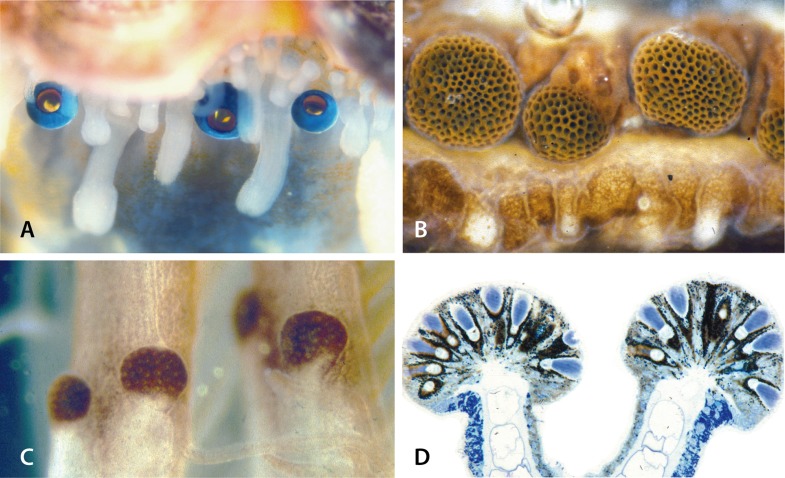
“Also protostomes have median ciliary photoreceptors ( Platynereis : Arendt et al., 2004 ; Apis : Velarde et al., 2005 ), but these are not associated with any pigment and are indicated to be involved in control of the photoperiod (class I task).”
Parietal-Eye Phototransduction Components and Their Potential Evolutionary Implications
Su, C.-Y., Luo, D.-G., Terakita, A., Shichida, Y., Liao, H.-W., Kazmi, M. A., Sakmar, T. P., & Yau, K.-W. (2006) · Science · doi:10.1126/science.1123802 · Cited by 154
Image formation by a concave reflector in the eye of the scallop, Pecten maximus.
Land, M. F. (1965) · The Journal of Physiology · doi:10.1113/jphysiol.1965.sp007653 · Cited by 153 · cited 2×
“The concave mirror eyes of scallops (Land, 1965 ) contain two retinas, and only the distal one is believed to warn for predators, whereas the proximal retina may be used for habitat selection (Speiser & Johnsen, 2008 ) and may properly be classifi ed as serving a class III task.”
Origins of the other metazoan body plans: the evolution of larval forms
Raff, R. A. (2008) · Philosophical Transactions of the Royal Society B: Biological Sciences · doi:10.1098/rstb.2007.2237 · Cited by 152 · cited 5×
“This is likely to have been an organism simpler than the urbilateria and probably at a planuloid level of organization (Raff, 2008 ; Hejnol & Martindale, 2008 ).”
InfluentialAcoel Flatworms Are Not Platyhelminthes: Evidence from Phylogenomics
Philippe, H., Brinkmann, H., Martinez, P., Riutort, M., & Baguñà, J. (2007) · PLoS ONE · doi:10.1371/journal.pone.0000717 · Cited by 148 · cited 1×
“…it is sensitive to the choice of phylogenetic tree, which is here based on Philippe et al. ( 2009 ), with the placement of the Acoela according to Philippe et al. ( 2007 ). https://doi.org/10.1017/S0952523813000035 Published online by Cambridge University Press Nilsson 16 If urbilateria had a…”
InfluentialThe Significance of Zoochromes
Needham, A. E. (1974) · Springer eBooks · doi:10.1007/978-3-642-80766-4 · Cited by 147 · cited 1×
“…the fact that vertebrate and cnidarian eyes with ciliary photoreceptors are associated with the screening pigment melanin (Kozmik et al., 2008 ), whereas arthropod and other invertebrate groups with eyes based on rhabdomeric photo-receptors are associated with ommochrome pigments (Needham, 1974 ).”
Assembly of the cnidarian camera-type eye from vertebrate-like components
Kozmik, Z., Ruzickova, J., Jonasova, K., Matsumoto, Y., Vopalensky, P., Kozmikova, I., Strnad, H., Kawamura, S., Piatigorsky, J., Paces, V., et al. (2008) · Proceedings of the National Academy of Sciences · doi:10.1073/pnas.0800388105 · Cited by 147 · cited 2×
“…is further supported by the fact that vertebrate and cnidarian eyes with ciliary photoreceptors are associated with the screening pigment melanin (Kozmik et al., 2008 ), whereas arthropod and other invertebrate groups with eyes based on rhabdomeric photo-receptors are associated with ommochrome…”
Eyes as optical alarm systems in fan worms and ark clams
Nilsson, D.-E. (1994) · Philosophical Transactions of the Royal Society of London. Series B: Biological Sciences · doi:10.1098/rstb.1994.0141 · Cited by 136 · cited 6×
“This type is the alarm photoreceptors on the mantle edge of bivalves and the tentacles of sabellid poly-chaetes (Nilsson, 1994 ).”
InfluentialSelf-citationSensory Systems in Amphioxus: A Window on the Ancestral Chordate Condition
Lacalli, T. C. (2004) · Brain, Behavior and Evolution · doi:10.1159/000079744 · Cited by 133 · cited 2×
“Cephalochordates and urochordate larvae, only have small median eyespots (Kusakabe et al., 2001 ; Lacalli, 2004 ; Vopalensky et al., 2012 ), and in echinoderms, rhabdomeric receptors are found in the optic cushions of starfi sh (Penn & Alexander, 1980 ), and in the tube feet of sea urchins (Lesser…”
Schnitzler, C. E., Pang, K., Powers, M. L., Reitzel, A. M., Ryan, J. F., Simmons, D., Tada, T., Park, M., Gupta, J., Brooks, S. Y., et al. (2012) · BMC Biology · doi:10.1186/1741-7007-10-107 · Cited by 132 · cited 4×
“Compared to bilateria, the ctenophores and cnidarians seem to have different sets of opsin families (see references above and Mason et al., 2012 ; Schnitzler et al., 2012 ), and it might be very rewarding to investigate the photopigment regeneration mechanisms in these groups.”
InfluentialWheeler, R. J., Gull, K., & Gluenz, E. (2012) · BMC Biology · doi:10.1186/1741-7007-10-1 · Cited by 129
Vopalensky, P., Pergner, J., Liegertova, M., Benito-Gutierrez, E., Arendt, D., & Kozmik, Z. (2012) · Proceedings of the National Academy of Sciences · doi:10.1073/pnas.1207580109 · Cited by 129 · cited 2×
“Cephalochordates and urochordate larvae, only have small median eyespots (Kusakabe et al., 2001 ; Lacalli, 2004 ; Vopalensky et al., 2012 ), and in echinoderms, rhabdomeric receptors are found in the optic cushions of starfi sh (Penn & Alexander, 1980 ), and in the tube feet of sea urchins (Lesser…”
Antagonistic chromatic mechanisms in photoreceptors of the parietal eye of lizards
Solessio, E., & Engbretson, G. A. (1993) · Nature · doi:10.1038/364442a0 · Cited by 122
A simple visual system without neurons in jellyfish larvae
Nordström, K., Wallén, Seymour, J., & Nilsson, D. (2003) · Proceedings of the Royal Society of London. Series B: Biological Sciences · doi:10.1098/rspb.2003.2504 · Cited by 121 · cited 3×
“4A ; Nordström et al., 2003 ).”
Self-citationThe Origins of Novel Protein Interactions during Animal Opsin Evolution
Plachetzki, D. C., Degnan, B. M., & Oakley, T. H. (2007) · PLoS ONE · doi:10.1371/journal.pone.0001054 · Cited by 120 · cited 5×
“Cnidarian polyps express opsin (Plachetzki et al., 2007 ) but not in association with screening pigment.”
InfluentialEye evolution: common use and independent recruitment of genetic components
Vopalensky, P., & Kozmik, Z. (2009) · Philosophical Transactions of the Royal Society B: Biological Sciences · doi:10.1098/rstb.2009.0079 · Cited by 116 · cited 3×
“7 ), it is most parsimonious to assume that this was the ancestral condition, although diverse screening-pigment identities suggest a common ancestor without pigment-associated photoreceptors (Vopalensky & Kozmik, 2009 ).”
Evidence for light perception in a bioluminescent organ
Tong, D., Rozas, N. S., Oakley, T. H., Mitchell, J., Colley, N. J., & McFall-Ngai, M. J. (2009) · Proceedings of the National Academy of Sciences · doi:10.1073/pnas.0904571106 · Cited by 115 · cited 2×
“The fi ring of cnidarian nematocysts is controlled by nearby neurons expressing opsins (Plachetzki et al., 2012 ), and squid photophores contain opsin-expressing cells that monitor the animal’s own bioluminescence (Tong et al., 2009 ).”
Wolken, J. J. (1982) · Trends in Neurosciences · doi:10.1016/0166-2236(82)90177-1 · Cited by 105
Cnidocyte discharge is regulated by light and opsin-mediated phototransduction
Plachetzki, D. C., Fong, C. R., & Oakley, T. H. (2012) · BMC Biology · doi:10.1186/1741-7007-10-17 · Cited by 101 · cited 2×
“The fi ring of cnidarian nematocysts is controlled by nearby neurons expressing opsins (Plachetzki et al., 2012 ), and squid photophores contain opsin-expressing cells that monitor the animal’s own bioluminescence (Tong et al., 2009 ).”
Kusakabe, T., Kusakabe, R., Kawakami, I., Satou, Y., Satoh, N., & Tsuda, M. (2001) · FEBS Letters · doi:10.1016/s0014-5793(01)02877-0 · Cited by 100 · cited 2×
“Cephalochordates and urochordate larvae, only have small median eyespots (Kusakabe et al., 2001 ; Lacalli, 2004 ; Vopalensky et al., 2012 ), and in echinoderms, rhabdomeric receptors are found in the optic cushions of starfi sh (Penn & Alexander, 1980 ), and in the tube feet of sea urchins (Lesser…”
Westfall, J. A. (1982) · American Journal of Ophthalmology · doi:10.1016/0002-9394(82)90158-1 · Cited by 97
Sea urchin tube feet are photosensory organs that express a rhabdomeric-like opsin and PAX6
Lesser, M. P., Carleton, K. L., Böttger, S. A., Barry, T. M., & WALKER, C. W. (2011) · Proceedings of the Royal Society B Biological Sciences · doi:10.1098/rspb.2011.0336 · Cited by 95 · cited 2×
“…have small median eyespots (Kusakabe et al., 2001 ; Lacalli, 2004 ; Vopalensky et al., 2012 ), and in echinoderms, rhabdomeric receptors are found in the optic cushions of starfi sh (Penn & Alexander, 1980 ), and in the tube feet of sea urchins (Lesser et al., 2011 ; Ullrich-Lü ter et al., 2011 ).”
Backfisch, B., Veedin Rajan, V. B., Fischer, R. M., Lohs, C., Arboleda, E., Tessmar-Raible, K., & Raible, F. (2013) · Proceedings of the National Academy of Sciences · doi:10.1073/pnas.1209657109 · Cited by 93
The ‘division of labour’ model of eye evolution
Arendt, D., Hausen, H., & Purschke, G. (2009) · Philosophical Transactions of the Royal Society B: Biological Sciences · doi:10.1098/rstb.2009.0104 · Cited by 90 · cited 2×
“It is not at all unlikely that the urbilaterian ciliary ocellus evolved by modifi cation from a shared ancestor with eyespots like those of cubozoan larvae (Arendt et al., 2009 ), but there is yet no convincing evidence for such a hypothesis.”
A Chiton Uses Aragonite Lenses to Form Images
Speiser, D. I., Eernisse, D. J., & Johnsen, S. (2011) · Current Biology · doi:10.1016/j.cub.2011.03.033 · Cited by 87 · cited 3×
“They can be interpreted as high-performance versions of shadow detectors and are able to respond to distant movements even if no direct shadow is cast on the receptors (Nilsson, 1994 ; Land, 2003 ; Speiser et al., 2011 ).”
The frontal eyes of crustaceans
Elofsson, R. (2006) · Arthropod Structure & Development · doi:10.1016/j.asd.2006.08.004 · Cited by 87 · cited 2×
“In some of the box jellyfi sh (O’Connor et al., 2009 ), and also in poly-chaete worms, the cup eyes are fi lled with a lens-like transparent material.”
The Fine Structure of Spider Photoreceptors in Relation to Function
Blest, A. D. (1985) · Springer eBooks · doi:10.1007/978-3-642-70348-5_5 · Cited by 85
Land, M. F. (1966) · Journal of Experimental Biology · doi:10.1242/jeb.45.1.83 · Cited by 84
The evolution of phototransduction from an ancestral cyclic nucleotide gated pathway
Plachetzki, D. C., Fong, C. R., & Oakley, T. H. (2010) · Proceedings of the Royal Society B: Biological Sciences · doi:10.1098/rspb.2009.1797 · Cited by 82 · cited 2×
“The phylogenetic relationship between the basic opsin-classes appears diffi cult to resolve (Plachetzki et al., 2007 , 2010 ; Kozmik et al., 2008 ; Suga et al., 2008 ; Porter et al., 2011 ; Feuda et al., 2012 ; Schnitzler et al., 2012) and this may indicate that there was a rapid initial divergence,…”
Spatial vision in the echinoid genus Echinometra
Blevins, E., & Johnsen, S. (2004) · Journal of Experimental Biology · doi:10.1242/jeb.01286 · Cited by 79
Ciliary photoreceptors in the cerebral eyes of a protostome larva
Passamaneck, Y. J., Furchheim, N., Hejnol, A., Martindale, M. Q., & Lüter, C. (2011) · EvoDevo · doi:10.1186/2041-9139-2-6 · Cited by 79 · cited 2×
“Small lens-like structures are known from some larval eyespots for directional photoreception (Blumer, 1994 ; Passamaneck et al., 2011 ).”
Kumburegama, S., Wijesena, N., Xu, R., & Wikramanayake, A. H. (2011) · EvoDevo · doi:10.1186/2041-9139-2-2 · Cited by 76
Photoreceptor evolution and phylogeny
Vanfleteren, J. R., & Coomans, A. (2009) · Journal of Zoological Systematics & Evolutionary Research · doi:10.1111/j.1439-0469.1976.tb00934.x · Cited by 74
Suga, H., Tschopp, P., Graziussi, D. F., Stierwald, M., Schmid, V., & Gehring, W. J. (2010) · Proceedings of the National Academy of Sciences · doi:10.1073/pnas.1008389107 · Cited by 70 · cited 3×
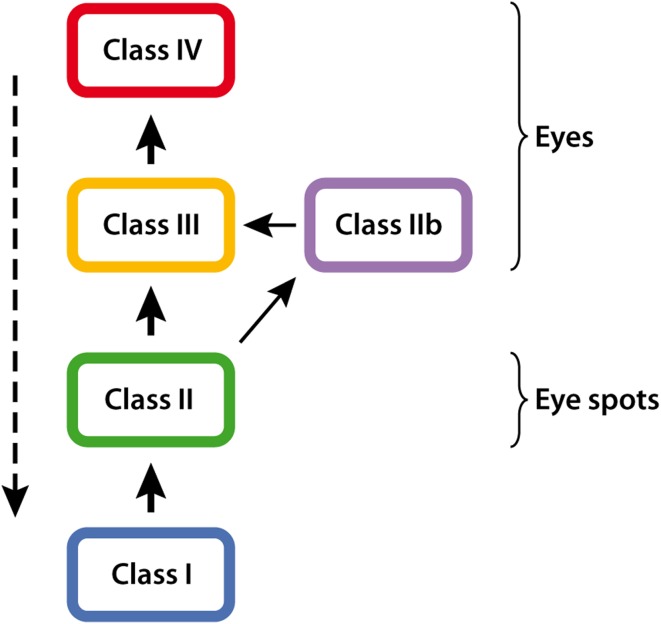
“…eye development in bilateria and cnidaria has been demonstrated to be specifi ed by nonhomologous control genes ( Pax-6 in Bilateria, and Pax-A in Cnidaria; Suga et al., 2010 ), which suggests independent transition from class I to class II in these two major branches of the animal kingdom.”
InfluentialZooplankton behavioral responses to solar UV radiation vary within and among lakes
Leech, D. M., Padeletti, A., & Williamson, C. E. (2005) · Journal of Plankton Research · doi:10.1093/plankt/fbi020 · Cited by 69 · cited 2×
“Warning for harmful levels of UV radiation is another task that is essential for many animals (Paul & Gwynn-Jones, 2003 ; Leech et al., 2005 ).”
Understanding the dermal light sense in the context of integrative photoreceptor cell biology
Ramirez, M. D., Speiser, D. I., Pankey, M. S., & Oakley, T. H. (2011) · Visual Neuroscience · doi:10.1017/s0952523811000150 · Cited by 68 · cited 2×
“Such light sensitive cells are indeed known from many corners of the animal kingdom (e.g., Provencio et al., 1998 , Gotow & Nishi, 2007 , 2008 ; Peirson et al., 2009 ; Ramirez et al., 2011 ; Backfi sch et al., 2013 ).”
Evidence for Multiple Phototransduction Pathways in a Reef-Building Coral
Mason, B., Schmale, M., Gibbs, P., Miller, M. W., Wang, Q., Levay, K., Shestopalov, V., & Slepak, V. Z. (2012) · PLoS ONE · doi:10.1371/journal.pone.0050371 · Cited by 67 · cited 3×
“Compared to bilateria, the ctenophores and cnidarians seem to have different sets of opsin families (see references above and Mason et al., 2012 ; Schnitzler et al., 2012 ), and it might be very rewarding to investigate the photopigment regeneration mechanisms in these groups.”
Spatial vision in the purple sea urchinStrongylocentrotus purpuratus(Echinoidea)
Yerramilli, D., & Johnsen, S. (2009) · Journal of Experimental Biology · doi:10.1242/jeb.033159 · Cited by 67 · cited 2×
“The origin of these lens-like structures in class II photoreceptor organs could also result from larval eyes being derived from more advanced adult eyes in accordance with the larvae being derived from more ancient body plans of adults (Hejnol & Martindale, 2008 ; Raff, 2008 ).”
From cornea to retinal image in invertebrate eyes
Nilsson, D. (1990) · Trends in Neurosciences · doi:10.1016/0166-2236(90)90069-m · Cited by 62 · cited 2×
“Some types of compound eyes, mainly in crustaceans, also use mirrors for focusing, but these solutions are more successful and represented in a larger number of species (Nilsson, 1990 ).”
Self-citationComparative Morphology of the Concave Mirror Eyes of Scallops (Pectinoidea)*
Speiser, D. I., & Johnsen, S. (2008) · American Malacological Bulletin · doi:10.4003/006.026.0204 · Cited by 56 · cited 6×
“The majority of recent opsin phylogenies indicate that the cnidar-ians split from bilaterians before the three opsin-families c-opsin, r-opsin, and RGR/G o diverged, but two recent studies suggest that also cnidarians have similar opsin families (Feuda et al., 2012 ; Mason et al., 2012 ).”
InfluentialThe eye as a replicating and diverging, modular developmental unit
Oakley, T. H. (2003) · Trends in Ecology & Evolution · doi:10.1016/j.tree.2003.09.005 · Cited by 54
Chance and Necessity in Eye Evolution
Gehring, W. J. (2011) · Genome Biology and Evolution · doi:10.1093/gbe/evr061 · Cited by 52 · cited 1×
“The employment of Pax-6 genes for controlling eye development in both protostome and vertebrate lateral eyes has been taken as evidence that eyes only evolved once (Gehring & Ikeo, 1999 ; Gehring, 2005 , 2011 ).”
Ultrastructure of the eye of the rotifer Asplanchna brightwelli
Eakin, R. M., & Westfall, J. A. (1965) · Journal of Ultrastructure Research · doi:10.1016/s0022-5320(65)80005-3 · Cited by 47 · cited 1×
“…inexplicably seem to have the “wrong” type of membrane stacking or both types in the same receptor, or change from one type to the other during ontogeny (Eakin & Westfall, 1965 ; Eakin, 1972 ; Eakin & Brandenberger, 1981 ; Blumer, 1995 , 1996 ; Passamaneck et al., 2011 ; Porter et al., 2011 ).”
The spatial resolution of the pinhole eyes of giant clams (Tridacna maxima
Land, M. F. (2003) · Proceedings of the Royal Society B Biological Sciences · doi:10.1098/rspb.2002.2222 · Cited by 47
Fine structure of the optic cusion in the asteroid Nepanthia belcheri
Penn, P., & Alexander, C. G. (1980) · Marine Biology · doi:10.1007/bf00390773 · Cited by 44 · cited 2×
“The dispersed lenses on brittle stars may serve a similar function (Aizenberg et al. 2001 ), whereas starfi sh have concentrated their organs for class III tasks to compound eyes, called the optic cushions, on the tip of each arm (Yoshida & Ohtsuki, 1968 ; Penn & Alexander, 1980 ).”
Fine structure and function of ocelli and sagittocysts of acoel flatworms
Yamasu, T. (1991) · Hydrobiologia · doi:10.1007/bf00027612 · Cited by 44 · cited 1×
“The paired eyespots of Acoels are unique in having a rather unspecial-ized membrane without microvillar or ciliary extensions (Yamasu, 1991 ).”
The fine structure of the pallial eyes of Laternula truncata (Bivalvia: Anomalodesmata: Pandoracea)
Adal, M. N., & Morton, B. S. (1973) · Journal of Zoology · doi:10.1111/j.1469-7998.1973.tb05068.x · Cited by 43 · cited 2×
“But because melatonin is irreversibly degraded by light, a far more effi cient light receptor would be generated if melatonin were replaced by retinal with its fl ip-fl op conformational properties.”
Eye of the cockle,Cardium edule: Anatomical and physiological investigations
Barber, V. C., & Land, M. F. (1967) · Cellular and Molecular Life Sciences · doi:10.1007/bf02144199 · Cited by 41 · cited 1×
“5 ) or on tentacles around the siphons (Barber & Land, 1967 ; Barber et al., 1967 ; Adal & Morton, 1973 ; Nilsson, 1994 ; Land, 2003 ).”
Evolution and the origin of the visual retinoid cycle in vertebrates
Kusakabe, T. G., Takimoto, N., Jin, M., & Tsuda, M. (2009) · Philosophical Transactions of the Royal Society B: Biological Sciences · doi:10.1098/rstb.2009.0043 · Cited by 41 · cited 1×
“In the c-opsins of vertebrates, all-trans retinal dissociates from the opsin molecule and is reconverted to 11-cis through a complex process of transport and enzyme conversion (Kusakabe et al., 2009 ; Goldsmith, 2013 ).”
Structure and optics of the eyes of the box jellyfish Chiropsella bronzie
O’Connor, M., Garm, A. L., & Nilsson, D. (2009) · Journal of Comparative Physiology A · doi:10.1007/s00359-009-0431-x · Cited by 40 · cited 3×
“At least in box jellyfi sh, it is known that the lenses are too weak to focus a sharp image on the retina (Nilsson et al., 2005 ; O’Connor et al., 2009 ), and it is likely that the same is true for polychaete eyes, most gastropod eyes and other small cup-eyes with a lens-like structure fi lling the…”
Self-citationResolution and Sensitivity in the Eye of the WinkleLittorina Littorea
Seyer, J. (1992) · Journal of Experimental Biology · doi:10.1242/jeb.170.1.57 · Cited by 37
Unique Eye of Probable Evolutionary Significance
Eakin, R. M., & Brandenberger, J. L. (1981) · Science · doi:10.1126/science.7466394 · Cited by 37 · cited 1×
“…inexplicably seem to have the “wrong” type of membrane stacking or both types in the same receptor, or change from one type to the other during ontogeny (Eakin & Westfall, 1965 ; Eakin, 1972 ; Eakin & Brandenberger, 1981 ; Blumer, 1995 , 1996 ; Passamaneck et al., 2011 ; Porter et al., 2011 ).”
Blumer, M. J. F. (1994) · Zoomorphology · doi:10.1007/bf00403262 · Cited by 35 · cited 2×
“Small lens-like structures are known from some larval eyespots for directional photoreception (Blumer, 1994 ; Passamaneck et al., 2011 ).”
THE PHOTOTACTIC BEHAVIOR OF THE STARFISH, ASTERIAS AMURENSIS LÜTKEN
Yoshida, M., & OHTSUKI, H. (1968) · Biological Bulletin · doi:10.2307/1539869 · Cited by 33 · cited 1×
“The dispersed lenses on brittle stars may serve a similar function (Aizenberg et al. 2001 ), whereas starfi sh have concentrated their organs for class III tasks to compound eyes, called the optic cushions, on the tip of each arm (Yoshida & Ohtsuki, 1968 ; Penn & Alexander, 1980 ).”
Alterations of the eyes during ontogenesis in Aporrhais pespelecani (Mollusca, Caenogastropoda)
Blumer, M. J. F. (1996) · Zoomorphology · doi:10.1007/bf02526944 · Cited by 32 · cited 1×
“…inexplicably seem to have the “wrong” type of membrane stacking or both types in the same receptor, or change from one type to the other during ontogeny (Eakin & Westfall, 1965 ; Eakin, 1972 ; Eakin & Brandenberger, 1981 ; Blumer, 1995 , 1996 ; Passamaneck et al., 2011 ; Porter et al., 2011 ).”
Speiser, D. I., Loew, E. R., & Johnsen, S. (2011) · Journal of Experimental Biology · doi:10.1242/jeb.048108 · Cited by 32 · cited 2×
“They can be interpreted as high-performance versions of shadow detectors and are able to respond to distant movements even if no direct shadow is cast on the receptors (Nilsson, 1994 ; Land, 2003 ; Speiser et al., 2011 ).”
Fine structure and function of ocelli and sagittocysts of acoel flatworms
Yamasu, T. (1991) · Springer eBooks · doi:10.1007/978-94-011-2775-2_39 · Cited by 32
Gereral purpose and special purpose visual systems
Land, M. F., & Nilsson, D. (2006) · Lund University Publications (Lund University) · Cited by 28
Self-citationSimple photoreceptors in some invertebrates: Physiological properties of a new photosensory modality
Gotow, T., & Nishi, T. (2008) · Brain Research · doi:10.1016/j.brainres.2008.04.059 · Cited by 27 · cited 2×
“Experimental measurements of the integration time in nondirectional photoreceptors are in the range of 10–30 min (Gotow & Nishi, 2008 ).”
Structure and optics of the eye of the hawk‐wing conch, Strombus raninus (L.)
Seyer, J. (1994) · Journal of Experimental Zoology · doi:10.1002/jez.1402680304 · Cited by 25 · cited 1×
“The lenses of a few gastropods such as Littorina and Strombus form sharp images on the retina, but they are not known to use the high performance for more than class III tasks (Seyer, 1992 , 1994 ).”
Evolutionary tinkering with visual photoreception
Goldsmith, T. H. (2012) · Visual Neuroscience · doi:10.1017/s095252381200003x · Cited by 25 · cited 1×
“In the c-opsins of vertebrates, all-trans retinal dissociates from the opsin molecule and is reconverted to 11-cis through a complex process of transport and enzyme conversion (Kusakabe et al., 2009 ; Goldsmith, 2013 ).”
Gotow, T., & Nishi, T. (2007) · Brain Research · doi:10.1016/j.brainres.2007.01.068 · Cited by 23 · cited 2×
“The transition from class I to class II would require a substantial reduction of the integration time (improvement of response speed) and the introduction of light shielding material close to the receptor.”
Blumer, M. J. F. (1995) · Zoomorphology · doi:10.1007/bf00403256 · Cited by 18 · cited 1×
“…inexplicably seem to have the “wrong” type of membrane stacking or both types in the same receptor, or change from one type to the other during ontogeny (Eakin & Westfall, 1965 ; Eakin, 1972 ; Eakin & Brandenberger, 1981 ; Blumer, 1995 , 1996 ; Passamaneck et al., 2011 ; Porter et al., 2011 ).”
Visual stabilization dynamics are enhanced by standing flight velocity
Theobald, J. C., Ringach, D. L., & Frye, M. A. (2009) · Biology Letters · doi:10.1098/rsbl.2009.0845 · Cited by 13 · cited 2×
“With knowledge about these functional requirements, at the organ level, we can correlate the evolution of the behavioral classes with the evolution of photoreceptor cells and visual organs.”
Courdavault, S., Baudouin, C., Sauvaigo, S., Mouret, S., Candéias, S., Charveron, M., Favier, A., Cadet, J., & Douki, T. (2004) · Photochemistry and Photobiology · doi:10.1111/j.1751-1097.2004.tb00004.x · Cited by 12
Spotlight on the evolution of vision
Colley, N. J., & Dowling, J. E. (2013) · Visual Neuroscience · doi:10.1017/s0952523813000059 · Cited by 12
Research works printed but not linked: 3
- 10.1562/0031-8655(2004)079 · doi:10.1562/0031-8655(2004)079
- Needham A.E. (1974). The Significance of Zoochromes. Berlin: Springer
- Bennett M.F. (1979). Extraocular light receptors and circadian rhythms In Handbook of Sensory Phyiology, Vol. VII/6A, ed. Autrum H., pp. 641– 663 Berlin: Springer
Cited by
Evolution of phototransduction, vertebrate photoreceptors and retina
Lamb, T. D. (2013) · Progress in Retinal and Eye Research · doi:10.1016/j.preteyeres.2013.06.001 · Cited by 397
“10C), which contrasts with the view of Nilsson (2013) that there is “very limited membrane stacking” of pineal membranes.”
Williams, S. T. (2017) · Biological Reviews · doi:10.1111/brv.12268 · Cited by 256
“Most (but not all) shelled molluscs are thought to have poor vision and it is unlikely that any can see in colour (Kobluk & Mapes, 1989; Nilsson, 2013; for gastropods with good vision see Seyer, 1992, 1994; for bivalves with good vision see Speiser & Johnsen, 2008).”
BackgroundBioinspired Artificial Eyes: Optic Components, Digital Cameras, and Visual Prostheses
Lee, G. J., Choi, C., Kim, D., & Song, Y. M. (2018) · Advanced Functional Materials · doi:10.1002/adfm.201705202 · Cited by 252
The foundations of plant intelligence
TREWAVAS, A. J. (2017) · Interface Focus · doi:10.1098/rsfs.2016.0098 · Cited by 191
The last common ancestor of most bilaterian animals possessed at least 9 opsins
Ramirez, M., Pairett, A., Pankey, M., Serb, J., Speiser, D., Swafford, A., & Oakley, T. (2016) · Genome Biology and Evolution · doi:10.1093/gbe/evw248 · Cited by 152
Metadata
- Authors
- NILSSON, D.-E.
- Affiliations
- Lund University (SE)
- Corresponding author
- NILSSON, DAN-E.
- Venue
- Visual Neuroscience
- Publisher
- Maximum Academic Press
- Published
- 2013-03
- Volume
- 30
- Issue
- 1-2
- Pages
- 5-20
- ISSN
- 0952-5238 (ISSN-L)
- 1469-8714
- PMC
- PMC3632888
- OpenAlex
- W2151644530
- Cited by
- 267
- References
- 118
- Citations by year
- 2026: 15 · 2025: 24 · 2024: 33 · 2023: 23 · 2022: 27 · 2021: 29 · 2020: 21 · 2019: 13 · 2018: 14 · 2017: 18 · 2016: 23 · 2015: 12 · 2014: 13 · 2013: 2
- FWCI
- 11.29
- Type
- journal article
- Language
- en
- Open access
- hybrid
- doi.org
- Licence
- Locations
- Visual Neuroscience (publishedVersion, cc-by-nc-sa)
- Europe PMC (PubMed Central) (publishedVersion, cc-by-nc-sa)
- PubMed Central (publishedVersion, cc-by-nc-sa)
- PubMed (publishedVersion)
- Lund University Publications (Lund University) (submittedVersion)
- Funders
- Knut och Alice Wallenbergs Stiftelse
- Vetenskapsrådet
- Topics
- Life Sciences › Agricultural and Biological Sciences › Animal Science and Zoology › Marine Invertebrate Physiology and Ecology
- Life Sciences › Biochemistry, Genetics and Molecular Biology › Molecular Biology › Developmental Biology and Gene Regulation
- Life Sciences › Neuroscience › Cognitive Neuroscience › Visual perception and processing mechanisms
- Keywords
- eye evolution, visual perception, rhabdomeric photoreceptors, ciliary photoreceptors, opsin, low-resolution vision, Urbilateria, Pax genes, eye development, Bivalvia, Sabellidae, chitons, Cambrian, bilaterians, Cnidaria
- MeSH terms
- Animals, Biological Evolution, Eye, Humans, Photoreceptor Cells, Vision, Ocular, Visual Pathways, Signal Detection, Psychological
About these checks
Registry, retraction, Cites and statistics results are computed, not judged, with one exception: a printed reference that no index lists is read once by a model before it counts as a citation error. Claims are extracted by a model and kept only when their quote appears verbatim in the text; each cited source is then checked, with a model’s help, for whether it says what the claim relies on. Those verdicts can be wrong — read the claim’s quote and the cited source before relying on one.
Statistics and arithmetic are recomputed, not judged.
Confidence bands are shown only for fields calibrated on our annotated test set. None is calibrated yet, so no band is shown.
What counts as a claim ›How we measure confidence ›How we check this ›
Are you an author, or do you see a problem with this page? Request a review
Data sources
Bibliographic data: Semantic Scholar, OpenAlex, Crossref.
Contains information from the Semantic Scholar Academic Graph Datasets, made available under the ODC Attribution License (ODC-BY 1.0).
Semantic Scholar’s data is described in: Kinney, R., et al. (2023). The Semantic Scholar Open Data Platform. arXiv:2301.10140.
