

The medial forebrain bundle as a target for deep brain stimulation for obsessive-compulsive disorder
Open accessThe DOI matches its Crossref record; 30 of the 30 references it cites were found in a registry or an index.
Abstract
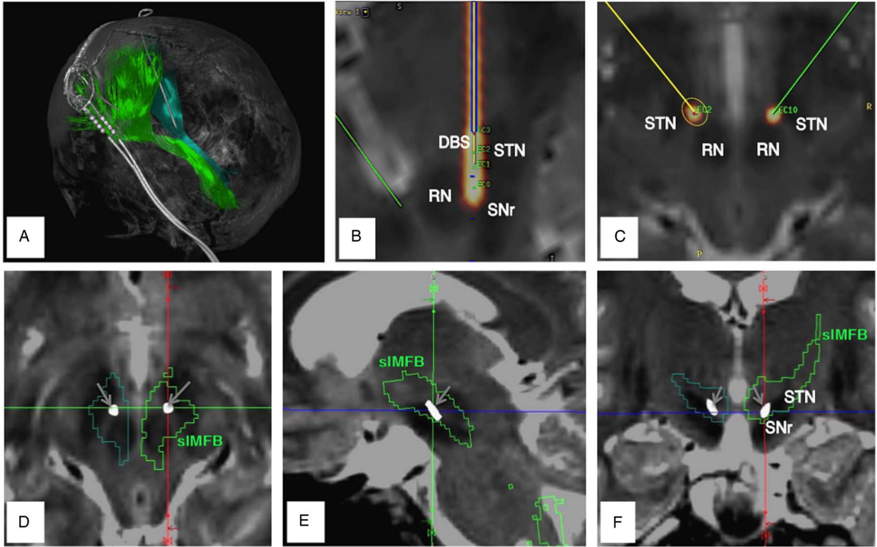
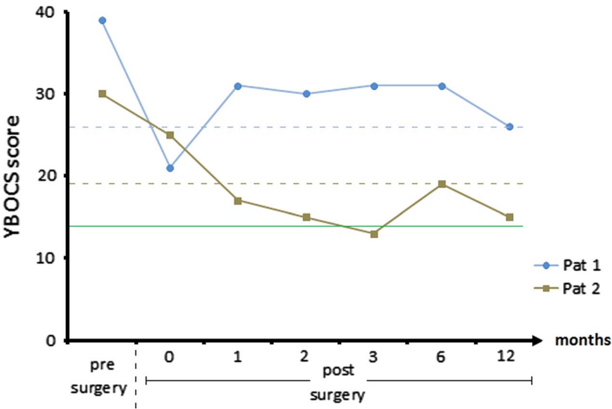
Deep brain stimulation (DBS) is a promising putative modality for the treatment of refractory psychiatric disorders such as major depression and obsessive-compulsive disorder (OCD). Several targets have been posited; however, a clear consensus on differential efficacy and possible modes of action remain unclear. DBS to the supero-lateral branch of the medial forebrain bundle (slMFB) has recently been introduced for major depression (MD). Due to our experience with slMFB stimulation for MD, and because OCD might be related to similar dysfunctions of the reward system, treatment with slMFB DBS seams meaningful. Here we describe our first 2 cases together with a hypothetical mode of action. We describe diffusion tensor imaging (DTI) fiber tractographically (FT)-assisted implantation of the bilateral DBS systems in 2 male patients. In a selected literature overview, we discuss the possible mode of action. Both patients were successfully implanted and stimulated. The follow-up time was 12 months. One patient showed a significant response (Yale–Brown Obsessive-Compulsive Scale [YBOCS] reduction by 35%); the other patient reached remission criteria 3 months after surgery (YBOCS<14) and showed mild OCD just above the remission criterion at 12 months follow-up. While the hypermetabolism theory for OCD involves the cortico–striato–thalamo–cortical (CSTC) network, we think that there is clinical evidence that the reward system plays a crucial role. Our findings suggest an important role of this network in mechanisms of disease development and recovery. In this uncontrolled case series, continuous bilateral DBS to the slMFB led to clinically significant improvements of ratings of OCD severity. Ongoing research focuses on the role of the reward system in OCD, and its yet-underestimated role in this underlying neurobiology of the disease.
Overview
The claims and statistics of this paper haven’t been checked yet.
Free: it reads the open-access text and checks the first 5 claims that cite a source we can check. Create a free account to check every claim.
Integrity signals
Registry
Cites
Statistics
Figures
Verification
Claims the paper makes
The claims and statistics of this paper haven’t been checked yet.
Free: it reads the open-access text and checks the first 5 claims that cite a source we can check. Create a free account to check every claim.
Claims other papers make about this one
Each is checked against this paper’s own text: does it say what the citing paper says it does?
The cited source says what the claim attributes to it.
In the citing paper
“DBS targeting the medial forebrain bundle (white matter tracts connecting regions of the reward system including the NAcc) also improves symptoms in treatment-resistant OCD [160].”
From Toward a neurocircuit-based taxonomy to guide treatment of obsessive-compulsive disorder (2021) · cites this paper as [160]
Self-check
Percentages, sums and reported differences re-computed from the paper’s own numbers.
The self-check needs the paper’s full text.
Citations
Cites
Rapid regulation of depression-related behaviours by control of midbrain dopamine neurons
Chaudhury, D., Walsh, J. J., Friedman, A. K., Juarez, B., Ku, S. M., Koo, J. W., Ferguson, D., Tsai, H.-C., Pomeranz, L., Christoffel, D. J., et al. (2013) · Nature · doi:10.1038/nature11713 · Cited by 1,156 · cited 1×
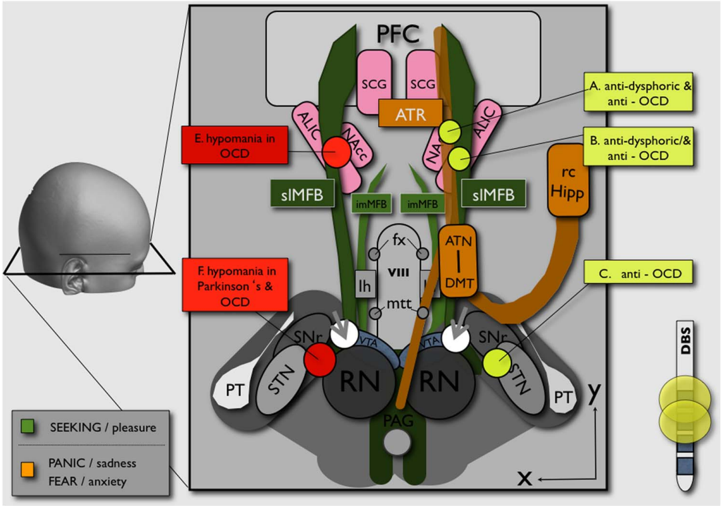
“16 Clinically, lesions of the anterior limb of internal capsule will simultaneously disconnect both the bilateral anterior thalamic radiation (ATR) and the MFB sys-tem, 10,11,17,18 which are in close proximity to ALIC and converge onto the PFC (Figure 3).”
Practice Guideline for the Treatment of Patients With Obsessive-Compulsive Disorder
(2008) · APA Practice Guidelines for the Treatment of Psychiatric Disorders: Comprehensive Guidelines and Guideline Watches · doi:10.1176/appi.books.9780890423363.149114 · Cited by 1,028
Subthalamic nucleus stimulation in severe obsessive-compulsive disorder
Mallet, L., Polosan, M., Jaafari, N., Baup, N., Welter, M.-L., Fontaine, D., Montcel, S. T. D., Yelnik, J., Chéreau, I., Arbus, C., et al. (2008) · New England Journal of Medicine · doi:10.1056/nejmoa0708514 · Cited by 965
Nuttin, B., Cosyns, P., Demeulemeester, H., Gybels, J., & Meyerson, B. (1999) · The Lancet · doi:10.1016/s0140-6736(99)02376-4 · Cited by 854
Prolonged dopamine signalling in striatum signals proximity and value of distant rewards
Howe, M. W., Tierney, P. L., Sandberg, S. G., Phillips, P. E. M., & Graybiel, A. M. (2013) · Nature · doi:10.1038/nature12475 · Cited by 565 · cited 1×
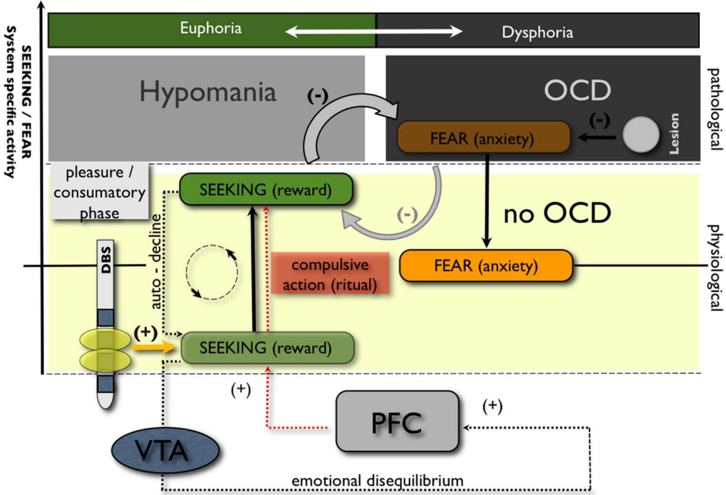
“Reward prediction behavior was shown in rodents to be linked to the level of free synaptic dopamine in the ventral striatum.(20) In slMFB DBS, a stimulation of fibers that descend into the VTA might (as suggested for rituals) transfer the function of dopaminergic neurons from phasic high-frequency oscillation into a t…”
Rapid effects of deep brain stimulation for treatment-resistant major depression
Schlaepfer, T. E., Bewernick, B. H., Kayser, S., Mädler, B., & Coenen, V. A. (2013) · Biological Psychiatry · doi:10.1016/j.biopsych.2013.01.034 · Cited by 563 · cited 10×
“Patients with MD react to slMFB DBS with an acute increase of appetitive motivation (goal directed behavior) owing to an improved prediction of distant reward.(7,8) Reward prediction behavior was shown in rodents to be linked to the level of free synaptic dopamine in the ventral striatum.”
InfluentialSelf-citationRepeated cortico-striatal stimulation generates persistent OCD-like behavior
Ahmari, S. E., Spellman, T., Douglass, N. L., Kheirbek, M. A., Simpson, H. B., Deisseroth, K., Gordon, J. A., & Hen, R. (2013) · Science · doi:10.1126/science.1234733 · Cited by 502 · cited 1×
“13 Thus it is the long-term and not the short-term activation that presumably leads to typical OCD symptoms.”
Invasive circuitry-based neurotherapeutics: stereotactic ablation and deep brain stimulation for OCD
Greenberg, B. D., Rauch, S. L., & Haber, S. N. (2010) · Neuropsychopharmacology · doi:10.1038/npp.2009.128 · Cited by 359
Zaitsev, M., Hennig, J., & Speck, O. (2004) · Magnetic Resonance in Medicine · doi:10.1002/mrm.20261 · Cited by 349 · cited 1×
“Deformation correction of the EPI sequence was performed according to Zaitsev et al.(12)”
Coenen, V. A., Panksepp, J., Hurwitz, T. A., Urbach, H., & Mädler, B. (2012) · The Journal of Neuropsychiatry and Clinical Neurosciences · doi:10.1176/appi.neuropsych.11080180 · Cited by 342 · cited 2×
“(Capitalization refers to affective neuroscience context in this interpretation.(10,11)) 288 V.”
Self-citation
Cited by
Items 101–130 of 130
Chiu, J. Z.-Y., Yap, Y. H. Y., & Tan, S.-H. (2026) · The International Journal of Psychiatry in Medicine · doi:10.1177/00912174261435019 · Cited by 1
Gouveia, F. V., Elias, G. J. B., Wong, E. H. Y., Yang, A., Beyn, M. E., Mesich, A., Omere, U., Iskin, S. A., Bai, Y., Hu, C., et al. (2026) · Nature Mental Health · doi:10.1038/s44220-026-00586-9 · Cited by 1
Bambico, F. R., Nicoglou, A., Relente, J., Surget, A., & Belzung, C. (2026) · Molecular Psychiatry · doi:10.1038/s41380-026-03872-1 · Cited by 1
Deep Brain Stimulation for Obsessive–Compulsive Disorder
Sharma, M., Reeves, K. C., Deogaonkar, M. S., & Rezai, A. R. (2018) · Elsevier eBooks · doi:10.1016/b978-0-12-805353-9.00085-1 · Cited by 1
Potvin, S., Dufault, S., & Patry, S. (2025) · SSRN Electronic Journal · doi:10.2139/ssrn.5118871 · Cited by 1
Dumas, S., François, C., Rosenkilde, M. B., Staryk, J., Roostalu, U., Heuer, A., Karachi, C., & Wallén-Mackenzie, Å. (2025) · bioRxiv (Cold Spring Harbor Laboratory) · doi:10.1101/2025.05.21.655268 · Cited by 1
A Multi-Symptom Circuit Architecture of Obsessive–Compulsive DisorderPreprint
Hollunder, B., Meyer, G. M., Li, N., Reinhardt, P., Sahin, I. A., Rajamani, N., Pijar, J., Nombela, C., Mosley, P. E., Acevedo, N., et al. (2025) · medRxiv · doi:10.64898/2025.12.14.25342121 · Cited by 3
Vissani, M., Tafreshi, A., Neudorfer, C., Nanda, P., Bush, A., Babapoor-Farrokhran, S., Horn, A., Camprodon, J. A., Dougherty, D. D., Cusin, C., et al. (2026) · Research Square · doi:10.21203/rs.3.rs-9316385/v1 · Cited by 2
“Common targets for DBS in OCD include the ventral capsule/ventral striatum (VC/VS), nucleus accumbens (NAcc), bed nucleus of the stria terminalis (BNST), anterior limb of the internal capsule, and anteromedial subthalamic nucleus 5,6 .”
Segrave, R. A., Hendrikse, J. J., & Parkes, L. (2018) · Cambridge University Press eBooks · doi:10.1017/9781108164313.021
Development of brain stimulation
Crowell, A. L., Riva‐Posse, P., & Mayberg, H. S. (2020) · doi:10.1093/med/9780198713005.003.0019
Coenen, V. A. (2021) · Operative Neurosurgery · doi:10.1093/ons/opab165
Self-citationChronic pain: Linking deep brain stimulation and sensory functional MRI
Polanski, W. H., & Klein, J. (2021) · Elsevier eBooks · doi:10.1016/b978-0-12-820589-1.00027-0
Comparing Major Targets of DBS in Individuals with Treatment Refractory OCD: A Systematic Review
Mahdi, H., & Vashi, V. (2022) · Undergraduate Research in Natural and Clinical Science and Technology (URNCST) Journal · doi:10.26685/urncst.347
Neurosurgery in Obsessive Compulsive Disorder: From targets to treatment to tracts and back again
van der Vlis, T. A. M. B. (2022) · Research Publications (Maastricht University) · doi:10.26481/dis.20221006tb
Boonstra, E., Bais, M. N., van Schouwenburg, M. R., van den Munckhof, P., Smit, D. J. A., Denys, D. A. J. P., & Slagter, H. A. (2022) · bioRxiv (Cold Spring Harbor Laboratory) · doi:10.1101/2022.11.15.516581
“Improvements in mood are thought to contribute to the improvement of OCD symptoms through stimulation (Coenen et al., 2017).”
BackgroundNordin, T. (2023) · Linköping studies in science and technology. Dissertations · doi:10.3384/9789179295349 · Cited by 1
Brain mechanisms underlying obsessive-compulsive disorder : evidences from a multimodal approach
Maatoug, R. (2023) · theses.fr (ABES) · doi:10.70675/0a85c6f9z3e25z4922za795z5c61d7dff634
Santin, M. D. N. (2023) · theses.fr (ABES) · doi:10.70675/d3b6a134z9d3cz4d33z87d3zb04e06790ca6 · Cited by 1
Wolf, N. D., Jakobs, M., & Wolf, R. C. (2025) · Nervenheilkunde · doi:10.1055/a-2616-7658
Laube, K. A. C., Iglésio, R., Arantes, P. R., Miguel, E. C., Hoexter, M. Q., Gilberto, C. J., Carlos, A., Carlos, L., & Godinho, F. L. F. (2025) · NeuroTarget · doi:10.47924/neurotarget2025508
Liu, V. M., Haast, R. A. M., Andrews, T. S., Inoue, W., Taha, A., Kai, J., Khan, A. R., & Lau, J. C. (2026) · bioRxiv (Cold Spring Harbor Laboratory) · doi:10.64898/2026.05.11.724328
Soubra, S. S., GARYALI, A., Jammal, R. E., Bentley, J. H., Hamre, T. A., Giridharan, N., Romain, C. S., Mansourian, K. A., Kabotyanski, K. E., Nitcheu, G. L. T., et al. (2026) · medRxiv · doi:10.64898/2026.05.26.26353680
Lauro, P. M., Palmer, C. F., Nambiar, M. M., Muller, U., Qiu, L., Halpern, C. H., & Scangos, K. W. (2026) · Frontiers in Psychiatry · doi:10.3389/fpsyt.2026.1828620
Dufault, S., Potvin, S., & Patry, S. (2026) · Brain Sciences · doi:10.3390/brainsci16080789
“…BNST-ALIC ( n = 49) [42,46,81,84,95], VC/VS ( n = 39) [76,79,82,86,93,94,97], amSTN ( n = 33) [50,89,91], slMFB ( n = 11) [32,35], ITP ( n = 11) [80,88], NAc ( n = 8) [81,84,90], ALIC ( n = 8) [98], and the MD/VA thalamic nuclei ( n = 4) [83], as well as the caudate…”
Neurobiology-informed treatment approaches for obsessive–compulsive disorder
Kawtharani, S., Shouman, W. A., Issa, D. A., Nitturi, V., Giridharan, N., Paulo, D. L., Merk, T., Provenza, N. R., Storch, E. A., Goodman, W. K., et al. (2026) · Elsevier eBooks · doi:10.1016/b978-0-443-27446-6.00007-8
McPherson, J. G., Miller, R. R., Fetz, E. E., & Perlmutter, S. I. (2026) · bioRxiv (Cold Spring Harbor Laboratory) · doi:10.64898/2026.10.01.755922
Pereira, J., Dold, M., Sajonz, B., Reinacher, P. C., Jarc, N., Czornik, M., Baldermann, J. C., Schlaepfer, T. E., Reisert, M., Tangermann, M., et al. (2026) · Clinical Neurophysiology · doi:10.1016/j.clinph.2026.2112451
Self-citationCzornik, M., Schlaepfer, T. E., Zöllner, L., Meyer, D. M., Rolker, S., Sajonz, B., Domschke, K., Endres, D., Runge, K., Coenen, V. A., et al. (2026) · Neurotherapeutics · doi:10.1016/j.neurot.2026.e01094 · Cited by 1
Self-citation
Metadata
- Authors
- Coenen, V. A., Schlaepfer, T. E., Goll, P., Reinacher, P. C., Voderholzer, U., Tebartz van Elst, L., Urbach, H., & Freyer, T.
- Affiliations
- University Medical Center Freiburg (DE)
- University Hospital Bonn (DE)
- Schön Klinik Roseneck (DE)
- Corresponding author
- Coenen, Volker A.
- Venue
- CNS Spectrums
- Publisher
- Cambridge University Press (CUP)
- Published
- 2016-06-08
- Volume
- 22
- Issue
- 3
- Pages
- 282-289
- ISSN
- 1092-8529 (ISSN-L)
- 2165-6509
- OpenAlex
- W2416957563
- Cited by
- 128
- References
- 30
- Citations by year
- 2026: 14 · 2025: 14 · 2024: 6 · 2023: 10 · 2022: 12 · 2021: 26 · 2020: 14 · 2019: 11 · 2018: 14 · 2017: 3 · 2016: 4
- FWCI
- 14.27
- Type
- journal article
- Language
- en
- Open access
- hybrid
- doi.org
- Licence
- Locations
- CNS Spectrums (publishedVersion, cc-by-nc-sa)
- PubMed (publishedVersion)
- Topics
- Social Sciences › Psychology › Clinical Psychology › Obsessive-Compulsive Spectrum Disorders
- Health Sciences › Medicine › Clinical Neurology › Deep Brain Stimulation and Movement Disorders
- Life Sciences › Neuroscience › Neurology › Transcranial Magnetic Stimulation Studies
- Keywords
- deep brain stimulation, medial forebrain bundle, obsessive-compulsive disorder, reward systems, mechanism of action, refractory psychiatric disorders
- MeSH terms
- Adult, Humans, Male, Medial Forebrain Bundle, Middle Aged, Obsessive-Compulsive Disorder, Deep Brain Stimulation
About these checks
Registry, retraction, Cites and statistics results are computed, not judged, with one exception: a printed reference that no index lists is read once by a model before it counts as a citation error. Claims are extracted by a model and kept only when their quote appears verbatim in the text; each cited source is then checked, with a model’s help, for whether it says what the claim relies on. Those verdicts can be wrong — read the claim’s quote and the cited source before relying on one.
Statistics and arithmetic are recomputed, not judged.
Confidence bands are shown only for fields calibrated on our annotated test set. None is calibrated yet, so no band is shown.
What counts as a claim ›How we measure confidence ›How we check this ›
Are you an author, or do you see a problem with this page? Request a review
Data sources
Bibliographic data: Semantic Scholar, OpenAlex, Crossref.
Contains information from the Semantic Scholar Academic Graph Datasets, made available under the ODC Attribution License (ODC-BY 1.0).
Semantic Scholar’s data is described in: Kinney, R., et al. (2023). The Semantic Scholar Open Data Platform. arXiv:2301.10140.
