

Are Trauma Memories Disjointed from other Autobiographical Memories in Posttraumatic Stress Disorder? An Experimental Investigation
Open accessThe DOI matches its Crossref record; 45 of the 45 references it cites were found in a registry or an index.
Abstract
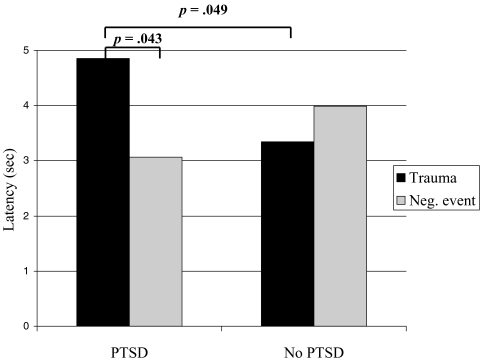
This study tested the hypothesis that trauma memories are disjointed from other autobiographical material in posttraumatic stress disorder (PTSD). Assault survivors with (n = 25) and without PTSD (n = 49) completed an autobiographical memory retrieval task during script-driven imagery of (a) the assault and (b) an unrelated negative event. When listening to a taped imagery script of the worst moment of their assault, survivors with PTSD took longer to retrieve unrelated non-traumatic autobiographical information than those without PTSD, but not when listening to a taped script of the worst moment of another negative life event. The groups also did not differ in general retrieval latencies, neither at baseline nor after the imagery tasks. The findings are in line with suggestions that traumatic memories are less integrated with other autobiographical information in trauma survivors with PTSD than in those without PTSD.
Overview
The claims and statistics of this paper haven’t been checked yet.
Free: it reads the open-access text and checks the first 5 claims that cite a source we can check. Create a free account to check every claim.
Integrity signals
Registry
Cites
Statistics
Figures
Verification
Claims the paper makes
The claims and statistics of this paper haven’t been checked yet.
Free: it reads the open-access text and checks the first 5 claims that cite a source we can check. Create a free account to check every claim.
Claims other papers make about this one
Each is checked against this paper’s own text: does it say what the citing paper says it does?
The cited source says what the claim attributes to it.
In the citing paper
“In other studies PTSD patients have been found to take longer to retrieve autobiographical memories when listening to a script of their traumatic event than to a script of another very distressing but non-traumatic event”
From Episodic memory, perceptual memory, and their interaction: Foundations for a theory of posttraumatic stress disorder. (2014) · cites this paper as Kleim, Wallott, & Ehlers, 2008
The cited source says what the claim attributes to it.
In the citing paper
“suggesting that the traumatic event memory was less well integrated with other autobiographical material (Kleim, Wallott, & Ehlers, 2008).”
From Episodic memory, perceptual memory, and their interaction: Foundations for a theory of posttraumatic stress disorder. (2014) · cites this paper as Kleim, Wallott, & Ehlers, 2008
Self-check
Percentages, sums and reported differences re-computed from the paper’s own numbers.
The self-check needs the paper’s full text.
Citations
Cites
A cognitive model of posttraumatic stress disorder
Ehlers, A., & Clark, D. M. (2000) · Behaviour Research and Therapy · doi:10.1016/s0005-7967(99)00123-0 · Cited by 6,147 · cited 15×
“First, trauma survivors with PTSD describe to a greater extent that intrusive memories appear to happen in the “here and now” than those without PTSD (Ehlers and Clark, 2000).”
InfluentialSelf-citationStructured Clinical Interview for DSM-IV Axis I Disorders
Spitzer, R. L., First, M. B., & Gibbon, M. (1997) · Medical Entomology and Zoology · Cited by 4,096
The construction of autobiographical memories in the self-memory system
Conway, M. A., & Pleydell-Pearce, C. W. (2000) · Psychological Review · doi:10.1037/0033-295x.107.2.261 · Cited by 4,089 · cited 4×
“In conclusion, this experiment was to our knowledge the first to experimentally investigate the hypothesis that trauma memories lack integration into the autobiographical memory base in PTSD (Conway and Pleydell-Pearce, 2000; Ehlers and Clark, 2000).”
InfluentialCognitive Therapy in Depression
Kovacs, M. (1980) · Journal of the American Academy of Psychoanalysis · doi:10.1521/jaap.1.1980.8.1.127 · Cited by 3,402 · cited 1×
“The Beck Depression Inventory (BDI; Beck, Rush, Shaw and Emery, 1979), a standardized questionnaire of established reliability and validity, assessed the severity of depressive symptoms.”
Foa, E. B., Cashman, L., Jaycox, L., & Perry, K. (1997) · Psychological Assessment · doi:10.1037/1040-3590.9.4.445 · Cited by 2,709
Assessing psychological trauma and PTSD
(1997) · Choice Reviews Online · doi:10.5860/choice.34-5966 · Cited by 2,330
Henry, J. (1977) · Psychosomatic Medicine · doi:10.1097/00006842-197701000-00013 · Cited by 2,254 · cited 1×
“Involuntary re-experiencing is a hallmark symptom of posttraumatic stress disorder (e.g. Horowitz, 1976).”
BackgroundHorowitz, M. J. (1993) · International Handbook of Traumatic Stress Syndromes · doi:10.1007/978-1-4615-2820-3_4 · Cited by 1,852
A dual representation theory of posttraumatic stress disorder.
Brewin, C. R., Dalgleish, T., & Joseph, S. (1996) · Psychological Review · doi:10.1037/0033-295x.103.4.670 · Cited by 1,696 · cited 2×
“…in particular with the “nowness” of intrusive memories, and with cognitive processing styles that are thought to lead to poor integration of trauma memories (dissociation, data-driven processing, and lack of binding; Brewin et al., 1996; Ehlers and Clark, 2000; Ehlers et al., 2004).”
Cognitive Therapy of Depression
Fischer, H. K. (1980) · Psychosomatics · doi:10.1016/s0033-3182(80)73639-3 · Cited by 1,612
Research works printed but not linked: 1
- McNally R. J. 2003 Remembering Trauma Cambridge, MA Harvard University Press
Cited by
Evaluation of the evidence for the trauma and fantasy models of dissociation.
Dalenberg, C. J., Brand, B. L., Gleaves, D. H., Dorahy, M. J., Loewenstein, R. J., Cardeña, E., Frewen, P. A., Carlson, E. B., & Spiegel, D. (2012) · Psychological Bulletin · doi:10.1037/a0027447 · Cited by 667
Brewin, C. R. (2014) · Psychological Bulletin · doi:10.1037/a0033722 · Cited by 492
The Nature and Significance of Memory Disturbance in Posttraumatic Stress Disorder
Brewin, C. R. (2011) · Annual Review of Clinical Psychology · doi:10.1146/annurev-clinpsy-032210-104544 · Cited by 428
Stress and multiple memory systems: from ‘thinking’ to ‘doing’
Schwabe, L., & Wolf, O. T. (2013) · Trends in Cognitive Sciences · doi:10.1016/j.tics.2012.12.001 · Cited by 355
Memory and narrative of traumatic events: A literature review.
Crespo, M., & Fernández-Lansac, V. (2016) · Psychological Trauma: Theory, Research, Practice, and Policy · doi:10.1037/tra0000041 · Cited by 193
Metadata
- Authors
- Kleim, B., Wallott, F., & Ehlers, A.
- Affiliations
- King's College London (GB)
- Corresponding author
- Ehlers, Anke
- Venue
- Behavioural and Cognitive Psychotherapy
- Publisher
- Cambridge University Press (CUP)
- Published
- 2008-01-08
- Volume
- 36
- Issue
- 2
- Pages
- 221-234
- ISSN
- 1352-4658 (ISSN-L)
- 1469-1833
- PMC
- PMC2889292
- OpenAlex
- W2127745723
- Cited by
- 52
- References
- 42
- Citations by year
- 2025: 3 · 2024: 2 · 2023: 4 · 2022: 2 · 2021: 2 · 2020: 3 · 2019: 4 · 2018: 3 · 2017: 1 · 2016: 3 · 2015: 4 · 2014: 4 · 2013: 6 · 2012: 2
- FWCI
- 3.35
- Type
- journal article
- Language
- en
- Open access
- bronze
- doi.org
- Locations
- Behavioural and Cognitive Psychotherapy (publishedVersion)
- Europe PMC (PubMed Central) (publishedVersion, cc-by-nc-sa)
- PubMed Central (publishedVersion, cc-by-nc-sa)
- PubMed (publishedVersion)
- Zurich Open Repository and Archive (University of Zurich) (acceptedVersion, cc-by-nc-sa)
- Research Portal (King's College London) (submittedVersion)
- Zurich Open Repository and Archive (University of Zurich) (submittedVersion, cc-by-nc-sa)
- Zurich Open Repository and Archive (University of Zurich)
- Funders
- Wellcome Trust (069777)
- Psychiatry Research Trust
- King's College London
- Topics
- Social Sciences › Psychology › Clinical Psychology › Posttraumatic Stress Disorder Research
- Life Sciences › Neuroscience › Cognitive Neuroscience › Memory Processes and Influences
- Social Sciences › Psychology › Developmental and Educational Psychology › Identity, Memory, and Therapy
- Keywords
- post-traumatic stress disorder, traumatic memory, autobiographical memory, script-driven imagery, memory integration, negative life events
About these checks
Registry, retraction, Cites and statistics results are computed, not judged, with one exception: a printed reference that no index lists is read once by a model before it counts as a citation error. Claims are extracted by a model and kept only when their quote appears verbatim in the text; each cited source is then checked, with a model’s help, for whether it says what the claim relies on. Those verdicts can be wrong — read the claim’s quote and the cited source before relying on one.
Statistics and arithmetic are recomputed, not judged.
Confidence bands are shown only for fields calibrated on our annotated test set. None is calibrated yet, so no band is shown.
What counts as a claim ›How we measure confidence ›How we check this ›
Are you an author, or do you see a problem with this page? Request a review
How to cite
Cite CoChat for the checks on this page, and the paper for its own findings.
- This page
- CoChat. (2026). Citation check: Are Trauma Memories Disjointed from other Autobiographical Memories in Posttraumatic Stress Disorder? An Experimental Investigation. https://app.cochat.ai/papers/10.1017/s1352465807004080
- The paper
- Kleim, B., Wallott, F., & Ehlers, A. (2008). Are Trauma Memories Disjointed from other Autobiographical Memories in Posttraumatic Stress Disorder? An Experimental Investigation. Behavioural and Cognitive Psychotherapy. https://doi.org/10.1017/s1352465807004080
Data sources
Bibliographic data: Semantic Scholar, OpenAlex, Crossref.
Contains information from the Semantic Scholar Academic Graph Datasets, made available under the ODC Attribution License (ODC-BY 1.0).
Semantic Scholar’s data is described in: Kinney, R., et al. (2023). The Semantic Scholar Open Data Platform. arXiv:2301.10140.
