

Are Trauma Memories Disjointed from other Autobiographical Memories in Posttraumatic Stress Disorder? An Experimental Investigation
Open accessThe DOI matches its Crossref record; 45 of the 45 references it cites were found in a registry or an index.
Abstract
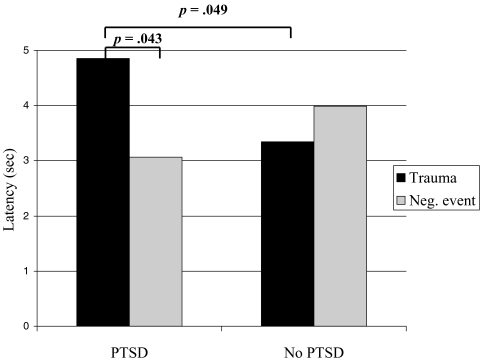
This study tested the hypothesis that trauma memories are disjointed from other autobiographical material in posttraumatic stress disorder (PTSD). Assault survivors with (n = 25) and without PTSD (n = 49) completed an autobiographical memory retrieval task during script-driven imagery of (a) the assault and (b) an unrelated negative event. When listening to a taped imagery script of the worst moment of their assault, survivors with PTSD took longer to retrieve unrelated non-traumatic autobiographical information than those without PTSD, but not when listening to a taped script of the worst moment of another negative life event. The groups also did not differ in general retrieval latencies, neither at baseline nor after the imagery tasks. The findings are in line with suggestions that traumatic memories are less integrated with other autobiographical information in trauma survivors with PTSD than in those without PTSD.
Overview
The claims and statistics of this paper haven’t been checked yet.
Free: it reads the open-access text and checks the first 5 claims that cite a source we can check. Create a free account to check every claim.
Integrity signals
Registry
Cites
Statistics
Figures
Verification
Claims the paper makes
The claims and statistics of this paper haven’t been checked yet.
Free: it reads the open-access text and checks the first 5 claims that cite a source we can check. Create a free account to check every claim.
Claims other papers make about this one
Each is checked against this paper’s own text: does it say what the citing paper says it does?
The cited source says what the claim attributes to it.
In the citing paper
“In other studies PTSD patients have been found to take longer to retrieve autobiographical memories when listening to a script of their traumatic event than to a script of another very distressing but non-traumatic event”
From Episodic memory, perceptual memory, and their interaction: Foundations for a theory of posttraumatic stress disorder. (2014) · cites this paper as Kleim, Wallott, & Ehlers, 2008
The cited source says what the claim attributes to it.
In the citing paper
“suggesting that the traumatic event memory was less well integrated with other autobiographical material (Kleim, Wallott, & Ehlers, 2008).”
From Episodic memory, perceptual memory, and their interaction: Foundations for a theory of posttraumatic stress disorder. (2014) · cites this paper as Kleim, Wallott, & Ehlers, 2008
Self-check
Percentages, sums and reported differences re-computed from the paper’s own numbers.
The self-check needs the paper’s full text.
Citations
Cites
A cognitive model of posttraumatic stress disorder
Ehlers, A., & Clark, D. M. (2000) · Behaviour Research and Therapy · doi:10.1016/s0005-7967(99)00123-0 · Cited by 6,147 · cited 15×
“First, trauma survivors with PTSD describe to a greater extent that intrusive memories appear to happen in the “here and now” than those without PTSD (Ehlers and Clark, 2000).”
InfluentialSelf-citationStructured Clinical Interview for DSM-IV Axis I Disorders
Spitzer, R. L., First, M. B., & Gibbon, M. (1997) · Medical Entomology and Zoology · Cited by 4,096
The construction of autobiographical memories in the self-memory system
Conway, M. A., & Pleydell-Pearce, C. W. (2000) · Psychological Review · doi:10.1037/0033-295x.107.2.261 · Cited by 4,089 · cited 4×
“In conclusion, this experiment was to our knowledge the first to experimentally investigate the hypothesis that trauma memories lack integration into the autobiographical memory base in PTSD (Conway and Pleydell-Pearce, 2000; Ehlers and Clark, 2000).”
InfluentialCognitive Therapy in Depression
Kovacs, M. (1980) · Journal of the American Academy of Psychoanalysis · doi:10.1521/jaap.1.1980.8.1.127 · Cited by 3,402 · cited 1×
“The Beck Depression Inventory (BDI; Beck, Rush, Shaw and Emery, 1979), a standardized questionnaire of established reliability and validity, assessed the severity of depressive symptoms.”
Foa, E. B., Cashman, L., Jaycox, L., & Perry, K. (1997) · Psychological Assessment · doi:10.1037/1040-3590.9.4.445 · Cited by 2,709
Assessing psychological trauma and PTSD
(1997) · Choice Reviews Online · doi:10.5860/choice.34-5966 · Cited by 2,330
Henry, J. (1977) · Psychosomatic Medicine · doi:10.1097/00006842-197701000-00013 · Cited by 2,254 · cited 1×
“Involuntary re-experiencing is a hallmark symptom of posttraumatic stress disorder (e.g. Horowitz, 1976).”
BackgroundHorowitz, M. J. (1993) · International Handbook of Traumatic Stress Syndromes · doi:10.1007/978-1-4615-2820-3_4 · Cited by 1,852
A dual representation theory of posttraumatic stress disorder.
Brewin, C. R., Dalgleish, T., & Joseph, S. (1996) · Psychological Review · doi:10.1037/0033-295x.103.4.670 · Cited by 1,696 · cited 2×
“…in particular with the “nowness” of intrusive memories, and with cognitive processing styles that are thought to lead to poor integration of trauma memories (dissociation, data-driven processing, and lack of binding; Brewin et al., 1996; Ehlers and Clark, 2000; Ehlers et al., 2004).”
Cognitive Therapy of Depression
Fischer, H. K. (1980) · Psychosomatics · doi:10.1016/s0033-3182(80)73639-3 · Cited by 1,612
Research works printed but not linked: 1
- McNally R. J. 2003 Remembering Trauma Cambridge, MA Harvard University Press
Cited by
Evaluation of the evidence for the trauma and fantasy models of dissociation.
Dalenberg, C. J., Brand, B. L., Gleaves, D. H., Dorahy, M. J., Loewenstein, R. J., Cardeña, E., Frewen, P. A., Carlson, E. B., & Spiegel, D. (2012) · Psychological Bulletin · doi:10.1037/a0027447 · Cited by 667
Brewin, C. R. (2014) · Psychological Bulletin · doi:10.1037/a0033722 · Cited by 492
The Nature and Significance of Memory Disturbance in Posttraumatic Stress Disorder
Brewin, C. R. (2011) · Annual Review of Clinical Psychology · doi:10.1146/annurev-clinpsy-032210-104544 · Cited by 428
Stress and multiple memory systems: from ‘thinking’ to ‘doing’
Schwabe, L., & Wolf, O. T. (2013) · Trends in Cognitive Sciences · doi:10.1016/j.tics.2012.12.001 · Cited by 355
Memory and narrative of traumatic events: A literature review.
Crespo, M., & Fernández-Lansac, V. (2016) · Psychological Trauma: Theory, Research, Practice, and Policy · doi:10.1037/tra0000041 · Cited by 193
Kleim, B., Graham, B., Bryant, R. A., & Ehlers, A. (2013) · Journal of Abnormal Psychology · doi:10.1037/a0034957 · Cited by 121
Self-citationMetacognition, memory disorganization and rumination in posttraumatic stress symptoms
Bennett, H., & Wells, A. (2010) · Journal of Anxiety Disorders · doi:10.1016/j.janxdis.2010.01.004 · Cited by 117
“Kleim et al. (2008) concluded that these results suggest that disjointedness between the trauma memory and other autobiographical information is associated with PTSD.”
ResultMemory under stress: from single systems to network changes
Schwabe, L. (2017) · European Journal of Neuroscience · doi:10.1111/ejn.13478 · Cited by 115
Post-traumatic stress disorder: The development of effective psychological treatments
Ehlers, A., & Clark, D. M. (2008) · Nordic Journal of Psychiatry · doi:10.1080/08039480802315608 · Cited by 85
Self-citationNey, L. J., Matthews, A., Bruno, R., & Felmingham, K. L. (2018) · Neuroscience & Biobehavioral Reviews · doi:10.1016/j.neubiorev.2018.07.006 · Cited by 66
“Intrusive memories are spontaneous recollections of trauma that are often difficult for patients to voluntarily recall or chronologically sequence (Brewin et al., 2010; Kleim et al., 2008).”
BackgroundGrimm, A., Hulse, L. M., Preiss, M., & Schmidt, S. (2013) · Disasters · doi:10.1111/disa.12034 · Cited by 65
Ney, L. J., Gogos, A., Hsu, C. K., & Felmingham, K. L. (2019) · Psychoneuroendocrinology · doi:10.1016/j.psyneuen.2019.104416 · Cited by 55
Cognitive Therapy for PTSD: Updating Memories and Meanings of Trauma
Ehlers, A., & Wild, J. (2015) · Springer eBooks · doi:10.1007/978-3-319-07109-1_9 · Cited by 57
Self-citationEhlers, A. (2015) · Clinical Perspectives On Autobiographical Memory · doi:10.1017/cbo9781139626767.007 · Cited by 37
Self-citationSingleton, S. P., Wang, J. B., Mithoefer, M. C., Hanlon, C. A., George, M. S., Mithoefer, A., Mithoefer, O. J., Coker, A. R., Yazar‐Klosinski, B., Emerson, A., et al. (2023) · Frontiers in Psychiatry · doi:10.3389/fpsyt.2022.947622 · Cited by 56
“Also, it has previously been shown that PTSD survivors take longer to retrieve unrelated autobiographical information when listening to taped imagery scripts of their traumatic memories (111).”
BackgroundSmeets, T., Giesbrecht, T., Raymaekers, L., Shaw, J., & Merckelbach, H. L. G. J. (2009) · Clinical Psychology & Psychotherapy · doi:10.1002/cpp.644 · Cited by 39
“This poor integration, in turn, would facilitate the development of PTSD symptoms (e.g., Ehlers & Clark, 2000; Kleim, Wallott, & Ehlers, 2008; for reviews, see Brewin & Holmes, 2003; Dalgleish, 2004).”
BackgroundConceptual and perceptual priming and dissociation in chronic posttraumatic stress disorder.
Lyttle, N., Dorahy, M. J., Hanna, D., & Huntjens, R. J. C. (2010) · Journal of Abnormal Psychology · doi:10.1037/a0020894 · Cited by 32
Sopp, M. R., Brueckner, A. H., Schäfer, S. K., Lass‐Hennemann, J., & Michael, T. (2019) · European Journal of Psychotraumatology · doi:10.1080/20008198.2019.1644128 · Cited by 28
Sex differences in intrusive memories following trauma
Hsu, C.-M. K., Kleim, B., Nicholson, E., Zuj, D. V., Cushing, P. J., Gray, K. E., Clark, L., & Felmingham, K. L. (2018) · PLoS ONE · doi:10.1371/journal.pone.0208575 · Cited by 39
“They are typically sensory-perceptual memories that are vivid [22], fragmented [23] and poorly contextualized into autobiographical memory [24].”
BackgroundSelf-citationDifferential Effects of Poor Recall and Memory Disjointedness on Trauma Symptoms
Sachschal, J., Woodward, E., Wichelmann, J. M., Haag, K., & Ehlers, A. (2019) · Clinical Psychological Science · doi:10.1177/2167702619847195 · Cited by 57
“Kleim, Wallott, and Ehlers (2008) further found that compared with trauma survivors without PTSD, people with PTSD took longer to access other information from autobiographical memory while listening to the worst parts of the trauma.”
BackgroundResultSelf-citationKildahl, A. N., Helverschou, S. B., Bakken, T. L., & Oddli, H. W. (2020) · Journal of Mental Health Research in Intellectual Disabilities · doi:10.1080/19315864.2020.1760972 · Cited by 23
“Sensory or perceptual processing of an experience leads to the formation of fragmented or disjointed memories that are poorly contextualized and primarily consists of sensory impressions (Ehlers & Clark, 2000; Halligan et al., 2002; Kleim et al., 2008; Sündermann et al., 2013).”
BackgroundRivi, V., Rigillo, G., Toscano, Y., Benatti, C., & Blom, J. M. C. (2023) · Children · doi:10.3390/children10071217 · Cited by 18
Young, C. Y. F. (2011) · African Journal of AIDS Research · doi:10.2989/16085906.2011.593376 · Cited by 17
Sopp, M. R., Friesen, E., Schäfer, S. K., Brueckner, A. H., Wirth, B. E., Weber, J., Lass‐Hennemann, J., & Michael, T. (2020) · Behaviour Research and Therapy · doi:10.1016/j.brat.2020.103776 · Cited by 12
Autobiographical Memories and PTSD
Lapidow, E. S., & Brown, A. D. (2016) · Springer eBooks · doi:10.1007/978-3-319-08359-9_117 · Cited by 10
“Recent examination of memory in assault survivors (Kleim et al. 2008) found that when listening to the worst moment in a description of their trauma, survivors with PTSD had significant deficits in recall of autobiographical information, but not when listening to a nontraumatic negative life event from the same period.”
BackgroundPoli, A., Cappellini, F., Sala, J., & Miccoli, M. (2023) · Frontiers in Psychology · doi:10.3389/fpsyg.2023.1164527 · Cited by 48
“Since it was shown that traumatic memories are less integrated with other autobiographical information in trauma survivors and this condition fostered dissociative symptoms (Kleim et al., 2008), the EMDR may promote the integration of autobiographical memories and a reduction in dissociative symptomatology.”
BackgroundMatrángolo, G., Simkin, H., & Azzollini, S. (2022) · CES Psicología · doi:10.21615/cesp.6009 · Cited by 28
“…1990), pacientes con diagnóstico de trastornos psiquiátricos (Cecil et al., 1995; Vaingankar et al., 2012), pacientes cardiacos (Heo et al., 2020; Kleim et al., 2008; Pedersen et al., 2009; Pushkarev et al., 2018), pacientes con infecciones respiratorias (Levin et al., 2009), adultos mayores…”
BackgroundLorenzzoni, P. L., da Silva, T. L. G., Poletto, M. P., Gauer, G., & Christian Haag-Kristensen, C. (2014) · Avances en Psicología Latinoamericana · doi:10.12804/apl32.03.2014.08 · Cited by 15
Corrigan, J.-P., Hanna, D., & Dyer, K. F. W. (2020) · Behavioural and Cognitive Psychotherapy · doi:10.1017/s135246582000048x · Cited by 7
“This mechanism has been empirically supported by research showing disjointedness effects in memory after trauma (Kleim et al., 2008) and its involvement in PTSD symptoms (Mayou et al., 2001).”
BackgroundRodenbaugh, M. M., Thompson, L. M., Sznitman, S. R., Jin, L., & Contractor, A. A. (2025) · European Journal of Psychotraumatology · doi:10.1080/20008066.2025.2563197 · Cited by 3
“…which can impede engagement with positive emotions and AMs (Litz & Gray, 2002; Moore & Zoellner, 2012) as well as with barriers reported by recipients of trauma-focused interventions, where they find it difficult to recall and narrate traumatic AMs (Kleim et al., 2008; Rahman & Brown, 2021).”
Impact of Trauma Type and Emotion on Overgeneral Autobiographical Memory
Zheng, P., & Gray, M. J. (2018) · Journal of Loss and Trauma · doi:10.1080/15325024.2018.1524616 · Cited by 3
Wilson, M., Donath, W., Dorahy, M. J., Habermas, T., Peters, I., Marsh, R. J., Johnson, B. M., Middleton, W., & Huntjens, R. J. C. (2025) · Journal of Trauma & Dissociation · doi:10.1080/15299732.2025.2507897 · Cited by 5
“However, this has not been so evident when studies have employed more “objective” measures, such as having participants sequence the events of a previously viewed distressing film (i.e., Halligan et al., 2002; Huntjens et al., 2013; Kleim et al., 2008).”
Ogden, J., Jobson, L., & Drummond, S. P. A. (2024) · Current Sleep Medicine Reports · doi:10.1007/s40675-024-00303-x · Cited by 3
“They may also be fragmented or disconnected from contextual information [12] and other autobiographical memories [13].”
Uzer, T., Beşiroğlu, L., Karakılıç, M., Yalçın, D. Ö., Yazar, M. S., & Koçkar, A. İ. (2023) · Memory · doi:10.1080/09658211.2023.2232588 · Cited by 3
“In studies supporting poor integration view, memory integration was usually inferred from narrative coherence, event-clustering and retrieval time (RT) measures, and these measures were negatively associated with PTSD severity (Ehlers et al., 2004; Hellawell & Brewin, 2002; Jelinek et al., 2009; Jones et al., 2007; Kl…”
BackgroundUnderstanding and Treating Unwanted Trauma Memories in Posttraumatic Stress Disorder
Ehlers, A. (2010) · Zeitschrift für Psychologie / Journal of Psychology · doi:10.1027/0044-3409/a000021 · Cited by 102
Self-citationSingleton, S. P., Wang, J., Mithoefer, M., Hanlon, C., George, M., Mithoefer, A., Mithoefer, O., Coker, A., Yazar-Klosinski, B., Emerson, A., et al. (2022) · medRxiv · doi:10.1101/2022.05.25.22275473 · Cited by 1
Lolich, M., Paly, G. L., Nistal, M., Becerra, L., & Azzollini, S. (2014) · Psykhe (Santiago) · doi:10.7764/psykhe.23.1.556 · Cited by 8
Towards an Extended Cognitive Model of Moral Injury—The Role of Mental Defeat
Letendre, M., & Reinecke, A. (2026) · Scandinavian Journal of Psychology · doi:10.1111/sjop.70086
“In PTSD, the features of the traumatic memory include disjoint-edness and lacking context within autobiographical memory (Ehlers et al. 2000; Kleim et al. 2008; Liberzon and Abelson 2016).”
Matrángolo, G., Yaccarini, C., & Paz, G. (2017) · Revista Científica Arbitrada de la Fundación MenteClara · doi:10.32351/rca.v2.2.35 · Cited by 10
고문 생존자의 외상기억표상의 특성과 외상후 심리적 증상과의 관계
최, 현., 이, 훈., & 이, 화. (2014) · doi:10.15842/kjcp.2014.33.3.002002
Murray, H., Wild, J., & Ehlers, A. (2021) · Elsevier eBooks · doi:10.1016/b978-0-12-818697-8.00229-6 · Cited by 3
Self-citationIffland, B., & Neuner, F. (2016) · Elsevier eBooks · doi:10.1016/b978-0-12-800951-2.00019-4 · Cited by 9
Metadata
- Authors
- Kleim, B., Wallott, F., & Ehlers, A.
- Affiliations
- King's College London (GB)
- Corresponding author
- Ehlers, Anke
- Venue
- Behavioural and Cognitive Psychotherapy
- Publisher
- Cambridge University Press (CUP)
- Published
- 2008-01-08
- Volume
- 36
- Issue
- 2
- Pages
- 221-234
- ISSN
- 1352-4658 (ISSN-L)
- 1469-1833
- PMC
- PMC2889292
- OpenAlex
- W2127745723
- Semantic Scholar
- 2e67c729e7e985413eacb43204e3600e53001c29
- Cited by
- 52
- References
- 42
- Citations by year
- 2025: 3 · 2024: 2 · 2023: 4 · 2022: 2 · 2021: 2 · 2020: 3 · 2019: 4 · 2018: 3 · 2017: 1 · 2016: 3 · 2015: 4 · 2014: 4 · 2013: 6 · 2012: 2
- FWCI
- 3.35
- Type
- journal article
- Language
- en
- Open access
- bronze
- doi.org
- Locations
- Behavioural and Cognitive Psychotherapy (publishedVersion)
- Europe PMC (PubMed Central) (publishedVersion, cc-by-nc-sa)
- PubMed Central (publishedVersion, cc-by-nc-sa)
- PubMed (publishedVersion)
- Zurich Open Repository and Archive (University of Zurich) (acceptedVersion, cc-by-nc-sa)
- Research Portal (King's College London) (submittedVersion)
- Zurich Open Repository and Archive (University of Zurich) (submittedVersion, cc-by-nc-sa)
- Zurich Open Repository and Archive (University of Zurich)
- Funders
- Wellcome Trust (069777)
- Psychiatry Research Trust
- King's College London
- Topics
- Social Sciences › Psychology › Clinical Psychology › Posttraumatic Stress Disorder Research
- Life Sciences › Neuroscience › Cognitive Neuroscience › Memory Processes and Influences
- Social Sciences › Psychology › Developmental and Educational Psychology › Identity, Memory, and Therapy
- Keywords
- post-traumatic stress disorder, traumatic memory, autobiographical memory, script-driven imagery, memory integration, negative life events
About these checks
Registry, retraction, Cites and statistics results are computed, not judged, with one exception: a printed reference that no index lists is read once by a model before it counts as a citation error. Claims are extracted by a model and kept only when their quote appears verbatim in the text; each cited source is then checked, with a model’s help, for whether it says what the claim relies on. Those verdicts can be wrong — read the claim’s quote and the cited source before relying on one.
Statistics and arithmetic are recomputed, not judged.
Confidence bands are shown only for fields calibrated on our annotated test set. None is calibrated yet, so no band is shown.
What counts as a claim ›How we measure confidence ›How we check this ›
Are you an author, or do you see a problem with this page? Request a review
Data sources
Bibliographic data: Semantic Scholar, OpenAlex, Crossref.
Contains information from the Semantic Scholar Academic Graph Datasets, made available under the ODC Attribution License (ODC-BY 1.0).
Semantic Scholar’s data is described in: Kinney, R., et al. (2023). The Semantic Scholar Open Data Platform. arXiv:2301.10140.
