

The DOI matches its Crossref record; 31 of the 31 references it cites were found in a registry or an index.
A double-blind, randomized, placebo-controlled, active reference study of Lu AA21004 in patients with major depressive disorder
Open accessAbstract
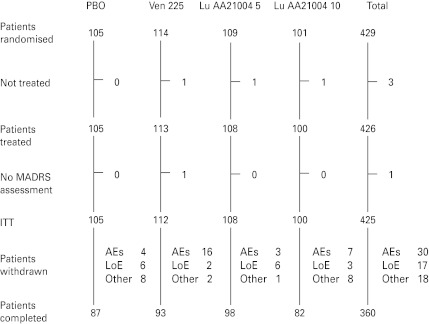
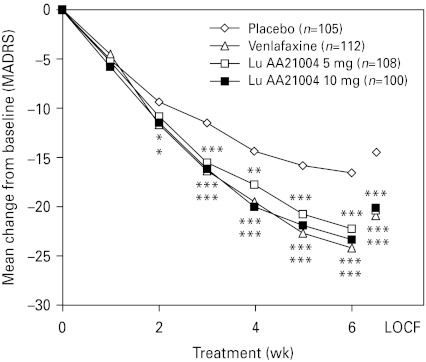
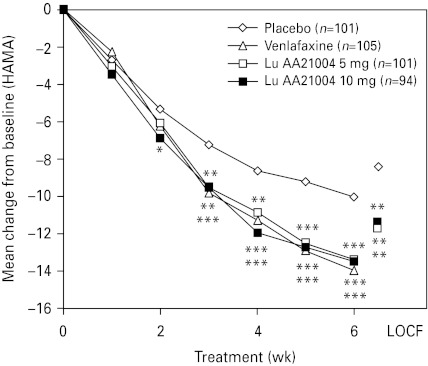
The efficacy, safety, and tolerability of Lu AA21004 vs. placebo using venlafaxine XR as active reference in patients with DSM-IV-TR major depressive disorder (MDD) were evaluated. Lu AA21004 is a novel antidepressant that is a 5-HT3 and 5-HT7 receptor antagonist, 5-HT1A receptor agonist, 5-HT1B receptor partial agonist and inhibitor of the 5-HT transporter in recombinant cell lines. In this 6-wk, multi-site study, 429 patients were randomly assigned (1:1:1:1) to 5 or 10 mg Lu AA21004, placebo or 225 mg venlafaxine XR. All patients had a baseline Montgomery-Åsberg Depression Rating Scale (MADRS) total score ≥ 30. The primary efficacy analysis was based on the MADRS total score adjusting for multiplicity using a hierarchical testing procedure starting with the highest dose vs. placebo. Lu AA21004 was statistically significantly superior to placebo (n=105) in mean change from baseline in MADRS total score at week 6 (p<0.0001, last observation carried forward), with a mean treatment difference vs. placebo of 5.9 (5 mg, n=108), and 5.7 (10 mg, n=100) points. Venlafaxine XR (n=112) was also significantly superior to placebo at week 6 (p<0.0001). In total, 30 patients withdrew due to adverse events (AEs)--placebo: four (4%); 5 mg Lu AA21004: three (3%); 10 mg Lu AA21004: seven (7%); and venlafaxine: 16 (14%). The most common AEs were nausea, headache, hyperhidrosis, and dry mouth. No clinically relevant changes over time were seen in the clinical laboratory results, vital signs, weight, or ECG parameters. In this study, treatment with 5 mg and 10 mg Lu AA21004 for 6 wk was efficacious and well tolerated in patients with MDD.
Overview
The claims and statistics of this paper haven’t been checked yet.
Run the check — free, no account needed. It reads the open-access text and checks the sources it cites.
Integrity signals
Registry
Cites
Statistics
Figures
Verification
Claims the paper makes
The claims and statistics of this paper haven’t been checked yet.
Run the check — free, no account needed. It reads the open-access text and checks the sources it cites.
Claims other papers make about this one
Each is checked against this paper’s own text: does it say what the citing paper says it does?
The cited source doesn’t support the claim as written.
In the citing paper
“The incidence rate is similar to that of previous clinical studies at around 30%.17,34”
From A Randomized Controlled Study of Efficacy and Cognitive Function Improvement of Vortioxetine and Escitalopram in Patients with Depression in Chinese Han Nationality (2024) · cites this paper as [34]
Checked by a reasoning model — may be wrong.
Experimental — accuracy not yet measuredThe source backs part of the claim, not all of it — or backs it for a different population, condition or comparison.
In the citing paper
“Vortioxetine (1-[2-(2,4-dimethyl-phenylsulfanyl)-phenyl]-piperazine-hydrobromide, Lu AA21004) is a novel antidepressant that has demonstrated efficacy in doses up to 20 mg/d in short-term studies of 6–8 wk duration in adult patients with MDD (Alvarez et al., 2012; Henigsberg et al., 2012; Boulenger et al., 2014).”
From A randomized, double-blind, placebo-controlled study of vortioxetine on cognitive function in depressed adults (2014) · cites this paper as Alvarez et al., 2012
Experimental — accuracy not yet measuredIn the citing paper
“there has been a tendency across studies to see increasing efficacy at higher doses”
From A randomized, double-blind, duloxetine-referenced study comparing efficacy and tolerability of 2 fixed doses of vortioxetine in the acute treatment of adults with MDD (2015) · cites this paper as Alvarez et al. 2012
In the citing paper
“Efficacy has been replicated at the 5-, 10-, and 20-mg doses in adults”
From A randomized, double-blind, duloxetine-referenced study comparing efficacy and tolerability of 2 fixed doses of vortioxetine in the acute treatment of adults with MDD (2015) · cites this paper as Alvarez et al. 2012
In the citing paper
“The efficacy of vortioxetine in reducing depressive symptoms has been demonstrated in patients with MDD in doses from 5 to 20 mg/day (Alvarez et al. 2012;Katona et al. 2012;Henigsberg et al. 2012;Baldwin et al. 2012a;Boulenger et al. 2012;Baldwin et al. 2012b;Jacobsen et al. 2013;Boulenger et al. 2014;Jain et al. 2013;Mahableshwarkar et al. 2013b).”
From A randomized, double-blind, duloxetine-referenced study comparing efficacy and tolerability of 2 fixed doses of vortioxetine in the acute treatment of adults with MDD (2015) · cites this paper as Alvarez et al. 2012
Self-check
Percentages, sums and reported differences re-computed from the paper’s own numbers.
The self-check needs the paper’s full text.
Citations
Cites
Diagnostic and Statistical Manual of Mental Disorders
Williams, J. B. W., & First, M. B. (2013) · Oxford University Press eBooks · doi:10.1093/acrefore/9780199975839.013.104 · Cited by 109,845
Hamilton, M. (1960) · Journal of Neurology, Neurosurgery & Psychiatry · doi:10.1136/jnnp.23.1.56 · Cited by 32,817
(1998) · The Journal of Clinical Psychiatry · Cited by 19,139
A new depression scale designed to be sensitive to change
Montgomery, S. A., & Åsberg, M. (1979) · British Journal of Psychiatry · doi:10.1192/bjp.134.4.382 · Cited by 13,962
Journal of Clinical Psychiatry
(2018) · Journal of Clinical Psychiatry · doi:10.5505/kpd · Cited by 13,703
The assessment of anxiety states by rating
HAMILTON, M. (1959) · British Journal of Medical Psychology · doi:10.1111/j.2044-8341.1959.tb00467.x · Cited by 11,455
(1998) · PubMed · Cited by 10,216
(1976) · Medical Entomology and Zoology · Cited by 8,899
The mini international neuropsychiatric interview
Lecrubier, Y., Sheehan, D. V., Hergueta, T., & Weiller, E. (1998) · European Psychiatry · doi:10.1016/s0924-9338(99)80239-9 · Cited by 5,899
Effectiveness of Antipsychotic Drugs in Patients with Chronic Schizophrenia
Lieberman, J. A., Stroup, T. S., McEvoy, J. P., Swartz, M. S., Rosenheck, R. A., Perkins, D. O., Keefe, R. S. E., Davis, S. M., Davis, C. E., Lebowitz, B. D., et al. (2005) · New England Journal of Medicine · doi:10.1056/nejmoa051688 · Cited by 5,892
Cited by
Sorted by citations
Items 101–200 of 225
Orsolini, L., Tomasetti, C., Valchera, A., Iasevoli, F., Buonaguro, E. F., Vellante, F., Fornaro, M., Fiengo, A. L. C., Mazza, M., Vecchiotti, R., et al. (2016) · Expert Review of Neurotherapeutics · doi:10.1586/14737175.2016.1173545 · Cited by 26
Lü, J., Jin, K., Jiao, J., Liu, R., Mou, T., Chen, B., Zhang, Z., Jiang, C., Zhao, H., Wang, Z., et al. (2022) · Psychiatry and Clinical Neurosciences · doi:10.1111/pcn.13510 · Cited by 25
Ngen, C. C., Zain, A. M., Hemrungrojn, S., Ung, E. K., Kwansanit, P., Yong, K. C. A., Chong, M. S. W., Inpa, C., Yen, T. H., Yeoh, B. B. D., et al. (2018) · Current Medical Research and Opinion · doi:10.1080/03007995.2018.1477746 · Cited by 24
Fu, J., & Chen, Y. (2014) · Psychopharmacology · doi:10.1007/s00213-014-3633-z · Cited by 24
McIntyre, R. S. (2017) · Neuropsychiatric Disease and Treatment · doi:10.2147/ndt.s150589 · Cited by 23
Meta-analysis: Second generation antidepressants and headache
Telang, S., Walton, C., Olten, B., & Bloch, M. H. (2018) · Journal of Affective Disorders · doi:10.1016/j.jad.2018.04.047 · Cited by 23
Kamp, C. B., Petersen, J. J., Faltermeier, P., Juul, S., Siddiqui, F., Moncrieff, J., Horowitz, M. A., Hengartner, M. P., Kirsch, I., Gluud, C. N., et al. (2024) · Epidemiology and Psychiatric Sciences · doi:10.1017/s2045796024000520 · Cited by 23
Qin, M., Qiao, H., Yuan, Y., & Shao, Q. (2018) · Analytical Methods · doi:10.1039/c7ay02642k · Cited by 21
The Black Book of Psychotropic Dosing and Monitoring
DeBattista, C., & Schatzberg, A. F. (2025) · Psychopharmacology Bulletin · doi:10.64719/pb.4493 · Cited by 23
Vortioxetine for the treatment of major depressive disorder
Tritschler, L., Felice, D., Colle, R., Guilloux, J., Corruble, E., Gardier, A. M., & David, D. J. P. (2014) · Expert Review of Clinical Pharmacology · doi:10.1586/17512433.2014.950655 · Cited by 23
Hatherall, L. C., Sánchez, C., & Morilak, D. A. (2016) · The International Journal of Neuropsychopharmacology · doi:10.1093/ijnp/pyw105 · Cited by 21
The well of novel antidepressants: running dry
Blier, P. (2010) · Journal of Psychiatry and Neuroscience · doi:10.1503/jpn.100098 · Cited by 20
Nissen, T. D., Laursen, B., Viardot, G., L’Hostis, P., Danjou, P., Sluth, L. B., Gram, M., Bastlund, J. F., Christensen, S. R., & Drewes, A. M. (2019) · Neuroscience · doi:10.1016/j.neuroscience.2019.09.039 · Cited by 16
Maxwell, J. K., Gleason, S. D., Falcone, J. F., Svensson, K. A., Balcer, O. M., Li, X., & Witkin, J. M. (2018) · Behavioural Brain Research · doi:10.1016/j.bbr.2018.11.019 · Cited by 19
Mattingly, G. W., Necking, O., Schmidt, S. N., Reines, E. H., & Ren, H. (2023) · Current Medical Research and Opinion · doi:10.1080/03007995.2023.2178082 · Cited by 20
Xue, L., Bocharova, M., Young, A. H., & Aarsland, D. (2024) · Journal of Affective Disorders · doi:10.1016/j.jad.2024.06.003 · Cited by 18
Li, G., Wang, X., & Ma, D. (2016) · Clinical Drug Investigation · doi:10.1007/s40261-016-0396-9 · Cited by 19
Yang, Y. K., Chen, C., Tsai, C.-F., Chang, C., Lai, T.-J., Lee, C.-T., Lin, C., Lan, T., & Herr, K. J. (2021) · Current Medical Research and Opinion · doi:10.1080/03007995.2021.1980869 · Cited by 18
Thase, M. E., Jacobsen, P. L., Hanson, E., Xu, R., Tolkoff, M., & Murthy, N. V. (2022) · Journal of Affective Disorders · doi:10.1016/j.jad.2022.02.002 · Cited by 18
Nußbaumer-Streit, B., Morgan, L. C., Reichenpfader, U., Greenblatt, A. M., Hansen, R. A., Noord, M. V., Lux, L. J., Gaynes, B. N., & Gartlehner, G. (2014) · CNS Drugs · doi:10.1007/s40263-014-0169-z · Cited by 17
Fernández‐Pastor, B., Ortega, J. E., & Meana, J. J. (2013) · Psychopharmacology · doi:10.1007/s00213-013-3112-y · Cited by 19
Matsuno, K., Nakamura, K., Aritomi, Y., & Nishimura, A. (2017) · Clinical Pharmacology in Drug Development · doi:10.1002/cpdd.381 · Cited by 16
Intravenous vortioxetine to accelerate onset of effect in major depressive disorder
Vieta, E., Florea, I., Schmidt, S. N., Areberg, J., & Ettrup, A. (2019) · International Clinical Psychopharmacology · doi:10.1097/yic.0000000000000271 · Cited by 16
Mahableshwarkar, A. R., Affinito, J., Reines, E. H., Xu, J., Nomikos, G. G., & Jacobsen, P. L. (2019) · CNS Spectrums · doi:10.1017/s109285291900097x · Cited by 16
Smagin, G. N., Song, D., Budac, D. P., Waller, J. A., Li, Y., Pehrson, A. L., & Sánchez, C. (2016) · Progress in Neuro-Psychopharmacology and Biological Psychiatry · doi:10.1016/j.pnpbp.2016.03.001 · Cited by 16
Riga, M. S., Sánchez, C., Celada, P., & Artigas, F. (2020) · Neuropharmacology · doi:10.1016/j.neuropharm.2020.108238 · Cited by 14
Self-citationPharmacokinetic evaluation of vortioxetine for the treatment of major depressive disorder
Dubovsky, S. L. (2014) · Expert Opinion on Drug Metabolism & Toxicology · doi:10.1517/17425255.2014.904286 · Cited by 14
Carlo, V. D., Vismara, M. E. M., Grancini, B. M., Benatti, B., Bosi, M. F., Colombo, A., Viganò, C. A., & Dell’Osso, B. M. (2020) · Human Psychopharmacology Clinical and Experimental · doi:10.1002/hup.2750 · Cited by 14
Naik, H., Chan, S., Vakilynejad, M., Chen, G., Loft, H., Mahableshwarkar, A. R., & Areberg, J. (2015) · Basic & Clinical Pharmacology & Toxicology · doi:10.1111/bcpt.12513 · Cited by 13
Self-citationAsenapine in the Treatment of Bipolar Depression
El‐Mallakh, R. S., Nuss, S., Gao, D. F., Gao, Y., Ahmad, S., Schrodt, C., & Adler, C. M. (2025) · Psychopharmacology Bulletin · doi:10.64719/pb.4597 · Cited by 13
Rancāns, E., Zámbori, J., Dalsgaard, M. K., Baayen, C., Areberg, J., Ettrup, A., & Florea, I. (2020) · International Clinical Psychopharmacology · doi:10.1097/yic.0000000000000326 · Cited by 13
Depression and Cerebrovascular Disease: Could Vortioxetine Represent a Valid Treatment Option?
Carta, M. G., Pala, A. N., Finco, G., Musu, M., & Moro, M. F. (2015) · Clinical Practice and Epidemiology in Mental Health · doi:10.2174/1745017901511010144 · Cited by 12
Effects of sertraline, duloxetine, vortioxetine, and idazoxan in the rat affective bias test
Refsgaard, L. K., Haubro, K., Pickering, D. S., Stuart, S. A., Robinson, E. S. J., & Andreasen, J. T. (2016) · Psychopharmacology · doi:10.1007/s00213-016-4407-6 · Cited by 13
He, H., Wang, W., Lyu, J., Zheng, J., Guo, L., An, X., Fan, Y., & Ma, X. (2017) · Journal of Psychiatric Research · doi:10.1016/j.jpsychires.2017.10.018 · Cited by 12
Vortioxetine overdose in a suicidal attempt
Mazza, M. G., Rossetti, A., Botti, R. E., & Clerici, M. (2018) · Medicine · doi:10.1097/md.0000000000010788 · Cited by 12
Zhang, Y., Lai, S., Zhang, J., Wang, Y., Zhao, H., He, J., Huang, D., Chen, G., Qi, Z., Chen, P., et al. (2024) · Journal of Affective Disorders · doi:10.1016/j.jad.2024.01.272 · Cited by 11
Yang, X. S., Fang, S., Lyu, W., Hu, Y., Xu, H., Jiang, X., Zhao, Y., Zhang, Y., Li, J., & Kuang, W. (2024) · Psychiatry and Clinical Neurosciences · doi:10.1111/pcn.13709 · Cited by 12
Xue, L., Lewis, E. T., Bocharova, M., Young, A. H., & Aarsland, D. (2025) · Brain Behavior and Immunity · doi:10.1016/j.bbi.2025.01.029 · Cited by 12
Zheng, J., Wang, Z., & Li, E. (2019) · African Health Sciences · doi:10.4314/ahs.v19i1.48 · Cited by 11
Zimmerman, M., Balling, C., Chelminski, I., & Dalrymple, K. (2020) · Journal of Affective Disorders · doi:10.1016/j.jad.2019.09.012 · Cited by 10
Lachaîne, J., Beauchemin, C., Bibeau, J., Patenaude, J., Chokka, P. R., Proulx, J., & Bougie, J. K. (2019) · CNS Spectrums · doi:10.1017/s1092852919000853 · Cited by 11
Effects of Intrinsic Factors on the Clinical Pharmacokinetics of Vortioxetine
Chen, G., Nomikos, G. G., Affinito, J., Jacobson, W., Zhao, Z., Wang, S., & Xie, J. (2018) · Clinical Pharmacology in Drug Development · doi:10.1002/cpdd.577 · Cited by 10
Parker, G. B., & Hadži-Pavlović, D. (2020) · Journal of Affective Disorders · doi:10.1016/j.jad.2020.05.138 · Cited by 10
On assessing potential efficacy for vortioxetine in generalized anxiety disorder
Baldwin, D. S., & Nutt, D. (2012) · European Neuropsychopharmacology · doi:10.1016/j.euroneuro.2012.07.018 · Cited by 11
Manna, C. K., Ranjan, R., Kumar, P., Ahmad, S., & Nath, S. (2023) · Indian Journal of Psychiatry · doi:10.4103/indianjpsychiatry.indianjpsychiatry_160_23 · Cited by 9
Vortioxetine in the treatment of major depressive disorder
Baldwin, D. S., & Hanumanthaiah, V. B. (2015) · Future Neurology · doi:10.2217/fnl.14.69 · Cited by 9
Emerging drugs for major depressive disorder: an update
Rizvi, S. J., & Kennedy, S. H. (2012) · Expert Opinion on Emerging Drugs · doi:10.1517/14728214.2012.681301 · Cited by 9
Chokka, P. R., Ge, H., Bougie, J. K., Ettrup, A., & Clerzius, G. (2021) · Therapeutic Advances in Psychopharmacology · doi:10.1177/20451253211013148 · Cited by 8
Nicola, M. D., Adair, M., Rieckmann, A., & Cronquist Christensen, M. (2024) · Journal of Psychopharmacology · doi:10.1177/02698811241260996 · Cited by 8
Montano, C. B., Jackson, W. C., Vanacore, D., & Weisler, R. H. (2022) · Neuropsychiatric Disease and Treatment · doi:10.2147/ndt.s337703 · Cited by 8
Zimmerman, M., Multach, M. D., Walsh, E. K., Rosenstein, L. K., Gazarian, D., & Clark, H. (2016) · CNS Drugs · doi:10.1007/s40263-016-0314-y · Cited by 7
Bose, R., Hamdani, S. U., Minhas, F. A., & Herr, K. J. (2022) · Current Medical Research and Opinion · doi:10.1080/03007995.2022.2031146 · Cited by 7
Zimmerman, M., Clark, H., Multach, M. D., Walsh, E. K., Rosenstein, L. K., & Gazarian, D. (2015) · Journal of Affective Disorders · doi:10.1016/j.jad.2015.10.041 · Cited by 6
Kennedy, S. H., Grouin, J., Cadour, S., Robert, V., & Picarel-Blanchot, F. (2018) · Human Psychopharmacology Clinical and Experimental · doi:10.1002/hup.2646 · Cited by 6
Zhang, H., Liu, Z., Cheng, J., Jiang, Y., Zhang, C., Zhang, C., & Li, Y.-L. (2025) · Chemico-Biological Interactions · doi:10.1016/j.cbi.2025.111748 · Cited by 5
Meta-analysis of placebo group dropout in adult antidepressant trials
Li, F., Nasir, M., Olten, B., & Bloch, M. H. (2019) · Progress in Neuro-Psychopharmacology and Biological Psychiatry · doi:10.1016/j.pnpbp.2019.109777 · Cited by 5
Overview of approved psychiatric medications 2008-2023: A systematic review
IsHak, W. W., Totlani, J., Murphy, N., Renteria, S., Chang, T. Y., Abdelsalam, R., Salem, M., Meyer, A., Khan, R., Chandy, T., et al. (2024) · World Journal of Advanced Research and Reviews · doi:10.30574/wjarr.2024.21.3.0705 · Cited by 5
Ma, D., Li, G., & Wang, X. (2016) · Neuropsychiatric Disease and Treatment · doi:10.2147/ndt.s103173 · Cited by 6
François, C., Nielsen, R. Z., Danchenko, N., Williams, V. S. L., & Lançon, C. (2017) · Current Medical Research and Opinion · doi:10.1080/03007995.2017.1299701 · Cited by 5
Systematic review of gender bias in vortioxetine clinical trials
Santos-Casado, M., Guisado-Gil, A. B., & Santos‐Ramos, B. (2020) · Progress in Neuro-Psychopharmacology and Biological Psychiatry · doi:10.1016/j.pnpbp.2020.110088 · Cited by 5
DEPRESSION AND COGNITIVE DISTURBANCES: EXPERIENCE OF VORTIOXETINE USE IN NEUROLOGIC PRACTICE
Azimova, Y. É. (2017) · Meditsinskiy sovet = Medical Council · doi:10.21518/2079-701x-2017-11-36-39 · Cited by 4
Gao, S., Xie, X., Fan, L., & Zhang, D. (2023) · Experimental and Therapeutic Medicine · doi:10.3892/etm.2023.12214 · Cited by 5
Weiss, F., Pacciardi, B., D’Alessandro, G., Caruso, V., Maremmani, I., Pini, S., & Perugi, G. (2024) · Journal of Clinical Medicine · doi:10.3390/jcm13020531 · Cited by 4
La vortioxétine : un nouvel antidépresseur pour traiter les épisodes dépressifs caractérisés
Colle, R., & Corruble, E. (2015) · L Encéphale · doi:10.1016/j.encep.2015.07.007 · Cited by 6
Levomilnacipran and vortioxetine: Review of new pharmacotherapies for major depressive disorder
Liu, M. T. (2015) · World Journal of Pharmacology · doi:10.5497/wjp.v4.i1.17 · Cited by 4
Future Strategies for the Treatment of Depression
Grosso, C. (2016) · Springer eBooks · doi:10.1007/978-3-319-14021-6_12 · Cited by 4
Effective Vortioxetine Dose Varies with Extent of Antidepressant Use Across Countries
Tegin, C., Tegin, G., & El‐Mallakh, R. S. (2025) · Psychopharmacology Bulletin · doi:10.64719/pb.4559 · Cited by 4
Conditional power of antidepressant network meta-analysis
Holper, L. (2021) · BMC Psychiatry · doi:10.1186/s12888-021-03094-5 · Cited by 4
Antidepressant Signal Detection in the Clinical Trials Vortex
Dunlop, B. W., & Rapaport, M. H. (2015) · The Journal of Clinical Psychiatry · doi:10.4088/jcp.15com09934 · Cited by 4
Behzadifar, M., Dehghan, H., Saki, K., Behzadifar, M., Keshavarzi, A., Saran, M., & Sari, A. A. (2015) · Pharmacology & Pharmacy · doi:10.4236/pp.2015.64024 · Cited by 4
The efficacy of vortioxetine for the treatment of major depressive disorder
Dhir, A., & Sarvaiya, J. (2014) · Expert Review of Neurotherapeutics · doi:10.1586/14737175.2014.987131 · Cited by 4
Ye, X., Xu, P., Jiao, J., Zhao, H., Jin, K., Zhang, S., Pan, F., Chen, J., Jiang, H., Hu, J., et al. (2024) · Neuropsychiatric Disease and Treatment · doi:10.2147/ndt.s491768 · Cited by 3
Barbosa, E. C., da Silva, G. H. S., Sbardelotto, Â. E. E., Barroso, D. C., de Lima, F. R., Paez, L. E. F. E., Lança, S. B., Petrucci, A. B. C., Guimarães, F. B. D. M., & Nascimento, A. L. (2024) · Asian Journal of Psychiatry · doi:10.1016/j.ajp.2024.104222 · Cited by 3
Medication for Depression: Monoamine Enhancers and Esketamine (Antidepressants)
Park, S., & Shen, W. W. (2023) · Springer eBooks · doi:10.1007/978-3-030-42825-9_133-1 · Cited by 4
Hochstrasser, B., Hasler, G., Baumann, A., Bose, R., Reines, E. H., Kammerer, M. H., & Sousek, A. (2025) · CNS Drugs · doi:10.1007/s40263-025-01207-2 · Cited by 3
Experimental Medicine in Psychiatry New Approaches in Schizophrenia, Depression and Cognition
Dawson, G. R. (2015) · Current topics in behavioral neurosciences · doi:10.1007/7854_2015_5016 · Cited by 4
Roman, M. W., & Wilkinson, S. M. (2014) · Issues in Mental Health Nursing · doi:10.3109/01612840.2014.955155 · Cited by 3
The usefulness of psychometric tests in dental treatment of patients aged above 65
Koczorowski, R., Ewa, J.-B., & Gałczyńska‐Rusin, M. (2013) · Acta Odontologica Scandinavica · doi:10.3109/00016357.2013.817604 · Cited by 3
Inoue, T., Fujimoto, S., Marumoto, T., Kitagawa, T., Ishida, K., Nakajima, T., Moriguchi, Y., Fujikawa, K., & Watanabe, K. (2021) · Neuropsychiatric Disease and Treatment · doi:10.2147/ndt.s335028 · Cited by 3
Donepezil and α‐synuclein Constipation: A 60 Month Follow-Up
Lepkowsky, C. M. (2022) · POJ Clinical Case Reports · doi:10.32648/2639-3298/4/1/1 · Cited by 2
Review of a New Multimodal Antidepressant Vortioxetine
Oppa, M., Cesnekova, D., Nosalova, G., & Ondrejka, I. (2016) · Acta Medica Martiniana · doi:10.1515/acm-2016-0011 · Cited by 3
Vortioxetine: a comprehensive update on a new-generation antidepressant
Evren, C. (2021) · Dusunen Adam The Journal of Psychiatry and Neurological Sciences · doi:10.14744/dajpns.2021.00115 · Cited by 2
Ng, C. G., Abousheishaa, A. A., Low, S.-Y., Zainal, N. Z., Thong, K. S., Awaluddin, A., Loo, T. H., Yacob, S., Jaafar, N. R. N., Taib, N. I. A., et al. (2023) · Asian Pacific Journal of Cancer Prevention · doi:10.31557/apjcp.2023.24.8.2583 · Cited by 1
Sankar, K., Viswanathan, S., Mugundan, U. M., Nazar, R. K., Ramasamy, S., & Rajanandh, M. G. (2023) · Health Sciences Review · doi:10.1016/j.hsr.2023.100129 · Cited by 2
Donepezil and α-synuclein Constipation: A 36 Month Follow-Up
Lepkowsky, C. M. (2019) · POJ Clinical Case Reports · doi:10.32648/2639-3298/2/1/002 · Cited by 2
Bundgaard, C., Pehrson, A. L., Sánchez, C., & Bang‐Andersen, B. (2015) · Wiley eBooks · doi:10.1002/9781118788523.ch23 · Cited by 2
Antidepressant medications: a comprehensive review of efficacy, safety, and future directions
Shah, N., Parmar, J., Shandilya, S., Parmar, D., & Singhal, P. K. (2025) · International Journal of Community Medicine and Public Health · doi:10.18203/2394-6040.ijcmph20253726 · Cited by 2
Developments in Psychopharmacology for Major Depressive Disorder
Chang, T. E., & Stahl, S. M. (2012) · FOCUS The Journal of Lifelong Learning in Psychiatry · doi:10.1176/appi.focus.10.4.452 · Cited by 1
Behzadifar, M., Keshavarzi, A., Tofighian, A., Rastian, M., Zobidi, M., & Sari, A. A. (2015) · Journal of Behavioral and Brain Science · doi:10.4236/jbbs.2015.510041 · Cited by 1
Vortioxetine – an antidepressant with a multifunctional mechanism of action
Wysokiński, A., & Sobów, T. (2016) · Psychiatria i Psychologia Kliniczna · doi:10.15557/pipk.2016.0014 · Cited by 1
Васильевич, Л. О., Bugorskij, A. V., Михайловна, Г. Е., Ivanova, T. V., Kulikova, J. S., Lozinskaja, O. I., Sineva, A. I., Otmahova, U. A., & Otmahova, A. P. (2020) · V M BEKHTEREV REVIEW OF PSYCHIATRY AND MEDICAL PSYCHOLOGY · doi:10.31363/2313-7053-2020-3-83-82 · Cited by 1
(2016) · Drug and Therapeutics Bulletin · doi:10.1136/dtb.2016.3.0387 · Cited by 1
Vortioxetine in major depressive disorder: a guide to its use in the EU
Garnock-Jones, K. P., & Lyseng-Williamson, K. A. (2015) · Drugs & Therapy Perspectives · doi:10.1007/s40267-015-0217-x · Cited by 1
Donepezil and α-synuclein Constipation: A 48 Month Follow-Up
Lepkowsky, C. M. (2021) · POJ Clinical Case Reports · doi:10.32648/2639-3298/3/1/001 · Cited by 1
Humes, E. D. C., & Brunoni, A. R. (2017) · Psychopharmacology · doi:10.1007/s00213-017-4531-y · Cited by 1
Lecours, M. (2013) · uO Research (University of Ottawa) · doi:10.20381/ruor-3484
Future perspectives on the pharmacological management of depression
Yates, S., Smith, E., Alhaj, H. A., & McAllister-Williams, H. (2013) · Clinical Investigation · doi:10.4155/cli.12.152
Zirngibl, C. (2014) · Journal of Depression & Anxiety · doi:10.4172/2167-1044.1000154
Antidepressivum mit unterschiedlichen Zielstrukturen und Wirkmechanismen
Volz, H. (2015) · DNP - Der Neurologe und Psychiater · doi:10.1007/s15202-015-0928-9
Vortioxetin — ein neues Antidepressivum?
Cseh, S., Köppl, A., Stegmann, B., & Haen, E. (2016) · NeuroTransmitter · doi:10.1007/s15016-016-5486-7
Metadata
- Authors
- Alvarez, E., Perez, V., Dragheim, M., Loft, H., & Artigas, F.
- Affiliations
- Lundbeck (Denmark) (DK)
- Consejo Superior de Investigaciones Científicas (ES)
- Corresponding author
- Dragheim, Marianne
- ORCID
- Artigas, Francesc
- Venue
- The International Journal of Neuropsychopharmacology
- Publisher
- Oxford University Press (OUP)
- Published
- 2011-07-18
- Volume
- 15
- Issue
- 05
- Pages
- 589-600
- ISSN
- 1461-1457 (ISSN-L)
- 1469-5111
- PMC
- PMC3349292
- OpenAlex
- W2048026164
- Cited by
- 225
- References
- 31
- Citations by year
- 2026: 4 · 2025: 7 · 2024: 14 · 2023: 9 · 2022: 13 · 2021: 11 · 2020: 9 · 2019: 15 · 2018: 13 · 2017: 17 · 2016: 20 · 2015: 33 · 2014: 27 · 2013: 19 · 2012: 11
- FWCI
- 13.82
- Type
- journal article
- Language
- en
- Open access
- hybrid
- doi.org
- Licence
- cc-by-nc-sa
- Locations
- The International Journal of Neuropsychopharmacology (publishedVersion, cc-by-nc-sa)
- PubMed Central (publishedVersion, cc-by-nc-sa)
- PubMed (publishedVersion)
- Dipòsit Digital de Documents de la UAB (Universitat Autònoma de Barcelona) (submittedVersion, cc-by-nc)
- DIGITAL.CSIC (Spanish National Research Council (CSIC)) (submittedVersion, other-oa)
- Funders
- Eli Lilly and Company
- Pfizer
- AstraZeneca
- Sanofi
- Servier
- H. Lundbeck A/S
- Topics
- Health Sciences › Medicine › Pharmacology (medical) › Treatment of Major Depression
- Social Sciences › Psychology › Experimental and Cognitive Psychology › Anxiety, Depression, Psychometrics, Treatment, Cognitive Processes
- Life Sciences › Neuroscience › Biological Psychiatry › Tryptophan and brain disorders
- Keywords
- vortioxetine, major depressive disorder, antidepressant efficacy, 5-HT3 receptor antagonists, 5-HT7 receptor antagonists, 5-HT1A receptor agonist, adverse events, drug tolerability
- MeSH terms
- Venlafaxine Hydrochloride, Vortioxetine, Adult, Cyclohexanols, Major Depressive Disorder, Double-Blind Method, Female, Humans, Male, Middle Aged, Piperazines, Placebos, Psychiatric Status Rating Scales, Sulfides, Treatment Outcome, Antidepressive Agents, Second-Generation, Diagnostic and Statistical Manual of Mental Disorders, Receptor, Serotonin, 5-HT1A
About these checks
Registry, retraction, Cites and statistics results are computed, not judged, with one exception: a printed reference that no index lists is read once by a model before it counts as a citation error. Claims are extracted by a model and kept only when their quote appears verbatim in the text; each cited source is then checked, with a model’s help, for whether it says what the claim relies on. Those verdicts can be wrong — read the claim’s quote and the cited source before relying on one.
Statistics and arithmetic are recomputed, not judged.
Confidence bands are shown only for fields calibrated on our annotated test set. None is calibrated yet, so no band is shown.
What counts as a claim ›How we measure confidence ›How we check this ›
Are you an author, or do you see a problem with this page? Request a review
