

A randomized, double-blind, placebo-controlled study of vortioxetine on cognitive function in depressed adults
Open accessThe DOI matches its Crossref record; 43 of the 43 references it cites were found in a registry or an index; 3 of the 21 sources its claims cite were checked for support.
Abstract
The efficacy of vortioxetine 10 and 20 mg/d vs. placebo on cognitive function and depression in adults with recurrent moderate-to-severe major depressive disorder (MDD) was evaluated. Patients (18-65 yr, N = 602) were randomized (1:1:1) to vortioxetine 10 or 20 mg/d or placebo for 8 wk in a double-blind multi-national study. Cognitive function was assessed with objective neuropsychological tests of executive function, processing speed, attention and learning and memory, and a subjective cognitive measure. The primary outcome measure was change from baseline to week 8 in a composite z-score comprising the Digit Symbol Substitution Test (DSST) and Rey Auditory Verbal Learning Test (RAVLT) scores. Depressive symptoms were assessed using the Montgomery-Åsberg Depression Rating Scale (MADRS). In the pre-defined primary efficacy analysis, both doses of vortioxetine were significantly better than placebo, with mean treatment differences vs. placebo of 0.36 (vortioxetine 10 mg, p < 0.0001) and 0.33 (vortioxetine 20 mg, p < 0.0001) on the composite cognition score. Significant improvement vs. placebo was observed for vortioxetine on most of the secondary objectives and subjective patient-reported cognitive measures. The differences to placebo in the MADRS total score at week 8 were -4.7 (10 mg: p < 0.0001) and -6.7 (20 mg: p < 0.0001). Path and subgroup analyses indicate that the beneficial effect of vortioxetine on cognition is largely a direct treatment effect. No safety concern emerged with vortioxetine. Vortioxetine significantly improved objective and subjective measures of cognitive function in adults with recurrent MDD and these effects were largely independent of its effect on improving depressive symptoms.
Overview
CoChat Summary
TL;DR
In adults with recurrent moderate-to-severe major depressive disorder, vortioxetine 10 and 20 mg/d for 8 weeks significantly improved a composite cognition z-score versus placebo, with effects largely independent of depressive symptom improvement. Both doses also improved most objective and subjective cognitive measures, with nausea and headache as common adverse events and no suicide-related safety signal.
Key findings
- On the primary composite cognition z-score, mean treatment differences versus placebo at week 8 were 0.36 (95% CI 0.22–0.50, p < 0.0001) for vortioxetine 10 mg and 0.33 (95% CI 0.19–0.47, p < 0.0001) for vortioxetine 20 mg.
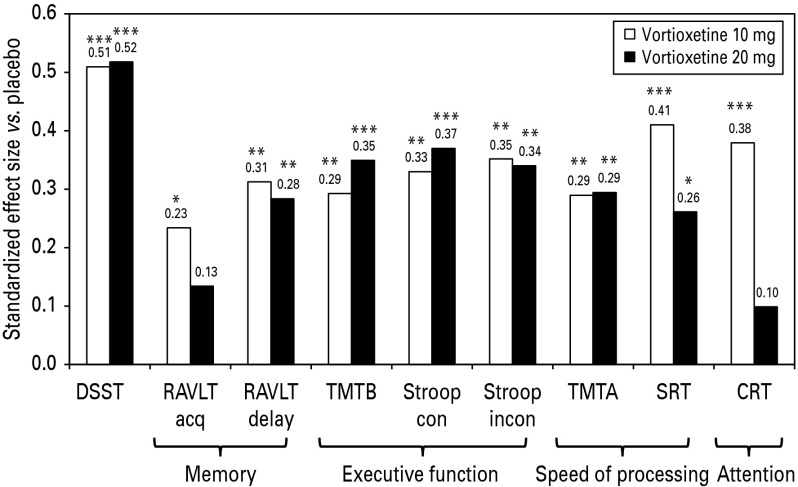
- DSST significantly separated from placebo for both doses; RAVLT acquisition stopped testing because p > 0.025 for each dose, while RAVLT delayed recall had p < 0.025 for each dose. Other cognitive measures separated from placebo (p < 0.05) except CRT for vortioxetine 20 mg; standardized effect sizes where p < 0.05 ranged from 0.23 to 0.52.
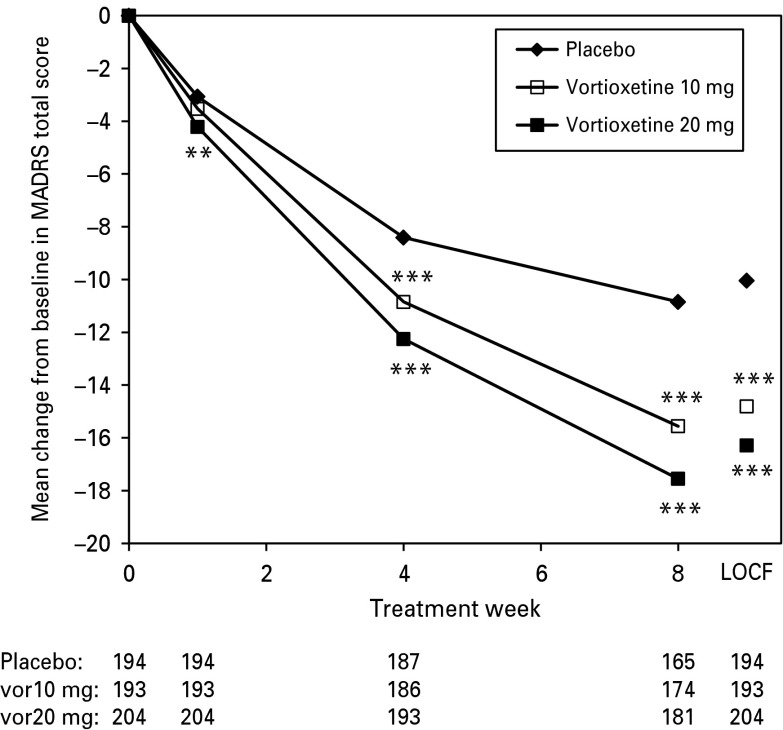
- MADRS total score differences versus placebo at week 8 were −4.7 (10 mg, p < 0.0001) and −6.7 (20 mg, p < 0.0001). Path analysis estimated direct effects on cognition of 64% and 48% for the composite z-score and 66% and 56% for DSST for 10 and 20 mg, respectively; cognitive improvement was also seen in non-responders and non-remitters.
- TEAEs occurred in 38.3% (placebo), 46.2% (10 mg), and 52.7% (20 mg); nausea in 4.1%, 16.4%, and 20.8%, and headache in 7.1%, 8.2%, and 12.6%. No TEAEs related to suicide or self-harm were found; suicidal ideation proportions were 11%, 9.3%, and 13%.
Methods
- Randomized, double-blind, fixed-dose, placebo-controlled, 8-week study at 79 psychiatric inpatient/outpatient settings in 12 countries from December 2011 to May 2013. Patients were 18–65 years old with recurrent MDD, a current major depressive episode ≥3 months, and MADRS total score ≥26 at screening and baseline; 602 were randomized 1:1:1, and the all-patients-treated set included 598.
- Treatments were vortioxetine 10 mg/d, vortioxetine 20 mg/d (10 mg/d in week 1, then 20 mg/d weeks 2–8), or placebo. Cognitive function was assessed with DSST, RAVLT, Trail Making Test A/B, Stroop, simple reaction time, choice reaction time, and the patient-reported Perceived Deficits Questionnaire; depressive symptoms used MADRS and CGI scales.
- Primary efficacy analysis was change from baseline to week 8 in a composite z-score weighting DSST 0.5 and RAVLT acquisition and delayed recall 0.25 each, analyzed in the full-analysis set using MMRM with treatment and center as fixed factors and baseline composite z-score as covariate.
Limitations
- Stated by the authors: treatment duration was only 8 weeks; eligible patients may not be representative of adults with MDD seen in normal clinical practice; individuals with an index episode and/or milder baseline severity were excluded; results pertain only to the two doses evaluated.
- Evident from the text: the composite z-score was used for the first time in this study and was based on post-hoc analysis of an elderly MDD study; some secondary analyses were not multiplicity-controlled and reported nominal p-values; no active comparator was included, so comparative efficacy versus other antidepressants is not established.
Model-written summary. Check it against the paper before relying on it.
Integrity signals
Registry
Cites
Statistics
Figures
Verification
Claims the paper makes
2 Valid · 0 Not valid · 12 Not checked · 60 Own results and interpretations
The cited sources support only part of this claim — read each source’s verdict below.
In the paper
“Preliminary evidence suggests that cognitive dysfunction is an important mediator of functional impairment (i.e. workplace performance) in individuals with MDD (Buist-Bouwman et al., 2008).”
§ A randomized, double-blind, placebo-controlled study of vortioxetine on cognitive function in depressed adults > Introduction
What the sources say
- Partly supportedcites Buist-Bouwman et al., 2008 matched to “Mediators of the association between depression and role functioning” (2008) sourceExperimental — accuracy not yet measured
The Results (Fig. 3 discussion, p. 6) state that 'only Cognition and Embarrassment were significantly associated with both MDE and role functioning, and thus mediating association', with the difference between total effect (0.43) and direct effect (0.17) indicating about half is mediated by Cognition and Embarrassment; the Discussion repeats that 'cognition and embarrassment accounted for half the association between MDE and role functioning'. So the core attribution (cognitive problems as an important mediator in MDE, hedged as preliminary — appropriate, since the data are cross-sectional and the authors recommend replication) is in our copy. However, the parenthetical gloss 'functional impairment (i.e. workplace performance)' is not what the source measured: its outcome was ESEMeD-WHODAS 'role functioning at home and in paid employment', scored as days totally out of role plus half-points for days of cutback in quantity or quality over the past 30 days, i.e. a broader days-out-of-role construct covering home activities, not workplace performance as such. The source also credits mediation jointly to Embarrassment alongside Cognition, which the citing sentence drops. (LLM, conf=0.72)
hedgedstates a cause- Asserted: passes — The authors put it forward as true.
- Checkable: passes — It can be checked against evidence.
- Load-bearing: passes — The paper’s conclusions depend on it.
- Based: passes — The paper gives a reason why it holds.
- Partly supported
The cited sources support only part of this claim — read each source’s verdict below.
In the paper
“Vortioxetine (1-[2-(2,4-dimethyl-phenylsulfanyl)-phenyl]-piperazine-hydrobromide, Lu AA21004) is a novel antidepressant that has demonstrated efficacy in doses up to 20 mg/d in short-term studies of 6–8 wk duration in adult patients with MDD (Alvarez et al., 2012; Henigsberg et al., 2012; Boulenger et al., 2014).”
§ A randomized, double-blind, placebo-controlled study of vortioxetine on cognitive function in depressed adults > Introduction
What the sources say
- Partly supportedcites Alvarez et al., 2012 matched to “A double-blind, randomized, placebo-controlled, active reference study of Lu AA21004 in patients with major depressive disorder” (2012) sourceExperimental — accuracy not yet measured
The Introduction and Discussion report efficacy of 5 and 10 mg/day Lu AA21004 after six weeks in adults with MDD. This study did not test 20 mg/day, so it supports the short-term efficacy claim but not the stated upper dose. (LLM, conf=0.88)
- Not checked — no full text of the sourcecites Henigsberg et al., 2012 matched to “A Randomized, Double-Blind, Placebo-Controlled 8-Week Trial of the Efficacy and Tolerability of Multiple Doses of Lu AA21004 in Adults With Major Depressive Disorder” (2012) source
- Supportedcites Boulenger et al., 2014 matched to “Efficacy and safety of vortioxetine (Lu AA21004), 15 and 20 mg/day: a randomized, double-blind, placebo-controlled, duloxetine-referenced study in the acute treatment of adult patients with major depressive disorder” (2014) source
The Discussion describes an 8-week study in patients with MDD, and the Conclusion reports that both 15 and 20 mg/day produced statistically significant effects on the prespecified efficacy measures. This supports the attributed claim that vortioxetine demonstrated efficacy at doses up to 20 mg/day in a short-term adult MDD study. (LLM, conf=0.93)
boostedstates a cause- Asserted: passes — The authors put it forward as true.
- Checkable: passes — It can be checked against evidence.
- Load-bearing: unclear — It is unclear whether the paper’s conclusions depend on it.
- Based: passes — The paper gives a reason why it holds.
- Partly supported
A result the paper reports from its own data — it cites no other source for it, so there is none to check. The quote shows it is in the paper.
In the paper
“For CRT, vortioxetine 20 mg vs. placebo, the estimation of the direct effect was not possible, as the treatment effects with and without correcting for the change from baseline to week 8 in the MADRS total score had different signs.”
§ A randomized, double-blind, placebo-controlled study of vortioxetine on cognitive function in depressed adults > Efficacy > Secondary efficacy endpoints
plain- Asserted: passes — The authors put it forward as true.
- Checkable: passes — It can be checked against evidence.
- Load-bearing: unclear — It is unclear whether the paper’s conclusions depend on it.
- Based: passes — The paper gives a reason why it holds.
A result the paper reports from its own data — it cites no other source for it, so there is none to check. The quote shows it is in the paper.
In the paper
“Patients in both vortioxetine groups separated from placebo in depressive symptom and CGI variables [MADRS total score, CGI-S score, CGI-I score, and response (⩾50% reduction from baseline in MADRS total score or a CGI-I score ⩽2) and remission (MADRS total score ⩽10 or a CGI-S score ⩽2) rates] (Table 2).”
§ A randomized, double-blind, placebo-controlled study of vortioxetine on cognitive function in depressed adults > Efficacy > Secondary efficacy endpoints
plainstates a cause- Asserted: passes — The authors put it forward as true.
- Checkable: passes — It can be checked against evidence.
- Load-bearing: passes — The paper’s conclusions depend on it.
- Based: passes — The paper gives a reason why it holds.
A result the paper reports from its own data — it cites no other source for it, so there is none to check. The quote shows it is in the paper.
In the paper
“During the 8 wk treatment period, the proportions of patients with TEAEs were 38.3% (placebo: n = 75), 46.2% (vortioxetine 10 mg; n = 90) and 52.7% (vortioxetine 20 mg; n = 109).”
§ A randomized, double-blind, placebo-controlled study of vortioxetine on cognitive function in depressed adults > Safety and tolerability > Treatment-emergent adverse events (TEAEs)
plainn = 75- Asserted: passes — The authors put it forward as true.
- Checkable: passes — It can be checked against evidence.
- Load-bearing: unclear — It is unclear whether the paper’s conclusions depend on it.
- Based: passes — The paper gives a reason why it holds.
37 more claims
Create a free account to see all 74 claims and every source verdict.
- It may state two separate claims as one. 23
- Probably not a substantial claim. 12
Claims other papers make about this one
Each is checked against this paper’s own text: does it say what the citing paper says it does?
The source backs part of the claim, not all of it — or backs it for a different population, condition or comparison.
In the citing paper
“In this study and two previous studies in patients with MDD, vortioxetine significantly improved cognitive performance (as measured by the change in DSST–number of correct symbols) (Katona et al, 2012; McIntyre et al, 2014), with a Cohen's d effect size ranging from 0.25 to 0.48 across all three studies.”
From A Randomized, Placebo-Controlled, Active-Reference, Double-Blind, Flexible-Dose Study of the Efficacy of Vortioxetine on Cognitive Function in Major Depressive Disorder (2015) · cites this paper as McIntyre et al, 2014
Experimental — accuracy not yet measuredThe source backs part of the claim, not all of it — or backs it for a different population, condition or comparison.
In the citing paper
“Subjective cognitive concerns are common in clinical settings and may be related to depressive symptomatology, real-world functioning, and quality of life (Allott et al., 2020;Brigola et al., 2015;McIntyre et al., 2014;Sumiyoshi et al., 2021).”
From Neurocognitive effects of theta burst stimulation for treatment-resistant depression in adults: A systematic review and recommendations for future research (2025) · cites this paper as McIntyre et al., 2014
Experimental — accuracy not yet measuredThe cited source says what the claim attributes to it.
In the citing paper
“Vortioxetine has been shown to improve a range of cognitive impairments in depressed patients (McIntyre et al 2014, Pehrson & Sanchez 2014, Sanchez et al 2015).”
From Prefrontal cortex executive processes affected by stress in health and disease (2018) · cites this paper as McIntyre et al 2014
The cited source says what the claim attributes to it.
In the citing paper
“In the first study, the effect sizes of treatment with 10 or 20 mg of vortioxetine on DSST scores were, respectively, 0.51 and 0.52.43”
From Digit Symbol Substitution Test: The Case for Sensitivity Over Specificity in Neuropsychological Testing (2018) · cites this paper as [43]
The cited source says what the claim attributes to it.
In the citing paper
“Results of a large clinical trial by McIntyre et al. evaluating the consequential of vortioxetine, compared with placebo, on measures of cognitive dysfunction as a primary endpoint in younger individuals with depressive disorder support the beneficial effects of this medication on objective and subjective measures of cognitive function [8].”
From Efficacy of Vortioxetine Versus Escitalopram on the Cognitive Profile of Patients With Depressive Disorder: A Comparative Study (2025) · cites this paper as [8]
8 more claims about this paper
Create a free account to see every claim other papers make about this one.
Citations
Cites
Statistical power analysis for the behavioral sciences
(1990) · Computers, Environment and Urban Systems · doi:10.1016/0198-9715(90)90050-4 · Cited by 65,269
The mini international neuropsychiatric interview
Lecrubier, Y., Sheehan, D., Hergueta, T., & Weiller, E. (1998) · European Psychiatry · doi:10.1016/s0924-9338(99)80239-9 · Cited by 5,872
Lecrubier, Y., Sheehan, D., Weiller, E., Amorim, P., Bonora, I., Sheehan, K. H., Janavs, J., & Dunbar, G. (1997) · European Psychiatry · doi:10.1016/s0924-9338(97)83296-8 · Cited by 3,513 · cited 2×
“Patients aged 518 and 465 yr, with a primary diagnosis of recurrent MDD according to DSM IV-TR criteria, a current MDE 53 months’ duration (confirmed using the Mini International Neuropsychiatric Interview (Lecrubier et al., 1997)) and a Montgomery-Åsberg Depression Rating Scale (MADRS) total score526 at screening and…”
MethodDeclaration of Helsinki. Ethical Principles for Medical Research Involving Human Subjects
(2014) · Jahrbuch für Wissenschaft und Ethik · doi:10.1515/jwiet-2014-0117 · Cited by 2,473
Cognitive impairment in depression: a systematic review and meta-analysis
Rock, P. L., Roiser, J. P., Riedel, W. J., & Blackwell, A. D. (2014) · Psychological Medicine · doi:10.1017/s0033291713002535 · Cited by 2,161 · cited 1×
“The standardized effect size of the deficits seen in MDD patients is typically 0.2–0.6 below what would be normal, depending on the cognitive domain (Rund et al., 2006; Lee et al., 2012; Rock et al., 2013).”
BackgroundInfluentialThe Economic Burden of Depression in the United States: How Did It Change Between 1990 and 2000?
Greenberg, P. E., Kessler, R. C., Birnbaum, H. G., Leong, S. A., Lowe, S. W., Berglund, P. A., & Corey-Lisle, P. K. (2003) · The Journal of Clinical Psychiatry · doi:10.4088/jcp.v64n1211 · Cited by 1,280 · cited 1×
“The estimated annual costs attributable to MDD are $83 billion in the US, with indirect costs due to decreased psychosocial function (notably workforce performance) being a major contributor (Greenberg et al., 2003).”
BackgroundThe role of the hippocampus in the pathophysiology of major depression
Campbell, S., & MacQueen, G. (2004) · Journal of Psychiatry and Neuroscience · doi:10.1139/jpn.0441 · Cited by 880
McIntyre, R. S., Cha, D. S., Soczynska, J. K., Woldeyohannes, H. O., Gallaugher, L. A., Kudlow, P., Alsuwaidan, M., & Baskaran, A. (2013) · Depression and Anxiety · doi:10.1002/da.22063 · Cited by 765
Self-citationA meta-analysis of cognitive deficits in first-episode Major Depressive Disorder
Lee, R. S. C., Hermens, D. F., Porter, M. A., & Redoblado-Hodge, M. A. (2012) · Journal of Affective Disorders · doi:10.1016/j.jad.2011.10.023 · Cited by 737
Bang-Andersen, B., Ruhland, T., Jørgensen, M., Smith, G., Frederiksen, K., Jensen, K. G., Zhong, H., Nielsen, S. M., Hogg, S., Mørk, A., et al. (2011) · Journal of Medicinal Chemistry · doi:10.1021/jm101459g · Cited by 606 · cited 2×
“: +1 -416-603-5279 Fax: +1-416-603-5368 Email: roger.mcintyre@uhn.ca and 5-HT7 receptor antagonist, 5-HT1B receptor partial agonist, 5-HT1A receptor agonist, and a 5-HT transporter inhibitor (Bang-Andersen et al., 2011; Mørk et al., 2012; Westrich et al., 2012).”
Background
Research works printed but not linked: 2
- Westrich L, Pehrson A, Zhong H, Nielsen SM, Frederiksen K, Stensbøl TB, Boyle N, Hentzer M, Sanchez C (2012) In vitro and in vivo effects of the multimodal antidepressant vortioxetine (Lu AA21004) at human and rat targets. Int J Psychiatry Clin Pract 16 (Suppl. 1): 47
- Dale E, Zhang H, Plath N, Sanchez C (2013) Vortioxetine's (Lu AA21004) memory enhancing properties in preclinical rat models may involve an increase of pyramidal cell output – rat hippocampal slice study. Biol Psychiatry 73 (Suppl. 9): 213S
Cited by
Items 301–400 of 427
Çökmüş, F. P., Özkan, H. M., Dikici, D. S., Aşçıbaşı, K., Alçı, D., Altunsoy, N., Kuru, E., Yüzeren, S., & Aydemır, Ö. (2021) · Psychiatry and Clinical Psychopharmacology · doi:10.5152/pcp.2021.20148 · Cited by 4
McIntyre, R. S. (2025) · Expert Opinion on Investigational Drugs · doi:10.1080/13543784.2025.2522885 · Cited by 4
Self-citationBang‐Andersen, B., Olsen, C. K., & Sánchez, C. (2016) · Wiley eBooks · doi:10.1002/9783527800315.ch9 · Cited by 4
Self-citationJacobsen, P. L., Zhong, W., Xu, R., & Nomikos, G. G. (2020) · Journal of Affective Disorders · doi:10.1016/j.jad.2020.01.090 · Cited by 3
Treatment of cognitive dysfunction in adults with major depressive disorder
McIntyre, R. S., Syeda, K., & Cha, D. S. (2015) · Cambridge University Press eBooks · doi:10.1017/cbo9781139860567.020 · Cited by 3
Self-citationBoontra, Y., Thanetnit, C., & Phanasathit, M. (2024) · F1000Research · doi:10.12688/f1000research.146897.3 · Cited by 3
Minhas, F. A., Rana, R. Z., Hamdani, S. U., & Rana, M. H. (2021) · Journal of Pakistan Psychiatric Society · doi:10.63050/jpps.18.01.87 · Cited by 3
Insights on the cognitive enhancement effect of desvenlafaxine in major depressive disorder
Vicent-Gil, M., Trujols, J., Sagués, T., Serra-Blasco, M., Navarra‐Ventura, G., Mantellini, C. L., Crivillés, S., Portella, M. J., & Cardoner, N. (2025) · Annals of General Psychiatry · doi:10.1186/s12991-025-00552-2 · Cited by 3
Recovery of visual scotomas by vortioxetine in a patient with symptomatic occipital lobe epilepsy
Önder, H., Coşkun, A., & Goksungur, M. (2018) · Annals of Indian Academy of Neurology · doi:10.4103/aian.aian_291_17 · Cited by 3
Experimental Medicine in Psychiatry New Approaches in Schizophrenia, Depression and Cognition
Dawson, G. R. (2015) · Current topics in behavioral neurosciences · doi:10.1007/7854_2015_5016 · Cited by 4
Leivaditis, V., Mulita, F., Andrikopoulou, C., Shaska, E., Liolis, E., Mitsos, S., Grapatsas, K., Tomos, P., & Baikoussis, N. G. (2026) · Medical Sciences · doi:10.3390/medsci14020244 · Cited by 3
Subjective measures of cognitive dysfunction in major depressive disorder
Lam, R. W. M. (2015) · Cambridge University Press eBooks · doi:10.1017/cbo9781139860567.018 · Cited by 5
Keefe, R. S. E., Nomikos, G. G., Zhong, W., Christensen, M. C., & Jacobson, W. (2018) · The International Journal of Neuropsychopharmacology · doi:10.1093/ijnp/pyy020 · Cited by 4
Cumbo, E., & Migliore, D. (2025) · Journal of Alzheimer s Disease · doi:10.1177/13872877251340084 · Cited by 4
Kolar, D., & Kolar, M. V. (2021) · Middle East Current Psychiatry · doi:10.1186/s43045-021-00124-6 · Cited by 4
Vortioxetine-Induced Amenorrhea: A Case Report
Işik, M., Kurhan, F., Ülkevan, T., & Özdemir, P. G. (2022) · Clinical Neuropharmacology · doi:10.1097/wnf.0000000000000490 · Cited by 3
Cha, D. S., Kleine, N., Teopiz, K. M., Vincenzo, J. D. D., Ho, R., Galibert, S. L., Samra, A., Zilm, S. P. M., Cha, R. H., d’Andrea, G., et al. (2024) · Expert Opinion on Pharmacotherapy · doi:10.1080/14656566.2023.2298340 · Cited by 4
Self-citationBarbosa, E. C., da Silva, G. H. S., Sbardelotto, Â. E. E., Barroso, D. C., de Lima, F. R., Paez, L. E. F. E., Lança, S. B., Petrucci, A. B. C., Guimarães, F. B. D. M., & Nascimento, A. L. (2024) · Asian Journal of Psychiatry · doi:10.1016/j.ajp.2024.104222 · Cited by 5
Yen, Y., Chiu, N.-Y., Hwang, T., Su, T., Yang, Y.-K., Chen, C., Li, C., Su, K., Lai, T., & Chang, C. (2022) · Journal of Personalized Medicine · doi:10.3390/jpm12030359 · Cited by 4
Li, Z., Wu, T., Xiong, Y.-T., Zhang, X., Bao, Y., Guo, L.-B., Bao-jie, H., Li, S., Wang, Y., Lü, L., et al. (2023) · Frontiers in Psychiatry · doi:10.3389/fpsyt.2023.1188175 · Cited by 4
Efficiency and safety of Vortioxetine in the treatment of depressive disorders in cardiac patients
Filippova, N. V., Barylnik, Y. B., Богданова, Т. М., Blinova, V. V., Shchelchkova, A. A., & Mozgacheva, E. S. (2023) · V M BEKHTEREV REVIEW OF PSYCHIATRY AND MEDICAL PSYCHOLOGY · doi:10.31363/2313-7053-2023-817 · Cited by 4
Faraji, R., Oraki, M., Zare, H., & Vahid, N. (2020) · The Neuroscience Journal of Shefaye Khatam · doi:10.29252/shefa.8.4.20 · Cited by 2
Donepezil and α‐synuclein Constipation: A 60 Month Follow-Up
Lepkowsky, C. M. (2022) · POJ Clinical Case Reports · doi:10.32648/2639-3298/4/1/1 · Cited by 2
Hutnyan, M., & McClintock, S. M. (2025) · Transcranial Magnetic Stimulation · doi:10.1016/j.transm.2025.100088 · Cited by 2
Faraji, R., Oraki, M., Zare, H., Vahid, N., & Moradi, A. (2022) · Journal of Clinical Research in Paramedical Sciences · doi:10.5812/jcrps-114294 · Cited by 2
Gill, H., Lieberman, J. M., Vincenzo, J. D. D., Rodrigues, N. B., Mansur, R. B., Mckenzie, A., Phan, L., Rosenblat, J. D., & McIntyre, R. S. (2022) · Current Treatment Options in Psychiatry · doi:10.1007/s40501-022-00281-3 · Cited by 2
Self-citationPsychiatric rehabilitation and cognitive deficit for treatment-resistant depression
Cheng, C., & Jeng, J. (2023) · Progress in brain research · doi:10.1016/bs.pbr.2023.02.006 · Cited by 2
Increased Odds of Cognitive Impairment in Adults with Depressive Symptoms and Antidepressant Use
Meshkat, S., Wu, M., Tassone, V. K., Janssen‐Aguilar, R., Pang, H. Y. M., Jung, H. J., Lou, W. Y. W., & Bhat, V. (2024) · Pharmacopsychiatry · doi:10.1055/a-2381-2061 · Cited by 2
Dolcetti, E., Annovazzi, P. O. L., Clerico, M., Cocco, E. E., Conte, A., Marfia, G. A., Salvetti, M., Tomassini, V., Clerici, V. T., Totaro, R., et al. (2024) · Current Neuropharmacology · doi:10.2174/011570159x326862240909105845 · Cited by 3
Review of a New Multimodal Antidepressant Vortioxetine
Oppa, M., Cesnekova, D., Nosalova, G., & Ondrejka, I. (2016) · Acta Medica Martiniana · doi:10.1515/acm-2016-0011 · Cited by 3
Clinical relevance of cognitive dysfunction in major depressive disorder
Cha, D. S. (2015) · Cambridge University Press eBooks · doi:10.1017/cbo9781139860567.002 · Cited by 2
Troian, O. (2021) · Modern medical technology · doi:10.34287/mmt.2(49).2021.1 · Cited by 2
Donepezil and α-synuclein Constipation: A 36 Month Follow-Up
Lepkowsky, C. M. (2019) · POJ Clinical Case Reports · doi:10.32648/2639-3298/2/1/002 · Cited by 2
Biabani, N., Mulas, M., Mutti, C., Higgins, S. E., Ilić, K., Benson, J., Santic, A., Gnoni, V., Drakatos, P., Romigi, A., et al. (2025) · Frontiers in Sleep · doi:10.3389/frsle.2025.1659300 · Cited by 2
Reznik, A. M., Syunyakov, T., Mudrak, A. V., Zakharov, N. B., Popova, Z. B., Khoroshilova, A. N., Ig, K., Sayfulina, A. M., Eliseenko, A. M., Matvievskaya, T. K., et al. (2023) · Consortium Psychiatricum · doi:10.17816/cp3728 · Cited by 2
Boontra, Y., Thanetnit, C., & Phanasathit, M. (2024) · F1000Research · doi:10.12688/f1000research.146897.4 · Cited by 4
Deardorff, W. J., & Grossberg, G. T. (2015) · Current Geriatrics Reports · doi:10.1007/s13670-015-0140-y · Cited by 2
James, J., Rani, J., & Varadarajan, S. (2022) · International Journal of Applied Pharmaceutics · doi:10.22159/ijap.2022.v14ti.28 · Cited by 3
Treatment opportunities for ameliorating cognitive dysfunction in major depressive disorder
Cha, D. S. (2015) · Cambridge University Press eBooks · doi:10.1017/cbo9781139860567.019 · Cited by 2
Ng, C. G., Abousheishaa, A. A., Low, S.-Y., Zainal, N. Z., Thong, K. S., Awaluddin, A., Loo, T. H., Yacob, S., Jaafar, N. R. N., Taib, N. I. A., et al. (2023) · Asian Pacific Journal of Cancer Prevention · doi:10.31557/apjcp.2023.24.8.2583 · Cited by 1
Underlying biological substrates associated with cognitive dysfunction in major depressive disorder
Cha, D. S. (2015) · Cambridge University Press eBooks · doi:10.1017/cbo9781139860567.012 · Cited by 2
Vortioxetine: a comprehensive update on a new-generation antidepressant
Evren, C. (2021) · Dusunen Adam The Journal of Psychiatry and Neurological Sciences · doi:10.14744/dajpns.2021.00115 · Cited by 2
Cao, B., Xiao, M., Chen, X., Zhao, Y., Pan, Z., McIntyre, R. S., & Chen, H. (2021) · Nordic Journal of Psychiatry · doi:10.1080/08039488.2021.1965654 · Cited by 2
Self-citationTaşkıran, A. Ş., & Filiz, A. K. (2024) · Neurochemical Journal · doi:10.1134/s1819712424700478 · Cited by 1
Neuropalliative Care in Dementia
Weisbrod, N. (2025) · CONTINUUM Lifelong Learning in Neurology · doi:10.1212/cont.0000000000001639 · Cited by 1
Donepezil and α-synuclein Constipation: A 48 Month Follow-Up
Lepkowsky, C. M. (2021) · POJ Clinical Case Reports · doi:10.32648/2639-3298/3/1/001 · Cited by 1
Antidepressant medications: a comprehensive review of efficacy, safety, and future directions
Shah, N., Parmar, J., Shandilya, S., Parmar, D., & Singhal, P. K. (2025) · International Journal of Community Medicine and Public Health · doi:10.18203/2394-6040.ijcmph20253726 · Cited by 3
Vortioxetine in major depressive disorder: a guide to its use in the EU
Garnock-Jones, K. P., & Lyseng-Williamson, K. A. (2015) · Drugs & Therapy Perspectives · doi:10.1007/s40267-015-0217-x · Cited by 1
Behavioral Health and Primary Care: A Status Report
Culpepper, L. (2016) · The Primary Care Companion For CNS Disorders · doi:10.4088/pcc.16ed01944 · Cited by 1
Depression in Alzheimer's disease : biomarkers and treatment
Enache, D. (2015) · Figshare · Cited by 2
Latest Developments in Cognitive Functioning in Mood and Anxiety Disorders
Gould, F., Kaplan, S., & Harvey, P. D. (2015) · Current Behavioral Neuroscience Reports · doi:10.1007/s40473-015-0045-2 · Cited by 1
Zheng, J., Tian, Y., Cheng, J., Hu, Z., Zhang, J., Yang, F., Li, P., Jiang, Z., Gong, X., Hou, Q., et al. (2025) · European Journal of Medicinal Chemistry · doi:10.1016/j.ejmech.2025.118198 · Cited by 1
Translational Medicine Strategies in Drug Development for Mood Disorders
Pan, Z., Grovu, R. C., & McIntyre, R. S. (2019) · Handbook of behavioral neuroscience · doi:10.1016/b978-0-12-803161-2.00023-0 · Cited by 2
Self-citationDølven, S., Moroń, M., Eriksen, I., Toft, J. E. G., & Semkovska, M. (2025) · Neuropsychology Review · doi:10.1007/s11065-025-09686-2 · Cited by 2
Deficit cognitivi nella malattia depressiva: quanti e quali strumenti per identificarli?
Sciascio, G. D., Furio, M. A., & Palumbo, C. (2015) · Rivista di psichiatria · doi:10.1708/1910.20790 · Cited by 2
Ahsan, M., Ahsan, S. D., Khalid, O., & Agha, H. (2020) · Therapeutic Advances in Psychopharmacology · doi:10.1177/2045125320943399 · Cited by 1
Mishra, S., Mudgal, V., Bagul, K. R., Jain, P., & Pal, V. (2025) · Cureus · doi:10.7759/cureus.79365 · Cited by 1
Nomikos, G. G. (2019) · Handbook of behavioral neuroscience · doi:10.1016/b978-0-12-803161-2.00027-8 · Cited by 1
Martín-Costa, I. H., Colman, R., García-Amador, Á., García-Caballero, C., Acosta-Rueda, J., Fontán-Esteban, M., & Martín-Quero, Y. (2026) · Journal of Clinical Medicine · doi:10.3390/jcm15041374 · Cited by 1
Advances in antidepressant pharmacotherapy: phase 3 evidence and clinical perspectives
Cuomo, A., Pinzi, M., & Fagiolini, A. M. (2026) · Expert Opinion on Pharmacotherapy · doi:10.1080/14656566.2026.2634195 · Cited by 1
Italian neurologists’ perception on cognitive symptoms in major depressive disorder
Neri, G., Serrati, C., Zolo, P., Cataldo, N., & Ripellino, C. (2016) · Neurological Sciences · doi:10.1007/s10072-016-2601-2 · Cited by 1
Kobayashi, Y., Hirano, J., Nakagawa, A., Takemura, R., Umeda, S., 田島, 美., Noda, S., Amano, M., Kamiya, K., Mimura, M., et al. (2026) · Journal of Affective Disorders · doi:10.1016/j.jad.2026.121632 · Cited by 1
Depression: Addressing Partial Response After First-Line Antidepressant Treatment
Thase, M. E., D, M. F. M., & Nierenberg, A. A. (2014) · The Journal of Clinical Psychiatry · doi:10.4088/jcp.13018co4c · Cited by 2
Chronic headache treatment: can we always follow international guidelines?
Владимировна, Л. Н. (2019) · Medical alphabet · doi:10.33667/2078-5631-2019-3-24(399)-5-9 · Cited by 3
Efficacy and adverse effect profile of vortioxetine in major depressive disorder: A meta-analysis
Vijayan, S., Ramanathan, B., Mohan, R., Venkatesan, V., Selvaraj, A., & Coumaravelou, M. (2025) · Journal of Psychopharmacology · doi:10.1177/02698811251375106 · Cited by 1
Chapter 20. Psychopharmacology
Mulsant, B. H., & Pollock, B. G. (2022) · American Psychiatric Association Publishing eBooks · doi:10.1176/appi.books.9781615375196.ds20 · Cited by 1
Farmakoterapia depresji u pacjentów z zaawansowanymi chorobami
Grabowski, J., & Przybylak, M. (2019) · Palliative Medicine in Practice · doi:10.5603/pmpi.2019.0012 · Cited by 3
Pan, Z. (2018) · TSpace (University of Toronto) · Cited by 1
Symptoms of depression: "hot" and "cold" cognition
Gramaglia, C. M., Pietrini, F., Zeppegno, P., & Carla, N. (2015) · Cited by 1
Bochenek, O., Koper, M., Nowak, A., Kałuża, J. A., Konaszczuk, A., Ratyna, K., Kozyra, O., Szypuła, Z., Paluch, K., & Skarbek, M. (2024) · Quality in Sport · doi:10.12775/qs.2024.19.53279 · Cited by 3
(2016) · Drug and Therapeutics Bulletin · doi:10.1136/dtb.2016.3.0387 · Cited by 1
Umamichi, K., Furukawa, T., Sato, C., Miura, H., Hatakenaka, K., Nunomura, T., Mikami, M., Koeda, S., & Yamada, J. (2025) · Physiology & Behavior · doi:10.1016/j.physbeh.2025.115176 · Cited by 4
Vortioxetine – an antidepressant with a multifunctional mechanism of action
Wysokiński, A., & Sobów, T. (2016) · Psychiatria i Psychologia Kliniczna · doi:10.15557/pipk.2016.0014 · Cited by 1
Ketamine and Cognitive Function in Depression: Detrimental, Neutral, or Advantageous?
Goldberg, J. F. (2022) · The Journal of Clinical Psychiatry · doi:10.4088/jcp.21com14243 · Cited by 2
A “Real-World” Chart Review Study of Monotherapy and Adjunctive Vortioxetine in Clinical Practice
Karia, S., Sousa, A. D., & Syeda, R. (2021) · Indian Journal of Private Psychiatry · doi:10.5005/jp-journals-10067-0059 · Cited by 1
El-Kassem, M., Ali, M., Madani, M. T., Butt, F. R., Elhusein, B., Scanavino, M. D. T., Khoodoruth, M. A. S., Sharma, V., & Makki, I. (2026) · Journal of Affective Disorders · doi:10.1016/j.jad.2026.122421
Sumiyoshi, T., Watanabe, K., Noto, S., Sakamoto, S., Moriguchi, Y., & Okamoto, S. (2017) · doi:10.2196/preprints.9682.a
Cognition and Depression: Management of Major Depressive Disorder cognitive symptoms
Pestana, P. C., Ferreira, A., Côrte‐Real, B., Andrade, G., & Cordeiro, C. R. (2019) · doi:10.26226/morressier.5d1a036b57558b317a13fc72
Çoban, C., & Bulut, S. D. (2025) · Psychiatry Research · doi:10.1016/j.psychres.2025.116778
CHARACTERISTICS OF COGNITIVE IMPAIRMENT IN PATIENTS WITH DEPRESSIVE DISORDERS
Yaroslavtsev, S. A. (2020) · Experimental and Clinical Medicine · doi:10.35339/ekm.2020.86.01.06
Antidepressivum mit unterschiedlichen Zielstrukturen und Wirkmechanismen
Volz, H. (2015) · DNP - Der Neurologe und Psychiater · doi:10.1007/s15202-015-0928-9
Yaroslavtsev, S. A. (2020) · Lviv clinical bulletin · doi:10.25040/lkv2020.03.046
Cotrena, C. (2015) · LA Referencia (Red Federada de Repositorios Institucionales de Publicaciones Científicas)
Carmellini, P., Cuomo, A., Rescalli, M. B., Pinzi, M., Dourmas, A., & Fagiolini, A. M. (2026) · Pharmaceuticals · doi:10.3390/ph19050662 · Cited by 1
Efectos del tratamiento antidepresivo en la cognición de pacientes con enfermedad de Alzheimer
García-Alberca, J. M. (2026) · Kranion · doi:10.24875/kranion.m23000048 · Cited by 1
Klöbl, M., Matev, V., Stöhrmann, P., Dörl, G., Rothenberg, M., Donath, J., Cukaci, C., Barede, K. A., Lanzenberger, R. R., Pjrek, E., et al. (2025) · medRxiv · doi:10.64898/2025.12.10.25341891
Boontra, Y., Thanetnit, C., & Phanasathit, M. (2024) · F1000Research · doi:10.12688/f1000research.146897.1
Xiao, K., Woo, Y., Dri, C. E., Le, G. H., Wong, S., Teopiz, K. M., Zheng, Y. J., Lo, H. K. Y., van Bruggen, F. H., Rhee, T. G., et al. (2026) · Psychiatry Research · doi:10.1016/j.psychres.2026.117456
Self-citationTitle: Clinical perspective of Anxiety Disorders in Korea
(2016) · The International Journal of Neuropsychopharmacology · doi:10.1093/ijnp/pyw042.061 · Cited by 1
Kennedy, S. H., & Rizvi, S. J. (2014) · Springer eBooks · doi:10.1007/978-3-642-27772-6_380-3
Clinical Management of the Homeless Patient with Traumatic Brain Injury and Cognitive Impairment
Subbarao, B. S., & Eapen, B. C. (2021) · Springer eBooks · doi:10.1007/978-3-030-70135-2_7
Validation of Smartphone-Based Cognitive Assessments for Individuals with Major Depressive Disorder
Thérond, A. (2021) · Carleton University's Institutional Repository (MacOdrum Library, Carleton University) · doi:10.22215/etd/2021-14740
Kalenska, G., & Yatoslavtsev, S. (2020) · Inter Collegas · doi:10.35339/ic.7.3.152-156
Guillena, S. L. R., de Diego, B. O. P. G., & Gotor, F. (2019) · European Neuropsychopharmacology · doi:10.1016/j.euroneuro.2019.09.088
Kumar, A., Kumari, S., Verma, A. K., Kumar, A., & Pradhan, R. K. (2025) · Student s Journal of Health Research Africa · doi:10.51168/sjhrafrica.v6i12.2458
Callaghan, R. M., Dalton, K., Coffey, F., Foley, T., Moloney, R. D., Waeber, C., & Hartigan, I. (2026) · Journal of Affective Disorders Reports · doi:10.1016/j.jadr.2026.101148
Vora, M. (2021) · Indian Journal of Private Psychiatry · doi:10.5005/jp-journals-10067-0061
The Approach to Diagnostic Ambiguity
Goldberg, J. F., & Stahl, S. M. (2024) · Cambridge University Press eBooks · doi:10.1017/9781009181549.004
Metadata
- Authors
- McIntyre, R. S., Lophaven, S., & Olsen, C. K.
- Affiliations
- University Health Network (CA)
- Lundbeck (Denmark) (DK)
- Corresponding author
- McIntyre, Roger S.
- Venue
- The International Journal of Neuropsychopharmacology
- Publisher
- Oxford University Press (OUP)
- Published
- 2014-04-30
- Volume
- 17
- Issue
- 10
- Pages
- 1557-1567
- ISSN
- 1461-1457 (ISSN-L)
- 1469-5111
- PMC
- PMC4162519
- OpenAlex
- W2153644230
- Semantic Scholar
- 864adcc6faf2d611446f03a2cc4ee8d8a885d75d
- Cited by
- 433
- References
- 42
- Citations by year
- 2026: 17 · 2025: 24 · 2024: 33 · 2023: 34 · 2022: 32 · 2021: 39 · 2020: 28 · 2019: 35 · 2018: 31 · 2017: 38 · 2016: 45 · 2015: 64 · 2014: 13
- FWCI
- 38.78
- Type
- journal article
- Language
- en
- Open access
- bronze
- doi.org
- Locations
- The International Journal of Neuropsychopharmacology (publishedVersion)
- Europe PMC (PubMed Central) (publishedVersion, cc-by)
- PubMed Central (publishedVersion, cc-by)
- PubMed (publishedVersion)
- Research at the University of Copenhagen (University of Copenhagen) (submittedVersion)
- Funders
- Brain and Behavior Research Foundation
- Bristol-Myers Squibb
- Eli Lilly and Company
- Pfizer
- Sunovion
- H. Lundbeck A/S
- National Institute of Mental Health
- Topics
- Health Sciences › Medicine › Pharmacology (medical) › Treatment of Major Depression
- Health Sciences › Medicine › Psychiatry and Mental health › Schizophrenia research and treatment
- Social Sciences › Psychology › Experimental and Cognitive Psychology › Anxiety, Depression, Psychometrics, Treatment, Cognitive Processes
- Keywords
- vortioxetine, major depressive disorder, recurrent depression, cognitive function, executive function, processing speed, attention, learning and memory, subjective cognitive complaints, antidepressant efficacy, dose comparison
- MeSH terms
- Vortioxetine, Adolescent, Adult, Aged, Analysis of Variance, Cognition Disorders, Depression, Dose-Response Relationship, Drug, Double-Blind Method, Female, Humans, International Cooperation, Male, Middle Aged, Neuropsychological Tests, Piperazines, Psychiatric Status Rating Scales, Sulfides, Anti-Anxiety Agents, Treatment Outcome, Young Adult
About these checks
Registry, retraction, Cites and statistics results are computed, not judged, with one exception: a printed reference that no index lists is read once by a model before it counts as a citation error. Claims are extracted by a model and kept only when their quote appears verbatim in the text; each cited source is then checked, with a model’s help, for whether it says what the claim relies on. Those verdicts can be wrong — read the claim’s quote and the cited source before relying on one.
The claim verdicts this report counts are experimental: their accuracy is not yet measured.
A language model drew the claims from the paper on 2026-10-10, under version 3 of the claim definition (model deepseek-v4.1-flash, prompt extract-v3).
A second model labelled each claim on 2026-10-10 (model jev-1.13-20260917, definition revision gold-guideline-v0.2).
Cited sources are checked with a language model’s help (qwen3.8-omni-flash and gpt-6-sol).
Statistics and arithmetic are recomputed, not judged.
Confidence bands are shown only for fields calibrated on our annotated test set. None is calibrated yet, so no band is shown.
What counts as a claim ›How we measure confidence ›How we check this ›
Are you an author, or do you see a problem with this page? Request a review
Data sources
Bibliographic data: Semantic Scholar, OpenAlex, Crossref.
Contains information from the Semantic Scholar Academic Graph Datasets, made available under the ODC Attribution License (ODC-BY 1.0).
Semantic Scholar’s data is described in: Kinney, R., et al. (2023). The Semantic Scholar Open Data Platform. arXiv:2301.10140.
