

A randomized, double-blind, placebo-controlled study of vortioxetine on cognitive function in depressed adults
Open accessThe DOI matches its Crossref record; 43 of the 43 references it cites were found in a registry or an index; 3 of the 21 sources its claims cite were checked for support.
Abstract
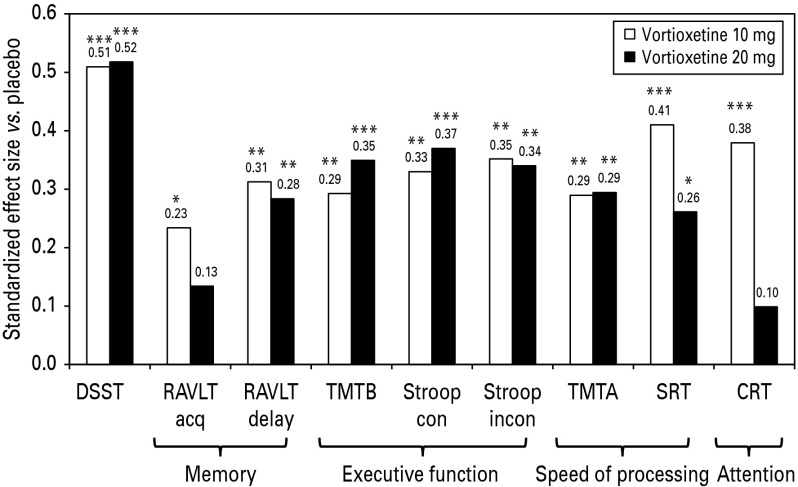
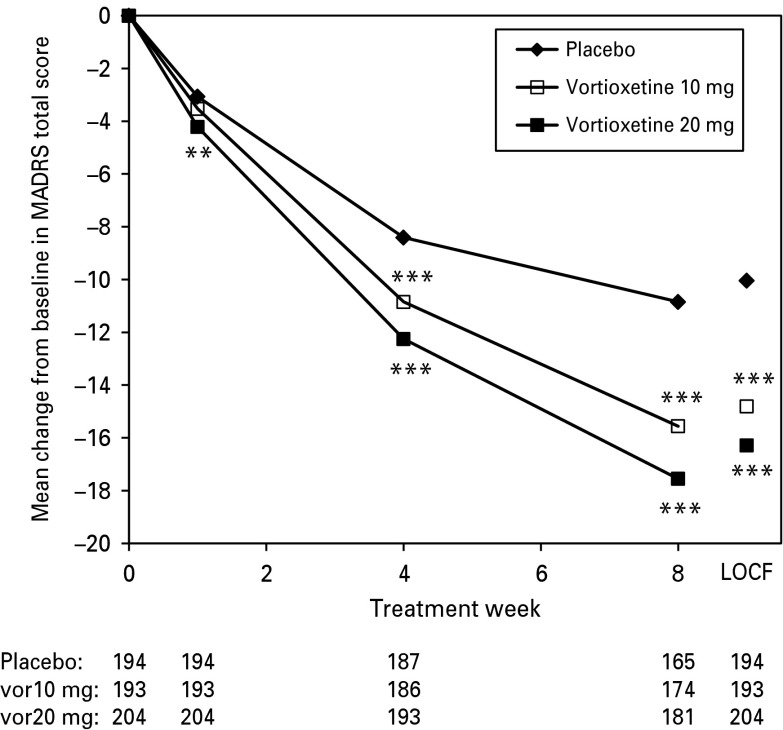
The efficacy of vortioxetine 10 and 20 mg/d vs. placebo on cognitive function and depression in adults with recurrent moderate-to-severe major depressive disorder (MDD) was evaluated. Patients (18-65 yr, N = 602) were randomized (1:1:1) to vortioxetine 10 or 20 mg/d or placebo for 8 wk in a double-blind multi-national study. Cognitive function was assessed with objective neuropsychological tests of executive function, processing speed, attention and learning and memory, and a subjective cognitive measure. The primary outcome measure was change from baseline to week 8 in a composite z-score comprising the Digit Symbol Substitution Test (DSST) and Rey Auditory Verbal Learning Test (RAVLT) scores. Depressive symptoms were assessed using the Montgomery-Åsberg Depression Rating Scale (MADRS). In the pre-defined primary efficacy analysis, both doses of vortioxetine were significantly better than placebo, with mean treatment differences vs. placebo of 0.36 (vortioxetine 10 mg, p < 0.0001) and 0.33 (vortioxetine 20 mg, p < 0.0001) on the composite cognition score. Significant improvement vs. placebo was observed for vortioxetine on most of the secondary objectives and subjective patient-reported cognitive measures. The differences to placebo in the MADRS total score at week 8 were -4.7 (10 mg: p < 0.0001) and -6.7 (20 mg: p < 0.0001). Path and subgroup analyses indicate that the beneficial effect of vortioxetine on cognition is largely a direct treatment effect. No safety concern emerged with vortioxetine. Vortioxetine significantly improved objective and subjective measures of cognitive function in adults with recurrent MDD and these effects were largely independent of its effect on improving depressive symptoms.
Overview
CoChat Summary
TL;DR
In adults with recurrent moderate-to-severe major depressive disorder, vortioxetine 10 and 20 mg/d for 8 weeks significantly improved a composite cognition z-score versus placebo, with effects largely independent of depressive symptom improvement. Both doses also improved most objective and subjective cognitive measures, with nausea and headache as common adverse events and no suicide-related safety signal.
Key findings
- On the primary composite cognition z-score, mean treatment differences versus placebo at week 8 were 0.36 (95% CI 0.22–0.50, p < 0.0001) for vortioxetine 10 mg and 0.33 (95% CI 0.19–0.47, p < 0.0001) for vortioxetine 20 mg.
- DSST significantly separated from placebo for both doses; RAVLT acquisition stopped testing because p > 0.025 for each dose, while RAVLT delayed recall had p < 0.025 for each dose. Other cognitive measures separated from placebo (p < 0.05) except CRT for vortioxetine 20 mg; standardized effect sizes where p < 0.05 ranged from 0.23 to 0.52.
- MADRS total score differences versus placebo at week 8 were −4.7 (10 mg, p < 0.0001) and −6.7 (20 mg, p < 0.0001). Path analysis estimated direct effects on cognition of 64% and 48% for the composite z-score and 66% and 56% for DSST for 10 and 20 mg, respectively; cognitive improvement was also seen in non-responders and non-remitters.
- TEAEs occurred in 38.3% (placebo), 46.2% (10 mg), and 52.7% (20 mg); nausea in 4.1%, 16.4%, and 20.8%, and headache in 7.1%, 8.2%, and 12.6%. No TEAEs related to suicide or self-harm were found; suicidal ideation proportions were 11%, 9.3%, and 13%.
Methods
- Randomized, double-blind, fixed-dose, placebo-controlled, 8-week study at 79 psychiatric inpatient/outpatient settings in 12 countries from December 2011 to May 2013. Patients were 18–65 years old with recurrent MDD, a current major depressive episode ≥3 months, and MADRS total score ≥26 at screening and baseline; 602 were randomized 1:1:1, and the all-patients-treated set included 598.
- Treatments were vortioxetine 10 mg/d, vortioxetine 20 mg/d (10 mg/d in week 1, then 20 mg/d weeks 2–8), or placebo. Cognitive function was assessed with DSST, RAVLT, Trail Making Test A/B, Stroop, simple reaction time, choice reaction time, and the patient-reported Perceived Deficits Questionnaire; depressive symptoms used MADRS and CGI scales.
- Primary efficacy analysis was change from baseline to week 8 in a composite z-score weighting DSST 0.5 and RAVLT acquisition and delayed recall 0.25 each, analyzed in the full-analysis set using MMRM with treatment and center as fixed factors and baseline composite z-score as covariate.
Limitations
- Stated by the authors: treatment duration was only 8 weeks; eligible patients may not be representative of adults with MDD seen in normal clinical practice; individuals with an index episode and/or milder baseline severity were excluded; results pertain only to the two doses evaluated.
- Evident from the text: the composite z-score was used for the first time in this study and was based on post-hoc analysis of an elderly MDD study; some secondary analyses were not multiplicity-controlled and reported nominal p-values; no active comparator was included, so comparative efficacy versus other antidepressants is not established.
Model-written summary. Check it against the paper before relying on it.
Integrity signals
Registry
Cites
Statistics
Figures
Verification
Claims the paper makes
2 Valid · 0 Not valid · 12 Not checked · 60 Own results and interpretations
The cited sources support only part of this claim — read each source’s verdict below.
In the paper
“Preliminary evidence suggests that cognitive dysfunction is an important mediator of functional impairment (i.e. workplace performance) in individuals with MDD (Buist-Bouwman et al., 2008).”
§ A randomized, double-blind, placebo-controlled study of vortioxetine on cognitive function in depressed adults > Introduction
What the sources say
- Partly supportedcites Buist-Bouwman et al., 2008 matched to “Mediators of the association between depression and role functioning” (2008) sourceExperimental — accuracy not yet measured
The Results (Fig. 3 discussion, p. 6) state that 'only Cognition and Embarrassment were significantly associated with both MDE and role functioning, and thus mediating association', with the difference between total effect (0.43) and direct effect (0.17) indicating about half is mediated by Cognition and Embarrassment; the Discussion repeats that 'cognition and embarrassment accounted for half the association between MDE and role functioning'. So the core attribution (cognitive problems as an important mediator in MDE, hedged as preliminary — appropriate, since the data are cross-sectional and the authors recommend replication) is in our copy. However, the parenthetical gloss 'functional impairment (i.e. workplace performance)' is not what the source measured: its outcome was ESEMeD-WHODAS 'role functioning at home and in paid employment', scored as days totally out of role plus half-points for days of cutback in quantity or quality over the past 30 days, i.e. a broader days-out-of-role construct covering home activities, not workplace performance as such. The source also credits mediation jointly to Embarrassment alongside Cognition, which the citing sentence drops. (LLM, conf=0.72)
hedgedstates a cause- Asserted: passes — The authors put it forward as true.
- Checkable: passes — It can be checked against evidence.
- Load-bearing: passes — The paper’s conclusions depend on it.
- Based: passes — The paper gives a reason why it holds.
- Partly supported
The cited sources support only part of this claim — read each source’s verdict below.
In the paper
“Vortioxetine (1-[2-(2,4-dimethyl-phenylsulfanyl)-phenyl]-piperazine-hydrobromide, Lu AA21004) is a novel antidepressant that has demonstrated efficacy in doses up to 20 mg/d in short-term studies of 6–8 wk duration in adult patients with MDD (Alvarez et al., 2012; Henigsberg et al., 2012; Boulenger et al., 2014).”
§ A randomized, double-blind, placebo-controlled study of vortioxetine on cognitive function in depressed adults > Introduction
What the sources say
- Partly supportedcites Alvarez et al., 2012 matched to “A double-blind, randomized, placebo-controlled, active reference study of Lu AA21004 in patients with major depressive disorder” (2012) sourceExperimental — accuracy not yet measured
The Introduction and Discussion report efficacy of 5 and 10 mg/day Lu AA21004 after six weeks in adults with MDD. This study did not test 20 mg/day, so it supports the short-term efficacy claim but not the stated upper dose. (LLM, conf=0.88)
- Not checked — no full text of the sourcecites Henigsberg et al., 2012 matched to “A Randomized, Double-Blind, Placebo-Controlled 8-Week Trial of the Efficacy and Tolerability of Multiple Doses of Lu AA21004 in Adults With Major Depressive Disorder” (2012) source
- Supportedcites Boulenger et al., 2014 matched to “Efficacy and safety of vortioxetine (Lu AA21004), 15 and 20 mg/day: a randomized, double-blind, placebo-controlled, duloxetine-referenced study in the acute treatment of adult patients with major depressive disorder” (2014) source
The Discussion describes an 8-week study in patients with MDD, and the Conclusion reports that both 15 and 20 mg/day produced statistically significant effects on the prespecified efficacy measures. This supports the attributed claim that vortioxetine demonstrated efficacy at doses up to 20 mg/day in a short-term adult MDD study. (LLM, conf=0.93)
boostedstates a cause- Asserted: passes — The authors put it forward as true.
- Checkable: passes — It can be checked against evidence.
- Load-bearing: unclear — It is unclear whether the paper’s conclusions depend on it.
- Based: passes — The paper gives a reason why it holds.
- Partly supported
A result the paper reports from its own data — it cites no other source for it, so there is none to check. The quote shows it is in the paper.
In the paper
“For CRT, vortioxetine 20 mg vs. placebo, the estimation of the direct effect was not possible, as the treatment effects with and without correcting for the change from baseline to week 8 in the MADRS total score had different signs.”
§ A randomized, double-blind, placebo-controlled study of vortioxetine on cognitive function in depressed adults > Efficacy > Secondary efficacy endpoints
plain- Asserted: passes — The authors put it forward as true.
- Checkable: passes — It can be checked against evidence.
- Load-bearing: unclear — It is unclear whether the paper’s conclusions depend on it.
- Based: passes — The paper gives a reason why it holds.
A result the paper reports from its own data — it cites no other source for it, so there is none to check. The quote shows it is in the paper.
In the paper
“Patients in both vortioxetine groups separated from placebo in depressive symptom and CGI variables [MADRS total score, CGI-S score, CGI-I score, and response (⩾50% reduction from baseline in MADRS total score or a CGI-I score ⩽2) and remission (MADRS total score ⩽10 or a CGI-S score ⩽2) rates] (Table 2).”
§ A randomized, double-blind, placebo-controlled study of vortioxetine on cognitive function in depressed adults > Efficacy > Secondary efficacy endpoints
plainstates a cause- Asserted: passes — The authors put it forward as true.
- Checkable: passes — It can be checked against evidence.
- Load-bearing: passes — The paper’s conclusions depend on it.
- Based: passes — The paper gives a reason why it holds.
A result the paper reports from its own data — it cites no other source for it, so there is none to check. The quote shows it is in the paper.
In the paper
“During the 8 wk treatment period, the proportions of patients with TEAEs were 38.3% (placebo: n = 75), 46.2% (vortioxetine 10 mg; n = 90) and 52.7% (vortioxetine 20 mg; n = 109).”
§ A randomized, double-blind, placebo-controlled study of vortioxetine on cognitive function in depressed adults > Safety and tolerability > Treatment-emergent adverse events (TEAEs)
plainn = 75- Asserted: passes — The authors put it forward as true.
- Checkable: passes — It can be checked against evidence.
- Load-bearing: unclear — It is unclear whether the paper’s conclusions depend on it.
- Based: passes — The paper gives a reason why it holds.
37 more claims
Create a free account to see all 74 claims and every source verdict.
- It may state two separate claims as one. 23
- Probably not a substantial claim. 12
Claims other papers make about this one
Each is checked against this paper’s own text: does it say what the citing paper says it does?
The source backs part of the claim, not all of it — or backs it for a different population, condition or comparison.
In the citing paper
“In this study and two previous studies in patients with MDD, vortioxetine significantly improved cognitive performance (as measured by the change in DSST–number of correct symbols) (Katona et al, 2012; McIntyre et al, 2014), with a Cohen's d effect size ranging from 0.25 to 0.48 across all three studies.”
From A Randomized, Placebo-Controlled, Active-Reference, Double-Blind, Flexible-Dose Study of the Efficacy of Vortioxetine on Cognitive Function in Major Depressive Disorder (2015) · cites this paper as McIntyre et al, 2014
Experimental — accuracy not yet measuredThe source backs part of the claim, not all of it — or backs it for a different population, condition or comparison.
In the citing paper
“Subjective cognitive concerns are common in clinical settings and may be related to depressive symptomatology, real-world functioning, and quality of life (Allott et al., 2020;Brigola et al., 2015;McIntyre et al., 2014;Sumiyoshi et al., 2021).”
From Neurocognitive effects of theta burst stimulation for treatment-resistant depression in adults: A systematic review and recommendations for future research (2025) · cites this paper as McIntyre et al., 2014
Experimental — accuracy not yet measuredThe cited source says what the claim attributes to it.
In the citing paper
“Vortioxetine has been shown to improve a range of cognitive impairments in depressed patients (McIntyre et al 2014, Pehrson & Sanchez 2014, Sanchez et al 2015).”
From Prefrontal cortex executive processes affected by stress in health and disease (2018) · cites this paper as McIntyre et al 2014
The cited source says what the claim attributes to it.
In the citing paper
“In the first study, the effect sizes of treatment with 10 or 20 mg of vortioxetine on DSST scores were, respectively, 0.51 and 0.52.43”
From Digit Symbol Substitution Test: The Case for Sensitivity Over Specificity in Neuropsychological Testing (2018) · cites this paper as [43]
The cited source says what the claim attributes to it.
In the citing paper
“Results of a large clinical trial by McIntyre et al. evaluating the consequential of vortioxetine, compared with placebo, on measures of cognitive dysfunction as a primary endpoint in younger individuals with depressive disorder support the beneficial effects of this medication on objective and subjective measures of cognitive function [8].”
From Efficacy of Vortioxetine Versus Escitalopram on the Cognitive Profile of Patients With Depressive Disorder: A Comparative Study (2025) · cites this paper as [8]
8 more claims about this paper
Create a free account to see every claim other papers make about this one.
Citations
Cites
Statistical power analysis for the behavioral sciences
(1990) · Computers, Environment and Urban Systems · doi:10.1016/0198-9715(90)90050-4 · Cited by 65,269
The mini international neuropsychiatric interview
Lecrubier, Y., Sheehan, D., Hergueta, T., & Weiller, E. (1998) · European Psychiatry · doi:10.1016/s0924-9338(99)80239-9 · Cited by 5,872
Lecrubier, Y., Sheehan, D., Weiller, E., Amorim, P., Bonora, I., Sheehan, K. H., Janavs, J., & Dunbar, G. (1997) · European Psychiatry · doi:10.1016/s0924-9338(97)83296-8 · Cited by 3,513 · cited 2×
“Patients aged 518 and 465 yr, with a primary diagnosis of recurrent MDD according to DSM IV-TR criteria, a current MDE 53 months’ duration (confirmed using the Mini International Neuropsychiatric Interview (Lecrubier et al., 1997)) and a Montgomery-Åsberg Depression Rating Scale (MADRS) total score526 at screening and…”
MethodDeclaration of Helsinki. Ethical Principles for Medical Research Involving Human Subjects
(2014) · Jahrbuch für Wissenschaft und Ethik · doi:10.1515/jwiet-2014-0117 · Cited by 2,473
Cognitive impairment in depression: a systematic review and meta-analysis
Rock, P. L., Roiser, J. P., Riedel, W. J., & Blackwell, A. D. (2014) · Psychological Medicine · doi:10.1017/s0033291713002535 · Cited by 2,161 · cited 1×
“The standardized effect size of the deficits seen in MDD patients is typically 0.2–0.6 below what would be normal, depending on the cognitive domain (Rund et al., 2006; Lee et al., 2012; Rock et al., 2013).”
BackgroundInfluentialThe Economic Burden of Depression in the United States: How Did It Change Between 1990 and 2000?
Greenberg, P. E., Kessler, R. C., Birnbaum, H. G., Leong, S. A., Lowe, S. W., Berglund, P. A., & Corey-Lisle, P. K. (2003) · The Journal of Clinical Psychiatry · doi:10.4088/jcp.v64n1211 · Cited by 1,280 · cited 1×
“The estimated annual costs attributable to MDD are $83 billion in the US, with indirect costs due to decreased psychosocial function (notably workforce performance) being a major contributor (Greenberg et al., 2003).”
BackgroundThe role of the hippocampus in the pathophysiology of major depression
Campbell, S., & MacQueen, G. (2004) · Journal of Psychiatry and Neuroscience · doi:10.1139/jpn.0441 · Cited by 880
McIntyre, R. S., Cha, D. S., Soczynska, J. K., Woldeyohannes, H. O., Gallaugher, L. A., Kudlow, P., Alsuwaidan, M., & Baskaran, A. (2013) · Depression and Anxiety · doi:10.1002/da.22063 · Cited by 765
Self-citationA meta-analysis of cognitive deficits in first-episode Major Depressive Disorder
Lee, R. S. C., Hermens, D. F., Porter, M. A., & Redoblado-Hodge, M. A. (2012) · Journal of Affective Disorders · doi:10.1016/j.jad.2011.10.023 · Cited by 737
Bang-Andersen, B., Ruhland, T., Jørgensen, M., Smith, G., Frederiksen, K., Jensen, K. G., Zhong, H., Nielsen, S. M., Hogg, S., Mørk, A., et al. (2011) · Journal of Medicinal Chemistry · doi:10.1021/jm101459g · Cited by 606 · cited 2×
“: +1 -416-603-5279 Fax: +1-416-603-5368 Email: roger.mcintyre@uhn.ca and 5-HT7 receptor antagonist, 5-HT1B receptor partial agonist, 5-HT1A receptor agonist, and a 5-HT transporter inhibitor (Bang-Andersen et al., 2011; Mørk et al., 2012; Westrich et al., 2012).”
Background
Research works printed but not linked: 2
- Westrich L, Pehrson A, Zhong H, Nielsen SM, Frederiksen K, Stensbøl TB, Boyle N, Hentzer M, Sanchez C (2012) In vitro and in vivo effects of the multimodal antidepressant vortioxetine (Lu AA21004) at human and rat targets. Int J Psychiatry Clin Pract 16 (Suppl. 1): 47
- Dale E, Zhang H, Plath N, Sanchez C (2013) Vortioxetine's (Lu AA21004) memory enhancing properties in preclinical rat models may involve an increase of pyramidal cell output – rat hippocampal slice study. Biol Psychiatry 73 (Suppl. 9): 213S
Cited by
Kennedy, S. H., Lam, R. W., McIntyre, R. S., Tourjman, S. V., Bhat, V., Blier, P., Hasnain, M., Jollant, F., Levitt, A. J., MacQueen, G. M., et al. (2016) · The Canadian Journal of Psychiatry · doi:10.1177/0706743716659417 · Cited by 1,181
Self-citationMcIntyre, R. S., Berk, M., Brietzke, E., Goldstein, B. I., López-Jaramillo, C., Kessing, L. V., Malhi, G. S., Nierenberg, A. A., Rosenblat, J. D., Majeed, A., et al. (2020) · The Lancet · doi:10.1016/s0140-6736(20)31544-0 · Cited by 1,047
Self-citationJaeger, J. (2018) · Journal of Clinical Psychopharmacology · doi:10.1097/jcp.0000000000000941 · Cited by 836
Malhi, G. S., Bassett, D., Boyce, P., Bryant, R., Fitzgerald, P. B., Fritz, K., Hopwood, M., Lyndon, B., Mulder, R., Murray, G., et al. (2015) · Australian & New Zealand Journal of Psychiatry · doi:10.1177/0004867415617657 · Cited by 842
Cleare, A., Pariante, C., Young, A., Anderson, I., Christmas, D., Cowen, P., Dickens, C., Ferrier, I., Geddes, J., Gilbody, S., et al. (2015) · Journal of Psychopharmacology · doi:10.1177/0269881115581093 · Cited by 759
Wilkinson, S. T., Ballard, E. D., Bloch, M. H., Mathew, S. J., Murrough, J. W., Feder, A., Sos, P., Wang, G., Zarate, C. A., & Sanacora, G. (2018) · American Journal of Psychiatry · doi:10.1176/appi.ajp.2017.17040472 · Cited by 696
A brief history of the development of antidepressant drugs: From monoamines to glutamate.
Hillhouse, T. M., & Porter, J. H. (2015) · Experimental and Clinical Psychopharmacology · doi:10.1037/a0038550 · Cited by 605
Sanchez, C., Asin, K. E., & Artigas, F. (2015) · Pharmacology & Therapeutics · doi:10.1016/j.pharmthera.2014.07.001 · Cited by 547
Lam, R. W., Kennedy, S. H., McIntyre, R. S., & Khullar, A. (2014) · The Canadian Journal of Psychiatry · doi:10.1177/070674371405901206 · Cited by 438
Self-citationMaj, M., Stein, D. J., Parker, G., Zimmerman, M., Fava, G. A., De Hert, M., Demyttenaere, K., McIntyre, R. S., Widiger, T., & Wittchen, H. (2020) · World Psychiatry · doi:10.1002/wps.20771 · Cited by 435
Self-citationCognitive impairment in depression: recent advances and novel treatments
Perini, G., Cotta Ramusino, M., Sinforiani, E., Bernini, S., Petrachi, R., & Costa, A. (2019) · Neuropsychiatric Disease and Treatment · doi:10.2147/ndt.s199746 · Cited by 384
Rosenblat, J. D., Kakar, R., & McIntyre, R. S. (2016) · International Journal of Neuropsychopharmacology · doi:10.1093/ijnp/pyv082 · Cited by 315
Self-citationCognitive Impairment in Major Depressive Disorder
Pan, Z., Park, C., Brietzke, E., Zuckerman, H., Rong, C., Mansur, R. B., Fus, D., Subramaniapillai, M., Lee, Y., & McIntyre, R. S. (2019) · CNS Spectrums · doi:10.1017/s1092852918001207 · Cited by 320
Self-citationMahableshwarkar, A. R., Zajecka, J., Jacobson, W., Chen, Y., & Keefe, R. S. (2015) · Neuropsychopharmacology · doi:10.1038/npp.2015.52 · Cited by 307
Recognition and Treatment of Cognitive Dysfunction in Major Depressive Disorder
Zuckerman, H., Pan, Z., Park, C., Brietzke, E., Musial, N., Shariq, A. S., Iacobucci, M., Yim, S. J., Lui, L. M. W., Rong, C., et al. (2018) · Frontiers in Psychiatry · doi:10.3389/fpsyt.2018.00655 · Cited by 252
“In this study, cognition was assessed using the DSST and RAVLT and significant improvements in objective measures of executive function, attention, and processing speed as well as learning and memory were described as a result of these assessments (72).”
MethodSelf-citationCognitive remission: a novel objective for the treatment of major depression?
Bortolato, B., Miskowiak, K. W., Köhler, C. A., Maes, M., Fernandes, B. S., Berk, M., & Carvalho, A. F. (2016) · BMC Medicine · doi:10.1186/s12916-016-0560-3 · Cited by 252
Shilyansky, C., Williams, L. M., Gyurak, A., Harris, A., Usherwood, T., & Etkin, A. (2016) · The Lancet Psychiatry · doi:10.1016/s2215-0366(16)00012-2 · Cited by 249
Emerging mechanisms and treatments for depression beyond SSRIs and SNRIs
Dale, E., Bang-Andersen, B., & Sánchez, C. (2015) · Biochemical Pharmacology · doi:10.1016/j.bcp.2015.03.011 · Cited by 234
Prévot, T., & Sibille, E. (2021) · Molecular Psychiatry · doi:10.1038/s41380-020-0727-3 · Cited by 231
Antidepressant efficacy and side-effect burden: a quick guide for clinicians
Santarsieri, D., & Schwartz, T. (2015) · Drugs in Context · doi:10.7573/dic.212290 · Cited by 224
“An additional advantage, as cited by McIntyre and colleagues in a recent study, may lie in its potential to improve cognitive function in adults with recurrent MDD, effects which the researchers determined to be independent of depressive symptom relief and may be due to the drug’s unique 5-HT7 receptor antagonism [57].”
Antidepressant Medications and Weight Change: A Narrative Review
Gill, H., Gill, B., El‐Halabi, S., Chen‐Li, D., Lipsitz, O., Rosenblat, J. D., Van Rheenen, T. E., Rodrigues, N. B., Mansur, R. B., Majeed, A., et al. (2020) · Obesity · doi:10.1002/oby.22969 · Cited by 193
“Multimodal antidepressant: vortioxetine Vortioxetine is a multimodal antidepressant that is approved for the treatment of MDD and has robust effects in many clinically significant domains of depressive symptomatology (93).”
BackgroundSelf-citationPrado, C. E., Watt, S., & Crowe, S. F. (2018) · Neuropsychology Review · doi:10.1007/s11065-018-9369-5 · Cited by 188
Baldwin, D. S., Chrones, L., Florea, I., Nielsen, R., Nomikos, G. G., Palo, W., & Reines, E. (2016) · Journal of Psychopharmacology · doi:10.1177/0269881116628440 · Cited by 187
McIntyre, R., Harrison, J., Loft, H., Jacobson, W., & Olsen, C. (2016) · International Journal of Neuropsychopharmacology · doi:10.1093/ijnp/pyw055 · Cited by 185
“The majority of patients were female, with a mean age of approximately 45 years in two trials (McIntyre et al., 2014; Mahableshwarkar et al., 2015) and 70 years in the third (Katona et al.”
BackgroundMethodResultInfluentialSelf-citationRestoring function in major depressive disorder: A systematic review
Sheehan, D. V., Nakagome, K., Asami, Y., Pappadopulos, E. A., & Boucher, M. (2017) · Journal of Affective Disorders · doi:10.1016/j.jad.2017.02.029 · Cited by 182
Cognitive dysfunction in major depressive disorder: a state-of-the-art clinical review
Bortolato, B., Carvalho, A., & McIntyre, R. (2015) · CNS & Neurological Disorders - Drug Targets · doi:10.2174/1871527313666141130203823 · Cited by 181
“Path analyses revealed that one-half to twothirds of the pro-cognitive effects could not be attributed to overall antidepressant effects [130].”
BackgroundMethodSelf-citationPrefrontal cortex executive processes affected by stress in health and disease
Girotti, M., Adler, S. M., Bulin, S. E., Fucich, E. A., Paredes, D., & Morilak, D. A. (2018) · Progress in Neuro-Psychopharmacology and Biological Psychiatry · doi:10.1016/j.pnpbp.2017.07.004 · Cited by 176
Cognitive dysfunction in major depression and bipolar disorder: Assessment and treatment options
MacQueen, G. M., & Memedovich, K. A. (2017) · Psychiatry and Clinical Neurosciences · doi:10.1111/pcn.12463 · Cited by 172
“Given the overlap in reports of type and magnitude of deficit between diagnostic groups, it appears unlikely that standard neuropsychological measures can be reliably used as an adjunctive tool to reduce diagnostic uncertainty in patients with BD or MDD.”
BackgroundInfluentialMansur, R. B., Ahmed, J., Cha, D. S., Woldeyohannes, H. O., Subramaniapillai, M., Lovshin, J., Lee, J. G., Lee, J.-H., Brietzke, E., Reininghaus, E. Z., et al. (2017) · Journal of Affective Disorders · doi:10.1016/j.jad.2016.09.056 · Cited by 164
Self-citationThase, M. E., Mahableshwarkar, A. R., Dragheim, M., Loft, H., & Vieta, E. (2016) · European Neuropsychopharmacology · doi:10.1016/j.euroneuro.2016.03.007 · Cited by 162
Dale, E., Pehrson, A. L., Jeyarajah, T., Li, Y., Leiser, S. C., Smagin, G., Olsen, C. K., & Sanchez, C. (2016) · CNS Spectrums · doi:10.1017/s1092852915000425 · Cited by 148
Self-citationMcIntyre, R. S., Xiao, H. X., Syeda, K., Vinberg, M., Carvalho, A. F., Mansur, R. B., Maruschak, N., & Cha, D. S. (2015) · CNS Drugs · doi:10.1007/s40263-015-0263-x · Cited by 145
Self-citationBaune, B. T., Brignone, M., & Larsen, K. G. (2018) · International Journal of Neuropsychopharmacology · doi:10.1093/ijnp/pyx070 · Cited by 140
“Vortioxetine, a novel antidepressant with multimodal activity, has shown evidence of cognitive benefit in animal models (Wallace et al., 2014; Sanchez et al., 2015) as well as in patients with MDD (Katona et al., 2012; McIntyre et al., 2014; Mahableshwarkar et al., 2015).”
BackgroundResultThe serotonergic system in the neurobiology of depression: Relevance for novel antidepressants
Köhler, S., Cierpinsky, K., Kronenberg, G., & Adli, M. (2016) · Journal of Psychopharmacology · doi:10.1177/0269881115609072 · Cited by 138
Vortioxetine: a novel antidepressant for the treatment of major depressive disorder
Gonda, X., Sharma, S. R., & Tarazi, F. I. (2019) · Expert Opinion on Drug Discovery · doi:10.1080/17460441.2019.1546691 · Cited by 123
Leiser, S. C., Li, Y., Pehrson, A. L., Dale, E., Smagin, G., & Sanchez, C. (2015) · ACS Chemical Neuroscience · doi:10.1021/cn500340j · Cited by 110
Cognitive Dysfunction in Depression – Pathophysiology and Novel Targets
Carvalho, A., Miskowiak, K., Hyphantis, T., Kohler, C., Alves, G., Bortolato, B., G. Sales, P., Machado-Vieira, R., Berk, M., & McIntyre, R. (2015) · CNS & Neurological Disorders - Drug Targets · doi:10.2174/1871527313666141130203627 · Cited by 107
“A recent multicenter randomized controlled trial (RCT) demonstrated that the antidepressant vortioxetine improved subjective and objective measures of cognitive function in adults with recurrent MDD [31].”
BackgroundSelf-citationVida, R. G., Sághy, E., Bella, R., Kovács, S., Erdősi, D., Józwiak‐Hagymásy, J., Zemplényi, A., Tényi, T., Osváth, P., & Vörös, V. (2023) · BMC Psychiatry · doi:10.1186/s12888-023-05033-y · Cited by 134
Lee, Y. L., Rosenblat, J. D., Lee, J., Carmona, N. E., Subramaniapillai, M., Shekotikhina, M., Mansur, R. B., Brietzke, E. M., Lee, J.-H., Ho, R., et al. (2017) · Journal of Affective Disorders · doi:10.1016/j.jad.2017.11.003 · Cited by 113
Self-citationCognition as a target in schizophrenia, bipolar disorder and depression
Martinez-Aran, A., & Vieta, E. (2015) · European Neuropsychopharmacology · doi:10.1016/j.euroneuro.2015.01.007 · Cited by 101
Drugs that Disturb Sleep and Wakefulness
Schweitzer, P. K., & Randazzo, A. C. (2016) · Elsevier eBooks · doi:10.1016/b978-0-323-24288-2.00045-3 · Cited by 106
Miskowiak, K. W., Carvalho, A. F., Vieta, E., & Kessing, L. V. (2016) · European Neuropsychopharmacology · doi:10.1016/j.euroneuro.2016.08.011 · Cited by 100
Cognition as a treatment target in depression
Kaser, M., Zaman, R., & Sahakian, B. J. (2017) · Psychological Medicine · doi:10.1017/s0033291716003123 · Cited by 96
“Consistent with the initial findings, a large randomized controlled trial showed that vortioxetine improved cognitive functions in nonelderly patients with depression (McIntyre et al. 2014).”
ResultSmith, J., Browning, M., Conen, S., Smallman, R., Buchbjerg, J., Larsen, K. G., Olsen, C. K., Christensen, S. R., Dawson, G. R., Deakin, J. F., et al. (2018) · Molecular Psychiatry · doi:10.1038/mp.2017.104 · Cited by 89
Self-citationVillalobos, D., Pacios, J., & Vázquez, C. (2021) · Frontiers in Psychology · doi:10.3389/fpsyg.2021.628416 · Cited by 116
Vortioxetine: A Review in Cognitive Dysfunction in Depression
Frampton, J. E. (2016) · Drugs · doi:10.1007/s40265-016-0655-3 · Cited by 90
Vortioxetine: a New Treatment for Major Depressive Disorder
Connolly, K. R., & Thase, M. E. (2016) · Expert Opinion on Pharmacotherapy · doi:10.1517/14656566.2016.1133588 · Cited by 92
Major depressive disorder: mechanism-based prescribing for personalized medicine
Lapolla, T., Saltiel, P., & Silvershein, D. (2015) · Neuropsychiatric Disease and Treatment · doi:10.2147/ndt.s73261 · Cited by 86
Cognition in major depressive disorder: a ‘Systemically Important Functional Index’ (SIFI)
McIntyre, R. S., & Lee, Y. (2016) · Current Opinion in Psychiatry · doi:10.1097/yco.0000000000000221 · Cited by 85
Self-citationTreating to target in major depressive disorder: response to remission to functional recovery
McIntyre, R. S., Lee, Y., & Mansur, R. B. (2015) · CNS Spectrums · doi:10.1017/s1092852915000826 · Cited by 84
Self-citationCognitive Dysfunction in Major Depressive Disorder: Assessment, Impact, and Management
Chakrabarty, T., Hadjipavlou, G., & Lam, R. W. (2016) · Focus · doi:10.1176/appi.focus.20150043 · Cited by 84
Greer, T. L., Grannemann, B. D., Chansard, M., Karim, A. I., & Trivedi, M. H. (2015) · European Neuropsychopharmacology · doi:10.1016/j.euroneuro.2014.10.001 · Cited by 81
Harvey, P. D., Twamley, E. W., Pinkham, A. E., Depp, C. A., & Patterson, T. L. (2016) · Schizophrenia Bulletin · doi:10.1093/schbul/sbw103 · Cited by 84
Li, Y., Abdourahman, A., Tamm, J. A., Pehrson, A. L., Sánchez, C., & Gulinello, M. (2015) · Pharmacology Biochemistry and Behavior · doi:10.1016/j.pbb.2015.05.013 · Cited by 79
Baune, B. T., Sluth, L. B., & Olsen, C. K. (2018) · Journal of Affective Disorders · doi:10.1016/j.jad.2017.12.056 · Cited by 73
Self-citationBurdick, K. E., Ketter, T. A., Goldberg, J. F., & Calabrese, J. R. (2015) · The Journal of Clinical Psychiatry · doi:10.4088/jcp.14cs09399 · Cited by 84
Vortioxetine for cognitive enhancement in major depression: From animal models to clinical research
Bennabi, D., Haffen, E., & Van Waes, V. (2019) · Frontiers in Psychiatry · doi:10.3389/fpsyt.2019.00771 · Cited by 75
“Concordant results were obtained in another doubleblind randomized controlled trial (RCT) with a fixed dose of vortioxetine (10–20 mg/day) in younger MDD patients (26).”
BackgroundResultInfluentialBschor, T., Nagel, L., Unger, J., Schwarzer, G., & Baethge, C. (2024) · JAMA Psychiatry · doi:10.1001/jamapsychiatry.2024.0994 · Cited by 84
The glycine site of NMDA receptors: A target for cognitive enhancement in psychiatric disorders
Peyrovian, B., Rosenblat, J. D., Pan, Z., Iacobucci, M., Brietzke, E. M., & McIntyre, R. S. (2019) · Progress in Neuro-Psychopharmacology and Biological Psychiatry · doi:10.1016/j.pnpbp.2019.02.001 · Cited by 83
Self-citationMorrison, R. L., Fedgchin, M., Singh, J., Van Gerven, J., Zuiker, R., Lim, K. S., van der Ark, P., Wajs, E., Xi, L., Zannikos, P., et al. (2018) · Psychopharmacology · doi:10.1007/s00213-018-4828-5 · Cited by 72
Vieta, E., Sluth, L. B., & Olsen, C. K. (2018) · Journal of Affective Disorders · doi:10.1016/j.jad.2017.11.053 · Cited by 72
Self-citationCognitive dysfunction in major depression: From assessment to novel therapies
Atique-Ur-Rehman, H., & Neill, J. C. (2019) · Pharmacology & Therapeutics · doi:10.1016/j.pharmthera.2019.05.013 · Cited by 72
“McIntyre et al., 2014 Vortioxe tine 10mg (195), 20mg (207) vs PBO (196) 8 weeks N=598 F:396 M:202 Mean age: 45 18-65 years Acute MDD DSM IVTR MADRS ≥26 Composite score: 1.”
BackgroundMethodInfluentialSalagre, E., Solé, B., Tomioka, Y., Fernandes, B. S., Hidalgo-Mazzei, D., Garriga, M., Jimenez, E., Sanchez-Moreno, J., Vieta, E., & Grande, I. (2017) · Journal of Affective Disorders · doi:10.1016/j.jad.2017.06.034 · Cited by 71
Miskowiak, K. W., Ott, C. V., Petersen, J. Z., & Kessing, L. V. (2016) · European Neuropsychopharmacology · doi:10.1016/j.euroneuro.2016.09.641 · Cited by 77
Sumiyoshi, T., Watanabe, K., Noto, S., Sakamoto, S., Moriguchi, Y., Tan, K. H. X., Hammer-Helmich, L., & Fernandez, J. (2019) · Journal of Affective Disorders · doi:10.1016/j.jad.2019.07.064 · Cited by 70
Cognition as a target in major depression: new developments.
Solé, B., Jiménez, E., Martinez-Aran, A., & Vieta, E. (2015) · European Neuropsychopharmacology · doi:10.1016/j.euroneuro.2014.12.004 · Cited by 68
“Recently, another group of authors has extended the investigation in adult MDD patients with cognition as a primary outcome (McIntyre et al., 2014).”
BackgroundAddictions Neuroclinical Assessment: A reverse translational approach
Kwako, L. E., Momenan, R., Grodin, E. N., Litten, R. Z., Koob, G. F., & Goldman, D. A. (2017) · Neuropharmacology · doi:10.1016/j.neuropharm.2017.03.006 · Cited by 70
Colwell, M., Tagomori, H., Chapman, S., Gillespie, A. L., Cowen, P. J., Harmer, C. J., & Murphy, S. E. (2022) · Translational Psychiatry · doi:10.1038/s41398-022-02249-6 · Cited by 74
Treatment of Functional Impairment in Patients with Bipolar Disorder
Sánchez‐Moreno, J., Martínez‐Arán, A., & Vieta, E. (2017) · Current Psychiatry Reports · doi:10.1007/s11920-017-0752-3 · Cited by 82
Citrome, L. (2016) · Journal of Affective Disorders · doi:10.1016/j.jad.2016.02.042 · Cited by 61
Which cognitive domains are improved by treatment with vortioxetine?
Harrison, J. E., Lophaven, S., & Olsen, C. K. (2016) · International Journal of Neuropsychopharmacology · doi:10.1093/ijnp/pyw054 · Cited by 59
Self-citationAl-Sukhni, M., Maruschak, N. A., & McIntyre, R. S. (2015) · Expert Opinion on Drug Safety · doi:10.1517/14740338.2015.1046836 · Cited by 58
Self-citationVortioxetine for depression in adults
Koesters, M., Ostuzzi, G., Guaiana, G., Breilmann, J., & Barbui, C. (2017) · Cochrane Database of Systematic Reviews · doi:10.1002/14651858.cd011520.pub2 · Cited by 56
Meeker, A. S., Herink, M. C., Haxby, D. G., & Hartung, D. M. (2015) · Systematic Reviews · doi:10.1186/s13643-015-0001-y · Cited by 58
Chokka, P., Bougie, J., Proulx, J., Tvistholm, A. H., & Ettrup, A. (2019) · CNS Spectrums · doi:10.1017/s1092852919000786 · Cited by 56
Kaser, M., Deakin, J. B., Michael, A., Zapata, C., Bansal, R., Ryan, D., Cormack, F., Rowe, J. B., & Sahakian, B. J. (2017) · Biological Psychiatry: Cognitive Neuroscience and Neuroimaging · doi:10.1016/j.bpsc.2016.11.009 · Cited by 56
Cumbo, E., Cumbo, S., Torregrossa, S., & Migliore, D. (2019) · The Journal of Prevention of Alzheimer's Disease · doi:10.14283/jpad.2019.24 · Cited by 57
Drugs, games, and devices for enhancing cognition: implications for work and society
Brühl, A. B., & Sahakian, B. J. (2016) · Annals of the New York Academy of Sciences · doi:10.1111/nyas.13040 · Cited by 61
Jahrling, J., & Laberge, R.-M. (2015) · Current Topics in Medicinal Chemistry · doi:10.2174/1568026615666150610125856 · Cited by 53
A Review of Novel Antidepressants: A Guide for Clinicians
Faquih, A. E., Memon, R. I., Hafeez, H., Zeshan, M., & Naveed, S. (2019) · Cureus · doi:10.7759/cureus.4185 · Cited by 77
Deardorff, W. J., & Grossberg, G. T. (2014) · Expert Opinion on Pharmacotherapy · doi:10.1517/14656566.2014.960842 · Cited by 49
Popovic, D., Vieta, E., Fornaro, M., & Perugi, G. (2015) · Journal of Affective Disorders · doi:10.1016/j.jad.2014.11.008 · Cited by 51
“Although antidepressants are suggested to improve cognitive function to some degree in patients with MDD (Keefe et al., 2014), there is a lack of adequate and well-controlled studies to investigate this issue (McIntyre et al., 2014).”
BackgroundWang, G., Si, T., Li, L., Fang, Y., Wang, C., Wang, L., Tan, K. H. X., Ettrup, A., Eriksen, H. F., Luo, S., et al. (2019) · Neuropsychiatric Disease and Treatment · doi:10.2147/ndt.s195505 · Cited by 55
Ott, C. V., Vinberg, M., Kessing, L. V., & Miskowiak, K. W. (2016) · European Neuropsychopharmacology · doi:10.1016/j.euroneuro.2016.05.009 · Cited by 50
Vortioxetine: A Review of Its Use in Major Depressive Disorder
Garnock-Jones, K. P. (2014) · CNS Drugs · doi:10.1007/s40263-014-0195-x · Cited by 52
Chokka, P., Bougie, J., Rampakakis, E., & Proulx, J. (2019) · CNS Spectrums · doi:10.1017/s1092852918000913 · Cited by 48
“The FOCUS study also showed similar improvement in DSST scores in patients treated with vortioxetine.(34) Moreover, the post hoc analysis from the FOCUS study demonstrated that greater improvement in the measures of cognitive functioning was observed in the working versus total population treated with vortioxetine.”
Result5HT3 receptors: Target for new antidepressant drugs
Gupta, D., Prabhakar, V., & Radhakrishnan, M. (2016) · Neuroscience & Biobehavioral Reviews · doi:10.1016/j.neubiorev.2016.03.001 · Cited by 51
Vortioxetine for the treatment of post-COVID-19 condition: a randomized controlled trial
McIntyre, R. S., Phan, L., Kwan, A. T. H., Mansur, R. B., Rosenblat, J. D., Guo, Z., Le, G. H., Lui, L. M. W., Teopiz, K. M., Ceban, F., et al. (2023) · Brain · doi:10.1093/brain/awad377 · Cited by 50
Self-citationChristensen, M. C., Loft, H., & McIntyre, R. S. (2018) · Journal of Affective Disorders · doi:10.1016/j.jad.2017.11.081 · Cited by 46
Self-citationAntidepressants on Multiple Sclerosis: A Review of In Vitro and In Vivo Models
Stamoula, Ε., Siafis, S., Dardalas, I., Ainatzoglou, A., Matsas, A., Athanasiadis, T., Sardeli, C., Stamoulas, K., & Papazisis, G. (2021) · Frontiers in Immunology · doi:10.3389/fimmu.2021.677879 · Cited by 53
Nathoo, N., & Mackie, A. (2017) · Multiple Sclerosis and Related Disorders · doi:10.1016/j.msard.2017.10.004 · Cited by 51
Nishimura, A., Aritomi, Y., Sasai, K., Kitagawa, T., & Mahableshwarkar, A. R. (2018) · Psychiatry and Clinical Neurosciences · doi:10.1111/pcn.12565 · Cited by 45
Pagonabarraga, J., Álamo, C., Castellanos, M., Díaz, S., & Manzano, S. (2023) · Brain Sciences · doi:10.3390/brainsci13020318 · Cited by 54
Huang, I.-C., Chang, T.-S., Chen, C., & Sung, J.-Y. (2022) · International Journal of Neuropsychopharmacology · doi:10.1093/ijnp/pyac054 · Cited by 41
“…various antidepressant agents thus far assessed, evidence for a positive, direct effect across multiple cognitive domains is strong for vortioxetine but relatively weak for other SSRI agents, serotonin-norepinephrine reuptake inhibitors, or bupropion (Jensen et al., 2014; McIntyre et al., 2015).”
BackgroundEffects of SSRI treatment on GABA and glutamate levels in an associative relearning paradigm
Spurny‐Dworak, B., Vanicek, T., Seiger, R., Reed, M. B., Klöbl, M., Ritter, V., Unterholzner, J., Godbersen, G. M., Silberbauer, L., Pacher, D., et al. (2021) · NeuroImage · doi:10.1016/j.neuroimage.2021.117913 · Cited by 43
Mattingly, G. W., Ren, H., Christensen, M. C., Katzman, M. A., Polosan, M., Simonsen, K., & Hammer-Helmich, L. (2022) · Frontiers in Psychiatry · doi:10.3389/fpsyt.2022.824831 · Cited by 48
The effect of vortioxetine on overall patient functioning in patients with major depressive disorder
Florea, I., Loft, H., Danchenko, N., Rive, B., Brignone, M., Merikle, E., Jacobsen, P. L., & Sheehan, D. V. (2017) · Brain and Behavior · doi:10.1002/brb3.622 · Cited by 40
Nomikos, G., Tomori, D., Zhong, W., Affinito, J., & Palo, W. (2016) · CNS Spectrums · doi:10.1017/s1092852916000626 · Cited by 37
Gilmour, G., Porcelli, S., Bertaina‐Anglade, V., Arce, E., Dukart, J., Hayen, A., Lobo, A., López‐Antón, R., Pich, E. M., Pemberton, D. J., et al. (2018) · Neuroscience & Biobehavioral Reviews · doi:10.1016/j.neubiorev.2018.09.025 · Cited by 40
Cognitive effects of vortioxetine in older adults: a systematic review
Bishop, M. M., Fixen, D. R., Linnebur, S. A., & Pearson, S. M. (2021) · Therapeutic Advances in Psychopharmacology · doi:10.1177/20451253211026796 · Cited by 45
Metadata
- Authors
- McIntyre, R. S., Lophaven, S., & Olsen, C. K.
- Affiliations
- University Health Network (CA)
- Lundbeck (Denmark) (DK)
- Corresponding author
- McIntyre, Roger S.
- Venue
- The International Journal of Neuropsychopharmacology
- Publisher
- Oxford University Press (OUP)
- Published
- 2014-04-30
- Volume
- 17
- Issue
- 10
- Pages
- 1557-1567
- ISSN
- 1461-1457 (ISSN-L)
- 1469-5111
- PMC
- PMC4162519
- OpenAlex
- W2153644230
- Semantic Scholar
- 864adcc6faf2d611446f03a2cc4ee8d8a885d75d
- Cited by
- 433
- References
- 42
- Citations by year
- 2026: 17 · 2025: 24 · 2024: 33 · 2023: 34 · 2022: 32 · 2021: 39 · 2020: 28 · 2019: 35 · 2018: 31 · 2017: 38 · 2016: 45 · 2015: 64 · 2014: 13
- FWCI
- 38.78
- Type
- journal article
- Language
- en
- Open access
- bronze
- doi.org
- Locations
- The International Journal of Neuropsychopharmacology (publishedVersion)
- Europe PMC (PubMed Central) (publishedVersion, cc-by)
- PubMed Central (publishedVersion, cc-by)
- PubMed (publishedVersion)
- Research at the University of Copenhagen (University of Copenhagen) (submittedVersion)
- Funders
- Brain and Behavior Research Foundation
- Bristol-Myers Squibb
- Eli Lilly and Company
- Pfizer
- Sunovion
- H. Lundbeck A/S
- National Institute of Mental Health
- Topics
- Health Sciences › Medicine › Pharmacology (medical) › Treatment of Major Depression
- Health Sciences › Medicine › Psychiatry and Mental health › Schizophrenia research and treatment
- Social Sciences › Psychology › Experimental and Cognitive Psychology › Anxiety, Depression, Psychometrics, Treatment, Cognitive Processes
- Keywords
- vortioxetine, major depressive disorder, recurrent depression, cognitive function, executive function, processing speed, attention, learning and memory, subjective cognitive complaints, antidepressant efficacy, dose comparison
- MeSH terms
- Vortioxetine, Adolescent, Adult, Aged, Analysis of Variance, Cognition Disorders, Depression, Dose-Response Relationship, Drug, Double-Blind Method, Female, Humans, International Cooperation, Male, Middle Aged, Neuropsychological Tests, Piperazines, Psychiatric Status Rating Scales, Sulfides, Anti-Anxiety Agents, Treatment Outcome, Young Adult
About these checks
Registry, retraction, Cites and statistics results are computed, not judged, with one exception: a printed reference that no index lists is read once by a model before it counts as a citation error. Claims are extracted by a model and kept only when their quote appears verbatim in the text; each cited source is then checked, with a model’s help, for whether it says what the claim relies on. Those verdicts can be wrong — read the claim’s quote and the cited source before relying on one.
The claim verdicts this report counts are experimental: their accuracy is not yet measured.
A language model drew the claims from the paper on 2026-10-10, under version 3 of the claim definition (model deepseek-v4.1-flash, prompt extract-v3).
A second model labelled each claim on 2026-10-10 (model jev-1.13-20260917, definition revision gold-guideline-v0.2).
Cited sources are checked with a language model’s help (qwen3.8-omni-flash and gpt-6-sol).
Statistics and arithmetic are recomputed, not judged.
Confidence bands are shown only for fields calibrated on our annotated test set. None is calibrated yet, so no band is shown.
What counts as a claim ›How we measure confidence ›How we check this ›
Are you an author, or do you see a problem with this page? Request a review
Data sources
Bibliographic data: Semantic Scholar, OpenAlex, Crossref.
Contains information from the Semantic Scholar Academic Graph Datasets, made available under the ODC Attribution License (ODC-BY 1.0).
Semantic Scholar’s data is described in: Kinney, R., et al. (2023). The Semantic Scholar Open Data Platform. arXiv:2301.10140.
