

The DOI matches its Crossref record; 43 of the 43 references it cites were found in a registry or an index; none of the 93 sources its claims cite is checked for support yet.
Weight bias and health care utilization: a scoping review
Open accessAbstract
Aim: The purpose of this scoping review was to explore the evidence on how perceptions and/or experiences of weight bias in primary health care influence engagement with and utilization of health care services by individuals with obesity. Background: Prior studies have found discrepancies in the use of health care services by individuals living with obesity; a greater body mass index has been associated with decreased health care utilization, and weight bias has been identified as a major barrier to engagement with health services. Methods: PubMed was searched from January 2000 to July 2017. Four reviewers independently selected 21 studies examining perceptions of weight bias and its impact on engagement with primary health care services. Findings: A thematic analysis was conducted on the 21 studies that were included in this scoping review. The following 10 themes were identified: contemptuous, patronizing, and disrespectful treatment, lack of training, ambivalence, attribution of all health issues to excess weight, assumptions about weight gain, barriers to health care utilization, expectation of differential health care treatment, low trust and poor communication, avoidance or delay of health services, and ‘doctor shopping’. Overall, our scoping review reveals how perceptions and/or experiences of weight bias from primary care health professionals negatively influence patient engagement with primary health care services.
Overview
AI snapshot
Written from the paper’s full text.
TL;DR
This scoping review of 21 studies found that perceptions and/or experiences of weight bias from primary care health professionals negatively influence patient engagement with primary health care. It identifies 10 themes, including disrespectful treatment, low trust, avoidance or delay of services, and “doctor shopping.”
Key findings
- Across 21 included studies, thematic analysis identified 10 themes: contemptuous, patronizing, and disrespectful treatment; lack of training; ambivalence; attribution of all health issues to excess weight; assumptions about weight gain; barriers to health care utilization; expectation of differential health care treatment; low trust and poor communication; avoidance or delay of health services; and “doctor shopping.”
- Quantitative findings included: 21% perceived weight-related judgment from their primary care provider and were less likely to trust them; 13% reported prior doctor shopping due to differential treatment; 17% changed primary care physicians due to perceived indifference or negative attitudes toward bariatric surgery; 19% would avoid a medical appointment and 21% would seek a new doctor if they felt stigmatized about weight.
- Avoidance/delay findings included: 32% of women with obesity and 55% of women with severe obesity reported delaying or canceling appointments because they knew they would be weighed; 12.7% reported delaying or canceling a physician appointment due to weight concerns; 2.6% attended but refused to be weighed. In severe obesity, health care stigmatization was associated with a 1.5 kg/m² increase in BMI.
- Four studies did not report decreased health care utilization: Bottone et al. found 29.6% of patients with obesity versus 23.4% of normal-weight patients visited their primary care provider three or more times in the past six months; Hilbert et al. found greater BMI predicted greater weight bias internalization and greater health care utilization.
Methods
- Scoping review using Arksey and O’Malley’s methodology and PRISMA-ScR reporting; PubMed was searched from January 2000 to July 2017, limited to English and French.
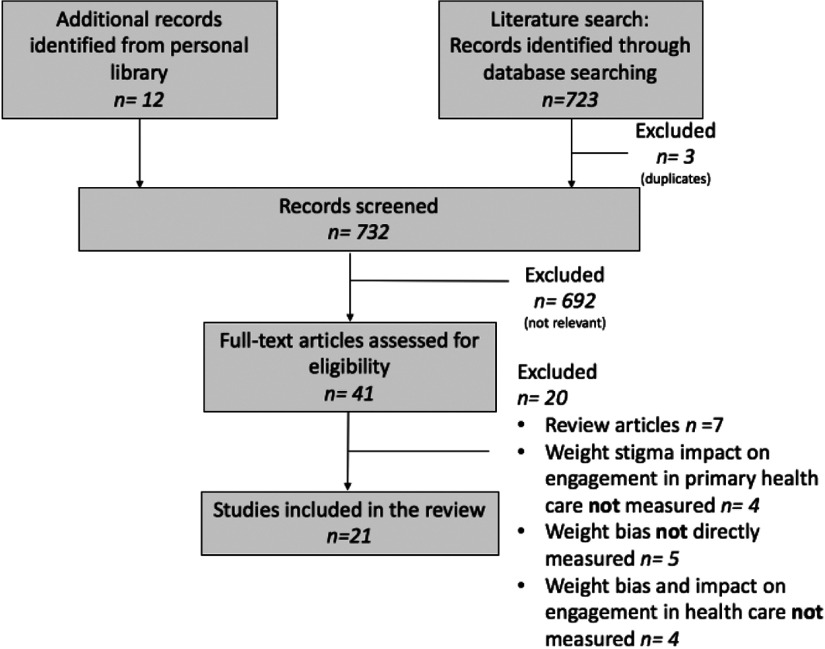
- Four independent reviewers screened titles, abstracts, and full texts; 720 unique articles plus 12 additional articles yielded 732 screened records, of which 21 studies met inclusion criteria.
- Data were charted for study characteristics, patient population, and outcomes, then synthesized using thematic analysis.
Limitations
- Stated: the review focused primarily on weight bias in primary care health professionals, so conclusions can only be made about primary care health professionals; three papers reported three different outcomes from the same sample, which may be viewed as a limitation; future research is needed in other health sectors and settings.
- Stated/evident: scoping review methodology is not intended to assess study quality or provide quantitative synthesis; findings were inconsistent across studies; the evidence base was predominantly US-based (71.4%), quantitative (62%), female-only in 47.6% of studies, and only 38.1% included exclusively participants with obesity, with a noted lack of literature on men’s engagement.
Model-written summary. Check it against the paper before relying on it.
Integrity signals
Registry
Cites
Statistics
Figures
Verification
Claims the paper makes
55 Not checked yet · 15 Own result · 5 Own interpretation · 3 Own method · 2 No basis given
In the paper
“Participants perceived that weight-related advice from health professionals was delivered in a patronizing manner when health professionals insinuated that there was a simple solution to patients’ excess weight (Merrill and Grassley, 2008).”
§ Weight bias and health care utilization: a scoping review > Themes > Contemptuous, patronizing, and disrespectful treatment
What the sources say
- Not checked yetcites Merrill and Grassley, 2008
plaindirect- Asserted: passes — The authors put it forward as true.
- Checkable: passes — It can be checked against evidence.
- Load-bearing: unclear — It is unclear whether the paper’s conclusions depend on it.
- Based: passes — The paper gives a reason why it holds.
None of the sources cited for this claim have been checked yet.
In the paper
“Four studies (Amy et al., 2006; Merrill and Grassley, 2008; Russell and Carryer, 2013; Buxton and Snethen, 2013) reported that participants with overweight and obesity experienced contemptuous, patronizing, and/or disrespectful treatment from health professionals.”
§ Weight bias and health care utilization: a scoping review > Themes > Contemptuous, patronizing, and disrespectful treatment
What the sources say
- Not checked yetcites Amy et al., 2006
- Not checked yetcites Merrill and Grassley, 2008
- Not checked yetcites Russell and Carryer, 2013
plainn = 4- Asserted: passes — The authors put it forward as true.
- Checkable: passes — It can be checked against evidence.
- Load-bearing: unclear — It is unclear whether the paper’s conclusions depend on it.
- Based: passes — The paper gives a reason why it holds.
In the paper
“Participants with overweight and obesity reported feeling that they were being treated less respectfully than individuals classified as having a normal BMI (Amy et al., 2006).”
§ Weight bias and health care utilization: a scoping review > Themes > Contemptuous, patronizing, and disrespectful treatment
What the sources say
- Not checked yetcites Amy et al., 2006
plaincorrelational- Asserted: passes — The authors put it forward as true.
- Checkable: passes — It can be checked against evidence.
- Load-bearing: unclear — It is unclear whether the paper’s conclusions depend on it.
- Based: passes — The paper gives a reason why it holds.
None of the sources cited for this claim have been checked yet.
In the paper
“Participants living with overweight and obesity perceived a lack of training among health professionals (Amy et al., 2006; Forhan et al., 2013; Russell and Carryer, 2013).”
§ Weight bias and health care utilization: a scoping review > Themes > Lack of training
What the sources say
- Not checked yetcites Amy et al., 2006
- Not checked yetcites Forhan et al., 2013
- Not checked yetcites Russell and Carryer, 2013
plain- Asserted: passes — The authors put it forward as true.
- Checkable: passes — It can be checked against evidence.
- Load-bearing: passes — The paper’s conclusions depend on it.
- Based: passes — The paper gives a reason why it holds.
A result the paper reports from its own data — it cites no other source for it, so there is none to check. The quote shows it is in the paper.
In the paper
“Only participants with obesity were included in 38.1% (n = 8) of the studies.”
§ Weight bias and health care utilization: a scoping review > Characteristics of included studies
plainn = 8- Asserted: passes — The authors put it forward as true.
- Checkable: passes — It can be checked against evidence.
- Load-bearing: unclear — It is unclear whether the paper’s conclusions depend on it.
- Based: passes — The paper gives a reason why it holds.
A result the paper reports from its own data — it cites no other source for it, so there is none to check. The quote shows it is in the paper.
In the paper
“Almost half of the studies [n = 9 (42.9%)] exclusively involved primary care physicians or nurse practitioners who work in general practice.”
§ Weight bias and health care utilization: a scoping review > Characteristics of included studies
plainn = 9- Asserted: passes — The authors put it forward as true.
- Checkable: passes — It can be checked against evidence.
- Load-bearing: unclear — It is unclear whether the paper’s conclusions depend on it.
- Based: passes — The paper gives a reason why it holds.
In the paper
“One study that exclusively examined women with obesity reported that almost 80% of participants rarely or never had been treated disrespectfully (e.g., insulted or criticized for not trying hard enough) by their health professionals when discussing weight management (Wadden et al., 2000).”
§ Weight bias and health care utilization: a scoping review > Themes > Contemptuous, patronizing, and disrespectful treatment
What the sources say
- Not checked yetcites Wadden et al., 2000
plain- Asserted: passes — The authors put it forward as true.
- Checkable: passes — It can be checked against evidence.
- Load-bearing: unclear — It is unclear whether the paper’s conclusions depend on it.
- Based: passes — The paper gives a reason why it holds.
In the paper
“Amy et al. showed that over half of their sampled health professionals reported that they had no specific education on providing clinical gynecological examinations for patients with obesity (Amy et al., 2006).”
§ Weight bias and health care utilization: a scoping review > Themes > Lack of training
What the sources say
- Not checked yetcites Amy et al., 2006
plain- Asserted: passes — The authors put it forward as true.
- Checkable: passes — It can be checked against evidence.
- Load-bearing: unclear — It is unclear whether the paper’s conclusions depend on it.
- Based: passes — The paper gives a reason why it holds.
In the paper
“Wadden et al. showed that over 60% of patients complained that their physicians did not truly understand how difficult it was to be overweight (Wadden et al., 2000).”
§ Weight bias and health care utilization: a scoping review > Themes > Health professional assumptions about a patient’s weight gain
What the sources say
- Not checked yetcites Wadden et al., 2000
plain- Asserted: passes — The authors put it forward as true.
- Checkable: passes — It can be checked against evidence.
- Load-bearing: unclear — It is unclear whether the paper’s conclusions depend on it.
- Based: passes — The paper gives a reason why it holds.
In the paper
“In the same study, 24% of patients reported that their primary care practitioners sometimes did not believe them when they told them they do not eat that much.”
§ Weight bias and health care utilization: a scoping review > Themes > Health professional assumptions about a patient’s weight gain
What the sources say
- Not checked yetcites Wadden et al., 2000
plain- Asserted: passes — The authors put it forward as true.
- Checkable: passes — It can be checked against evidence.
- Load-bearing: unclear — It is unclear whether the paper’s conclusions depend on it.
- Based: passes — The paper gives a reason why it holds.
- Probably not a substantial claim. 18
- It may state two separate claims as one. 13
The paper states this without a source or data behind it here, so there is nothing to check it against. The quote shows it is in the paper.
In the paper
“These studies did not explicitly mention the types of primary health care services that the health professionals performed.”
§ Weight bias and health care utilization: a scoping review > Characteristics of included studies
plain- Asserted: passes — The authors put it forward as true.
- Checkable: passes — It can be checked against evidence.
- Load-bearing: fails — The paper’s conclusions may not depend on it.
- Based: passes — The paper gives a reason why it holds.
Probably not a substantial claim. The paper’s conclusions may not depend on it.
A result the paper reports from its own data — it cites no other source for it, so there is none to check. The quote shows it is in the paper.
In the paper
“The remaining 47.6% included only female participants (n = 10).”
§ Weight bias and health care utilization: a scoping review > Characteristics of included studies
plainn = 10- Asserted: passes — The authors put it forward as true.
- Checkable: passes — It can be checked against evidence.
- Load-bearing: fails — The paper’s conclusions may not depend on it.
- Based: passes — The paper gives a reason why it holds.
Probably not a substantial claim. The paper’s conclusions may not depend on it.
A result the paper reports from its own data — it cites no other source for it, so there is none to check. The quote shows it is in the paper.
In the paper
“Of the 732 articles that we screened as potentially relevant, 21 studies met the inclusion criteria and were included in the review”
§ Weight bias and health care utilization: a scoping review > Results
plain- Asserted: passes — The authors put it forward as true.
- Checkable: passes — It can be checked against evidence.
- Load-bearing: passes — The paper’s conclusions depend on it.
- Based: passes — The paper gives a reason why it holds.
It may state two separate claims as one.
A result the paper reports from its own data — it cites no other source for it, so there is none to check. The quote shows it is in the paper.
In the paper
“Surveys were the most commonly used measure in quantitative studies [n = 13 (62%)].”
§ Weight bias and health care utilization: a scoping review > Characteristics of included studies
plainn = 13- Asserted: passes — The authors put it forward as true.
- Checkable: passes — It can be checked against evidence.
- Load-bearing: fails — The paper’s conclusions may not depend on it.
- Based: passes — The paper gives a reason why it holds.
Probably not a substantial claim. The paper’s conclusions may not depend on it.
A result the paper reports from its own data — it cites no other source for it, so there is none to check. The quote shows it is in the paper.
In the paper
“Other studies [n = 12 (57%)] compared different combinations of underweight, normal weight, overweight, and obese BMI classifications.”
§ Weight bias and health care utilization: a scoping review > Characteristics of included studies
plainn = 12- Asserted: passes — The authors put it forward as true.
- Checkable: passes — It can be checked against evidence.
- Load-bearing: fails — The paper’s conclusions may not depend on it.
- Based: passes — The paper gives a reason why it holds.
Probably not a substantial claim. The paper’s conclusions may not depend on it.
A result the paper reports from its own data — it cites no other source for it, so there is none to check. The quote shows it is in the paper.
In the paper
“An additional 12 articles were identified from other sources resulting in a total of 732 articles.”
§ Weight bias and health care utilization: a scoping review > Results
plain- Asserted: passes — The authors put it forward as true.
- Checkable: passes — It can be checked against evidence.
- Load-bearing: fails — The paper’s conclusions may not depend on it.
- Based: passes — The paper gives a reason why it holds.
Probably not a substantial claim. The paper’s conclusions may not depend on it. It may state two separate claims as one.
A result the paper reports from its own data — it cites no other source for it, so there is none to check. The quote shows it is in the paper.
In the paper
“The literature search resulted in 720 unique articles.”
§ Weight bias and health care utilization: a scoping review > Results
plain- Asserted: passes — The authors put it forward as true.
- Checkable: passes — It can be checked against evidence.
- Load-bearing: fails — The paper’s conclusions may not depend on it.
- Based: passes — The paper gives a reason why it holds.
Probably not a substantial claim. The paper’s conclusions may not depend on it.
A result the paper reports from its own data — it cites no other source for it, so there is none to check. The quote shows it is in the paper.
In the paper
“The most commonly used qualitative method was interviews [n = 7 (33%)] including focus groups [n = 1 (4.8%)], telephone [n = 1 (4.8%)], face-to-face [n = 4 (19%)], or a combination of face-to-face and telephone [n = 1 (4.8%)].”
§ Weight bias and health care utilization: a scoping review > Characteristics of included studies
plainn = 7- Asserted: passes — The authors put it forward as true.
- Checkable: passes — It can be checked against evidence.
- Load-bearing: fails — The paper’s conclusions may not depend on it.
- Based: passes — The paper gives a reason why it holds.
Probably not a substantial claim. The paper’s conclusions may not depend on it. It may state two separate claims as one.
A result the paper reports from its own data — it cites no other source for it, so there is none to check. The quote shows it is in the paper.
In the paper
“Another 28.6% of studies did not exclusively examine one health sector (n = 6).”
§ Weight bias and health care utilization: a scoping review > Characteristics of included studies
plainn = 6- Asserted: passes — The authors put it forward as true.
- Checkable: passes — It can be checked against evidence.
- Load-bearing: fails — The paper’s conclusions may not depend on it.
- Based: passes — The paper gives a reason why it holds.
Probably not a substantial claim. The paper’s conclusions may not depend on it.
A result the paper reports from its own data — it cites no other source for it, so there is none to check. The quote shows it is in the paper.
In the paper
“One study did not measure participant BMI (4.8%).”
§ Weight bias and health care utilization: a scoping review > Characteristics of included studies
plainSingle case- Asserted: passes — The authors put it forward as true.
- Checkable: passes — It can be checked against evidence.
- Load-bearing: fails — The paper’s conclusions may not depend on it.
- Based: passes — The paper gives a reason why it holds.
Probably not a substantial claim. The paper’s conclusions may not depend on it.
A result the paper reports from its own data — it cites no other source for it, so there is none to check. The quote shows it is in the paper.
In the paper
“and used quantitative methods [n = 13 (62%)]”
§ Weight bias and health care utilization: a scoping review > Characteristics of included studies
plainn = 13- Asserted: passes — The authors put it forward as true.
- Checkable: passes — It can be checked against evidence.
- Load-bearing: fails — The paper’s conclusions may not depend on it.
- Based: passes — The paper gives a reason why it holds.
Probably not a substantial claim. The paper’s conclusions may not depend on it.
A result the paper reports from its own data — it cites no other source for it, so there is none to check. The quote shows it is in the paper.
In the paper
“The majority of studies included in this review were carried out in the United States [n = 15 (71.4%)]”
§ Weight bias and health care utilization: a scoping review > Characteristics of included studies
plainn = 15- Asserted: passes — The authors put it forward as true.
- Checkable: passes — It can be checked against evidence.
- Load-bearing: fails — The paper’s conclusions may not depend on it.
- Based: passes — The paper gives a reason why it holds.
Probably not a substantial claim. The paper’s conclusions may not depend on it.
A result the paper reports from its own data — it cites no other source for it, so there is none to check. The quote shows it is in the paper.
In the paper
“The following 10 themes were identified: contemptuous, patronizing, and disrespectful treatment, lack of training, ambivalence, attribution of all health issues to excess weight, assumptions about weight gain, barriers to health care utilization, expectation of differential health care treatment, low trust and poor communication, avoidance or delay of health services, and ‘doctor shopping’.”
§ Weight bias and health care utilization: a scoping review > Abstract > Findings:
plain- Asserted: passes — The authors put it forward as true.
- Checkable: passes — It can be checked against evidence.
- Load-bearing: passes — The paper’s conclusions depend on it.
- Based: passes — The paper gives a reason why it holds.
It may state two separate claims as one.
A result the paper reports from its own data — it cites no other source for it, so there is none to check. The quote shows it is in the paper.
In the paper
“The majority of the studies included mixed samples of both female and male participants [n = 11 (52.4%)].”
§ Weight bias and health care utilization: a scoping review > Characteristics of included studies
plainn = 11- Asserted: passes — The authors put it forward as true.
- Checkable: passes — It can be checked against evidence.
- Load-bearing: fails — The paper’s conclusions may not depend on it.
- Based: passes — The paper gives a reason why it holds.
Probably not a substantial claim. The paper’s conclusions may not depend on it.
None of the sources cited for this claim have been checked yet.
In the paper
“Patients felt that the emphasis health professionals put on their weight distracted from other health issues and resulted in feelings of not being listened to (Brown et al., 2006; Russell and Carryer, 2013).”
§ Weight bias and health care utilization: a scoping review > Themes > Attribution of all health issues to excess weight
What the sources say
- Not checked yetcites Brown et al., 2006
- Not checked yetcites Russell and Carryer, 2013
plaindirect- Asserted: passes — The authors put it forward as true.
- Checkable: passes — It can be checked against evidence.
- Load-bearing: passes — The paper’s conclusions depend on it.
- Based: passes — The paper gives a reason why it holds.
It may state two separate claims as one.
None of the sources cited for this claim have been checked yet.
In the paper
“These types of assumptions were often inaccurate, but health professionals did not listen when patients made efforts to correct them (Pryor, 2002; Merrill and Grassley, 2008; DeJoy et al., 2016).”
§ Weight bias and health care utilization: a scoping review > Themes > Health professional assumptions about a patient’s weight gain
What the sources say
- Not checked yetcites Pryor, 2002
- Not checked yetcites Merrill and Grassley, 2008
- Not checked yetcites DeJoy et al., 2016
plain- Asserted: passes — The authors put it forward as true.
- Checkable: passes — It can be checked against evidence.
- Load-bearing: passes — The paper’s conclusions depend on it.
- Based: passes — The paper gives a reason why it holds.
It may state two separate claims as one.
None of the sources cited for this claim have been checked yet.
In the paper
“Although seven studies reported the association between weight bias and decreased health care utilization, four studies reported different findings (Merrill and Grassley, 2008; Buxton and Snethen, 2013; Hilbert et al., 2014; Bottone et al., 2014).”
§ Weight bias and health care utilization: a scoping review > Themes > Avoidance or delay of health services
What the sources say
- Not checked yetcites Merrill and Grassley, 2008
- Not checked yetcites Buxton and Snethen, 2013
- Not checked yetcites Hilbert et al., 2014
plaincorrelational- Asserted: passes — The authors put it forward as true.
- Checkable: passes — It can be checked against evidence.
- Load-bearing: unclear — It is unclear whether the paper’s conclusions depend on it.
- Based: passes — The paper gives a reason why it holds.
It may state two separate claims as one.
In the paper
“Contrary to these results, a qualitative study conducted with women with obesity in a general practice setting reported that many participants denied being treated differently because of their weight and did not believe that they received less care (Buxton and Snethen, 2013).”
§ Weight bias and health care utilization: a scoping review > Themes > Expectation of differential health care
What the sources say
- Not checked yetcites Buxton and Snethen, 2013
plain- Asserted: passes — The authors put it forward as true.
- Checkable: passes — It can be checked against evidence.
- Load-bearing: unclear — It is unclear whether the paper’s conclusions depend on it.
- Based: passes — The paper gives a reason why it holds.
It may state two separate claims as one.
In the paper
“Hilbert et al. reported that a greater BMI predicted greater weight bias internalization and greater health care utilization (Hilbert et al., 2014).”
§ Weight bias and health care utilization: a scoping review > Themes > Avoidance or delay of health services
What the sources say
- Not checked yetcites Hilbert et al., 2014
plaindirect- Asserted: passes — The authors put it forward as true.
- Checkable: passes — It can be checked against evidence.
- Load-bearing: fails — The paper’s conclusions may not depend on it.
- Based: passes — The paper gives a reason why it holds.
Probably not a substantial claim. The paper’s conclusions may not depend on it. It may state two separate claims as one.
In the paper
“These stigmatizing attitudes are perceived and received by individuals with obesity and may contribute to the creation of multiple barriers to health care utilization”
§ Weight bias and health care utilization: a scoping review > Introduction
What the sources say
- Not checked yetcites Drury and Louis, 2002
hedgedconditional- Asserted: passes — The authors put it forward as true.
- Checkable: passes — It can be checked against evidence.
- Load-bearing: passes — The paper’s conclusions depend on it.
- Based: passes — The paper gives a reason why it holds.
It may state two separate claims as one.
None of the sources cited for this claim have been checked yet.
In the paper
“Over the past decade, the prevalence of weight bias has increased in the United States by 66% and has been documented in employment, education, and health care settings”
§ Weight bias and health care utilization: a scoping review > Introduction
What the sources say
- Not checked yetcites Andreyeva et al., 2008
- Not checked yetcites Puhl and Heuer, 2009
plaindirect- Asserted: passes — The authors put it forward as true.
- Checkable: passes — It can be checked against evidence.
- Load-bearing: unclear — It is unclear whether the paper’s conclusions depend on it.
- Based: passes — The paper gives a reason why it holds.
It may state two separate claims as one.
What the paper did — it cites no source for this, so there is none to check. The quote shows it is in the paper.
In the paper
“Four independent reviewers screened titles and abstracts using the following keywords and their synonyms: weight bias, primary health care, and use of health care services.”
§ Weight bias and health care utilization: a scoping review > Study selection
plain- Asserted: passes — The authors put it forward as true.
- Checkable: passes — It can be checked against evidence.
- Load-bearing: fails — The paper’s conclusions may not depend on it.
- Based: passes — The paper gives a reason why it holds.
Probably not a substantial claim. The paper’s conclusions may not depend on it.
What the paper did — it cites no source for this, so there is none to check. The quote shows it is in the paper.
In the paper
“All reviewers verified the data for accuracy and completeness.”
§ Weight bias and health care utilization: a scoping review > Data charting
plain- Asserted: passes — The authors put it forward as true.
- Checkable: passes — It can be checked against evidence.
- Load-bearing: fails — The paper’s conclusions may not depend on it.
- Based: passes — The paper gives a reason why it holds.
Probably not a substantial claim. The paper’s conclusions may not depend on it.
In the paper
“Weight bias was cited as the fourth most common form of discrimination among US adults”
§ Weight bias and health care utilization: a scoping review > Introduction
What the sources say
- Not checked yetcites Puhl et al., 2008
plain- Asserted: passes — The authors put it forward as true.
- Checkable: passes — It can be checked against evidence.
- Load-bearing: fails — The paper’s conclusions may not depend on it.
- Based: passes — The paper gives a reason why it holds.
Probably not a substantial claim. The paper’s conclusions may not depend on it.
What the paper did — it cites no source for this, so there is none to check. The quote shows it is in the paper.
In the paper
“Discrepancies were resolved by consensus between reviewers.”
§ Weight bias and health care utilization: a scoping review > Study selection
plain- Asserted: passes — The authors put it forward as true.
- Checkable: passes — It can be checked against evidence.
- Load-bearing: fails — The paper’s conclusions may not depend on it.
- Based: passes — The paper gives a reason why it holds.
Probably not a substantial claim. The paper’s conclusions may not depend on it.
In the paper
“The Preferred Reporting Items for Systematic Review and Meta-Analyses extension for Scoping Reviews (PRISMA- ScR) was used to guide the reporting for this scoping review”
§ Weight bias and health care utilization: a scoping review > Methods
What the sources say
- Not checked yetcites Tricco et al., 2018
plain- Asserted: passes — The authors put it forward as true.
- Checkable: passes — It can be checked against evidence.
- Load-bearing: fails — The paper’s conclusions may not depend on it.
- Based: passes — The paper gives a reason why it holds.
Probably not a substantial claim. The paper’s conclusions may not depend on it.
None of the sources cited for this claim have been checked yet.
In the paper
“Not only does weight bias pose adverse mental and physical health consequences such as exercise avoidance (Vartanian and Shaprow, 2008), anxiety (Hilbert et al., 2014), low self-esteem (Hilbert et al., 2014), and depression (Hilbert et al., 2014)”
§ Weight bias and health care utilization: a scoping review > Introduction
What the sources say
- Not checked yetcites Vartanian and Shaprow, 2008
- Not checked yetcites Hilbert et al., 2014
plaindirect- Asserted: passes — The authors put it forward as true.
- Checkable: passes — It can be checked against evidence.
- Load-bearing: passes — The paper’s conclusions depend on it.
- Based: passes — The paper gives a reason why it holds.
It may state two separate claims as one.
A conclusion the paper draws from its own results — it cites no other source for it, so there is none to check. The quote shows it is in the paper.
In the paper
“Second, it is clear that weight bias negatively affects patients’ engagement in primary health care through their perceived barriers to health care utilization, expectations of differential health care treatment, low trust and poor communication, avoidance or delay of health services, and ‘doctor shopping’.”
§ Weight bias and health care utilization: a scoping review > Conclusion
boosteddirect- Asserted: passes — The authors put it forward as true.
- Checkable: passes — It can be checked against evidence.
- Load-bearing: passes — The paper’s conclusions depend on it.
- Based: passes — The paper gives a reason why it holds.
It may state two separate claims as one.
- Rests on an assumption: Patients' self-reported perceptions of weight bias accurately reflect health professionals' actual weight bias.
- Rests on an assumption: The association between weight bias and avoidance or delay of health care is causal.
The paper relies on this without support.
Patients' self-reported perceptions of weight bias accurately reflect health professionals' actual weight bias.
“Patients with overweight and obesity who felt their primary care providers judged their weight were less likely to report high trust in these primary care practitioners (Gudzune et al., 2014a).”
The paper relies on this without support.
The included studies are sufficiently methodologically sound and comparable to synthesize into themes and conclusions.
“In this scoping review, we reviewed 21 published studies to examine the influence of weight bias on engagement in primary health care.”
The paper relies on this without support.
The association between weight bias and avoidance or delay of health care is causal.
“The results of this review indicate that patients with overweight and obesity delay or avoid health care services as a result of health professionals’ weight bias.”
Claims other papers make about this one
Each is checked against this paper’s own text: does it say what the citing paper says it does?
In the citing paper
“Perceptions and/or experiences of weight bias in primary care settings have been shown to negatively influence patient engagement with health care services [210].”
From Food Addiction and Psychosocial Adversity: Biological Embedding, Contextual Factors, and Public Health Implications (2020) · cites this paper as [210]
Self-check
Percentages, sums and reported differences re-computed from the paper’s own numbers.
Each contradiction between two passages listed here was confirmed by an independent check.
Rated minor: it would not touch a result — a value no result rests on, a p-value that stays on the same side of the significance level, or a conflict that is clerical, resolved elsewhere in the paper, or outside its own findings.
In the paper
“N = 11(M = 2, F = 8) 19–64 years old registered with a primary care practice”
§ Weight bias and health care utilization: a scoping review > Data charting
Reported 11 · recomputed 10
Rated minor: it would not touch a result — a value no result rests on, a p-value that stays on the same side of the significance level, or a conflict that is clerical, resolved elsewhere in the paper, or outside its own findings.
In the paper
“N = 216 women from church sites 30–59 years old | Normal <27.5 kg/m2 (n = 137), mild obesity 27.5–30.0 kg/m2 (n = 19), moderate obesity >30–40 kg/m2 (n = 43), morbid obesity >40 kg/m2 (n = 11)”
§ Weight bias and health care utilization: a scoping review > Data charting
Reported 216 · recomputed 210
Rated minor: it would not touch a result — a value no result rests on, a p-value that stays on the same side of the significance level, or a conflict that is clerical, resolved elsewhere in the paper, or outside its own findings.
In the paper
“N = 2788 adults aged 25–64 years in 2008 | Normal weight (n = 1064), moderate obesity (n = 1273), and severe obesity (n = 291) at the time of participation in the ULF survey”
§ Weight bias and health care utilization: a scoping review > Data charting
Reported 2788 · recomputed 2628
Rated minor: it would not touch a result — a value no result rests on, a p-value that stays on the same side of the significance level, or a conflict that is clerical, resolved elsewhere in the paper, or outside its own findings.
In the paper
§ Weight bias and health care utilization: a scoping review > Data charting
“Underweight >20 kg/m2”
§ Weight bias and health care utilization: a scoping review > Data charting
“normal weight 20–24.9 kg/m2”
Citations
Cites
PRISMA Extension for Scoping Reviews (PRISMA-ScR): Checklist and Explanation
Tricco, A. C., Lillie, E., Zarin, W., O'Brien, K. K., Colquhoun, H., Levac, D., Moher, D., Peters, M. D. J., Horsley, T., Weeks, L., et al. (2018) · Annals of Internal Medicine · doi:10.7326/m18-0850 · Cited by 43,565
Scoping studies: towards a methodological framework
Arksey, H., & O'Malley, L. (2005) · International Journal of Social Research Methodology · doi:10.1080/1364557032000119616 · Cited by 36,742
Lippa, N. C., & Sanderson, S. C. (2013) · Human Heredity · doi:10.1159/000353712 · Cited by 6,095
The Stigma of Obesity: A Review and Update
Puhl, R. M., & Heuer, C. A. (2009) · Obesity · doi:10.1038/oby.2008.636 · Cited by 3,323 · cited 2×
“Weight bias and stigma, known as negative, prejudicial, or stereotypical beliefs and attitudes toward individuals based on their size, has been identified as a barrier to seeking health care services (Drury and Louis, 2002; Puhl and Heuer, 2009; Washington, 2011).”
BackgroundImpact of weight bias and stigma on quality of care and outcomes for patients with obesity
Phelan, S. M., Burgess, D. J., Yeazel, M. W., Hellerstedt, W. L., Griffin, J. M., & van Ryn, M. (2015) · Obesity Reviews · doi:10.1111/obr.12266 · Cited by 1,361
Puhl, R. M., Andreyeva, T., & Brownell, K. D. (2008) · International Journal of Obesity · doi:10.1038/ijo.2008.22 · Cited by 900
Changes in Perceived Weight Discrimination Among Americans, 1995–1996 Through 2004–2006
Andreyeva, T., Puhl, R. M., & Brownell, K. D. (2008) · Obesity · doi:10.1038/oby.2008.35 · Cited by 684
Implicit anti-fat bias among health professionals: is anyone immune?
Teachman, B., & Kd, B. (2001) · International Journal of Obesity · doi:10.1038/sj.ijo.0801745 · Cited by 598
Barriers to routine gynecological cancer screening for White and African-American obese women
Amy, N. K., Aalborg, A. E., Lyons, P., & Keränen, L. (2005) · International Journal of Obesity · doi:10.1038/sj.ijo.0803105 · Cited by 453
Effects of Weight Stigma on Exercise Motivation and Behavior
Vartanian, L. R., & Shaprow, J. G. (2007) · Journal of Health Psychology · doi:10.1177/1359105307084318 · Cited by 401
Cited by
Sorted by citations
Items 201–300 of 348
Wijayatunga, N. N., Bailey, D. A., Klobodu, S. S., Donatello, R. A., Knight, K., & Dhurandhar, E. J. (2024) · Topics in Clinical Nutrition · doi:10.1097/tin.0000000000000371 · Cited by 1
Supporting Adherence and Self-management
Rich, K. L., Varnell, C. D., & Lazear, D. (2024) · Springer eBooks · doi:10.1007/978-3-031-64672-0_11 · Cited by 1
Obesity and postpartum hospital use among individuals without additional medical comorbidities
Glazer, K. B., Janevic, T. M., Boychuk, N., Egorova, N., Hebert, P. L., Zeitlin, J. A., & Howell, E. A. (2024) · Obesity · doi:10.1002/oby.24167 · Cited by 2
Physical Health in Psychosis: a Perspective on the Recovery Paradigm
Zierotin, A., Norton, M. J., O'Donoghue, B. N., O’Connor, K., & Clarke, M. (2025) · Irish Journal of Psychological Medicine · doi:10.1017/ipm.2025.1 · Cited by 1
Nash, S. H., Verhage, E., McDowell, B. D., Neuner, J. M., Chrischilles, E. A., Lizarraga, I. M., & Schroeder, M. C. (2025) · Cancer Medicine · doi:10.1002/cam4.70628 · Cited by 1
Taylor, J. L. W., Travaglini, L. E., O'Connell, M., Carreño, P. K., Herrera, G. F., Velosky, A. G., Amoako, M. Y., Costantino, R. C., & Highland, K. B. (2025) · Pain · doi:10.1097/j.pain.0000000000003559 · Cited by 1
Bonfils, K. A., Longenecker, J., Seo, Y., Soreca, I., Hammer, L. A., Tighe, C. A., Beals, K., Haas, G. L., & Bramoweth, A. D. (2025) · Journal of Affective Disorders · doi:10.1016/j.jad.2025.03.022 · Cited by 1
Sorensen, J., West, M. M., Robinson, K. M., Charlton, M. E., Lizarraga, I. M., & Nash, S. H. (2025) · Cancer Medicine · doi:10.1002/cam4.70823 · Cited by 1
Starman, E., Wedemire, C., & Sandhu, R. (2025) · Journal of Critical Dietetics · doi:10.32920/jcd.v8i1.2281 · Cited by 1
Kwok, C., Lister, N. B., House, E. T., Baur, L. A., Garnett, S. P., Jebeile, H., & on behalf of the Fast Track to Health study team (2025) · Childhood Obesity · doi:10.1089/chi.2025.0023 · Cited by 1
An Analysis of Anti-Fat Bias LibGuides: Are Libraries in the Thick of It?
Silkotch, C., Haines, L., & Dolan, A. M. (2025) · Evidence Based Library and Information Practice · doi:10.18438/eblip30616 · Cited by 1
Hardy, A. R., & Lamont, J. M. (2025) · Psychology Health & Medicine · doi:10.1080/13548506.2025.2546588 · Cited by 1
Obesity paradox in atrial fibrillation and flutter: a multivariate nationwide inpatient analysis
Sparling, K. (2025) · American Journal of Cardiovascular Disease · doi:10.62347/zotx5048 · Cited by 1
Schröder, L., Fahrenkrog, S., Klüpfel, L., & Stumm, J. (2025) · Journal of Pediatric Nursing · doi:10.1016/j.pedn.2025.09.018 · Cited by 2
Sharp, G., Rathbone, J. A., West, M. L., Low, B. Y., McGrath, I., Bilal, M., & Fernando, A. N. (2025) · Patient Education and Counseling · doi:10.1016/j.pec.2025.109373 · Cited by 2
Côté, M., Forouhar, V., Sacco, S., González-González, M., Baillot, A., Himmelstein, M. S., Hussey, B., Rodriguez, A. C. I., Nagpal, T. S., Nutter, S., et al. (2025) · International Journal of Obesity · doi:10.1038/s41366-025-01975-3 · Cited by 2
Self-citationBanton, C., Buchanan, H., & Asimakopoulou, K. G. (2026) · Psychology Health & Medicine · doi:10.1080/13548506.2026.2623304 · Cited by 1
Development and validation of the EDIT weight stigma reduction checklist
Garcia, X. D. L. P., Cooper, K., Jardine, I. R., Alberga, A. S., Darling, K. E., Hill, A. J., Howes, E. M., Vidmar, A. P., Yourell, J., Lister, N. B., et al. (2026) · International Journal of Obesity · doi:10.1038/s41366-026-02045-y · Cited by 1
Self-citationTefera, G. M., Winter, V. R., Varol, S., Terhaar, A., Ngondwe, P., Anderson, S., & Trout, K. E. (2026) · Social Science & Medicine · doi:10.1016/j.socscimed.2026.119361 · Cited by 1
Experienced Weight Stigma Changes Following Bariatric Surgery: a Systematic Review and Meta‐Analysis
Farnsworth, H. R., Leget, D. L., LaCaille, L. J., LaCaille, R. A., Koball, A. M., Niemann, A., Backderf, C. Z., Mastrian, C. R., & Duyke, E. M. V. (2026) · Obesity Reviews · doi:10.1111/obr.70179 · Cited by 1
Person-First Treatment Strategies
Crowley, N. M. (2022) · Primary Care Clinics in Office Practice · doi:10.1016/j.pop.2022.10.002 · Cited by 1
Digital Mental Health Interventions: Differences in Diet Culture Intervention Framing
Fitterman-Harris, H. F., Davis, G. G., Bedard, S. P., Cusack, C. E., & Levinson, C. A. (2023) · International Journal of Environmental Research and Public Health · doi:10.3390/ijerph21010024 · Cited by 1
Krstic, S., Dennis, S. M., Southcombe, F., & Denney‐Wilson, E. (2024) · BMC Health Services Research · doi:10.1186/s12913-024-10790-x · Cited by 1
Mirzadeh, P., Kuk, J. L., Wharton, S., Reid, R. A., & Ardern, C. I. (2024) · PLoS ONE · doi:10.1371/journal.pone.0311190 · Cited by 1
Mathews, N., Joseph, J., Joseph, M. E., Muñoz, E. G., & Lee, L. T. (2024) · Journal of Radiology Nursing · doi:10.1016/j.jradnu.2024.09.007 · Cited by 1
Turner, L., & Bombak, A. E. (2024) · Qualitative Research in Medicine & Healthcare · doi:10.4081/qrmh.2024.12480 · Cited by 1
Benítez-Muñoz, J., Aguarón-García, M. J., Malagón-Aguilera, M. D. C., Cuesta-Martínez, R., García, G. R., & Solà-Miravete, M. E. (2025) · Nursing Reports · doi:10.3390/nursrep15050168 · Cited by 1
Supporting patients living with obesity in general practice
Mulrooney, H. M. (2022) · Practice Nursing · doi:10.12968/pnur.2022.33.12.508 · Cited by 1
Ryan, L., Quigley, F., Birney, S., Crotty, M., Conlan, O., & Walsh, J. C. (2024) · doi:10.31219/osf.io/b835y · Cited by 1
Quigley, F., Moorhead, A., Bond, R., McAloon, T., & Zheng, H. (2024) · doi:10.2196/preprints.65949 · Cited by 1
山崎, 允., & 裕絵, 菊. (2021) · 心身医学 · doi:10.15064/jjpm.61.3_242
Obesity in cats and dogs: simple things you can do
Calcraft, L. (2021) · The Veterinary Nurse · doi:10.12968/vetn.2021.12.6.258
Psihogios, A., Baggio, A., & Clouthier, S. N. (2021) · CAND Journal · doi:10.54434/candj.16
La semiotica dell'esperienza: un paradigma in divenire
Eugeni, R. (2009)
Discussion of Weight Loss Surgery in Instagram Posts: Successive Sampling Study (Preprint)Preprint
Meleo-Erwin, Z. C., Basch, C. H., Fera, J., & Smith, B. (2021) · doi:10.2196/preprints.29390
Taxes, Subsidies, and Policies
Barquera, S., Véjar-Rentería, L. S., White, M., & Unar‐Munguía, M. (2022) · Wiley eBooks · doi:10.1002/9781119695257.ch30
Faber, A., Jung, C. A., & Daumann, F. (2022) · Journal of Public Health · doi:10.1007/s10389-022-01711-5
Costa, J. D. C. (2022) · Digital Library of Theses and Dissertations (Universidade de São Paulo) · doi:10.11606/d.6.2022.tde-19072022-163744
Shanouda, F., & Langdon, T.-L. (2022) · Springer eBooks · doi:10.1007/978-981-16-1278-7_39-1
Shibli-Rahhal, A. A., Ogunsakin, A. A., & Robinson, K. M. (2023) · Advances in medical education, research, and ethics (AMERE) book series · doi:10.4018/978-1-6684-5493-0.ch003
Corah, L. (2023) · Veterinary Record · doi:10.1002/vetr.2755
Public Policy and the Repercussions of Fat Stigma on Women and Children
Herndon, A. M. (2023) · Routledge eBooks · doi:10.4324/9781003140665-15
Prejudice associated with weight images in health communication in the social networks
Flauzino, P. A., Freire, Y. A., Monteiro, I. R. M., Soares, S. C. M. R., & Carioca, A. A. F. (2023) · Revista de Nutrição · doi:10.1590/1678-9865202336e210220 · Cited by 2
Estigma relacionado ao peso corporal: da compreensão teórica à mudança no cuidado em saúde
Scagliusi, F. B. (2021) · Digital Library of Theses and Dissertations (Universidade de São Paulo) · doi:10.11606/t.6.2021.tde-06092023-131237 · Cited by 1
de Oliveira, L. C., Soares, A. R. D. S., Sabatini, F., Ulian, M. D., Unsain, R. F., & Scagliusi, F. B. (2023) · Interface - Comunicação Saúde Educação · doi:10.1590/interface.230039 · Cited by 1
Mathew, D. (2023) · Journal of Hospital Medicine · doi:10.1002/jhm.13232
Communication, Bias, and Stigma
Scherr, K. A., Honeycutt, L. K., Page, S., & Armstrong, S. (2023) · Springer eBooks · doi:10.1007/978-3-031-37380-0_2
Yunus, N. A., Sturgiss, E. A., & Soh, S. (2023) · Obesity Research & Clinical Practice · doi:10.1016/j.orcp.2023.11.004 · Cited by 1
Duval, K., Couturier, É., Laferrière, M.-C., Gagnon, M., & Gallani, M. C. B. J. (2024) · Science of Nursing and Health Practices · doi:10.7202/1108910ar · Cited by 1
Viana, T. G. (2024) · Esmam eBooks · doi:10.55339/9786560720961008
AMOR E PRECONCEITO: reflexões sobre a união civil homoafetiva e o enfrentamento à discriminação
Silva, G. P. (2024) · Esmam eBooks · doi:10.55339/9786560720961009
INVISIBILIDADE DO RACISMO AOS POVOS INDÍGENAS: Marcos Legais e Desenvolvimento Sustentável
Martins, A. A. (2024) · Esmam eBooks · doi:10.55339/9786560720961018
O CONTEXTO DA LUTA ANTIMANICOMIAL E O SIGNIFICADO PARA A CONSTRUÇÃO DOS DIREITOS HUMANOS
Valporto, A. C. D. R. (2024) · Esmam eBooks · doi:10.55339/9786560720961021
ENVELHECIMENTO, ETARISMO E OS DESAFIOS PARA AFIRMAÇÃO DE DIREITOS NO CONTEXTO CONTURBADO BRASILEIRO
Neto, A. M. L., de Sena, J. P., & de Jesus, T. A. C. (2024) · Esmam eBooks · doi:10.55339/9786560720961012
LITERATURA, LEGISLAÇÃO E LUTA POR LIBERDADE EM “A ESCRAVA”, DE MARIA FIRMINA DOS REIS
Silva, R. K. M., & Mendes, T. A. S. P. (2024) · Esmam eBooks · doi:10.55339/9786560720961024
DIREITO DA ANTIDISCRIMINAÇÃO, DESIGUALDADES E DIFERENÇAS
Ríos, R. R. (2024) · Esmam eBooks · doi:10.55339/9786560720961001
Lima, J. D. S., & Gomes, J. D. S. (2024) · Esmam eBooks · doi:10.55339/9786560720961011
de Almeida, N. M. D. O., Ramos, E. M. B., & Camarão, F. C. (2024) · Esmam eBooks · doi:10.55339/9786560720961005
da Silva, Í. V., & Neta, M. D. C. A. (2024) · Esmam eBooks · doi:10.55339/9786560720961022
Camarão, F. C., Santana, A. F. L., & Silva, S. F. D. M. (2024) · Esmam eBooks · doi:10.55339/9786560720961002
ENTRE A CRÍTICA E O RECONHECIMENTO: POR UMA EPISTEMOLOGIA TRANSVIADA NA CIÊNCIA JURÍDICA
da Silva, D. M., Alves, F. L. D. F., & da Silva, Í. V. (2024) · Esmam eBooks · doi:10.55339/9786560720961028
Abreu, M. M., Pimentel, C. V., & Carvalho, J. M. P. (2024) · Esmam eBooks · doi:10.55339/9786560720961010
Diversidade e antidiscriminação: uma discussão necessária
Chaves, A. S., de Mesquita, A. A. J., Carvalho, E. S., & Fonsêca, M. A. R. (2024) · Esmam eBooks · doi:10.55339/9786560720961
Neto, E. D. J. C., & Silva, M. C. D. O. (2024) · Esmam eBooks · doi:10.55339/9786560720961003
Pereira, M. S., & Lima, R. D. A. S. (2024) · Esmam eBooks · doi:10.55339/9786560720961030
A IMPORTÂNCIA HISTÓRICA DA FILOSOFIA FEMININA
de Almeida, J. E. F. (2024) · Esmam eBooks · doi:10.55339/9786560720961006
Goltzman, E. M., & de Moraes, G. A. S. (2024) · Esmam eBooks · doi:10.55339/9786560720961004
Lima, E. T. T., de Jesús, T. A. C., & Costa, L. G. A. (2024) · Esmam eBooks · doi:10.55339/9786560720961020
Neto, A. M. L., Ramos, E. M. B., & de Jesús, T. A. C. (2024) · Esmam eBooks · doi:10.55339/9786560720961014
ADO 26 E CRIMINALIZAÇÃO DA HOMOTRANSFOBIA: uma (outra) resposta possível da Criminologia Queer
Veloso, M. J. F. (2024) · Esmam eBooks · doi:10.55339/9786560720961032
A VIOLÊNCIA DE GÊNERO PARA A MULHER NA POLÍTICA: negação da igualdade de gênero no Brasil
de Oliveira, Y. C. O., & Leão, I. V. (2024) · Esmam eBooks · doi:10.55339/9786560720961023
Souza, D. D. M., & Moura, A. C. S. (2024) · Esmam eBooks · doi:10.55339/9786560720961013
de Araujo, L. B., & Costa, F. B. D. A. (2024) · Esmam eBooks · doi:10.55339/9786560720961016
Ryan, L., Donoghue, G. O., Heary, C., Birney, S., Crotty, M., Hanlon, M. L. D., Conlan, O., & Walsh, J. C. (2024) · doi:10.31219/osf.io/qnasm
Lawrence, B. J. (2024) · Physiotherapy Canada · doi:10.3138/ptc-2022-0038-cc
Junqueira, A. C. P., Marques, M., Pagnano, M. C. L., Bonacasata, J. P., da Cunha, M. C. F., & Laus, M. F. (2024) · Trends in Psychology · doi:10.1007/s43076-024-00384-1 · Cited by 1
Shanouda, F., & Langdon, T.-L. (2024) · Springer eBooks · doi:10.1007/978-981-19-6056-7_39
Perspectives: The nursing lens: caring for people living with severe obesity
Williamson, K. (2024) · Journal of research in nursing · doi:10.1177/17449871241245711
Martin, L., McKinney, C. D., Escobar‐Acosta, L., Coughlin, J. W., Jeffers, N. K., Solano-Umaña, A., Carson, K. A., Wang, N., Bennett, W. L., & Bower, K. M. (2024) · JMIR Research Protocols · doi:10.2196/62847
de Freitas, V. T., Coutinho, C. D. O., Leal, F., Barbosa, R. B. D. C., Honório, O. S., & Oliveira, A. C. R. (2024) · Saúde e Sociedade · doi:10.1590/s0104-12902024230448en
de Freitas, V. T., Coutinho, C. D. O., Leal, F., Barbosa, R. B. D. C., Honório, O. S., & Oliveira, A. C. R. (2024) · Saúde e Sociedade · doi:10.1590/s0104-12902024230448pt
Obesity management requires a personalised, collaborative approach from general practice
Williamson, K. (2025) · Evidence-Based Nursing · doi:10.1136/ebnurs-2024-104170
Dieting among a community sample of adults with chronic pain
Gillen, M. M., Markey, C. N., Rosenbaum, D. L., & Dunaev, J. (2025) · Journal of Health Psychology · doi:10.1177/13591053251333957
Kelly, N. R., Doty, K. J., Schrag, B. H. C., Bryant, S., Plezia, S., Parr, N. J., & Budd, E. L. (2025) · Pilot and Feasibility Studies · doi:10.1186/s40814-025-01630-8 · Cited by 1
Desafíos actuales en el tratamiento de la obesidad en la población adulta
Jiménez-Gallegos, E. J. (2024) · Space Scientific Journal of Multidisciplinary · doi:10.63618/omd/ssjm/v2/n3/34 · Cited by 1
The Effects of Three Forms of Provider Discrimination on Access to Health Care and Mental Health
Call, K. T., Arthur, N. S. M., Pando, C., Cha, J., & Jones‐Webb, R. (2025) · Medical Care · doi:10.1097/mlr.0000000000002154
Li, Y., Ma, Y.-X., Zhao, Q. A., Zhao, M., Zhang, Y., Wu, Q., & Ning, S. (2025) · Scientific Reports · doi:10.1038/s41598-025-03413-w · Cited by 3
Phelan, S. M., Philip, S. R., Barwise, A. K., Akambase, J. P., Johnson, M. G., Huang, L., & Allyse, M. A. (2025) · Clinical Obesity · doi:10.1111/cob.70019
Hales, C., Chrystall, R., Jeffreys, M., Weatherall, R., & Haase, A. M. (2025) · Journal of Health Services Research & Policy · doi:10.1177/13558196251349448
Sarr, S. A., Ndour, M. A., Dieng, M., Bassène, H., Ndiaye, M., Diouf, O. B. K., Nassour, H., Gadji, F. K., Diembou, M., Sow, D., et al. (2025) · Open Journal of Internal Medicine · doi:10.4236/ojim.2025.152016
A Qualitative Study on the Feasibility and Acceptability of Concealed WeighingPreprint
Siemers, N., Carrière, K., Gao, X., & Knaüper, B. (2025) · Research Square · doi:10.21203/rs.3.rs-6946872/v1
Association of Obesity and Obesity Severity With Primary Care Use
Yao, Z., & Blaha, M. J. (2025) · Mayo Clinic Proceedings · doi:10.1016/j.mayocp.2025.05.008
Gomez, G., Sittner, K. J., & Greensky, C. (2025) · Journal of Behavioral Medicine · doi:10.1007/s10865-025-00598-3
Magny‐Normilus, C., Sanders, J., UNDERWOOD, P. C., & LaPlante, R. D. (2025) · Obesity Reviews · doi:10.1111/obr.70016
Lienhart, G., Verroul, M., Farge, P., Schott, A., Thivichon‐Prince, B., & Chanelière, M. (2025) · Research Square · doi:10.21203/rs.3.rs-7648443/v1
Metadata
- Authors
- Alberga, A. S., Edache, I. Y., Forhan, M., & Russell-Mayhew, S.
- Affiliations
- Concordia University (CA)
- University of Alberta (CA)
- Corresponding author
- Alberga, Angela S.
- Venue
- Primary Health Care Research & Development
- Publisher
- Cambridge University Press (CUP)
- Published
- 2019
- Volume
- 20
- Pages
- e116-e116
- ISSN
- 1463-4236 (ISSN-L)
- 1477-1128
- PMC
- PMC6650789
- OpenAlex
- W2963174560
- Semantic Scholar
- 3ddb8d0f8b7f175fcb188f006c0c9a9ec4f5faa3
- Cited by
- 348
- References
- 42
- Citations by year
- 2026: 37 · 2025: 71 · 2024: 110 · 2023: 50 · 2022: 38 · 2021: 28 · 2020: 12 · 2019: 1
- FWCI
- 3.80
- Type
- journal article
- Language
- en
- Open access
- gold
- doi.org
- Locations
- Primary Health Care Research & Development (publishedVersion, cc-by)
- Europe PMC (PubMed Central) (publishedVersion, cc-by)
- PubMed Central (publishedVersion, cc-by)
- PubMed (publishedVersion)
- Libraries and Cultural Resources (University of Calgary) (publishedVersion, cc-by)
- Funders
- Concordia University
- Canadian Institutes of Health Research
- Topics
- Health Sciences › Medicine › Public Health, Environmental and Occupational Health › Obesity and Health Practices
- Health Sciences › Health Professions › General Health Professions › Patient-Provider Communication in Healthcare
- Health Sciences › Medicine › Psychiatry and Mental health › Mental Health Treatment and Access
- Keywords
- weight bias, obesity, health care utilization, primary care, patient engagement, doctor shopping, patient trust, clinician attitudes, barriers to care, weight stigma
- MeSH terms
- Weight Prejudice, Adult, Aged, Aged, 80 and over, Body Weight, Female, Humans, Male, Middle Aged, Obesity, Patient Acceptance of Health Care, Primary Health Care, Body Mass Index, Qualitative Research
About these checks
Registry, retraction, Cites and statistics results are computed, not judged, with one exception: a printed reference that no index lists is read once by a model before it counts as a citation error. Claims are extracted by a model and kept only when their quote appears verbatim in the text; each cited source is then checked, with a model’s help, for whether it says what the claim relies on. Those verdicts can be wrong — read the claim’s quote and the cited source before relying on one.
A language model drew the claims from the paper on 2026-10-09, under version 3 of the claim definition (model deepseek-v4.1-flash, prompt extract-v3).
A second model labelled each claim on 2026-10-09 (model jev-1.13-20260917, definition revision gold-guideline-v0.2).
Statistics and arithmetic are recomputed, not judged.
Confidence bands are shown only for fields calibrated on our annotated test set. None is calibrated yet, so no band is shown.
What counts as a claim ›How we measure confidence ›How we check this ›
Are you an author, or do you see a problem with this page? Request a review
