

Coalition-Based Gender Lobbying: Revisiting Women's Substantive Representation in China's Authoritarian Governance
Open accessThe DOI matches its Crossref record; 55 of the 59 references it cites were found in a registry or an index; 5 of the 54 sources its claims cite were checked for support.
Abstract
While research on women's substantive representation in legislatures has proliferated, our knowledge of gender lobbying mechanisms in authoritarian regimes remains limited. Adopting a state-society interaction approach, this article addresses how women's interests are substantively represented in China despite the absence of an electoral mandate and the omnipresence of state power. Drawing on extensive fieldwork, this article maps out the intertwining of key political agents and institutions within and outside the state that mobilize for women's grievances and demands. We find that representation of women's interests in China requires the emergence of a unified societal demand followed by a coalition of state agency allies navigating within legislative, executive, and Party-affiliated institutional bodies. The pursuit of women's interests is also politically bounded and faces strong repression if the lobbying lacks state alliances or the targeted issue is considered “politically sensitive” by the government.
Overview
CoChat Summary
## TL;DR
This article argues that women’s substantive representation in China’s authoritarian governance is produced through coalition-based gender lobbying that links state and nonstate actors across legislative, executive, and Party-affiliated institutions. Comparing anti-domestic-violence and anti-sexual-harassment activism, it finds that unified grievances plus state allies can produce legislation, while lack of coalition and political sensitivity invite repression.
## Key findings
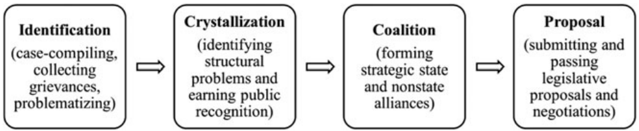
- The paper identifies a four-step lobbying process in the anti-domestic-violence case: case identification and compilation, crystallization, coalition building, and submission of proposals; this culminated in China’s first local ADV law in 2000 and the national Anti-Domestic Violence Law in 2015.
- In the domestic-violence case, Qing and her team compiled 29,388 petition cases from 1995 to 1997, of which 7,876 were domestic violence cases; they then selected 254 cases to show legislators the issue’s systematicity.
- The national domestic-violence law moved relatively fast once admitted: it took six years from proposal submission to inclusion in the legislative plan, but then passed within a year; the paper says this was aided by public shocks such as the 2013 Yang Li case and earlier public attention from the 1995 Beijing conference.
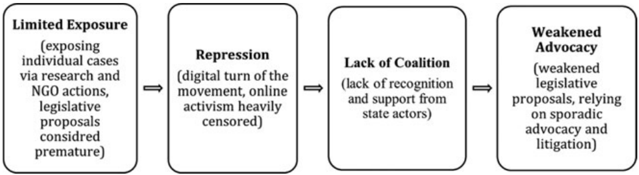
- By contrast, the sexual-harassment case remained stalled: the 1995 study reported that 84% of 169 female respondents had experienced sexual harassment, Maple hotline records showed 613 calls from 1992 to 2004, yet activism led only to scattered rules and no specific national law, alongside censorship and detentions during the #MeToo turn.
## Methods
- Comparative qualitative case-study design of two gender-lobbying efforts in China: anti-domestic-violence legislation (1995–2015) and anti-sexual-harassment activism/movement (1995–present).
- Data came from primary sources including reports, autobiographies, and legislative records, plus semistructured fieldwork interviews conducted in Hunan, Hubei, and Guangdong from 2016 to 2020; the authors report 76 interviewees, including Women’s Federation members, legislators, Party-state cadres, NGO workers, and lawyers.
- The main analysis traces lobbying mechanisms across institutions and actors using a state-society interaction approach and compares how case identification, issue crystallization, coalition formation, and proposal writing affected outcomes.
## Limitations
- The paper states that the research on women’s substantive representation in nondemocratic contexts remains limited, and that this study is one comparative examination rather than a general account of all authoritarian settings.
- Evident from the text: the empirical evidence is drawn from only two cases in China, so the findings may not generalize beyond domestic violence and sexual harassment, or beyond the specific provinces and institutions studied.
- Evident from the text: the interview sample is purposive and heavily skewed toward people advancing women’s interests, with only one male interviewee, which may limit balance in perspective.
Model-written summary. Check it against the paper before relying on it.
Integrity signals
Registry
Cites
Statistics
Figures
Verification
Claims the paper makes
5 Valid · 7 Not valid · 39 Not checked · 90 Own results and interpretations
The cited sources support only part of this claim — read each source’s verdict below.
In the paper
“In addition, such gender legislation also serves to legitimize the CCP ' s governance by ' usher[ing] in a modern state devoid of ' feudal ' practices ' and conforming to international norms (Angeloff and Lieber 2012, 19).”
What the sources say
- Partly supportedcites Angeloff and Lieber 2012 matched to “Equality, Did You Say?: Chinese feminism after 30 years of reforms” (2012) sourceExperimental — accuracy not yet measured
In the section on legislative development (paras. 12 and 14), the paper says China drew on international principles when making gender-equality laws and launched campaigns to help usher in a modern state devoid of “feudal” practices. It does not say that the legislation thereby legitimized the CCP’s governance; that purpose is the citing author’s added interpretation. (LLM, conf=0.83)
plainstates a cause- Asserted: passes — The authors put it forward as true.
- Checkable: passes — It can be checked against evidence.
- Load-bearing: unclear — It is unclear whether the paper’s conclusions depend on it.
- Based: passes — The paper gives a reason why it holds.
- Partly supported
Every source the paper cites for this claim was checked and supports it.
In the paper
“However, as the ' good daughter of the Party, ' the ACWF ' s agenda has always shifted along with the CCP ' s priorities (Zhou 2019).”
What the sources say
- Supportedcites Zhou 2019 matched to ““Being a Good Daughter of the Party”?: A Neo-Institutional Analysis of the All-China Women’s Federation Organisational Reforms in China’s Xi Era” (2019) source
The Introduction states that the ACWF’s central task has shifted periodically in response to contexts shaped by central Party-state directives, and gives examples across several decades. The section on local Women’s Federations likewise describes periodic shifts in their narrative and work focus. (LLM, conf=0.92)
plainstates a cause- Asserted: passes — The authors put it forward as true.
- Checkable: passes — It can be checked against evidence.
- Load-bearing: unclear — It is unclear whether the paper’s conclusions depend on it.
- Based: passes — The paper gives a reason why it holds.
- Supported
The cited sources support only part of this claim — read each source’s verdict below.
In the paper
“In the case of ASH, many have sensed a change in the political climate since 2013, when more internationally funded NGOs were suspended or disassembled (Shieh 2018).”
What the sources say
- Partly supportedcites Shieh 2018 matched to “The Chinese State and Overseas NGOs: From Regulatory Ambiguity to the Overseas NGO Law” (2018) sourceExperimental — accuracy not yet measured
In “The End of Regulatory Ambiguity” (page unavailable), Shieh describes a crackdown beginning in 2013 and continuing repression against NGOs in 2014–2016, supporting the claim of a changed political climate. The passage does not say that more internationally funded NGOs were suspended or disassembled, and the paper does not identify ASH. (LLM, conf=0.84)
hedged- Asserted: passes — The authors put it forward as true.
- Checkable: passes — It can be checked against evidence.
- Load-bearing: passes — The paper’s conclusions depend on it.
- Based: passes — The paper gives a reason why it holds.
- Partly supported
In the paper
“Not only do domestic actors use international practice to justify their lobbying (Liu 2006), information exchange at the societal level also helps raise public awareness, as seen in the case of both domestic violence and sexual harassment.”
What the sources say
- Not checked — no full text of the sourcecites Liu 2006 matched to “When Do National Movements Adopt or Reject International Agendas? A Comparative Analysis of the Chinese and Indian Women's Movements” (2006) source
plainstates a cause- Asserted: passes — The authors put it forward as true.
- Checkable: passes — It can be checked against evidence.
- Load-bearing: unclear — It is unclear whether the paper’s conclusions depend on it.
- Based: passes — The paper gives a reason why it holds.
A result the paper states — it cites no source for it, so there is none to check. The quote shows it is in the paper.
In the paper
“But its relationship with the CCP also complicates its role and practices.”
plainstates a cause- Asserted: passes — The authors put it forward as true.
- Checkable: passes — It can be checked against evidence.
- Load-bearing: passes — The paper’s conclusions depend on it.
- Based: passes — The paper gives a reason why it holds.
52 more claims
Create a free account to see all 141 claims and to verify the 5 references still open.
- It may state two separate claims as one. 57
- Probably not a substantial claim. 36
Citations
Cites
Agendas, Alternatives, and Public Policies
Perry, J., & Kingdon, J. W. (1985) · Journal of Policy Analysis and Management · doi:10.2307/3323801 · Cited by 11,225
Agendas, alternatives, and public policies
Kingdon, J. W. (1984) · Cited by 9,299
Fenichel Pitkin, H. (1967) · doi:10.1525/9780520340503 · Cited by 5,162 · cited 1×
“While classic political theorists such as Pitkin (1967) assume that political representation depicts the fundamental relationship between the elected and their constituencies, many have expanded the understanding of political representation to a broader institutional context.”
The Concept of Representation, by Hanna F. Pitkin
Mansfield, H. C. (1969) · Political Science Quarterly · doi:10.2307/2147153 · Cited by 3,086
Saward, M. (2006) · Contemporary Political Theory · doi:10.1057/palgrave.cpt.9300234 · Cited by 1,471 · cited 1×
“Among them, Michael Saward (2010, 93) marks the constructivist turn, arguing that representation is not a theory that is only pertinent to a specific type of political regime, but encompasses the fundamental social relations and power dynamics that run through society from a holistic perspective.”
Background‘Fragmented Authoritarianism 2.0’: Political Pluralization in the Chinese Policy Process
Mertha, A. (2009) · The China Quarterly · doi:10.1017/s0305741009990592 · Cited by 936 · cited 4×
“As Mertha (2009) records, Chinese businessmen’s persistent lobbying eventually brought key Chinese officials to negotiate with the European Commission on the issue of international trade, an area that is extremely unlikely to be influenced by nonstate actors.”
BackgroundInfluentialSources of Authoritarian Responsiveness: A Field Experiment in China
Chen, J., Pan, J., & Xu, Y. (2016) · American Journal of Political Science · doi:10.1111/ajps.12207 · Cited by 636
Gender Quotas and Women's Substantive Representation: Lessons from Argentina
Franceschet, S., & Piscopo, J. M. (2008) · Politics & Gender · doi:10.1017/s1743923x08000342 · Cited by 620
Analysing Women's Substantive Representation: From Critical Mass to Critical Actors
Childs, S., & Krook, M. L. (2009) · Government and Opposition · doi:10.1111/j.1477-7053.2009.01279.x · Cited by 606
RETHINKING WOMEN'S SUBSTANTIVE REPRESENTATION
Celis, K., Childs, S., Kantola, J., & Krook, M. L. (2008) · Representation · doi:10.1080/00344890802079573 · Cited by 425 · cited 2×
“For a long time, scholars have tended to limit their research on WSR to a single site, often the parliament, and a limited sets of actors (Celis et al. 2008).”
BackgroundMaking Autocracy Work: Representation and Responsiveness in Modern China
Truex, R. (2016) · Cambridge University Press eBooks · doi:10.1017/cbo9781316771785 · Cited by 287 · cited 2×
“As a result, the majority of legislative members, being full-time executive cadres as well, are restrained in their political autonomy and only selectively respond to their constituencies (Truex 2016).”
BackgroundChina's Longest Campaign: Birth Planning in the People's Republic, 1949–2005
White, T. (2006) · Works - Scholarship, Research, & Creative Expression (Swarthmore College) · Cited by 272
(2014) · Are South Africans Free? · doi:10.5040/9781472593054.ch-004 · Cited by 247
What is made-in-China feminism(s)? Gender discontent and class friction in post-socialist China
Wu, A. X., & Dong, Y. (2019) · Critical Asian Studies · doi:10.1080/14672715.2019.1656538 · Cited by 236 · cited 1×
“Meanwhile, many more radical lines of women’s interests are emerging in China’s rapidly globalizing and liberalizing society, such as educated women’s pursuit of economic independence and uncooperative attitude toward marriage, and a more diverse sexuality (Wu and Dong 2019).”
BackgroundCoalitions of Contention: The Case of the WTO Protests in Seattle
Levi, M., & Murphy, G. H. (2006) · Political Studies · doi:10.1111/j.1467-9248.2006.00629.x · Cited by 200
Wang, B. (2017) · Asian Women · doi:10.14431/aw.2017.12.33.4.109 · Cited by 185 · cited 2×
“Lastly, women’s social movements in China, which used to be monopolized by Party-authorized organizations, are now engaging in new forms of activism (Angeloff and Lieber 2012; Wang 2017).”
BackgroundSources of Authoritarian Responsiveness: A Field Experiment in ChinaPreprint
Chen, J., Pan, J., & Xu, Y. (2014) · SSRN Electronic Journal · doi:10.2139/ssrn.2479953 · Cited by 169
Childs, S., & Lovenduski, J. (2013) · The Oxford Handbook of Gender and Politics · doi:10.1093/oxfordhb/9780199751457.013.0019 · Cited by 166
‘State Feminism’? Gender and socialist state formation in maoist China
Zheng, W. (2005) · Feminist Studies · doi:10.2307/20459044 · Cited by 165
Women's Access to Political Power in Post-Communist Europe
(2003) · doi:10.1093/0199246866.001.0001 · Cited by 164
Seeking Legitimacy: Why Arab Autocracies Adopt Women's Rights
Tripp, A. M. (2019) · Cambridge University Press eBooks · doi:10.1017/9781108348621 · Cited by 164 · cited 1×
“For instance, AiliMari Tripp (2019) has argued that political regime might play a significant role in predicting the results of WSR in different domains.”
BackgroundYin, S., & Sun, Y. (2021) · Feminist Media Studies · doi:10.1080/14680777.2020.1837908 · Cited by 159 · cited 2×
“Many Chinese women also used online forums to share their testimony of being sexually harassed or assaulted by advisors, colleagues, and relatives (Yin and Sun 2020).”
BackgroundInformation for Autocrats: Representation in Chinese Local Congresses
Manion, M. (2015) · Cambridge University Press eBooks · doi:10.1017/cbo9781107273696 · Cited by 156 · cited 1×
“Complaints and suggestions are directed by representatives to government bureaus for resolution or brought to the annual assembly for further discussion if the matter is beyond the capacity of a single bureau (Manion 2015).”
BackgroundThe SAGE handbook of governance
(2012) · Choice Reviews Online · doi:10.5860/choice.49-4135 · Cited by 156
Rose, K. (2019) · Asian Journal of Women's Studies · doi:10.1080/12259276.2019.1639308 · Cited by 143
Authoritarian Institutions and Women’s Rights
Donno, D., & Kreft, A.-K. (2019) · Comparative Political Studies · doi:10.1177/0010414018797954 · Cited by 121
Associations and the Chinese State: Contested Spaces
Unger, J. (2014) · Routledge eBooks · doi:10.4324/9781315706269 · Cited by 111
Individual and collective empowerment: Women's voices in the #MeToo movement in China
Lin, Z., & Yang, L. (2019) · Asian Journal of Women's Studies · doi:10.1080/12259276.2019.1573002 · Cited by 93 · cited 4×
“For most online participants, the #MeToo movement served as a platform to share personal voices, educate peers, raise awareness of sexual harassment, and receive support; it also served as a means to counter patriarchal power and seek moral justice (Lin and Yang 2019; Zhou and Qiu 2020).”
BackgroundInfluentialAuthoritarian Gridlock? Understanding Delay in the Chinese Legislative System
Truex, R. (2017) · Comparative Political Studies · doi:10.1177/0010414018758766 · Cited by 91
You Say #MeToo, I Say #MiTu: China’s Online Campaigns Against Sexual Abuse
Zeng, J. (2019) · #MeToo and the Politics of Social Change · doi:10.1007/978-3-030-15213-0_5 · Cited by 71 · cited 3×
“Interviewed by the authors, Hunan, China. or other subaltern groups (Yin and Sun 2019; Zeng 2019).”
BackgroundWhen are Interests Interesting? The Problem of Political Representation of Women
Sapiro, V. (1998) · Feminism And Politics · doi:10.1093/oso/9780198782063.003.0008 · Cited by 67
Equality, Did You Say?: Chinese feminism after 30 years of reforms
Angeloff, T., & Lieber, M. (2012) · China Perspectives · doi:10.4000/chinaperspectives.6014 · Cited by 65
How a Bill Becomes a Law in China: Stages and Processes in Lawmaking
Tanner, M. S. (1995) · The China Quarterly · doi:10.1017/s0305741000032902 · Cited by 60 · cited 3×
“Lastly, national legislative success depends on support from the politically powerful ministries, and fighting among ministries easily delays the process (Tanner 1995; Truex 2020).”
BackgroundMaking Autocracy Work: Representation and Responsiveness in Modern China
Truex, R. (2016) · Cited by 54
Kennedy, S. (2009) · China Information · doi:10.1177/0920203x09105125 · Cited by 53 · cited 1×
“Second, policy entrepreneurs — that is, “advocates for proposals or for the prominence of an idea” (Kingdon 1995)— are equally critical in shaping policy outcomes (Kennedy 2009; Mertha 2009).”
Background(2010) · University of Michigan Library Repository · Cited by 50
Liu, D. (2006) · American Sociological Review · doi:10.1177/000312240607100603 · Cited by 50 · cited 2×
“…era, state feminists have increasingly come under international influence, exemplified by the way the Convention on the Elimination of All Forms of Discrimination Against Women (CEDAW) shaped domestic understanding of women’s civil, cultural, and political rights (Liu 2006; Wang and Zhang 2010).”
BackgroundInformation for Autocrats: Representation in Chinese Local Congresses
Manion, M. (2015) · Cited by 44
Cho, Y. N. (2002) · The China Quarterly · doi:10.1017/s000944390200044x · Cited by 42 · cited 1×
“While many participants in gender lobbying are CCP members, the CCP committees’ organizational control over specific lawmaking has eroded greatly in recent years (Cho 2002; Tanner 1995).”
BackgroundSellers, J. M. (2011) · SAGE Publications Ltd eBooks · doi:10.4135/9781446200964.n9 · Cited by 40
(2018) · Cited by 38
The Struggle for Survival: Prospects for the Women's Federation in Post-Mao China
Howell, J. (1996) · World Development · doi:10.1016/0305-750x(96)00112-x · Cited by 35 · cited 1×
“The agenda of nonstate actors, including, for example, women’s land rights, labor rights, and tackling gender-based violence, is not always in line with the interests of the CCP and therefore cannot be adequately resolved by existing laws and policies (Howell 1996; Sargeson and Song 2011).”
BackgroundLeggett, A. (2016) · VOLUNTAS International Journal of Voluntary and Nonprofit Organizations · doi:10.1007/s11266-016-9680-9 · Cited by 35
Zhou, Q., & Qiu, H. (2020) · Chinese Journal of Communication · doi:10.1080/17544750.2020.1725077 · Cited by 30 · cited 1×
“For most online participants, the #MeToo movement served as a platform to share personal voices, educate peers, raise awareness of sexual harassment, and receive support; it also served as a means to counter patriarchal power and seek moral justice (Lin and Yang 2019; Zhou and Qiu 2020).”
BackgroundWomen, Gender and Rural Development in China
(2011) · Edward Elgar Publishing eBooks · doi:10.4337/9780857933546 · Cited by 24
The Chinese State and Overseas NGOs: From Regulatory Ambiguity to the Overseas NGO Law
Shieh, S. (2018) · Nonprofit Policy Forum · doi:10.1515/npf-2017-0034 · Cited by 20 · cited 1×
“In the case of ASH, many have sensed a change in the political climate since 2013, when more internationally funded NGOs were suspended or disassembled (Shieh 2018).”
BackgroundZhou, Y. (2019) · China Perspectives · doi:10.4000/chinaperspectives.9042 · Cited by 19 · cited 3×
“…refuted the notion that democracy should be the premise of representative studies, as de facto representative loops that act as key instruments bridging the interests of the citizens, representatives, and upper-level authorities can be found in many authoritarian regimes (Sintomer and Zhou 2019).”
BackgroundSelf-citationJacka, T., & Sargeson, S. (2015) · Critical Asian Studies · doi:10.1080/14672715.2015.1079990 · Cited by 17
Women and Socialism: A Comparative Study of Women in Poland and the USSR
Bystydzienski, J. M. (1989) · Signs · doi:10.1086/494529 · Cited by 15 · cited 1×
“…scholarship on women’s representation in communist and postcommunist regimes, in which authors observe that progressive ideologies and state-provided welfare play a dual role in advancing women’s interests while exploiting women’s liberty and labor (Bystydzienski 1989; Matland and Montgomery 2003).”
BackgroundAiring Dirty Laundry in Public: Anti-Domestic Violence Activism in Beijing
(2014) · Routledge eBooks · doi:10.4324/9781315706269-14 · Cited by 13 · cited 9×
“During the conference, Network members reiterated the urgency of an enforceable law against domestic violence, as the current administrative and legal frameworks “are mainly principle-based and almost impossible to enforce” (Chen 2008).”
MethodInfluentialImproving Women's Substantive Representation in Community Government: Evidence from Chinese Villages
Sargeson, S., & Jacka, T. (2018) · Development and Change · doi:10.1111/dech.12377 · Cited by 12 · cited 2×
“While past research has investigated the link between women’s descriptive and substantive representation, especially in legislative bodies, this study shows that studying the number female legislators might not be enough to understand substantive representation in China (Sargeson and Jacka 2017).”
BackgroundSeeking Legitimacy : Why Arab Autocracies Adopt Women's Rights
Tripp, A. M. (2019) · Cited by 6
Sintomer, Y., & Zhou, Y. (2019) · Journal of Chinese Governance · doi:10.1080/23812346.2019.1672371 · Cited by 5 · cited 1×
“…refuted the notion that democracy should be the premise of representative studies, as de facto representative loops that act as key instruments bridging the interests of the citizens, representatives, and upper-level authorities can be found in many authoritarian regimes (Sintomer and Zhou 2019).”
BackgroundSelf-citationGender, Citizenship and Agency in Land Development
Sargeson, S., & Yu, S. (2011) · Women, Gender and Rural Development in China · doi:10.4337/9780857933546.00010 · Cited by 3
China: Women’s Rights Advocacy
Manning, K. E. (2019) · The Palgrave Handbook of Women’s Political Rights · doi:10.1057/978-1-137-59074-9_21 · Cited by 2 · cited 1×
“…instance, state feminists advocated for women’s interests in the provision of maternal care in the early 1950s, the promotion of equal labor and political participation during the 1960s and 1970s, and the elimination of gender discrimination and gender-based violence since the 1990s (Manning 2019).”
Background
Research works printed but not linked: 17
- Pengpai News. 2020. ' One Year since ' Sexual Harassment ' Became an Independent Civil Cause of Action, Victims Still Face Difficulties to Break Silence ' [ ' 性 骚 扰 ' 独 立 案 由 施 行 一 周 年 , 受 害 者 仍 难 打 破 沉 默 ]. https://www.thepaper.cn/newsDetail\_forward\_ 5411908 (accessed January 3, 2020). - Pitkin, Hanna Fenichel. 1967. The Concept of Representation . Berkeley: University of California Press.
- Jiang, 2006, “Comparative Research on the Legislation of Sexual Harassment—The Design of China's Anti-Sexual Harassment Law” [性骚扰立法的比较研究——兼论中国反性骚扰法之设计], Global Law Review, 28, 506
- Hu, Bo. 2006. ' Reflections on Legislative Actions against Sexual Harassment -Including Comments on the Relevant Clauses against Harassment of the Law on the Protection of the Rights and Interests of Women ' [ 关 于 性 骚 扰 立 法 的 几 点 思 考 - -兼 评 《 妇女 权 益 保 障 法 》 相 关 条 款 ]. Collection of Women ' s Studies 1: 5 -10.
- Shen, 2004, “‘The Generalizing and Narrowing of the ‘Sexual Harassment’ Conceptn Abd Coping Measures” [性骚扰’概念的泛化、窄化及应对措施], Collection of Women's Studies, 1, 11
- Research Group of ' Sexual Harassment at the Workplace. ' 2009. ' Sexual Harrassment at the Workplace: Inequality in Powers and Identities Shown in Twenty Cases ' [ 工 作 场 所 中 的 性 骚 扰 : 多 重 权 力 和 身 份 关 系 的 不 平 等 --对 20 个 案 例 的 调 查 和 分 析 ] Collection of Women ' s Studies 96 (6): 22 -31.
- Jiang, 2006, “Empirical Analysis of China's Domestic Violence Problem: Using Fujian Province as an Example” [中国家庭暴力问题实证研究—以福建省为例], Jin Ling Law Review, 1, 37
- Jiang, Xinhui. Forthcoming. ' Selecting the First Hands: Women ' s Representation at the County-Level Congress of China. ' The China Quarterly .
- Feng, Yuan . 2020. “Review 1994–2019: The Anti-Sexual Harassment History in Mainland China” [回顾1994–2019:中国大陆反性骚扰历程]. China Development Brief. http://www.chinadevelopmentbrief.org.cn/news-24313.html (accessed November 25, 2020).
- Li, 2000, “The Current Situation of Sexual Harassment Problem in China and Its Legal Reflections” [我国性骚扰问题的现状及其法律思考], Zhongyang Zhengfa Guanli Ganbu Xueyuan Xuebao, 6, 26
- Ma, Dongling. 2005. ' Gaps, Challenges and Solutions: Summary of ' International Seminar of Anti -Sexual Harassment in Workplace '' [ 差 距 , 挑 战 与 对 策 - -' 反 对 工 作 场 合 性 骚 扰 国 际 研 讨 会 ' 综 述 ]. Collection of Women ' s Studies 3: 74 -77.
- Li, 2014, “Structure for Common Offenses of Sexual Harassment Academe: Academic Authority, Organizational Environment and Gender-Based Discrimination: Chinese Examples” [学术性骚扰的共犯性结构: 学术权力, 组织氛围与性别歧视——基于国内案例的分析]., Collection of Women's Studies, 6, 44
- Li, Ling, and Changqong Dong. 2004. ' Reflections on the Legislation on Sexual Harassment ' [ 关 于 性 骚 扰 立 法 的 几 点 思 考 ]. People ' s Procuratorial Semimonthly 3: 70 -72.
- - -. 2001. ' Sexual Harassment in Work Environment and its Control Measures ' [ 工 作 环 境 中 的 性 骚 扰 及 其 控 制 措 施 ]. Collection of Women ' s Studies 5: 26 -31.
- Tang, 1995, “The Existence of Sexual Harassment in China—The Case Study of 169 Women” [性骚扰在中国的存在──169名女性的个例研究], Collection of Women's Studies, 2, 31
- - -. 2014. ' The Progress of China ' s Legislation against Domestic Violence ' [ 中 国 反 家 庭 暴 力 立 法 的 进 程 ]. Chinese Women ' s Movement 6: 38 -41.
- Wang, Xingjuan. 1998. ' The Current Condition of and Research on Sexual Harassment ' [ 性 骚 扰 的 现 状 与 研 究 ]. Collection of Women ' s Studies 3: 39 -44.
- Wang, Hengtao. 2006. ' Research on the Legislation on Sexual Harassment ' [ 性 骚 扰 立 法 研 究 ]. Global Law Review 5: 609 -19.
Cited by
Equality, Did You Say?: Chinese feminism after 30 years of reforms
Angeloff, T., & Lieber, M. (2012) · China Perspectives · doi:10.4000/chinaperspectives.6014 · Cited by 65
Zhou, Y. (2023) · Women s Studies International Forum · doi:10.1016/j.wsif.2023.102734 · Cited by 17
Self-citationUnderrepresented Outperformers: Female Legislators in the Chinese Congress
Feng, X.-R., Hou, Y., & Liu, M.-X. (2023) · The China Quarterly · doi:10.1017/s0305741023001157 · Cited by 2
Whyke, T. W., Wang, Z., & Lopez-Mugica, J. (2024) · Asian Journal of Women's Studies · doi:10.1080/12259276.2024.2388352 · Cited by 10
Rejuvenating Communism: Youth Organizations and Elite Renewal in Post-Mao China
Doyon, J. (2022) · University of Michigan Press eBooks · doi:10.3998/mpub.12291596 · Cited by 11
Metadata
- Authors
- Jiang, X., & Zhou, Y.
- Affiliations
- Freie Universität Berlin (DE)
- University of Oslo (NO)
- Venue
- Politics & Gender
- Publisher
- Cambridge University Press (CUP)
- Published
- 2021-10-15
- Volume
- 18
- Issue
- 4
- Pages
- 978-1010
- ISSN
- 1743-923X (ISSN-L)
- 1743-9248
- OpenAlex
- W3206755929
- Cited by
- 17
- References
- 59
- Citations by year
- 2026: 3 · 2025: 6 · 2024: 1 · 2023: 5 · 2022: 2
- FWCI
- 2.78
- Type
- journal article
- Language
- en
- Open access
- hybrid
- doi.org
- Locations
- Politics & Gender (publishedVersion, cc-by)
- Refubium (Universitätsbibliothek der Freien Universität Berlin) (submittedVersion, cc-by)
- NORA - Norwegian Open Research Archives (submittedVersion, cc-by)
- Universitätsbibliothek der FU Berlin Hochschulschriftenstelle u. Dokumentenserver (cc-by)
- Topics
- Social Sciences › Gender Studies › Gender Politics and Representation
- Social Sciences › Gender Studies › Gender Diversity and Inequality
- Social Sciences › Sociology and Political Science › Historical Gender and Feminism Studies
- Keywords
- authoritarian governance, China, state-society relations, political alliances, women's political mobilization, state repression, Chinese Communist Party
About these checks
Registry, retraction, Cites and statistics results are computed, not judged, with one exception: a printed reference that no index lists is read once by a model before it counts as a citation error. Claims are extracted by a model and kept only when their quote appears verbatim in the text; each cited source is then checked, with a model’s help, for whether it says what the claim relies on. Those verdicts can be wrong — read the claim’s quote and the cited source before relying on one.
The claim verdicts this report counts are experimental: their accuracy is not yet measured.
A language model drew the claims from the paper on 2026-10-10, under version 3 of the claim definition (model deepseek-v4.1-flash, prompt extract-v3).
A second model labelled each claim on 2026-10-10 (model jev-1.13-20260917, definition revision gold-guideline-v0.2).
Cited sources are checked with a language model’s help (gpt-6-sol).
Statistics and arithmetic are recomputed, not judged.
Confidence bands are shown only for fields calibrated on our annotated test set. None is calibrated yet, so no band is shown.
What counts as a claim ›How we measure confidence ›How we check this ›
Are you an author, or do you see a problem with this page? Request a review
Data sources
Bibliographic data: Semantic Scholar, OpenAlex, Crossref.
Contains information from the Semantic Scholar Academic Graph Datasets, made available under the ODC Attribution License (ODC-BY 1.0).
Semantic Scholar’s data is described in: Kinney, R., et al. (2023). The Semantic Scholar Open Data Platform. arXiv:2301.10140.
