

Localising livestock protein feed production and the impact on land use and greenhouse gas emissions
Open accessThe DOI matches its Crossref record; 29 of the 29 references it cites were found in a registry or an index.
Abstract
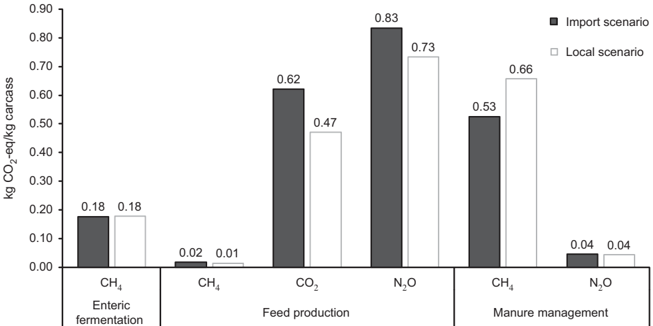
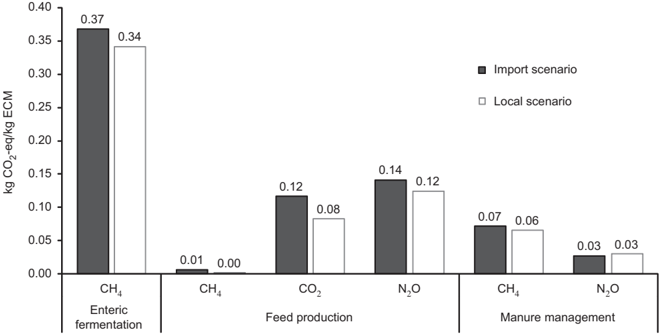
Livestock farmers in Sweden usually grow feed grains for livestock but import protein feed from outside Sweden. Aside from the economic implications, some environmental issues are associated with this practice. We used life cycle assessment to evaluate the impact of local protein feed production on land use and greenhouse gas emissions, compared with the use of imported protein feed, for pig meat and dairy milk produced in Sweden. Our results showed that local production reduced greenhouse gas emissions by 4.5% and 12%, respectively, for pigs and dairy cows. Land use for feed production in Sweden increased by 11% for pigs and 25% for dairy cows, but total land use decreased for pig production and increased for dairy milk production. Increased protein feed cultivation in Sweden decreased inputs needed for animal production and improved some ecological processes (e.g. nutrient recycling) of the farm systems. However, the differences in results between scenarios are relatively small and influenced to an extent by methodological choices such as co-product allocation. Moreover, it was difficult to assess the contribution of greenhouse emissions from land use change. The available accounting methods we applied did not adequately account for the potential land use changes and in some cases provided conflicting results. We conclude that local protein feed production presents an opportunity to reduce greenhouse gas emissions but at a cost of increasing land occupation in Sweden for feed production.
Overview
The claims and statistics of this paper haven’t been checked yet.
Free: it reads the open-access text and checks the first 5 claims that cite a source we can check. Create a free account to check every claim.
Integrity signals
Registry
Cites
Statistics
Figures
Verification
Claims the paper makes
The claims and statistics of this paper haven’t been checked yet.
Free: it reads the open-access text and checks the first 5 claims that cite a source we can check. Create a free account to check every claim.
Claims other papers make about this one
Each is checked against this paper’s own text: does it say what the citing paper says it does?
The source backs part of the claim, not all of it — or backs it for a different population, condition or comparison.
In the citing paper
“In a global overview of the livestock sector, feed transportation is the primary cause of deforestation [21,22].”
From Grassland-Based Farming Systems Targeting Agroecology: Which Indicators Should Be Used for On-Farm Assessment? (2025) · cites this paper as [22]
Experimental — accuracy not yet measured
Self-check
Percentages, sums and reported differences re-computed from the paper’s own numbers.
The self-check needs the paper’s full text.
Citations
Cites
Climate change 2001: synthesis report
(2003) · Choice Reviews Online · doi:10.5860/choice.40-4660 · Cited by 5,272
(2013) · Cited by 2,540
Enhancing Nitrogen Use Efficiency in Crop Plants
Fageria, N. K., & Baligar, V. C. (2005) · Advances in Agronomy · doi:10.1016/s0065-2113(05)88004-6 · Cited by 1,436 · cited 1×
“recycling, pest and disease control) are closely linked with the species diversity achieved from integrating protein crops with grains, forage and animal productions (Fageria and Baligar, 2005; Nemecek et al., 2008; Dumont et al., 2013).”
BackgroundNutritional management for enteric methane abatement: a review
Beauchemin, K. A., Kreuzer, M., O'Mara, F., & McAllister, T. A. (2008) · Australian Journal of Experimental Agriculture · doi:10.1071/ea07199 · Cited by 1,162
The role of pasture and soybean in deforestation of the Brazilian Amazon
Barona, E., Ramankutty, N., Hyman, G., & Coomes, O. T. (2010) · Environmental Research Letters · doi:10.1088/1748-9326/5/2/024002 · Cited by 667 · cited 2×
“Sweden imports soya beans mainly from South America (FAOSTAT, 2014), where its production has in several studies been linked to deforestation and associated GHG emissions (Barona et al., 2010).”
BackgroundAgriculture, forestry and other land use
Sohi, S. (2014) · Cited by 600
Hertel, T. W., Golub, A. A., Jones, A. D., O'Hare, M., Plevin, R. J., & Kammen, D. M. (2010) · BioScience · doi:10.1525/bio.2010.60.3.8 · Cited by 554
Break crop benefits in temperate wheat production
Kirkegaard, J., Christen, O., Krupinsky, J., & Layzell, D. (2008) · Field Crops Research · doi:10.1016/j.fcr.2008.02.010 · Cited by 506
Gerber, P. J., Hristov, A. N., Henderson, B., Makkar, H., Oh, J., Lee, C., Meinen, R., Montes, F., Ott, T., Firkins, J., et al. (2013) · Animal · doi:10.1017/s1751731113000876 · Cited by 442
Environmental impacts of introducing grain legumes into European crop rotations
Nemecek, T., von Richthofen, J.-S., Dubois, G., Casta, P., Charles, R., & Pahl, H. (2008) · European Journal of Agronomy · doi:10.1016/j.eja.2007.11.004 · Cited by 395
Research works printed but not linked: 1
- Mogensen L, Kristensen T, Nguyen TTH and Knudsen MT 2012. Greenhouse gas emissions from production of imported and local cattle feed. In 8th International conference on life cycle assessment in the agri-food sector (ed. MS Corson and HMG van der Werf), pp. 321-326. INRA, Rennes, France.
Cited by
Livestock and the Environment: What Have We Learned in the Past Decade?
Herrero, M., Wirsenius, S., Henderson, B., Rigolot, C., Thornton, P., Havlík, P., de Boer, I., & Gerber, P. J. (2015) · Annual Review of Environment and Resources · doi:10.1146/annurev-environ-031113-093503 · Cited by 357
Self-citationGrain Legume Production and Use in European Agricultural Systems
Watson, C. A., Reckling, M., Preissel, S., Bachinger, J., Bergkvist, G., Kuhlman, T., Lindström, K., Nemecek, T., Topp, C. F. E., Vanhatalo, A., et al. (2017) · Advances in Agronomy · doi:10.1016/bs.agron.2017.03.003 · Cited by 328
Strategies for greenhouse gas emissions mitigation in Mediterranean agriculture: A review
Sanz-Cobena, A., Lassaletta, L., Aguilera, E., Prado, A. D., Garnier, J., Billen, G., Iglesias, A., Sánchez, B., Guardia, G., Abalos, D., et al. (2017) · Agriculture, Ecosystems & Environment · doi:10.1016/j.agee.2016.09.038 · Cited by 286
“The potential of reconnecting livestock and crop farming for mitigating GHG emissions is illustrated by several examples at the local or regional level (Granlund et al., 2015; Sasu-Boakye et al., 2014; Soussana and Lemaire, 2014).”
BackgroundA critical review of the recent evolution of Life Cycle Assessment applied to milk production
Baldini, C., Gardoni, D., & Guarino, M. (2017) · Journal of Cleaner Production · doi:10.1016/j.jclepro.2016.06.078 · Cited by 198
Environmental Impacts of Pig and Poultry Production: Insights From a Systematic Review
Andretta, I., Hickmann, F., Remus, A., Franceschi, C. H., Mariani, A. B., Orso, C., Kipper, M., Létourneau-Montminy, M.-P., & Pomar, C. (2021) · Frontiers in Veterinary Science · doi:10.3389/fvets.2021.750733 · Cited by 182
“different countries or even continents (22, 43, 64).”
BackgroundRauw, W. M., Rydhmer, L., Kyriazakis, I., Øverland, M., Gilbert, H., Dekkers, J. C. M., Hermesch, S., Bouquet, A., Izquierdo, E. G., Louveau, I., et al. (2020) · Journal of the Science of Food and Agriculture · doi:10.1002/jsfa.10338 · Cited by 153
Peri-Urban Food Production and Its Relation to Urban Resilience
Olsson, E., Kerselaers, E., Kristensen, L. S., Primdahl, J., Rogge, E., & Wästfelt, A. (2016) · Sustainability · doi:10.3390/su8121340 · Cited by 147
“, Brazil, to feed dairy cows in Sweden [20].”
BackgroundInfluentialLegume dreams: The contested futures of sustainable plant-based food systems in Europe
Cusworth, G., Garnett, T., & Lorimer, J. (2021) · Global Environmental Change · doi:10.1016/j.gloenvcha.2021.102321 · Cited by 126
Protein hunger of the feed sector: the alternatives offered by the plant world
Parisi, G., Tulli, F., Fortina, R., Marino, R., Bani, P., Zotte, A. D., Angelis, A. D., Piccolo, G., Pinotti, L., Schiavone, A., et al. (2020) · Italian Journal of Animal Science · doi:10.1080/1828051x.2020.1827993 · Cited by 123
“In addition, some recent studies have shown that the environmental impact of replacing soybean meal in livestock diets with on locally cultivated pulses (Baumgartner et al. 2008; Nemecek et al. 2008) and/or other protein-rich plantderived products (Sasu-Boakye et al. 2014) could be mitigated.”
BackgroundMierlo, K. V., Rohmer, S. U. K., & Gerdessen, J. C. (2017) · Journal of Cleaner Production · doi:10.1016/j.jclepro.2017.07.098 · Cited by 117
Garnier, J. A., Anglade, J., Benoît, M., Billen, G., Puech, T., Ramarson, A., Passy, P., Silvestre, M., Lassaletta, L., Trommenschlager, J.-M., et al. (2016) · Environmental Science & Policy · doi:10.1016/j.envsci.2016.04.019 · Cited by 117
Halting European Union soybean feed imports favours ruminants over pigs and poultry
Karlsson, J. O., Parodi, A., van Zanten, H. H. E., Hansson, P., & Röös, E. (2020) · Nature Food · doi:10.1038/s43016-020-00203-7 · Cited by 105
Environmental impact of the typical heavy pig production in Italy
Bava, L., Zucali, M., Sandrucci, A., & Tamburini, A. (2015) · Journal of Cleaner Production · doi:10.1016/j.jclepro.2015.11.029 · Cited by 102
Billen, G., Lassaletta, L., & Garnier, J. (2015) · Environmental Research Letters · doi:10.1088/1748-9326/10/2/025001 · Cited by 100
The future of protein sources in livestock feeds: implications for sustainability and food safety
Pexas, G., Doherty, B., & Kyriazakis, I. (2023) · Frontiers in Sustainable Food Systems · doi:10.3389/fsufs.2023.1188467 · Cited by 98
Environmental impact of replacing soybean meal with rapeseed meal in diets of finishing pigs
van Zanten, H. H. E., Bikker, P., Mollenhorst, H., Meerburg, B. G., & de Boer, I. J. M. (2015) · animal · doi:10.1017/s1751731115001469 · Cited by 92
“To our knowledge, no other studies aimed to assess the environmental impact of replacing SBM with RSM in finishing pig diets, although some assessed the impact of replacing SBM with locally produced protein sources such as peas, lupines and rapeseed products (Eriksson et al., 2005; Meul et al., 2012; Sasu-Boakye et al…”
Backgroundvan Zanten, H. H. E., Bikker, P., Meerburg, B. G., & de Boer, I. J. M. (2017) · The International Journal of Life Cycle Assessment · doi:10.1007/s11367-017-1299-6 · Cited by 92
“ReplacingSBMwith locallyproducedprotein sources resulted in a reduction of globalwarming potential (GWP) up to 13%andof land use (LU) up to 11% (Eriksson et al. 2005;Meul et al. 2012; Sasu-Boakye et al. 2014).”
BackgroundPulina, G., Acciaro, M., Atzori, A. S., Battacone, G., Crovetto, G. M., Mele, M. L., Pirlo, G., & Rassu, S. P. G. (2021) · animal · doi:10.1016/j.animal.2021.100358 · Cited by 91
The market impacts of shortening feed supply chains in Europe
Депперманн, А., Havlík, P., Valin, H., Boere, E., Herrero, M., Vervoort, J., & Mathijs, E. (2018) · Food Security · doi:10.1007/s12571-018-0868-2 · Cited by 58
Catarino, R., Thérond, O., Berthomier, J., Miara, M., Mérot, E., Misslin, R., Vanhove, P., Villerd, J., & Angevin, F. (2021) · Agricultural Systems · doi:10.1016/j.agsy.2021.103066 · Cited by 58
Environmental impact assessment of different cropping systems of home-grown feed for milk production
Zucali, M., Bacenetti, J., Tamburini, A., Nonini, L., Sandrucci, A., & Bava, L. (2017) · Journal of Cleaner Production · doi:10.1016/j.jclepro.2017.07.048 · Cited by 50
Lamnatou, C., Ezcurra-Ciaurriz, X., Chemisana, D., & Plà‐Aragonès, L. M. (2016) · Journal of Cleaner Production · doi:10.1016/j.jclepro.2016.07.051 · Cited by 47
Future farming: protein production for livestock feed in the EU
Rauw, W. M., Izquierdo, E. G., Torres, O., Gil, M. G., Beascoechea, E. D. M., Beñayas, J. M. R., & Gomez‐Raya, L. (2023) · Sustainable Earth Reviews · doi:10.1186/s42055-023-00052-9 · Cited by 47
Hörtenhuber, S. J., Seiringer, M., Theurl, M. C., Größbacher, V., Piringer, G., Kral, I., & Zollitsch, W. J. (2022) · animal · doi:10.1016/j.animal.2022.100638 · Cited by 39
Gate-to-gate environmental impacts of dairy processing products in Thiruvananthapuram, India
Mahath, C. S., Kani, K. M., & Dubey, B. (2018) · Resources Conservation and Recycling · doi:10.1016/j.resconrec.2018.09.023 · Cited by 36
Sustainable development in circular agriculture: An illustrative bee↺legume↺poultry example
Rauw, W. M., Gomez‐Raya, L., Star, L., Øverland, M., Delezie, E., Grīviņš, M., Hamann, K. T., Pietropaoli, M., Klaassen, M. T., Klemetsdal, G., et al. (2022) · Sustainable Development · doi:10.1002/sd.2435 · Cited by 36
Strauss, V., Carsten, P., Dönmez, C., & Burkhard, B. (2024) · Journal of Environmental Management · doi:10.1016/j.jenvman.2024.123253 · Cited by 33
Hu, Q., Shi, H., Wang, L., Wang, L., Hou, Y., Wang, H., Lai, C., & Zhang, S. (2022) · The Science of The Total Environment · doi:10.1016/j.scitotenv.2022.159103 · Cited by 30
Jaisli, I., & Brunori, G. (2024) · Journal of Agriculture and Food Research · doi:10.1016/j.jafr.2024.101496 · Cited by 26
Editorial: Agroecology for producing goods and services in sustainable animal farming systems
Dumont, B., & Bernués, A. (2014) · animal · doi:10.1017/s1751731114001554 · Cited by 25
de Castro, M. M. F., Teixeira, A. D. C., & Fernández-Núñez, E. (2021) · Agroforestry Systems · doi:10.1007/s10457-020-00588-1 · Cited by 24
Femeena, P. V., House, G. R., & Brennan, R. A. (2022) · Journal of the ASABE · doi:10.13031/ja.14891 · Cited by 23
Chen, X., Lin, J., Tan, K., Pei, Y., & Wang, X. (2023) · Agriculture Ecosystems & Environment · doi:10.1016/j.agee.2023.108406 · Cited by 22
The effects of weather on beef carcass and growth traits
Bunning, H., & Wall, E. (2022) · animal · doi:10.1016/j.animal.2022.100657 · Cited by 21
Nordborg, M., Sasu-Boakye, Y., Cederberg, C., & Berndes, G. (2016) · The International Journal of Life Cycle Assessment · doi:10.1007/s11367-016-1158-x · Cited by 21
“Land use requirements for feed production were based on a modified version of mainly local feed rations in Sasu-Boakye et al. (2014), in which minor amounts of imported soymealanddriedbeetpulpweresubstitutedwith locallysourced feed ingredientswhilemaintaining the rations’nutritional values.”
BackgroundMethodSelf-citationWei, S., Ledgard, S. F., Fan, J., Tian, Y., & Dong, H. (2023) · Agricultural Systems · doi:10.1016/j.agsy.2023.103835 · Cited by 20
Economic and Environmental Consequences of the ECJ Genome Editing Judgment in Agriculture
Gocht, A., Consmüller, N., Thom, F., & Grethe, H. (2021) · Agronomy · doi:10.3390/agronomy11061212 · Cited by 20
“For example, the dependencies of the EU on soybean imports are addressed by [36–38].”
BackgroundMethane yield from cattle, sheep, and goats housing with emphasis on emission factors: a review
Brouček, J. (2015) · Slovak Journal of Animal Science · Cited by 20
The future of protein feed: a case study of sustainable substitutes in the German livestock industry
Soisontes, S., Freund, F., & Laquai, V. (2023) · Environment Development and Sustainability · doi:10.1007/s10668-023-03676-1 · Cited by 19
“These include lower GHG emissions (Hortenhuber et al., 2011; Sasu-Boakye et al., 2014) and better social standards (Garret & Rausch, 2016; Sojafördering, 2023).”
Christodoulou, C., Kliem, K. E., Auffret, M. D., Humphries, D. J., Newbold, J. R., Davison, N., Crompton, L. A., Dhanoa, M. S., Smith, L. G., & Stergiadis, S. (2024) · Animal Feed Science and Technology · doi:10.1016/j.anifeedsci.2024.116151 · Cited by 20
Protein efficiency in intensive dairy production: a Swedish example
Swensson, C., Lindmark-Månsson, H., Smedman, A., Henriksson, M., & Modin-Edman, A.-K. (2017) · Journal of the Science of Food and Agriculture · doi:10.1002/jsfa.8362 · Cited by 19
Feed sources for livestock : recycling towards a green planet
van Zanten, H. H. E. (2016) · doi:10.18174/380267 · Cited by 18
Heinrichs, J., Jouan, J., Pahmeyer, C., & Britz, W. (2021) · Q Open · doi:10.1093/qopen/qoaa011 · Cited by 16
Silva, J. P., Giehl, C. J., Cardinal, K. M., Andretta, I., & Ribeiro, A. M. L. (2023) · Livestock Science · doi:10.1016/j.livsci.2023.105320 · Cited by 15
The role of maternal dietary protein on livestock development, production and health
Xiao, S., Liu, W., Zhang, S. J., & Schroyen, M. (2025) · Animal Reproduction Science · doi:10.1016/j.anireprosci.2025.107835 · Cited by 14
Life cycle analysis of semi-intensive and intensive sheep milk production
Ravani, M., Liantas, G., Alvanou, M. V., Tampaki, E., Chatzigeorgiou, I., Giantsis, I. Α., & Ntinas, G. K. (2023) · The International Journal of Life Cycle Assessment · doi:10.1007/s11367-023-02245-y · Cited by 14
“…the effect of storage emissions, as well as the effect of including the LU index due to the use of soybean and to explore the verification of the influence of co-products allocation, N 2 O emissions and CH 4 emissions from enteric fermentation (Sasu-Boakye et al. 2014; Battini et al. 2014).”
Hörtenhuber, S. J., Größbacher, V., Schanz, L., & Zollitsch, W. J. (2023) · Sustainability · doi:10.3390/su15064814 · Cited by 13
Canola Meal: A Sustainable Protein Source for Poultry Diets
Dao, H. T., & Moss, A. F. (2025) · Animals · doi:10.3390/ani15243609 · Cited by 11
Bi-Objective Optimization Model Based on Profit and CO2 Emissions for Pig Deliveries to the Abattoir
Nadal-Roig, E., Pagès‐Bernaus, A., & Plà‐Aragonès, L. M. (2018) · Sustainability · doi:10.3390/su10061782 · Cited by 11
Lobón, S., Joy, M., Casasús, I., Rufino‐Moya, P. J., & Blanco, M. (2020) · Animals · doi:10.3390/ani10020243 · Cited by 11
“) in the countries of origin [1,2] and consumption implications [3], because it is generally genetically modified, which causes its social rejection [4].”
BackgroundProtein Sources for Ruminant Feed: A Systematic Review of Nutritional Value and Sustainability
López-Herrera, M., Delgado-Pertíñez, M., & Vallés, S. M. (2026) · Agriculture · doi:10.3390/agriculture16050537 · Cited by 10
“Local production might reduce transport-related emissions and water consumption relative to conventional SBM [74,78,218].”
Environmental impacts of feeding crops to poultry and pigs
Andretta, I., Remus, A., Franceschi, C. H., Orso, C., & Kipper, M. (2021) · Elsevier eBooks · doi:10.1016/b978-0-12-821363-6.00001-1 · Cited by 9
The Effect of Sodium Humate Feed Additives in Diets for Holstein Breed Heifers
Kairiša, D., Валдовска, А., Vircava, I., Pilvere, I., Proškina, L., Gāliņa, D., Gutmanis, G., & Mešķis, S. (2023) · Emerging Science Journal · doi:10.28991/esj-2023-07-04-023 · Cited by 9
“Feed composition and quality are the main factors that influence the productivity of farm animals and feed absorption efficiency [14, 15].”
BackgroundLegume Grains as an Alternative to Soybean Meal in the Diet of Intensively Reared Dairy Ewes
Vouraki, S., Papanikolopoulou, V., Irakli, M. N., Parissi, Z. M., Abraham, Ε. M., & Arsenos, G. I. (2023) · Sustainability · doi:10.3390/su15021028 · Cited by 8
Tsimelas, G., & Kofinas, D. (2023) · Sustainability · doi:10.3390/su15129726 · Cited by 8
Rebolledo-Leiva, R., Hernández, D., Moreira, M. T., & González‐García, S. (2024) · Environmental Technology & Innovation · doi:10.1016/j.eti.2024.103549 · Cited by 7
The impact of slaughter weight and sex on the carbon footprint of pig feed intake
Cuyper, C. D., den Broeke, A. V., linden, V. V., Leen, F., Aluwé, M., Meensel, J. V., & Millet, S. (2024) · animal · doi:10.1016/j.animal.2024.101119 · Cited by 7
Umu, Ö. C. O., Mydland, L. T., Chen, C., de Nanclares, M. P., Shurson, G. C., Urriola, P. E., Sørum, H. R., & Øverland, M. (2024) · ISME Communications · doi:10.1093/ismeco/ycae061 · Cited by 7
“Improving the utilization of locally grown crops (i.e. RS) is one of many ways of reducing the environmental impacts of food production for greater long-term sustainability [7–9].”
BackgroundTheoretical Methane Emission Estimation from Volatile Fatty Acids in Bovine Rumen Fluid
Lee, S., Cho, Y., Ju, H. K., & Kim, E. (2021) · Applied Sciences · doi:10.3390/app11167730 · Cited by 7
Jouan, J. (2020) · theses.fr (ABES) · doi:10.70675/3b000810z66abz4cd8zab29zbf9777e7592d · Cited by 6
“Additionally, legumes used as protein-rich feed can substitute vegetable meals, often derived from imported crops and linked to loss of natural habitats (Sasu-Boakye et al. 2014).”
BackgroundPotential of alternative feeds in poultry nutrition: a Systematic Review
Santos, A. N. D. A., Rufino, J. P. F., Beltrão, P. H. S. P., Alves, A. C. N., Dias, F. V. N., Maquiné, L. D. C., Damasceno, B. D. S., Reis, S. D. S. S., & de Oliveira, A. T. (2025) · World s Poultry Science Journal · doi:10.1080/00439339.2025.2540284 · Cited by 5
“Including by-products in animal feed has proven to be a promising strategy (Sasu et al .”
Janodet, E., Gilbert, H., Brossard, L., Renaudeau, D., & Garcia-Launay, F. (2025) · animal · doi:10.1016/j.animal.2025.101572 · Cited by 5
Maatilojen yhteistyön ja vähennetyn typpilannoituksen vaikutus tilojen kasvihuonekaasupäästöihin
Niemelä, A. (2016) · Työväentutkimus Vuosikirja · Cited by 5
Economic and Environmental Consequences of the ECJ Genome Editing Judgement in AgriculturePreprint
Gocht, A., Consmüller, N., Thom, F., & Grethe, H. (2020) · RePEc: Research Papers in Economics · doi:10.22004/ag.econ.305512 · Cited by 4
Elshani, N., Steinshamn, H., Adler, S., Nilsson, J., & Tidåker, P. (2025) · The Science of The Total Environment · doi:10.1016/j.scitotenv.2025.180373 · Cited by 3
Kapitel 5. Mitigation des Klimawandels
Kraxner, F., Zollitsch, W. J., Kottusch, C., Bruckman, V. J., Glatzel, S., Hood-Nowotny, R. C., Jandl, R., Lindenthal, T., Schmid, C., Theurl, M. C., et al. (2024) · Springer eBooks · doi:10.1007/978-3-662-67864-0_7 · Cited by 3
Shrivastava, S., Guðjónsdóttir, M., Merida, V. E., Þorkelsson, G., & Ögmundarson, Ó. (2025) · Sustainability · doi:10.3390/su172310778 · Cited by 2
Braamhaar, D. J. M., van der Lee, J., Vermeij, C., Bebe, B. O., & Oosting, S. J. (2025) · Outlook on Agriculture · doi:10.1177/00307270251369891 · Cited by 1
“Such an approach could help prevent nutrient accumulation and lower GHG emissions (Sasu-Boakye et al., 2014).”
Managos, M. (2025) · Acta universitatis agriculturae Sueciae · doi:10.54612/a.1929uke7ci · Cited by 1
Tarsia, E. (2016) · Helda - University of Helsinki Institutional Repository · Cited by 1
EMISSIONS ARISING FROM MANURE MANAGEMENT IN DAIRY FARMS: AN EVALUATION USING LIFE CYCLE ASSESSMENT
Baldini, C. (2018) · Archivio Istituzionale della Ricerca (Universita Degli Studi Di Milano) · doi:10.13130/baldini-cecilia_phd2018-02-06 · Cited by 1
Rethinking the food system: an Operations Research approach
Rohmer, S. U. K. (2019) · doi:10.18174/498977 · Cited by 1
Fundamental Changes in Food: Improving the Toolbox of Simulation Modeling
Thom, F. (2025) · eDiss (Georg-August-Universität Göttingen) · doi:10.53846/goediss-11080 · Cited by 1
Farm technical-economic performance depending on the degree of ecological approaches
Niedermayr, A., Kantelhardt, J., Eckart, L., Kohrs, M., Schaller, L., Walder, P., Ayouba, K., Bakucs, Z., Baráth, L., Barnes, A., et al. (2021) · HAL · doi:10.5281/zenodo.5075487 · Cited by 1
Costa-Roura, S., Balcells Terés, J., & Mata, D. V. (2017) · LA Referencia (Red Federada de Repositorios Institucionales de Publicaciones Científicas) · Cited by 1
Benedetti del Rio, E., Michaud, A., Brunschwig, G., & Sturaro, E. (2025) · Sustainability · doi:10.3390/su17062720
“In a global overview of the livestock sector, feed transportation is the primary cause of deforestation [21,22].”
Simonetto, M., Mazzi, A., Fedele, A., Pieretto, C., & Scipioni, A. (2015) · Padua Research Archive (University of Padova)
Ripoll, G. V. (2018) · RECERCAT (Consorci de Serveis Universitaris de Catalunya)
Åkerfeldt, M. P., & Göransson, L. (2018) · Acta Agriculturae Scandinavica Section A – Animal Science · doi:10.1080/09064702.2019.1657175
“Producing protein feed ingredients locally instead of importing them can lower the greenhouse gas emissions in pig production (Sasu-Boakye et al., 2014) and legumes in rotation have been shown to have environmental benefits (Crépon 2006; Topp et al.”
BackgroundJouan, J., Heinrichs, J., Britz, W., & Pahmeyer, C. (2019) · RePEc: Research Papers in Economics · doi:10.22004/ag.econ.289765
ANM volume 8 issue 8 Cover and Back matter
(2014) · animal · doi:10.1017/s175173111400158x
Christodoulou, C., Kliem, K. E., Aufret, M., Humphries, D. J., Newbold, J. R., Davison, N., Crompton, L. A., Dhanoa, M. S., Smith, L., & Stergiadis, S. (2024) · Animal - science proceedings · doi:10.1016/j.anscip.2024.02.087
Vogiatzi, S. (2025) · DSpace - NTUA (National Technical University of Athens) · doi:10.26240/heal.ntua.28822
Nadal-Roig, E. (2019) · LA Referencia (Red Federada de Repositorios Institucionales de Publicaciones Científicas)
Ballemans, H. (2021) · Research Repository (Delft University of Technology)
Rigo Cavinato, M. E. (2018) · Epsilon Archive for Student Projects (Swedish University of Agricultural Sciences)
Evaluating strategies to reduce greenhouse gas emissions from dairy production systems
Baker, F. T. (2025) · Nottingham ePrints (University of Nottingham)
Feed Rations in Dairy Production and Their Climate Footprint
Managos, M. (2025) · Epsilon Open Archive (Sveriges lantbruksuniversitet biblioteket (Swedish University of Agricultural Sciences))
del Rio, E. B. (2025) · theses.fr (ABES) · doi:10.70675/5699ff48zb656z4d65z9cd3zfb3f4ade2654
Batista, M. D. S., de Lima, R. F., Duarte, C. T. D. S., & Lara, T. S. (2026) · Research Society and Development · doi:10.33448/rsd-v15i7.51359
More stew from less land : the differences in land use efficiency between legumes and pork
Berg, C.-S. E. (2026) · Epsilon Archive for Student Projects (Swedish University of Agricultural Sciences)
Marinheiro, J., Serra, J., Topp, K., Marques-dos-Santos, C. S. C., & Fonseca, A. (2026) · Agricultural Systems · doi:10.1016/j.agsy.2026.104979
Metadata
- Authors
- Sasu-Boakye, Y., Cederberg, C., & Wirsenius, S.
- Affiliations
- Chalmers University of Technology (SE)
- Corresponding author
- Sasu-Boakye, Y.
- Venue
- Animal
- Publisher
- Elsevier BV
- Published
- 2014
- Volume
- 8
- Issue
- 8
- Pages
- 1339-1348
- ISSN
- 1751-7311 (ISSN-L)
- OpenAlex
- W2171223428
- Cited by
- 71
- References
- 29
- Citations by year
- 2026: 2 · 2025: 8 · 2024: 8 · 2023: 11 · 2022: 5 · 2021: 8 · 2020: 6 · 2019: 1 · 2018: 4 · 2017: 5 · 2016: 7 · 2015: 5 · 2014: 1
- FWCI
- 5.20
- Type
- journal article
- Language
- en
- Open access
- hybrid
- doi.org
- Licence
- cc-by-nc-nd
- www.elsevier.com/tdm/userlicense/1.0/ (tdm)
- www.elsevier.com/legal/tdmrep-license (tdm)
- creativecommons.org/licenses/by-nc-nd/4.0/ (vor, 2506 d)
- Locations
- animal (publishedVersion, cc-by-nc-nd)
- PubMed (publishedVersion)
- DOAJ (DOAJ: Directory of Open Access Journals) (submittedVersion, cc-by-sa)
- Chalmers Publication Library (Chalmers University of Technology) (submittedVersion)
- Chalmers Research (Chalmers University of Technology) (submittedVersion)
- Topics
- Physical Sciences › Environmental Science › Ecology › Agriculture Sustainability and Environmental Impact
- Physical Sciences › Environmental Science › Environmental Engineering › Environmental Impact and Sustainability
- Life Sciences › Agricultural and Biological Sciences › Agronomy and Crop Science › Sustainable Agricultural Systems Analysis
- Keywords
- animal feed, land use, greenhouse gas emissions, pork, dairy milk, land use change, nutrient cycling, co-product allocation, Sweden
- MeSH terms
- Agriculture, Animals, Conservation of Natural Resources, Female, Sweden, Greenhouse Effect, Livestock
About these checks
Registry, retraction, Cites and statistics results are computed, not judged, with one exception: a printed reference that no index lists is read once by a model before it counts as a citation error. Claims are extracted by a model and kept only when their quote appears verbatim in the text; each cited source is then checked, with a model’s help, for whether it says what the claim relies on. Those verdicts can be wrong — read the claim’s quote and the cited source before relying on one.
Statistics and arithmetic are recomputed, not judged.
Confidence bands are shown only for fields calibrated on our annotated test set. None is calibrated yet, so no band is shown.
What counts as a claim ›How we measure confidence ›How we check this ›
Are you an author, or do you see a problem with this page? Request a review
Data sources
Bibliographic data: Semantic Scholar, OpenAlex, Crossref.
Contains information from the Semantic Scholar Academic Graph Datasets, made available under the ODC Attribution License (ODC-BY 1.0).
Semantic Scholar’s data is described in: Kinney, R., et al. (2023). The Semantic Scholar Open Data Platform. arXiv:2301.10140.
