

Treatment gap and mental health service use among Syrian refugees in Sultanbeyli, Istanbul: a cross-sectional survey
Open accessThe DOI matches its Crossref record; 44 of the 47 references it cites were found in a registry or an index; 3 of the 11 sources its claims cite were checked for support.
Abstract
AIMS: Syrian refugees may have increased mental health needs due to the frequent exposure to potentially traumatic events and violence experienced during the flight from their home country, breakdown of supportive social networks and daily life stressors related to refugee life. The aim of this study is to report evidence on mental health needs and access to mental health and psychosocial support (MHPSS) among Syrians refugees living in Sultanbeyli-Istanbul, Turkey. METHODS: A cross-sectional survey was conducted among Syrian refugees aged 18 years or over in Sultanbeyli between February and May 2018. We used random sampling to select respondents by using the registration system of the municipality. Data among 1678 Syrian refugees were collected on mental health outcomes using the Posttraumatic Stress Disorder (PTSD) Checklist (PCL-5) and the Hopkins Symptoms Checklist (HSCL-25) for depression and anxiety. We also collected data on health care utilisation, barriers to seeking and continuing care as well as knowledge and attitudes towards mental health. Descriptive analyses were used. RESULTS: The estimated prevalence of symptoms of PTSD, depression and anxiety was 19.6, 34.7 and 36.1%, respectively. In total, 249 respondents (15%) screened positive for either PTSD, depression or anxiety in our survey and self-reported emotional/behavioural problems since arriving in Sultanbeyli. The treatment gap (the proportion of these 249 people who did not seek care) was 89% for PTSD, 90% for anxiety and 88% for depression. Several structural and attitudinal barriers for not seeking care were reported, including the cost of mental health care, the belief that time would improve symptoms, fear of being stigmatised and lack of knowledge on where and how to get help. Some negative attitudes towards people with mental health problems were reported by respondents. CONCLUSIONS: Syrian refugees hardly access MHPSS services despite high mental health needs, and despite formally having access to the public mental health system in Turkey. To overcome the treatment gap, MHPSS programmes need to be implemented in the community and need to overcome the barriers to seeking care which were identified in this study. Mental health awareness raising activities should be provided in the community alongside the delivery of psychological interventions. This is to increase help-seeking and to tackle negative attitudes towards mental health and people with mental health problems.
Overview
CoChat Summary
## TL;DR
This cross-sectional survey of 1,678 Syrian refugees in Sultanbeyli, Istanbul found high symptoms of PTSD, depression, and anxiety, but very low use of mental health care. The paper estimates an 88–90% treatment gap among those screening positive and reporting emotional/behavioural problems, despite reported access to public and NGO services.
## Key findings
- Among 1,678 participants, estimated symptom prevalence was 19.6% for PTSD, 34.7% for depression, and 36.1% for anxiety; 46.9% met criteria for symptomatic depression, anxiety, or PTSD.
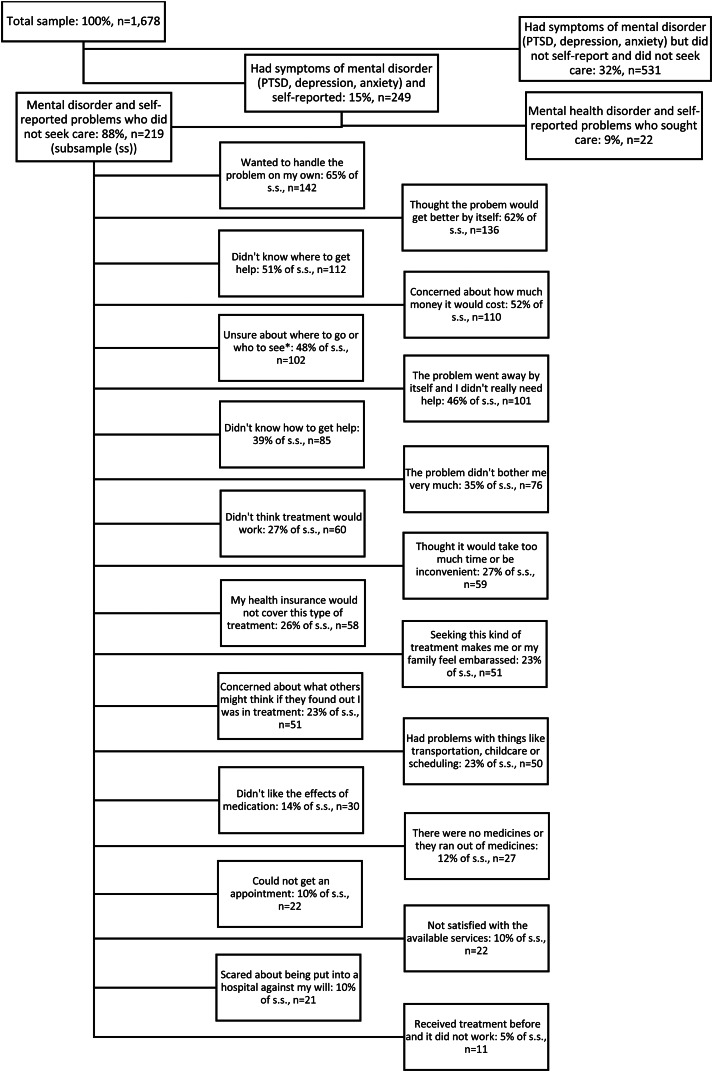
- 249 respondents (15%) screened positive for PTSD, depression, or anxiety and also self-reported emotional/behavioural problems since arriving in Sultanbeyli; only 22 (9%) sought care, while 219 (88%) did not.
- The treatment gap was 89% for PTSD, 90% for anxiety, and 88% for depression.
- Common barriers to care included cost, believing symptoms would improve with time, stigma/embarrassment, not knowing where or how to get help, and doubts that treatment would help; 12 of 22 (55%) who sought care did not complete the full course of treatment.
## Methods
- Cross-sectional survey of Syrian refugees aged 18 years or over in Sultanbeyli, Istanbul, conducted between February and May 2018.
- Random sampling from the Sultanbeyli Municipality registration system yielded 1,678 participants out of 2,865 names drawn (59% participation).
- Face-to-face Arabic interviews collected data on mental health symptoms using PCL-5 and HSCL-25, plus health care use, barriers, and knowledge/attitudes; analysis was descriptive.
## Limitations
- The sample came from the municipality’s registration system and included only officially registered Syrian refugees; the paper notes that unregistered or undocumented refugees were not included and may have higher mental health needs.
- The treatment gap measure captured contact coverage only and did not assess quality or effectiveness of care; the authors state it is based on screening questionnaires and self-perceived problems, not diagnostic interviews, so it is an upper boundary on the actual gap.
- The paper states that a more in-depth diagnostic interview might have produced more precise prevalence estimates, and that the PCL-5 cut-off was not validated for Syrian refugees; it also says the study could not do multivariable analysis because too few respondents accessed care.
Model-written summary. Check it against the paper before relying on it.
Integrity signals
Registry
Cites
Statistics
Figures
Verification
Claims the paper makes
3 Valid · 0 Not valid · 5 Not checked · 57 Own results and interpretations
The sources with a verdict support this claim; the rest weren’t checked yet, have no full text we could read, or their verdicts aren’t rated yet.
In the paper
“Fourth, the cut-off score of the PCL-5, which has been used in this paper, has not been validated for Syrian refugees but has been used in other studies among male veterans in the USA (Bovin et al., 2016) and among conflict-affected populations in Ukraine (Roberts et al., 2017).”
§ Treatment gap and mental health service use among Syrian refugees in Sultanbeyli, Istanbul: a cross-sectional survey > Discussion > Limitations First, we have drawn our sample from the Sultanbeyli Municipality's registration system which only includes data of officially registered Syrian refugees. The registration system does not include data on unregistered or undocumented Syrian refugees, who may have even higher mental health needs. Second, our estimate of the treatment gap measures contact coverage only, and does not take the quality of care into account. We do not know if the mental health treatment which Syrian refugees received is effective in improving their symptom severity, and therefore, we were unable to speculate about effectiveness coverage. Our definition of the treatment gap is based on screening questionnaires and self-perceived psychological problems which do not necessarily mean that the individual needs treatment. This is supported by the response of around one-third of the respondents who were not sufficiently bothered by the mental health problems (see Fig. 1) and therefore did not seek care. Thus, it is important to view our results as providing an upper boundary on the actual treatment gap. Notwithstanding this limitation, we believe that our findings do make a distinct contribution to the sparse evidence on the mental health treatment gap of conflict-affected populations particularly among Syrian refugees (Hendrickx et al., 2019; Satinsky et al., 2019). Third, we used a screening questionnaire to measure the symptoms of PTSD, anxiety and depression. A more in-depth diagnostic interview (which includes an assessment of functional impairment) may have resulted in more precise prevalence estimates as self-report questionnaires are associated with higher rates of mental disorders (Steel et al., 2009). Fourth, the cut-off score of the PCL-5, which has been used in this paper, has not been validated for Syrian refugees but has been used in other studies among male veterans in the USA (Bovin et al., 2016) and among conflict-affected populations in Ukraine (Roberts et al., 2017). For the HSCL-25, we applied the cut-off score of Mahfoud (Mahfoud et al., 2013) who validated his cut-off score among disadvantaged Lebanese women. Ideally, both cut-off scores of the PCL-5 and HSCL-25 should have been validated by both culture and gender. Finally, we could not engage in multivariable analysis to investigate the factors associated with accessing mental health care and the type of care individuals receive, as only a small number of respondents did access care.
What the sources say
- Not checked — no full text of the sourcecites Bovin et al., 2016 matched to “Psychometric properties of the PTSD Checklist for Diagnostic and Statistical Manual of Mental Disorders–Fifth Edition (PCL-5) in veterans.” (2016) source
- Supportedcites Roberts et al., 2017 matched to “Mental health care utilisation among internally displaced persons in Ukraine: results from a nation-wide survey” (2019) source
The Survey questionnaire section states that the study used the PCL-5 to screen for PTSD with a cut-off score >33; the Conclusions identify the study population as internally displaced adults in Ukraine. Roberts et al. thus supports the part of the citing sentence about use of the cut-off in a conflict-affected Ukrainian population. The statement about validation for Syrian refugees is not attributed to Roberts et al. (LLM, conf=0.93)
plain- Asserted: passes — The authors put it forward as true.
- Checkable: passes — It can be checked against evidence.
- Load-bearing: unclear — It is unclear whether the paper’s conclusions depend on it.
- Based: passes — The paper gives a reason why it holds.
A result the paper reports from its own data — it cites no other source for it, so there is none to check. The quote shows it is in the paper.
In the paper
“Over 70% of the respondents indicated that health and social care institutions (n = 1214, 72%) and NGOs (n = 1305, 78%) operating in Sultanbeyli were not providing any information on mental health.”
§ Treatment gap and mental health service use among Syrian refugees in Sultanbeyli, Istanbul: a cross-sectional survey > Results > Health care utilisation and sources of information on mental health
plainn = 1,305- Asserted: passes — The authors put it forward as true.
- Checkable: passes — It can be checked against evidence.
- Load-bearing: passes — The paper’s conclusions depend on it.
- Based: passes — The paper gives a reason why it holds.
A result the paper reports from its own data — it cites no other source for it, so there is none to check. The quote shows it is in the paper.
In the paper
“Over 70% of the respondents indicated that health and social care institutions (n = 1214, 72%) and NGOs (n = 1305, 78%) operating in Sultanbeyli were not providing any information on mental health.”
§ Treatment gap and mental health service use among Syrian refugees in Sultanbeyli, Istanbul: a cross-sectional survey > Results > Health care utilisation and sources of information on mental health
plainn = 1,214- Asserted: passes — The authors put it forward as true.
- Checkable: passes — It can be checked against evidence.
- Load-bearing: passes — The paper’s conclusions depend on it.
- Based: passes — The paper gives a reason why it holds.
A result the paper reports from its own data — it cites no other source for it, so there is none to check. The quote shows it is in the paper.
In the paper
“Eight per cent (n = 138) of the respondents indicated that care would not be available at all and a further 15% (n = 251) did not know if members of their community sought care at any of the places presented in Table 3.”
§ Treatment gap and mental health service use among Syrian refugees in Sultanbeyli, Istanbul: a cross-sectional survey > Results > Health care utilisation and sources of information on mental health
hedgedn = 138- Asserted: passes — The authors put it forward as true.
- Checkable: passes — It can be checked against evidence.
- Load-bearing: unclear — It is unclear whether the paper’s conclusions depend on it.
- Based: passes — The paper gives a reason why it holds.
A result the paper reports from its own data — it cites no other source for it, so there is none to check. The quote shows it is in the paper.
In the paper
“The estimated prevalence of symptoms of PTSD, depression and anxiety was 19.6, 34.7 and 36.1%, respectively (see Table 2).”
§ Treatment gap and mental health service use among Syrian refugees in Sultanbeyli, Istanbul: a cross-sectional survey > Results
hedgedn = 1,678- Asserted: passes — The authors put it forward as true.
- Checkable: passes — It can be checked against evidence.
- Load-bearing: unclear — It is unclear whether the paper’s conclusions depend on it.
- Based: passes — The paper gives a reason why it holds.
38 more claims
Create a free account to see all 65 claims and every source verdict.
- Probably not a substantial claim. 11
- It may state two separate claims as one. 12
- The quote only partly states this claim. 4
Claims other papers make about this one
Each is checked against this paper’s own text: does it say what the citing paper says it does?
In the citing paper
“and people suffering from PTSS are prone to not seeking care because of barriers such as lack of information, being afraid of stigmatization, or the belief that symptoms may decrease with time [46].”
From Post-Traumatic Stress Symptoms in Healthcare Workers Dealing with the COVID-19 Pandemic: A Systematic Review (2021) · cites this paper as [46]
Citations
Cites
Statistical Power Analysis for the Behavioral Sciences
Muller, K. (1989) · Technometrics · doi:10.1080/00401706.1989.10488618 · Cited by 99,167
Statistical power analysis for the behavioral sciences
(1990) · Computers, Environment and Urban Systems · doi:10.1016/0198-9715(90)90050-4 · Cited by 65,269
Blevins, C. A., Weathers, F. W., Davis, M. T., Witte, T. K., & Domino, J. L. (2015) · Journal of Traumatic Stress · doi:10.1002/jts.22059 · Cited by 5,233
The Lancet Commission on global mental health and sustainable development
Patel, V., Saxena, S., Lund, C., Thornicroft, G., Baingana, F., Bolton, P., Chisholm, D., Collins, P. Y., Cooper, J. L., Eaton, J., et al. (2018) · The Lancet · doi:10.1016/s0140-6736(18)31612-x · Cited by 3,692 · cited 1×
“There is a large mental health treatment gap for common mental disorders among the general population in almost every country (Patel et al., 2018), and our findings correspond to the mental health treatment gap seen among other vulnerable groups including refugees or internally displaced persons…”
ResultBovin, M. J., Marx, B. P., Weathers, F. W., Gallagher, M. W., Rodriguez, P., Schnurr, P. P., & Keane, T. M. (2016) · Psychological Assessment · doi:10.1037/pas0000254 · Cited by 2,532 · cited 1×
“Fourth, the cut-off score of the PCL-5, which has been used in this paper, has not been validated for Syrian refugees but has been used in other studies among male veterans in the USA (Bovin et al., 2016) and among conflict-affected populations in Ukraine (Roberts et al., 2017).”
ResultSteel, Z., Chey, T., Silove, D., Marnane, C., Bryant, R. A., & van Ommeren, M. (2009) · JAMA · doi:10.1001/jama.2009.1132 · Cited by 2,246 · cited 3×
“Inter-survey variability has been reported previously (Steel et al., 2009) and reflects different data collection methods, the choice of screening tools, participant recruitment setting (e.g. https://www.cambridge.org/core/terms. https://doi.org/10.1017/S2045796019000660 Downloaded from…”
BackgroundMethodInfluentialCharlson, F., van Ommeren, M., Flaxman, A., Cornett, J., Whiteford, H., & Saxena, S. (2019) · The Lancet · doi:10.1016/s0140-6736(19)30934-1 · Cited by 1,702 · cited 1×
“…Health Organization estimate the age-standardised point prevalence for depression to be 10.8%, for anxiety disorder (including post-traumatic stress disorder (PTSD)) to be 21.7%, and for PTSD alone to be 15.3% at any point in time among all conflict-affected populations (Charlson et al., 2019).”
BackgroundInfluentialMiller, K. E., & Rasmussen, A. (2010) · Social Science & Medicine · doi:10.1016/j.socscimed.2009.09.029 · Cited by 1,524 · cited 1×
“…are at an increased risk of mental disorders due to frequent exposure to potentially traumatic events, multiple losses, breakdown of supportive social networks and accumulation of daily life stressors related to refugee life (Miller and Rasmussen, 2010; Steel et al., 2009; Silove et al., 2017).”
BackgroundThe contemporary refugee crisis: an overview of mental health challenges
Silove, D., Ventevogel, P., & Rees, S. (2017) · World Psychiatry · doi:10.1002/wps.20438 · Cited by 775 · cited 1×
“…are at an increased risk of mental disorders due to frequent exposure to potentially traumatic events, multiple losses, breakdown of supportive social networks and accumulation of daily life stressors related to refugee life (Miller and Rasmussen, 2010; Steel et al., 2009; Silove et al., 2017).”
BackgroundSelf-citationvan Ginneken, N., Tharyan, P., Lewin, S., Rao, G. N., Meera, S., Pian, J., Chandrashekar, S., & Patel, V. (2013) · Cochrane Database of Systematic Reviews · doi:10.1002/14651858.cd009149.pub2 · Cited by 575
Research works printed but not linked: 10
- WHO (2018) Process of Translation and Adaptation of Instruments. Geneva: WHO.
- IMC (International Medical Corps) (2017) Mental Health and Psychosocial Support Considerations for Syrian Refugees in Turkey: Sources of Distress, Coping Mechanisms, & Access to Support. Los Angeles/Washington: IMC.
- UNHCR (2019) Mid Year Trends 2018. Geneva: UNHCR.
- CDC (2019) Mental Health: Syrian Refugee Health Profile. Atlanta, Georgia: CDC.
- Mollica RW, Massagli L and Silove MD (2004) Measuring Trauma, Measuring Torture. Massachusetts: Harvard University, Cambridge.
- UNHCR (2018b) UNHCR Turkey: Provincial Breakdown Syrian Refugees in Turkey. Geneva, Switzerland: UNHCR. Available at: https://www.unhcr.org/tr/wp-content/uploads/sites/14/2019/08/9.2-UNHCR_Provincial-Breakdown-Syrian-Refugees-in-Turkey-August-2019.png (last accessed on 4.11.2019).
- Republic of Turkey, M. o. I., Directorate General of Migration Management (2018) Temporary Protection in Turkey. Ankara, Turkey: Ministry of Interior.
- UNHCR (2018a) TURKEY – Regional Refugee & Resilience Plan (3RP) 2018–2019, UNHCR, Geneva, Switzerland. Available at: https://data2.unhcr.org/en/documents/details/63168 (last accessed 4.11.2019).
- Roberts B Mental health care utilisation among internally displaced persons in Ukraine: results from a nation-wide survey. Epidemiol Psychiatr Sci. 2017 Jul 27: 1– 12. PMC6998949 28747237 · DOI · Paper page
- WHO/UNHCR (2012) Assessing Mental Health and Psychosocial Needs Resources. Toolkit for Humanitarian Settings. Geneva: WHO.
Cited by
Items 101–117 of 117
Roberts, B. (2023) · Cambridge Prisms Global Mental Health · doi:10.1017/gmh.2024.16.pr4
Self-citationDecision: Mental healthcare access among resettled Syrian refugees in Leipzig, Germany — R0/PR3
Schoenberger, S. F., Schönenberg, K., Fuhr, D. C., et al. (2023) · Cambridge Prisms Global Mental Health · doi:10.1017/gmh.2024.16.pr3
Self-citationSchoenberger, S. F., Schönenberg, K., Fuhr, D. C., et al. (2023) · Cambridge Prisms Global Mental Health · doi:10.1017/gmh.2024.16.pr2
Self-citationRoberts, B. (2023) · Cambridge Prisms Global Mental Health · doi:10.1017/gmh.2024.16.pr1
Self-citationChavez, C. J. R., & Gonzales, N. A. C. (2024) · Universidad Peruana de Ciencias Aplicadas (UPC) · doi:10.19083/tesis/672196
Koch, K., Nesterko, Y., Schönenberg, K., & Glaesmer, H. (2024) · PPmP - Psychotherapie · Psychosomatik · Medizinische Psychologie · doi:10.1055/a-2311-4717
“Menschen, deren Migration länger zurückliegt, zeigen ein höheres Hilfesuchverhal-ten im medizinischen Versorgungssektor, da sich ihr Verständnis des Gesundheitssystems verbessert hat [13, 28].”
BackgroundMental Health and Psychosocial Support (MHPSS) in the Context of the Climate and Ecological Crisis
Massazza, A., Nemiro, A., Hijazi, Z., Snider, L., Graef, V., Hill, K. X., & Augustinavicius, J. (2024) · Springer eBooks · doi:10.1007/978-3-031-56736-0_14
Cultural adaptation of an internet-based self-help app for grieving Syrian refugees in SwitzerlandPreprint
Aeschlimann, A., Heim, E., Hoxha, A., Triantafyllidou, V., Killikelly, C., Haji, F., Stoeckli, R. T., Aebersold, M., & Maercker, A. (2024) · Research Square · doi:10.21203/rs.3.rs-4804166/v1
Dangerous Knowledge and Proxy-Reasons: A Kurdish Woman’s Therapeutic Attempts
Weiss, N. (2024) · Medical Anthropology · doi:10.1080/01459740.2024.2406769
“However, access to health care is not equally distributed (Santas et al. 2018), and particularly marginalized and minoritised groups experience inequalities in access, service quality and health outcomes (Doğan et al. 2019; Fuhr et al. 2020; Soner and Avci 2023).”
Predictors of well‐being among Syrian women in northern and southern Türkiye
Shaw, S. A., Yalim, A. C., Dinç, Y., Yalniz, A., & Yang, C. (2024) · Journal of Community & Applied Social Psychology · doi:10.1002/casp.2893
Mutambudzi, M. S., Sharma, A., Sous, W., Shaw, A., & Heffernan, K. S. (2024) · Ethnicity & Disease · doi:10.18865/ethndis-2023-59 · Cited by 4
Mastrogiovanni, N., & Nickerson, A. (2025) · Transcultural Psychiatry · doi:10.1177/13634615251348300
Ranjbar, H. A., Elazab, K., Yiğit, İ., Almeamari, F., Acartürk, C., Kurt, G., Turan, J. M., Pala, A. N., & Turan, B. (2025) · BMJ Global Health · doi:10.1136/bmjgh-2024-017276 · Cited by 2
Self-citationBringmann, M., Böhm, M., Specht, F., Vöhringer, M., Aldoibal, M., Knaevelsrud, C., Wagner, B., Böttche, M., & Nesterko, Y. (2026) · Journal of Migration and Health · doi:10.1016/j.jmh.2026.100399 · Cited by 1
“In a study among over 1500 Syrian refugees in Sultanbeyli-Istanbul, Turkey, 19.6 % of respondents screened positively for PTSD, and 34.7 % for depression (Fuhr et al., 2019).”
Influentialブラームス作曲「ピアノ五重奏曲ヘ短調作品34」についての一考察 : 「2台のピアノのためのソナタ作品34bis」との比較を視点として
村澤, 由. (2006) · Institutional Repositories DataBase (IRDB) · doi:10.24727/00027633
Prakash, P., & Reddy, K. J. (2026) · Advances in computational intelligence and robotics book series · doi:10.4018/979-8-3373-9109-0.ch011
de Jonge, J. M., Taguba, C., Noijen, J., Latour, C. H. M., & Hilbink-Smolders, M. (2026) · Springer eBooks · doi:10.1007/978-3-032-32399-6_9
Metadata
- Authors
- Fuhr, D. C., Acarturk, C., McGrath, M., Ilkkursun, Z., Sondorp, E., Sijbrandij, M., Ventevogel, P., Cuijpers, P., McKee, M., & Roberts, B.
- Affiliations
- London School of Hygiene & Tropical Medicine (GB)
- Royal Tropical Institute (NL)
- Vrije Universiteit Amsterdam (NL)
- Office of the United Nations High Commissioner for Refugees (CH)
- Corresponding author
- Roberts, B.
- Venue
- Epidemiology and psychiatric sciences
- Publisher
- Cambridge University Press (CUP)
- Published
- 2019-11-15
- Volume
- 29
- Pages
- e70-e70
- ISSN
- 2045-7960 (ISSN-L)
- 2045-7979
- PMC
- PMC8061186
- OpenAlex
- W2982777903
- Semantic Scholar
- d4c7e76e2097a23d38807f5b66b270cd94715620
- Cited by
- 120
- References
- 47
- Citations by year
- 2026: 5 · 2025: 14 · 2024: 25 · 2023: 15 · 2022: 17 · 2021: 27 · 2020: 16
- FWCI
- 17.51
- Type
- journal article
- Language
- en
- Open access
- hybrid
- doi.org
- Locations
- Epidemiology and Psychiatric Sciences (publishedVersion, cc-by)
- PubMed Central (publishedVersion, cc-by)
- PubMed (publishedVersion)
- LSHTM Research Online (London School of Hygiene and Tropical Medicine) (acceptedVersion)
- UCL Discovery (University College London) (submittedVersion)
- VU Research Portal (submittedVersion, other-oa)
- Data Archiving and Networked Services (DANS) (submittedVersion, other-oa)
- Topics
- Social Sciences › Psychology › Clinical Psychology › Migration, Health and Trauma
- Health Sciences › Medicine › Psychiatry and Mental health › Mental Health Treatment and Access
- Social Sciences › Law › Migration, Racism, and Human Rights
- Keywords
- Syrian refugees, treatment gap, mental health service utilization, psychosocial support, post-traumatic stress disorder, depression, anxiety, barriers to care, help-seeking, mental health stigma, attitudes toward mental illness, mental health awareness, refugee mental health, Sultanbeyli
- MeSH terms
- Facilities and Services Utilization, Adolescent, Adult, Anxiety, Cross-Sectional Studies, Depression, Female, Health Services Accessibility, Humans, Health Knowledge, Attitudes, Practice, Male, Mental Health Services, Middle Aged, Patient Acceptance of Health Care, Refugees, Social Support, Stress Disorders, Post-Traumatic, Syria, Turkey, Needs Assessment, Young Adult
About these checks
Registry, retraction, Cites and statistics results are computed, not judged, with one exception: a printed reference that no index lists is read once by a model before it counts as a citation error. Claims are extracted by a model and kept only when their quote appears verbatim in the text; each cited source is then checked, with a model’s help, for whether it says what the claim relies on. Those verdicts can be wrong — read the claim’s quote and the cited source before relying on one.
A language model drew the claims from the paper on 2026-10-11, under version 3 of the claim definition (model deepseek-v4.1-flash, prompt extract-v3).
A second model labelled each claim on 2026-10-11 (model jev-1.13-20260917, definition revision gold-guideline-v0.2).
Cited sources are checked with a language model’s help (gpt-6-sol).
Statistics and arithmetic are recomputed, not judged.
Confidence bands are shown only for fields calibrated on our annotated test set. None is calibrated yet, so no band is shown.
What counts as a claim ›How we measure confidence ›How we check this ›
Are you an author, or do you see a problem with this page? Request a review
Data sources
Bibliographic data: Semantic Scholar, OpenAlex, Crossref.
Contains information from the Semantic Scholar Academic Graph Datasets, made available under the ODC Attribution License (ODC-BY 1.0).
Semantic Scholar’s data is described in: Kinney, R., et al. (2023). The Semantic Scholar Open Data Platform. arXiv:2301.10140.
