

The DOI matches its Crossref record; 7 of the 7 references it cites were found in a registry or an index.
Large Language Model Agent for Modular Task Execution in Drug Discovery
Open accessPublished version of a preprint
Abstract
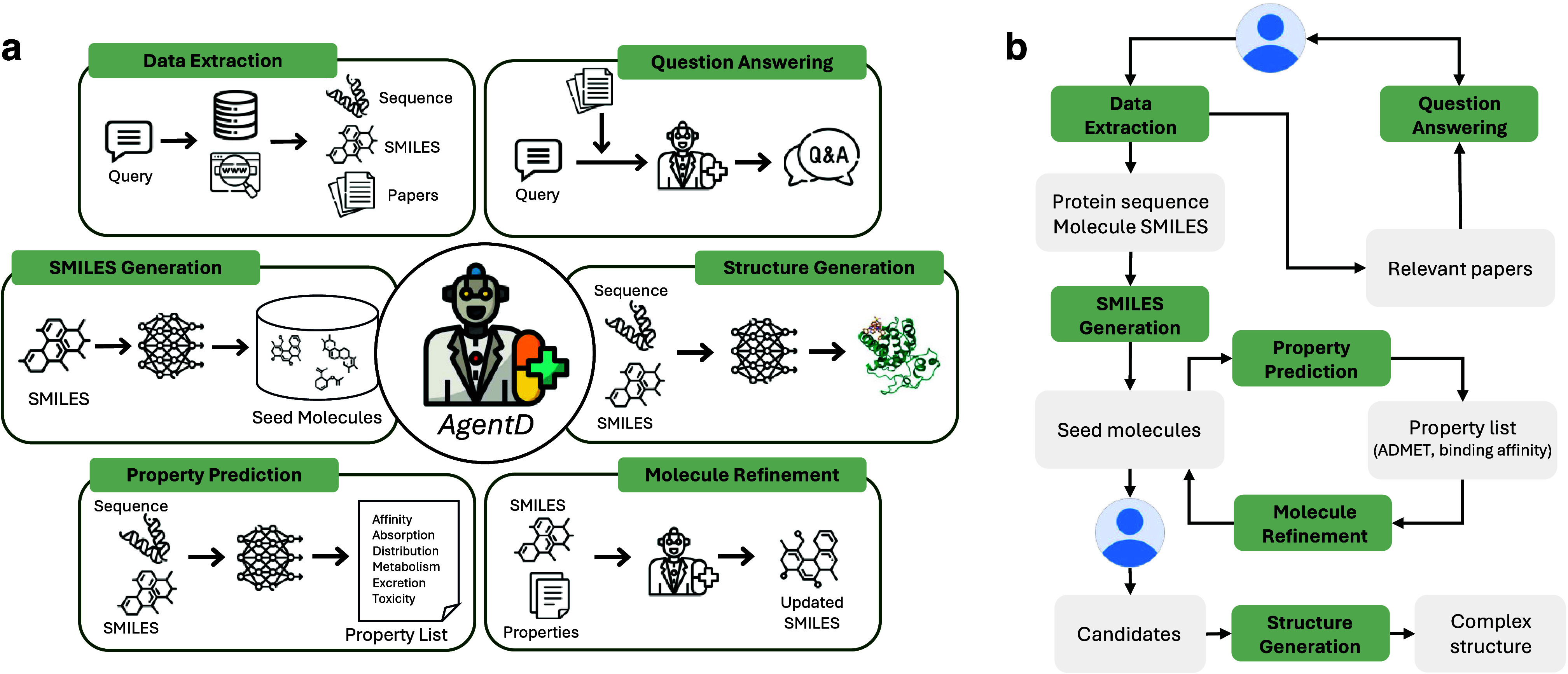
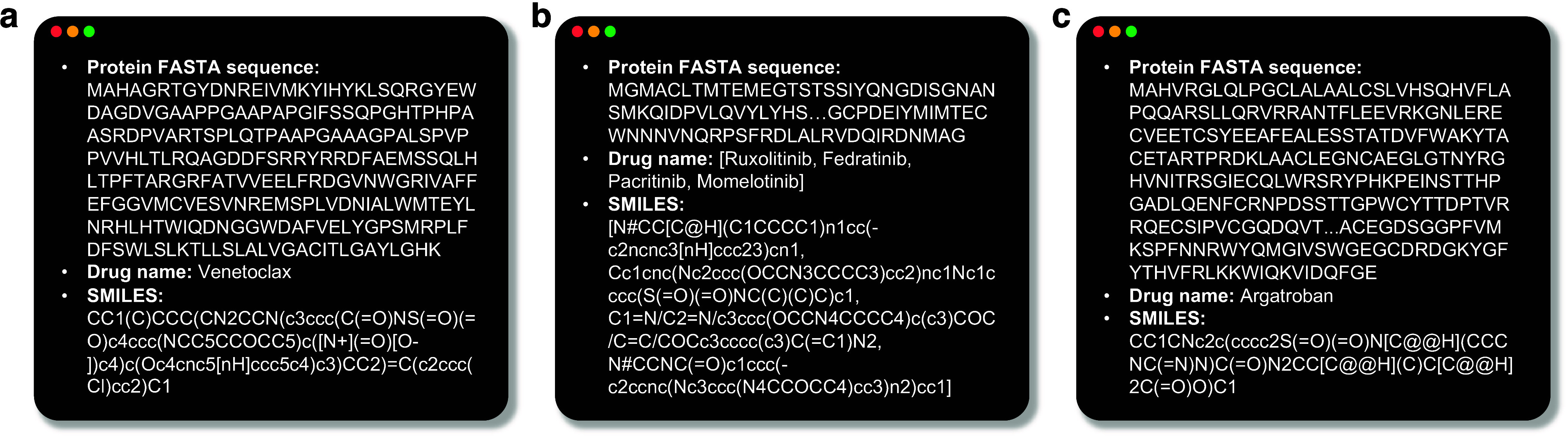
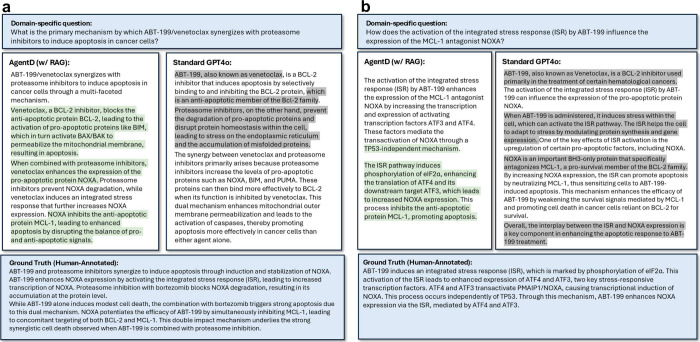
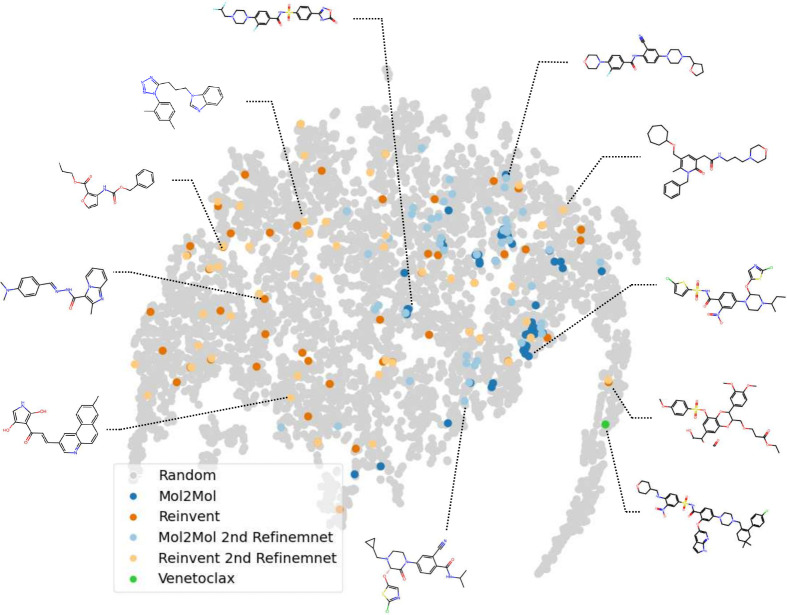
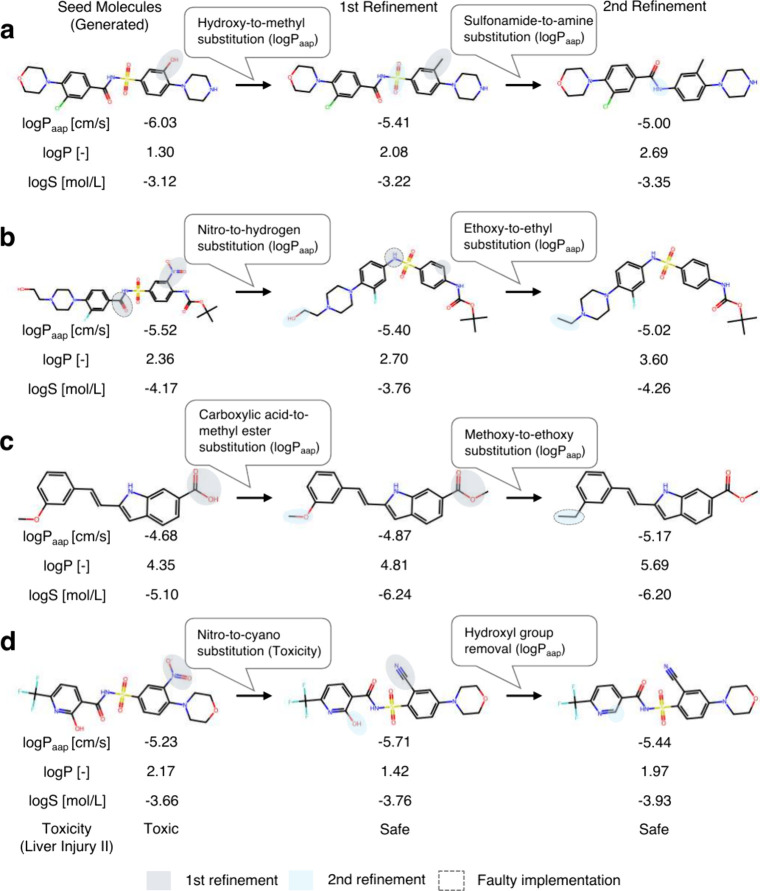
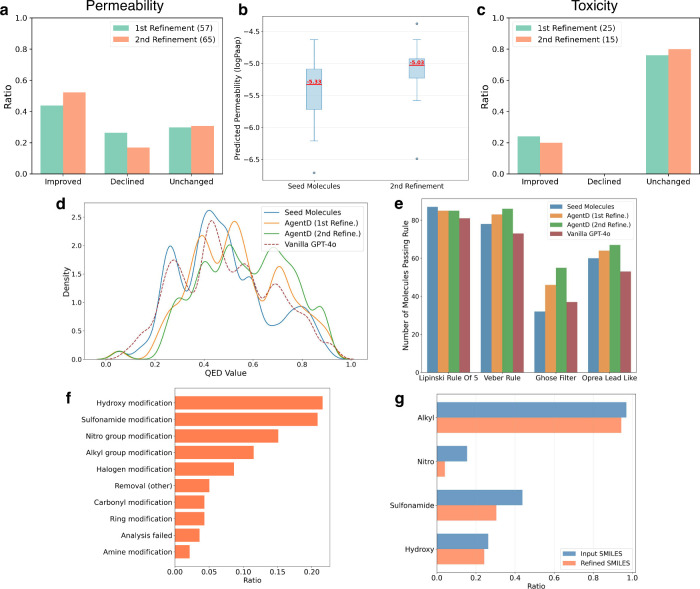
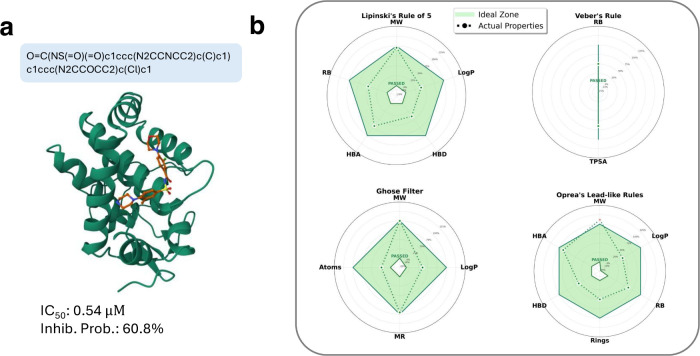
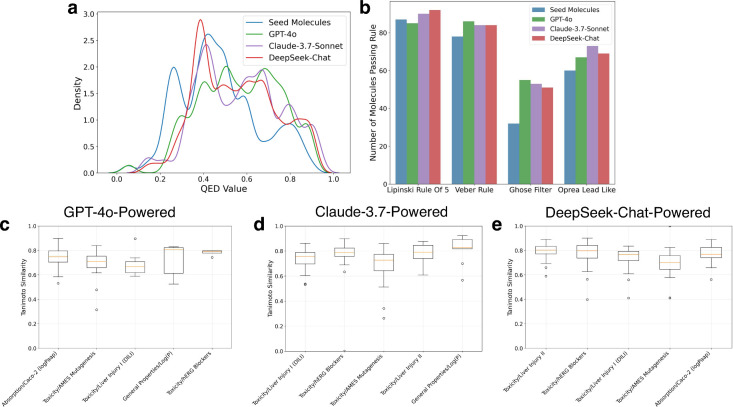
We present a modular framework powered by large language models (LLMs) that automates and streamlines key tasks across the early stage computational drug discovery pipeline. By combining LLM reasoning with domain-specific tools, the framework performs biomedical data retrieval, literature-grounded question answering via retrieval-augmented generation, molecular generation, multiproperty prediction, property-aware molecular refinement, and 3D protein-ligand structure generation. The agent autonomously retrieves relevant biomolecular information, including FASTA sequences, SMILES representations, and literature, and answers mechanistic questions with improved contextual accuracy compared to standard LLMs. It then generates chemically diverse seed molecules and predicted 75 properties, including ADMET-related and general physicochemical descriptors, which guids iterative molecular refinement. Across two refinement rounds, the number of molecules with QED >0.6 increased from 34 to 55. The number of molecules satisfying empirical drug-likeness filters also rose; for example, compliance with the Ghose filter increased from 32 to 55 within a pool of 100 molecules. The framework also employed Boltz-2 to generate 3D protein-ligand complexes and provide rapid binding affinity estimates for candidate compounds. These results demonstrate that the approach effectively supports molecular screening, prioritization, and structure evaluation. Its modular design enables flexible integration of evolving tools and models, providing a scalable foundation for AI-assisted therapeutic discovery.
Overview
The claims and statistics of this paper haven’t been checked yet.
Run the check — free, no account needed. It reads the open-access text and checks the sources it cites.
Integrity signals
Registry
Cites
Statistics
Figures
Verification
Claims the paper makes
The claims and statistics of this paper haven’t been checked yet.
Run the check — free, no account needed. It reads the open-access text and checks the sources it cites.
Self-check
Percentages, sums and reported differences re-computed from the paper’s own numbers.
The self-check needs the paper’s full text.
Citations
Cites
Highly accurate protein structure prediction with AlphaFold
Jumper, J., Evans, R., Pritzel, A., Green, T., Figurnov, M., Ronneberger, O., Tunyasuvunakool, K., Bates, R., Žídek, A., Potapenko, A., et al. (2021) · Nature · doi:10.1038/s41586-021-03819-2 · Cited by 43,764
Accurate structure prediction of biomolecular interactions with AlphaFold 3
Abramson, J., Adler, J., Dunger, J., Evans, R., Green, T., Pritzel, A., Ronneberger, O., Willmore, L., Ballard, A. J., Bambrick, J., et al. (2024) · Nature · doi:10.1038/s41586-024-07487-w · Cited by 15,861
DeepTox: toxicity prediction using deep learning
Mayr, A., Klambauer, G., Unterthiner, T., & Hochreiter, S. (2016) · Frontiers in Environmental Science · doi:10.3389/fenvs.2015.00080 · Cited by 1,081
Autonomous chemical research with large language models
Boiko, D. A., MacKnight, R., Kline, B., & Gomes, G. (2023) · Nature · doi:10.1038/s41586-023-06792-0 · Cited by 1,050
Large-scale chemical language representations capture molecular structure and properties
Ross, J., Belgodere, B., Chenthamarakshan, V., Padhi, I., Mroueh, Y., & Das, P. (2022) · Nature Machine Intelligence · doi:10.1038/s42256-022-00580-7 · Cited by 590
Emergent autonomous scientific research capabilities of large language models
Boiko, D. A., MacKnight, R., & Gomes, G. (2023) · arXiv · doi:10.48550/arxiv.2304.05332 · Cited by 72
Ock, J., Meda, R. S., Vinchurkar, T., Jadhav, Y., & Barati Farimani, A. (2026) · Digital Discovery · doi:10.1039/d5dd00298b · Cited by 3
Self-citation
Research works printed but not linked: 69
- 10.1038/nrd3078 · DOI · Paper page
- 10.1038/d41573-024-00068-6 · DOI
- 10.1038/s41591-022-02160-z · DOI
- 10.1002/(SICI)1098-1128(199601)16:1<3::AID-MED1>3.0.CO;2-6 · DOI
- 10.1007/s10822-013-9672-4 · DOI · Paper page
- 10.1007/s40484-019-0172-y · DOI
- 10.1002/jcc.21334 · DOI · Paper page
- 10.1007/s12551-016-0247-1 · DOI · Paper page
- 10.1021/acs.jcim.7b00274 · DOI · Paper page
- 10.1897/01-171 · DOI
- 10.1038/s41573-023-00832-0 · DOI
- 10.1073/pnas.0408930102 · DOI
- 10.1002/1873-3468.14076 · DOI
- 10.1021/acs.jctc.4c00316 · DOI
- Badrinarayanan, S.; Magar, R.; Antony, A.; Meda, R. S.; Farimani, A. B. MOFGPT: Generative Design of Metal-Organic Frameworks using Language Models. 2025; https://arxiv.org/abs/2506.00198. · DOI
- 10.1021/acs.jpclett.3c02398 · DOI
- 10.1021/acs.jpcb.4c02507 · DOI
- 10.1021/acs.jcim.4c01443 · DOI
- 10.1038/s41392-023-01381-z · DOI
- Jin, W.; Barzilay, R.; Jaakkola, T. Junction Tree Variational Autoencoder for Molecular Graph Generation. Proceedings of the 35th International Conference on Machine Learning. 2018; pp 2323–2332.
- Cao, N. D.; Kipf, T. MolGAN: An implicit generative model for small molecular graphs. 2022; https://arxiv.org/abs/1805.11973. · arXiv
- Peng, X.; Guan, J.; Liu, Q.; Ma, J. MolDiff: Addressing the Atom-Bond Inconsistency Problem in 3D Molecule Diffusion Generation . 2023; https://arxiv.org/abs/2305.07508. · arXiv
- 10.1093/nar/gkab255 · DOI
- 10.1039/C7SC02664A · DOI · Paper page
- 10.1186/s13321-024-00846-9 · DOI
- 10.4155/fmc-2019-0307 · DOI
- 10.1111/j.1476-5381.2010.01127.x · DOI · Paper page
- Sinha, S.; Vohora, D. In Pharmaceutical Medicine and Translational Clinical Research ; Vohora, D., Singh, G., Eds. Academic Press: Boston, 2018; pp 19–32. · DOI
- Lu, C.; Lu, C.; Lange, R. T.; Foerster, J.; Clune, J.; Ha, D. The AI Scientist: Towards Fully Automated Open-Ended Scientific Discovery. 2024; https://arxiv.org/abs/2408.06292. · arXiv
- 10.1038/s42256-024-00832-8 · DOI · Paper page
- Jadhav, Y.; Farimani, A. B. Large Language Model Agent as a Mechanical Designer . 2024; https://arxiv.org/abs/2404.17525. · arXiv
- Jadhav, Y.; Pak, P.; Farimani, A. B. LLM-3D Print: Large Language Models To Monitor and Control 3D Printing . 2024; https://arxiv.org/abs/2408.14307. · DOI
- Chaudhari, A.; Ock, J.; Barati Farimani, A. Modular Large Language Model Agents for Multi-Task Computational Materials Science. 2025;10.26434/chemrxiv-2025-zkn81-v2. · DOI
- Ansari, M.; Watchorn, J.; Brown, C. E.; Brown, J. S. dZiner: Rational Inverse Design of Materials with AI Agents . 2024; https://arxiv.org/abs/2410.03963. · arXiv
- 10.1021/acsomega.4c08408 · DOI
- 10.1038/s43588-025-00849-y · DOI
- 10.1093/nar/gku989 · DOI · Paper page
- 10.1093/nar/gkr777 · DOI · Paper page
- 10.1021/acs.jcim.0c00915 · DOI · Paper page
- 10.1186/s13321-024-00812-5 · DOI
- 10.1038/s41467-024-51672-4 · DOI
- 10.1093/nar/gkae254 · DOI
- Meda, R. S.; Farimani, A. BAPULM: Binding Affinity Prediction using Language Models. 2024; https://arxiv.org/abs/2411.04150. · arXiv
- Wohlwend, J.; Corso, G.; Passaro, S.; Reveiz, M.; Leidal, K.; Swiderski, W.; Portnoi, T.; Chinn, I.; Silterra, J.; Jaakkola, T.; Barzilay, R. Boltz-1 Democratizing Biomolecular Interaction Modeling . 2024; https://www.biorxiv.org/content/early/2024/11/20/2024.11.19.624167. · DOI
- Passaro, S.; Corso, G.; Wohlwend, J.; Reveiz, M.; Thaler, S.; Somnath, V. R.; Getz, N.; Portnoi, T.; Roy, J.; Stark, H.; Kwabi-Addo, D.; Beaini, D.; Jaakkola, T.; Barzilay, R. Boltz-2: Towards Accurate and Efficient Binding Affinity Prediction. 2025. · DOI
- 10.1038/s41420-022-01009-1 · DOI
- 10.1038/s41416-019-0573-8 · DOI
- Beltagy, I.; Lo, K.; Cohan, A. SciBERT: A pretrained language model for scientific text. 2019. · DOI · Paper page
- 10.1186/s13321-018-0258-y · DOI
- 10.1038/nchem.1243 · DOI
- 10.1016/S0169-409X(00)00129-0 · DOI · Paper page
- 10.1021/jm020017n · DOI · Paper page
- 10.1021/cc9800071 · DOI
- 10.1021/ci010366a · DOI
- DeepSeek-AI, DeepSeek-R1: Incentivizing Reasoning Capability in LLMs via Reinforcement Learning. 2025; https://arxiv.org/abs/2501.12948. · arXiv
- 10.1021/ci9800211 · DOI
- 10.1186/s13321-015-0069-3 · DOI
- 10.1002/cphc.200900270 · DOI
- Radford, A.; Narasimhan, K. Improving Language Understanding by Generative Pre-Training. 2018; https://api.semanticscholar.org/CorpusID:49313245.
- 10.1002/cmdc.200600155 · DOI
- 10.1016/j.drudis.2019.03.015 · DOI
- 10.1038/nrd1032 · DOI
- 10.1038/nrd2445 · DOI · Paper page
- 10.48550/arXiv.2007.06225 · DOI
- Wang B., 2023, Nature Reviews Chemistry, 7, 681
- 10.1016/0006-2952(73)90196-2 · DOI · Paper page
- 10.1016/j.drudis.2020.12.003 · DOI
- 10.1162/neco.1989.1.2.270 · DOI · Paper page
- Vaswani A., 2017, Advances in Neural Information Processing Systems.
Metadata
- Authors
- Ock, J., Meda, R. S., Badrinarayanan, S., Aluru, N. S., Chandrasekhar, A., & Barati Farimani, A.
- Affiliations
- University of Nebraska–Lincoln (US)
- Carnegie Mellon University (US)
- Texas A&M University (US)
- Department of Mechanical Engineering, Carnegie Mellon University, 5000 Forbes Avenue, Pittsburgh, Pennsylvania 15213, United States
- ORCID
- Venue
- Journal of Chemical Information and Modeling
- Publisher
- American Chemical Society (ACS)
- Published
- 2026-02-09
- Volume
- 66
- Issue
- 4
- Pages
- 2055-2068
- ISSN
- 1549-9596 (ISSN-L)
- 1549-960X
- PMC
- PMC12933718
- OpenAlex
- W7128440866
- Cited by
- 5
- References
- 7
- Citations by year
- 2026: 5
- FWCI
- 18.15
- Type
- journal article
- Language
- en
- Open access
- hybrid
- doi.org
- Locations
- Journal of Chemical Information and Modeling (publishedVersion, cc-by)
- bioRxiv (Cold Spring Harbor Laboratory) (acceptedVersion, cc-by)
- PubMed (publishedVersion)
- PubMed Central (publishedVersion, cc-by)
- Topics
- Life Sciences › Pharmacology, Toxicology and Pharmaceutics › Drug Discovery › Computational Drug Discovery Methods
- Physical Sciences › Materials Science › Materials Chemistry › Machine Learning in Materials Science
- Life Sciences › Biochemistry, Genetics and Molecular Biology › Molecular Biology › vaccines and immunoinformatics approaches
- Keywords
- LLM agents, computational drug discovery, retrieval-augmented generation, molecular generation, quantum electrodynamics, Boltz-2, binding affinity prediction, ADMET properties
- MeSH terms
- Large Language Models, Ligands, Programming Languages, Proteins, Drug Discovery
About these checks
Registry, retraction, Cites and statistics results are computed, not judged, with one exception: a printed reference that no index lists is read once by a model before it counts as a citation error. Claims are extracted by a model and kept only when their quote appears verbatim in the text; each cited source is then checked, with a model’s help, for whether it says what the claim relies on. Those verdicts can be wrong — read the claim’s quote and the cited source before relying on one.
Statistics and arithmetic are recomputed, not judged.
Confidence bands are shown only for fields calibrated on our annotated test set. None is calibrated yet, so no band is shown.
What counts as a claim ›How we measure confidence ›How we check this ›
Are you an author, or do you see a problem with this page? Request a review
