

The DOI matches its Crossref record; 120 of the 120 references it cites were found in a registry or an index.
Surrogate Based Genetic Algorithm Method for Efficient Identification of Low-Energy Peptide Structures
Open accessPublished version of a preprint
Abstract
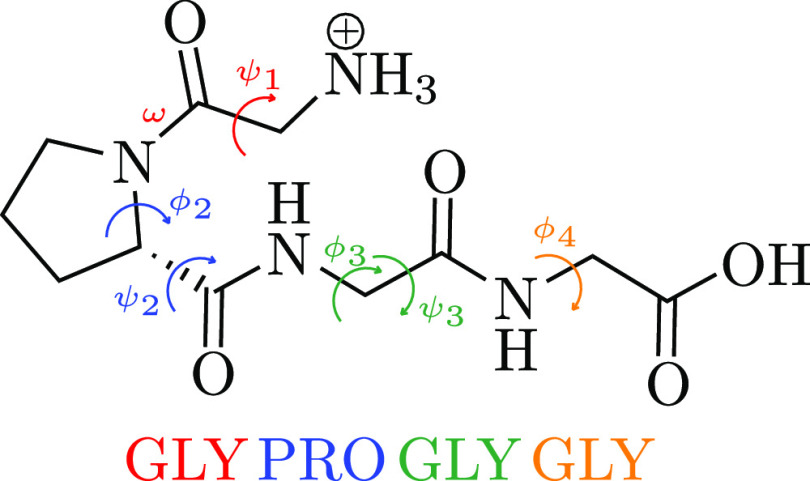
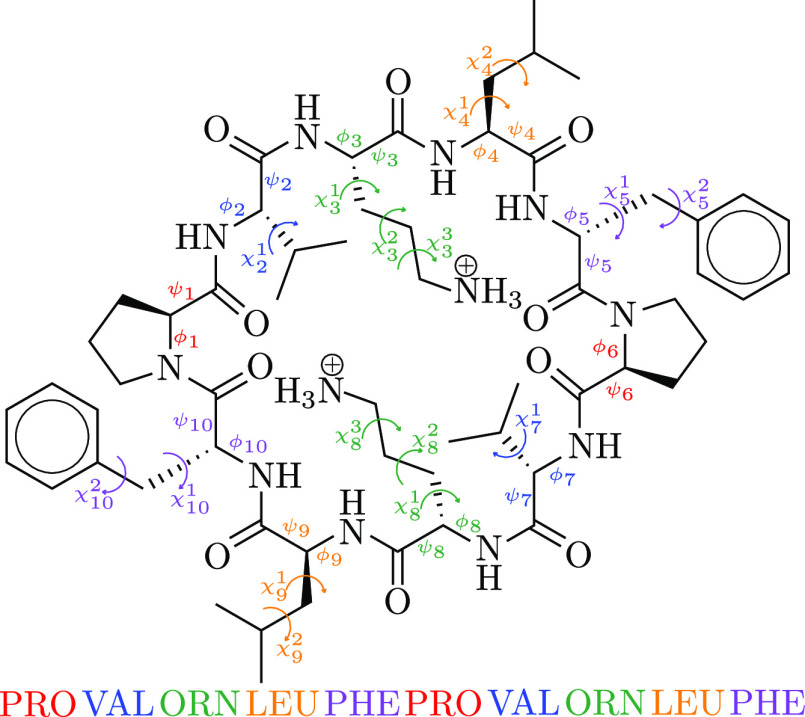
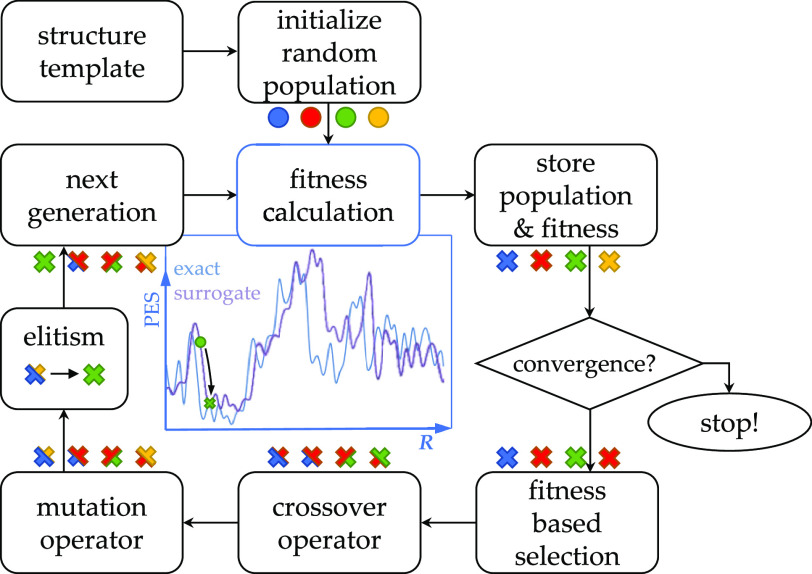
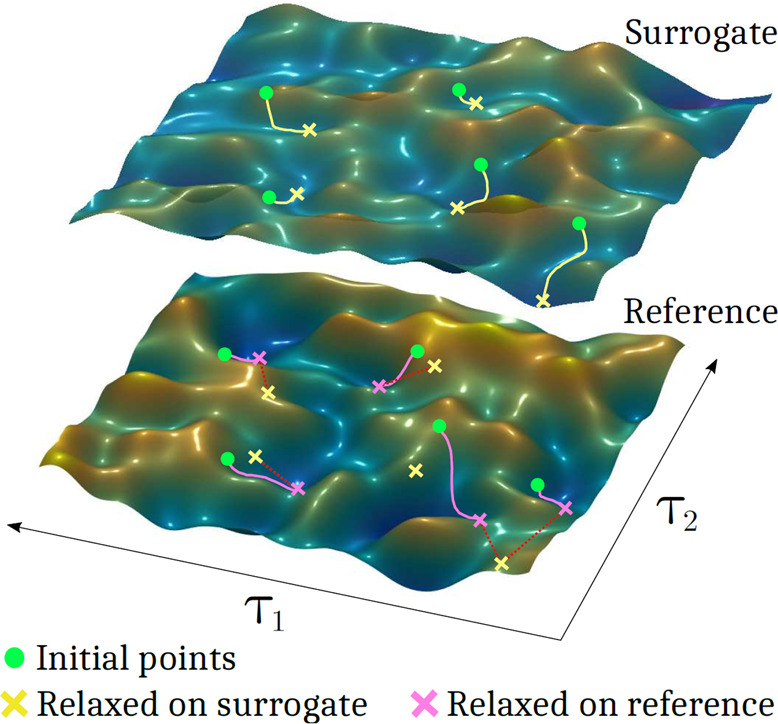
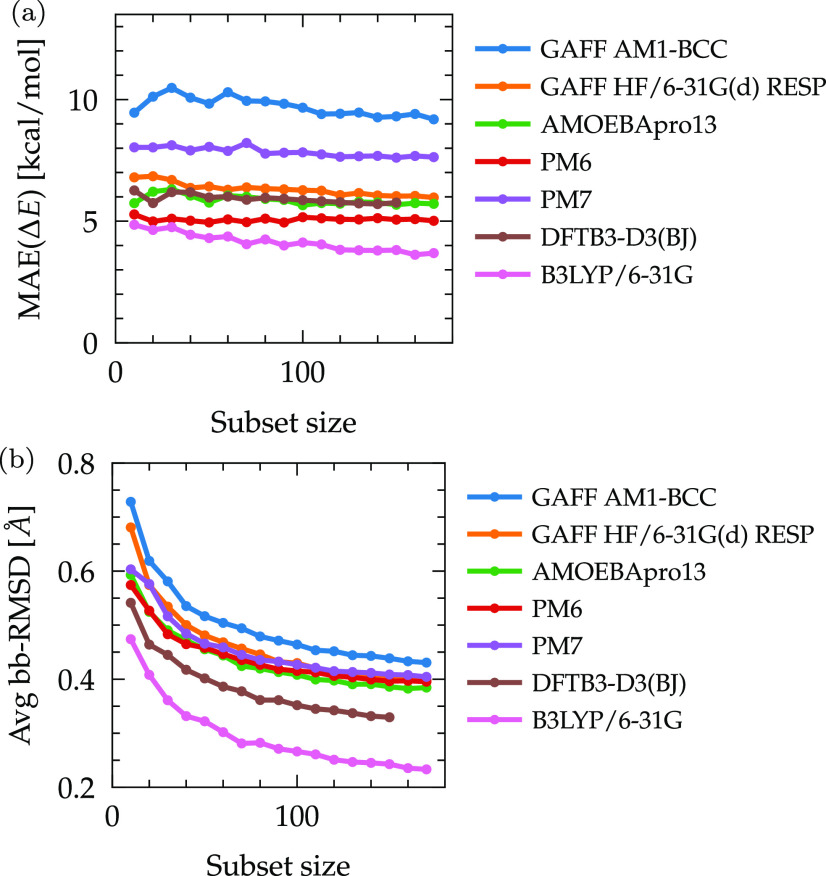
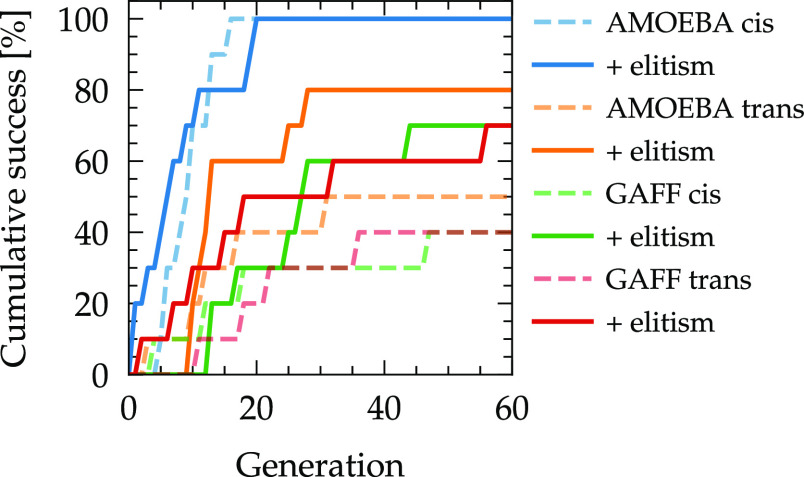
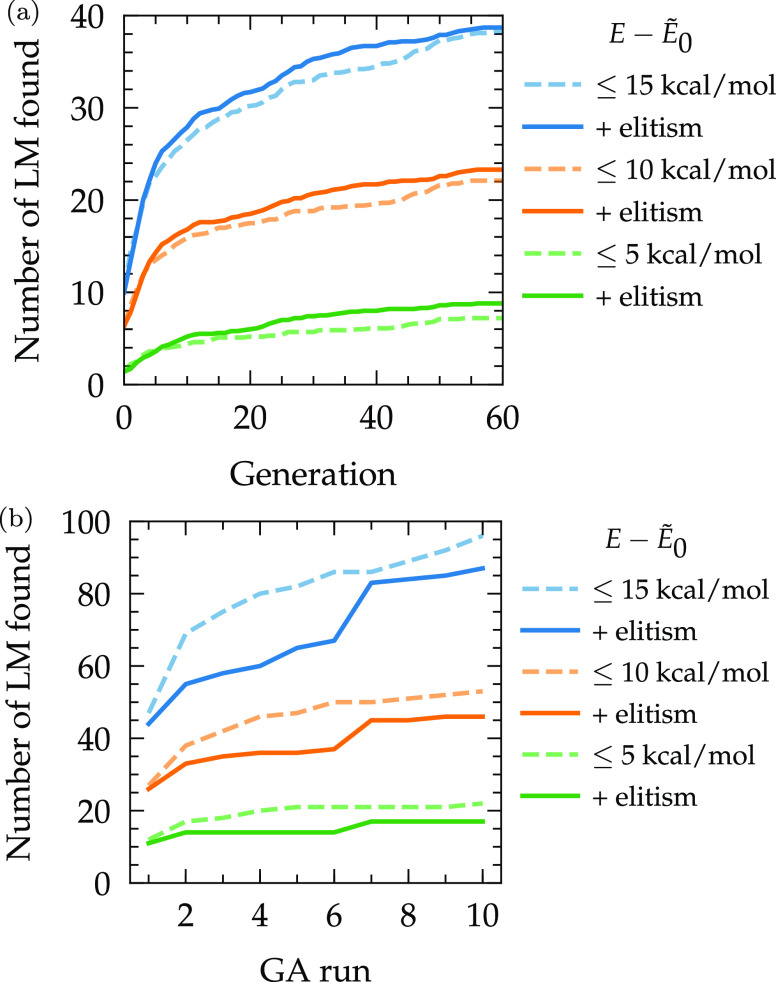
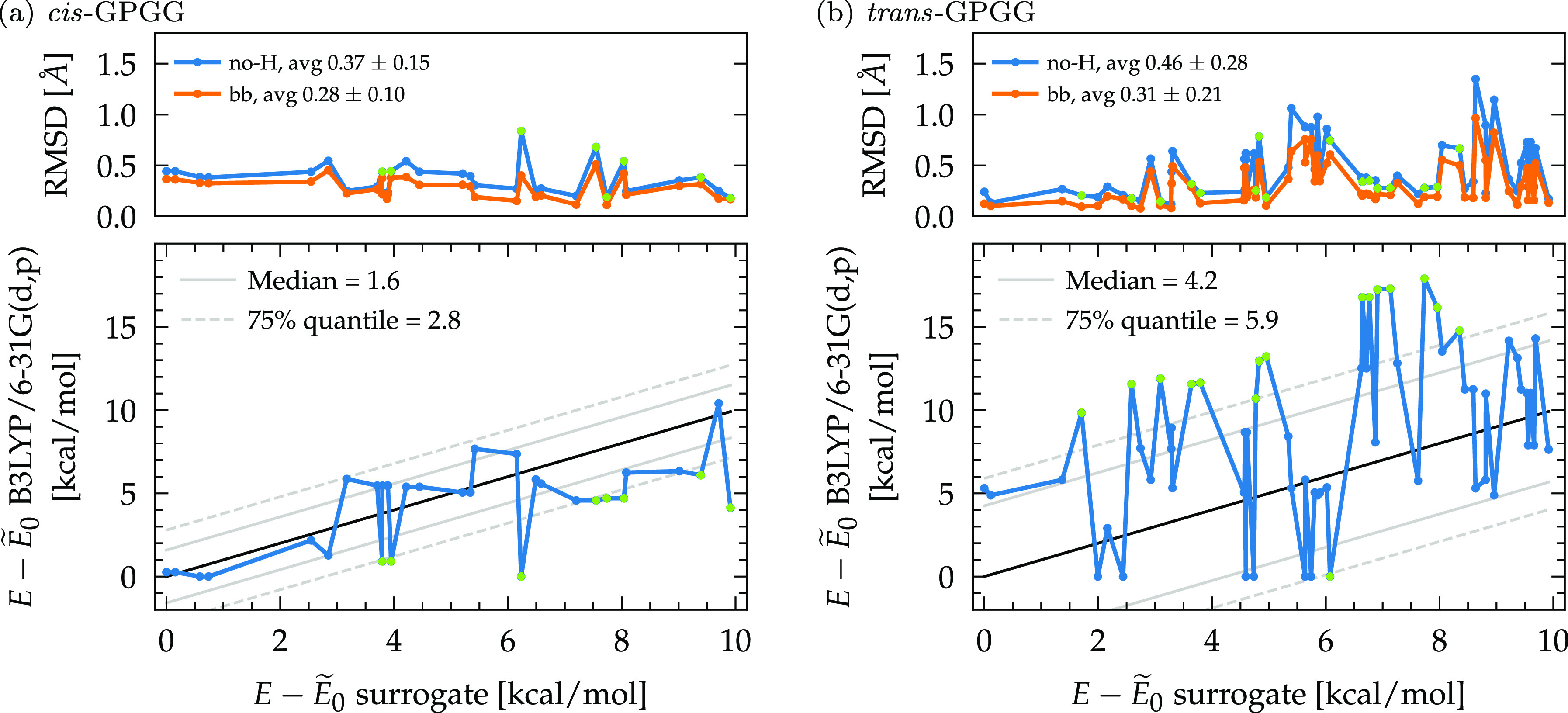
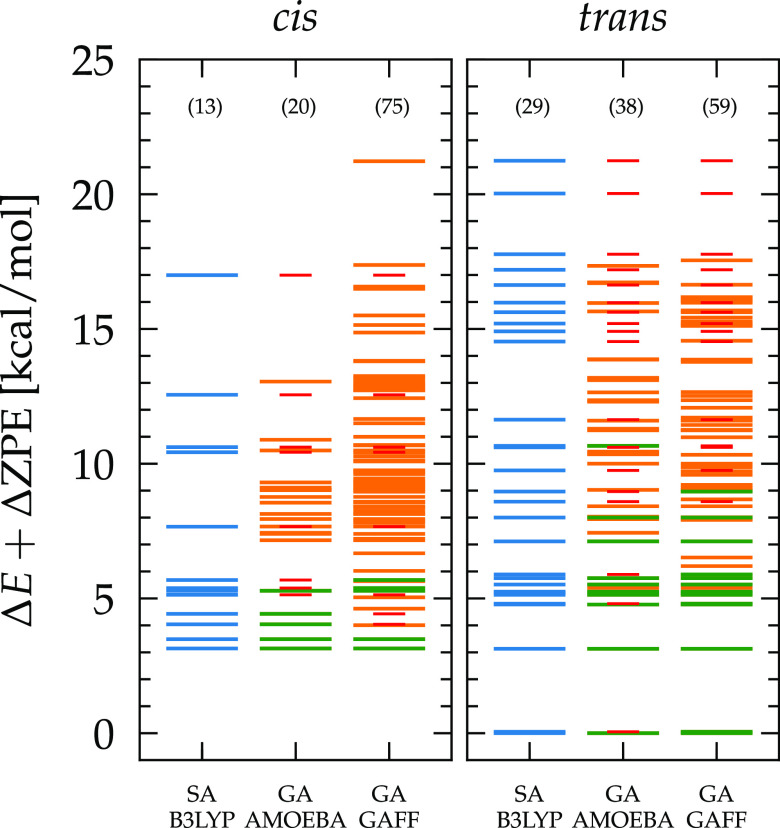
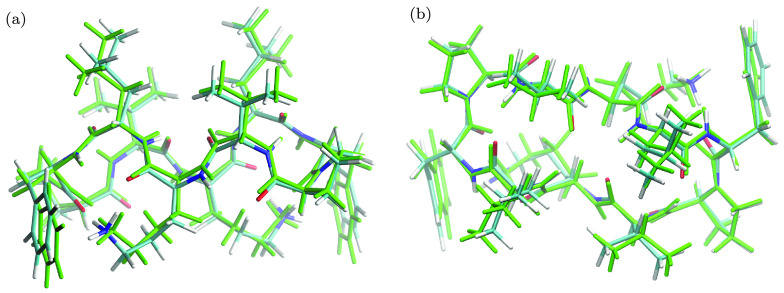
High Resolution Image Download MS PowerPoint Slide Identification of the most stable structure(s) of a system is a prerequisite for the calculation of any of its properties from first-principles. However, even for relatively small molecules, exhaustive explorations of the potential energy surface (PES) are severely hampered by the dimensionality bottleneck. In this work, we address the challenging task of efficiently sampling realistic low-lying peptide coordinates by resorting to a surrogate based genetic algorithm (GA)/density functional theory (DFT) approach (sGADFT) in which promising candidates provided by the GA are ultimately optimized with DFT. We provide a benchmark of several computational methods (GAFF, AMOEBApro13, PM6, PM7, DFTB3-D3(BJ)) as possible prescanning surrogates and apply sGADFT to two test case systems that are (i) two isomer families of the protonated Gly-Pro-Gly-Gly tetrapeptide ( Masson, A.; J. Am. Soc. Mass Spectrom. 2015, 26, 1444−1454) and (ii) the doubly protonated cyclic decapeptide gramicidin S ( Nagornova, N. S.; J. Am. Chem. Soc. 2010, 132, 4040−4041). We show that our GA procedure can correctly identify low-energy minima in as little as a few hours. Subsequent refinement of surrogate low-energy structures within a given energy threshold (≤10 kcal/mol (i), ≤5 kcal/mol (ii)) via DFT relaxation invariably led to the identification of the most stable structures as determined from high-resolution infrared (IR) spectroscopy at low temperature. The sGADFT method therefore constitutes a highly efficient route for the screening of realistic low-lying peptide structures in the gas phase as needed for instance for the interpretation and assignment of experimental IR spectra.
Overview
The claims and statistics of this paper haven’t been checked yet.
Run the check — free, no account needed. It reads the open-access text and checks the sources it cites.
Integrity signals
Registry
Cites
Statistics
Figures
Verification
Claims the paper makes
The claims and statistics of this paper haven’t been checked yet.
Run the check — free, no account needed. It reads the open-access text and checks the sources it cites.
Self-check
Percentages, sums and reported differences re-computed from the paper’s own numbers.
The self-check needs the paper’s full text.
Citations
Cites
Grimme, S., Antony, J., Ehrlich, S., & Krieg, H. (2010) · The Journal of Chemical Physics · doi:10.1063/1.3382344 · Cited by 59,686
Holland, J. H. (1992) · The MIT Press eBooks · doi:10.7551/mitpress/1090.001.0001 · Cited by 47,002
Highly accurate protein structure prediction with AlphaFold
Jumper, J., Evans, R., Pritzel, A., Green, T., Figurnov, M., Ronneberger, O., Tunyasuvunakool, K., Bates, R., Žídek, A., Potapenko, A., et al. (2021) · Nature · doi:10.1038/s41586-021-03819-2 · Cited by 43,764
Berman, H. M. (2000) · Nucleic Acids Research · doi:10.1093/nar/28.1.235 · Cited by 40,196
Effect of the damping function in dispersion corrected density functional theory
Grimme, S., Ehrlich, S., & Goerigk, L. (2011) · Journal of Computational Chemistry · doi:10.1002/jcc.21759 · Cited by 28,221
Stephens, P. J., Devlin, F. J., Chabalowski, C. F., & Frisch, M. J. (1994) · The Journal of Physical Chemistry · doi:10.1021/j100096a001 · Cited by 23,248
Development and testing of a general amber force field
Wang, J., Wolf, R. M., Caldwell, J. W., Kollman, P. A., & Case, D. A. (2004) · Journal of Computational Chemistry · doi:10.1002/jcc.20035 · Cited by 19,506
The Proceedings of the National Academy of Sciences
Richards, J. W. (1915) · Science · doi:10.1126/science.42.1074.161 · Cited by 13,983
An Introduction to Genetic Algorithms
Mitchell, M. (1996) · doi:10.7551/mitpress/3927.001.0001 · Cited by 11,340
Open Babel: An open chemical toolbox
O'Boyle, N. M., Banck, M., James, C. A., Morley, C., Vandermeersch, T., & Hutchison, G. R. (2011) · Journal of Cheminformatics · doi:10.1186/1758-2946-3-33 · Cited by 10,939
Research works printed but not linked: 2
- 10.1002/(SICI)1097-0134(1997)1+<179::AID-PROT23>3.0.CO;2-K · DOI
- Deb K., 1995, Complex Syst., 9, 115
Metadata
- Authors
- Villard, J., Kılıç, M., & Rothlisberger, U.
- Affiliations
- École Polytechnique Fédérale de Lausanne (CH)
- Laboratory of Computational Chemistry and Biochemistry, Institute of Chemical Sciences and Engineering, École Polytechnique Fédérale de Lausanne (EPFL), CH-1015Lausanne, Switzerland
- Venue
- Journal of Chemical Theory and Computation
- Publisher
- American Chemical Society (ACS)
- Published
- 2023-01-24
- Volume
- 19
- Issue
- 3
- Pages
- 1080-1097
- ISSN
- 1549-9618 (ISSN-L)
- 1549-9626
- PMC
- PMC9933449
- OpenAlex
- W4317867555
- Cited by
- 19
- References
- 120
- Citations by year
- 2026: 12 · 2025: 2 · 2024: 3 · 2023: 2
- FWCI
- 2.21
- Type
- journal article
- Language
- en
- Open access
- hybrid
- doi.org
- Licence
- Locations
- Journal of Chemical Theory and Computation (publishedVersion, cc-by-nc-nd)
- ChemRxiv (acceptedVersion, cc-by)
- PubMed Central (publishedVersion, cc-by-nc-nd)
- PubMed (publishedVersion)
- Infoscience (Ecole Polytechnique Fédérale de Lausanne) (submittedVersion, cc-by-nc-nd)
- Funders
- Schweizerischer Nationalfonds zur Förderung der Wissenschaftlichen Forschung (200020_185092)
- Topics
- Physical Sciences › Physics and Astronomy › Atomic and Molecular Physics, and Optics › Advanced Chemical Physics Studies
- Physical Sciences › Chemistry › Spectroscopy › Mass Spectrometry Techniques and Applications
- Life Sciences › Biochemistry, Genetics and Molecular Biology › Molecular Biology › Protein Structure and Dynamics
- Keywords
- density functional theory, gramicidin S, infrared spectroscopy, GAFF, amoebae, PM6, PM7
- MeSH terms
- Algorithms, Gramicidin, Peptides
About these checks
Registry, retraction, Cites and statistics results are computed, not judged, with one exception: a printed reference that no index lists is read once by a model before it counts as a citation error. Claims are extracted by a model and kept only when their quote appears verbatim in the text; each cited source is then checked, with a model’s help, for whether it says what the claim relies on. Those verdicts can be wrong — read the claim’s quote and the cited source before relying on one.
Statistics and arithmetic are recomputed, not judged.
Confidence bands are shown only for fields calibrated on our annotated test set. None is calibrated yet, so no band is shown.
What counts as a claim ›How we measure confidence ›How we check this ›
Are you an author, or do you see a problem with this page? Request a review
How to cite
Cite CoChat for the checks on this page, and the paper for its own findings.
- This page
- CoChat. (2026). Citation check: Surrogate Based Genetic Algorithm Method for Efficient Identification of Low-Energy Peptide Structures. https://app.cochat.ai/papers/10.1021/acs.jctc.2c01078
- The paper
- Villard, J., Kılıç, M., & Rothlisberger, U. (2023). Surrogate Based Genetic Algorithm Method for Efficient Identification of Low-Energy Peptide Structures. Journal of Chemical Theory and Computation. https://doi.org/10.1021/acs.jctc.2c01078
Data sources
Bibliographic data: Semantic Scholar, OpenAlex, Crossref.
Contains information from the Semantic Scholar Academic Graph Datasets, made available under the ODC Attribution License (ODC-BY 1.0).
Semantic Scholar’s data is described in: Kinney, R., et al. (2023). The Semantic Scholar Open Data Platform. arXiv:2301.10140.
