

On the Changing Role of the Stratosphere on the Tropospheric Ozone Budget: 1979–2010
Open accessThe DOI matches its Crossref record; 41 of the 41 references it cites were found in a registry or an index.
Abstract
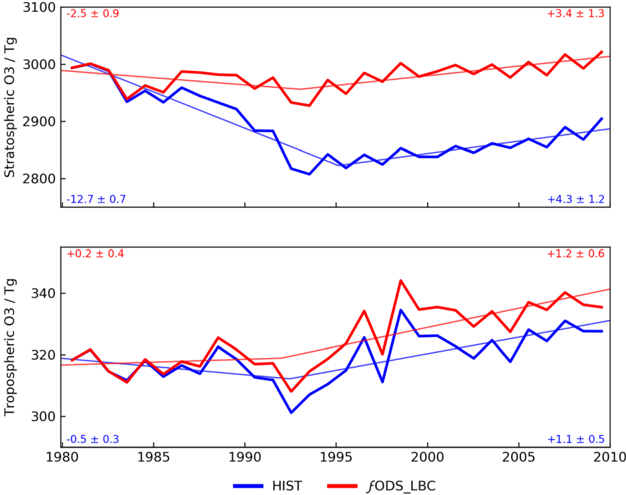
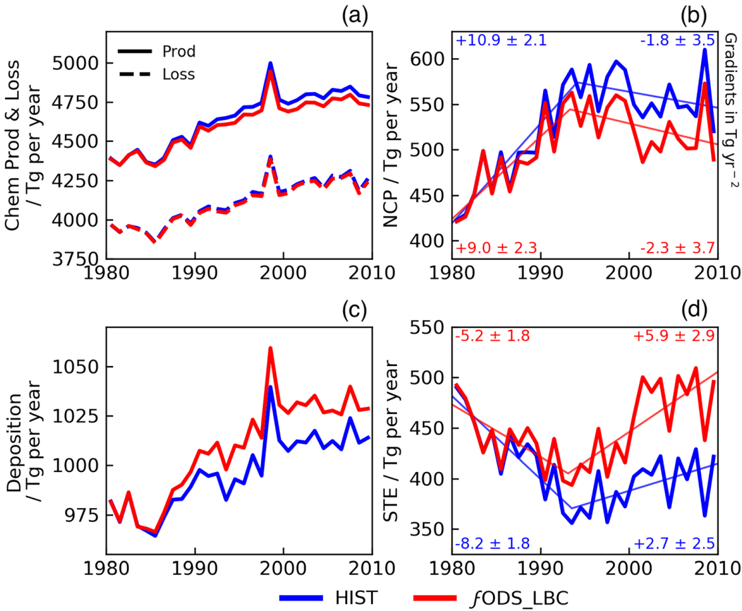
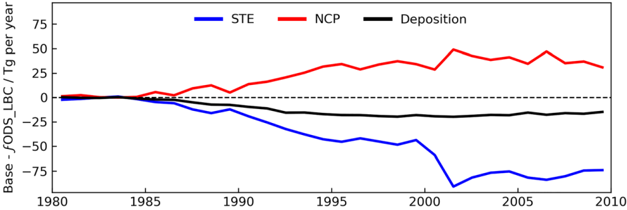
We study the evolution of tropospheric ozone over the period 1979–2010 using a chemistry‐climate model employing a stratosphere‐troposphere chemistry scheme. By running with specified dynamics, the key feedback of composition on meteorology is suppressed, isolating the chemical response. By using historical forcings and emissions, interactions between processes are realistically represented. We use the model to assess how the ozone responds over time and to investigate model responses and trends. We find that the chlorofluorocarbon (CFC)‐driven decrease in stratospheric ozone plays a significant role in the tropospheric ozone burden. Over the period 1979–1994, the decline in transport of ozone from the stratosphere, partially offsets an emissions‐driven increase in tropospheric ozone production. From 1994–2010, despite a leveling off in emissions, increased stratosphere‐to‐troposphere transport of ozone drives a small increase in the tropospheric ozone burden. These results have implications for the impact of future stratospheric ozone recovery on air quality and radiative forcing.
Overview
The claims and statistics of this paper haven’t been checked yet.
Free: it reads the open-access text and checks the first 5 claims that cite a source we can check. Create a free account to check every claim.
Integrity signals
Registry
Cites
Statistics
Figures



Verification
Claims the paper makes
The claims and statistics of this paper haven’t been checked yet.
Free: it reads the open-access text and checks the first 5 claims that cite a source we can check. Create a free account to check every claim.
Claims other papers make about this one
Each is checked against this paper’s own text: does it say what the citing paper says it does?
The cited source says what the claim attributes to it.
In the citing paper
“A modeling study focusing on the period 1980–2010 calculated a decrease in the transport of O3 from the stratosphere to the troposphere due to the impact of ODSs on stratospheric O3 [160].”
From Changes in tropospheric air quality related to the protection of stratospheric ozone in a changing climate (2023) · cites this paper as [160]
In the citing paper
“The model estimated a 4% decrease (14 Tg O3) in global tropospheric O3 resulting from ODS up until 1994.”
From Changes in tropospheric air quality related to the protection of stratospheric ozone in a changing climate (2023) · cites this paper as [160]
Self-check
Percentages, sums and reported differences re-computed from the paper’s own numbers.
The self-check needs the paper’s full text.
Citations
Cites
The ERA‐Interim reanalysis: configuration and performance of the data assimilation system
Dee, D. P., Uppala, S. M., Simmons, A. J., Berrisford, P., Poli, P., Kobayashi, S., Andrae, U., Balmaseda, M. A., Balsamo, G., Bauer, P., et al. (2011) · Quarterly Journal of the Royal Meteorological Society · doi:10.1002/qj.828 · Cited by 24,480 · cited 2×
“, 2008)) to ERA-Interim Reanalysis data (Dee et al., 2011).”
BackgroundRayner, N. A., Parker, D. E., Horton, E. B., Folland, C. K., Alexander, L. V., Rowell, D. P., Kent, E. C., & Kaplan, A. (2003) · Journal of Geophysical Research: Atmospheres · doi:10.1029/2002jd002670 · Cited by 10,991 · cited 2×
“This simulation spans 1979–2010, with emissions taken from MACCity (Granier et al., 2011) and uses prescribed sea surface temperatures and sea ice fromHadISST (Rayner et al., 2003).”
BackgroundMethodAnthropogenic and Natural Radiative Forcing
(2014) · Climate Change 2013 – The Physical Science Basis · doi:10.1017/cbo9781107415324.018 · Cited by 3,683 · cited 1×
“The changes in tropospheric ozone since the preindustrial era are estimated to have resulted in an increase in radiative forcing of 0.4 W m−2 (Myhre et al., 2013; Stevenson et al., 2006), making tropospheric ozone the third most important anthropogenic greenhouse gas.”
BackgroundInfluentialParameterization of surface resistances to gaseous dry deposition in regional-scale numerical models
Wesely, M. L. (1989) · Atmospheric Environment (1967) · doi:10.1016/0004-6981(89)90153-4 · Cited by 2,304
Monks, P. S., Archibald, A. T., Colette, A., Cooper, O., Coyle, M., Derwent, R., Fowler, D., Granier, C., Law, K. S., Mills, G. E., et al. (2015) · Atmospheric Chemistry and Physics · doi:10.5194/acp-15-8889-2015 · Cited by 1,572 · cited 3×
“Unlike the major greenhouse gases, carbon dioxide (CO2) and methane (CH4), ozone is not emitted directly, but is the result of a complex scheme of oxidation of VOCs in the presence of NOx (Monks et al., 2015).”
BackgroundSelf-citationMultimodel ensemble simulations of present‐day and near‐future tropospheric ozone
Stevenson, D. S., Dentener, F. J., Schultz, M. G., Ellingsen, K., van Noije, T. P. C., Wild, O., Zeng, G., Amann, M., Atherton, C. S., Bell, N., et al. (2006) · Journal of Geophysical Research: Atmospheres · doi:10.1029/2005jd006338 · Cited by 1,198 · cited 4×
“, 2013]) and 336 ± 27 (+16–21) Tg (ACCENT,(Stevenson et al., 2006) (although we note the TOAR burden is restricted to the latitude ±60°).”
BackgroundMethodInfluentialSelf-citationGranier, C., Bessagnet, B., Bond, T., D’Angiola, A., Denier van der Gon, H., Frost, G. J., Heil, A., Kaiser, J. W., Kinne, S., Klimont, Z., et al. (2011) · Climatic Change · doi:10.1007/s10584-011-0154-1 · Cited by 847 · cited 4×
“This simulation spans 1979-2010, with emissions taken from MACCity (Granier et al., 2011), and uses prescribed sea surface temperatures and sea ice from HadISST (Rayner et al.”
MethodInfluentialButchart, N. (2014) · Reviews of Geophysics · doi:10.1002/2013rg000448 · Cited by 791 · cited 2×
“From 1994–2006, modeled STE slowly increases, driven in part by early signs of stratospheric ozone recovery in the mid‐latitudes (e.g. (Keeble et al., 2018), and stratospheric dynamical changes resulting from increased GHGs (e.g., Butchart, 2014).”
BackgroundYoung, P. J., Archibald, A. T., Bowman, K. W., Lamarque, J.-F., Naik, V., Stevenson, D. S., Tilmes, S., Voulgarakis, A., Wild, O., Bergmann, D., et al. (2013) · Atmospheric Chemistry and Physics · doi:10.5194/acp-13-2063-2013 · Cited by 677 · cited 3×
“The residual STT of 441 Tg yr−1 is within the ACCMIP range of 535 ± 161 Tg yr−1 (Young et al., 2013).”
BackgroundMethodSelf-citationGaudel, A., Cooper, O. R., Ancellet, G., Barret, B., Boynard, A., Burrows, J. P., Clerbaux, C., Coheur, P.-F., Cuesta, J., Cuevas, E., et al. (2018) · Elementa: Science of the Anthropocene · doi:10.1525/elementa.291 · Cited by 663 · cited 6×
“The tropospheric O3 burden (using 125ppbv ozonopause) is 295 Tg for year 2000, which compares well with observational estimates of between 260 Tg and 340 Tg (Gaudel et al., 2018), over the same latitude range.”
BackgroundMethodInfluential
Cited by
Tropospheric ozone in CMIP6 simulations
Griffiths, P. T., Murray, L. T., Zeng, G., Shin, Y. M., Abraham, N. L., Archibald, A. T., Deushi, M., Emmons, L. K., Galbally, I. E., Hassler, B., et al. (2021) · Atmospheric Chemistry and Physics · doi:10.5194/acp-21-4187-2021 · Cited by 289
Self-citationNeale, R. E., Barnes, P. W., Robson, T. M., Neale, P. J., Williamson, C. E., Zepp, R. G., Wilson, S. R., Madronich, S., Andrady, A. L., Heikkilä, A. M., et al. (2021) · Photochemical & Photobiological Sciences · doi:10.1007/s43630-020-00001-x · Cited by 225
Wang, H., Lu, X. H., Jacob, D. J., Cooper, O. R., Chang, K., Li, K., Gao, M. C., Liu, Y., Sheng, B., Wu, K., et al. (2022) · Atmospheric chemistry and physics · doi:10.5194/acp-22-13753-2022 · Cited by 159
Madronich, S., Sulzberger, B., Longstreth, J. D., Schikowski, T., Andersen, M. P. S., Solomon, K. R., & Wilson, S. R. (2023) · Photochemical & Photobiological Sciences · doi:10.1007/s43630-023-00369-6 · Cited by 64
“A modeling study focusing on the period 1980–2010 calculated a decrease in the transport of O3 from the stratosphere to the troposphere due to the impact of ODSs on stratospheric O3 [160].”
Christiansen, A., Mickley, L. J., Liu, J., Oman, L. D., & Hu, L. (2022) · Atmospheric chemistry and physics · doi:10.5194/acp-22-14751-2022 · Cited by 78
Zhao, K., Hu, C., Yuan, Z., Xu, D., Zhang, S., Luo, H., Wang, J., & Jiang, R. (2020) · Atmospheric Research · doi:10.1016/j.atmosres.2020.105158 · Cited by 41
Remote Sensing of Tropospheric Ozone from Space: Progress and Challenges
Xu, J., Zhang, Z., Rao, L., Wang, Y., Letu, H., Shi, C., Tana, G., Wang, W., Zhu, S., Liu, S., et al. (2024) · Journal of Remote Sensing · doi:10.34133/remotesensing.0178 · Cited by 40
Rosanka, S., Sander, R., Franco, B., Wespes, C., Wahner, A., & Taraborrelli, D. (2021) · Atmospheric chemistry and physics · doi:10.5194/acp-21-9909-2021 · Cited by 40
Wang, M., & Fu, Q. (2021) · Journal of Geophysical Research: Atmospheres · doi:10.1029/2021jd035159 · Cited by 34
“Stratosphere-troposphere exchange (STE) of ozone represents a significant source for the tropospheric ozone budget (e.g., Bates & Jacob, 2020; Collins et al., 2003; Griffiths et al., 2020; Stohl et al., 2003).”
Backgrounddu Preez, D. J., Benchérif, H., Portafaix, T., Lamy, K., & Wright, C. Y. (2021) · Atmosphere · doi:10.3390/atmos12020132 · Cited by 24
“Using the ozone sounding data from the Irene weather station, the tropospheric ozone profile and tropospheric ozone total column were derived for the periods 1998 to 2018 (369 ozonesondes) (Figure 3a,b) and 2012 to 2018 (113 ozonesondes) (Figure 4a,b).”
BackgroundInfluentialMalderen, R. V., Muer, D. D., Backer, H. D., Poyraz, D., Verstraeten, W. W., Bock, V. D., Delcloo, A., Mangold, A., Laffineur, Q., Allaart, M., et al. (2021) · Atmospheric chemistry and physics · doi:10.5194/acp-21-12385-2021 · Cited by 27
Influence of stratosphere-troposphere exchange on long-term trends of surface ozone in CMIP6
Li, Y., Xia, Y., Xie, F., & Yan, Y. (2023) · Atmospheric Research · doi:10.1016/j.atmosres.2023.107086 · Cited by 28
Wang, M., & Fu, Q. (2023) · Journal of Geophysical Research Atmospheres · doi:10.1029/2023jd038487 · Cited by 19
“Stratosphere-troposphere exchange (STE) of ozone is an important source for the tropospheric ozone budget (e.g., Bates & Jacob, 2020; Collins et al., 2003; Griffiths et al., 2020; Stohl et al., 2003).”
BackgroundSurface Ozone Concentration over Russian Territory in the First Half of 2020
Andreev, V. V., Arshinov, M., Belan, B. D., Davydov, D., Elansky, N. F., Жамсуева, Г. С., Zayakhanov, A. S., Ivlev, G. A., Kozlov, A. V., Kotelnikov, S. N., et al. (2020) · Atmospheric and Oceanic Optics · doi:10.1134/s1024856020060184 · Cited by 18
Russo, M. R., Kerridge, B. J., Abraham, N. L., Keeble, J., Latter, B. G., Siddans, R., Weber, J., Griffiths, P. T., Pyle, J. A., & Archibald, A. T. (2023) · Atmospheric chemistry and physics · doi:10.5194/acp-23-6169-2023 · Cited by 25
Self-citationStratosphere‐Troposphere Exchanges of Air Mass and Ozone Concentration in the Last Glacial Maximum
Wang, M., Fu, Q., Solomon, S., Alexander, B., & White, R. H. (2022) · Journal of Geophysical Research Atmospheres · doi:10.1029/2021jd036327 · Cited by 14
“Ozone STE is a crucial component for the tropospheric ozone budget (e.g., Bates & Jacob, 2020; Griffiths et al., 2020; Stohl et al., 2003).”
BackgroundTropospheric ozone as an atmospheric pollutant and short-lived climate forcer in the Third Pole
Sharma, B. R., Kuttippurath, J., & Gopikrishnan, G. P. (2025) · Chemosphere · doi:10.1016/j.chemosphere.2025.144474 · Cited by 9
Causes of growing middle-to-upper tropospheric ozone over the northwest Pacific region
Ma, X., Huang, J., Hegglin, M. I., Jöckel, P., & Zhao, T. (2025) · Atmospheric chemistry and physics · doi:10.5194/acp-25-943-2025 · Cited by 10
Sahu, S. K., Chen, L., Liu, S., Xing, J., & Mathur, R. (2023) · Aerosol and Air Quality Research · doi:10.4209/aaqr.220414 · Cited by 6
Abed, F. G., Rajab, J. M., & Daway, H. G. (2025) · Papers in Applied Geography · doi:10.1080/23754931.2025.2455745 · Cited by 6
“2020; Griffiths et al .”
Wood, D. A. (2022) · Urban Climate · doi:10.1016/j.uclim.2022.101382 · Cited by 5
Feng, T., Liu, L., & Zhao, S. (2023) · Environmental Pollution · doi:10.1016/j.envpol.2023.122347 · Cited by 5
Elsbury, D., Butler, A. H., Albers, J. R., Breeden, M. L., & Langford, A. O. (2023) · Atmospheric chemistry and physics · doi:10.5194/acp-23-5101-2023 · Cited by 5
Liu, S., Hua, J., Wang, H., Han, S., Lee, L., Qi, C., Lu, F., Luo, Y., Zhao, X., Li, Z., et al. (2025) · Journal of Geophysical Research Atmospheres · doi:10.1029/2024jd042292 · Cited by 10
“Furthermore, its concentration is also influenced by meteorological phenomena, including the exchange between the stratosphere and troposphere (e.g., Griffiths et al., 2020).”
Technical note: Northern midlatitude baseline ozone – long-term changes and the COVID-19 impact
Parrish, D. D., Derwent, R. G., Faloona, I. C., & Mims, C. A. (2022) · Atmospheric chemistry and physics · doi:10.5194/acp-22-13423-2022 · Cited by 9
ENSO‐Driven Variability in Ozone Sources and Its Impact on Tropospheric Ozone Radiative Forcing
Pouyaei, A., Ginoux, P. A., Naïk, V., Feng, J., Horowitz, L. W., & Paulot, F. (2025) · Geophysical Research Letters · doi:10.1029/2025gl115898 · Cited by 3
“On the other hand, ENSO‐driven changes in circulation patterns such as the Brewer‐Dobson (BD) circulation can alter ozone concentrations in the upper‐troposphere lower‐stratosphere (UTLS) region, further impacting ozone radiative effects (Albers et al., 2022; Griffiths et al., 2020).”
High O3 pollution initiated by cold front passage over Pearl River Estuary
Wu, B., Liu, Q., Ling, Z., Fang, G., Wu, L., Wang, X., & Tham, Y. J. (2024) · Atmospheric Research · doi:10.1016/j.atmosres.2024.107636 · Cited by 5
Zeng, S., Zhou, S., Wang, F., Zhou, Y., & Yuan, Z. (2025) · Open Geosciences · doi:10.1515/geo-2025-0833 · Cited by 1
(2022) · Atmospheric chemistry and physics · doi:10.5194/acp-2022-99-rc1
Misleading paper with major flaws. Needs fundamental revisions and more years with data.
(2022) · Atmospheric chemistry and physics · doi:10.5194/acp-2022-424-rc1
(2022) · Atmospheric chemistry and physics · doi:10.5194/acp-2022-424-rc2
Reply to 2nd Comment of Anonymous Referee #1: acp-2022-424-RC2
Parrish, D. D. (2022) · Atmospheric chemistry and physics · doi:10.5194/acp-2022-424-ac2
(2022) · Atmospheric chemistry and physics · doi:10.5194/acp-2022-99-rc2
Comment on trends and ozonesonde data
Christiansen, A., Mickley, L. J., Liu, J., et al. (2022) · Atmospheric chemistry and physics · doi:10.5194/acp-2022-330-cc1
Christiansen, A., Mickley, L. J., Liu, J., et al. (2022) · Atmospheric chemistry and physics · doi:10.5194/acp-2022-330-rc1
(2022) · Atmospheric chemistry and physics · doi:10.5194/acp-2022-424-rc4
Christiansen, A., Mickley, L. J., Liu, J., et al. (2022) · Atmospheric chemistry and physics · doi:10.5194/acp-2022-330-rc2
Wang, H., Lu, X. H., Jacob, D. J., et al. (2022) · Atmospheric chemistry and physics · doi:10.5194/acp-2022-381-rc2
Lu, X. H. (2022) · Atmospheric chemistry and physics · doi:10.5194/acp-2022-381-ac1
Lu, X. H. (2022) · Atmospheric chemistry and physics · doi:10.5194/acp-2022-381-ac2
Christiansen, A. (2022) · Atmospheric chemistry and physics · doi:10.5194/acp-2022-330-ac1
Russo, M. R. (2022) · Atmospheric chemistry and physics · doi:10.5194/acp-2022-99-ac1
Russo, M. R. (2022) · Atmospheric chemistry and physics · doi:10.5194/acp-2022-99-ac2
Werner, M., Guzikowski, J., & Kryza, M. (2022) · Springer proceedings in complexity · doi:10.1007/978-3-031-12786-1_26
Elsbury, D., Butler, A. H., Albers, J. R., et al. (2023) · Atmospheric chemistry and physics · doi:10.5194/acp-2022-700-rc2
Causes of growing middle-upper tropospheric ozone over the Northwest Pacific regionPreprint
Ma, X., Huang, J., Hegglin, M. I., Joeckel, P., & Zhao, T. (2024) · doi:10.5194/egusphere-2023-2411
Huang, J. (2024) · doi:10.5194/egusphere-2023-2411-ac1
Huang, J. (2024) · doi:10.5194/egusphere-2023-2411-ac2
Stratospheric circulation trends and their impact on the climate system
Seviour, W. J. M., & Ábalos, M. (2025) · Elsevier eBooks · doi:10.1016/b978-0-443-15748-6.00010-1
A storyline of ozone pollution extremes in warmer climatesPreprint
Emmerichs, T., Shen, F., Gromov, S. S., Hegglin, M. I., Wahner, A., & Taraborrelli, D. (2024) · Research Square · doi:10.21203/rs.3.rs-4208627/v1
Abed, F. G., Rajab, J. M., & Daway, H. G. (2026) · Communications in computer and information science · doi:10.1007/978-3-032-13026-6_20
CRUX-1.0: an automatic GHG and Ozone observation system for inland Antarctica Plateau
Tian, B., Ding, M., Zhu, K., Yao, X., Zhao, Y., Zhang, W., Yang, D., Sun, W., Yu, Y., Zhao, S., et al. (2026) · Atmospheric measurement techniques · doi:10.5194/amt-19-5683-2026
du Preez, D. J. (2021) · theses.fr (ABES) · doi:10.70675/45eac48cze496z4fa0z9aa7zc228db820901
Hall, A., Dong, C., Fu, Q., & Solomon, S. (2026) · Climate · doi:10.3390/cli14100205
Mao, G., Zhang, C., Wang, X., Zhao, R., Shu, S., Wang, Q., Wang, Y., Xu, N., Chen, L., & Liu, C. (2026) · IEEE Transactions on Geoscience and Remote Sensing · doi:10.1109/tgrs.2026.3738810
“Especially in regions of the Northern Hemisphere significantly a ff ected by anthropogenic activities, vertical ozone monitoring data serve as a core basis for analyzing its variation mechanisms [8], [9], [10].”
Tropospheric Ozone Assessment Report II: Stratosphere–troposphere exchange of ozone
Keeble, J., Griffiths, P. T., Ábalos, M., Akritidis, D., Bartusek, S., Cooper, O. R., Fu, Q., Hegglin, M. I., Iglesias‐Suarez, F., Koren, G., et al. (2026) · Philosophical Transactions of the Royal Society A Mathematical Physical and Engineering Sciences · doi:10.1098/rsta.2025.0271 · Cited by 3
Self-citationSzopa, S., Cooper, O. R., Collins, B., Fiore, A. M., Lee, J., Lin, M., Lu, X., Naïk, V., Turnock, S. T., West, J. J., et al. (2026) · Philosophical Transactions of the Royal Society A Mathematical Physical and Engineering Sciences · doi:10.1098/rsta.2025.0272 · Cited by 4
Metadata
- Authors
- Griffiths, P. T., Keeble, J., Shin, Y. M., Abraham, N. L., Archibald, A. T., & Pyle, J. A.
- Affiliations
- University of Cambridge (GB)
- Corresponding author
- Griffiths, P. T.
- Venue
- Geophysical Research Letters
- Publisher
- American Geophysical Union (AGU)
- Published
- 2020-05-13
- Volume
- 47
- Issue
- 10
- ISSN
- 0094-8276 (ISSN-L)
- 1944-8007
- OpenAlex
- W3013590456
- Cited by
- 62
- References
- 39
- Citations by year
- 2026: 6 · 2025: 7 · 2024: 11 · 2023: 8 · 2022: 21 · 2021: 7 · 2020: 2
- FWCI
- 3.11
- Type
- journal article
- Language
- en
- Open access
- hybrid
- doi.org
- Licence
- Locations
- Geophysical Research Letters (publishedVersion, cc-by)
- Lancaster EPrints (Lancaster University) (submittedVersion)
- Bristol Research (University of Bristol) (submittedVersion)
- OSF Preprints (OSF Preprints) (submittedVersion, cc-by)
- EarthArXiv (OSF Preprints) (submittedVersion)
- EarthArXiv (OSF Preprints) (submittedVersion, cc-by)
- Apollo (University of Cambridge) (submittedVersion)
- Apollo
- Funders
- European Research Council (603557)
- Natural Environment Research Council
- Topics
- Physical Sciences › Earth and Planetary Sciences › Atmospheric Science › Atmospheric Ozone and Climate
- Physical Sciences › Earth and Planetary Sciences › Atmospheric Science › Atmospheric chemistry and aerosols
- Physical Sciences › Environmental Science › Global and Planetary Change › Atmospheric aerosols and clouds
- Keywords
- tropospheric ozone, stratospheric ozone, stratosphere-troposphere exchange, ozone budget, chlorofluorocarbons, ozone depletion, ozone emissions, stratospheric ozone recovery, chemistry-climate model, air quality, radiative forcing
About these checks
Registry, retraction, Cites and statistics results are computed, not judged, with one exception: a printed reference that no index lists is read once by a model before it counts as a citation error. Claims are extracted by a model and kept only when their quote appears verbatim in the text; each cited source is then checked, with a model’s help, for whether it says what the claim relies on. Those verdicts can be wrong — read the claim’s quote and the cited source before relying on one.
Statistics and arithmetic are recomputed, not judged.
Confidence bands are shown only for fields calibrated on our annotated test set. None is calibrated yet, so no band is shown.
What counts as a claim ›How we measure confidence ›How we check this ›
Are you an author, or do you see a problem with this page? Request a review
Data sources
Bibliographic data: Semantic Scholar, OpenAlex, Crossref.
Contains information from the Semantic Scholar Academic Graph Datasets, made available under the ODC Attribution License (ODC-BY 1.0).
Semantic Scholar’s data is described in: Kinney, R., et al. (2023). The Semantic Scholar Open Data Platform. arXiv:2301.10140.
