

The DOI matches its Crossref record; 40 of the 40 references it cites were found in a registry or an index.
Treatment of Relapsing Mild-to-Moderate Ulcerative Colitis With the Probiotic VSL#3 as Adjunctive to a Standard Pharmaceutical Treatment: A Double-Blind, Randomized, Placebo-Controlled Study
Open accessAbstract
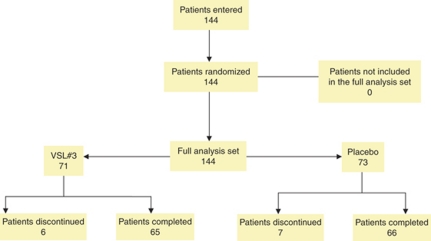
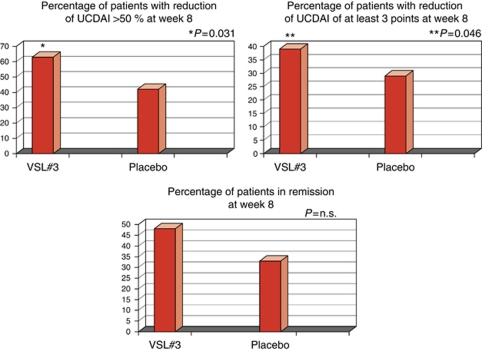
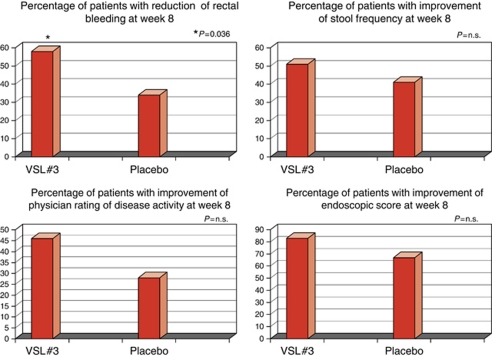
OBJECTIVES: VSL#3 is a high-potency probiotic mixture that has been used successfully in the treatment of pouchitis. The primary end point of the study was to assess the effects of supplementation with VSL#3 in patients affected by relapsing ulcerative colitis (UC) who are already under treatment with 5-aminosalicylic acid (ASA) and/or immunosuppressants at stable doses. METHODS: A total of 144 consecutive patients were randomly treated for 8 weeks with VSL#3 at a dose of 3,600 billion CFU/day (71 patients) or with placebo (73 patients). RESULTS: In all, 65 patients in the VSL#3 group and 66 patients in the placebo group completed the study. The decrease in ulcerative colitis disease activity index (UCDAI) scores of 50% or more was higher in the VSL#3 group than in the placebo group (63.1 vs. 40.8; per protocol (PP) P=0.010, confidence interval (CI)₉₅(%) 0.51-0.74; intention to treat (ITT) P=0.031, CI₉₅(%) 0.47-0.69). Significant results with VSL#3 were recorded in an improvement of three points or more in the UCDAI score (60.5% vs. 41.4%; PP P=0.017, CI₉₅(%) 0.51-0.74; ITT P=0.046, CI₉₅(%) 0.47-0.69) and in rectal bleeding (PP P=0.014, CI₉₅(%) 0.46-0.70; ITT P=0.036, CI₉₅(%) 0.41-0.65), whereas stool frequency (PP P=0.202, CI₉₅(%) 0.39-0.63; ITT P=0.229, CI₉₅(%) 0.35-0.57), physician's rate of disease activity (PP P=0.088, CI₉₅(%) 0.34-0.58; ITT P=0.168, CI₉₅(%) 0.31-0.53), and endoscopic scores (PP P=0.086, CI₉₅(%) 0.74-0.92; ITT P=0.366, CI₉₅(%) 0.66-0.86) did not show statistical differences. Remission was higher in the VSL#3 group than in the placebo group (47.7% vs. 32.4%; PP P=0.069, CI₉₅(%) 0.36-0.60; ITT P=0.132, CI₉₅(%) 0.33-0.56). Eight patients on VSL#3 (11.2%) and nine patients on placebo (12.3%) reported mild side effects. CONCLUSIONS: VSL#3 supplementation is safe and able to reduce UCDAI scores in patients affected by relapsing mild-to-moderate UC who are under treatment with 5-ASA and/or immunosuppressants. Moreover, VSL#3 improves rectal bleeding and seems to reinduce remission in relapsing UC patients after 8 weeks of treatment, although these parameters do not reach statistical significance.
Overview
The claims and statistics of this paper haven’t been checked yet.
Run the check — free, no account needed. It reads the open-access text and checks the sources it cites.
Integrity signals
Registry
Cites
Statistics
Figures
Verification
Claims the paper makes
The claims and statistics of this paper haven’t been checked yet.
Run the check — free, no account needed. It reads the open-access text and checks the sources it cites.
Claims other papers make about this one
Each is checked against this paper’s own text: does it say what the citing paper says it does?
In the citing paper
“In IBD, the probiotic mixture VSL#3, which contains bifidobacteria of different species, was able to reduce the UC symptoms in adults (144, 145) as well as the remission of the disease in children (84).”
From Bifidobacteria and Their Health-Promoting Effects (2017) · cites this paper as [145]
In the citing paper
“Both demonstrate that high doses improve disease activity scores”
From The gut microbiota and host health: a new clinical frontier (2016) · cites this paper as [74]
Self-check
Percentages, sums and reported differences re-computed from the paper’s own numbers.
The self-check needs the paper’s full text.
Citations
Cites
The gut microbiota shapes intestinal immune responses during health and disease
Round, J. L., & Mazmanian, S. K. (2009) · Nature Reviews Immunology · doi:10.1038/nri2515 · Cited by 5,029
A microbial symbiosis factor prevents intestinal inflammatory disease
Mazmanian, S. K., Round, J. L., & Kasper, D. L. (2008) · Nature · doi:10.1038/nature07008 · Cited by 2,340
Kornbluth, A. A., & Sachar, D. B. (2010) · The American Journal of Gastroenterology · doi:10.1038/ajg.2009.727 · Cited by 2,032
Gionchetti, P., Rizzello, F., Venturi, A., Brigidi, P., Matteuzzi, D., Bazzocchi, G., Poggioli, G., Miglioli, M., & Campieri, M. (2000) · Gastroenterology · doi:10.1053/gast.2000.9370 · Cited by 1,485
Kruis, W., Frič, P., Pokrotnieks, J., Lukáš, M., Fixa, B., Kaščák, M., Kamm, M. A., Weismueller, J., Beglinger, C., Stolte, M., et al. (2004) · Gut · doi:10.1136/gut.2003.037747 · Cited by 1,285
Podolsky, D. K. (1991) · New England Journal of Medicine · doi:10.1056/nejm199109263251306 · Cited by 1,226
Prophylaxis of pouchitis onset with probiotic therapy: a double-blind, placebo-controlled trial
Gionchetti, P., Rizzello, F., Helwig, U., Venturi, A., Lammers, K. M., Brigidi, P., Vitali, B., Poggioli, G., Miglioli, M., & Campieri, M. (2003) · Gastroenterology · doi:10.1016/s0016-5085(03)00171-9 · Cited by 1,147
Rembacken, B., Snelling, A. M., Hawkey, P. M., Chalmers, D. M., & Axon, A. (1999) · The Lancet · doi:10.1016/s0140-6736(98)06343-0 · Cited by 1,100
Probiotic bacteria enhance murine and human intestinal epithelial barrier function
Madsen, K., Cornish, A. S., Soper, P., McKaigney, C. J., Jijon, H. B., Yachimec, C., Doyle, J. S. G., Jewell, L. D., & Simone, C. D. (2001) · Gastroenterology · doi:10.1053/gast.2001.27224 · Cited by 1,096
Kruis, W., SCHÜTZ, E., Fric, P., Fixa, B., Judmaier, G., & Stolte, M. (1997) · Alimentary Pharmacology & Therapeutics · doi:10.1046/j.1365-2036.1997.00225.x · Cited by 774
Cited by
Sorted by citations
The gut microbiota and host health: a new clinical frontier
Marchesi, J. R., Adams, D. H., Fava, F., Hermes, G. D. A., Hirschfield, G. M., Hold, G., Quraishi, M. N., Kinross, J., Smidt, H., Tuohy, K. M., et al. (2016) · Gut · doi:10.1136/gutjnl-2015-309990 · Cited by 2,302
Probiotics and prebiotics in intestinal health and disease: from biology to the clinic
Sanders, M. E., Merenstein, D. J., Reid, G., Gibson, G. R., & Rastall, R. A. (2019) · Nature Reviews Gastroenterology & Hepatology · doi:10.1038/s41575-019-0173-3 · Cited by 2,059
Large-scale association analyses identify host factors influencing human gut microbiome composition
Kurilshikov, A., Medina-Gomez, C., Bacigalupe, R., Radjabzadeh, D., Wang, J., Demirkan, A., Le Roy, C. I., Raygoza Garay, J. A., Finnicum, C. T., Liu, X., et al. (2021) · Nature Genetics · doi:10.1038/s41588-020-00763-1 · Cited by 1,786
ACG Clinical Guideline: Ulcerative Colitis in Adults
Rubin, D. T., Ananthakrishnan, A. N., Siegel, C. A., Sauer, B. G., & Long, M. D. (2019) · The American Journal of Gastroenterology · doi:10.14309/ajg.0000000000000152 · Cited by 1,594
“In 1 clinical trial using VSL#3® as add-on therapy to 5-ASA, endoscopic improvement was not achieved (109).”
MethodDignass, A., Lindsay, J. O., Sturm, A., Windsor, A., Colombel, J.-F., Allez, M., D'Haens, G., D'Hoore, A., Mantzaris, G., Novacek, G., et al. (2012) · Journal of Crohn's and Colitis · doi:10.1016/j.crohns.2012.09.002 · Cited by 1,548
Metadata
- Authors
- Tursi, A., Brandimarte, G., Papa, A., Giglio, A., Elisei, W., Giorgetti, G. M., Forti, G., Morini, S., Hassan, C., Pistoia, M. A., Modeo, M. E., Rodino', S., D'Amico, T., Sebkova, L., Sacca', N., Di Giulio, E., Luzza, F., Imeneo, M., Larussa, T., Di Rosa, S., Annese, V., Danese, S., & Gasbarrini, A.
- Affiliations
- Ospedale L. Bonomo (IT)
- Ospedale Cristo Re (IT)
- Agostino Gemelli University Polyclinic (IT)
- Azienda Ospedaliera Pugliese Ciaccio (IT)
- St. Eugenio Hospital (IT)
- Ospedale Santa Maria Goretti (IT)
- Azienda Universitaria Ospedaliera Consorziale - Policlinico Bari (IT)
- Azienda Ospedaliero-Universitaria "Renato Dulbecco" (IT)
- Casa Sollievo della Sofferenza (IT)
- Corresponding author
- Tursi, Antonio
- ORCID
- Venue
- American Journal of Gastroenterology
- Published
- 2010-10
- Volume
- 105
- Issue
- 10
- Pages
- 2218-2227
- ISSN
- 0002-9270 (ISSN-L)
- PMC
- PMC3180711
- OpenAlex
- W1998335236
- Cited by
- 489
- References
- 39
- Citations by year
- 2026: 10 · 2025: 22 · 2024: 35 · 2023: 30 · 2022: 29 · 2021: 28 · 2020: 46 · 2019: 31 · 2018: 39 · 2017: 38 · 2016: 28 · 2015: 29 · 2014: 38 · 2013: 27 · 2012: 28
- FWCI
- 15.30
- Type
- journal article
- Language
- en
- Open access
- hybrid
- doi.org
- Licence
- cc-by-nc-nd
- www.springer.com/tdm (unspecified)
- Locations
- The American Journal of Gastroenterology (publishedVersion, cc-by-nc-nd)
- PubMed Central (publishedVersion, cc-by-nc-nd)
- PubMed (publishedVersion)
- IRIS Research product catalog (Sapienza University of Rome) (submittedVersion)
- Archivio Istituzionale della Ricerca - Università Vita-Salute San Raffaele (submittedVersion)
- Archivio Istituzionale della Ricerca - Università degli Studi dell Aquila (submittedVersion)
- Topics
- Health Sciences › Medicine › Gastroenterology › Inflammatory Bowel Disease
- Life Sciences › Agricultural and Biological Sciences › Food Science › Probiotics and Fermented Foods
- Life Sciences › Biochemistry, Genetics and Molecular Biology › Molecular Biology › Gut microbiota and health
- Keywords
- ulcerative colitis, VSL#3, probiotics, adjunctive therapy, relapsing disease, 5-aminosalicylic acid, immunosuppressants, disease activity, rectal bleeding, stool frequency, inflammatory bowel disease treatment, pouchitis, Crohn's disease, irritable bowel syndrome, irritable bowel syndrome with diarrhea
- MeSH terms
- Adult, Azathioprine, Bifidobacterium, Colitis, Ulcerative, Combined Modality Therapy, Double-Blind Method, Female, Humans, Lactobacillus, Male, Middle Aged, Recurrence, Remission Induction, Severity of Illness Index, Treatment Outcome, Patient Selection, Mesalamine, Probiotics, Streptococcus thermophilus
About these checks
Registry, retraction, Cites and statistics results are computed, not judged, with one exception: a printed reference that no index lists is read once by a model before it counts as a citation error. Claims are extracted by a model and kept only when their quote appears verbatim in the text; each cited source is then checked, with a model’s help, for whether it says what the claim relies on. Those verdicts can be wrong — read the claim’s quote and the cited source before relying on one.
Statistics and arithmetic are recomputed, not judged.
Confidence bands are shown only for fields calibrated on our annotated test set. None is calibrated yet, so no band is shown.
What counts as a claim ›How we measure confidence ›How we check this ›
Are you an author, or do you see a problem with this page? Request a review
