

Two-dimensional gas of massless Dirac fermions in graphene
Open accessThe DOI matches its Crossref record; 32 of the 32 references it cites were found in a registry or an index; 12 of the 52 sources its claims cite were checked for support.
Abstract
Quantum electrodynamics (resulting from the merger of quantum mechanics and relativity theory) has provided a clear understanding of phenomena ranging from particle physics to cosmology and from astrophysics to quantum chemistry. The ideas underlying quantum electrodynamics also influence the theory of condensed matter, but quantum relativistic effects are usually minute in the known experimental systems that can be described accurately by the non-relativistic Schrödinger equation. Here we report an experimental study of a condensed-matter system (graphene, a single atomic layer of carbon) in which electron transport is essentially governed by Dirac's (relativistic) equation. The charge carriers in graphene mimic relativistic particles with zero rest mass and have an effective ‘speed of light’ c* ≈ 106 m s-1. Our study reveals a variety of unusual phenomena that are characteristic of two-dimensional Dirac fermions. In particular we have observed the following: first, graphene's conductivity never falls below a minimum value corresponding to the quantum unit of conductance, even when concentrations of charge carriers tend to zero; second, the integer quantum Hall effect in graphene is anomalous in that it occurs at half-integer filling factors; and third, the cyclotron mass mc of massless carriers in graphene is described by E = mcc*2. This two-dimensional system is not only interesting in itself but also allows access to the subtle and rich physics of quantum electrodynamics in a bench-top experiment.
Overview
CoChat Summary
TL;DR
Graphene is a two-dimensional gas of massless Dirac fermions with linear dispersion and an effective speed of light \(c^* \approx 10^6\) m/s. Transport measurements reveal an anomalous half-integer quantum Hall effect, a minimum conductivity, cyclotron mass \(m_c = E/c^{*2}\), and a \(\pi\) Berry-phase shift in Shubnikov–de Haas oscillations.
Key findings
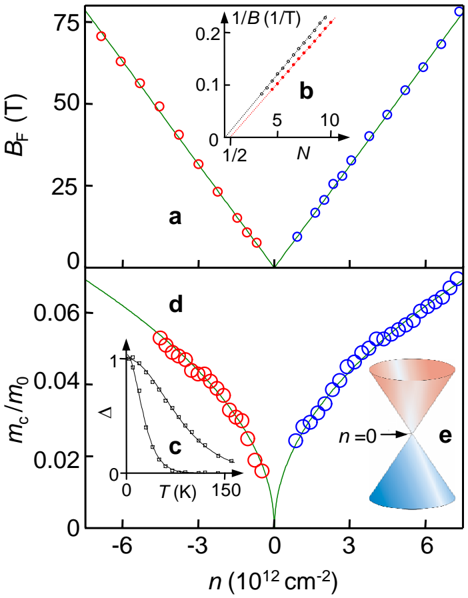
- Graphene’s charge carriers behave as massless Dirac fermions: the data imply \(E = \hbar k c^*\) for both electrons and holes, with \(c^* \approx 1 \times 10^6\) m/s; the cyclotron mass varies between \(\approx 0.02\) and \(0.07\,m_0\) and follows \(m_c \propto n^{1/2}\).
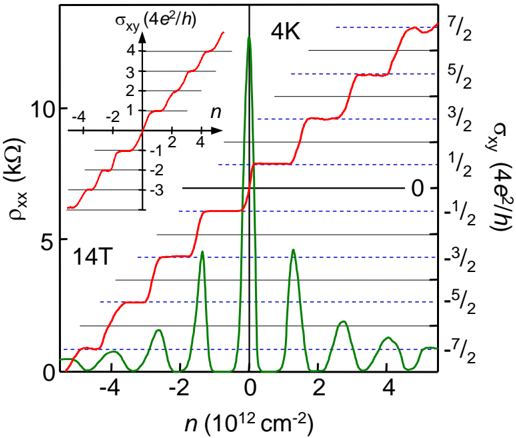
- The integer quantum Hall effect is anomalous: plateaux occur at half-integer \(\nu\), with sequence \((4e^2/h)(N+\tfrac12)\) and the first plateau at \(2e^2/h\); two-layer graphene returns to the normal integer sequence.
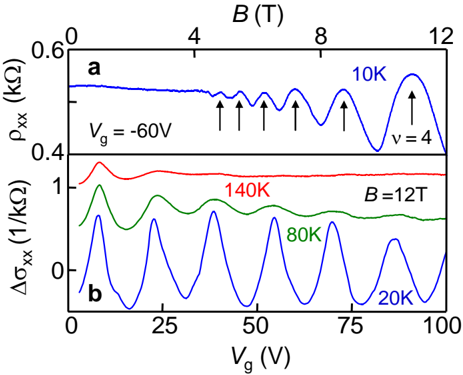
- Shubnikov–de Haas oscillations show a single set for electrons and holes, with \(B_F = \beta n\), \(\beta \approx 1.04 \times 10^{-15}\) T·m\(^2\) (\(\pm 2\%\)), yielding degeneracy \(f=4\); the oscillations exhibit a phase shift of \(\pi\) attributed to Berry’s phase.
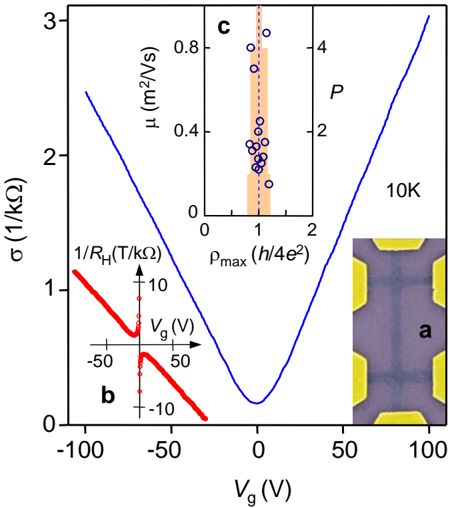
- Conductivity never falls below a minimum: \(\rho_{\max} \approx 6.5\) k\(\Omega\) in 15 devices (experimental error \(\approx 15\%\)), associated with \(h/fe^2 = 6.45\) k\(\Omega\), independent of mobility (which varied by a factor of 10) and of temperature between 4 and 100 K.
Methods
- Graphene samples were obtained by micromechanical cleavage of graphite, followed by identification and selection of monolayers using optical, scanning-electron, and atomic-force microscopies; selected films were processed into multi-terminal devices, with some devices made from 2 or 3 layers.
- Transport measurements included the electric field effect, Hall coefficient, Shubnikov–de Haas oscillations, and quantum Hall effect in magnetic fields; mobility was measured between 10 and 100 K, minimum conductivity between 4 and 100 K, and SdHO up to 140 K and room temperature.
- Analysis used fan diagrams to determine \(B_F\), fits of SdHO amplitude to \(T/\sinh(2\pi^2 k_B T m_c / h eB)\), and semiclassical expressions \(B_F = (h/2\pi e)S(E)\) and \(m_c = (h^2/2\pi)\partial S(E)/\partial E\) to infer \(E \propto k\).
Limitations
- The paper has no dedicated limitations section; stated caveats include that mobility was “probably still limited by defects in parent graphite,” that the two-layer finite-mass result is “to be published elsewhere,” and that most theories suggest a minimum conductivity of \(\approx e^2/\pi h\), in disagreement with the experiment.
- Evident from the text: devices are unprotected from the environment (though stable under ambient conditions), some measured devices consisted of 2 or 3 graphene layers, and the transition region was often shifted from zero \(V_g\) due to chemical doping, although annealing normally eliminated the shift.
- The inference of linear dispersion relies on a semiclassical model that the paper says is justified by recent theory, so the experimental conclusion depends on that theoretical framework.
Model-written summary. Check it against the paper before relying on it.
Integrity signals
Registry
Cites
Statistics
Figures
Verification
Claims the paper makes
3 Valid · 5 Not valid · 11 Not checked · 51 Own results and interpretations
The cited sources support only part of this claim — read each source’s verdict below.
In the paper
“d) Shubnikov-de Haas oscillations in graphene exhibit a phase shift of π due to Berry's phase”
- Also stated in: § Two-Dimensional Gas of Massless Dirac Fermions in Graphene · plain
“The shift is due to Berry's phase [9,15].”
What the sources say
- Partly supportedcites [9] Berger, C. et al. Ultrathin epitaxial graphite: 2D electron gas properties and a route toward graphene-based nanoelectronics. J. Phys. Chem. B 108, 19912–19916 (2004) sourceExperimental — accuracy not yet measured
The Figure 2 caption (p. 3) reports Shubnikov–de Haas oscillations in an epitaxial graphene sample. The discussion on pp. 3–4 addresses their occurrence and period, but does not report a π phase shift or attribute one to Berry’s phase. (LLM, conf=0.85)
- Partly supportedcites [15] Gusynin, V. P. & Sharapov, S. G. Unconventional integer quantum Hall effect in grapheme. Preprint at http://xxx.lanl.gov/abs/cond-mat/0506575 (2005). sourceExperimental — accuracy not yet measured
Our copy (Introduction, p. 1) does state that 'the phase of de Haas van Alphen and Shubnikov de Haas oscillations for Dirac quasiparticles is shifted ... compared to the phase of non-relativistic quasiparticles' (citing Refs. 7-10), so the existence of a phase shift in graphene is supported; the magnitude symbol itself is lost in our copy's undecoded formulas. What is NOT supported is the causal attribution to Berry's phase: no passage of our copy mentions Berry's phase at all (searched: 'Berry phase pseudospin topological phase π', 'oscillation phase factor'). Instead the paper explains the unconventional magneto-transport phenomena by the quantum anomaly of the n = 0 Landau level — its halved degeneracy and B-independent energy (p. 1 and p. 3) — and relates the oscillation minima to fillings ν_B = 2n+1 (p. 3). (LLM, conf=0.75)
plainstates a cause- Asserted: passes — The authors put it forward as true.
- Checkable: passes — It can be checked against evidence.
- Load-bearing: passes — The paper’s conclusions depend on it.
- Based: passes — The paper gives a reason why it holds.
- Also stated in: § Two-Dimensional Gas of Massless Dirac Fermions in Graphene · plain
The cited sources that could be checked couldn’t confirm or dispute this claim.
In the paper
“we invoke the formal expression [9-12] for the energy of massless relativistic fermions in quantized fields, EN =[2 e h c ∗ 2 B ( N +½ ± ½)] 1/2”
What the sources say
- Could not verifycites [9] Berger, C. et al. Ultrathin epitaxial graphite: 2D electron gas properties and a route toward graphene-based nanoelectronics. J. Phys. Chem. B 108, 19912–19916 (2004) sourceExperimental — accuracy not yet measured
The discussion of magnetoconductance (p. 3) says Shubnikov–de Haas oscillations indicate quantization of the electron energy spectrum, but it gives no energy formula. Searches for massless relativistic fermions, Landau levels, and the N + 1/2 ± 1/2 term found no passage stating the claimed expression. (LLM, conf=0.76)
- Not checked — no full text of the sourcecites [10] Bunch, J. S., Yaish, Y., Brink, M., Bolotin, K. & McEuen, P. L. Coulomb oscillations and Hall effect in quasi-2D graphite quantum dots. Nano Lett. 5, 287–290 (2005) source
- Not checked — no full text of the sourcecites [11] Dresselhaus, M. S. & Dresselhaus, G. Intercalation compounds of graphite. Adv. In Phys. 51, 1–186 (2002) source
- Not matchedcites [12] Brandt, N. B., Chudinov, S. M. & Ponomarev, Y. G. Semimetals 1: Graphite and Its Compounds (North-Holland, Amsterdam, 1988)
We searched by its title and found no matching paper.
plain- Asserted: passes — The authors put it forward as true.
- Checkable: passes — It can be checked against evidence.
- Load-bearing: passes — The paper’s conclusions depend on it.
- Based: passes — The paper gives a reason why it holds.
- Could not verify
The cited sources that could be checked couldn’t confirm or dispute this claim.
In the paper
“The employed semiclassical model is fully justified by a recent theory for graphene [9], which shows that SdHO's amplitude can indeed be described by the above expression T /sinh(2 π 2 k B Tm c / h eB ) with m c = E / c ∗ 2 .”
What the sources say
- Could not verifycites [9] Berger, C. et al. Ultrathin epitaxial graphite: 2D electron gas properties and a route toward graphene-based nanoelectronics. J. Phys. Chem. B 108, 19912–19916 (2004) sourceExperimental — accuracy not yet measured
The discussion of magnetoconductance (pp. 3–4) reports observed Shubnikov–de Haas oscillations, but does not give a theory for their amplitude. Searches for the temperature-dependent amplitude expression and m_c = E/c*² found no passage addressing either, so our copy cannot verify the attributed claim. (LLM, conf=0.76)
boostedstates a cause- Asserted: passes — The authors put it forward as true.
- Checkable: passes — It can be checked against evidence.
- Load-bearing: passes — The paper’s conclusions depend on it.
- Based: passes — The paper gives a reason why it holds.
- Could not verify
The cited sources that could be checked couldn’t confirm or dispute this claim.
In the paper
“The latter can be viewed as a direct consequence of the Atiyah-Singer index theorem that plays an important role in quantum field theory and the theory of superstrings [13,14].”
What the sources say
- Not checked — no full text of the sourcecites [13] Vonsovsky, S. V. & Katsnelson, M. I. Quantum Solid State Physics (Springer, New York, 1989) source
- Could not verifycites [14] Gusynin, V. P. & Sharapov, S. G. Magnetic oscillations in planar systems with the Dirac-like spectrum of quasiparticle excitations. Phys. Rev. B 71, 125124 (2005) sourceExperimental — accuracy not yet measured
Our copy of Gusynin & Sharapov II gives the relativistic Landau-level spectrum with n = 0, 1, ... in the Introduction (p. 1) and discusses the lowest level E_1 and its crossing of the Fermi surface (Discussion, p. 6; Sect. II.B, p. 6), but it never invokes or discusses the Atiyah-Singer index theorem, topology, or zero-mode counting as the reason for a level pinned at E = 0. Searches on 'Atiyah-Singer index theorem zero-energy Landau level', 'index theorem topological zero modes chiral anomaly', and 'zero-energy Landau level n=0 degeneracy independent of field strength' returned only the spectrum/quantization-condition passages. Since the index-theorem grounding is simply not addressed in our copy (and no alternative work is credited for it there), the attribution can be neither confirmed nor contradicted. (LLM, conf=0.68)
plainstates a cause- Asserted: passes — The authors put it forward as true.
- Checkable: passes — It can be checked against evidence.
- Load-bearing: unclear — It is unclear whether the paper’s conclusions depend on it.
- Based: passes — The paper gives a reason why it holds.
The cited sources that could be checked couldn’t confirm or dispute this claim.
In the paper
“in agreement with band structure calculations [6,7]”
What the sources say
- Could not verifycites [6] Novoselov, K. S. et al. Two dimensional atomic crystals. Proc. Natl Acad. Sci. USA 102, 10451–10453 (2005) sourceExperimental — accuracy not yet measured
The discussion of graphene transport in “Two Dimensional Atomic Crystals” (p. 3) reports carrier concentrations and mobilities, but not a fitted c* or a comparison with band-structure calculations. Searches for the velocity, its approximate value, and band-structure calculations found no passage addressing that comparison. (LLM, conf=0.76)
- Could not verifycites [7] Novoselov, K. S. et al. Electric field effect in atomically thin carbon films. Science 306, 666–669 (2004) sourceExperimental — accuracy not yet measured
The discussion on p. 2 says graphene is expected to have linear energy dispersion and massless carriers, but gives no calculated velocity to compare with c* ≈ 1·10^6 m/s. Searches for the velocity and band-structure comparison found no passage in our copy establishing the claimed agreement. (LLM, conf=0.73)
plainstates an association- Asserted: passes — The authors put it forward as true.
- Checkable: passes — It can be checked against evidence.
- Load-bearing: passes — The paper’s conclusions depend on it.
- Based: passes — The paper gives a reason why it holds.
- Could not verify
34 more claims
Create a free account to see all 70 claims and to verify the 10 references still open.
- It may state two separate claims as one. 27
- Probably not a substantial claim. 8
Claims other papers make about this one
Each is checked against this paper’s own text: does it say what the citing paper says it does?
The source backs part of the claim, not all of it — or backs it for a different population, condition or comparison.
In the citing paper
“Recently, the non-relativistic electrons in graphene monolayer were found to obey the massless relativistic dispersion known as the Dirac cone, leading to the realization of analogies to Zitterbewegung and Klein tunneling in low-energy condensed-matter physics and atom optics 4 -19 .”
From Observation of interaction-induced phenomena of relativistic quantum mechanics (2021) · cites this paper as [4]
Experimental — accuracy not yet measuredThe source backs part of the claim, not all of it — or backs it for a different population, condition or comparison.
In the citing paper
“Dirac points in graphene1–3 or photonic graphene12 belong to the first type, which occur in lattices with unbroken T. These occur in pairs and are stabilized by a symmetry of the underlying lattice.”
From Observation of an unpaired photonic Dirac point (2020) · cites this paper as [1]
Experimental — accuracy not yet measuredThe cited source says what the claim attributes to it.
In the citing paper
“The energy spectrum of ˆ H 1 is E n = sgn( n ) ℏ Ω √ | n | , where n = 0 , ± 1 , . . . , see Fig. 1.”
From Theory of electron Zitterbewegung in graphene probed by femtosecond laser pulses (2009) · cites this paper as [36]
The cited source says what the claim attributes to it.
In the citing paper
“Around Dirac cones, conduction and valence bands intersect linearly at a degenerate point resulting in the linear energy band and massless relativistic transport of electrons as quasiparticles [4].”
From Observing movement of Dirac cones from single-photon dynamics (2021) · cites this paper as [4]
The check wasn’t confident either way, so it gives no verdict — never disputed.
In the citing paper
“photonic Dirac points are known to occur in pairs in “photonic graphene” and other similar photonic crystals”
From Observation of an unpaired photonic Dirac point (2020) · cites this paper as [1]
Experimental — accuracy not yet measured
3 more claims about this paper
Create a free account to see every claim other papers make about this one.
Citations
Cites
Electric Field Effect in Atomically Thin Carbon Films
Novoselov, K. S., Geim, A. K., Morozov, S. V., Jiang, D., Zhang, Y., Dubonos, S. V., Grigorieva, I. V., & Firsov, A. A. (2004) · Science · doi:10.1126/science.1102896 · Cited by 66,834
Self-citationTwo-dimensional atomic crystals
Novoselov, K. S., Jiang, D., Schedin, F., Booth, T. J., Khotkevich, V. V., Morozov, S. V., & Geim, A. K. (2005) · Proceedings of the National Academy of Sciences · doi:10.1073/pnas.0502848102 · Cited by 11,788
Self-citationScaling Theory of Localization: Absence of Quantum Diffusion in Two Dimensions
Abrahams, E., Anderson, P. W., Licciardello, D. C., & Ramakrishnan, T. V. (1979) · Physical Review Letters · doi:10.1103/physrevlett.42.673 · Cited by 6,134
Berger, C., Song, Z., Li, T., Li, X., Ogbazghi, A. Y., Feng, R., Dai, Z., Marchenkov, A. N., Conrad, E. H., First, P. N., et al. (2004) · The Journal of Physical Chemistry B · doi:10.1021/jp040650f · Cited by 3,548
The Universe in a Helium Droplet
Volovik, G. E. (2009) · doi:10.1093/acprof:oso/9780199564842.001.0001 · Cited by 2,632
Intercalation compounds of graphite
Dresselhaus, M. S., & Dresselhaus, G. (2002) · Advances in Physics · doi:10.1080/00018730110113644 · Cited by 2,139
Geometry, Topology and Physics
Nakahara, M. (1990) · doi:10.1887/0750306068 · Cited by 1,620
Geometry, Topology and Physics
Nakahara, M. (2018) · CRC Press eBooks · doi:10.1201/9781315275826 · Cited by 1,505
Unconventional Integer Quantum Hall Effect in Graphene
Gusynin, V. P., & Sharapov, S. G. (2005) · Physical Review Letters · doi:10.1103/physrevlett.95.146801 · Cited by 1,374
Field Theories of Condensed Matter Systems
Fradkin, E. (2007) · Medical Entomology and Zoology · Cited by 1,118
Research works printed but not linked: 1
- Mott, N.F. & Davis, E.A. Electron Processes in Non-Crystalline Materials (Clarendon Press, Oxford, 1979).
Cited by
Items 7,901–8,000 of 21,614
Photoreduction of graphite oxide nanosheets with vacuum ultraviolet radiation
Shul’ga, Y. M., Vasilets, V. N., Baskakov, S. A., et al. (2012) · High Energy Chemistry · doi:10.1134/s0018143912020099 · Cited by 29
Graphene-Based Floating-Gate Nonvolatile Optical Switch
Li, Y., Yu, H., Dai, T., et al. (2015) · IEEE Photonics Technology Letters · doi:10.1109/lpt.2015.2494876 · Cited by 29
Mondal, N. S., Nath, S., Jana, D., & Ghosh, N. K. (2020) · Journal of Physics and Chemistry of Solids · doi:10.1016/j.jpcs.2020.109801 · Cited by 28
Predicted low thermal conductivities in antimony films and the role of chemical functionalization
Zhang, T., Qi, Y., Chen, X.-R., & Cai, L. (2016) · Physical Chemistry Chemical Physics · doi:10.1039/c6cp05908b · Cited by 31
Graphene nanogap for gate-tunable quantum-coherent single-molecule electronics
Bergvall, A., Berland, K., Hyldgaard, P., et al. (2011) · Physical Review B · doi:10.1103/physrevb.84.155451 · Cited by 29
Robust ultralow friction between graphene and octadecyltrichlorosilane self-assembled monolayers
Hu, L., Wang, J., Hou, K., & Yang, S. (2018) · Applied Surface Science · doi:10.1016/j.apsusc.2018.12.280 · Cited by 29
Control of excitonic absorption by thickness variation in few-layer GaSe
Budweg, A., Yadav, D., Grupp, A., et al. (2019) · Physical review. B./Physical review. B · doi:10.1103/physrevb.100.045404 · Cited by 29
Li, L., Li, X., Du, M., et al. (2016) · Chemistry of Materials · doi:10.1021/acs.chemmater.6b00426 · Cited by 29
Nemes‐Incze, P., Tapasztó, L., Magda, G. Z., Osváth, Z., Dobrik, G., Jin, X., Hwang, C., & Biró, L. P. (2013) · Applied Surface Science · doi:10.1016/j.apsusc.2013.11.012 · Cited by 30
Graphene-based hybrid plasmonic optical electro-absorption modulator on InP platform
Nezamdoost, H., Nikoufard, M., & Saghaei, H. (2024) · Optical and Quantum Electronics · doi:10.1007/s11082-023-06136-2 · Cited by 34
“To overcome the size limitations of various modulator schemes, the unique electrooptical properties of graphene can be utilized (Novoselov et al. 2005; Vakil and Engheta 1979).”
Exotic electronic properties in Thue–Morse graphene superlattices
Xu, Y., Zou, J., & Jin, G. (2013) · Journal of Physics Condensed Matter · doi:10.1088/0953-8984/25/24/245301 · Cited by 29
Interface-induced terahertz persistent photoconductance in rGO-gelatin flexible films
Qi, M., Zhou, Y., Huang, Y., et al. (2016) · Nanoscale · doi:10.1039/c6nr06573b · Cited by 29
Ganji, M. D., Tajbakhsh, M., Kariminasab, M., & Alinezhad, H. (2016) · Physica E Low-dimensional Systems and Nanostructures · doi:10.1016/j.physe.2016.03.008 · Cited by 30
Sári, J., Goerbig, M. O., & Tőke, C. (2015) · Physical Review B · doi:10.1103/physrevb.92.035306 · Cited by 33
Xiong, K., Li, G., Jin, C., et al. (2015) · Materials Letters · doi:10.1016/j.matlet.2015.10.143 · Cited by 29
Pseudospin-induced chirality with staggered optical graphene
Liu, J.-L., Ye, W.-M., & Zhang, S. (2016) · Light: Science & Applications · doi:10.1038/lsa.2016.94 · Cited by 29
Detailed studies of Na intercalation on furnace-grown graphene on 6H-SiC(0001)
Xia, C., Watcharinyanon, S., Zakharov, A. A., et al. (2013) · Surface Science · doi:10.1016/j.susc.2013.03.011 · Cited by 29
Quantum speed limit for a relativistic electron in a uniform magnetic field
Villamizar, D. V., & Duzzioni, E. I. (2015) · Physical Review A · doi:10.1103/physreva.92.042106 · Cited by 29
Bipolar Photoresponse of a Graphene Field-Effect Transistor Induced by Photochemical Reactions
Khan, M. F., Elahi, E., Hassan, N. U., et al. (2023) · ACS Applied Electronic Materials · doi:10.1021/acsaelm.3c00851 · Cited by 29
Renormalization Effects on Quasi-Two-Dimensional Organic Conductor α-(BEDT-TTF)2I3
Isobe, H., & Nagaosa, N. (2012) · Journal of the Physical Society of Japan · doi:10.1143/jpsj.81.113704 · Cited by 29
Chiral-symmetry breaking in pseudoquantum electrodynamics at finite temperature
Nascimento, L. O., Alves, V. S., Peña, F., Smith, C. M., & Marino, E. C. (2015) · Physical review. D. Particles, fields, gravitation, and cosmology/Physical review. D. Particles and fields · doi:10.1103/physrevd.92.025018 · Cited by 32
Wang, H., Su, H., Qian, H., Wang, Z., Wang, X., & Xia, A. (2010) · The Journal of Physical Chemistry A · doi:10.1021/jp1056489 · Cited by 29
Yoshino, H., & Murata, K. (2015) · Journal of the Physical Society of Japan · doi:10.7566/jpsj.84.024601 · Cited by 31
Growth and Features of Epitaxial Graphene on SiC
Kusunoki, M., Norimatsu, W., Bao, J., Morita, K., & Starke, U. (2015) · Journal of the Physical Society of Japan · doi:10.7566/jpsj.84.121014 · Cited by 36
Reduced humic acid nanosheets and its uses as nanofiller
Duraia, E. M., Henderson, B., & Beall, G. W. (2015) · Journal of Physics and Chemistry of Solids · doi:10.1016/j.jpcs.2015.05.001 · Cited by 32
β-cyclodextrin functionalized graphene nano platelets for electrochemical determination of triclosan
Li, B., Qiu, Z., Wan, Q., Liu, Y., & Yang, N. (2014) · physica status solidi (a) · doi:10.1002/pssa.201431540 · Cited by 29
Actively tunable linear and circular dichroic metamirrors based on single-layer graphene
Xu, J., Tang, J., Chen, M., Teng, C., Deng, S., Cheng, Y., Qu, S., & Yuan, L. (2022) · Optics Express · doi:10.1364/oe.479151 · Cited by 33
Synthesis and Characterization of Graphene
Das, S., Sudhagar, P., Kang, Y. S., & Choi, W. (2015) · Wiley eBooks · doi:10.1002/9781118980989.ch3 · Cited by 35
Chiral quasiparticle local density of states maps in graphene
Pereg-Barnea, T., & MacDonald, A. H. (2008) · Physical Review B · doi:10.1103/physrevb.78.014201 · Cited by 30
Dimensionality reduction and band quantization induced by potassium intercalation in 1T−HfTe2
Nakata, Y., Sugawara, K., Chainani, A., Yamauchi, K., Nakayama, K., Souma, S., Chuang, P.-Y., Cheng, C.-M., Oguchi, T., Ueno, K., et al. (2019) · Physical Review Materials · doi:10.1103/physrevmaterials.3.071001 · Cited by 33
Enhanced polarization sensitivity by plasmonic-cavity in graphene phototransistors
Zhang, D., Zhou, J., Liu, C., Guo, S., Deng, J., Cai, Q.-Y., Li, Z., Zhang, Y., Zhang, W., & Chen, X. (2019) · Journal of Applied Physics · doi:10.1063/1.5109249 · Cited by 30
Charge-modulated permeability and selectivity in graphdiyne for hydrogen purification
Tan, X., Kou, L., Tahini, H. A., et al. (2015) · Molecular Simulation · doi:10.1080/08927022.2015.1086486 · Cited by 29
Two-dimensional superconducting MoSi2N4(MoN)4n homologous compounds
Liu, Z., Wang, L., Hong, Y., et al. (2022) · National Science Review · doi:10.1093/nsr/nwac273 · Cited by 29
Mananghaya, M. (2014) · Journal of Chemical Sciences · doi:10.1007/s12039-014-0744-3 · Cited by 29
Phuc, H. V., Hieu, N. N., Hoi, B. D., et al. (2017) · Superlattices and Microstructures · doi:10.1016/j.spmi.2017.10.011 · Cited by 29
Fermi energy-dependence of electromagnetic wave absorption in graphene
Ukhtary, M. S., Hasdeo, E. H., Nugraha, A. R. T., et al. (2015) · Applied Physics Express · doi:10.7567/apex.8.055102 · Cited by 29
Phase-coherent transport measured in a side-gated mesoscopic graphite wire
Graf, D. E., Molitor, F., Ihn, T., & Ensslin, K. (2007) · Physical Review B · doi:10.1103/physrevb.75.245429 · Cited by 29
Suspended graphene arrays for gas sensing applications
Gupta, R. K., Alqahtani, F. H., Dawood, O. M., Carini, M., Criado, A., Prato, M., Garlapati, S. K., Jones, G., Sexton, J., Persaud, K. C., et al. (2020) · 2D Materials · doi:10.1088/2053-1583/abcf11 · Cited by 32
Quantum Hall Response to Time-Dependent Strain Gradients in Graphene
Sela, E., Bloch, Y., von Oppen, F., & Shalom, M. B. (2020) · Physical Review Letters · doi:10.1103/physrevlett.124.026602 · Cited by 27
Plasmonic energy transfer in periodically doped graphene
Silveiro, I., Manjavacas, A., Thongrattanasiri, S., & de Abajo, F. J. G. (2013) · New Journal of Physics · doi:10.1088/1367-2630/15/3/033042 · Cited by 32
Zhou, J. J., Huang, J., Sumpter, B. G., Kent, P. R. C., Terrones, H., & Smith, S. C. (2013) · The Journal of Physical Chemistry C · doi:10.1021/jp409772r · Cited by 30
Li, H., Hu, H., Bai, C., et al. (2018) · Physica B Condensed Matter · doi:10.1016/j.physb.2018.11.003 · Cited by 29
Cooper-pair propagation and superconducting correlations in graphene
González, J., & Perfetto, E. (2007) · Physical Review B · doi:10.1103/physrevb.76.155404 · Cited by 29
Topological insulating phases in monolayer and bilayer graphene: An effective action approach
Cortijo, A., Grushin, A. G., & Vozmediano, M. A. H. (2010) · Physical Review B · doi:10.1103/physrevb.82.195438 · Cited by 31
Photo catalytic reduction of Cr6+ by ZnO decorated on reduced graphene oxide (rGO) Nanocomposites
Srirattanapibul, S., Tang, I., & Thongmee, S. (2019) · Materials Research Bulletin · doi:10.1016/j.materresbull.2019.110705 · Cited by 30
Overview of the Recent Advancements in Graphene-Based H2S Sensors
Tan, G., Tang, D., Wang, X., & Yin, X.-T. (2022) · ACS Applied Nano Materials · doi:10.1021/acsanm.2c02553 · Cited by 33
Can a silicene transistor be realized?
Zandvliet, H. J. W. (2014) · Nano Today · doi:10.1016/j.nantod.2014.09.007 · Cited by 29
Kaushik, P. D., Ivanov, I. G., Lin, P.-C., Kaur, G., Eriksson, J., Lakshmi, G. B. V. S., Avasthi, D. K., Gupta, V., Aziz, A., Siddiqui, A. M., et al. (2017) · Applied Surface Science · doi:10.1016/j.apsusc.2017.01.111 · Cited by 32
Reversible photo-induced doping in WSe 2 field effect transistors
Luo, X., Andrews, K., Wang, T., et al. (2019) · Nanoscale · doi:10.1039/c8nr09929d · Cited by 29
Ni, X., Huang, H., & Brédas, J. (2022) · Chemistry of Materials · doi:10.1021/acs.chemmater.1c04317 · Cited by 32
Broadband Photodetection of GeSe Films of Vertically Grown Nanoflakes
Wang, Z., Li, M., Gao, X., et al. (2019) · ACS Applied Electronic Materials · doi:10.1021/acsaelm.9b00442 · Cited by 29
Zhang, J., Sun, R., Zhang, X., Wu, J., Dou, Y., Zhu, X., Yu, L., Guo, L., Liu, M., Guo, L., et al. (2022) · Advanced Functional Materials · doi:10.1002/adfm.202202119 · Cited by 30
Interplay between lattice-scale physics and the quantum Hall effect in graphene
Alicea, J., & Fisher, M. P. A. (2007) · Solid State Communications · doi:10.1016/j.ssc.2007.06.035 · Cited by 33
Hydrogen Adsorption on Nearly Zigzag-Edged Nanoribbons: A Density Functional Theory Study
Mananghaya, M., Santos, G. N. C., Yu, D., & Stampfl, C. (2017) · Scientific Reports · doi:10.1038/s41598-017-14189-z · Cited by 35
Aharonov-Bohm effect in an electron-hole graphene ring system
Smirnov, D., Schmidt, H., & Haug, R. J. (2012) · Institutional Repository of Leibniz Universität Hannover (Leibniz Universität Hannover) · doi:10.15488/2822 · Cited by 29
Formation of graphene-like 2D spinel MnCo2O4 and its lithium storage properties
Huang, G., Guo, X., Cao, X., et al. (2016) · Journal of Alloys and Compounds · doi:10.1016/j.jallcom.2016.11.379 · Cited by 29
Dave, K., Park, K. H., & Dhayal, M. (2015) · RSC Advances · doi:10.1039/c5ra23018g · Cited by 29
Jin, K., Huang, H., Wang, Z., & Liu, F. (2019) · Nanoscale · doi:10.1039/c9nr00906j · Cited by 34
Tunneling of Dirac fermions in graphene through a velocity barrier with modulated by magnetic fields
Yuan, J., Zhang, J.-J., Zeng, Q.-J., Zhang, J., & Cheng, Z. (2011) · Physica B Condensed Matter · doi:10.1016/j.physb.2011.08.010 · Cited by 34
Oxidation resistance of graphene-coated Cu and Cu/Ni alloyPreprint
Chen, S., Brown, L., Levendorf, M. P., et al. (2010) · arXiv (Cornell University) · doi:10.48550/arxiv.1011.3875 · Cited by 29
Color-Selective Schottky Barrier Modulation for Optoelectric Logic
Choi, Y. J., Kim, S., Woo, H. J., Song, Y. J., Hwang, E. H., Kang, M. S., & Cho, J. H. (2020) · ACS Nano · doi:10.1021/acsnano.0c07719 · Cited by 30
Simultaneous Synthesis and Nitrogen Doping of Free-Standing Graphene Applying Microwave Plasma
Tsyganov, D. L., Bundaleska, N., Henriques, J., Felizardo, E., Dias, A., Abrashev, M. V., Kiss’ovski, Z., do Rego, A. M. B., Ferraria, A. M., & Tatarova, E. S. (2020) · Materials · doi:10.3390/ma13184213 · Cited by 26
“Graphene is one of the examples, which has attracted great attention since it was first synthesized in 2004 [2].”
BackgroundZang, Y., Xie, D., Chen, Y., et al. (2012) · Journal of Applied Physics · doi:10.1063/1.4748876 · Cited by 29
Re‐ordering Chaotic Carbon: Origins and Application of Textured Carbon
Shakerzadeh, M., Loh, G. C., Xu, N., Chow, W. L., Tan, C. W., Lu, C., Yap, R. C. C., Tan, D., Tsang, S. H., Teo, E. H. T., et al. (2012) · Advanced Materials · doi:10.1002/adma.201104991 · Cited by 32
An Ab Initio and Kinetic Monte Carlo Simulation Study of Lithium Ion Diffusion on Graphene
Zhong, K., Yang, Y., Xu, G., et al. (2017) · Materials · doi:10.3390/ma10070761 · Cited by 29
On the Landau system in noncommutative phase-space
Gangopadhyay, S., Saha, A., & Halder, A. (2015) · Physics Letters A · doi:10.1016/j.physleta.2015.08.039 · Cited by 25
Defect-Free Mechanical Graphene Transfer Using n-Doping Adhesive Gel Buffer
Seo, Y.-M., Jang, W., Gu, T., et al. (2021) · ACS Nano · doi:10.1021/acsnano.0c10798 · Cited by 28
Seebeck effect in the graphene-superconductor junction
Wysokiński, M. M., & Spałek, J. (2013) · Journal of Applied Physics · doi:10.1063/1.4802503 · Cited by 30
Electronic Properties of Graphyne and Graphdiyne in Tight-binding Model
Sani, S. S., Mousavi, H., Asshabi, M., et al. (2020) · ECS Journal of Solid State Science and Technology · doi:10.1149/2162-8777/ab801b · Cited by 28
Kim, Y. H., Choi, C. H., Song, H. W., Lee, E. K., Kim, D., & Oh, J. H. (2024) · EcoMat · doi:10.1002/eom2.12433 · Cited by 30
Эберт, Д., Клименко, К. Г., Kolmakov, P. B., & Zhukovsky, V. C. (2016) · Annals of Physics · doi:10.1016/j.aop.2016.05.001 · Cited by 32
Tuning the Fano factor of graphene via Fermi velocity modulation
Lima, J. R. F., Barbosa, A. L. R., Bezerra, C. G., & Pereira, L. F. C. (2017) · Physica E Low-dimensional Systems and Nanostructures · doi:10.1016/j.physe.2017.10.019 · Cited by 29
Woltornist, S. J., & Adamson, D. H. (2016) · Industrial & Engineering Chemistry Research · doi:10.1021/acs.iecr.5b05016 · Cited by 28
Graphene electrical properties modulated by swift heavy ion irradiation
Zeng, J. C., Liu, J., Zhang, S., Duan, J., Zhai, P., Yao, H., Hu, P., Maaz, K., & Sun, Y. (2019) · Carbon · doi:10.1016/j.carbon.2019.08.006 · Cited by 29
Electronic properties of Au-graphene contacts
Malec, C. E., & Davidović, D. M. (2011) · Physical Review B · doi:10.1103/physrevb.84.033407 · Cited by 28
Stress- and electric-field-induced band gap tuning in hexagonal boron phosphide layers
Wang, Y., Huang, C., Li, D., Huang, F., Zhang, X., Huang, K., & Xu, J. (2019) · Journal of Physics Condensed Matter · doi:10.1088/1361-648x/ab36e5 · Cited by 28
Diffusion in the random gap model of monolayer and bilayer graphene
Ziegler, K. (2009) · Physical Review B · doi:10.1103/physrevb.79.195424 · Cited by 30
Efficient solution-processed small-molecule solar cells by insertion of graphene quantum dots
Wang, D. H., Kim, J. K., Kim, S. J., Hong, B. H., & Park, J. H. (2014) · Nanoscale · doi:10.1039/c4nr04944f · Cited by 28
Dispersion engineering via nonlocal transformation optics
Moccia, M., Castaldi, G., Galdi, V., Alù, A., & Engheta, N. (2016) · Optica · doi:10.1364/optica.3.000179 · Cited by 27
Origin of zigzag antiferromagnetic order in X PS 3 ( X = Fe , Ni ) monolayers
Li, P., Li, X., Feng, J. H., et al. (2024) · Physical review. B./Physical review. B · doi:10.1103/physrevb.109.214418 · Cited by 28
Yu, Z. G., Yakobson, B. I., & Zhang, Y. (2018) · ACS Applied Energy Materials · doi:10.1021/acsaem.8b00774 · Cited by 28
Kumar, A., Ubaidullah, M., Pham, P. V., & Gupta, R. K. (2024) · Chemical Engineering Journal · doi:10.1016/j.cej.2024.156664 · Cited by 30
Otsuji, T., Watanabe, T., Moutaouakil, A. E., Karasawa, H., Komori, T., Satou, A., Suemitsu, T., Suemitsu, M., Sano, E., Knap, W., et al. (2010) · Journal of Infrared Millimeter and Terahertz Waves · doi:10.1007/s10762-010-9714-0 · Cited by 32
Hattori, A. N., Okamoto, T., Sadakuni, S., et al. (2010) · Surface Science · doi:10.1016/j.susc.2010.12.025 · Cited by 28
Recent progress of spintronics based on emerging 2D materials: CrI3 and Xenes
Wei, S., Tang, X., Liao, X., et al. (2019) · Materials Research Express · doi:10.1088/2053-1591/ab5d45 · Cited by 28
Graphene and some of its structural analogues: full-potential density functional theory calculations
Mukhopadhyay, G., & Behera, H. (2013) · World Journal of Engineering · doi:10.1260/1708-5284.10.1.39 · Cited by 27
Atmospheric stability and doping protection of noble-metal intercalated graphene on Ni(111)
Marchenko, D. E., Varykhalov, A., Rybkin, A. G., Shikin, A. M., & Rader, O. (2011) · Applied Physics Letters · doi:10.1063/1.3565248 · Cited by 32
A Review Paper on “Graphene Field Emission for Electron Microscopy”
Shao, X., & Khursheed, A. (2018) · Applied Sciences · doi:10.3390/app8060868 · Cited by 28
The thermoelectric properties of monolayer SiP and GeP from first-principles calculations
Jiang, E., Zhu, X.-L., Ouyang, T., Tang, C. W., Li, J., He, C., Zhang, C., & Zhong, J. (2019) · Journal of Applied Physics · doi:10.1063/1.5121517 · Cited by 30
Zaminpayma, E., & Nayebi, P. (2014) · Physica B Condensed Matter · doi:10.1016/j.physb.2014.11.015 · Cited by 30
Yarmohammadi, M. (2016) · Physics Letters A · doi:10.1016/j.physleta.2016.09.021 · Cited by 28
Qiu, G., Nian, Q., Motlag, M., et al. (2018) · Advanced Materials · doi:10.1002/adma.201704405 · Cited by 28
Mesoscopic behaviour of multi-layered graphene: the meaning of supercapacitance revisited
Gutierrez, F. A., Fernandes, F. C. B., Rivas, G. A., & Bueno, P. R. (2017) · Physical Chemistry Chemical Physics · doi:10.1039/c6cp07775g · Cited by 30
Salehi, M., Alidoust, M., Rahnavard, Y., & Rashedi, G. (2010) · Journal of Applied Physics · doi:10.1063/1.3452364 · Cited by 27
First-Principles Insight into Pd-Doped C3N Monolayer as a Promising Scavenger for NO, NO2 and SO2
Peng, R., Zhou, Q., & Zeng, W. (2021) · Nanomaterials · doi:10.3390/nano11051267 · Cited by 28
Electronic properties of zigzag graphene nanoribbons on Si(001)
Zhang, Z., & Guo, W. (2009) · Applied Physics Letters · doi:10.1063/1.3179426 · Cited by 28
Plasmonic Effects in Metal-Semiconductor Nanostructures
Toropov, A. A., & Shubina, T. V. (2015) · doi:10.1093/acprof:oso/9780199699315.001.0001 · Cited by 40
Kanjwal, M. A., & Leung, W. W. (2018) · Ceramics International · doi:10.1016/j.ceramint.2018.12.022 · Cited by 25
Xu, Z., Li, Y., Liu, Z., et al. (2015) · Physica E Low-dimensional Systems and Nanostructures · doi:10.1016/j.physe.2015.12.031 · Cited by 28
Eom, N. S. A., Cho, H., Song, Y., et al. (2017) · Sensors · doi:10.3390/s17122750 · Cited by 28
Metadata
- Authors
- Novoselov, K. S., Geim, A. K., Morozov, S. V., Jiang, D., Katsnelson, M. I., Grigorieva, I. V., Dubonos, S. V., & Firsov, A. A.
- Affiliations
- University of Manchester (GB)
- Institute of Microelectronics Technology and High Purity Materials (RU)
- Radboud University Nijmegen (NL)
- Corresponding author
- Novoselov, K. S.
- Geim, A. K.
- Venue
- Nature
- Published
- 2005-11
- Volume
- 438
- Issue
- 7065
- Pages
- 197-200
- ISSN
- 0028-0836 (ISSN-L)
- 1476-4687
- OpenAlex
- W2125284466
- Semantic Scholar
- 228e604ea7c1333a99663b6b547cf47b98e721e7
- Cited by
- 21,611
- References
- 32
- Citations by year
- 2026: 442 · 2025: 677 · 2024: 798 · 2023: 924 · 2022: 992 · 2021: 1082 · 2020: 1230 · 2019: 1268 · 2018: 1350 · 2017: 1395 · 2016: 1501 · 2015: 1473 · 2014: 1387 · 2013: 1382 · 2012: 1375
- FWCI
- 217.72
- Type
- journal article
- Language
- en
- Open access
- green
- arxiv.org
- Licence
- www.springer.com/tdm (tdm)
- Locations
- Nature (publishedVersion)
- PubMed (publishedVersion)
- arXiv (Cornell University) (submittedVersion)
- RePEc: Research Papers in Economics (submittedVersion)
- Research Explorer (The University of Manchester) (submittedVersion)
- Radboud Repository (Radboud University) (submittedVersion)
- arXiv (Cornell University)
- Topics
- Physical Sciences › Materials Science › Materials Chemistry › Graphene research and applications
- Physical Sciences › Physics and Astronomy › Condensed Matter Physics › Topological Materials and Phenomena
- Physical Sciences › Physics and Astronomy › Atomic and Molecular Physics, and Optics › Quantum Electrodynamics and Casimir Effect
- Keywords
- graphene, massless Dirac fermions, two-dimensional Dirac fermions, quantum Hall effect, cyclotron mass, electron transport, relativistic electrons
About these checks
Registry, retraction, Cites and statistics results are computed, not judged, with one exception: a printed reference that no index lists is read once by a model before it counts as a citation error. Claims are extracted by a model and kept only when their quote appears verbatim in the text; each cited source is then checked, with a model’s help, for whether it says what the claim relies on. Those verdicts can be wrong — read the claim’s quote and the cited source before relying on one.
The claim verdicts this report counts are experimental: their accuracy is not yet measured.
A language model drew the claims from the paper on 2026-10-10, under version 3 of the claim definition (model deepseek-v4.1-flash, prompt extract-v3).
A second model labelled each claim on 2026-10-10 (model jev-1.13-20260917, definition revision gold-guideline-v0.2).
Cited sources are checked with a language model’s help (gpt-6-sol and qwen3.8-omni-flash).
Statistics and arithmetic are recomputed, not judged.
Confidence bands are shown only for fields calibrated on our annotated test set. None is calibrated yet, so no band is shown.
What counts as a claim ›How we measure confidence ›How we check this ›
Are you an author, or do you see a problem with this page? Request a review
Data sources
Bibliographic data: Semantic Scholar, OpenAlex, Crossref.
Contains information from the Semantic Scholar Academic Graph Datasets, made available under the ODC Attribution License (ODC-BY 1.0).
Semantic Scholar’s data is described in: Kinney, R., et al. (2023). The Semantic Scholar Open Data Platform. arXiv:2301.10140.
