

Photonic topological boundary pumping as a probe of 4D quantum Hall physics
Open accessThe DOI matches its Crossref record; 45 of the 45 references it cites were found in a registry or an index; 18 of the 28 sources its claims cite were checked for support.
Abstract
When a two-dimensional (2D) electron gas is placed in a perpendicular magnetic field, its in-plane transverse conductance becomes quantized; this is known as the quantum Hall effect. It arises from the non-trivial topology of the electronic band structure of the system, where an integer topological invariant (the first Chern number) leads to quantized Hall conductance. It has been shown theoretically that the quantum Hall effect can be generalized to four spatial dimensions, but so far this has not been realized experimentally because experimental systems are limited to three spatial dimensions. Here we use tunable 2D arrays of photonic waveguides to realize a dynamically generated four-dimensional (4D) quantum Hall system experimentally. The inter-waveguide separation in the array is constructed in such a way that the propagation of light through the device samples over momenta in two additional synthetic dimensions, thus realizing a 2D topological pump. As a result, the band structure has 4D topological invariants (known as second Chern numbers) that support a quantized bulk Hall response with 4D symmetry. In a finite-sized system, the 4D topological bulk response is carried by localized edge modes that cross the sample when the synthetic momenta are modulated. We observe this crossing directly through photon pumping of our system from edge to edge and corner to corner. These crossings are equivalent to charge pumping across a 4D system from one three-dimensional hypersurface to the spatially opposite one and from one 2D hyperedge to another. Our results provide a platform for the study of higher-dimensional topological physics.
Overview
CoChat Summary
TL;DR
The paper reports an experimental realization of a dynamically generated 4D quantum Hall system in a 2D photonic waveguide array, using a 2D topological pump with synthetic dimensions. By scanning pump parameters, the authors observe edge-to-edge and corner-to-corner photon pumping consistent with a nonzero second Chern number.
Key findings
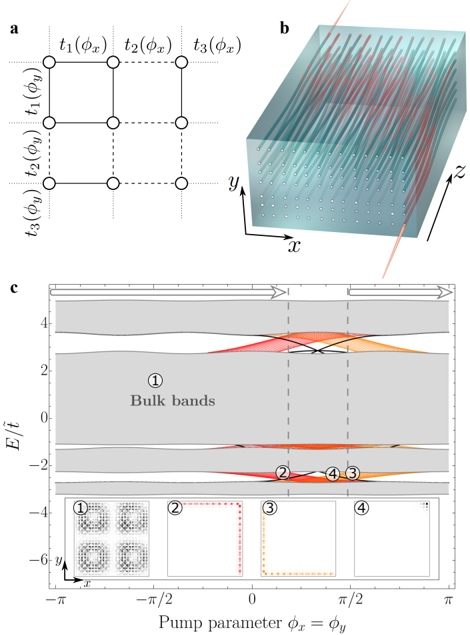
- The device implements a 2D topological pump in a 7 × 13 coupled-waveguide array with \(b_x=b_y=1/3\), \(\lambda_x=\lambda_y=1.06/\mathrm{cm}\), and \(\tilde t_x=\tilde t_y=1.94/\mathrm{cm}\) at 1550 nm; pump parameters \(\phi_i\) are scanned from \(0.477\pi\) to \(2.19\pi\) over 15 cm of propagation.
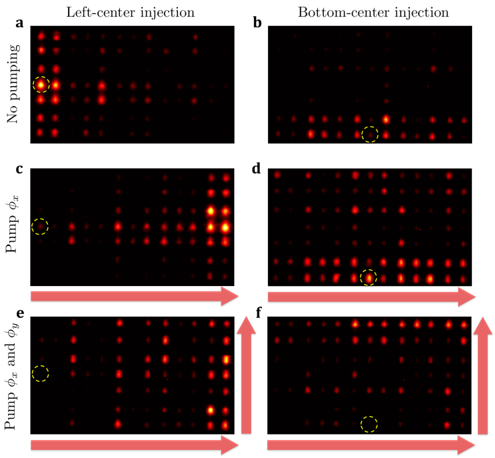
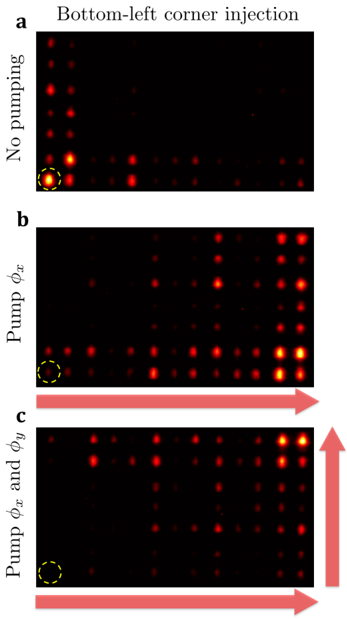
- Without pumping (\(\phi_x=\phi_y=0.477\pi\)), light stays largely confined to the injected edge or corner. Pumping only \(\phi_x\) pumps light left-to-right but not bottom-to-top; pumping both \(\phi_x\) and \(\phi_y\) pumps left-to-right and bottom-to-top, and the corner mode is pumped from bottom-left to top-right.
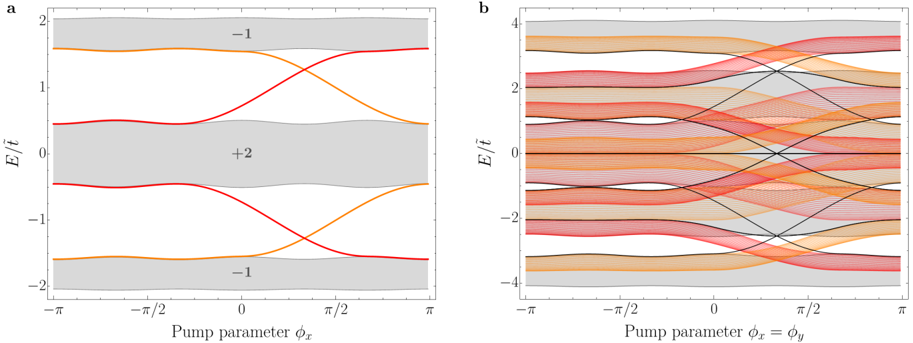
- For the direct-sum model, the lower and upper gaps have second Chern numbers \(V=+1\) and \(-1\), respectively; although long-range hopping prevents a pure direct sum, the gaps remain open and the associated second Chern numbers remain unchanged.
- The observed edge and corner pumping is interpreted as boundary phenomena of the 4D quantum Hall effect: 1D edge states map to 3D hypersurfaces and 0D corner states map to 2D hyperedges.
Methods
- Arrays of evanescently coupled waveguides were fabricated in borosilicate glass using femtosecond laser writing; inter-waveguide separation was modulated to realize the off-diagonal 2D model in Eq. (1).
- Output after 15 cm of propagation was measured over 1510–1590 nm in 5 nm increments and averaged over wavelengths to minimize sensitive interference effects from fabrication imperfections.
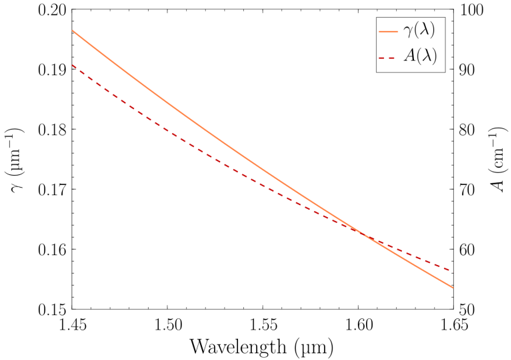
- Light propagation is governed by the paraxial Schrödinger equation and modeled with tight-binding theory; hopping calibration used \(t(s)=A\exp(-\gamma s)\), background index \(n_0=1.473\), and a Gaussian index profile with \(\delta n=2.8\times10^{-3}\), \(\sigma_x=3.5\,\mu\mathrm{m}\), and \(\sigma_y=5.35\,\mu\mathrm{m}\).
Limitations
- The paper states that long-range coupling means the device is not a pure direct sum of two 1D pumps; corner modes can hybridize with bulk modes and are interpreted as long-lived resonances, and some bulk occupation arises from imperfect coupling to edge states and deviations from adiabaticity.
- The paper notes that the Minkowski sum spectrum may not always be gapped depending on amplitudes; if gaps close, the topology of the combined spectrum can no longer be discussed.
- Evident from the text: the experiment uses finite 7 × 13 arrays and wavelength averaging, and it does not directly measure the quantized 4D bulk response; edge/surface pumping provides an independent observation of the physics implied by the second Chern number.
Model-written summary. Check it against the paper before relying on it.
Integrity signals
Registry
Cites
Statistics
Figures
Verification
Claims the paper makes
7 Valid · 2 Not valid · 6 Not checked · 63 Own results and interpretations
Every source the paper cites for this claim was checked and supports it.
In the paper
“Interestingly, a 2D topological pump can be subject to two pump parameters such that it corresponds to a 4D QH system 7 .”
What the sources say
- Supportedcites [7] [S3] Y. E. Kraus, Z. Ringel, and O. Zilberberg, Phys. Rev. Lett. 111 , 226401 (2013). sourceExperimental — accuracy not yet measured
The dimensional-extension discussion (p. 2) identifies two shift parameters, φx and φy, as momenta in two additional dimensions of an ancestor 4D Hamiltonian. The same page explains that adiabatically scanning either parameter pumps charge in the 2D model, supporting the claimed correspondence to a 4D quantum Hall system. (LLM, conf=0.93)
states a cause- Asserted: passes — The authors put it forward as true.
- Checkable: passes — It can be checked against evidence.
- Load-bearing: passes — The paper’s conclusions depend on it.
- Based: passes — The paper gives a reason why it holds.
- Supported
The cited sources support only part of this claim — read each source’s verdict below.
In the paper
“The interwaveguide separation is constructed such that the propagation of light along the device samples over higher-dimensional momenta in the directions orthogonal to the two physical dimensions, thus realizing a 2D topological pump 2,5-10 .”
What the sources say
- Could not verifycites [2] Avron, J. E., Sadun, L., Segert, J. & Simon, B. Chern numbers, quaternions, and Berry’s phases in Fermi systems. Commun. Math. Phys. 124, 595–627 (1989) sourceExperimental — accuracy not yet measured
The Introduction and Proposition 1.4 discuss parameter-dependent Hamiltonians, adiabatic evolution, and Chern numbers on a four-dimensional parameter surface. The passages do not address interwaveguide separation, light propagation, higher-dimensional momenta in a photonic device, or realization of a 2D topological pump; searches for those terms found no supporting passage. (LLM, conf=0.76)
- Not checked — no full text of the sourcecites [5] Thouless, D. J. Quantization of particle transport. Phys. Rev. B 27, 6083–6087 (1983) source
- Partly supportedcites [6] [S2] Y. E. Kraus, Y. Lahini, Z. Ringel, M. Verbin, and O. Zilberberg, Phys. Rev. Lett. 109 , 106402 (2012). sourceExperimental — accuracy not yet measured
The experimental description (p. 3) says waveguide spacing was varied along the propagation axis to sweep the phase φ and pump light. The paper’s higher-dimensional mapping (pp. 3–4) treats φ as an extra dimension, but its demonstrated array is one-dimensional, not a pump with two physical dimensions sampling additional orthogonal momenta. (LLM, conf=0.87)
- Partly supportedcites [7] [S3] Y. E. Kraus, Z. Ringel, and O. Zilberberg, Phys. Rev. Lett. 111 , 226401 (2013). sourceExperimental — accuracy not yet measured
The main text (p. 2) identifies φx and φy as momenta in two fictitious directions. The photonic proposal (p. 6) says inter-waveguide spacing helps emulate the model and proposes varying φx along the light-propagation axis to pump light. It does not say that propagation samples both higher-dimensional momenta, or that inter-waveguide separation alone produces that variation. (LLM, conf=0.84)
- Partly supportedcites [8] Verbin, M., Zilberberg, O., Lahini, Y., Kraus, Y. E. & Silberberg, Y. Topological pumping over a photonic Fibonacci quasicrystal. Phys. Rev. B 91, 064201 (2015) sourceExperimental — accuracy not yet measured
The Experimental Apparatus section says interwaveguide separation was customized to set the coupling profile, and Adiabatic pumping says parameters were varied along the propagation axis to pump light across the array (page numbers not supplied). The paper describes a one-dimensional waveguide array and a two-parameter pump; it does not say propagation samples higher-dimensional momenta orthogonal to two physical dimensions or realizes a 2D topological pump. (LLM, conf=0.88)
- Could not verifycites [9] Haldane, F. & Raghu, S. Possible realization of directional optical waveguides in photonic crystals with broken time-reversal symmetry. Phys. Rev. Lett. 100, 013904 (2008) sourceExperimental — accuracy not yet measured
The discussion of the photonic-crystal model (pp. 2–3) concerns two-dimensional Bloch bands and Faraday-induced edge modes. A search for interwaveguide separation, higher-dimensional momenta, and topological pumping found no passage describing the claimed device construction or 2D pump. (LLM, conf=0.78)
- Not checked — no full text of the sourcecites [10] Wang, Z., Chong, Y., Joannopoulos, J. & Soljačić, M. Observation of unidirectional backscattering-immune topological electromagnetic states. Nature 461, 772–775 (2009) source
plainstates a cause- Asserted: passes — The authors put it forward as true.
- Checkable: passes — It can be checked against evidence.
- Load-bearing: passes — The paper’s conclusions depend on it.
- Based: passes — The paper gives a reason why it holds.
- Could not verify
The cited sources that could be checked couldn’t confirm or dispute this claim.
In the paper
“Therefore, the diffraction of light through the array mimics the timeevolution of the wavefunction of a quantum mechanical particle 36-38 .”
What the sources say
- Could not verifycites [36] Harper, P. G. Single band motion of conduction electrons in a uniform magnetic field. Proc. Phys. Soc. A 68, 874–878 (1955) sourceExperimental — accuracy not yet measured
Our copy of Harper (1955) contains only the tight-binding treatment of a conduction electron in a uniform magnetic field: the difference equation and its W.K.B. solution (§1.1-1.3, eqs. 1.1-1.9), the level-broadening discussion (§3, eqs. 1.10-1.11), and the reference list (Harper 1955, Luttinger 1951, Onsager 1952, Peierls 1933, Watson 1944). No passage mentions light, optical diffraction, or a fabricated array/waveguide lattice, so the paper neither states nor contradicts the claim that light diffraction through an array mimics quantum time evolution. Searched: 'diffraction of light through a periodic array', 'analogy with wave propagation optics light beam' — only semantic neighbours on the electron wavefunction u(r) and the Harper equation came back. (LLM, conf=0.75)
- Could not verifycites [37] [S4] Y. E. Kraus and O. Zilberberg, Phys. Rev. Lett. 109 , 116404 (2012). sourceExperimental — accuracy not yet measured
Our copy of Kraus & Zilberberg (2012) is a purely theoretical paper on topological equivalence of 1D quasiperiodic tight-binding models; no passage states that light diffraction through an array mimics the time evolution of a quantum wavefunction. The only related sentence is the introduction (p. 1): 'Recent experimental developments in photonic crystals [1, 2] and ultracold atoms [3-5] have made the study of the dynamics of particles in one-dimensional (1D) quasiperiodic systems experimentally accessible', which credits experiments but does not assert the diffraction/time-evolution correspondence. Searched: 'diffraction of light through the array mimics time evolution of the wavefunction', 'photonic crystal optical waveguide array experiment'; the closest matches were the p. 1 introduction, the model definition Eq. (1) discussion (p. 2), and the reference list (p. 5, incl. [2] Lahini et al. PRL 103, 013901 (2009)), none of which contains the claimed statement. (LLM, conf=0.68)
- Not checked — no full text of the sourcecites [38] [S5] D. R. Hofstadter, Phys. Rev. B 14 , 2239 (1976). source
plainstates an association- Asserted: passes — The authors put it forward as true.
- Checkable: passes — It can be checked against evidence.
- Load-bearing: passes — The paper’s conclusions depend on it.
- Based: passes — The paper gives a reason why it holds.
- Could not verify
The cited sources support only part of this claim — read each source’s verdict below.
In the paper
“Since this model can be decomposed as a direct sum of 1D pumps that each have gaps that are associated with nontrivial 1 st Chern numbers 6,28,29 , it follows that:”
What the sources say
- Partly supportedcites [6] [S2] Y. E. Kraus, Y. Lahini, Z. Ringel, M. Verbin, and O. Zilberberg, Phys. Rev. Lett. 109 , 106402 (2012). sourceExperimental — accuracy not yet measured
The main text (pp. 2–3) describes adiabatic pumping in a 1D Aubry–André model, and the supplement’s “The Chern Number of a Quasicrystal” (p. 7) associates a Chern number with a gap. Our copy does not establish that the citing paper’s model decomposes as a direct sum of such pumps, or that every pump in that decomposition has gaps with nontrivial first Chern numbers. (LLM, conf=0.84)
- Partly supportedcites [28] [S9] T. Ozawa, H. M. Price, N. Goldman, O. Zilberberg, and I. Carusotto, Phys. Rev. A 93 , 043827 (2016). sourceExperimental — accuracy not yet measured
Section III.B, “Introduction to the 2D Harper-Hofstadter model” (page unavailable), describes topologically nontrivial bands with nonzero first Chern numbers and edge states in the band gaps. It does not describe decomposing the model into a direct sum of 1D pumps, so that part of the attributed claim is unsupported by our copy. (LLM, conf=0.82)
- Partly supportedcites [29] [S10] H. M. Price, O. Zilberberg, T. Ozawa, I. Carusotto, and N. Goldman, Phys. Rev. B 93 , 245113 (2016). sourceExperimental — accuracy not yet measured
In “A. Minimal 4D topological model” (page unavailable), the paper describes the model as two constituent 2D Harper–Hofstadter models and identifies a first Chern number for each plane. Its discussion of Harper–Hofstadter gaps also associates gaps with Chern numbers of the bands below them. Our copy does not describe the decomposition as a direct sum of 1D pumps, so that part of the claim is not supported. (LLM, conf=0.82)
plainstates an association- Asserted: passes — The authors put it forward as true.
- Checkable: passes — It can be checked against evidence.
- Load-bearing: passes — The paper’s conclusions depend on it.
- Based: passes — The paper gives a reason why it holds.
- Rests on an assumption not shown here.
- Partly supported
A result the paper reports from its own data — it cites no other source for it, so there is none to check. The quote shows it is in the paper.
In the paper
“We see that light stays largely confined to the injected edge, i.e., it had mostly excited the topological localized edge modes (see Fig. 2 a , b ).”
plain- Asserted: passes — The authors put it forward as true.
- Checkable: passes — It can be checked against evidence.
- Load-bearing: passes — The paper’s conclusions depend on it.
- Based: passes — The paper gives a reason why it holds.
47 more claims
Create a free account to see all 78 claims and every source verdict.
- Probably not a substantial claim. 7
- It may state two separate claims as one. 19
- Borderline: one of the tests for a substantial claim is unclear. 1
- The quote only partly states this claim. 1
Claims other papers make about this one
Each is checked against this paper’s own text: does it say what the citing paper says it does?
The cited source says what the claim attributes to it.
In the citing paper
“As mentioned in Sec.IV.B, a recent photonic experiment has used topological pumping to probe the edge states of a four-dimensional quantum Hall system (Zilberberg et al., 2018), based on the proposal of Kraus, Ringel, and Zilberberg (2013).”
From Topological photonics (2019) · cites this paper as Zilberberg et al., 2018
Citations
Cites
Colloquium : Topological insulators
Hasan, M. Z., & Kane, C. L. (2010) · Reviews of Modern Physics · doi:10.1103/revmodphys.82.3045 · Cited by 19,930
Klitzing, K. V., Dorda, G., & Pepper, M. (1980) · Physical Review Letters · doi:10.1103/physrevlett.45.494 · Cited by 7,119
Energy levels and wave functions of Bloch electrons in rational and irrational magnetic fields
Hofstadter, D. R. (1976) · Physical Review B · doi:10.1103/physrevb.14.2239 · Cited by 3,495
Photonic Floquet topological insulators
Rechtsman, M. C., Zeuner, J. M., Plotnik, Y., Lumer, Y., Podolsky, D., Dreisow, F., Nolte, S., Segev, M., & Szameit, A. (2013) · Nature · doi:10.1038/nature12066 · Cited by 3,332
Self-citationTopological field theory of time-reversal invariant insulators
Qi, X.-L., Hughes, T. L., & Zhang, S.-C. (2008) · Physical Review B · doi:10.1103/physrevb.78.195424 · Cited by 3,329
Observation of unidirectional backscattering-immune topological electromagnetic states
Wang, Z., Chong, Y., Joannopoulos, J. D., & Soljačić, M. (2009) · Nature · doi:10.1038/nature08293 · Cited by 3,123
Haldane, F. D. M., & Raghu, S. (2008) · Physical Review Letters · doi:10.1103/physrevlett.100.013904 · Cited by 2,787
Haldane, F. D. M., & Raghu, S. (2005) · arXiv · doi:10.48550/arxiv.cond-mat/0503588 · Cited by 2,739
Quantized electric multipole insulators
Benalcazar, W. A., Bernevig, B. A., & Hughes, T. L. (2017) · Science · doi:10.1126/science.aah6442 · Cited by 2,029
Experimental realization of the topological Haldane model with ultracold fermions
Jotzu, G., Messer, M., Desbuquois, R., Lebrat, M., Uehlinger, T., Greif, D., & Esslinger, T. (2014) · Nature · doi:10.1038/nature13915 · Cited by 2,017
Cited by
Items 501–534 of 534
Zak-Phase Dislocations in Trimer Lattices
Uakhitov, T., Urmanov, A., Kumekov, S. E., & Desyatnikov, A. S. (2025) · Symmetry · doi:10.3390/sym17101631 · Cited by 2
Designing transient bandlike structures in regular photonic lattices
Arévalo, E., & Morales-Molina, L. (2019) · Physical Review A · doi:10.1103/physreva.99.023806
Numerical calculation of the k -space second Chern number in four dimensions
Liu, X., Yi, X.-X., Liu, Z., Chen, R., & Zhou, B. (2026) · Physica Scripta · doi:10.1088/1402-4896/ae8e4d · Cited by 2
Arbitrary number of tunable localized states by synthetic band windings
Liu, M.-Y., Chen, Z., Sun, X., Lu, M.-H., & Chen, Y. (2025) · Physical review. B./Physical review. B · doi:10.1103/z7v8-dxbz
Higher-Order Topology and Fully Flat Bands in Multimode Photonic Time-Reversal-Invariant Lattices
Mazanov, M., Kupriianov, A. S., He, Z., Savelev, R. S., & Gorlach, M. A. (2023) · Light Conference (LC) · doi:10.1109/ieeeconf59639.2023.10367218 · Cited by 1
Broadband coupled resonator optical waveguides with robust topological coupler
Tang, G., Jin, L.-H., Sun, L., He, X., Chen, X., Guo, C.-H., Hu, P., Li, M.-Y., Li, J.-C., Wang, H.-W., et al. (2026) · PhotoniX · doi:10.1186/s43074-026-00253-3
Topologically quantized solitonlike pumping using synthetic nonlinearity
Maisuriya, A., Mali, S., & Mittal, S. (2026) · Physical Review A · doi:10.1103/ybcb-4tq4
Wei, X.-H., Luo, X.-W., Guo, G.-C., & Zhou, Z.-W. (2026) · Physical Review Research · doi:10.1103/vtqw-7yjf · Cited by 2
One-dimensional emulation of high-dimensional disclination topology
Wang, J., Lei, S., Song, D., Tang, L., Xia, S., & Chen, Z. (2026) · Photonics Research · doi:10.1364/prj.599128
Realisation of Laughlin's topological charge pump in an atomic Hall cylinder
Fabre, A. (2022) · theses.fr (ABES) · doi:10.70675/a8c1d0b2z0a6ez422ez8c26zfd96c80dec4a · Cited by 2
Chengting, 沈. S., Song, W., & Tao, 李. L. (2026) · Acta Optica Sinica · doi:10.3788/aos260516
Periodically driven photonic topological gapless systems
Upreti, L. K. (2020) · theses.fr (ABES) · doi:10.70675/fda10778z2268z4c36z9ca2z4a06fe20d976 · Cited by 2
Nonreciprocity-induced fractional nonlinear Thouless pumping
Zheng, Y., Pu, K., Ren, L., Bai, C., & Liang, Z. (2026) · Physical Review A · doi:10.1103/w2sw-br7d
Kremer, M., Petrides, I., Meyer, E., Heinrich, M., Zilberberg, O., & Szameit, A. (2019) · Conference on Lasers and Electro-Optics · doi:10.23919/cleo.2019.8750678
Self-citationLin, C.-Y., Marcucci, G., Wan, G., Chuang, Y.-L., Conti, C., & Lee, R. (2021) · OSA Continuum · doi:10.1364/osac.413213 · Cited by 1
Regulation mechanisms of Weyl points and Fermi arcs in magnetic plasmonics
QIAN, W., Hou, J., Chen, X., Huang, W., Li, K.-G., & Zuo, Z. (2026) · Optics Express · doi:10.1364/oe.608560
Exploring Topological Photonics in Synthetic Dimensions
Price, H. M., Ozawa, T., Goldman, N., Zilberberg, O., & Carusotto, I. (2019) · Conference on Lasers and Electro-Optics Europe & European Quantum Electronics Conference (CLEO/Europe-EQEC) · doi:10.1109/cleoe-eqec.2019.8872904
Self-citationTopological polariton lasers and circuits
Septembre, I. (2023) · theses.fr (ABES) · doi:10.70675/3752f0a4zbc0bz499eza67azfd987c6efd38
HofstadterTools: A Python package for analyzing the Hofstadter model
Andrews, B. (2023) · arXiv (Cornell University) · doi:10.48550/arxiv.2311.18726
Quantum logical controlled-NOT gate in a lithium niobate-on-insulator photonic quantum walkPreprint
Chapman, R. J., Häusler, S., Finco, G., Kaufmann, F., & Grange, R. (2023) · arXiv (Cornell University) · doi:10.3929/ethz-b-000646223
Quantized transport of solitons in Bose-Einstein condensates driven by spin-orbit coupling
Kartashov, Y. V., Konotop, V. V., & Zezyulin, D. A. (2026) · Physical Review A · doi:10.1103/wmyd-tnzv · Cited by 3
Topological pumping in non-Abelian synthetic gauge fields
Zhang, Y., Zhang, W., Qian, L., Yuan, H., & Zhang, X. (2026) · Physical review. B./Physical review. B · doi:10.1103/dm79-94hr
Thouless pumps and universal geometry-induced drift velocity in multisliding quasiperiodic lattices
Xu, Z., & Yao, Y. (2026) · Physical review. B./Physical review. B · doi:10.1103/dp19-2r4z
Goblot, V. (2019) · theses.fr (ABES) · doi:10.70675/ad409689zb168z4dc0z9c72z8fc96ce1c6dd · Cited by 2
Laughlin arguments in arbitrary dimensionsPreprint
Carey, A. L., & Schulz‐Baldes, H. (2017) · arXiv (Cornell University)
Advances on Topological Photonics in Non‐Hermitian, Spatial‐Temporal, Nonlinear, and Quantum Regimes
Wan, F., Hou, X., Sun, Y., Zhang, Y., Wang, D., & Yang, Z. (2026) · Laser & Photonics Review · doi:10.1002/lpor.71929
Routing light with different wavevectors using synthetic dimensions
Lyu, X., Bai, K., & Xiao, M. (2024) · Journal of the Optical Society of America A · doi:10.1364/josaa.519506
Metadata
- Authors
- Zilberberg, O., Huang, S., Guglielmon, J., Wang, M., Chen, K. P., Kraus, Y. E., & Rechtsman, M. C.
- Affiliations
- ETH Zurich (CH)
- University of Pittsburgh (US)
- Pennsylvania State University (US)
- Holon Institute of Technology (IL)
- Corresponding author
- Zilberberg, Oded
- Rechtsman, Mikael C.
- Venue
- Nature
- Published
- 2018-01
- Volume
- 553
- Issue
- 7686
- Pages
- 59-62
- ISSN
- 0028-0836 (ISSN-L)
- 1476-4687
- OpenAlex
- W2781846354
- Semantic Scholar
- 1398c50a49f6450b9a53262ca7bdba33ee9aa2ea
- Cited by
- 533
- References
- 42
- Citations by year
- 2026: 45 · 2025: 50 · 2024: 74 · 2023: 58 · 2022: 74 · 2021: 72 · 2020: 59 · 2019: 62 · 2018: 38
- FWCI
- 26.71
- Type
- journal article
- Language
- en
- Open access
- green
- arxiv.org
- Licence
- www.springer.com/tdm (tdm)
- Locations
- Nature (publishedVersion)
- PubMed (publishedVersion)
- arXiv (Cornell University) (submittedVersion)
- RePEc: Research Papers in Economics (submittedVersion)
- Figshare (submittedVersion, public-domain)
- arXiv (Cornell University)
- Funders
- National Science Foundation (1620218, 1509546, 1509199)
- Alfred P. Sloan Foundation (FG‐2016‐6418)
- Schweizerischer Nationalfonds zur Förderung der Wissenschaftlichen Forschung
- Division of Electrical, Communications and Cyber Systems
- Topics
- Physical Sciences › Physics and Astronomy › Condensed Matter Physics › Topological Materials and Phenomena
- Physical Sciences › Physics and Astronomy › Atomic and Molecular Physics, and Optics › Quantum Mechanics and Non-Hermitian Physics
- Physical Sciences › Physics and Astronomy › Condensed Matter Physics › Quantum and electron transport phenomena
- Keywords
- second Chern number, photonic waveguide arrays, synthetic dimensions, edge states, topological boundary modes, Hall conductance quantization, topological invariants, higher-dimensional topology, photonic lattices, topological protection, photonic crystals, topological photonics, ultracold atoms in optical lattices
About these checks
Registry, retraction, Cites and statistics results are computed, not judged, with one exception: a printed reference that no index lists is read once by a model before it counts as a citation error. Claims are extracted by a model and kept only when their quote appears verbatim in the text; each cited source is then checked, with a model’s help, for whether it says what the claim relies on. Those verdicts can be wrong — read the claim’s quote and the cited source before relying on one.
The claim verdicts this report counts are experimental: their accuracy is not yet measured.
A language model drew the claims from the paper on 2026-10-10, under version 3 of the claim definition (model deepseek-v4.1-flash, prompt extract-v3).
A second model labelled each claim on 2026-10-10 (model jev-1.13-20260917, definition revision gold-guideline-v0.2).
Cited sources are checked with a language model’s help (gpt-6-sol and qwen3.8-omni-flash).
Statistics and arithmetic are recomputed, not judged.
Confidence bands are shown only for fields calibrated on our annotated test set. None is calibrated yet, so no band is shown.
What counts as a claim ›How we measure confidence ›How we check this ›
Are you an author, or do you see a problem with this page? Request a review
Data sources
Bibliographic data: Semantic Scholar, OpenAlex, Crossref.
Contains information from the Semantic Scholar Academic Graph Datasets, made available under the ODC Attribution License (ODC-BY 1.0).
Semantic Scholar’s data is described in: Kinney, R., et al. (2023). The Semantic Scholar Open Data Platform. arXiv:2301.10140.
