

Photonic topological boundary pumping as a probe of 4D quantum Hall physics
Open accessThe DOI matches its Crossref record; 45 of the 45 references it cites were found in a registry or an index; 18 of the 28 sources its claims cite were checked for support.
Abstract
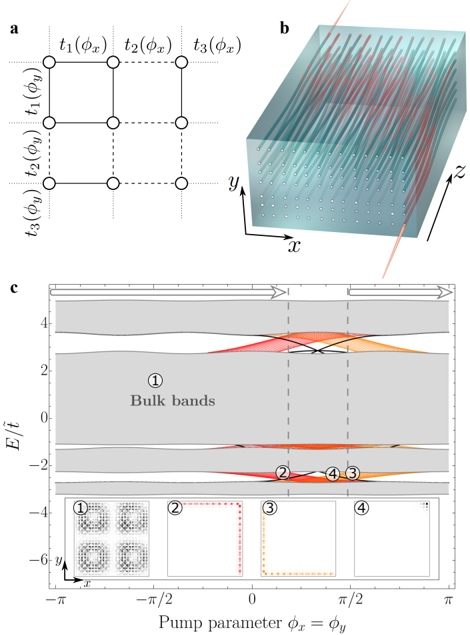
When a two-dimensional (2D) electron gas is placed in a perpendicular magnetic field, its in-plane transverse conductance becomes quantized; this is known as the quantum Hall effect. It arises from the non-trivial topology of the electronic band structure of the system, where an integer topological invariant (the first Chern number) leads to quantized Hall conductance. It has been shown theoretically that the quantum Hall effect can be generalized to four spatial dimensions, but so far this has not been realized experimentally because experimental systems are limited to three spatial dimensions. Here we use tunable 2D arrays of photonic waveguides to realize a dynamically generated four-dimensional (4D) quantum Hall system experimentally. The inter-waveguide separation in the array is constructed in such a way that the propagation of light through the device samples over momenta in two additional synthetic dimensions, thus realizing a 2D topological pump. As a result, the band structure has 4D topological invariants (known as second Chern numbers) that support a quantized bulk Hall response with 4D symmetry. In a finite-sized system, the 4D topological bulk response is carried by localized edge modes that cross the sample when the synthetic momenta are modulated. We observe this crossing directly through photon pumping of our system from edge to edge and corner to corner. These crossings are equivalent to charge pumping across a 4D system from one three-dimensional hypersurface to the spatially opposite one and from one 2D hyperedge to another. Our results provide a platform for the study of higher-dimensional topological physics.
Overview
CoChat Summary
TL;DR
The paper reports an experimental realization of a dynamically generated 4D quantum Hall system in a 2D photonic waveguide array, using a 2D topological pump with synthetic dimensions. By scanning pump parameters, the authors observe edge-to-edge and corner-to-corner photon pumping consistent with a nonzero second Chern number.
Key findings
- The device implements a 2D topological pump in a 7 × 13 coupled-waveguide array with \(b_x=b_y=1/3\), \(\lambda_x=\lambda_y=1.06/\mathrm{cm}\), and \(\tilde t_x=\tilde t_y=1.94/\mathrm{cm}\) at 1550 nm; pump parameters \(\phi_i\) are scanned from \(0.477\pi\) to \(2.19\pi\) over 15 cm of propagation.
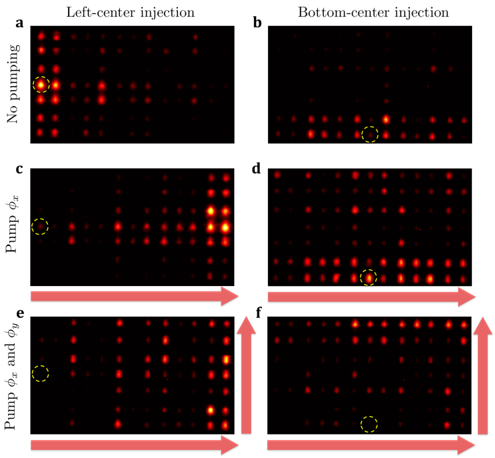
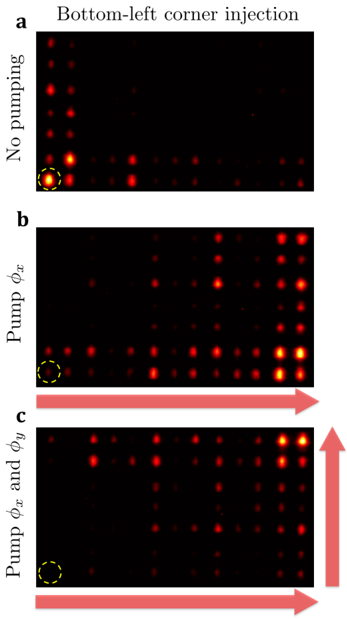
- Without pumping (\(\phi_x=\phi_y=0.477\pi\)), light stays largely confined to the injected edge or corner. Pumping only \(\phi_x\) pumps light left-to-right but not bottom-to-top; pumping both \(\phi_x\) and \(\phi_y\) pumps left-to-right and bottom-to-top, and the corner mode is pumped from bottom-left to top-right.
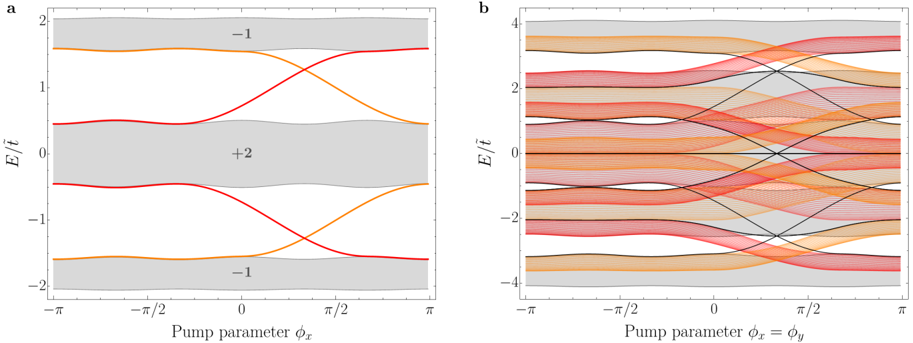
- For the direct-sum model, the lower and upper gaps have second Chern numbers \(V=+1\) and \(-1\), respectively; although long-range hopping prevents a pure direct sum, the gaps remain open and the associated second Chern numbers remain unchanged.
- The observed edge and corner pumping is interpreted as boundary phenomena of the 4D quantum Hall effect: 1D edge states map to 3D hypersurfaces and 0D corner states map to 2D hyperedges.
Methods
- Arrays of evanescently coupled waveguides were fabricated in borosilicate glass using femtosecond laser writing; inter-waveguide separation was modulated to realize the off-diagonal 2D model in Eq. (1).
- Output after 15 cm of propagation was measured over 1510–1590 nm in 5 nm increments and averaged over wavelengths to minimize sensitive interference effects from fabrication imperfections.
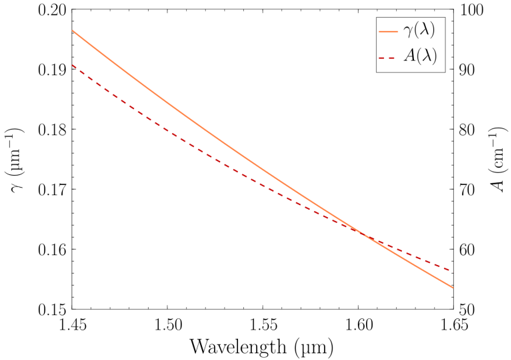
- Light propagation is governed by the paraxial Schrödinger equation and modeled with tight-binding theory; hopping calibration used \(t(s)=A\exp(-\gamma s)\), background index \(n_0=1.473\), and a Gaussian index profile with \(\delta n=2.8\times10^{-3}\), \(\sigma_x=3.5\,\mu\mathrm{m}\), and \(\sigma_y=5.35\,\mu\mathrm{m}\).
Limitations
- The paper states that long-range coupling means the device is not a pure direct sum of two 1D pumps; corner modes can hybridize with bulk modes and are interpreted as long-lived resonances, and some bulk occupation arises from imperfect coupling to edge states and deviations from adiabaticity.
- The paper notes that the Minkowski sum spectrum may not always be gapped depending on amplitudes; if gaps close, the topology of the combined spectrum can no longer be discussed.
- Evident from the text: the experiment uses finite 7 × 13 arrays and wavelength averaging, and it does not directly measure the quantized 4D bulk response; edge/surface pumping provides an independent observation of the physics implied by the second Chern number.
Model-written summary. Check it against the paper before relying on it.
Integrity signals
Registry
Cites
Statistics
Figures
Verification
Claims the paper makes
7 Valid · 2 Not valid · 6 Not checked · 63 Own results and interpretations
Every source the paper cites for this claim was checked and supports it.
In the paper
“Interestingly, a 2D topological pump can be subject to two pump parameters such that it corresponds to a 4D QH system 7 .”
What the sources say
- Supportedcites [7] [S3] Y. E. Kraus, Z. Ringel, and O. Zilberberg, Phys. Rev. Lett. 111 , 226401 (2013). sourceExperimental — accuracy not yet measured
The dimensional-extension discussion (p. 2) identifies two shift parameters, φx and φy, as momenta in two additional dimensions of an ancestor 4D Hamiltonian. The same page explains that adiabatically scanning either parameter pumps charge in the 2D model, supporting the claimed correspondence to a 4D quantum Hall system. (LLM, conf=0.93)
states a cause- Asserted: passes — The authors put it forward as true.
- Checkable: passes — It can be checked against evidence.
- Load-bearing: passes — The paper’s conclusions depend on it.
- Based: passes — The paper gives a reason why it holds.
- Supported
The cited sources support only part of this claim — read each source’s verdict below.
In the paper
“The interwaveguide separation is constructed such that the propagation of light along the device samples over higher-dimensional momenta in the directions orthogonal to the two physical dimensions, thus realizing a 2D topological pump 2,5-10 .”
What the sources say
- Could not verifycites [2] Avron, J. E., Sadun, L., Segert, J. & Simon, B. Chern numbers, quaternions, and Berry’s phases in Fermi systems. Commun. Math. Phys. 124, 595–627 (1989) sourceExperimental — accuracy not yet measured
The Introduction and Proposition 1.4 discuss parameter-dependent Hamiltonians, adiabatic evolution, and Chern numbers on a four-dimensional parameter surface. The passages do not address interwaveguide separation, light propagation, higher-dimensional momenta in a photonic device, or realization of a 2D topological pump; searches for those terms found no supporting passage. (LLM, conf=0.76)
- Not checked — no full text of the sourcecites [5] Thouless, D. J. Quantization of particle transport. Phys. Rev. B 27, 6083–6087 (1983) source
- Partly supportedcites [6] [S2] Y. E. Kraus, Y. Lahini, Z. Ringel, M. Verbin, and O. Zilberberg, Phys. Rev. Lett. 109 , 106402 (2012). sourceExperimental — accuracy not yet measured
The experimental description (p. 3) says waveguide spacing was varied along the propagation axis to sweep the phase φ and pump light. The paper’s higher-dimensional mapping (pp. 3–4) treats φ as an extra dimension, but its demonstrated array is one-dimensional, not a pump with two physical dimensions sampling additional orthogonal momenta. (LLM, conf=0.87)
- Partly supportedcites [7] [S3] Y. E. Kraus, Z. Ringel, and O. Zilberberg, Phys. Rev. Lett. 111 , 226401 (2013). sourceExperimental — accuracy not yet measured
The main text (p. 2) identifies φx and φy as momenta in two fictitious directions. The photonic proposal (p. 6) says inter-waveguide spacing helps emulate the model and proposes varying φx along the light-propagation axis to pump light. It does not say that propagation samples both higher-dimensional momenta, or that inter-waveguide separation alone produces that variation. (LLM, conf=0.84)
- Partly supportedcites [8] Verbin, M., Zilberberg, O., Lahini, Y., Kraus, Y. E. & Silberberg, Y. Topological pumping over a photonic Fibonacci quasicrystal. Phys. Rev. B 91, 064201 (2015) sourceExperimental — accuracy not yet measured
The Experimental Apparatus section says interwaveguide separation was customized to set the coupling profile, and Adiabatic pumping says parameters were varied along the propagation axis to pump light across the array (page numbers not supplied). The paper describes a one-dimensional waveguide array and a two-parameter pump; it does not say propagation samples higher-dimensional momenta orthogonal to two physical dimensions or realizes a 2D topological pump. (LLM, conf=0.88)
- Could not verifycites [9] Haldane, F. & Raghu, S. Possible realization of directional optical waveguides in photonic crystals with broken time-reversal symmetry. Phys. Rev. Lett. 100, 013904 (2008) sourceExperimental — accuracy not yet measured
The discussion of the photonic-crystal model (pp. 2–3) concerns two-dimensional Bloch bands and Faraday-induced edge modes. A search for interwaveguide separation, higher-dimensional momenta, and topological pumping found no passage describing the claimed device construction or 2D pump. (LLM, conf=0.78)
- Not checked — no full text of the sourcecites [10] Wang, Z., Chong, Y., Joannopoulos, J. & Soljačić, M. Observation of unidirectional backscattering-immune topological electromagnetic states. Nature 461, 772–775 (2009) source
plainstates a cause- Asserted: passes — The authors put it forward as true.
- Checkable: passes — It can be checked against evidence.
- Load-bearing: passes — The paper’s conclusions depend on it.
- Based: passes — The paper gives a reason why it holds.
- Could not verify
The cited sources that could be checked couldn’t confirm or dispute this claim.
In the paper
“Therefore, the diffraction of light through the array mimics the timeevolution of the wavefunction of a quantum mechanical particle 36-38 .”
What the sources say
- Could not verifycites [36] Harper, P. G. Single band motion of conduction electrons in a uniform magnetic field. Proc. Phys. Soc. A 68, 874–878 (1955) sourceExperimental — accuracy not yet measured
Our copy of Harper (1955) contains only the tight-binding treatment of a conduction electron in a uniform magnetic field: the difference equation and its W.K.B. solution (§1.1-1.3, eqs. 1.1-1.9), the level-broadening discussion (§3, eqs. 1.10-1.11), and the reference list (Harper 1955, Luttinger 1951, Onsager 1952, Peierls 1933, Watson 1944). No passage mentions light, optical diffraction, or a fabricated array/waveguide lattice, so the paper neither states nor contradicts the claim that light diffraction through an array mimics quantum time evolution. Searched: 'diffraction of light through a periodic array', 'analogy with wave propagation optics light beam' — only semantic neighbours on the electron wavefunction u(r) and the Harper equation came back. (LLM, conf=0.75)
- Could not verifycites [37] [S4] Y. E. Kraus and O. Zilberberg, Phys. Rev. Lett. 109 , 116404 (2012). sourceExperimental — accuracy not yet measured
Our copy of Kraus & Zilberberg (2012) is a purely theoretical paper on topological equivalence of 1D quasiperiodic tight-binding models; no passage states that light diffraction through an array mimics the time evolution of a quantum wavefunction. The only related sentence is the introduction (p. 1): 'Recent experimental developments in photonic crystals [1, 2] and ultracold atoms [3-5] have made the study of the dynamics of particles in one-dimensional (1D) quasiperiodic systems experimentally accessible', which credits experiments but does not assert the diffraction/time-evolution correspondence. Searched: 'diffraction of light through the array mimics time evolution of the wavefunction', 'photonic crystal optical waveguide array experiment'; the closest matches were the p. 1 introduction, the model definition Eq. (1) discussion (p. 2), and the reference list (p. 5, incl. [2] Lahini et al. PRL 103, 013901 (2009)), none of which contains the claimed statement. (LLM, conf=0.68)
- Not checked — no full text of the sourcecites [38] [S5] D. R. Hofstadter, Phys. Rev. B 14 , 2239 (1976). source
plainstates an association- Asserted: passes — The authors put it forward as true.
- Checkable: passes — It can be checked against evidence.
- Load-bearing: passes — The paper’s conclusions depend on it.
- Based: passes — The paper gives a reason why it holds.
- Could not verify
The cited sources support only part of this claim — read each source’s verdict below.
In the paper
“Since this model can be decomposed as a direct sum of 1D pumps that each have gaps that are associated with nontrivial 1 st Chern numbers 6,28,29 , it follows that:”
What the sources say
- Partly supportedcites [6] [S2] Y. E. Kraus, Y. Lahini, Z. Ringel, M. Verbin, and O. Zilberberg, Phys. Rev. Lett. 109 , 106402 (2012). sourceExperimental — accuracy not yet measured
The main text (pp. 2–3) describes adiabatic pumping in a 1D Aubry–André model, and the supplement’s “The Chern Number of a Quasicrystal” (p. 7) associates a Chern number with a gap. Our copy does not establish that the citing paper’s model decomposes as a direct sum of such pumps, or that every pump in that decomposition has gaps with nontrivial first Chern numbers. (LLM, conf=0.84)
- Partly supportedcites [28] [S9] T. Ozawa, H. M. Price, N. Goldman, O. Zilberberg, and I. Carusotto, Phys. Rev. A 93 , 043827 (2016). sourceExperimental — accuracy not yet measured
Section III.B, “Introduction to the 2D Harper-Hofstadter model” (page unavailable), describes topologically nontrivial bands with nonzero first Chern numbers and edge states in the band gaps. It does not describe decomposing the model into a direct sum of 1D pumps, so that part of the attributed claim is unsupported by our copy. (LLM, conf=0.82)
- Partly supportedcites [29] [S10] H. M. Price, O. Zilberberg, T. Ozawa, I. Carusotto, and N. Goldman, Phys. Rev. B 93 , 245113 (2016). sourceExperimental — accuracy not yet measured
In “A. Minimal 4D topological model” (page unavailable), the paper describes the model as two constituent 2D Harper–Hofstadter models and identifies a first Chern number for each plane. Its discussion of Harper–Hofstadter gaps also associates gaps with Chern numbers of the bands below them. Our copy does not describe the decomposition as a direct sum of 1D pumps, so that part of the claim is not supported. (LLM, conf=0.82)
plainstates an association- Asserted: passes — The authors put it forward as true.
- Checkable: passes — It can be checked against evidence.
- Load-bearing: passes — The paper’s conclusions depend on it.
- Based: passes — The paper gives a reason why it holds.
- Rests on an assumption not shown here.
- Partly supported
A result the paper reports from its own data — it cites no other source for it, so there is none to check. The quote shows it is in the paper.
In the paper
“We see that light stays largely confined to the injected edge, i.e., it had mostly excited the topological localized edge modes (see Fig. 2 a , b ).”
plain- Asserted: passes — The authors put it forward as true.
- Checkable: passes — It can be checked against evidence.
- Load-bearing: passes — The paper’s conclusions depend on it.
- Based: passes — The paper gives a reason why it holds.
47 more claims
Create a free account to see all 78 claims and every source verdict.
- Probably not a substantial claim. 7
- It may state two separate claims as one. 19
- Borderline: one of the tests for a substantial claim is unclear. 1
- The quote only partly states this claim. 1
Claims other papers make about this one
Each is checked against this paper’s own text: does it say what the citing paper says it does?
The cited source says what the claim attributes to it.
In the citing paper
“As mentioned in Sec.IV.B, a recent photonic experiment has used topological pumping to probe the edge states of a four-dimensional quantum Hall system (Zilberberg et al., 2018), based on the proposal of Kraus, Ringel, and Zilberberg (2013).”
From Topological photonics (2019) · cites this paper as Zilberberg et al., 2018
Citations
Cites
Colloquium : Topological insulators
Hasan, M. Z., & Kane, C. L. (2010) · Reviews of Modern Physics · doi:10.1103/revmodphys.82.3045 · Cited by 19,930
Klitzing, K. V., Dorda, G., & Pepper, M. (1980) · Physical Review Letters · doi:10.1103/physrevlett.45.494 · Cited by 7,119
Energy levels and wave functions of Bloch electrons in rational and irrational magnetic fields
Hofstadter, D. R. (1976) · Physical Review B · doi:10.1103/physrevb.14.2239 · Cited by 3,495
Photonic Floquet topological insulators
Rechtsman, M. C., Zeuner, J. M., Plotnik, Y., Lumer, Y., Podolsky, D., Dreisow, F., Nolte, S., Segev, M., & Szameit, A. (2013) · Nature · doi:10.1038/nature12066 · Cited by 3,332
Self-citationTopological field theory of time-reversal invariant insulators
Qi, X.-L., Hughes, T. L., & Zhang, S.-C. (2008) · Physical Review B · doi:10.1103/physrevb.78.195424 · Cited by 3,329
Observation of unidirectional backscattering-immune topological electromagnetic states
Wang, Z., Chong, Y., Joannopoulos, J. D., & Soljačić, M. (2009) · Nature · doi:10.1038/nature08293 · Cited by 3,123
Haldane, F. D. M., & Raghu, S. (2008) · Physical Review Letters · doi:10.1103/physrevlett.100.013904 · Cited by 2,787
Haldane, F. D. M., & Raghu, S. (2005) · arXiv · doi:10.48550/arxiv.cond-mat/0503588 · Cited by 2,739
Quantized electric multipole insulators
Benalcazar, W. A., Bernevig, B. A., & Hughes, T. L. (2017) · Science · doi:10.1126/science.aah6442 · Cited by 2,029
Experimental realization of the topological Haldane model with ultracold fermions
Jotzu, G., Messer, M., Desbuquois, R., Lebrat, M., Uehlinger, T., Greif, D., & Esslinger, T. (2014) · Nature · doi:10.1038/nature13915 · Cited by 2,017
Cited by
Ozawa, T., Price, H. M., Amo, A., Goldman, N., Hafezi, M., Lu, L., Rechtsman, M. C., Schuster, D., Simon, J., Zilberberg, O., et al. (2019) · Reviews of Modern Physics · doi:10.1103/revmodphys.91.015006 · Cited by 3,722
“…al., 2018) performed a direct mapping of the Berry curvature by looking at anomalous transport in the bulk of the system, the photonic experiment (Zilberberg et al., 2018) studied the boundary states associated with a second Chern number response using similar methods to those previously…”
MethodInfluentialSelf-citationTopological Phases of Non-Hermitian Systems
Gong, Z., Ashida, Y., Kawabata, K., Takasan, K., Higashikawa, S., & Ueda, M. (2018) · Physical Review X · doi:10.1103/physrevx.8.031079 · Cited by 1,462
Ghatak, A., Brandenbourger, M., van Wezel, J., & Coulais, C. (2020) · Proceedings of the National Academy of Sciences · doi:10.1073/pnas.2010580117 · Cited by 558
Synthetic dimension in photonics
Yuan, L., Lin, Q., Xiao, M., & Fan, S. (2018) · Optica · doi:10.1364/optica.5.001396 · Cited by 545
Recent advances in 2D, 3D and higher-order topological photonics
Kim, M., Jacob, Z., & Rho, J. (2020) · Light: Science & Applications · doi:10.1038/s41377-020-0331-y · Cited by 470
Exploring 4D quantum Hall physics with a 2D topological charge pump
Lohse, M., Schweizer, C., Price, H. M., Zilberberg, O., & Bloch, I. (2018) · Nature · doi:10.1038/nature25000 · Cited by 455
Self-citationTopological quantum matter in synthetic dimensions
Ozawa, T., & Price, H. M. (2019) · Nature Reviews Physics · doi:10.1038/s42254-019-0045-3 · Cited by 387
Photonic topological insulator in synthetic dimensions
Lustig, E., Weimann, S., Plotnik, Y., Lumer, Y., Bandres, M. A., Szameit, A., & Segev, M. (2019) · Nature · doi:10.1038/s41586-019-0943-7 · Cited by 381
Topological aspects of photonic time crystals
Lustig, E., Sharabi, Y., & Segev, M. (2018) · Optica · doi:10.1364/optica.5.001390 · Cited by 350
Topological Photonic Crystals: Physics, Designs, and Applications
Tang, G., He, X., Shi, F., Liu, J., Chen, X., & Dong, J. (2022) · Laser & Photonics Reviews · doi:10.1002/lpor.202100300 · Cited by 340
Topological quantum matter with cold atoms
Zhang, D.-W., Zhu, Y.-Q., Zhao, Y. X., Yan, H., & Zhu, S.-L. (2018) · Advances in Physics · doi:10.1080/00018732.2019.1594094 · Cited by 309
A single photonic cavity with two independent physical synthetic dimensions
Dutt, A., Lin, Q., Yuan, L., Minkov, M., Xiao, M., & Fan, S. (2020) · Science · doi:10.1126/science.aaz3071 · Cited by 298
Nonlinearity-induced photonic topological insulator
Maczewsky, L. J., Heinrich, M., Kremer, M., Ivanov, S. K., Ehrhardt, M., Martinez, F., Kartashov, Y. V., Konotop, V. V., Torner, L., Bauer, D., et al. (2020) · Science · doi:10.1126/science.abd2033 · Cited by 268
Artificial gauge fields in materials and engineered systems
Aidelsburger, M., Nascimbene, S., & Goldman, N. (2018) · Comptes Rendus. Physique · doi:10.1016/j.crhy.2018.03.002 · Cited by 254
Realization of an Acoustic Third-Order Topological Insulator
Xue, H., Yang, Y., Liu, G., Gao, F., Chong, Y., & Zhang, B. (2019) · Physical Review Letters · doi:10.1103/physrevlett.122.244301 · Cited by 236
Nonlinearity-induced photonic topological insulator
Maczewsky, L. J., Heinrich, M., Kremer, M., Ivanov, S. K., Ehrhardt, M., Martinez, F., Kartashov, Y. V., Konotop, V. V., Torner Sabata, L., Bauer, D., et al. (2020) · LA Referencia (Red Federada de Repositorios Institucionales de Publicaciones Científicas) · Cited by 226
Kremer, M., Petrides, I., Meyer, E., Heinrich, M., Zilberberg, O., & Szameit, A. (2020) · Nature Communications · doi:10.1038/s41467-020-14692-4 · Cited by 209
Self-citationObservation of a Higher-Order Topological Bound State in the Continuum
Cerjan, A., Jürgensen, M., Benalcazar, W. A., Mukherjee, S., & Rechtsman, M. C. (2020) · Physical Review Letters · doi:10.1103/physrevlett.125.213901 · Cited by 208
Self-citationQuantized nonlinear Thouless pumping
Jürgensen, M., Mukherjee, S., & Rechtsman, M. C. (2021) · Nature · doi:10.1038/s41586-021-03688-9 · Cited by 201
Self-citationNon-Abelian reciprocal braiding of Weyl points and its manifestation in ZrTe
Bouhon, A., Wu, Q., Slager, R.-J., Weng, H., Yazyev, O. V., & Bzdušek, T. (2020) · Nature Physics · doi:10.1038/s41567-020-0967-9 · Cited by 201
Citro, R., & Aidelsburger, M. (2023) · Nature Reviews Physics · doi:10.1038/s42254-022-00545-0 · Cited by 195
Tan, D., Wang, Z., Xu, B., & Qiu, J. (2021) · Advanced Photonics · doi:10.1117/1.ap.3.2.024002 · Cited by 185
“2D honeycomb photonic lattices with broken inversion symmetry were also reported to exhibit photonic topological valley Hall edge states and four- dimensional (4D) quantum Hall.132,135 Detuning the refractive index of the two honeycomb sublattices with varying average writing pulse energy of the fs laser generates an…”
BackgroundExperimental band structure spectroscopy along a synthetic dimension
Dutt, A., Minkov, M., Lin, Q., Yuan, L., Miller, D. A. B., & Fan, S. (2019) · Nature Communications · doi:10.1038/s41467-019-11117-9 · Cited by 178
Circuit implementation of a four-dimensional topological insulator
Wang, Y., Price, H. M., Zhang, B., & Chong, Y. D. (2020) · Nature Communications · doi:10.1038/s41467-020-15940-3 · Cited by 172
Machine learning inverse problem for topological photonics
Pilozzi, L., Farrelly, F. A., Marcucci, G., & Conti, C. (2018) · Communications Physics · doi:10.1038/s42005-018-0058-8 · Cited by 163
Edge States and Topological Pumping in Spatially Modulated Elastic Lattices
Rosa, M. I. N., Pal, R. K., Arruda, J. R. F., & Ruzzene, M. (2019) · Physical Review Letters · doi:10.1103/physrevlett.123.034301 · Cited by 161
“This approach has been exploited to induce the adiabatic pumping of waves between opposite ends of 1D quasi-periodic arrays of photonic waveguides [4], and also to experimentally realize a dynamically generated four-dimensional (4D) quantum Hall system through two-dimensional (2D) periodic arrays [5].”
MethodPhotonic topological insulator in synthetic dimensions
Lustig, E., Weimann, S., Plotnik, Y., Lumer, Y., Bandres, M. A., Szameit, A., & Segev, M. (2019) · RePEc: Research Papers in Economics · Cited by 157
Roadmap on topological photonics
Price, H. M., Chong, Y. D., Khanikaev, A. B., Schomerus, H., Maczewsky, L. J., Kremer, M., Heinrich, M., Szameit, A., Zilberberg, O., Yang, Y., et al. (2022) · Journal of Physics Photonics · doi:10.1088/2515-7647/ac4ee4 · Cited by 210
Self-citationCircuit implementation of a four-dimensional topological insulator
Wang, Y., Price, H. M., Zhang, B., & Chong, Y. D. (2020) · RePEc: Research Papers in Economics · Cited by 147
Topological Rainbow Concentrator Based on Synthetic Dimension
Lu, C., Wang, C., Xiao, M., Zhang, Z.-Q., & Chan, C. T. (2021) · Physical Review Letters · doi:10.1103/physrevlett.126.113902 · Cited by 166
Ni, X., Yves, S., Krasnok, A., & Alù, A. (2023) · Chemical Reviews · doi:10.1021/acs.chemrev.2c00800 · Cited by 191
Spoof Plasmonics: From Metamaterial Concept to Topological Description
Gao, Z., Wu, L., Gao, F., Luo, Y., & Zhang, B. (2018) · Advanced Materials · doi:10.1002/adma.201706683 · Cited by 156
Non-Abelian Thouless pumping in photonic waveguides
Sun, Y., Zhang, X., Yu, F., Tian, Z., Chen, Q., & Sun, H. (2022) · Nature Physics · doi:10.1038/s41567-022-01669-x · Cited by 181
Quantum interference of topological states of light
Tambasco, J.-L., Corrielli, G., Chapman, R. J., Crespi, A., Zilberberg, O., Osellame, R., & Peruzzo, A. (2018) · Science Advances · doi:10.1126/sciadv.aat3187 · Cited by 141
Self-citationTopological light-trapping on a dislocation
Li, F.-F., Wang, H., Xiong, Z., Lou, Q., Chen, P., Wu, R., Poo, Y., Jiang, J., & John, S. (2018) · Nature Communications · doi:10.1038/s41467-018-04861-x · Cited by 172
Quantized nonlinear Thouless pumping
Jürgensen, M., Mukherjee, S., & Rechtsman, M. C. (2021) · RePEc: Research Papers in Economics · Cited by 141
Self-citationNi, X., Chen, K., Weiner, M., Apigo, D. J., Prodan, C., Alù, A., Prodan, E. V., & Khanikaev, A. B. (2019) · Communications Physics · doi:10.1038/s42005-019-0151-7 · Cited by 153
Self-citationTopological photonics in synthetic dimensions
Lustig, E., & Segev, M. (2021) · Advances in Optics and Photonics · doi:10.1364/aop.418074 · Cited by 135
Experimental Observation of Temporal Pumping in Electromechanical Waveguides
Xia, Y., Riva, E., Rosa, M. I. N., Cazzulani, G., Ertürk, A., Braghin, F., & Ruzzene, M. (2021) · Physical Review Letters · doi:10.1103/physrevlett.126.095501 · Cited by 143
Coupled-wire construction of static and Floquet second-order topological insulators
Bomantara, R. W., Zhou, L., Pan, J., & Gong, J. (2019) · Physical review. B./Physical review. B · doi:10.1103/physrevb.99.045441 · Cited by 134
Probing chiral edge dynamics and bulk topology of a synthetic Hall system
Chalopin, T., Satoor, T., Evrard, A., Makhalov, V., Dalibard, J., Lopes, R., & Nascimbène, S. (2020) · Nature Physics · doi:10.1038/s41567-020-0942-5 · Cited by 169
Topological dissipation in a time-multiplexed photonic resonator network
Leefmans, C., Dutt, A., Williams, J., Yuan, L., Parto, M., Nori, F., Fan, S., & Marandi, A. (2022) · Nature Physics · doi:10.1038/s41567-021-01492-w · Cited by 128
Topological light-trapping on a dislocation
Li, F., Wang, H., Xiong, Z., Lou, Q., Chen, P., Wu, R., Poo, Y., Jiang, J., & John, S. (2018) · RePEc: Research Papers in Economics · Cited by 128
Thouless pumping in disordered photonic systems
Cerjan, A., Wang, M., Huang, S. W., Chen, K. P., & Rechtsman, M. C. (2020) · Light Science & Applications · doi:10.1038/s41377-020-00408-2 · Cited by 159
Self-citationObservation of Topologically Protected Edge States in a Photonic Two-Dimensional Quantum Walk
Chen, C., Ding, X., Qin, J., He, Y., Luo, Y.-H., Chen, M.-C., Liu, C., Wang, X.-L., Zhang, W.-J., Li, H., et al. (2018) · Physical Review Letters · doi:10.1103/physrevlett.121.100502 · Cited by 127
Robust temporal pumping in a magneto-mechanical topological insulator
Grinberg, I. H., Lin, M., Harris, C., Benalcazar, W. A., Peterson, C. W., Hughes, T. L., & Bahl, G. (2020) · Nature Communications · doi:10.1038/s41467-020-14804-0 · Cited by 146
A perspective on topological nanophotonics: Current status and future challenges
Rider, M. S., Palmer, S. J., Pocock, S. R., Xiao, X., Huidobro, P. A., & Giannini, V. (2019) · Journal of Applied Physics · doi:10.1063/1.5086433 · Cited by 134
Topological photonics: Where do we go from here?
Segev, M., & Bandres, M. A. (2020) · Nanophotonics · doi:10.1515/nanoph-2020-0441 · Cited by 134
Topological one-way fiber of second Chern number
Lü, L., Gao, H., & Wang, Z. (2018) · Nature Communications · doi:10.1038/s41467-018-07817-3 · Cited by 149
Observation of novel topological states in hyperbolic lattices
Zhang, W., Yuan, H., Sun, N., Sun, H., & Zhang, X. (2022) · Nature Communications · doi:10.1038/s41467-022-30631-x · Cited by 145
Higher‐Order Topological States in Surface‐Wave Photonic Crystals
Zhang, L., Yang, Y., Lin, Z., Qin, P., Chen, Q., Gao, F., Li, E., Jiang, J., Zhang, B., & Chen, H. (2020) · Advanced Science · doi:10.1002/advs.201902724 · Cited by 123
Two-dimensional non-Hermitian Skin Effect in a Synthetic Photonic Lattice
Song, Y., Liu, W., Zheng, L., Zhang, Y., Wang, B., & Lu, P. (2020) · Physical Review Applied · doi:10.1103/physrevapplied.14.064076 · Cited by 113
Topological one-way fiber of second Chern number
Lü, L., Gao, H.-Z., & Wang, Z. (2018) · RePEc: Research Papers in Economics · Cited by 109
Experimentally Detecting Quantized Zak Phases without Chiral Symmetry in Photonic Lattices
Jiao, Z., Longhi, S., Wang, X., Gao, J., Zhou, W., Wang, Y., Fu, Y.-X., Wang, L., Ren, R.-J., Qiao, L., et al. (2021) · Physical Review Letters · doi:10.1103/physrevlett.127.147401 · Cited by 124
4D spinless topological insulator in a periodic electric circuit
Yu, R., Zhao, Y. X., & Schnyder, A. P. (2020) · National Science Review · doi:10.1093/nsr/nwaa065 · Cited by 106
Topological pumping of edge states via adiabatic passage
Longhi, S. (2019) · Physical review. B./Physical review. B · doi:10.1103/physrevb.99.155150 · Cited by 117
Nonlinear Thouless Pumping: Solitons and Transport Breakdown
Fu, Q., Wang, P., Kartashov, Y. V., Konotop, V. V., & Ye, F. (2022) · Physical Review Letters · doi:10.1103/physrevlett.128.154101 · Cited by 131
Acoustic analogues of three-dimensional topological insulators
He, C., Lai, H., He, B., Yu, S., Xu, X., Lu, M., & Chen, Y. (2020) · Nature Communications · doi:10.1038/s41467-020-16131-w · Cited by 106
Nakajima, S., Takei, N., Sakuma, K., Kuno, Y., Marra, P., & Takahashi, Y. (2021) · Nature Physics · doi:10.1038/s41567-021-01229-9 · Cited by 134
Synthetic space with arbitrary dimensions in a few rings undergoing dynamic modulation
Yuan, L., Xiao, M., Lin, Q., & Fan, S. (2018) · Physical Review B · doi:10.1103/physrevb.97.104105 · Cited by 98
Non-Abelian physics in light and sound
Yang, Y., Yang, B., Ma, G., Li, J., Zhang, S., & Chan, C. T. (2024) · Science · doi:10.1126/science.adf9621 · Cited by 144
Cheng, W., Prodan, E. V., & Prodan, C. (2020) · Physical Review Letters · doi:10.1103/physrevlett.125.224301 · Cited by 109
A programmable topological photonic chip
Dai, T., Ma, A., Mao, J., Ao, Y., Jia, X., Zheng, Y., Zhai, C., Yang, Y., Li, Z., Tang, B., et al. (2024) · Nature Materials · doi:10.1038/s41563-024-01904-1 · Cited by 132
Discovery of coexisting Dirac and triply degenerate magnons in a three-dimensional antiferromagnet
Bao, S., Wang, J., Wang, W., Cai, Z., Li, S., Ma, Z., Wang, D., Ran, K., Dong, Z.-Y., Abernathy, D. L., et al. (2018) · Nature Communications · doi:10.1038/s41467-018-05054-2 · Cited by 101
Photonic topological insulator induced by a dislocation in three dimensions
Lustig, E., Maczewsky, L. J., Beck, J., Biesenthal, T., Heinrich, M., Yang, Z., Plotnik, Y., Szameit, A., & Segev, M. (2022) · Nature · doi:10.1038/s41586-022-05129-7 · Cited by 104
Six-dimensional quantum Hall effect and three-dimensional topological pumps
Petrides, I., Price, H. M., & Zilberberg, O. (2018) · Physical review. B./Physical review. B · doi:10.1103/physrevb.98.125431 · Cited by 92
Self-citationSynthetic frequency dimensions in dynamically modulated ring resonators
Yuan, L., Dutt, A., & Fan, S. (2021) · APL Photonics · doi:10.1063/5.0056359 · Cited by 91
Landau-Zener Transition in the Dynamic Transfer of Acoustic Topological States
Chen, Z., Tang, W., Zhang, R.-Y., Chen, Z., & Ma, G. (2021) · Physical Review Letters · doi:10.1103/physrevlett.126.054301 · Cited by 93
Edge states and topological pumping in stiffness-modulated elastic plates
Riva, E., Rosa, M. I. N., & Ruzzene, M. (2020) · Physical review. B./Physical review. B · doi:10.1103/physrevb.101.094307 · Cited by 87
Topological circuits of inductors and capacitors
Zhao, E. (2018) · Annals of Physics · doi:10.1016/j.aop.2018.10.006 · Cited by 97
Topologically Protected Edge State in Two-Dimensional Su–Schrieffer–Heeger Circuit
Liu, S., Gao, W., Zhang, Q., Ma, S., Zhang, L., Liu, C., Xiang, Y. J., Cui, T. J., & Zhang, S. (2019) · Research · doi:10.34133/2019/8609875 · Cited by 105
Experimental Observation of Momentum-Space Chiral Edge Currents in Room-Temperature Atoms
Cai, H., Liu, J., Wu, J., He, Y., Zhu, S., Zhang, J., & Wang, D. (2019) · Physical Review Letters · doi:10.1103/physrevlett.122.023601 · Cited by 92
Hyperbolic band topology with non-trivial second Chern numbers
Zhang, W., Di, F., Zheng, X., Sun, H., & Zhang, X. (2023) · Nature Communications · doi:10.1038/s41467-023-36767-8 · Cited by 108
Observation of Non-Abelian Thouless Pump
You, O., Liang, S., Xie, B., Gao, W., Ye, W., Zhu, J., & Zhang, S. (2022) · Physical Review Letters · doi:10.1103/physrevlett.128.244302 · Cited by 105
Discrete nonlinear topological photonics
Szameit, A., & Rechtsman, M. C. (2024) · Nature Physics · doi:10.1038/s41567-024-02454-8 · Cited by 108
Self-citationChen, Z., Zhu, W., Tan, Y., Wang, L., & Ma, G. (2021) · Physical Review X · doi:10.1103/physrevx.11.011016 · Cited by 94
Diffusive topological transport in spatiotemporal thermal lattices
Xu, G., Yang, Y., Zhou, X., Chen, H., Alù, A., & Qiu, C. (2022) · Nature Physics · doi:10.1038/s41567-021-01493-9 · Cited by 85
Mode-Locked Topological Insulator Laser Utilizing Synthetic Dimensions
Yang, Z., Lustig, E., Harari, G., Plotnik, Y., Lumer, Y., Bandres, M. A., & Segev, M. (2020) · Physical Review X · doi:10.1103/physrevx.10.011059 · Cited by 86
Topological charge pumping in the interacting bosonic Rice-Mele model
Hayward, A. L. C., Schweizer, C., Lohse, M., Aidelsburger, M., & Heidrich‐Meisner, F. (2018) · Physical review. B./Physical review. B · doi:10.1103/physrevb.98.245148 · Cited by 87
Observation of fractal higher-order topological states in acoustic metamaterials
Zheng, S., Man, X., Kong, Z., Lin, Z., Duan, G., Chen, N., Yu, D., Jiang, J., & Xia, B. (2022) · 中国科学通报:英文版 · doi:10.1016/j.scib.2022.09.020 · Cited by 91
Topolectrical-circuit realization of a four-dimensional hexadecapole insulator
Zhang, W., Zou, D., Bao, J., He, W., Pei, Q., Sun, H., & Zhang, X. (2020) · Physical review. B./Physical review. B · doi:10.1103/physrevb.102.100102 · Cited by 75
Topological aspects of antiferromagnets
Bonbien, V., Zhuo, F., Salimath, A., Ly, O., Abbout, A., & Manchon, A. (2021) · Journal of Physics D Applied Physics · doi:10.1088/1361-6463/ac28fa · Cited by 96
Linked Weyl surfaces and Weyl arcs in photonic metamaterials
Ma, S., Bi, Y., Guo, Q., Yang, B., You, O., Feng, J., Sun, H., & Zhang, S. (2021) · Science · doi:10.1126/science.abi7803 · Cited by 79
Creating synthetic spaces for higher-order topological sound transport
Chen, H., Zhang, H., Wu, Q., Huang, Y. W., Nguyen, H., Prodan, E. V., Zhou, X., & Huang, G. (2021) · Nature Communications · doi:10.1038/s41467-021-25305-z · Cited by 85
Yan, Q., Hu, X., Fu, Y., Lu, C., Fan, C., Liu, Q., Feng, X., Sun, Q., & Gong, Q. (2021) · Advanced Optical Materials · doi:10.1002/adom.202001739 · Cited by 74
Chen, J., Liang, W., & Li, Z. (2019) · Physical review. B./Physical review. B · doi:10.1103/physrevb.99.014103 · Cited by 74
Mixed spectra and partially extended states in a two-dimensional quasiperiodic model
Szabó, A., & Schneider, U. (2020) · Physical review. B./Physical review. B · doi:10.1103/physrevb.101.014205 · Cited by 83
Probing Weyl Physics with One-Dimensional Sonic Crystals
Fan, X., Qiu, C., Shen, Y., He, H., Xiao, M., Ke, M., & Liu, Z. (2019) · Physical Review Letters · doi:10.1103/physrevlett.122.136802 · Cited by 71
Topological bands and localized vibration modes in quasiperiodic beams
Pal, R. K., Rosa, M. I. N., & Ruzzene, M. (2019) · New Journal of Physics · doi:10.1088/1367-2630/ab3cd7 · Cited by 69
Topological edge states of quasiperiodic elastic metasurfaces
Pu, X., Palermo, A., & Marzani, A. (2022) · Mechanical Systems and Signal Processing · doi:10.1016/j.ymssp.2022.109478 · Cited by 64
Chern Number Governs Soliton Motion in Nonlinear Thouless Pumps
Jürgensen, M., & Rechtsman, M. C. (2022) · Physical Review Letters · doi:10.1103/physrevlett.128.113901 · Cited by 87
Self-citationLocal invariants identify topology in metals and gapless systems
Cerjan, A., & Loring, T. A. (2022) · Physical review. B./Physical review. B · doi:10.1103/physrevb.106.064109 · Cited by 81
Topology in quasicrystals [Invited]
Zilberberg, O. (2021) · Optical Materials Express · doi:10.1364/ome.416552 · Cited by 78
Self-citationTwo-dimensional Thouless pumping of light in photonic moiré lattices
Wang, P., Fu, Q., Peng, R., Kartashov, Y. V., Torner, L., Konotop, V. V., & Ye, F. (2022) · Nature Communications · doi:10.1038/s41467-022-34394-3 · Cited by 78
Non-Abelian Thouless pumping in a photonic lattice
Brosco, V., Pilozzi, L., Fazio, R., & Conti, C. (2021) · Physical Review A · doi:10.1103/physreva.103.063518 · Cited by 70
Trends in Quantum Nanophotonics
Huang, L., Xu, L., Woolley, M., & Miroshnichenko, A. E. (2020) · Advanced Quantum Technologies · doi:10.1002/qute.201900126 · Cited by 62
Non-Abelian lattice gauge fields in photonic synthetic frequency dimensions
Cheng, D., Wang, K., Roques-Carmes, C., Lustig, E., Long, O. Y., Wang, H., & Fan, S. (2025) · Nature · doi:10.1038/s41586-024-08259-2 · Cited by 58
Topological photonics: Fundamental concepts, recent developments, and future directions
Mehrabad, M. J., Mittal, S., & Hafezi, M. (2023) · Physical Review A · doi:10.1103/physreva.108.040101 · Cited by 72
Electromagnetic response of quantum Hall systems in dimensions five and six and beyond
Lee, C. H., Wang, Y., Chen, Y., & Zhang, X. (2018) · Physical review. B./Physical review. B · doi:10.1103/physrevb.98.094434 · Cited by 61
Rainbow Trapping with Engineered Topological Corner States and Cavities in Photonic Crystals
AbdelAll, N., Almokhtar, M., Khouqeer, G. A., Abood, I., & Elshahat, S. (2024) · Advanced Quantum Technologies · doi:10.1002/qute.202400050 · Cited by 58
Metadata
- Authors
- Zilberberg, O., Huang, S., Guglielmon, J., Wang, M., Chen, K. P., Kraus, Y. E., & Rechtsman, M. C.
- Affiliations
- ETH Zurich (CH)
- University of Pittsburgh (US)
- Pennsylvania State University (US)
- Holon Institute of Technology (IL)
- Corresponding author
- Zilberberg, Oded
- Rechtsman, Mikael C.
- Venue
- Nature
- Published
- 2018-01
- Volume
- 553
- Issue
- 7686
- Pages
- 59-62
- ISSN
- 0028-0836 (ISSN-L)
- 1476-4687
- OpenAlex
- W2781846354
- Semantic Scholar
- 1398c50a49f6450b9a53262ca7bdba33ee9aa2ea
- Cited by
- 533
- References
- 42
- Citations by year
- 2026: 45 · 2025: 50 · 2024: 74 · 2023: 58 · 2022: 74 · 2021: 72 · 2020: 59 · 2019: 62 · 2018: 38
- FWCI
- 26.71
- Type
- journal article
- Language
- en
- Open access
- green
- arxiv.org
- Licence
- www.springer.com/tdm (tdm)
- Locations
- Nature (publishedVersion)
- PubMed (publishedVersion)
- arXiv (Cornell University) (submittedVersion)
- RePEc: Research Papers in Economics (submittedVersion)
- Figshare (submittedVersion, public-domain)
- arXiv (Cornell University)
- Funders
- National Science Foundation (1620218, 1509546, 1509199)
- Alfred P. Sloan Foundation (FG‐2016‐6418)
- Schweizerischer Nationalfonds zur Förderung der Wissenschaftlichen Forschung
- Division of Electrical, Communications and Cyber Systems
- Topics
- Physical Sciences › Physics and Astronomy › Condensed Matter Physics › Topological Materials and Phenomena
- Physical Sciences › Physics and Astronomy › Atomic and Molecular Physics, and Optics › Quantum Mechanics and Non-Hermitian Physics
- Physical Sciences › Physics and Astronomy › Condensed Matter Physics › Quantum and electron transport phenomena
- Keywords
- second Chern number, photonic waveguide arrays, synthetic dimensions, edge states, topological boundary modes, Hall conductance quantization, topological invariants, higher-dimensional topology, photonic lattices, topological protection, photonic crystals, topological photonics, ultracold atoms in optical lattices
About these checks
Registry, retraction, Cites and statistics results are computed, not judged, with one exception: a printed reference that no index lists is read once by a model before it counts as a citation error. Claims are extracted by a model and kept only when their quote appears verbatim in the text; each cited source is then checked, with a model’s help, for whether it says what the claim relies on. Those verdicts can be wrong — read the claim’s quote and the cited source before relying on one.
The claim verdicts this report counts are experimental: their accuracy is not yet measured.
A language model drew the claims from the paper on 2026-10-10, under version 3 of the claim definition (model deepseek-v4.1-flash, prompt extract-v3).
A second model labelled each claim on 2026-10-10 (model jev-1.13-20260917, definition revision gold-guideline-v0.2).
Cited sources are checked with a language model’s help (gpt-6-sol and qwen3.8-omni-flash).
Statistics and arithmetic are recomputed, not judged.
Confidence bands are shown only for fields calibrated on our annotated test set. None is calibrated yet, so no band is shown.
What counts as a claim ›How we measure confidence ›How we check this ›
Are you an author, or do you see a problem with this page? Request a review
Data sources
Bibliographic data: Semantic Scholar, OpenAlex, Crossref.
Contains information from the Semantic Scholar Academic Graph Datasets, made available under the ODC Attribution License (ODC-BY 1.0).
Semantic Scholar’s data is described in: Kinney, R., et al. (2023). The Semantic Scholar Open Data Platform. arXiv:2301.10140.
