

The DOI matches its Crossref record; 4 of the 4 references it cites were found in a registry or an index.
Topological phase transitions and chiral inelastic transport induced by the squeezing of light
Abstract
There is enormous interest in engineering topological photonic systems. Despite intense activity, most works on topological photonic states (and more generally bosonic states) amount in the end to replicating a well-known fermionic single-particle Hamiltonian. Here we show how the squeezing of light can lead to the formation of qualitatively new kinds of topological states. Such states are characterized by non-trivial Chern numbers, and exhibit protected edge modes, which give rise to chiral elastic and inelastic photon transport. These topological bosonic states are not equivalent to their fermionic (topological superconductor) counterparts and, in addition, cannot be mapped by a local transformation onto topological states found in particle-conserving models. They thus represent a new type of topological system. We study this physics in detail in the case of a kagome lattice model, and discuss possible realizations using nonlinear photonic crystals or superconducting circuits.
Overview
The claims and statistics of this paper haven’t been checked yet.
Run the check — free, no account needed. It reads the open-access text and checks the sources it cites.
Integrity signals
Registry
Cites
Statistics
Figures
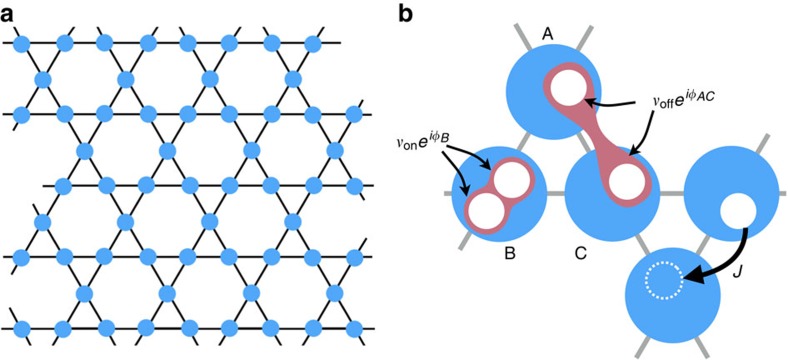
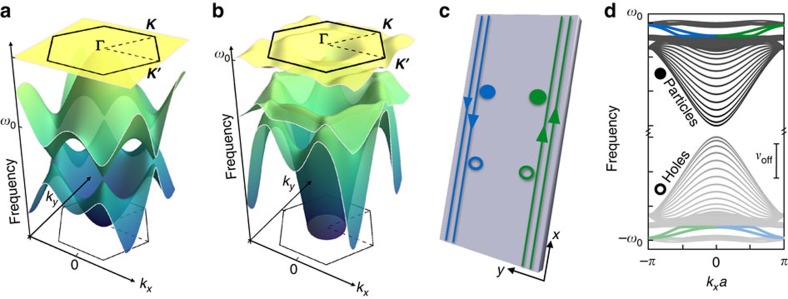
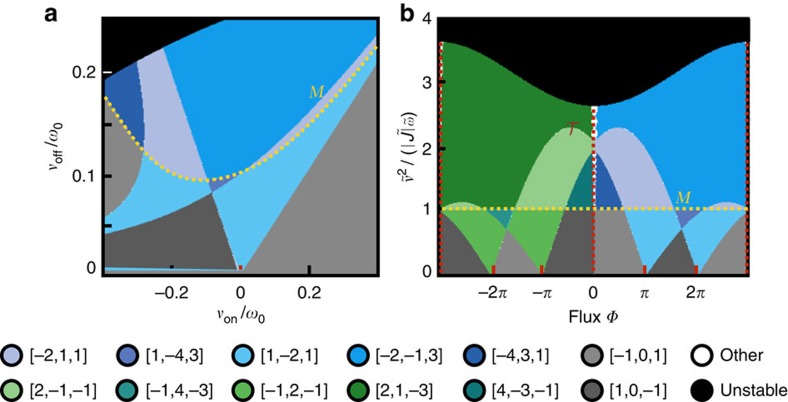
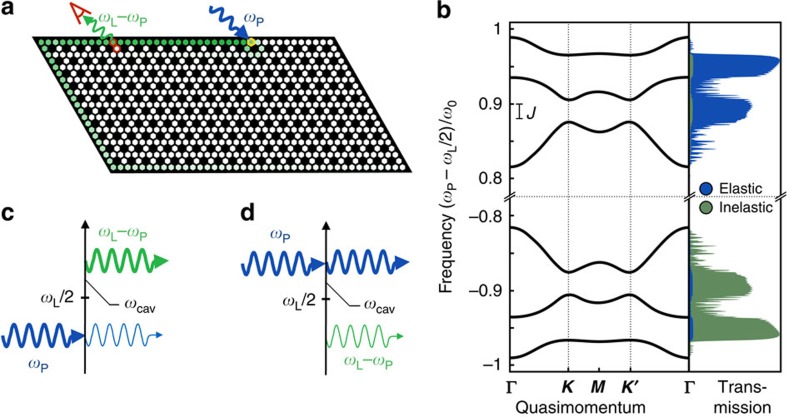
Verification
Claims the paper makes
The claims and statistics of this paper haven’t been checked yet.
Run the check — free, no account needed. It reads the open-access text and checks the sources it cites.
Claims other papers make about this one
Each is checked against this paper’s own text: does it say what the citing paper says it does?
In the citing paper
“In a lattice of photonic cavities under parametric driving, Peano, Houde, Brendel et al. (2016) proposed a model which has a nonzero gap at zero energy.”
From Topological photonics (2019) · cites this paper as Peano, Houde, Brendel et al., 2016
Self-check
Percentages, sums and reported differences re-computed from the paper’s own numbers.
The self-check needs the paper’s full text.
Citations
Cites
Observation of unidirectional backscattering-immune topological electromagnetic states
Wang, Z., Chong, Y., Joannopoulos, J. D., & Soljačić, M. (2009) · Nature · doi:10.1038/nature08293 · Cited by 3,123
Observation of topologically protected bound states in photonic quantum walks
Kitagawa, T., Broome, M. A., Fedrizzi, A., Rudner, M. S., Berg, E., Kassal, I., Aspuru-Guzik, A., Demler, E., & White, A. G. (2012) · Nature Communications · doi:10.1038/ncomms1872 · Cited by 607 · cited 4×
“By putting together Equations (20, 23, 24) and neglecting the off-resonant terms we find that for o; ~ o44 j ~J j; k; j o ~ o j,”
BackgroundInfluentialTopological Creation and Destruction of Edge States in Photonic Graphene
Rechtsman, M. C., Plotnik, Y., Zeuner, J. M., Song, D., Chen, Z., Szameit, A., & Segev, M. (2013) · Physical Review Letters · doi:10.1103/physrevlett.111.103901 · Cited by 302
Artificial gauge field for photons in coupled cavity arrays
Umucalılar, R. O., & Carusotto, I. (2011) · Physical Review A · doi:10.1103/physreva.84.043804 · Cited by 300
Research works printed but not linked: 43
- Goldman, N., Juzeliunas, G., Öhberg, P. & Spielman, I. B. Light-induced gauge fields for ultracold atoms. Rep. Prog. Phys. 77, 126401 (2014). · DOI · Paper page
- Lu, L., Joannopoulos, J. D. & Soljacic, M. Topological photonics. Nat. Photon. 8, 821–829 (2014). · DOI · Paper page
- Prodan, E. & Prodan, C. Topological phonon modes and their role in dynamic instability of microtubules. Phys. Rev. Lett. 103, 248101 (2009). · DOI
- Kane, C. L. & Lubensky, T. C. Topological boundary modes in isostatic lattices. Nat. Phys. 10, 39–45 (2013). · DOI
- Peano, V., Brendel, C., Schmidt, M. & Marquardt, F. Topological phases of sound and light. Phys. Rev. X 5, 031011 (2015).
- Yang, Z. et al. Topological acoustics. Phys. Rev. Lett. 114, 114301 (2015). · DOI
- Süsstrunk, R. & Huber, S. D. Observation of phononic helical edge states in a mechanical topological insulator. Science 349, 47–50 (2015). · DOI
- Paulose, J., Chen, B. G. & Vitelli, V. Topological modes bound to dislocations in mechanical metamaterials. Nat. Phys. 11, 153–156 (2015). · DOI
- Nash, L. M. et al. Topological mechanics of gyroscopic metamaterials. Proc. Natl Acad. Sci. USA 112, 14495–14500 (2015). · DOI
- Haldane, F. D. M. & Raghu, S. Possible realization of directional optical waveguides in photonic crystals with broken time-reversal symmetry. Phys. Rev. Lett. 100, 013904 (2008). · DOI · Paper page
- Raghu, S. & Haldane, F. D. M. Analogs of quantum-hall-effect edge states in photonic crystals. Phys. Rev. A 78, 033834 (2008). · DOI · Paper page
- Koch, J., Houck, A. A., Le Hur, K. & Girvin, S. M. Time-reversal-symmetry breaking in circuit-QED-based photon lattices. Phys. Rev. A 82, 043811 (2010). · DOI · Paper page
- Fang, K., Yu, Z. & Fan, S. Realizing effective magnetic field for photons by controlling the phase of dynamic modulation. Nat. Photon. 6, 782–787 (2012). · DOI · Paper page
- Petrescu, A., Houck, A. A. & Le Hur, K. Anomalous Hall effects of light and chiral edge modes on the Kagomé lattice. Phys. Rev. A 86, 053804 (2012). · DOI · Paper page
- Tzuang, L. D., Fang, K., Nussenzveig, P., Fan, S. & Lipson, M. Non-reciprocal phase shift induced by an effective magnetic flux for light. Nat. Photon. 8, 701–705 (2014). · DOI
- Schmidt, M., Kessler, S., Peano, V., Painter, O. & Marquardt, F. Optomechanical creation of magnetic fields for photons on a lattice. Optica 2, 635–641 (2015). · DOI
- Hafezi, M., Demler, E. A., Lukin, M. D. & Taylor, J. M. Robust optical delay lines with topological protection. Nat. Phys. 7, 907–912 (2011). · DOI · Paper page
- Khanikaev, A. B. et al. Photonic topological insulators. Nat. Mater. 12, 233–239 (2012). · DOI · Paper page
- Hafezi, M., Mittal, S., Fan, J., Migdall, A. & Taylor, J. M. Imaging topological edge states in silicon photonics. Nat. Photon. 7, 1001–1005 (2013). · DOI · Paper page
- Mittal, S. et al. Topologically robust transport of photons in a synthetic gauge field. Phys. Rev. Lett. 113, 087403 (2014). · DOI
- Bardyn, C.-E. & Imamoğlu, A. Majorana-like modes of light in a one-dimensional array of nonlinear cavities. Phys. Rev. Lett. 109, 253606 (2012). · DOI
- Ryu, S., Schnyder, A. P., Furusaki, A. & Ludwig, A. W. W. Topological insulators and superconductors: tenfold way and dimensional hierarchy. New J. Phys. 12, 065010 (2010). · DOI · Paper page
- Shindou, R., Matsumoto, R., Murakami, S. & Ohe, J. Topological chiral magnonic edge mode in a magnonic crystal. Phys. Rev. B 87, 174427 (2013). · DOI
- Barnett, R. Edge-state instabilities of bosons in a topological band. Phys. Rev. A 88, 063631 (2013). · DOI
- Engelhardt, G. & Brandes, T. Topological bogoliubov excitations in inversion-symmetric systems of interacting bosons. Phys. Rev. A 91, 053621 (2015). · DOI
- Galilo, B., Lee, D. K. K. & Barnett, R. Selective population of edge states in a 2d topological band system. Phys. Rev. Lett. 115, 245302 (2015). · DOI
- Bardyn, C.-E., Karzig, T., Refael, G. & Liew, T. C. H. Chiral bogoliubov excitations in nonlinear bosonic systems. Phys. Rev. B 93, 020502 (2016). · DOI · Paper page
- Gerry, C. C. & Knight, P. L. Introductory Quantum Optics Cambridge University Press (2005). · DOI
- Ohgushi, K., Murakami, S. & Nagaosa, N. Spin anisotropy and quantum hall effect in the kagomé lattice: chiral spin state based on a ferromagnet. Phys. Rev. B 62, R6065–R6068 (2000). · DOI
- Green, D., Santos, L. & Chamon, C. Isolated flat bands and spin-1 conical bands in two-dimensional lattices. Phys. Rev. B 82, 075104 (2010). · DOI
- Fukui, T., Hatsugai, Y. & Suzuki, H. Chern numbers in discretized brillouin zone: Efficient method of computing (spin) hall conductances. J. Phys. Soc. Jpn. 74, 1674–1677 (2005). · DOI
- Notomi, M., Kuramochi, E. & Tanabe, T. Large-scale arrays of ultrahigh-q coupled nanocavities. Nat. Photon. 2, 741–747 (2008). · DOI
- Mookherjea, S. & Yariv, A. Coupled resonator optical waveguides. IEEE J. Quantum Elec. 8, 448 (2002). · DOI
- Eggleton, B. J., Luther-Davies, B. & Richardson, K. Chalcogenide photonics. Nat. Photon. 5, 141–148 (2011). · DOI
- Dahdah, J., Pilar-Bernal, M., Courjal, N., Ulliac, G. & Baida, F. Near-field observations of light confinement in a two dimensional lithium niobate photonic crystal cavity. J. Appl. Phys. 110, 074318 (2011). · DOI
- Safavi-Naeini, A. H. et al. Squeezed light from a silicon micromechanical resonator. Nature 500, 185–189 (2013). · DOI
- Purdy, T. P., Yu, P. L., Peterson, R. W., Kampel, N. S. & Regal, C. A. Strong Optomechanical Squeezing of Light. Phys. Rev. X 3, 031012 (2013).
- Kronwald, A., Marquardt, F. & Clerk, A. A. Arbitrarily large steady-state bosonic squeezing via dissipation. Phys. Rev. A 88, 063833 (2013). · DOI
- Bergeal, N. et al. Analog information processing at the quantum limit with a Josephson ring modulator. Nat. Phys. 6, 296–302 (2010). · DOI
- Abdo, B., Kamal, A. & Devoret, M. Nondegenerate three-wave mixing with the Josephson ring modulator. Phys. Rev. B 87, 014508 (2013). · DOI
- Underwood, D. L., Shanks, W. E., Koch, J. & Houck, A. A. Low-disorder microwave cavity lattices for quantum simulation with photons. Phys. Rev. A 86, 023837 (2012). · DOI · Paper page
- Gurarie, V. & Chalker, J. T. Bosonic excitations in random media. Phys. Rev. B 68, 134207 (2003). · DOI
- Clerk, A. A., Devoret, M. H., Girvin, S. M., Marquardt, F. & Schoelkopf, R. J. Introduction to quantum noise, measurement, and amplification. Rev. Mod. Phys. 82, 1155–1208 (2010). · DOI
Cited by
Sorted by citations
Ozawa, T., Price, H. M., Amo, A., Goldman, N., Hafezi, M., Lu, L., Rechtsman, M. C., Schuster, D., Simon, J., Zilberberg, O., et al. (2019) · Reviews of Modern Physics · doi:10.1103/revmodphys.91.015006 · Cited by 3,722
Edge Solitons in Nonlinear-Photonic Topological Insulators
Leykam, D., & Chong, Y. D. (2016) · Physical Review Letters · doi:10.1103/physrevlett.117.143901 · Cited by 355
Metadata
- Authors
- Peano, V., Houde, M., Brendel, C., Marquardt, F., & Clerk, A. A.
- Venue
- Nature Communications
- Published
- 2016-03-02
- Volume
- 7
- Issue
- 1
- ISSN
- 2041-1723
- PMC
- PMC4778048
- Cited by
- 107
- References
- 4
- Language
- en
About these checks
Registry, retraction, Cites and statistics results are computed, not judged, with one exception: a printed reference that no index lists is read once by a model before it counts as a citation error. Claims are extracted by a model and kept only when their quote appears verbatim in the text; each cited source is then checked, with a model’s help, for whether it says what the claim relies on. Those verdicts can be wrong — read the claim’s quote and the cited source before relying on one.
Statistics and arithmetic are recomputed, not judged.
Confidence bands are shown only for fields calibrated on our annotated test set. None is calibrated yet, so no band is shown.
What counts as a claim ›How we measure confidence ›How we check this ›
Are you an author, or do you see a problem with this page? Request a review
