

The DOI matches its Crossref record; 52 of the 53 references it cites were found in a registry or an index.
Skin-inspired hydrogel–elastomer hybrids with robust interfaces and functional microstructures
Open accessAbstract
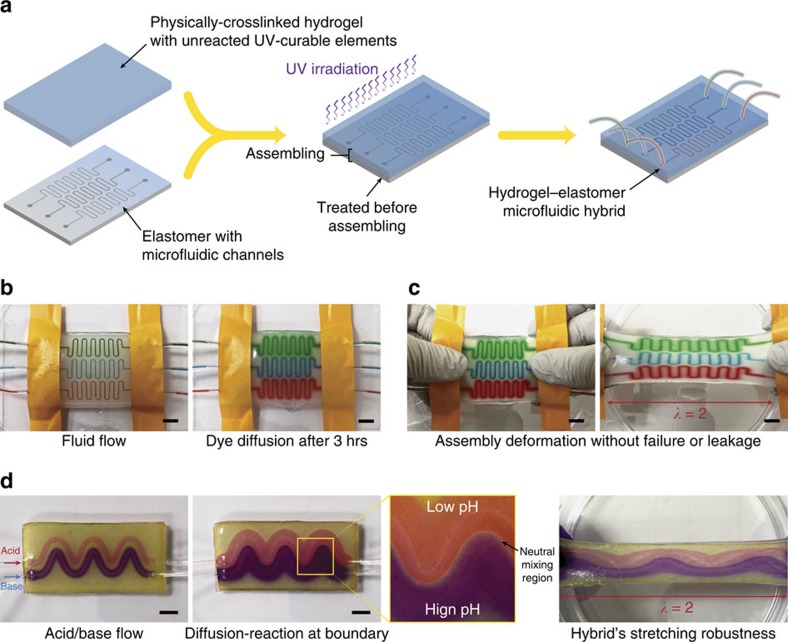
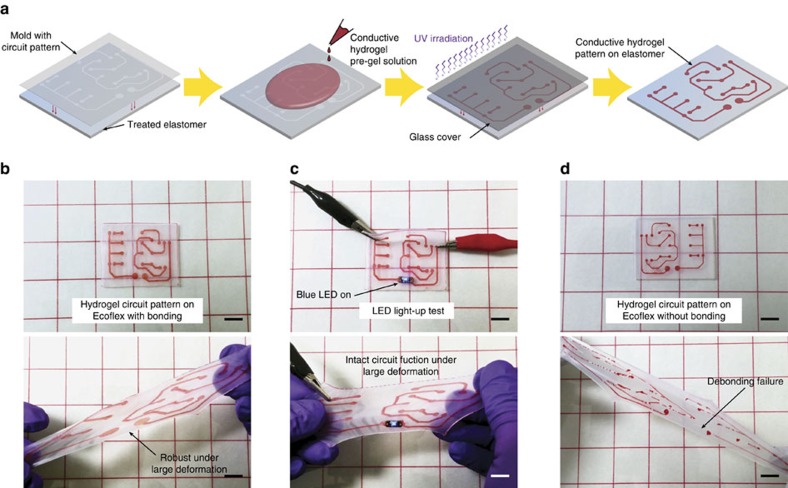
Inspired by mammalian skins, soft hybrids integrating the merits of elastomers and hydrogels have potential applications in diverse areas including stretchable and bio-integrated electronics, microfluidics, tissue engineering, soft robotics and biomedical devices. However, existing hydrogel–elastomer hybrids have limitations such as weak interfacial bonding, low robustness and difficulties in patterning microstructures. Here, we report a simple yet versatile method to assemble hydrogels and elastomers into hybrids with extremely robust interfaces (interfacial toughness over 1,000 Jm −2 ) and functional microstructures such as microfluidic channels and electrical circuits. The proposed method is generally applicable to various types of tough hydrogels and diverse commonly used elastomers including polydimethylsiloxane Sylgard 184, polyurethane, latex, VHB and Ecoflex. We further demonstrate applications enabled by the robust and microstructured hydrogel–elastomer hybrids including anti-dehydration hydrogel–elastomer hybrids, stretchable and reactive hydrogel–elastomer microfluidics, and stretchable hydrogel circuit boards patterned on elastomer.
Overview
The claims and statistics of this paper haven’t been checked yet.
Run the check — free, no account needed. It reads the open-access text and checks the sources it cites.
Integrity signals
Registry
Cites
Statistics
Figures
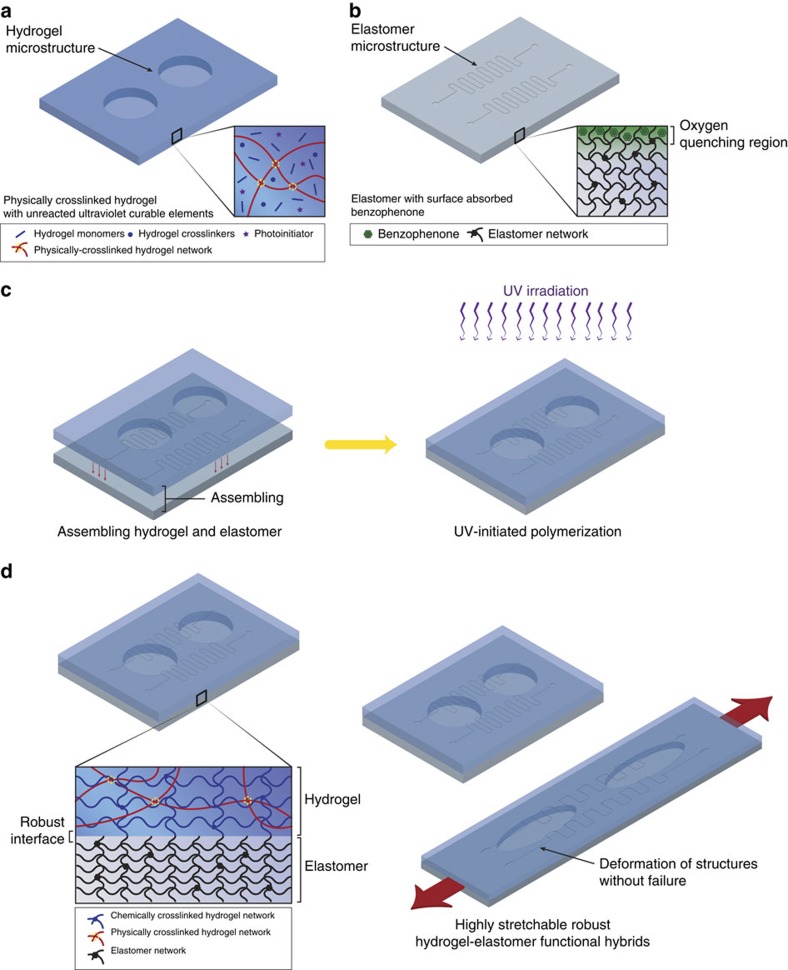
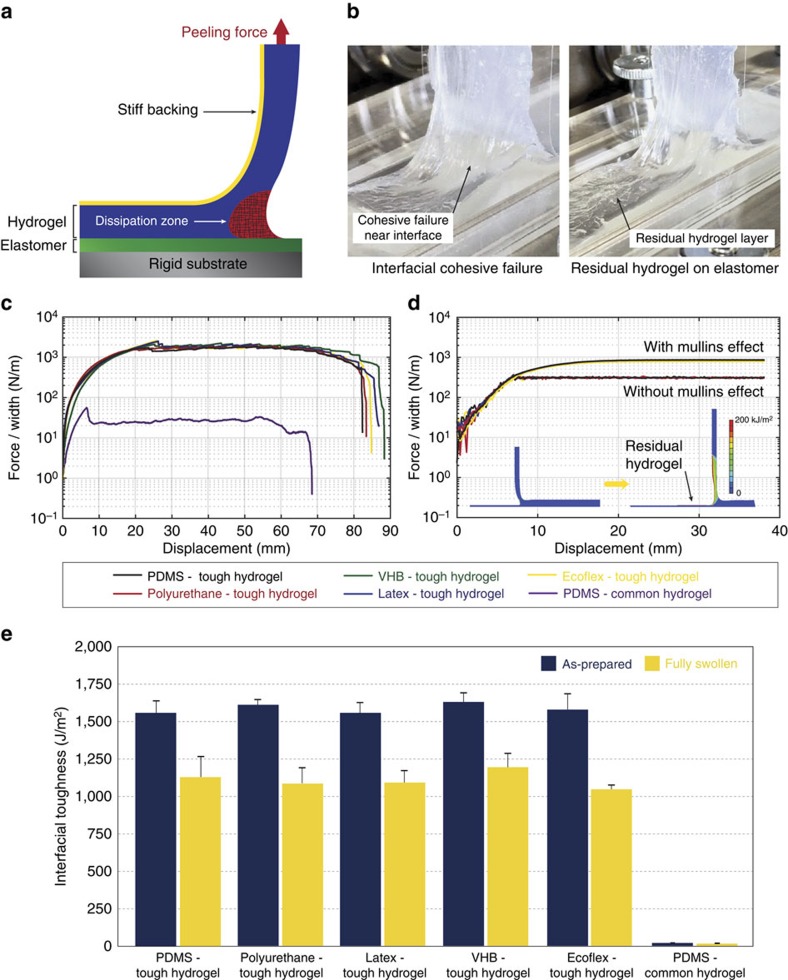
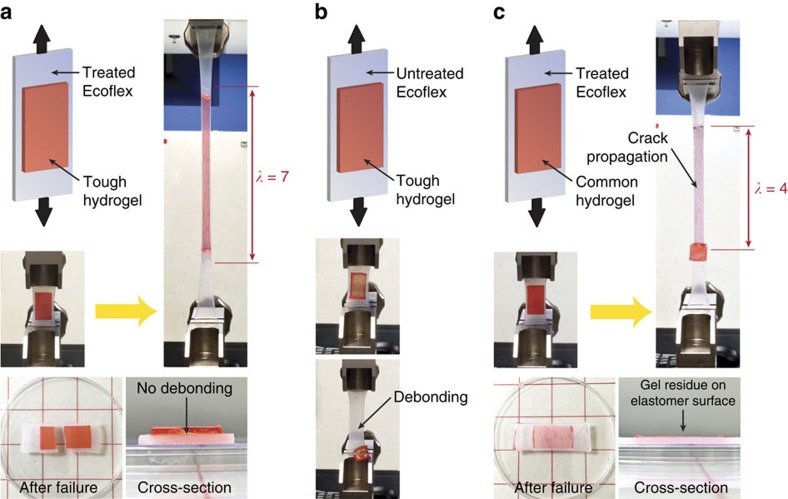
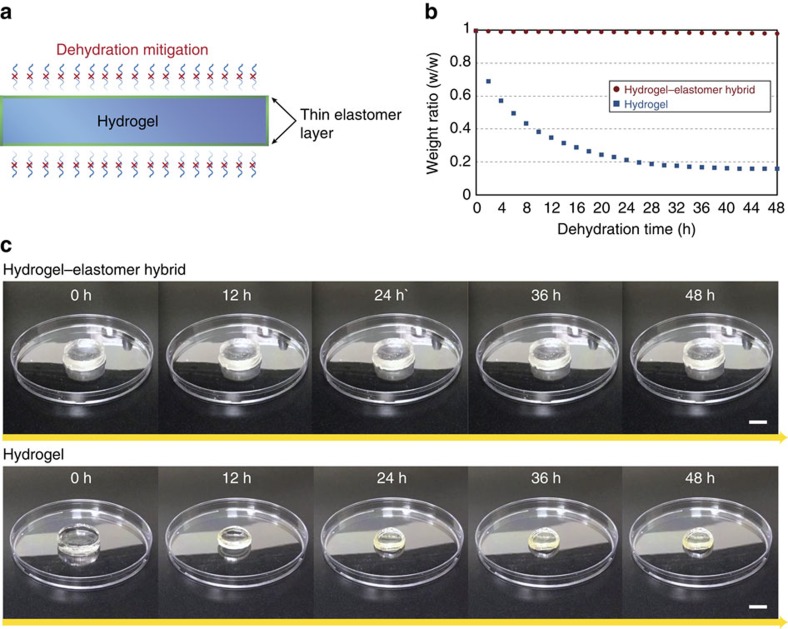
Verification
Claims the paper makes
The claims and statistics of this paper haven’t been checked yet.
Run the check — free, no account needed. It reads the open-access text and checks the sources it cites.
Claims other papers make about this one
Each is checked against this paper’s own text: does it say what the citing paper says it does?
The source backs part of the claim, not all of it — or backs it for a different population, condition or comparison.
In the citing paper
“The encapsulation of hydrogel sensors with elastomeric materials is an effective approach to prevent the evaporation of water from hydrogels”
From Functionalized Hydrogel-Based Wearable Gas and Humidity Sensors. (2023) · cites this paper as [151]
Experimental — accuracy not yet measuredThe cited source says what the claim attributes to it.
In the citing paper
“The hybrid retains stretchability, while enhancing the water-retention capacity of the hydrogel, thereby enabling it to work in dry environments”
From Functionalized Hydrogel-Based Wearable Gas and Humidity Sensors. (2023) · cites this paper as [151]
Self-check
Percentages, sums and reported differences re-computed from the paper’s own numbers.
The self-check needs the paper’s full text.
Citations
Cites
The origins and the future of microfluidics
Whitesides, G. M. (2006) · Nature · doi:10.1038/nature05058 · Cited by 9,687
Highly stretchable and tough hydrogels
Sun, J., Zhao, X., Illeperuma, W. R. K., Chaudhuri, O., Oh, K. H., Mooney, D. J., Vlassak, J. J., & Suo, Z. (2012) · Nature · doi:10.1038/nature11409 · Cited by 5,499
Self-citationHydrogels for Tissue Engineering
Lee, K. Y., & Mooney, D. J. (2001) · Chemical Reviews · doi:10.1021/cr000108x · Cited by 5,295
Materials and Mechanics for Stretchable Electronics
Rogers, J. A., Someya, T., & Huang, Y. Y. (2010) · Science · doi:10.1126/science.1182383 · Cited by 5,071
Younan Xia, A., & Whitesides, G. M. (1998) · Annual Review of Materials Science · doi:10.1146/annurev.matsci.28.1.153 · Cited by 4,610
Double‐Network Hydrogels with Extremely High Mechanical Strength
Gong, J. P., Katsuyama, Y., Kurokawa, T., & Osada, Y. (2003) · Advanced Materials · doi:10.1002/adma.200304907 · Cited by 4,552
Hydrogels in Biology and Medicine: From Molecular Principles to Bionanotechnology
Peppas, N. A., Hilt, J. Z., Khademhosseini, A., & Langer, R. (2006) · Advanced Materials · doi:10.1002/adma.200501612 · Cited by 4,109
Why are double network hydrogels so tough?
Gong, J. P. (2010) · Soft Matter · doi:10.1039/b924290b · Cited by 2,334
Shepherd, R. F., Ilievski, F., Choi, W., Morin, S. A., Stokes, A. A., Mazzeo, A. D., Chen, X., Wang, M. Y., & Whitesides, G. M. (2011) · Proceedings of the National Academy of Sciences · doi:10.1073/pnas.1116564108 · Cited by 2,142
3D bioprinting of vascularized, heterogeneous cell-laden tissue constructs
Kolesky, D. B., Truby, R. L., Gladman, A. S., Busbee, T. A., Homan, K. A., & Lewis, J. A. (2014) · Advanced Materials · doi:10.1002/adma.201305506 · Cited by 2,102
Stretchable, Transparent, Ionic Conductors
Keplinger, C., Sun, J.-Y., Foo, C. C., Rothemund, P., Whitesides, G. M., & Suo, Z. (2013) · Science · doi:10.1126/science.1240228 · Cited by 1,754
Stretchable and Foldable Silicon Integrated Circuits
Kim, D., Ahn, J., Choi, W. M., Kim, H., Kim, T., Song, J., Huang, Y. Y., Liu, Z., Lu, C., & Rogers, J. A. (2008) · Science · doi:10.1126/science.1154367 · Cited by 1,680
Multi-scale multi-mechanism design of tough hydrogels: building dissipation into stretchy networks
Zhao, X. (2013) · Soft Matter · doi:10.1039/c3sm52272e · Cited by 1,254
Self-citationSun, J., Keplinger, C., Whitesides, G. M., & Suo, Z. (2014) · Advanced Materials · doi:10.1002/adma.201403441 · Cited by 1,205
Soft Microfluidic Assemblies of Sensors, Circuits, and Radios for the Skin
Xu, S., Zhang, Y., Jia, L., Mathewson, K. E., Jang, K.-I., Kim, J., Fu, H., Huang, X., Chava, P., Wang, R., et al. (2014) · Science · doi:10.1126/science.1250169 · Cited by 1,199
Tough bonding of hydrogels to diverse non-porous surfaces
Yuk, H., Zhang, T., Lin, S., Parada, G. A., & Zhao, X. (2015) · Nature Materials · doi:10.1038/nmat4463 · Cited by 1,192
Self-citationAdaptive liquid microlenses activated by stimuli-responsive hydrogels
Dong, L., Agarwal, A., Beebe, D. J., & Jiang, H. (2006) · Nature · doi:10.1038/nature05024 · Cited by 1,050
3D Printing of Highly Stretchable and Tough Hydrogels into Complex, Cellularized Structures
Hong, S., Sycks, D. G., Chan, H. F., Lin, S., López, G. P., Guilak, F., Leong, K. W., & Zhao, X. (2015) · Advanced Materials · doi:10.1002/adma.201501099 · Cited by 890
Self-citationA skin-inspired organic digital mechanoreceptor
Tee, B. C.-K., Chortos, A., Berndt, A., Nguyen, A. K., Tom, A., McGuire, A., Lin, Z. C., Tien, K., Bae, W.-G., Wang, H., et al. (2015) · Science · doi:10.1126/science.aaa9306 · Cited by 882
Thin-film peeling-the elastic term
Kendall, K. (1975) · Journal of Physics D Applied Physics · doi:10.1088/0022-3727/8/13/005 · Cited by 876
Benzophenone Photophores in Biochemistry
Dormán, G., & Prestwich, G. D. (1994) · Biochemistry · doi:10.1021/bi00185a001 · Cited by 855
Recent developments in PDMS surface modification for microfluidic devices
Zhou, J., Ellis, A. V., & Voelcker, N. H. (2009) · Electrophoresis · doi:10.1002/elps.200900475 · Cited by 849
Soft, stretchable, fully implantable miniaturized optoelectronic systems for wireless optogenetics
Park, S. I., Brenner, D. S., Shin, G., Morgan, C. D., Copits, B. A., Chung, H. U., Pullen, M. Y., Noh, K. N., Davidson, S., Oh, S. J., et al. (2015) · Nature Biotechnology · doi:10.1038/nbt.3415 · Cited by 794
Camouflage and Display for Soft Machines
Morin, S. A., Shepherd, R. F., Kwok, S. W., Stokes, A. A., Nemiroski, A., & Whitesides, G. M. (2012) · Science · doi:10.1126/science.1222149 · Cited by 772
Muscular Thin Films for Building Actuators and Powering Devices
Feinberg, A. W., Feigel, A., Shevkoplyas, S. S., Sheehy, S., Whitesides, G. M., & Parker, K. K. (2007) · Science · doi:10.1126/science.1146885 · Cited by 765
A pseudo–elastic model for the Mullins effect in filled rubber
Ogden, R. W., & Roxburgh, D. G. (1999) · Proceedings of the Royal Society A Mathematical Physical and Engineering Sciences · doi:10.1098/rspa.1999.0431 · Cited by 756
Stretchable Hydrogel Electronics and Devices
Lin, S., Yuk, H., Zhang, T., Parada, G. A., Koo, H., Yu, C., & Zhao, X. (2016) · Advanced Materials · doi:10.1002/adma.201504152 · Cited by 682
Self-citationA tissue-engineered jellyfish with biomimetic propulsion
Nawroth, J. C., Lee, H., Feinberg, A. W., Ripplinger, C. M., McCain, M. L., Grosberg, A., Dabiri, J. O., & Parker, K. K. (2012) · Nature Biotechnology · doi:10.1038/nbt.2269 · Cited by 660
Wound Tissue Can Utilize a Polymeric Template to Synthesize a Functional Extension of Skin
Yannas, I. V., Burke, J. F., Orgill, D. P., & Skrabut, E. M. (1982) · Science · doi:10.1126/science.7031899 · Cited by 644
Wireless Optofluidic Systems for Programmable In Vivo Pharmacology and Optogenetics
Jeong, J., McCall, J. G., Shin, G., Zhang, Y., Al‐Hasani, R., Kim, M. K., Li, S., Sim, J. Y., Jang, K., Shi, Y., et al. (2015) · Cell · doi:10.1016/j.cell.2015.06.058 · Cited by 501
Developments and new applications of UV-induced surface graft polymerizations
DENG, J., Wang, L., Liu, L., & Yang, W. (2008) · Progress in Polymer Science · doi:10.1016/j.progpolymsci.2008.06.002 · Cited by 473
THIN SILICONE MEMBRANES‐THEIR PERMEATION PROPERTIES AND SOME APPLICATIONS
Robb, W. L. (1968) · Annals of the New York Academy of Sciences · doi:10.1111/j.1749-6632.1968.tb20277.x · Cited by 428
Jang, K., Han, S. Y., Xu, S. H., Mathewson, K. E., Zhang, Y., Jeong, J., Kim, G.-T., Webb, R. C., Lee, J. W., Dawidczyk, T. J., et al. (2014) · Nature Communications · doi:10.1038/ncomms5779 · Cited by 392
Transparent hydrogel with enhanced water retention capacity by introducing highly hydratable salt
Bai, Y., Chen, B., Xiang, F., Zhou, J., Wang, H., & Suo, Z. (2014) · Applied Physics Letters · doi:10.1063/1.4898189 · Cited by 383
Light-guiding hydrogels for cell-based sensing and optogenetic synthesis in vivo
Choi, M., Choi, J. W., Kim, S., Nizamoğlu, S., Hahn, S. K., & Yun, S. H. (2013) · Nature Photonics · doi:10.1038/nphoton.2013.278 · Cited by 380
An overview of the suitability of hydrogel-forming polymers for extrusion-based 3D-printing
Kirchmajer, D. M., Gorkin, R. A., III, & Panhuis, M. I. H. (2015) · Journal of Materials Chemistry B · doi:10.1039/c5tb00393h · Cited by 336
Modeling of Oxygen-Inhibited Free Radical Photopolymerization in a PDMS Microfluidic Device
Dendukuri, D., Panda, P., Haghgooie, R., Kim, J. M., Hatton, T. A., & Doyle, P. S. (2008) · Macromolecules · doi:10.1021/ma801219w · Cited by 324
Step‐Index Optical Fiber Made of Biocompatible Hydrogels
Choi, M., Humar, M., Kim, S., & Yun, S. H. (2015) · Advanced Materials · doi:10.1002/adma.201501603 · Cited by 250
Yang, C. H., Chen, B., Lu, J., Yang, J., Zhou, J., Chen, Y. M., & Suo, Z. (2015) · Extreme Mechanics Letters · doi:10.1016/j.eml.2015.03.001 · Cited by 224
Predicting fracture energies and crack-tip fields of soft tough materials
Zhang, T., Lin, S., Yuk, H., & Zhao, X. (2015) · Extreme Mechanics Letters · doi:10.1016/j.eml.2015.07.007 · Cited by 180
Self-citationCasavant, B. P., Berthier, E., Theberge, A. B., Berthier, J., Montanez-Sauri, S. I., Bischel, L. L., Brakke, K. A., Hedman, C. J., BUSHMAN, W. A., Keller, N. P., et al. (2013) · Proceedings of the National Academy of Sciences · doi:10.1073/pnas.1302566110 · Cited by 178
Hydraulic fracture during epithelial stretching
Casares, L., Vincent, R. R. R., Zalvidea, D., Campillo, N., Navajas, D., Arroyo, M., & Trepat, X. (2015) · Nature Materials · doi:10.1038/nmat4206 · Cited by 176
Radical Living Graft Polymerization on the Surface of Polymeric Materials
Yang, W., & Rånby, B. G. (1996) · Macromolecules · doi:10.1021/ma9515543 · Cited by 174
Engineering Living Functional Materials
Chen, A. Y., Zhong, C., & Lu, T. K. (2015) · ACS Synthetic Biology · doi:10.1021/sb500113b · Cited by 162
Covalent Micropatterning of Poly(dimethylsiloxane) by Photografting through a Mask
Wang, Y., Lai, H., Bachman, M., Sims, C. E., Li, G. P., & Allbritton, N. L. (2005) · Analytical Chemistry · doi:10.1021/ac0509915 · Cited by 133
Schneider, M. H., Tran, Y., & Tabeling, P. (2011) · Langmuir · doi:10.1021/la103345k · Cited by 115
Effects of chain pull-out on adhesion of elastomers
Brown, H. R. (1993) · Macromolecules · doi:10.1021/ma00059a027 · Cited by 112
Lee, W., Choi, D., Lee, Y., Kim, D. N., Park, J., & Koh, W. (2007) · Sensors and Actuators B Chemical · doi:10.1016/j.snb.2007.09.085 · Cited by 64
Graded delamination behavior of human stratum corneum
Wu, K. S., Stefik, M., Ananthapadmanabhan, K. P., & Dauskardt, R. H. (2006) · Biomaterials · doi:10.1016/j.biomaterials.2006.08.008 · Cited by 52
Simmons, C. S., Ribeiro, A. J. S., & Pruitt, B. L. (2012) · Lab on a Chip · doi:10.1039/c2lc41110e · Cited by 51
Modification of Polydimethylsiloxane Surfaces Using Benzophenone
Smet, N. D., Rymarczyk‐Machał, M., & Schacht, E. H. (2009) · Journal of Biomaterials Science Polymer Edition · doi:10.1163/156856208x397901 · Cited by 28
Specific Solvent Effects on the Structure and Reaction Dynamics of Benzophenone Ketyl Radical
Kawai, A., Hirakawa, M., Abe, T., Obi, K., & Shibuya, K. (2001) · The Journal of Physical Chemistry A · doi:10.1021/jp0121320 · Cited by 25
Cited by
Sorted by citations
Advances in engineering hydrogels
Zhang, Y. S., & Khademhosseini, A. (2017) · Science · doi:10.1126/science.aaf3627 · Cited by 2,908
Yuk, H., Lu, B., & Zhao, X. (2018) · Chemical Society Reviews · doi:10.1039/c8cs00595h · Cited by 2,148
Self-citationYang, C., & Suo, Z. (2018) · Nature Reviews Materials · doi:10.1038/s41578-018-0018-7 · Cited by 1,737
Dry double-sided tape for adhesion of wet tissues and devices
Yuk, H., Varela, C. E., Nabzdyk, C. S., Mao, X., Padera, R. F., Roche, E. T., & Zhao, X. (2019) · Nature · doi:10.1038/s41586-019-1710-5 · Cited by 1,508
Self-citationHydrogels and Hydrogel-Derived Materials for Energy and Water Sustainability
Guo, Y., Bae, J., Fang, Z., Li, P., Zhao, F., & Yu, G. (2020) · Chemical Reviews · doi:10.1021/acs.chemrev.0c00345 · Cited by 1,418
Metadata
- Authors
- Yuk, H., Zhang, T., Parada, G. A., Liu, X., & Zhao, X.
- Affiliations
- Massachusetts Institute of Technology (US)
- Syracuse University (US)
- Corresponding author
- Zhao, Xuanhe
- Venue
- Nature Communications
- Published
- 2016-06-27
- Volume
- 7
- Issue
- 1
- Pages
- 12028-12028
- ISSN
- 2041-1723 (ISSN-L)
- PMC
- PMC4931236
- OpenAlex
- W2461891321
- Cited by
- 1,035
- References
- 53
- Citations by year
- 2026: 85 · 2025: 131 · 2024: 136 · 2023: 113 · 2022: 123 · 2021: 114 · 2020: 114 · 2019: 86 · 2018: 84 · 2017: 44 · 2016: 5
- FWCI
- 35.61
- Type
- journal article
- Language
- en
- Open access
- gold
- doi.org
- Locations
- Nature Communications (publishedVersion, cc-by)
- Europe PMC (PubMed Central) (publishedVersion, cc-by)
- PubMed Central (publishedVersion, cc-by)
- PubMed (publishedVersion)
- RePEc: Research Papers in Economics (submittedVersion)
- DOAJ (DOAJ: Directory of Open Access Journals) (submittedVersion, cc-by-sa)
- Funders
- National Science Foundation (1253495)
- Charles Stark Draper Laboratory
- National Institutes of Health (UH3TR000505)
- Samsung
- Office of Naval Research (N00014‐14‐1‐0528, N00014)
- Division of Civil, Mechanical and Manufacturing Innovation (CMMI-1253495)
- National Center for Advancing Translational Sciences
- Topics
- Physical Sciences › Materials Science › Biomaterials › Hydrogels: synthesis, properties, applications
- Physical Sciences › Engineering › Mechanical Engineering › Advanced Materials and Mechanics
- Physical Sciences › Engineering › Biomedical Engineering › Advanced Sensor and Energy Harvesting Materials
- Keywords
- interfacial bonding, interfacial toughness, micropatterning, microfluidic channels, stretchable electronics, stretchable circuits, polydimethylsiloxane, polyurethane, LaTeX, Ecoflex, soft robotics, bio-integrated electronics
- MeSH terms
- Chemical Engineering, Materials Testing, Surface Properties, Hydrogels, Elastomers, Mechanical Phenomena
About these checks
Registry, retraction, Cites and statistics results are computed, not judged, with one exception: a printed reference that no index lists is read once by a model before it counts as a citation error. Claims are extracted by a model and kept only when their quote appears verbatim in the text; each cited source is then checked, with a model’s help, for whether it says what the claim relies on. Those verdicts can be wrong — read the claim’s quote and the cited source before relying on one.
Statistics and arithmetic are recomputed, not judged.
Confidence bands are shown only for fields calibrated on our annotated test set. None is calibrated yet, so no band is shown.
What counts as a claim ›How we measure confidence ›How we check this ›
Are you an author, or do you see a problem with this page? Request a review
