

The DOI matches its Crossref record; 34 of the 34 references it cites were found in a registry or an index.
Exosome engineering for efficient intracellular delivery of soluble proteins using optically reversible protein-protein interaction module
Open accessAbstract
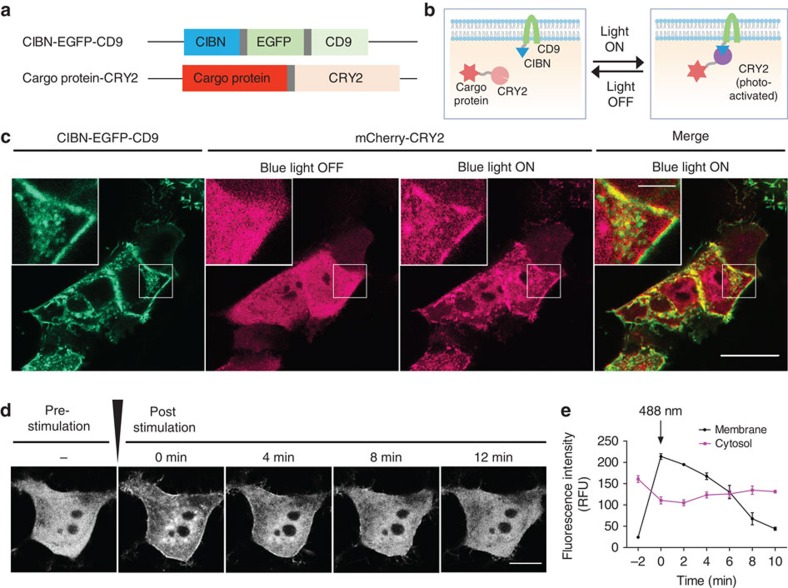
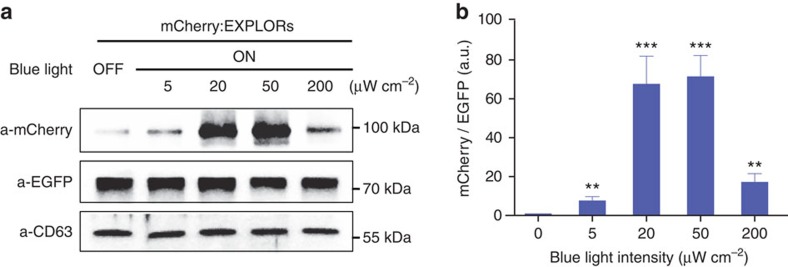
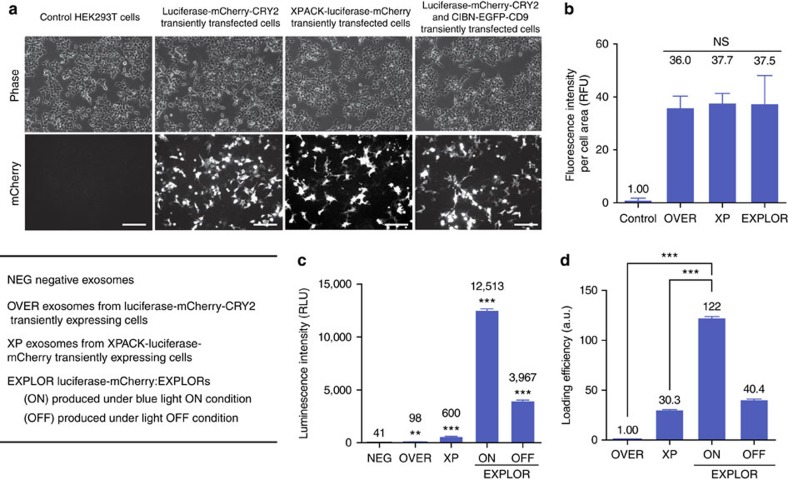
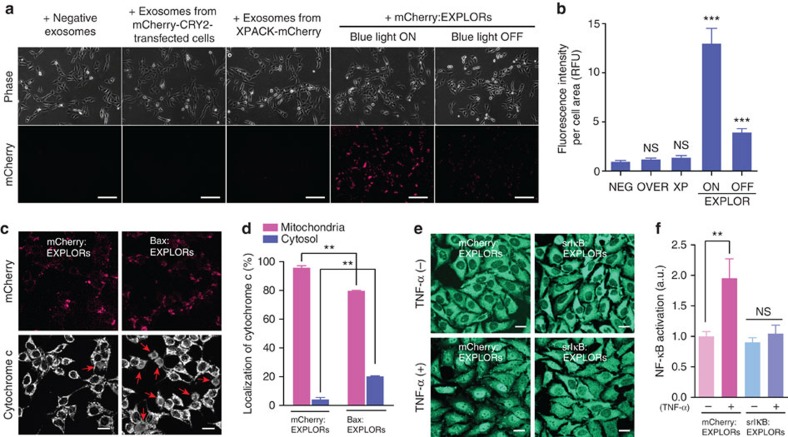
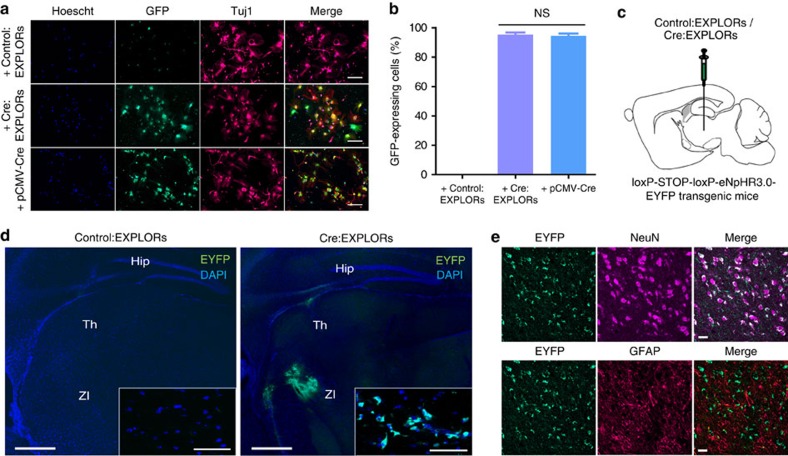
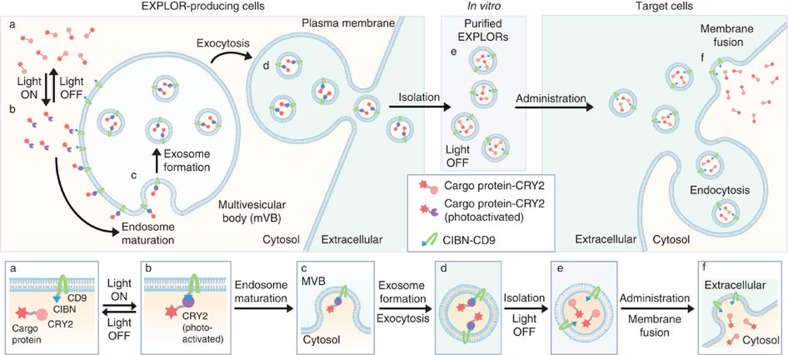
Nanoparticle-mediated delivery of functional macromolecules is a promising method for treating a variety of human diseases. Among nanoparticles, cell-derived exosomes have recently been highlighted as a new therapeutic strategy for the in vivo delivery of nucleotides and chemical drugs. Here we describe a new tool for intracellular delivery of target proteins, named 'exosomes for protein loading via optically reversible protein-protein interactions' (EXPLORs). By integrating a reversible protein-protein interaction module controlled by blue light with the endogenous process of exosome biogenesis, we are able to successfully load cargo proteins into newly generated exosomes. Treatment with protein-loaded EXPLORs is shown to significantly increase intracellular levels of cargo proteins and their function in recipient cells in vitro and in vivo. These results clearly indicate the potential of EXPLORs as a mechanism for the efficient intracellular transfer of protein-based therapeutics into recipient cells and tissues.
Overview
The claims and statistics of this paper haven’t been checked yet.
Run the check — free, no account needed. It reads the open-access text and checks the sources it cites.
Integrity signals
Registry
Cites
Statistics
Figures
Verification
Claims the paper makes
The claims and statistics of this paper haven’t been checked yet.
Run the check — free, no account needed. It reads the open-access text and checks the sources it cites.
Claims other papers make about this one
Each is checked against this paper’s own text: does it say what the citing paper says it does?
In the citing paper
“Exosomes may provide a more rational way for therapeutic protein delivery to exert antitumor effects as we highlighted above [42].”
From The Therapeutic Potential and Clinical Significance of Exosomes as Carriers of Drug Delivery System (2022) · cites this paper as [42]
Self-check
Percentages, sums and reported differences re-computed from the paper’s own numbers.
The self-check needs the paper’s full text.
Citations
Cites
1 retracted
Haney, M. J., Zhao, Y., Harrison, E. B., Mahajan, V., Ahmed, S., He, Z., Suresh, P., Hingtgen, S., Klyachko, N. L., Mosley, R. L., et al. (2013) · PLoS ONE · doi:10.1371/journal.pone.0061852 · Cited by 144
RetractedPushko, P., Pumpens, P., & Grens, E. (2013) · Intervirology · doi:10.1159/000346773 · Cited by 5,975
Isolation and Characterization of Exosomes from Cell Culture Supernatants and Biological Fluids
Théry, C., Amigorena, S., Raposo, G., & Clayton, A. (2006) · Current Protocols in Cell Biology · doi:10.1002/0471143030.cb0322s30 · Cited by 5,766
Exosomes: composition, biogenesis and function
Théry, C., Zitvogel, L., & Amigorena, S. (2002) · Nature reviews. Immunology · doi:10.1038/nri855 · Cited by 5,355
Delivery of siRNA to the mouse brain by systemic injection of targeted exosomes
Alvarez-Erviti, L., Seow, Y., Yin, H., Betts, C., Lakhal, S., & Wood, M. J. A. (2011) · Nature Biotechnology · doi:10.1038/nbt.1807 · Cited by 4,930
Exosomes as drug delivery vehicles for Parkinson’s disease therapy
Haney, M. J., Klyachko, N. L., Zhao, Y., Gupta, R., Plotnikova, E. G., He, Z., Patel, T., Piroyan, A., Sokolsky, M., Kabanov, A. V., et al. (2015) · Journal of Controlled Release · doi:10.1016/j.jconrel.2015.03.033 · Cited by 2,009
Movement of Bax from the Cytosol to Mitochondria during Apoptosis
Wolter, K. G., Hsu, Y., Smith, C. L., Nechushtan, A., Xi, X., & Youle, R. J. (1997) · The Journal of Cell Biology · doi:10.1083/jcb.139.5.1281 · Cited by 1,809
Overcoming the challenges in administering biopharmaceuticals: Formulation and delivery strategies
Mitragotri, S., Burke, P. A., & Langer, R. (2014) · Nature Reviews Drug Discovery · doi:10.1038/nrd4363 · Cited by 1,702
Systemically Injected Exosomes Targeted to EGFR Deliver Antitumor MicroRNA to Breast Cancer Cells
Ohno, S.-I., Takanashi, M., Sudo, K., Ueda, S., Ishikawa, A., Matsuyama, N., Fujita, K., Mizutani, T., Ohgi, T., Ochiya, T., et al. (2013) · Molecular Therapy · doi:10.1038/mt.2012.180 · Cited by 1,666
Cytosol-to-membrane redistribution of Bax and Bcl-X L during apoptosis
Hsu, Y., Wolter, K. G., & Youle, R. J. (1997) · Proceedings of the National Academy of Sciences · doi:10.1073/pnas.94.8.3668 · Cited by 1,134
Cited by
Sorted by citations
Pegtel, D. M., & Gould, S. J. (2019) · Annual Review of Biochemistry · doi:10.1146/annurev-biochem-013118-111902 · Cited by 2,682
NF-κB in biology and targeted therapy: new insights and translational implications
Guo, Q., Jin, Y., Chen, X., Ye, X., Shen, X., Lin, M., Zeng, C., Zhou, T., & Zhang, J. (2024) · Signal Transduction and Targeted Therapy · doi:10.1038/s41392-024-01757-9 · Cited by 2,405
Exosome Theranostics: Biology and Translational Medicine
He, C., Zheng, S., Luo, Y., & Wang, B. (2017) · Theranostics · doi:10.7150/thno.21945 · Cited by 1,271
Extracellular vesicles as drug delivery systems: Why and how?
Elsharkasy, O. M., Nordin, J. Z., Hagey, D. W., de Jong, O. G., Schiffelers, R. M., Andaloussi, S. E., & Vader, P. (2020) · Advanced Drug Delivery Reviews · doi:10.1016/j.addr.2020.04.004 · Cited by 1,235
Advances in therapeutic applications of extracellular vesicles
Wiklander, O. P. B., Brennan, M. Á., Lötvall, J., Breakefield, X. O., & EL Andaloussi, S. (2019) · Science Translational Medicine · doi:10.1126/scitranslmed.aav8521 · Cited by 1,039
Metadata
- Authors
- Yim, N., Ryu, S.-W., Choi, K., Lee, K. R., Lee, S., Choi, H., Kim, J., Shaker, M. R., Sun, W., Park, J.-H., Kim, D., Heo, W. D., & Choi, C.
- Affiliations
- Korea Advanced Institute of Science and Technology (KR)
- Korea University (KR)
- Corresponding author
- Choi, Kyungsun
- Choi, Chulhee
- ORCID
- Venue
- Nature Communications
- Published
- 2016-07-22
- Volume
- 7
- Issue
- 1
- Pages
- 12277-12277
- ISSN
- 2041-1723 (ISSN-L)
- PMC
- PMC4961865
- OpenAlex
- W2477351770
- Cited by
- 578
- References
- 34
- Citations by year
- 2026: 37 · 2025: 62 · 2024: 68 · 2023: 65 · 2022: 88 · 2021: 80 · 2020: 63 · 2019: 50 · 2018: 34 · 2017: 29 · 2016: 2
- FWCI
- 19.93
- Type
- journal article
- Language
- en
- Open access
- gold
- doi.org
- Locations
- Nature Communications (publishedVersion, cc-by)
- PubMed Central (publishedVersion, cc-by)
- PubMed (publishedVersion)
- RePEc: Research Papers in Economics (submittedVersion)
- DOAJ (DOAJ: Directory of Open Access Journals) (submittedVersion, cc-by-sa)
- Funders
- National Research Foundation
- Korea Health Industry Development Institute (HI14C0042)
- Korea Basic Science Institute
- National Research Foundation of Korea (HI14C0042)
- Topics
- Life Sciences › Biochemistry, Genetics and Molecular Biology › Molecular Biology › Extracellular vesicles in disease
- Physical Sciences › Materials Science › Biomaterials › Nanoparticle-Based Drug Delivery
- Life Sciences › Biochemistry, Genetics and Molecular Biology › Molecular Biology › RNA Interference and Gene Delivery
- Keywords
- exosomes, exosome engineering, intracellular protein delivery, blue light, cargo loading, exosome biogenesis, therapeutic proteins
- MeSH terms
- Animals, Genetic Engineering, HeLa Cells, Humans, Mice, Transgenic, Recombinant Proteins, Drug Delivery Systems, Arabidopsis Proteins, Basic Helix-Loop-Helix Transcription Factors, Basic Helix-Loop-Helix Proteins, Exosomes, Cryptochromes, HEK293 Cells, Optical Imaging
About these checks
Registry, retraction, Cites and statistics results are computed, not judged, with one exception: a printed reference that no index lists is read once by a model before it counts as a citation error. Claims are extracted by a model and kept only when their quote appears verbatim in the text; each cited source is then checked, with a model’s help, for whether it says what the claim relies on. Those verdicts can be wrong — read the claim’s quote and the cited source before relying on one.
Statistics and arithmetic are recomputed, not judged.
Confidence bands are shown only for fields calibrated on our annotated test set. None is calibrated yet, so no band is shown.
What counts as a claim ›How we measure confidence ›How we check this ›
Are you an author, or do you see a problem with this page? Request a review
