

Adding control to arbitrary unknown quantum operations
Open accessThe DOI matches its Crossref record; 42 of the 42 references it cites were found in a registry or an index.
Abstract
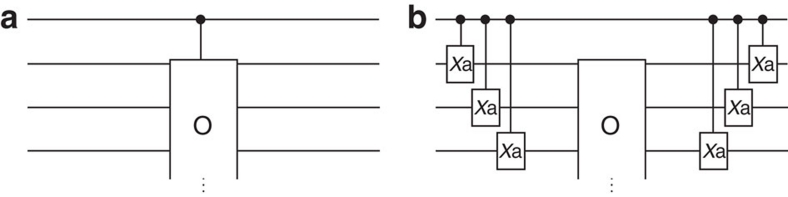
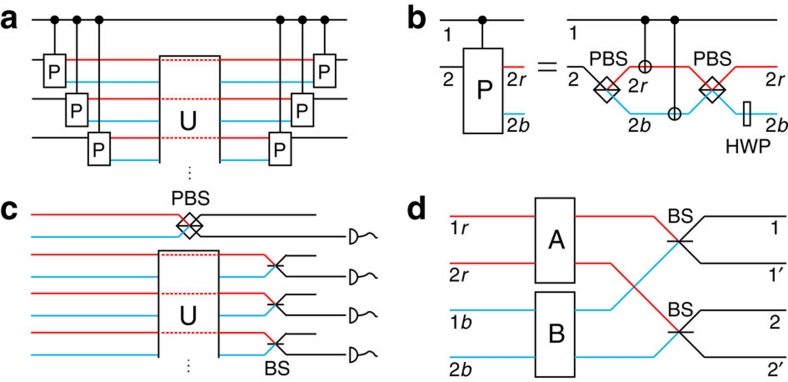
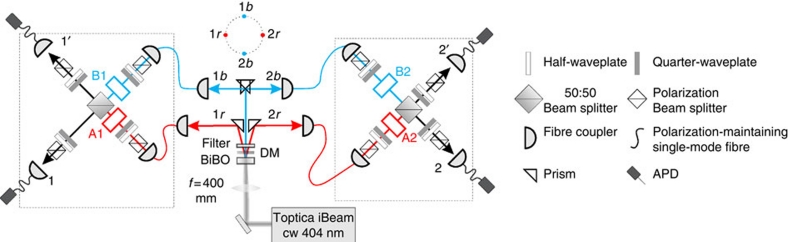
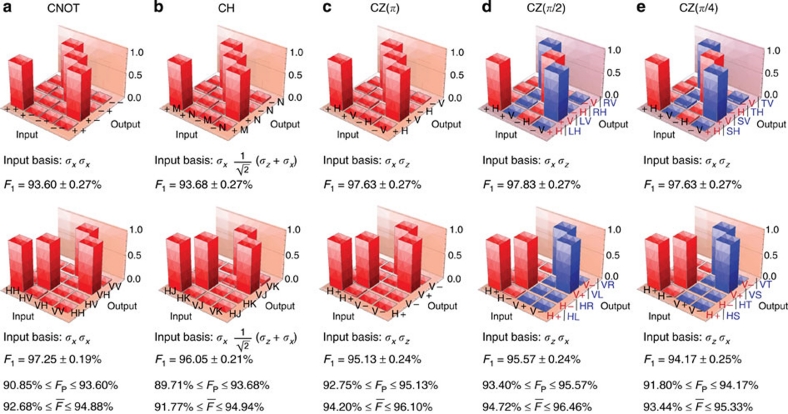
Although quantum computers promise significant advantages, the complexity of quantum algorithms remains a major technological obstacle. We have developed and demonstrated an architecture-independent technique that simplifies adding control qubits to arbitrary quantum operations—a requirement in many quantum algorithms, simulations and metrology. The technique, which is independent of how the operation is done, does not require knowledge of what the operation is, and largely separates the problems of how to implement a quantum operation in the laboratory and how to add a control. Here, we demonstrate an entanglement-based version in a photonic system, realizing a range of different two-qubit gates with high fidelity. Quantum computing has advantages over conventional computing, but the complexity of quantum algorithms creates technological challenges. Here, an architecture-independent technique, that simplifies adding control qubits to arbitrary quantum operations, is developed and demonstrated.
Overview
The claims and statistics of this paper haven’t been checked yet.
Free: it reads the open-access text and checks the first 5 claims that cite a source we can check. Create a free account to check every claim.
Integrity signals
Registry
Cites
Statistics
Figures
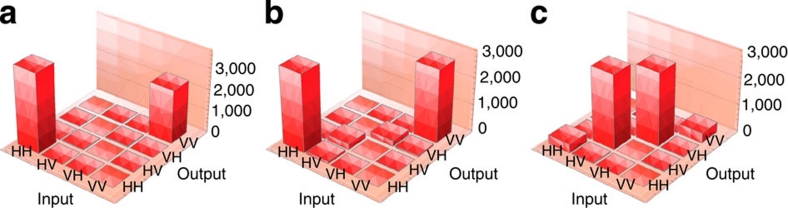
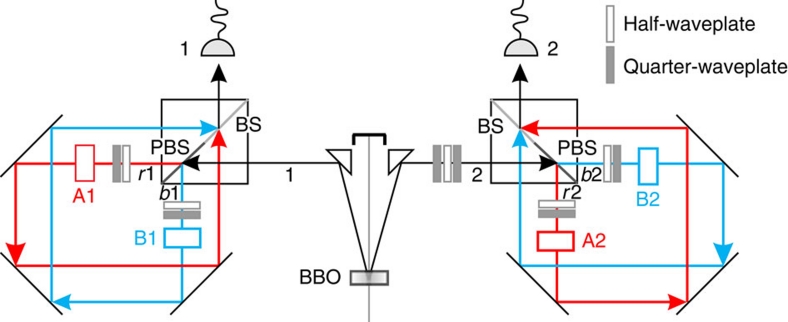
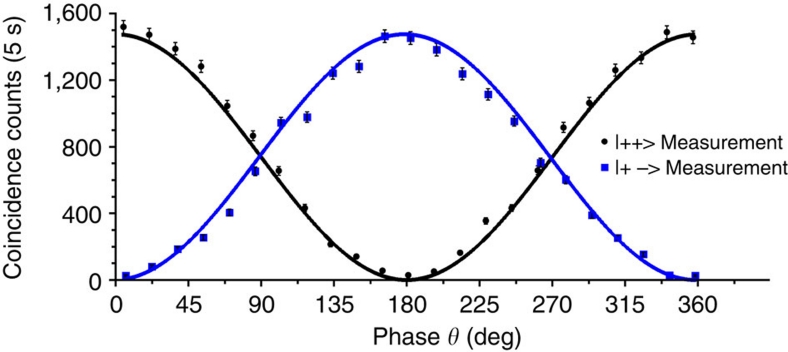
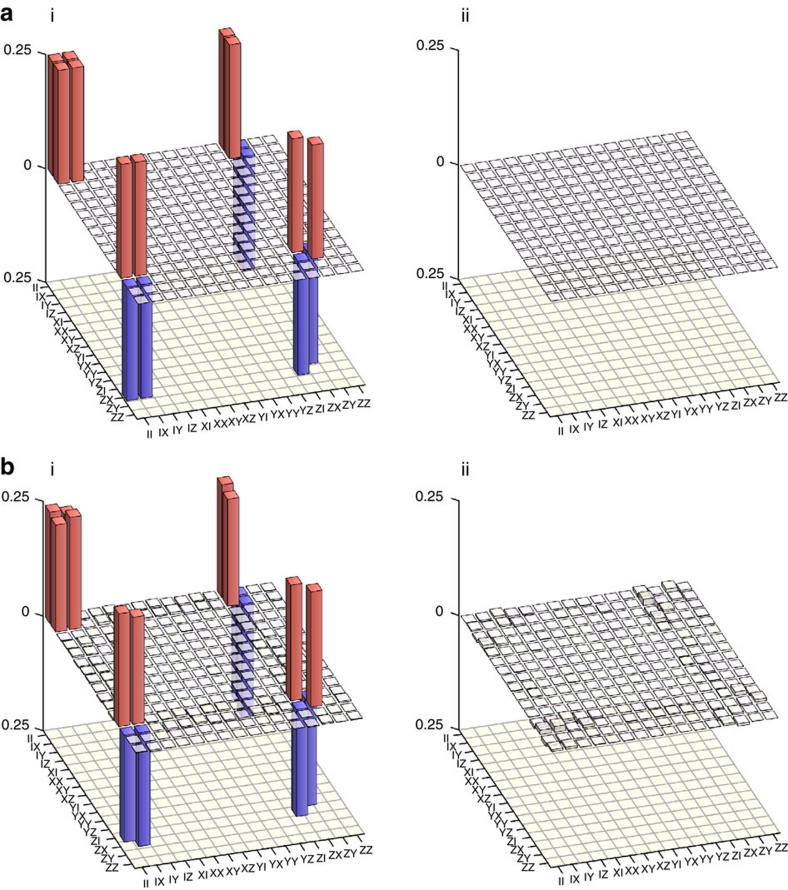
Verification
Claims the paper makes
The claims and statistics of this paper haven’t been checked yet.
Free: it reads the open-access text and checks the first 5 claims that cite a source we can check. Create a free account to check every claim.
Claims other papers make about this one
Each is checked against this paper’s own text: does it say what the citing paper says it does?
The source backs part of the claim, not all of it — or backs it for a different population, condition or comparison.
In the citing paper
“In principle, efficient quantum computation can be achieved using single-photon sources, linear optics, and single-photon detectors [25, 29, 30].”
From Experimental Quantum Computing to Solve Systems of Linear Equations (2013) · cites this paper as [25]
Experimental — accuracy not yet measuredIn the citing paper
“The technique of coherently controlling multiple qubits and executing complex, multiple-gate quantum circuits presents an advance on linear optics quantum computation [21, 25] and allows to test other similar quantum algorithms such as solving differential equations [26, 27] and data fitting [28].”
From Experimental Quantum Computing to Solve Systems of Linear Equations (2013) · cites this paper as [25]
Self-check
Percentages, sums and reported differences re-computed from the paper’s own numbers.
The self-check needs the paper’s full text.
Citations
Cites
Quantum Computation and Quantum Information
Nielsen, M. A., Chuang, I., & Grover, L. K. (2002) · American Journal of Physics · doi:10.1119/1.1463744 · Cited by 21,895
Quantum computation and quantum information
Law, J. (2001) · ACM SIGSOFT Software Engineering Notes · doi:10.1145/505482.505499 · Cited by 18,842
Algorithms for quantum computation: discrete logarithms and factoring
Shor, P. W. (2002) · Proceedings 35th Annual Symposium on Foundations of Computer Science · doi:10.1109/sfcs.1994.365700 · Cited by 8,713
Gisin, N., Ribordy, G., Tittel, W., & Zbinden, H. (2002) · Reviews of Modern Physics · doi:10.1103/revmodphys.74.145 · Cited by 8,515
Simulating physics with computers
Feynman, R. P. (1982) · International Journal of Theoretical Physics · doi:10.1007/bf02650179 · Cited by 7,691
A scheme for efficient quantum computation with linear optics
Knill, E., Laflamme, R., & Milburn, G. J. (2001) · Nature · doi:10.1038/35051009 · Cited by 5,880 · cited 1×
“This entanglement-based scheme would be useful for small-scale applications as well as subroutines in larger calculations, and it could be made deterministic, following the original prescription for linear optical quantum computatio”
MethodRaussendorf, R., & Briegel, H. J. (2001) · Physical Review Letters · doi:10.1103/physrevlett.86.5188 · Cited by 4,477 · cited 1×
“We then show that the equivalent operation can be achieved by exploiting an entangled initial state—reminiscent, but distinct from, cluster state quantum computin”
BackgroundQuantum Mechanics Helps in Searching for a Needle in a Haystack
Grover, L. K. (1997) · Physical Review Letters · doi:10.1103/physrevlett.79.325 · Cited by 4,306 · cited 1×
“Then two spatial modes 1r,1b (2r,2b) of photon 1 (2) are combined at a Bs.”
BackgroundLadd, T. D., Jelezko, F., Laflamme, R., Nakamura, Y., Monroe, C., & O’Brien, J. L. (2010) · Nature · doi:10.1038/nature08812 · Cited by 3,592
Self-citationHansen, H. M., Hurwitz, W. N., & Madow, W. G. (1953) · Wiley eBooks · Cited by 1,614
Cited by
A variational eigenvalue solver on a photonic quantum processor
Peruzzo, A., McClean, J., Shadbolt, P., Yung, M.-H., Zhou, X.-Q., Love, P. J., Aspuru-Guzik, A., & O’Brien, J. L. (2014) · Nature Communications · doi:10.1038/ncomms5213 · Cited by 4,552
Self-citationPhotonic quantum information processing: a concise review
Slussarenko, S., & Pryde, G. J. (2019) · Applied Physics Reviews · doi:10.1063/1.5115814 · Cited by 644
Large-scale silicon quantum photonics implementing arbitrary two-qubit processing
Qiang, X., Zhou, X., Wang, J., Wilkes, C. M., Loke, T., O’Gara, S., Kling, L., Marshall, G. D., Santagati, R., Ralph, T. C., et al. (2018) · Nature Photonics · doi:10.1038/s41566-018-0236-y · Cited by 516
Self-citationQuantum-assisted quantum compiling
Khatri, S., LaRose, R., Poremba, A., Cincio, L., Sornborger, A. T., & Coles, P. J. (2019) · Quantum · doi:10.22331/q-2019-05-13-140 · Cited by 382
Experimental realization of Shor's quantum factoring algorithm using qubit recycling
Martín-López, E., Laing, A., Lawson, T., Alvarez, R., Zhou, X.-Q., & O'Brien, J. L. (2012) · Nature Photonics · doi:10.1038/nphoton.2012.259 · Cited by 349
“The eCNOT gate is driven by pre-entanglement 24 from the polarisation entangled SPDC source in the state | 1 H,U (cid:105) | 1 H,L (cid:105) + | 1 V,U (cid:105) | 1 V,L (cid:105) (where H/V denotes horizontally/vertically polarised light and U/L denotes upper/lower path) which is then converted to…”
BackgroundMethodSelf-citation
Metadata
- Authors
- Zhou, X.-Q., Ralph, T. C., Kalasuwan, P., Zhang, M., Peruzzo, A., Lanyon, B. P., & O'Brien, J. L.
- Affiliations
- The University of Queensland (AU)
- University of Bristol (GB)
- Cornell University (US)
- Universität Innsbruck (AT)
- Venue
- Nature Communications
- Published
- 2011-08-02
- Volume
- 2
- Issue
- 1
- Pages
- 413-413
- ISSN
- 2041-1723 (ISSN-L)
- PMC
- PMC3267055
- OpenAlex
- W2134719239
- Cited by
- 173
- References
- 42
- Citations by year
- 2026: 6 · 2025: 8 · 2024: 11 · 2023: 42 · 2022: 10 · 2021: 15 · 2020: 8 · 2019: 9 · 2018: 8 · 2017: 6 · 2016: 15 · 2015: 6 · 2014: 18 · 2013: 9 · 2012: 1
- FWCI
- 8.53
- Type
- journal article
- Language
- en
- Open access
- hybrid
- doi.org
- Licence
- cc-by-nc-nd
- creativecommons.org/licenses/by-nc-nd/3.0/ (tdm)
- creativecommons.org/licenses/by-nc-nd/3.0/ (vor)
- Locations
- Nature Communications (publishedVersion, cc-by-nc-nd)
- Europe PMC (PubMed Central) (publishedVersion, cc-by-nc-nd)
- PubMed Central (publishedVersion, cc-by-nc-nd)
- PubMed (publishedVersion)
- arXiv (Cornell University) (submittedVersion)
- UWA Profiles and Research Repository (UWA) (submittedVersion, cc-by)
- RePEc: Research Papers in Economics (submittedVersion)
- RMIT Research Repository (RMIT University Library) (submittedVersion)
- Figshare (submittedVersion)
- Explore Bristol Research (submittedVersion)
- Bristol Research (University of Bristol) (submittedVersion)
- arXiv (Cornell University)
- Funders
- Leverhulme Trust
- Intelligence Advanced Research Projects Activity
- Engineering and Physical Sciences Research Council (EP/F010524/1)
- Topics
- Physical Sciences › Computer Science › Artificial Intelligence › Quantum Computing Algorithms and Architecture
- Physical Sciences › Physics and Astronomy › Atomic and Molecular Physics, and Optics › Quantum Information and Cryptography
- Physical Sciences › Physics and Astronomy › Atomic and Molecular Physics, and Optics › Quantum Mechanics and Applications
- Keywords
- quantum photonics, two-qubit gates, gate fidelity, quantum algorithms
About these checks
Registry, retraction, Cites and statistics results are computed, not judged, with one exception: a printed reference that no index lists is read once by a model before it counts as a citation error. Claims are extracted by a model and kept only when their quote appears verbatim in the text; each cited source is then checked, with a model’s help, for whether it says what the claim relies on. Those verdicts can be wrong — read the claim’s quote and the cited source before relying on one.
Statistics and arithmetic are recomputed, not judged.
Confidence bands are shown only for fields calibrated on our annotated test set. None is calibrated yet, so no band is shown.
What counts as a claim ›How we measure confidence ›How we check this ›
Are you an author, or do you see a problem with this page? Request a review
How to cite
Cite CoChat for the checks on this page, and the paper for its own findings.
- This page
- CoChat. (2026). Citation check: Adding control to arbitrary unknown quantum operations. https://app.cochat.ai/papers/10.1038/ncomms1392
- The paper
- Zhou, X.-Q., Ralph, T. C., Kalasuwan, P., Zhang, M., Peruzzo, A., Lanyon, B. P., & O'Brien, J. L. (2011). Adding control to arbitrary unknown quantum operations. Nature Communications. https://doi.org/10.1038/ncomms1392
Data sources
Bibliographic data: Semantic Scholar, OpenAlex, Crossref.
Contains information from the Semantic Scholar Academic Graph Datasets, made available under the ODC Attribution License (ODC-BY 1.0).
Semantic Scholar’s data is described in: Kinney, R., et al. (2023). The Semantic Scholar Open Data Platform. arXiv:2301.10140.
