

The DOI matches its Crossref record; 70 of the 70 references it cites were found in a registry or an index.
Genome-wide characteristics of de novo mutations in autism
Open accessAbstract
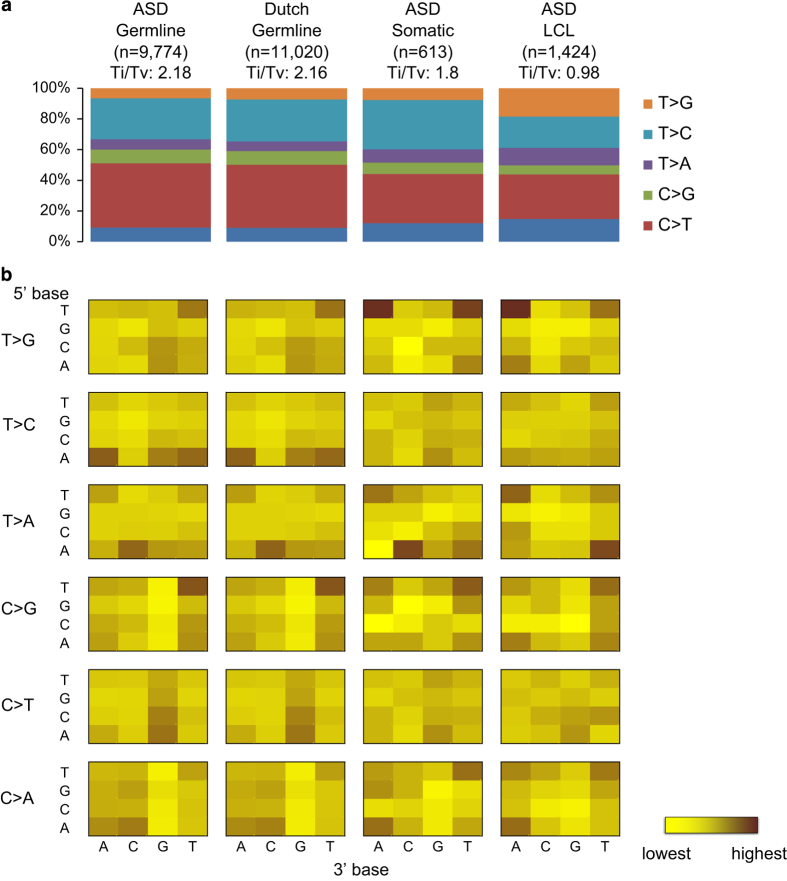
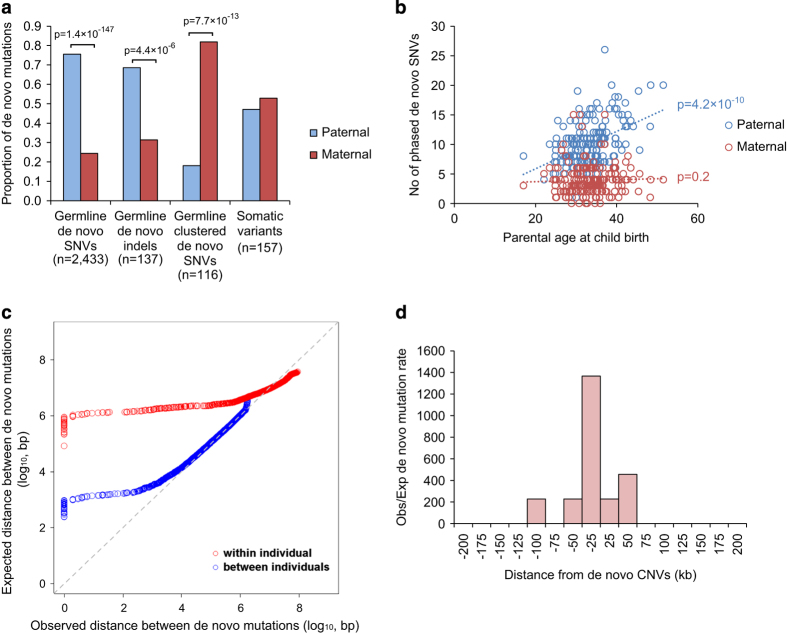
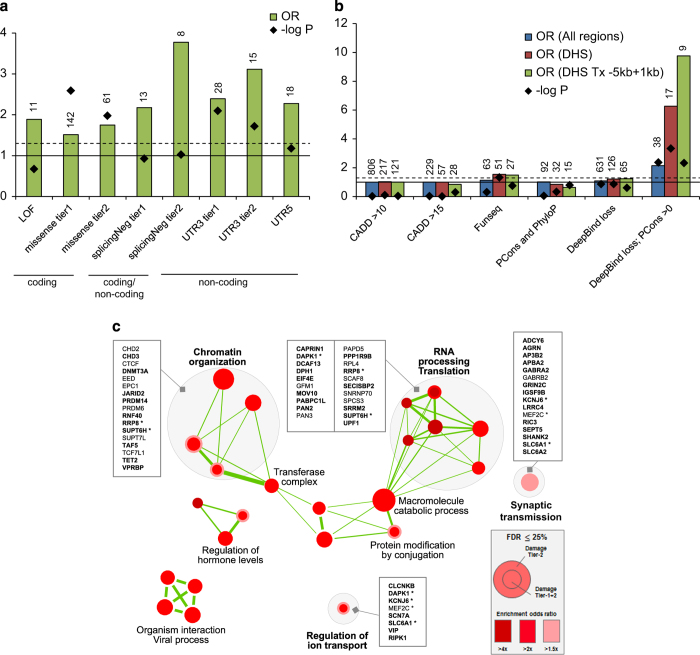
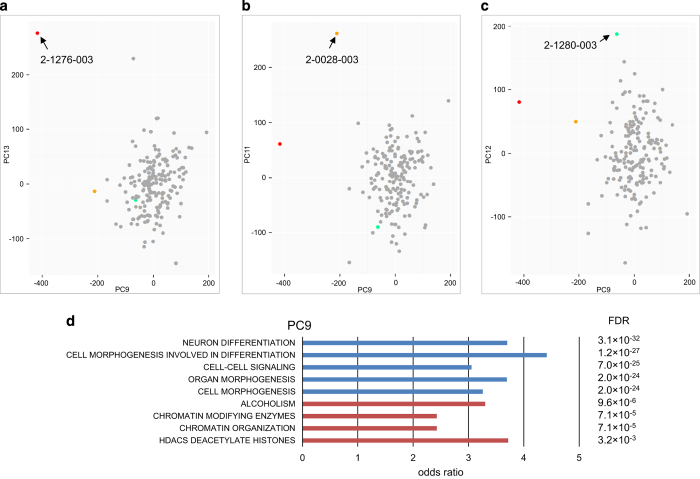
De novo mutations (DNMs) are important in autism spectrum disorder (ASD), but so far analyses have mainly been on the ~1.5% of the genome encoding genes. Here, we performed whole-genome sequencing (WGS) of 200 ASD parent–child trios and characterised germline and somatic DNMs. We confirmed that the majority of germline DNMs (75.6%) originated from the father, and these increased significantly with paternal age only (P=4.2×10⁻¹⁰). However, when clustered DNMs (those within 20 kb) were found in ASD, not only did they mostly originate from the mother (P=7.7×10⁻¹³), but they could also be found adjacent to de novo copy number variations where the mutation rate was significantly elevated (P=2.4×10⁻²⁴). By comparing with DNMs detected in controls, we found a significant enrichment of predicted damaging DNMs in ASD cases (P=8.0×10⁻⁹; odds ratio=1.84), of which 15.6% (P=4.3×10⁻³) and 22.5% (P=7.0×10⁻⁵) were non-coding or genic non-coding, respectively. The non-coding elements most enriched for DNM were untranslated regions of genes, regulatory sequences involved in exon-skipping and DNase I hypersensitive regions. Using microarrays and a novel outlier detection test, we also found aberrant methylation profiles in 2/185 (1.1%) of ASD cases. These same individuals carried independently identified DNMs in the ASD-risk and epigenetic genes DNMT3A and ADNP. Our data begins to characterize different genome-wide DNMs, and highlight the contribution of non-coding variants, to the aetiology of ASD.
Overview
The claims and statistics of this paper haven’t been checked yet.
Run the check — free, no account needed. It reads the open-access text and checks the sources it cites.
Integrity signals
Registry
Cites
Statistics
Figures
Verification
Claims the paper makes
The claims and statistics of this paper haven’t been checked yet.
Run the check — free, no account needed. It reads the open-access text and checks the sources it cites.
Claims other papers make about this one
Each is checked against this paper’s own text: does it say what the citing paper says it does?
In the citing paper
“individuals with ASD have a two- to three-fold increase in the number of rare copy number variations (CNVs) and de novo loss-of-function (nonsense, frameshift, and splice site) variants compared to their unaffected siblings11–14.”
From Genome-wide detection of tandem DNA repeats that are expanded in autism (2020) · cites this paper as [14]
Self-check
Percentages, sums and reported differences re-computed from the paper’s own numbers.
The self-check needs the paper’s full text.
Citations
Cites
An integrated encyclopedia of DNA elements in the human genome
The ENCODE Project Consortium (2012) · Nature · doi:10.1038/nature11247 · Cited by 18,072
ANNOVAR: functional annotation of genetic variants from high-throughput sequencing data
Wang, K., Li, M., & Hakonarson, H. H. (2010) · Nucleic Acids Research · doi:10.1093/nar/gkq603 · Cited by 14,724
A method and server for predicting damaging missense mutations.
Adzhubei, I. A., Schmidt, S., Peshkin, L., Ramensky, V. E., Gerasimova, A., Bork, P., Kondrashov, A. S., & Sunyaev, S. R. (2010) · Nature Methods · doi:10.1038/nmeth0410-248 · Cited by 13,194
Integrative analysis of 111 reference human epigenomes
Roadmap Epigenomics Consortium, Kundaje, A., Meuleman, W., Ernst, J., Bilenky, M., Yen, A., Heravi-Moussavi, A., Kheradpour, P., Zhang, Z., Wang, J., et al. (2015) · Nature · doi:10.1038/nature14248 · Cited by 6,368
Self-citationA general framework for estimating the relative pathogenicity of human genetic variants
Kircher, M., Witten, D. M., Jain, P., O'Roak, B. J., Cooper, G. M., & Shendure, J. (2014) · Nature Genetics · doi:10.1038/ng.2892 · Cited by 6,183
Okano, M., Bell, D. W., Haber, D. A., & Li, E. (1999) · Cell · doi:10.1016/s0092-8674(00)81656-6 · Cited by 6,143
DNA methylation arrays as surrogate measures of cell mixture distribution
Houseman, E. A., Accomando, W. P., Koestler, D. C., Christensen, B. C., Marsit, C. J., Nelson, H. H., Wiencke, J. K., & Kelsey, K. T. (2012) · BMC Bioinformatics · doi:10.1186/1471-2105-13-86 · Cited by 3,175
MutationTaster evaluates disease-causing potential of sequence alterations
Schwarz, J. M., Rödelsperger, C., Schuelke, M., & Seelow, D. (2010) · Nature Methods · doi:10.1038/nmeth0810-575 · Cited by 2,975
Predicting the sequence specificities of DNA- and RNA-binding proteins by deep learning
Alipanahi, B., Delong, A., Weirauch, M. T., & Frey, B. J. (2015) · Nature Biotechnology · doi:10.1038/nbt.3300 · Cited by 2,873
Self-citationStrong association of de novo copy number mutations with autism
Sebat, J., Lakshmi, B., Malhotra, D., Troge, J., Lese-Martin, C., Walsh, T., Yamrom, B., Yoon, S., Krasnitz, A., Kendall, J., et al. (2007) · Science · doi:10.1126/science.1138659 · Cited by 2,795
Cited by
Sorted by citations
Whole genome sequencing resource identifies 18 new candidate genes for autism spectrum disorder
C Yuen, R. K., Merico, D., Bookman, M., L Howe, J., Thiruvahindrapuram, B., Patel, R. V., Whitney, J., Deflaux, N., Bingham, J., Wang, Z., et al. (2017) · Nature Neuroscience · doi:10.1038/nn.4524 · Cited by 844
Self-citationInferring the molecular and phenotypic impact of amino acid variants with MutPred2
Pejaver, V., Urresti, J., Lugo-Martinez, J., Pagel, K. A., Lin, G. N., Nam, H.-J., Mort, M., Cooper, D. N., Sebat, J., Iakoucheva, L. M., et al. (2020) · Nature Communications · doi:10.1038/s41467-020-19669-x · Cited by 923
Structural variation in the sequencing era
Ho, S. S., Urban, A. E., & Mills, R. E. (2019) · Nature Reviews Genetics · doi:10.1038/s41576-019-0180-9 · Cited by 630
Parental influence on human germline de novo mutations in 1,548 trios from Iceland
Jónsson, H., Sulem, P., Kehr, B., Kristmundsdottir, S., Zink, F., Hjartarson, E., Hardarson, M. T., Hjorleifsson, K. E., Eggertsson, H. P., Gudjonsson, S. A., et al. (2017) · Nature · doi:10.1038/nature24018 · Cited by 561
Neurodevelopmental disease genes implicated by de novo mutation and copy number variation morbidity
Coe, B. P., Stessman, H. A. F., Sulovari, A., Geisheker, M. R., Bakken, T. E., Lake, A. M., Dougherty, J. D., Lein, E. S., Hormozdiari, F., Bernier, R. A., et al. (2019) · Nature Genetics · doi:10.1038/s41588-018-0288-4 · Cited by 330
Metadata
- Authors
- Yuen, R. K., Merico, D., Cao, H., Pellecchia, G., Alipanahi, B., Thiruvahindrapuram, B., Tong, X., Sun, Y., Cao, D., Zhang, T., Wu, X., Jin, X., Zhou, Z., Liu, X., Nalpathamkalam, T., Walker, S., Howe, J. L., Wang, Z., MacDonald, J. R., Chan, A. J., D’Abate, L., Deneault, E., Siu, M. T., Tammimies, K., Uddin, M., Zarrei, M., Wang, M., Li, Y., Wang, J., Wang, J., Yang, H., Bookman, M., Bingham, J., Gross, S. S., Loy, D., Pletcher, M., Marshall, C. R., Anagnostou, E., Zwaigenbaum, L., Weksberg, R., Fernandez, B. A., Roberts, W., Szatmari, P., Glazer, D., Frey, B. J., Ring, R. H., Xu, X., & Scherer, S. W.
- Affiliations
- Hospital for Sick Children (CA)
- BGI Group (China) (CN)
- University of Toronto (CA)
- Karolinska Institutet (SE)
- Google (United States) (US)
- Autism Speaks (US)
- University of Alberta (CA)
- Memorial University of Newfoundland (CA)
- Corresponding author
- Scherer, Stephen W
- ORCID
- Yuen, Ryan KC
- Merico, Daniele
- Cao, Hongzhi
- Pellecchia, Giovanna
- Alipanahi, Babak
- Thiruvahindrapuram, Bhooma
- Tong, Xin
- Sun, Yuhui
- Cao, Dandan
- Zhang, Tao
- Jin, Xin
- Liu, Xiaomin
- Nalpathamkalam, Thomas
- Walker, Susan
- Wang, Zhuozhi
- MacDonald, Jeffrey R
- D’Abate, Lia
- Tammimies, Kristiina
- Uddin, Mohammed
- Wang, Mingbang
- Li, Yingrui
- Wang, Jun
- Wang, Jian
- Yang, Huanming
- Marshall, Christian R
- Anagnostou, Evdokia
- Zwaigenbaum, Lonnie
- Weksberg, Rosanna
- Fernandez, Bridget A
- Glazer, David
- Ring, Robert H
- Xu, Xun
- Scherer, Stephen W
- Venue
- npj Genomic Medicine
- Published
- 2016-08-03
- Volume
- 1
- Issue
- 1
- Pages
- 160271-1602710
- ISSN
- 2056-7944 (ISSN-L)
- PMC
- PMC4980121
- OpenAlex
- W2484001856
- Cited by
- 216
- References
- 70
- Citations by year
- 2026: 9 · 2025: 6 · 2024: 7 · 2023: 13 · 2022: 28 · 2021: 23 · 2020: 30 · 2019: 33 · 2018: 32 · 2017: 33 · 2016: 2
- FWCI
- 21.21
- Type
- journal article
- Language
- en
- Open access
- gold
- doi.org
- Locations
- npj Genomic Medicine (publishedVersion, cc-by)
- Europe PMC (PubMed Central) (publishedVersion, cc-by)
- PubMed Central (publishedVersion, cc-by)
- PubMed (publishedVersion)
- Funders
- Autism Speaks
- GlaxoSmithKline
- Genome Canada
- Ontario Brain Institute
- National Alliance for Research on Schizophrenia and Depression
- Stollery Children’s Hospital Foundation
- Children's Hospital Foundation
- Ontario Genomics
- Government of Ontario
- Ontario Genomics Institute
- Sick Kids Foundation
- University of Toronto
- Vetenskapsrådet
- Hospital for Sick Children
- U.S. Public Health Service (140849-1)
- Canadian Institutes of Health Research (140849_1)
- Topics
- Life Sciences › Neuroscience › Cognitive Neuroscience › Autism Spectrum Disorder Research
- Life Sciences › Biochemistry, Genetics and Molecular Biology › Genetics › Genetics and Neurodevelopmental Disorders
- Life Sciences › Biochemistry, Genetics and Molecular Biology › Genetics › Genomic variations and chromosomal abnormalities
- Keywords
- de novo mutations, autism spectrum disorder, germline mutations, somatic mutations, paternal age, clustered mutations, copy number variation, non-coding variants, untranslated regions, exon skipping, DNA methylation, DNMT3A, ADNP, mutation rate
About these checks
Registry, retraction, Cites and statistics results are computed, not judged, with one exception: a printed reference that no index lists is read once by a model before it counts as a citation error. Claims are extracted by a model and kept only when their quote appears verbatim in the text; each cited source is then checked, with a model’s help, for whether it says what the claim relies on. Those verdicts can be wrong — read the claim’s quote and the cited source before relying on one.
Statistics and arithmetic are recomputed, not judged.
Confidence bands are shown only for fields calibrated on our annotated test set. None is calibrated yet, so no band is shown.
What counts as a claim ›How we measure confidence ›How we check this ›
Are you an author, or do you see a problem with this page? Request a review
