

Renal denervation for atrial fibrillation: a comprehensive updated systematic review and meta-analysis
Open accessThe DOI matches its Crossref record; 51 of the 51 references it cites were found in a registry or an index.
Abstract
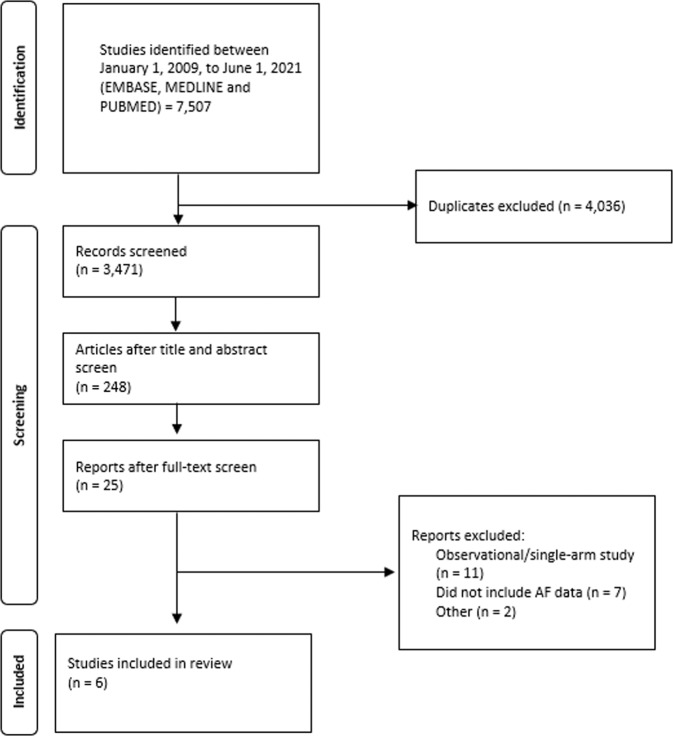
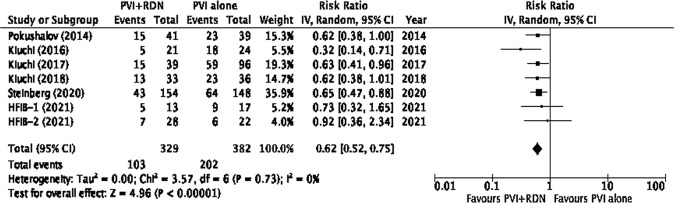
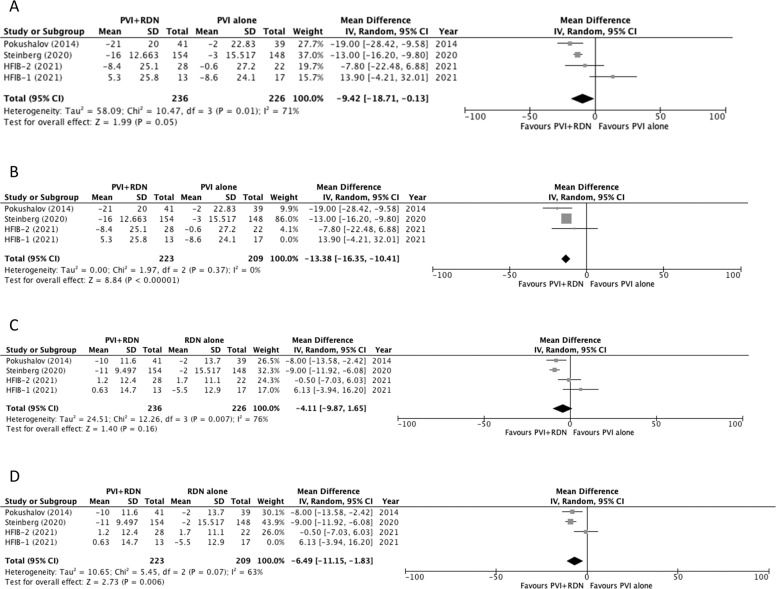
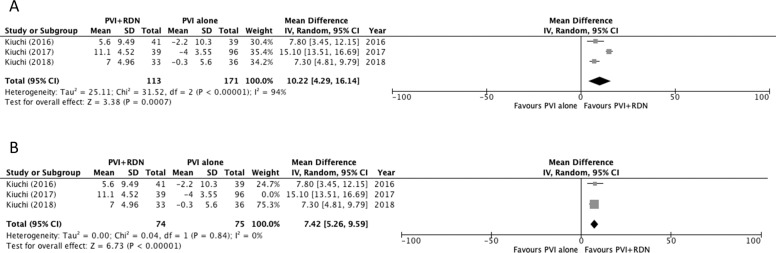
The study aims to compare clinical outcomes following renal denervation (RDN) in hypertensive patients with atrial fibrillation (AF). Three online databases were searched (MEDLINE, EMBASE and PubMed) for literature related to outcomes of RDN on hypertension and AF, between January 1, 2010, and June 1, 2021. Where possible, risk ratios (RR) and mean differences (MD) were combined using a random effects model. Significance was set at p ≤ 0.05. Seven trials were included that assessed the effect of adding RDN to pulmonary vein isolation (PVI) in patients with hypertension and AF. A total of 711 patients (329 undergoing PVI + RDN and 382 undergoing PVI alone), with an age range of 56 ± 6 to 68 ± 9 years, were included. Pooled analysis showed a significant lowering of AF recurrence in the PVI + RDN (31.3%) group compared to the PVI-only (52.9%) group (p < 0.00001). Pooled analysis of patients with resistant hypertension showed a significant mean reduction of systolic blood pressure (SBP) (−9.42 mm Hg, p = 0.05), but not diastolic blood pressure (DBP) (−4.11 mm Hg, p = 0.16) in favor of PVI + RDN. Additionally, the pooled analysis showed that PVI + RDN significantly improved estimated glomerular filtration rate (eGFR) (+10.2 mL/min per 1.73 m 2, p < 0.001) compared to PVI alone. RDN procedures in these trials have proven to be both safe and efficacious with an overall complication rate of 6.32%. Combined PVI and RDN is beneficial for patients with hypertension and AF. Combined therapy showed improvement in SBP and eGFR, reducing the risk of AF recurrence. RDN may serve as an innovative intervention in the treatment of AF.
Overview
The claims and statistics of this paper haven’t been checked yet.
Free: it reads the open-access text and checks the first 5 claims that cite a source we can check. Create a free account to check every claim.
Integrity signals
Registry
Cites
Statistics
Figures
Verification
Claims the paper makes
The claims and statistics of this paper haven’t been checked yet.
Free: it reads the open-access text and checks the first 5 claims that cite a source we can check. Create a free account to check every claim.
Claims other papers make about this one
Each is checked against this paper’s own text: does it say what the citing paper says it does?
The source backs part of the claim, not all of it — or backs it for a different population, condition or comparison.
In the citing paper
“A meta-analysis of data from the ERADICATE-AF trial and five smaller studies of RDN in patients with hypertension and atrial fibrillation who were undergoing PVI reported a risk ratio for recurrence of atrial fibrillation among those in the PVI plus RDN group versus the PVI alone group of 0.62 (95% CI 0.52–0.75)141. A pooled analysis of the blood pressure data collected in these trials showed”
From Renal nerves in physiology, pathophysiology and interoception (2025) · cites this paper as [141]
Experimental — accuracy not yet measured
Self-check
Percentages, sums and reported differences re-computed from the paper’s own numbers.
The self-check needs the paper’s full text.
Citations
Cites
Preferred Reporting Items for Systematic Reviews and Meta-Analyses: the PRISMA statement
Moher, D., Liberati, A., Tetzlaff, J., Altman, D. G., & for the PRISMA Group (2009) · BMJ · doi:10.1136/bmj.b2535 · Cited by 83,823
Measuring inconsistency in meta-analyses
Higgins, J. P. T., Thompson, S. G., Deeks, J. J., & Altman, D. G. (2003) · BMJ · doi:10.1136/bmj.327.7414.557 · Cited by 63,139 · cited 1×
“To assess for heterogeneity due to differences in study methods and populations, the I(2) values were used [15].”
MethodCochrane Handbook for Systematic Reviews of Interventions: Cochrane Book Series
(2008) · doi:10.1002/9780470712184 · Cited by 25,048
Interrater reliability: The kappa statistic
McHugh, M. L. (2012) · Biochemia Medica · doi:10.11613/bm.2012.031 · Cited by 19,877 · cited 2×
“6 threshold which indicates strong inter-rater reliability [14].”
BackgroundMethodWang, G., Ma, R., Qiao, G., Wada, K., Aizawa, Y., & Satoh, T. (2015) · Integrative Medicine International · doi:10.1159/000368408 · Cited by 18,657
Heart Disease and Stroke Statistics—2019 Update: A Report From the American Heart Association
Benjamin, E. J., Muntner, P., Alonso, A., Bittencourt, M. S., Callaway, C. W., Carson, A. P., Chamberlain, A. M., Chang, A. R., Cheng, S., Das, S. R., et al. (2019) · Circulation · doi:10.1161/cir.0000000000000659 · Cited by 9,036 · cited 1×
“However, a common underpinning in AF patients is that hypertension (HTN) is associated with one in five cases of AF [3].”
BackgroundSlim, K., Nini, E., Forestier, D., Kwiatkowski, F., Panis, Y., & Chipponi, J. (2003) · ANZ Journal of Surgery · doi:10.1046/j.1445-2197.2003.02748.x · Cited by 7,603
Whelton, P. K., Carey, R. M., Aronow, W. S., Casey, D. E., Collins, K. J., Dennison Himmelfarb, C., DePalma, S. M., Gidding, S., Jamerson, K. A., Jones, D. W., et al. (2018) · Hypertension · doi:10.1161/hyp.0000000000000065 · Cited by 7,391
Heart Disease and Stroke Statistics—2010 Update: A Report From the American Heart Association
WRITING GROUP MEMBERS, Lloyd-Jones, D., Adams, R. J., Brown, T. M., Carnethon, M., Dai, S., De Simone, G., Ferguson, T. B., Ford, E., Furie, K., et al. (2010) · Circulation · doi:10.1161/circulationaha.109.192667 · Cited by 5,700
The global epidemiology of hypertension
Mills, K. T., Stefanescu, A., & He, J. (2020) · Nature Reviews Nephrology · doi:10.1038/s41581-019-0244-2 · Cited by 4,133 · cited 1×
“While various drug combinations, doses, and additional agents can be used to reach blood pressure targets, HTN remains the main risk factor for cardiovascular disease including AF and premature death worldwide [24].”
Background
Cited by
Targeting the Substrate for Atrial Fibrillation
McCauley, M. D., Iacobellis, G., Li, N., Nattel, S., & Goldberger, J. J. (2024) · Journal of the American College of Cardiology · doi:10.1016/j.jacc.2024.02.050 · Cited by 58
Swaminathan, R. V., East, C. A., Feldman, D. N., Fisher, N. D. L., Garasic, J. M., Giri, J. S., Kandzari, D. E., Kirtane, A. J., Klein, A. J., Kobayashi, T., et al. (2023) · Journal of the Society for Cardiovascular Angiography & Interventions · doi:10.1016/j.jscai.2023.101121 · Cited by 55
Nesapiragasan, V., Hayıroğlu, M. İ., Sciacca, V., Sommer, P., Sohns, C., & Fink, T. (2023) · Balkan Medical Journal · doi:10.4274/balkanmedj.galenos.2023.2023-9-48 · Cited by 48
“96 However, these findings need to be validated by large long-term trials, which should potentially include studies with a sham control group to further strengthen the findings.”
BackgroundRenal nerves in physiology, pathophysiology and interoception
Evans, L. C., Dayton, A., & Osborn, J. W. (2025) · Nature Reviews Nephrology · doi:10.1038/s41581-024-00893-3 · Cited by 46
“…from the ERADICATE-AF trial and five smaller studies of RDN in patients with hypertension and atrial fibrillation who were undergoing PVI reported a risk ratio for recurrence of atrial fibrillation among those in the PVI plus RDN group versus the PVI alone group of 0.62 (95% CI 0.52–0.75) 141 .”
InfluentialMohammad, A. A., Nawar, K., Binks, O., & Abdulla, M. H. (2023) · Journal of Human Hypertension · doi:10.1038/s41371-023-00857-3 · Cited by 29
Self-citationThe Potential Role of Renal Denervation in the Management of Heart Failure
Kassab, K., Soni, R., Kassier, A., & Fischell, T. A. (2022) · Journal of Clinical Medicine · doi:10.3390/jcm11144147 · Cited by 19
“Recently, there has been an increasing interest in RDN as a treatment for chronic heart failure and tachy-arrhythmias, such as atrial fibrillation, with multiple studies demonstrating its efficacy, up to 1-year follow-up [21,22].”
BackgroundPredictors of Atrial Fibrillation Recurrence After Catheter Ablation: A State-of-the-Art Review
Vempati, R., Garg, A., Shah, M., Jena, N. K., Raj, K., Reddy, Y. M., Noheria, A., Ha, Q. D., Umashankar, D., & Gahona, C. C. T. (2025) · Hearts · doi:10.3390/hearts6020012 · Cited by 16
“%) compared to the PVI-only group (52.9%), with a p -value of less than 0.00001 [157].”
InfluentialNeurocardiac Axis Physiology and Clinical Applications
Plott, C. F., Harb, T., Arvanitis, M., Gerstenblith, G., Blumenthal, R. S., & Leucker, T. M. (2024) · IJC Heart & Vasculature · doi:10.1016/j.ijcha.2024.101488 · Cited by 15
“[ 84] There is also a significantly higher risk of arrhythmias including ventricular fibrillation and tachycardia after a stroke.”
BackgroundImpact of renal denervation on cardiac remodeling in resistant hypertension: A meta‐analysis
Xie, L., Li, Y., Luo, S., & Huang, B. (2024) · Clinical Cardiology · doi:10.1002/clc.24222 · Cited by 11
“32 Moreover, studies have shown that besides its role in treating RH, RDN may also be effective in the management of other diseases associated with excessive activation of the sympathetic nervous system, such as congestive heart failure, 33 atrial fibrillation, 34 obstructive sleep apnea syndrome.”
BackgroundMicroalbuminuria as a Prognostic Marker in Essential Hypertension
Dimitriadis, K. S., Pyrpyris, N., Vakka, A., Iliakis, P., Theofilis, P., Tatakis, F., Beneki, E., Pitsiori, D., Tsioufis, P., Aznaouridis, K. A., et al. (2025) · Current Medicinal Chemistry · doi:10.2174/0109298673348953250310044927 · Cited by 11
Update on Renal Sympathetic Denervation for the Treatment of Hypertension
Rao, A., & Krishnan, N. (2022) · Current Cardiology Reports · doi:10.1007/s11886-022-01753-x · Cited by 10
Zeijen, V. J. M., Theuns, D. A. M. J., Feyz, L., Saville, K. A., Bhagwandien, R. E., Kardys, I., Mieghem, N. M. V., & Daemen, J. (2023) · Clinical Research in Cardiology · doi:10.1007/s00392-023-02222-3 · Cited by 8
Percutaneous Neuromodulation for Atrial Fibrillation
Zuhair, M., Keene, D., Kanagaratnam, P., & Lim, P. B. (2023) · Cardiac Electrophysiology Clinics · doi:10.1016/j.ccep.2023.09.001 · Cited by 5
Emerging Role of Renal Sympathetic Denervation as an Adjunct Therapy to Atrial Fibrillation Ablation
Akrawinthawong, K., & Yamada, T. (2024) · Reviews in Cardiovascular Medicine · doi:10.31083/j.rcm2504122 · Cited by 5
Renal Denervation in Heart Failure Treatment: Data for a Self-Fulfilling Prophecy
Dimitriadis, K. S., Iliakis, P., Pyrpyris, N., Tatakis, F., Fragoulis, C., Mantziaris, V., Plaitis, A., Beneki, E., Tsioufis, P., Hering, D., et al. (2024) · Journal of Clinical Medicine · doi:10.3390/jcm13226656 · Cited by 5
Migliaro, S., Petrolini, A., Mariani, S., & Tomai, F. (2024) · Journal of Cardiovascular Medicine · doi:10.2459/jcm.0000000000001609 · Cited by 5
Functional insights into the cardiorenal syndrome
Johns, E. J. (2024) · Hypertension Research · doi:10.1038/s41440-024-01665-z · Cited by 5
Self-citationRenal denervation for hypertensive heart disease and atrial fibrillation
Shinohara, K. (2024) · Hypertension Research · doi:10.1038/s41440-024-01755-y · Cited by 4
Коростовцева, Л. С., Васильевич, И. М., Shcherbakova, E. A., Викторович, Б. М., Emelyanov, I. V., Yudina, Y. S., Mironova, S. A., Зверев, Д. А., Lebedev, D. S., Vakhrushev, A. D., et al. (2023) · BMC Pulmonary Medicine · doi:10.1186/s12890-023-02757-1 · Cited by 4
“Moreover, other protective effects of RDN are widely investigated including reduction in ventricular arrhythmias [19, 20], atrial fibrillation recurrence [21], improvement in renal function [22], glucose control [23], target organ damage, etc. [24].”
BackgroundThe effect of renal denervation in microcirculation: focusing on coronary microvascular dysfunction
Dimitriadis, K. S., Pyrpyris, N., Tatakis, F., Kyriakoulis, K., Pitsiori, D., Beneki, E., Fragoulis, C., Konstantinidis, D., Κόλλιας, Α., Aznaouridis, K. A., et al. (2025) · Future Cardiology · doi:10.1080/14796678.2025.2464478 · Cited by 2
Jelaković, B., Perkov, D., Barišić, K., Bukal, N., Gellineo, L., Jelaković, A., Josipović, J., Prkačin, I., Vrkić, T. Ž., & Živko, M. (2023) · Vascular Health and Risk Management · doi:10.2147/vhrm.s422773 · Cited by 3
Ramezani, P., Amiri, M., Bagheri, A., & Naderi, F. (2024) · Jundishapur Journal of Health Sciences · doi:10.5812/jjhs-157051 · Cited by 1
Gonçalves, O. R., Neto, A. P. D. M., Pereira, M. A. O. M., Ohannesian, V. A., Fernandes, M. A. N., Dantas, C. R., Camarotti, M. T., de Oliveira, J. V. A., Sanchez, G. J. S., de Lima, C. E. B., et al. (2025) · Herz · doi:10.1007/s00059-025-05302-4 · Cited by 1
Renal denervation for atrial fibrillation: the issue of bias due to nonblinding
Cheema, H. A., & Shahid, A. (2022) · Journal of Human Hypertension · doi:10.1038/s41371-022-00699-5 · Cited by 1
“[1] investigated the safety and effectiveness of renal denervation (RDN) for hypertensive patients with atrial fibrillation (AF).”
Devices for the treatment of arterial hypertension
Głuszek, J., & Kosicka, T. M. (2023) · Postępy Higieny i Medycyny Doświadczalnej · doi:10.2478/ahem-2023-0004
Autonomic Modulation Options in Cardiovascular Disease Treatment: Current and Emerging
Vien, A. C., Balaji, P., & Qian, P. C. (2023) · Current Treatment Options in Cardiovascular Medicine · doi:10.1007/s11936-023-01023-1 · Cited by 1
Skowerski, T., Skowerski, M., Wozniak‐Skowerska, I., Hoffmann, A., Kułach, A., Ochala, A. J., Mizia‐Stec, K., Gąsior, Z., & Smolka, G. A. (2025) · Journal of Clinical Medicine · doi:10.3390/jcm14051727 · Cited by 1
The Use of Renal Artery Denervation in Atrial Fibrillation Patients: A Review of Literature
Shudayfat, Q., Shitawi, J., Al-Jafari, M., Quran, S., Owaidat, J. F., Nofal, M. A., Abu‐Jeyyab, M., Daseh, A. I., & Zuaiter, S. (2025) · High Yield Medical Reviews · doi:10.59707/hymreiws7701
Electric Frontiers: Innovations in Cardiac Electrophysiology and Arrhythmia Management
Yellamilli, A., Ravi, B. K., Mudigonda, D., Subahani, N., Chandhar, H., & Zahra (2025) · doi:10.38124/ijisrt/25jul1889
Willyanto, S. E., Dewi, L., Mulia, R. H., Puling, I. M. D. R., Giri, N. D. P., Rampengan, D. D. C. H., & Rizal, A. (2025) · Indian Heart Journal · doi:10.1016/j.ihj.2025.08.004
“24 Similarly, Pranata et al (2020) reported that RDN + CA/PVI was associated with reduced AF recurrence (HR 0.51) and a similar complication rate to CA alone (RR = 0.87).”
InfluentialКоростовцева, Л. С., Васильевич, И. М., Shcherbakova, E. A., Викторович, Б. М., Emelyanov, I. V., Yudina, Y. S., Mironova, S. A., Зверев, Д. А., Сергеевич, Л. Д., Vakhrushev, A. D., et al. (2024) · Figshare · doi:10.6084/m9.figshare.26644480
Yuan, Y., Ding, J., & Li, N. (2026) · Canadian Journal of Cardiology · doi:10.1016/j.cjca.2026.03.017 · Cited by 1
Renal Denervation in Cardiovascular Diseases: Mechanisms, Evidence, and Expanding Applications
Awashra, A., Neiroukh, H., Alnatour, L., Jibril, N. S., AbuBaha, M., Emara, A., Shehadeh, W., Zahran, A., Elgendy, M. S., Shubietah, A. R. M., et al. (2026) · Catheterization and Cardiovascular Interventions · doi:10.1002/ccd.70656 · Cited by 1
“At around 12 months of follow‐up, AF recurrence was observed in about 31% of patients who underwent combined PVI and RDN, compared with 53% of those who received PVI alone, representing a relative risk reduction of roughly 40% [23].”
InfluentialWang, K., Yi, N., Liang, Y. C., Xion, J., & Wan, T. (2026) · Journal of College of Physicians And Surgeons Pakistan · doi:10.29271/jcpsp.2026.10.1318
Metadata
- Authors
- Nawar, K., Mohammad, A., Johns, E. J., & Abdulla, M. H.
- Affiliations
- University College Cork (IE)
- Corresponding author
- Abdulla, Mohammed H.
- Venue
- Journal of Human Hypertension
- Published
- 2022-01-29
- Volume
- 36
- Issue
- 10
- Pages
- 887-897
- ISSN
- 0950-9240 (ISSN-L)
- 1476-5527
- PMC
- PMC9553644
- OpenAlex
- W4210703310
- Cited by
- 32
- References
- 51
- Citations by year
- 2026: 2 · 2025: 8 · 2024: 11 · 2023: 9 · 2022: 2
- FWCI
- 1.53
- Type
- journal article
- Language
- en
- Open access
- hybrid
- doi.org
- Licence
- cc-by
- creativecommons.org/licenses/by/4.0 (tdm)
- creativecommons.org/licenses/by/4.0 (vor)
- Locations
- Journal of Human Hypertension (publishedVersion, cc-by)
- PubMed Central (publishedVersion, cc-by)
- PubMed (publishedVersion)
- Funders
- Irish Research eLibrary
- Topics
- Health Sciences › Medicine › Cardiology and Cardiovascular Medicine › Atrial Fibrillation Management and Outcomes
- Health Sciences › Medicine › Cardiology and Cardiovascular Medicine › Blood Pressure and Hypertension Studies
- Health Sciences › Medicine › Cardiology and Cardiovascular Medicine › Cardiac Arrhythmias and Treatments
- Keywords
- renal denervation, atrial fibrillation, hypertension, pulmonary vein isolation, resistant hypertension, atrial fibrillation recurrence, systolic blood pressure reduction, estimated glomerular filtration rate, procedural complications
- MeSH terms
- Atrial Fibrillation, Humans, Hypertension, Recurrence, Renal Artery, Sympathectomy, Treatment Outcome, Catheter Ablation
About these checks
Registry, retraction, Cites and statistics results are computed, not judged, with one exception: a printed reference that no index lists is read once by a model before it counts as a citation error. Claims are extracted by a model and kept only when their quote appears verbatim in the text; each cited source is then checked, with a model’s help, for whether it says what the claim relies on. Those verdicts can be wrong — read the claim’s quote and the cited source before relying on one.
Statistics and arithmetic are recomputed, not judged.
Confidence bands are shown only for fields calibrated on our annotated test set. None is calibrated yet, so no band is shown.
What counts as a claim ›How we measure confidence ›How we check this ›
Are you an author, or do you see a problem with this page? Request a review
Data sources
Bibliographic data: Semantic Scholar, OpenAlex, Crossref.
Contains information from the Semantic Scholar Academic Graph Datasets, made available under the ODC Attribution License (ODC-BY 1.0).
Semantic Scholar’s data is described in: Kinney, R., et al. (2023). The Semantic Scholar Open Data Platform. arXiv:2301.10140.
