

Multi-particle quantum walks on 3D integrated photonic chip
Open accessThe DOI matches its Crossref record; 72 of the 83 references it cites were found in a registry or an index.
Abstract
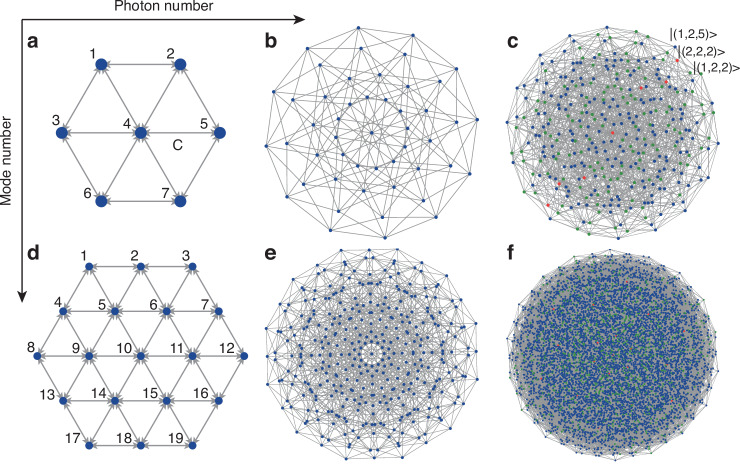
Quantum walks provide a speed-up in computational power for various quantum algorithms and serve as inspiration for the construction of complex graph representations. Many pioneering works have been dedicated to expanding the experimental state space and the complexity of graphs. However, these experiments are mostly limited to small experimental scale, which do not reach a many-body level and fail to reflect the multi-particle quantum interference effects among non-adjacent modes. Here, we present a quantum walk with three photons on a two-dimensional triangular lattice, which is mapped to a 19 × 19 × 19 high-dimensional state space and constructs a complex graph with 6859 nodes and 45,486 edges. By utilizing the statistical signatures of the output combinations and incorporating machine learning techniques, we successfully validate the nonclassical properties of the experiment. Our implementation provides a paradigm for exponentially expanding the state space and graph complexity of quantum walks, paving the way for surmounting the classical regime in large-scale quantum simulations.
Verification finished with gaps
Some checks didn’t finish. The results below cover the steps that did.
- Registry recordVerified
- Full textRead the full text
- Reference list72 references found
- Reference check72 of 72 references checked
- StatisticsRecomputed
- ClaimsDidn’t finish — the rest of the report still applies.
- Cited sourcesDidn’t finish — the rest of the report still applies.
- Self-checkChecked
- VerificationFindings verified
Overview
CoChat Summary
TL;DR
The paper reports a three-photon quantum walk on a 3D integrated photonic chip with a 19-site triangular lattice, mapped to a 19 × 19 × 19 state space and a graph with 6859 nodes and 45,486 edges. Using collision-free and partial bunching events, the authors validate nonclassical correlations via statistical signatures and machine learning.
Key findings
- The three-photon walk constructs a graph with 6859 nodes and 45,486 edges, decomposed into 969 collision-free combinations, 342 two-photon bunching combinations, and 19 three-photon bunching combinations.
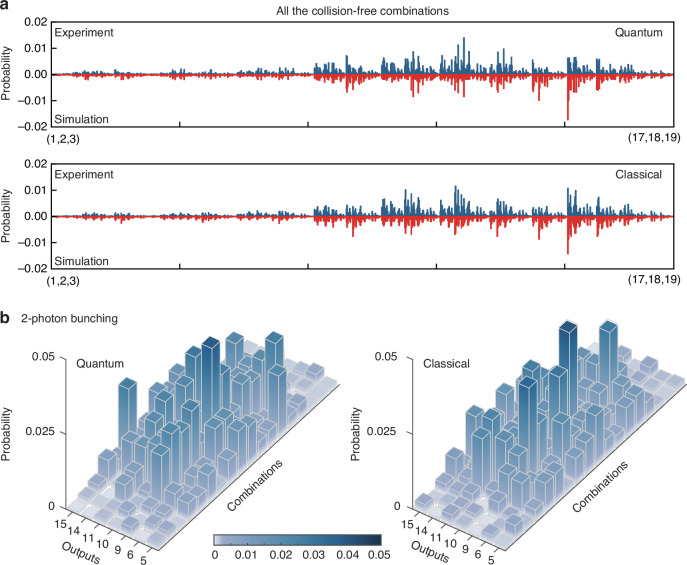
- Complete collision-free combinations were collected in 15 h, with fidelities of 93.42% ± 0.15% for indistinguishable photons and 95.70% ± 0.14% for distinguishable photons; single-photon intensity similarities were 97.50% ± 0.01%, 93.74% ± 0.02%, and 97.00% ± 0.02%.
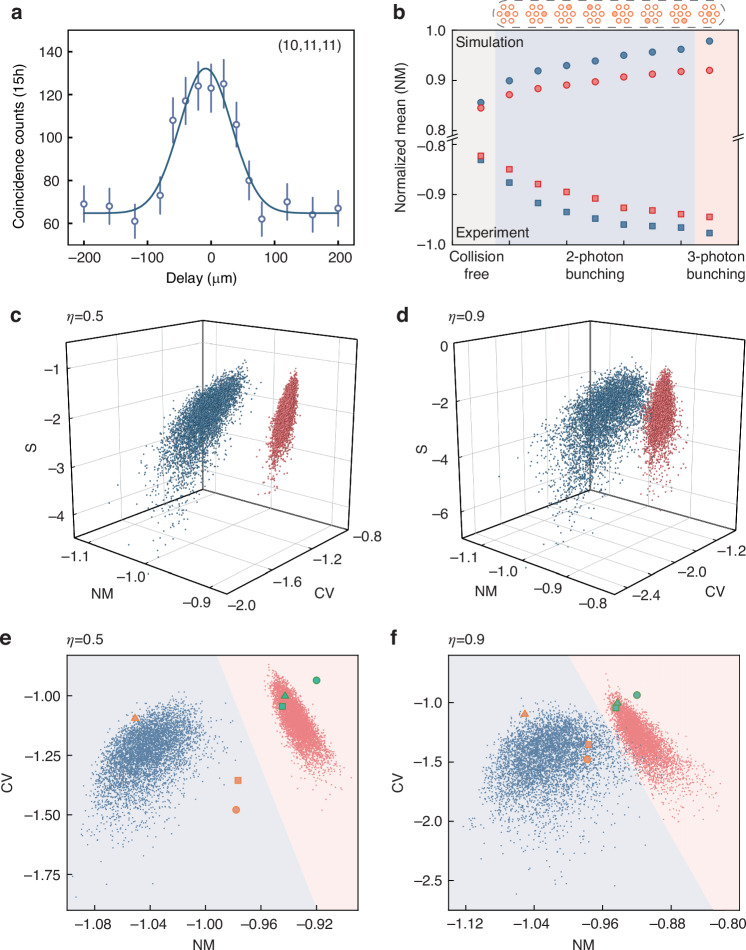
- Two-photon bunching events were measured at first-layer sites 5, 6, 9, 10, 11, 14, 15; the (10,11,11) interference curve peaked nearly twice the distinguishable case. Three-photon bunching at central site 10 after 50 h gave 23 classical counts versus 65 quantum counts.
- Statistical signatures NM, CV, and S, combined with SVM classification, separated quantum from classical behavior; adding partial bunching events created clear separation, and the method remained effective under perturbation ranges η = 0.5 and η = 0.9.
Methods
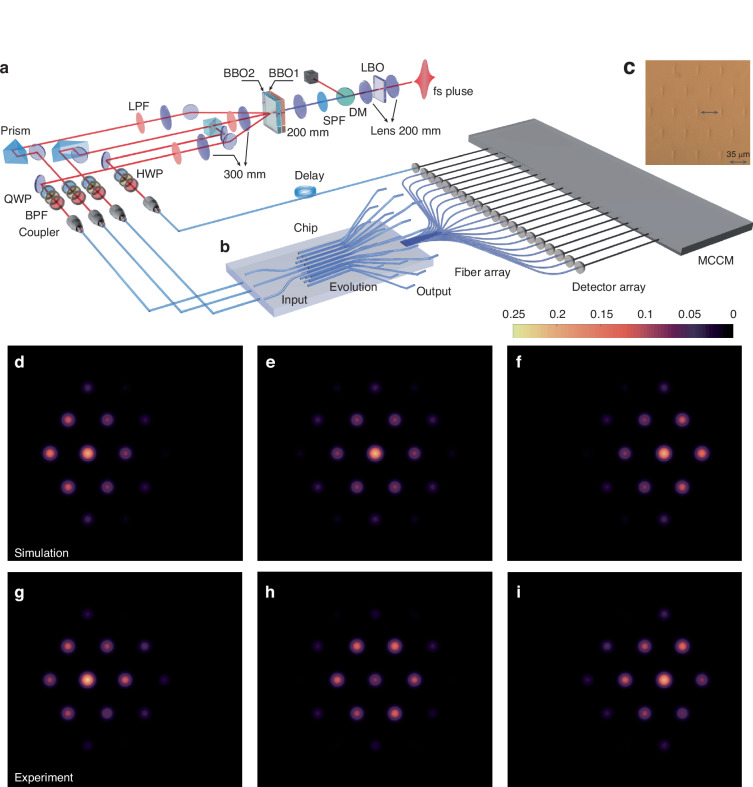
- The 3D photonic chip was fabricated by femtosecond laser direct-writing in borosilicate glass, using 513 nm light at 80 mW and 10 mm s⁻¹, forming a 19-site triangular lattice with 2 mm evolution and site-by-site coupling to a 2D fiber array.
- Three indistinguishable photons were generated via spontaneous parametric down-conversion from two BBO crystals pumped by a frequency-doubled 780 nm femtosecond pulse, injected into the chip, and detected with avalanche photodetectors and a multi-channel coincidence module.
- Analysis used a continuous-time quantum walk Hamiltonian and unitary evolution U = e−iHz, with event probabilities linked to permanents; the authors collected a C-dataset, computed 2-mode correlations and NM/CV/S statistics, simulated 5000 perturbed Hamiltonians, and applied SVM classification.
Limitations
- The paper states that complete measurement of all bunching combinations is challenging due to low count rate and occurrence probability; only partial bunching events were collected—two-photon bunching at the first layer and three-photon bunching at central site 10—so probability distributions alone may not definitively distinguish classical and quantum walks.
- The paper states that fidelity deviations mainly arise from differential losses of varying waveguide bending radii and can be improved by imaging-based large-scale correlation measurement.
- Evident from the text: the experiment is limited to three photons and 19 sites, and the validation relies on partial correlations plus machine learning rather than a full bunching dataset.
Model-written summary. Check it against the paper before relying on it.
Integrity signals
Registry
Cites
Statistics
Figures
Verification
Claims the paper makes
This check didn’t finish.
Self-check
Percentages, sums and reported differences re-computed from the paper’s own numbers.
Each contradiction between two passages listed here was confirmed by an independent check.
Rated minor: it would not touch a result — a value no result rests on, a p-value that stays on the same side of the significance level, or a conflict that is clerical, resolved elsewhere in the paper, or outside its own findings.
In the paper
§ Multi-particle quantum walks on 3D integrated photonic chip > Results > Correlation measurements of the three-photon quantum walks
“The triangle points represent the theoretical values without perturbation, based on the complete correlation matrix”
§ Multi-particle quantum walks on 3D integrated photonic chip > Results > Validation of the quantum features in three-photon quantum walks
“In Fig. 4e, f, we observe correct classification for both theoretical (circle) and experimental (square) results, using the partial correlations shown in Fig. 3.”
Citations
Cites
Quantum Computing in the NISQ era and beyond
Preskill, J. (2018) · Quantum · doi:10.22331/q-2018-08-06-79 · Cited by 8,830
Writing waveguides in glass with a femtosecond laser
Davis, K. M., Miura, K., Sugimoto, N., & Hirao, K. (1996) · Optics Letters · doi:10.1364/ol.21.001729 · Cited by 2,622 · cited 1×
“The triangular lattice in the photonic chip is realized using the femtosecond laser direct-writing technique 55 (see Methods for fabrication details).”
MethodAharonov, Y., Davidovich, L., & Zagury, N. (1993) · Physical Review A · doi:10.1103/physreva.48.1687 · Cited by 1,622
Quantum random walks: An introductory overview
Kempe, J. (2003) · Contemporary Physics · doi:10.1080/00107151031000110776 · Cited by 1,413 · cited 1×
“Classical random walks and Markov chains on graphs have been used as computational frameworks for developing algorithms in mathematics, physics, computer science, and economics 1 .”
MethodQuantum computation and decision trees
Farhi, E., & Gutmann, S. (1998) · Physical Review A · doi:10.1103/physreva.58.915 · Cited by 1,215 · cited 1×
“In contrast to classical random walks, quantum walks (QWs) 2,3 , based on inherent quantum superposition, can be applied to realize quantum algorithms 4 – 8 and facilitate the development of quantum simulation 9 – 11 , quantum transport processes 12 – 14 , quantum random number 15,16 and universal…”
BackgroundEnvironment-assisted quantum walks in photosynthetic energy transfer
Mohseni, M., Rebentrost, P., Lloyd, S., & Aspuru-Guzik, A. (2008) · The Journal of Chemical Physics · doi:10.1063/1.3002335 · Cited by 1,189 · cited 2×
“We only detect a suf fi cient number of coincidence counts at the fi rst layer of the triangular lattice (site 5, 6, 9, 10, 11, 14, 15).”
BackgroundMethodQuantum random-walk search algorithm
Shenvi, N., Kempe, J., & Whaley, K. B. (2003) · Physical Review A · doi:10.1103/physreva.67.052307 · Cited by 1,150 · cited 1×
“…to classical random walks, quantum walks (QWs) 2,3 , based on inherent quantum superposition, can be applied to realize quantum algorithms 4 – 8 and facilitate the development of quantum simulation 9 – 11 , quantum transport processes 12 – 14 , quantum random number 15,16 and universal…”
BackgroundUniversal Computation by Quantum Walk
Childs, A. M. (2009) · Physical Review Letters · doi:10.1103/physrevlett.102.180501 · Cited by 1,002 · cited 1×
“…walks, quantum walks (QWs) 2,3 , based on inherent quantum superposition, can be applied to realize quantum algorithms 4 – 8 and facilitate the development of quantum simulation 9 – 11 , quantum transport processes 12 – 14 , quantum random number 15,16 and universal quantum computation 17,18 .”
BackgroundDephasing-assisted transport: quantum networks and biomolecules
Plenio, M. B., & Huelga, S. F. (2008) · New Journal of Physics · doi:10.1088/1367-2630/10/11/113019 · Cited by 1,002 · cited 3×
“We only detect a suf fi cient number of coincidence counts at the fi rst layer of the triangular lattice (site 5, 6, 9, 10, 11, 14, 15).”
BackgroundMethodQuantum Walks of Correlated Photons
Peruzzo, A., Lobino, M., Matthews, J. C. F., Matsuda, N., Politi, A., Poulios, K., Zhou, X.-Q., Lahini, Y., Ismail, N., Wörhoff, K., et al. (2010) · Science · doi:10.1126/science.1193515 · Cited by 929
Research works printed but not linked: 1
- Walschaers, M. Efficient quantum transport, Ph.D. thesis, Albert-Ludwigs-Universität Freiburg, Freiburg, (2016).
Cited by
Zhong, L., Wang, Y., Han, X., Hu, J., & Qiu, J. (2025) · Chip · doi:10.1016/j.chip.2025.100157 · Cited by 16
Xu, J., Ren, W., Zhang, A., Wang, F., Xu, J., Zhang, G., & Cheng, G. (2025) · Applied Surface Science Advances · doi:10.1016/j.apsadv.2025.100748 · Cited by 9
Recent progress towards large-scale integrated photonic quantum computation
zhu, H., Chen, T., Ma, H., Zhao, Z., Jia, G. U. O., Liang, Q., Tu, Y., He, T., Luo, W., Wang, B., et al. (2026) · npj Nanophotonics · doi:10.1038/s44310-026-00114-8 · Cited by 24
Ruiqi, 王. W., Yuliang, 唐. T., & Li, Y. (2025) · Laser & Optoelectronics Progress · doi:10.3788/lop250995 · Cited by 5
Reservoir engineering for nonreciprocal photon coupling in three-dimensional helical waveguides
Liu, Y., Wang, S., & Lin, L. (2025) · Physical Review A · doi:10.1103/physreva.111.033528 · Cited by 5
Ultrafast Laser-Fabricated Three-Dimensional Photonic Chips Empowering Diverse Applications
Wang, J., Wang, J., Cai, C., Wang, K., & Ding, S. (2026) · IEEE Journal of Selected Topics in Quantum Electronics · doi:10.1109/jstqe.2026.3669125 · Cited by 1
Implementation of Leaking Quantum Walks on a Photonic Processor
Stefanutti, E., Philipps, J., Bütow, J., Guidara, A., Nuvoli, M., Chiuri, A., & Sansoni, L. (2026) · Applied Sciences · doi:10.3390/app16041976 · Cited by 4
A graph-based quantum-inspired approximation of the Feynman path integral
Collignon, B. (2026) · Academia quantum. · doi:10.20935/acadquant8290
Quantum–classical analogy in structured light
Qin, Y., Wang, Z., Liu, Q., & Fu, X. (2026) · Applied Physics Reviews · doi:10.1063/5.0331582 · Cited by 1
Sun, J., & Bian, Z. (2026) · Physical Review A · doi:10.1103/cqgc-yz4r
从经典噪声到量子关联:激光器噪声在量子态制备中的角色与相互达成(特邀)
Ruixin, 李. L., Yajun, 王. W., Long, 田. T., Shaoping, 史. S., Wei, 李. L., Lirong, 陈. C., Desheng, 赵. Z., & Yaohui, 郑. Z. (2026) · Chinese Journal of Lasers · doi:10.3788/cjl251421
Xue, P. (2025) · Elsevier eBooks · doi:10.1016/b978-0-443-33965-3.00003-1
On the Interference of Coherent Photon States and Number Photon States
Suryadi, S. (2024) · IEEE International Conference on Communication, Networks and Satellite (COMNETSAT) · doi:10.1109/comnetsat63286.2024.10861939
Metadata
- Authors
- Zhou, W.-H., Wang, X.-W., Ren, R.-J., Fu, Y.-X., Chang, Y.-J., Xu, X.-Y., Tang, H., & Jin, X.-M.
- Affiliations
- University of Shanghai for Science and Technology (CN)
- Shanghai Jiao Tong University (CN)
- Corresponding author
- Jin, Xian-Min
- Venue
- Light: Science & Applications
- Published
- 2024-10-19
- Volume
- 13
- Issue
- 1
- Pages
- 296-296
- ISSN
- 2047-7538 (ISSN-L)
- PMC
- PMC11489590
- OpenAlex
- W4403525225
- Semantic Scholar
- 9012169b99fa5de2f34353f8640f8e0782970372
- Cited by
- 16
- References
- 83
- Citations by year
- 2026: 10 · 2025: 5 · 2024: 1
- FWCI
- 1.94
- Type
- journal article
- Language
- en
- Open access
- gold
- doi.org
- Licence
- cc-by
- creativecommons.org/licenses/by/4.0 (tdm)
- creativecommons.org/licenses/by/4.0 (vor)
- Locations
- Light Science & Applications (publishedVersion, cc-by)
- PubMed Central (publishedVersion, cc-by)
- PubMed (publishedVersion)
- DOAJ (DOAJ: Directory of Open Access Journals) (submittedVersion)
- Funders
- National Natural Science Foundation of China (11690033, 2017YFA0303700, 61734005, 62235012, 201701, 11904299, 12304342, 11761141014, 12104299)
- China Postdoctoral Science Foundation (2020M671091, 2022T150415, 2021M692094)
- Shanghai Municipal Education Commission (2017‐ 01‐07‐00‐02‐E00049, 20JC1416300, 2019SHZDZX01)
- Science and Technology Commission of Shanghai Municipality (21ZR1432800, 2019SHZ DZX01, 20JC1416300, 22QA1404600)
- Shanghai Jiao Tong University
- Topics
- Physical Sciences › Computer Science › Artificial Intelligence › Quantum Computing Algorithms and Architecture
- Physical Sciences › Physics and Astronomy › Atomic and Molecular Physics, and Optics › Quantum Information and Cryptography
- Physical Sciences › Physics and Astronomy › Atomic and Molecular Physics, and Optics › Quantum Mechanics and Applications
- Keywords
- integrated photonics, triangular lattice, high-dimensional state spaces, quantum simulation
About these checks
Registry, retraction, Cites and statistics results are computed, not judged, with one exception: a printed reference that no index lists is read once by a model before it counts as a citation error. Claims are extracted by a model and kept only when their quote appears verbatim in the text; each cited source is then checked, with a model’s help, for whether it says what the claim relies on. Those verdicts can be wrong — read the claim’s quote and the cited source before relying on one.
Statistics and arithmetic are recomputed, not judged.
Confidence bands are shown only for fields calibrated on our annotated test set. None is calibrated yet, so no band is shown.
What counts as a claim ›How we measure confidence ›How we check this ›
Are you an author, or do you see a problem with this page? Request a review
Data sources
Bibliographic data: Semantic Scholar, OpenAlex, Crossref.
Contains information from the Semantic Scholar Academic Graph Datasets, made available under the ODC Attribution License (ODC-BY 1.0).
Semantic Scholar’s data is described in: Kinney, R., et al. (2023). The Semantic Scholar Open Data Platform. arXiv:2301.10140.
