

Violent aggression predicted by multiple pre-adult environmental hits
Open accessThe DOI matches its Crossref record; 57 of the 57 references it cites were found in a registry or an index.
Abstract
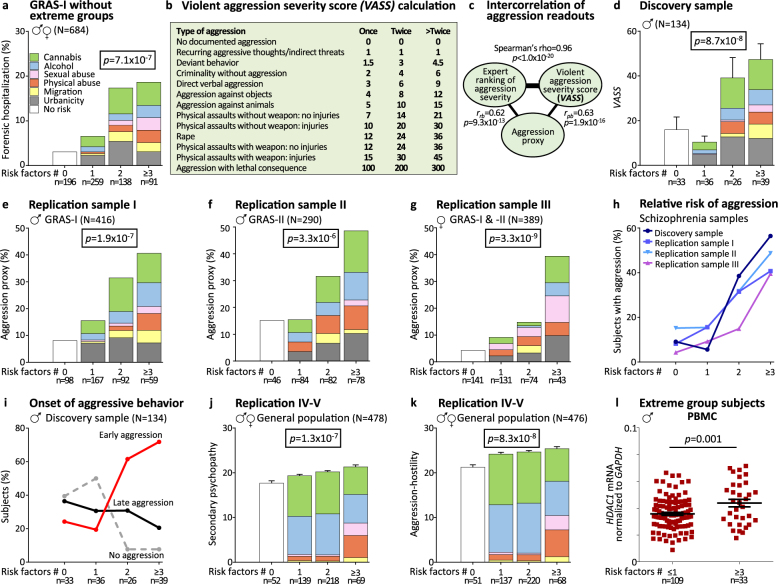
Early exposure to negative environmental impact shapes individual behavior and potentially contributes to any mental disease. We reported previously that accumulated environmental risk markedly decreases age at schizophrenia onset. Follow-up of matched extreme group individuals (≤1 vs. ≥3 risks) unexpectedly revealed that high-risk subjects had >5 times greater probability of forensic hospitalization. In line with longstanding sociological theories, we hypothesized that risk accumulation before adulthood induces violent aggression and criminal conduct, independent of mental illness. We determined in 6 independent cohorts (4 schizophrenia and 2 general population samples) pre-adult risk exposure, comprising urbanicity, migration, physical and sexual abuse as primary, and cannabis or alcohol as secondary hits. All single hits by themselves were marginally associated with higher violent aggression. Most strikingly, however, their accumulation strongly predicted violent aggression (odds ratio 10.5). An epigenome-wide association scan to detect differential methylation of blood-derived DNA of selected extreme group individuals yielded overall negative results. Conversely, determination in peripheral blood mononuclear cells of histone-deacetylase1 mRNA as 'umbrella mediator' of epigenetic processes revealed an increase in the high-risk group, suggesting lasting epigenetic alterations. Together, we provide sound evidence of a disease-independent unfortunate relationship between well-defined pre-adult environmental hits and violent aggression, calling for more efficient prevention.
Overview
The claims and statistics of this paper haven’t been checked yet.
Free: it reads the open-access text and checks the first 5 claims that cite a source we can check. Create a free account to check every claim.
Integrity signals
Registry
Cites
Statistics
Figures
Verification
Claims the paper makes
The claims and statistics of this paper haven’t been checked yet.
Free: it reads the open-access text and checks the first 5 claims that cite a source we can check. Create a free account to check every claim.
Claims other papers make about this one
Each is checked against this paper’s own text: does it say what the citing paper says it does?
In the citing paper
“Behavioural molecular genetics has identified a third susceptibility window, adolescence, during which adverse life experiences affect the risk of anxiety, depression and aggressive behaviour, associated with DNA methylation of specific genes 138 or with alterations in levels of HDAC1 139 .”
From Advances in epigenetics link genetics to the environment and disease (2019) · cites this paper as [139]
Self-check
Percentages, sums and reported differences re-computed from the paper’s own numbers.
The self-check needs the paper’s full text.
Citations
Cites
limma powers differential expression analyses for RNA-sequencing and microarray studies
Ritchie, M. E., Phipson, B., Wu, D., Hu, Y., Law, C. W., Shi, W., & Smyth, G. K. (2015) · Nucleic Acids Research · doi:10.1093/nar/gkv007 · Cited by 40,458
Development and validation of a brief screening version of the Childhood Trauma Questionnaire
Bernstein, D. P., Stein, J. A., Newcomb, M. D., Walker, E., Pogge, D., Ahluvalia, T., Stokes, J., Handelsman, L., Medrano, M., Desmond, D., et al. (2003) · Child Abuse & Neglect · doi:10.1016/s0145-2134(02)00541-0 · Cited by 6,419 · cited 1×
“Physical and sexual abuse was assessed by the shortened version of Childhood Trauma Questionnaire (CTQ) [24] and dichotomously recorded (never/any), as was migration (not born in Spain), alcohol (Alcohol Use Disorders Identification Test - AUDIT ≥ 4) [25] and any cannabis consumption.”
Method(2001) · Cited by 5,455
Aryee, M. J., Jaffe, A. E., Corrada-Bravo, H., Ladd-Acosta, C., Feinberg, A. P., Hansen, K. D., & Irizarry, R. A. (2014) · Bioinformatics · doi:10.1093/bioinformatics/btu049 · Cited by 4,397
Assessing psychopathic attributes in a noninstitutionalized population.
Levenson, M. R., Kiehl, K. A., & Fitzpatrick, C. M. (1995) · Journal of Personality and Social Psychology · doi:10.1037//0022-3514.68.1.151 · Cited by 1,768 · cited 4×
“Since data on criminal conduct could not be obtained in these cohorts, we had to use alternative, psychometrically validated instruments as aggression proxies, namely LSRP secondary psychopathy score [26], measuring rule-breaking and lack of effort towards socially rewarded behavior, and the aggression-hostility facto…”
MethodInfluentialCity living and urban upbringing affect neural social stress processing in humans
Lederbogen, F., Kirsch, P., Haddad, L., Streit, F., Tost, H., Schuch, P., Wüst, S., Pruessner, J. C., Rietschel, M., Deuschle, M., et al. (2011) · Nature · doi:10.1038/nature10190 · Cited by 1,584
Stress Effects on Neuronal Structure: Hippocampus, Amygdala, and Prefrontal Cortex
McEwen, B. S., Nasca, C., & Gray, J. D. (2016) · Neuropsychopharmacology · doi:10.1038/npp.2015.171 · Cited by 1,574 · cited 1×
“The hypothetical biological mechanisms underlying this accumulation effect in humans may range from alterations in neuroendocrine and neurotransmitter systems, neuronal/ synaptic plasticity and neurogenesis to changes in the adaptive immune system and interference with developmental myelination, affecting brain connec…”
BackgroundThe environment and schizophrenia
van Os, J., Kenis, G., & Rutten, B. P. F. (2010) · Nature · doi:10.1038/nature09563 · Cited by 1,572
Read, J., van Os, J., Morrison, A. P., & Ross, C. A. (2005) · Acta Psychiatrica Scandinavica · doi:10.1111/j.1600-0447.2005.00634.x · Cited by 1,534
Rhee, S. H., & Waldman, I. D. (2002) · Psychological Bulletin · doi:10.1037/0033-2909.128.3.490 · Cited by 1,266
Schizophrenia and Violence: Systematic Review and Meta-Analysis
Fazel, S., Gulati, G., Linsell, L., Geddes, J. R., & Grann, M. (2009) · PLoS Medicine · doi:10.1371/journal.pmed.1000120 · Cited by 1,147 · cited 2×
“Effective violence prevention strategies start early and include family-focused and school-based programs [2, 16, 38].”
BackgroundAccounting for cellular heterogeneity is critical in epigenome-wide association studies
Jaffe, A. E., & Irizarry, R. A. (2014) · Genome Biology · doi:10.1186/gb-2014-15-2-r31 · Cited by 1,067 · cited 1×
“Covariates were age, medication and estimated cell proportions (monocytes, granulocytes, CD4T, CD8T, natural killer, and B-cells), calculated using Cell Counts Function in Minfi package [30].”
MethodBiosocial studies of antisocial and violent behavior in children and adults: A review
Raine, A. (2002) · Journal of Abnormal Child Psychology · doi:10.1023/a:1015754122318 · Cited by 824 · cited 1×
“Effective violence prevention strategies start early and include family-focused and school-based programs [2, 16, 38].”
BackgroundParadise lost: the neurobiological and clinical consequences of child abuse and neglect
Nemeroff, C. B. (2016) · Neuron · doi:10.1016/j.neuron.2016.01.019 · Cited by 768 · cited 1×
“The hypothetical biological mechanisms underlying this accumulation effect in humans may range from alterations in neuroendocrine and neurotransmitter systems, neuronal/ synaptic plasticity and neurogenesis to changes in the adaptive immune system and interference with developmental myelination, affecting brain connec…”
BackgroundDEATER–DECKARD, K., DODGE, K. A., BATES, J. E., & PETTIT, G. S. (1998) · Development and Psychopathology · doi:10.1017/s0954579498001709 · Cited by 691 · cited 4×
“The risk factors of the sociological domains seem to be stable predictors over time, to some degree interchangeable, pointing to many pathways leading to the same outcome (principle of equifinality) [41].”
BackgroundInfluentialThe environment and susceptibility to schizophrenia
Brown, A. S. (2011) · Progress in Neurobiology · doi:10.1016/j.pneurobio.2010.09.003 · Cited by 664
Developmental risk factors for youth violence
Herrenkohl, T. I., Maguin, E., Hill, K. G., Hawkins, J. D., Abbott, R. D., & Catalano, R. F. (2000) · Journal of Adolescent Health · doi:10.1016/s1054-139x(99)00065-8 · Cited by 635 · cited 1×
“A full model of the development of conduct problems has been suggested to include at least these 4 domains [41, 43, 44].”
BackgroundCannabis Use and Earlier Onset of Psychosis: A Systematic Meta-analysis
Large, M., Sharma, S., Compton, M. T., Slade, T., & Nielssen, O. (2011) · Archives of General Psychiatry · doi:10.1001/archgenpsychiatry.2011.5 · Cited by 563
Genetic Influences in Criminal Convictions: Evidence from an Adoption Cohort
Mednick, S. A., Gabrielli, W. F., & Hutchings, B. (1984) · Science · doi:10.1126/science.6719119 · Cited by 459
Genetic and environmental architecture on human aggression.
Miles, D. R., & Carey, G. (1997) · Journal of Personality and Social Psychology · doi:10.1037/0022-3514.72.1.207 · Cited by 414
Cognitive and neurobiological mechanisms of alcohol-related aggression
Heinz, A. J., Beck, A., Meyer-Lindenberg, A., Sterzer, P., & Heinz, A. (2011) · Nature Reviews Neuroscience · doi:10.1038/nrn3042 · Cited by 368
Gender and the development of conduct disorder
Zoccolillo, M. (1993) · Development and Psychopathology · doi:10.1017/s0954579400004260 · Cited by 361 · cited 1×
“In fact, the etiology of externalizing behavior problems is similar for girls and boys [41, 52], as is the consequence of risk accumulation in the present study for males and females.”
BackgroundViolence in the United States: Status, Challenges, and Opportunities
Sumner, S. A., Mercy, J. A., Dahlberg, L. L., Hillis, S. D., Klevens, J., & Houry, D. (2015) · JAMA · doi:10.1001/jama.2015.8371 · Cited by 291 · cited 1×
“Effective violence prevention strategies start early and include family-focused and school-based programs [2, 16, 38].”
BackgroundThe Prediction of Violence and Homicide in Young Men.
Loeber, R., Pardini, D., Homish, D. L., Wei, E. H., Crawford, A. M., Farrington, D. P., Stouthamer-Loeber, M., Creemers, J., Koehler, S. A., & Rosenfeld, R. (2005) · Journal of Consulting and Clinical Psychology · doi:10.1037/0022-006x.73.6.1074 · Cited by 285 · cited 1×
“A full model of the development of conduct problems has been suggested to include at least these 4 domains [41, 43, 44].”
BackgroundThe heritability of antisocial behavior: A meta-analysis of twin and adoption studies
Mason, D. A., & Frick, P. J. (1994) · Journal of Psychopathology and Behavioral Assessment · doi:10.1007/bf02239409 · Cited by 241
Galanter, J. M., Gignoux, C. R., Oh, S. S., Torgerson, D., Pino-Yanes, M., Thakur, N., Eng, C., Hu, D., Huntsman, S., Farber, H. J., et al. (2017) · eLife · doi:10.7554/elife.20532 · Cited by 237
Coccaro, E. F., Bergeman, C. S., Kavoussi, R. J., & Seroczynski, A. D. (1997) · Biological Psychiatry · doi:10.1016/s0006-3223(96)00257-0 · Cited by 222
Tsai, P.-C., & Bell, J. T. (2015) · International Journal of Epidemiology · doi:10.1093/ije/dyv041 · Cited by 218 · cited 2×
“Our approach to detect methylation changes in blood using an epigenome-wide association scan was unsuccessful despite matched extreme group comparison, likely due to the small sample size (although in the suggested range [32]), and perhaps the etiological/pathogenetic complexity of accumulated risks.”
BackgroundMethodBiological and genetic contributors to violence: Widom's untold tale.
DiLalla, L. F., & Gottesman, I. I. (1991) · Psychological Bulletin · doi:10.1037//0033-2909.109.1.125 · Cited by 209 · cited 1×
“Heritability of aggression, estimated from twin studies, reaches > 60% [50, 51].”
BackgroundMcMahon, R. J. (1994) · Journal of Consulting and Clinical Psychology · doi:10.1037//0022-006x.62.5.901 · Cited by 197 · cited 1×
“In the psychosociological literature, the so-called externalizing behavior in childhood includes hostile and aggressive physical behavior toward others, impulsivity, hyperactivity, and noncompliance with limit-setting [41, 42].”
BackgroundEarly-life stress mediated modulation of adult neurogenesis and behavior
Korosi, A., Naninck, E. F. G., Oomen, C. A., Schouten, M., Krugers, H., Fitzsimons, C., & Lucassen, P. J. (2012) · Behavioural Brain Research · doi:10.1016/j.bbr.2011.07.037 · Cited by 194 · cited 1×
“The hypothetical biological mechanisms underlying this accumulation effect in humans may range from alterations in neuroendocrine and neurotransmitter systems, neuronal/ synaptic plasticity and neurogenesis to changes in the adaptive immune system and interference with developmental myelination, affecting brain connec…”
BackgroundAluja, A., Rossier, J., García, L. F., Angleitner, A., Kuhlman, M. B., & Zuckerman, M. (2006) · Personality and Individual Differences · doi:10.1016/j.paid.2006.03.001 · Cited by 190 · cited 3×
“Since data on criminal conduct could not be obtained in these cohorts, we had to use alternative, psychometrically validated instruments as aggression proxies, namely LSRP secondary psychopathy score [26], measuring rule-breaking and lack of effort towards socially rewarded behavior, and the aggression-hostility facto…”
MethodGalanter, J., Gignoux, C., Oh, S. S., Torgerson, D., Pino-Yanes, M., Thakur, N., Eng, C., Hu, D., Huntsman, S., Farber, H., et al. (2016) · bioRxiv · doi:10.1101/036822 · Cited by 185 · cited 1×
“Hits associated with migration were likely related to ethnicity rather than environmental risk, as reported recently [31].”
The neurobiological basis of human aggression: A review on genetic and epigenetic mechanisms
Waltes, R., Chiocchetti, A. G., & Freitag, C. M. (2016) · American Journal of Medical Genetics Part B: Neuropsychiatric Genetics · doi:10.1002/ajmg.b.32388 · Cited by 182
Orlovska, S., Pedersen, M. S., Benros, M. E., Mortensen, P. B., Agerbo, E., & Nordentoft, M. (2014) · American Journal of Psychiatry · doi:10.1176/appi.ajp.2013.13020190 · Cited by 165
Early and late environmental risk factors for schizophrenia
McDonald, C. (2000) · Brain Research Reviews · doi:10.1016/s0165-0173(99)00030-2 · Cited by 158
Myelination and Oligodendrocyte Functions in Psychiatric Diseases
Nave, K.-A., & Ehrenreich, H. (2014) · JAMA Psychiatry · doi:10.1001/jamapsychiatry.2014.189 · Cited by 157 · cited 1×
“The hypothetical biological mechanisms underlying this accumulation effect in humans may range from alterations in neuroendocrine and neurotransmitter systems, neuronal/ synaptic plasticity and neurogenesis to changes in the adaptive immune system and interference with developmental myelination, affecting brain connec…”
BackgroundSelf-citationStepniak, B., Papiol, S., Hammer, C., Ramin, A., EVERTS, S., Hennig, L., Begemann, M., & Ehrenreich, H. (2014) · The Lancet Psychiatry · doi:10.1016/s2215-0366(14)70379-7 · Cited by 138 · cited 22×
“accumulation of environmental risks leads to a nearly 10year earlier schizophrenia onset, demonstrating the substantial impact of the environment on mental disease, which by far outlasted any common genetic effects [18].”
BackgroundMethodResultSelf-citationAlcohol-related aggression during the college years: theories, risk factors and policy implications.
Giancola, P. R. (2002) · Journal of Studies on Alcohol, Supplement · doi:10.15288/jsas.2002.s14.129 · Cited by 132
Distinct Epigenetic Effects of Tobacco Smoking in Whole Blood and among Leukocyte Subtypes
Su, D., Wang, X., Campbell, M. R., Porter, D. K., Pittman, G. S., Bennett, B. D., Wan, M., Englert, N. A., Crowl, C. L., Gimple, R. N., et al. (2016) · PLOS ONE · doi:10.1371/journal.pone.0166486 · Cited by 125
Predicting violence in schizophrenia: a prospective study
Walsh, E., Gilvarry, C. M., Samele, C., Harvey, K., Manley, C., Tattan, T., Tyrer, P. J., Creed, F. H., Murray, R. M., & Fahy, T. A. (2003) · Schizophrenia Research · doi:10.1016/s0920-9964(03)00091-4 · Cited by 124
Stoddard, S. A., Whiteside, L., Zimmerman, M. A., Cunningham, R. M., Chermack, S. T., & Walton, M. A. (2012) · American Journal of Community Psychology · doi:10.1007/s10464-012-9541-7 · Cited by 116
HDAC1 links early life stress to schizophrenia-like phenotypes
Bahari-Javan, S., Varbanov, H., Halder, R., Benito, E., Kaurani, L., Burkhardt, S., Anderson-Schmidt, H., Anghelescu, I., Budde, M., Stilling, R. M., et al. (2017) · Proceedings of the National Academy of Sciences · doi:10.1073/pnas.1613842114 · Cited by 101
van der Laan, A. M., Veenstra, R., Bogaerts, S., Verhulst, F. C., & Ormel, J. (2010) · Journal of Abnormal Child Psychology · doi:10.1007/s10802-009-9368-3 · Cited by 98
Modification of Cognitive Performance in Schizophrenia by Complexin 2 Gene Polymorphisms
Begemann, M., Grube, S., Papiol, S., Malzahn, D., Krampe, H., Ribbe, K., Friedrichs, H., Radyushkin, K. A., El-Kordi, A., Benseler, F., et al. (2010) · Archives of General Psychiatry · doi:10.1001/archgenpsychiatry.2010.107 · Cited by 94 · cited 7×
“The GRAS data collection contains comprehensive information regarding sociodemographic and disease-related parameters, acquired through detailed examination, semistructured interviews, telephone consultations, questionnaires, and complete collection of hospitalization letters, allowing meticulous double-checking of pa…”
BackgroundMethodSelf-citationGunter, T. D., Vaughn, M. G., & Philibert, R. A. (2010) · Behavioral Sciences & the Law · doi:10.1002/bsl.923 · Cited by 86
Triggers for Violent Criminality in Patients With Psychotic Disorders
Sariaslan, A., Lichtenstein, P., Larsson, H., & Fazel, S. (2016) · JAMA Psychiatry · doi:10.1001/jamapsychiatry.2016.1349 · Cited by 81 · cited 1×
“Adverse experiences in adulthood, like exposure to violence, traumatic brain injury, or substance intoxication, can act as single triggers to increase the short-term risk of violence in mentally ill individuals as much as in control subjects [16, 17].”
BackgroundKolla, N. J., Matthews, B. A., Wilson, A. A., Houle, S., Bagby, R. M., Links, P. S., Simpson, A. I. F., Hussain, A., & Meyer, J. H. (2015) · Neuropsychopharmacology · doi:10.1038/npp.2015.106 · Cited by 78
Ribbe, K., Friedrichs, H., Begemann, M., Grube, S., Papiol, S., Kästner, A., Gerchen, M. F., Ackermann, V., Tarami, A., Treitz, A., et al. (2010) · BMC Psychiatry · doi:10.1186/1471-244x-10-91 · Cited by 61 · cited 5×
“The GRAS data collection contains comprehensive information regarding sociodemographic and disease-related parameters, acquired through detailed examination, semistructured interviews, telephone consultations, questionnaires, and complete collection of hospitalization letters, allowing meticulous double-checking of pa…”
BackgroundMethodSelf-citationAssessing the Five Factors of Personality in Adolescents: The Junior Version of the Spanish NEO-PI-R
Ortet, G., Ibáñez, M. I., Moya-Higueras, J., Villa, H., Viruela, A. M., & Mezquita, L. (2011) · Assessment · doi:10.1177/1073191111410166 · Cited by 51
Self-citationA forensic neuropsychiatric approach to traumatic brain injury, aggression, and suicide.
Wortzel, H. S., & Arciniegas, D. B. (2013) · PubMed · Cited by 48
Ribbe, K. (2011) · Archives of General Psychiatry · doi:10.1001/archgenpsychiatry.2011.100 · Cited by 34 · cited 1×
“Each patient was dichotomously classified as having/not having been exposed premorbid and until age 18 years to severe physical abuse (comprising unpredictability of violence, injury due to physical reprimand or objects for corporal punishment), sexual abuse (forced touches, kissing, attempted or real rape), migration…”
BackgroundCannabis Use and Earlier Onset of Psychosis
Meta-analysis, A. S., Sharma, S. K., Compton, M. T., Slade, T. N., & Nielssen, O. B. (2011) · Cited by 29
Alemany, S., Moya-Higueras, J., Ibáñez, M. I., Villa, H., Mezquita, L., Ortet, G., Gastó, C., Fañanás, L., & Arias, B. (2015) · Psychological Medicine · doi:10.1017/s0033291715001695 · Cited by 24 · cited 1×
“Ethical approval was obtained from University Ethics Committees; participants provided written informed consent [21, 22].”
MethodSelf-citationOTTO: a new strategy to extract mental disease-relevant combinations of GWAS hits from individuals
Ehrenreich, H., Mitjans, M., der Auwera, S. V., Centeno, T. P., Begemann, M., Grabe, H. J., Bonn, S., & Nave, K. (2016) · Molecular Psychiatry · doi:10.1038/mp.2016.208 · Cited by 23 · cited 15×
“The GRAS data collection contains comprehensive information regarding sociodemographic and disease-related parameters, acquired through detailed examination, semistructured interviews, telephone consultations, questionnaires, and complete collection of hospitalization letters, allowing meticulous double-checking of pa…”
ResultSelf-citationMental Illness, Release From Prison, and Social Context
Swanson, J. W. (2016) · JAMA · doi:10.1001/jama.2016.12434 · Cited by 18
Ehrenreich, H. (2017) · EMBO Reports · doi:10.15252/embr.201744197 · Cited by 14 · cited 1×
“As a novel concept, scientific efforts on ‘phenotyping of the environment’ [11] should be promoted to achieve more fundamental risk estimation and more effective prevention in the future.”
BackgroundSelf-citation
Research works printed but not linked: 1
- Plomin R DeFries JC Knopik VS Neiderhiser J Behavioral genetics 2013 6th ed New York, NY Worth Publishers
Cited by
Advances in epigenetics link genetics to the environment and disease
Cavalli, G., & Heard, E. (2019) · Nature · doi:10.1038/s41586-019-1411-0 · Cited by 1,509
A microRNA signature that correlates with cognition and is a target against cognitive decline
Islam, M. R., Kaurani, L., Berulava, T., Heilbronner, U., Budde, M., Centeno, T. P., Elerdashvili, V., Zafieriou, M., Benito, E., Sertel, S. M., et al. (2021) · EMBO Molecular Medicine · doi:10.15252/emmm.202013659 · Cited by 74
Self-citationvan Dongen, J., Hagenbeek, F. A., Suderman, M. J., Roetman, P. J., Sugden, K., Chiocchetti, A. G., Ismail, K., Mulder, R. H., Hafferty, J. D., Adams, M. J., et al. (2021) · Molecular Psychiatry · doi:10.1038/s41380-020-00987-x · Cited by 44
“Small-scale studies (maximum sample size= 260) have provided some evidence that DNA methylation differences in blood, cord blood, and buccal cells are associated with severe forms of aggressive behavior and related problems in children and adults, including (chronic) physical aggression and early onset conduct problem…”
Integrative Multi-omics Analysis of Childhood Aggressive Behavior
Hagenbeek, F. A., van Dongen, J., Pool, R., Roetman, P. J., Harms, A. C., Hottenga, J., Kluft, C., Colins, O. F., van Beijsterveldt, C. E. M., Fanos, V., et al. (2022) · Behavior Genetics · doi:10.1007/s10519-022-10126-7 · Cited by 28
Epigenome-wide DNA methylation in externalizing behaviours: A review and combined analysis
Meijer, M., Franke, B., Sandi, C., & Klein, M. (2022) · Neuroscience & Biobehavioral Reviews · doi:10.1016/j.neubiorev.2022.104997 · Cited by 25
Metadata
- Authors
- Mitjans, M., Seidel, J., Begemann, M., Bockhop, F., Moya-Higueras, J., Bansal, V., Wesolowski, J., Seelbach, A., Ibáñez, M. I., Kovacevic, F., Duvar, O., Fañanás, L., Wolf, H.-U., Ortet, G., Zwanzger, P., Klein, V., Lange, I., Tänzer, A., Dudeck, M., Penke, L., van Elst, L. T., Bittner, R. A., Schmidmeier, R., Freese, R., Müller-Isberner, R., Wiltfang, J., Bliesener, T., Bonn, S., Poustka, L., Müller, J. L., Arias, B., & Ehrenreich, H.
- Affiliations
- Instituto de Salud Carlos III (ES)
- Max Planck Institute of Experimental Medicine (DE)
- Universität Hamburg (DE)
- Universitat Jaume I (ES)
- Inn-Salzach-Klinikum (DE)
- Universität Ulm (DE)
- University of Göttingen (DE)
- Goethe University Frankfurt (DE)
- Vitos (DE)
- Criminological Research Institute of Lower Saxony (DE)
- Nanoscale Microscopy and Molecular Physiology of the Brain Cluster of Excellence 171 — DFG Research Center 103 (DE)
- Corresponding author
- Arias, Bárbara
- Ehrenreich, Hannelore
- ORCID
- Mitjans, Marina
- Begemann, Martin
- Bockhop, Fabian
- Bansal, Vikas
- Seelbach, Anna
- Ibáñez, Manuel Ignacio
- Fañanás, Lourdes
- Ortet, Generós
- Zwanzger, Peter
- Klein, Verena
- Dudeck, Manuela
- Penke, Lars
- Bittner, Robert A.
- Wiltfang, Jens
- Bliesener, Thomas
- Bonn, Stefan
- Poustka, Luise
- Müller, Jürgen L.
- Arias, Bárbara
- Ehrenreich, Hannelore
- Venue
- Molecular Psychiatry
- Published
- 2018-05-24
- Volume
- 24
- Issue
- 10
- Pages
- 1549-1564
- ISSN
- 1359-4184 (ISSN-L)
- 1476-5578
- PMC
- PMC6756097
- OpenAlex
- W2804215560
- Cited by
- 29
- References
- 57
- Citations by year
- 2025: 4 · 2023: 1 · 2022: 7 · 2021: 6 · 2020: 7 · 2019: 3 · 2018: 1
- FWCI
- 4.98
- Type
- journal article
- Language
- en
- Open access
- hybrid
- doi.org
- Licence
- cc-by
- creativecommons.org/licenses/by/4.0 (tdm)
- Locations
- Molecular Psychiatry (publishedVersion, cc-by)
- PubMed Central (publishedVersion, cc-by)
- PubMed (publishedVersion)
- LA Referencia (Red Federada de Repositorios Institucionales de Publicaciones Científicas) (publishedVersion, cc-by)
- LA Referencia (Red Federada de Repositorios Institucionales de Publicaciones Científicas) (publishedVersion, other-oa)
- Repositori ObertUDL (University of Lleida) (publishedVersion, other-oa)
- Dipòsit Digital de la Universitat de Barcelona (Universitat de Barcelona) (submittedVersion, cc-by)
- LA Referencia (Red Federada de Repositorios Institucionales de Publicaciones Científicas) (submittedVersion, cc-by)
- Max Planck Digital Library (submittedVersion, other-oa)
- GoeScholar The Publication Server of the Georg-August-Universität Göttingen (Georg-August-Universität Göttingen) (submittedVersion, cc-by)
- GRO (submittedVersion, cc-by)
- MPG.PuRe (Max Planck Society) (submittedVersion, cc-by)
- RECERCAT (Consorci de Serveis Universitaris de Catalunya) (submittedVersion, cc-by)
- Repositori UJI (Universitat Jaume I) (submittedVersion, cc-by-sa)
- Funders
- Autism Speaks
- European Federation of Pharmaceutical Industries and Associations (FP7/20072013)
- Max-Planck-Förderstiftung
- European Commission (EU-FP7, 2007–2013, FP7 2007-2013, 115300, PI16/00998, FP7/2007)
- Deutsche Forschungsgemeinschaft (FP7/2007–2013)
- Departament d'Innovació, Universitats i Empresa, Generalitat de Catalunya
- Ministerio de Economía y Competitividad (PI16/)
- Max-Planck-Gesellschaft
- Centro de Investigación Biomédica en Red de Salud Mental
- Innovative Medicines Initiative (FP7/2007‐2013, 115300)
- Instituto de Salud Carlos III (PI16/, PI16/00998, FP7/2007-2013)
- Topics
- Social Sciences › Psychology › Clinical Psychology › Psychopathy, Forensic Psychiatry, Sexual Offending
- Health Sciences › Medicine › Psychiatry and Mental health › Schizophrenia research and treatment
- Social Sciences › Psychology › Clinical Psychology › Child Abuse and Trauma
- Keywords
- risk accumulation, schizophrenia, urbanicity, migration, physical abuse, sexual abuse, cannabis use, alcohol consumption, criminal behavior, HDAC1, epigenetic modifications, DNA methylation
- MeSH terms
- Exposure to Violence, Adverse Childhood Experiences, Adolescent, Adult, Aggression, Female, Humans, Male, Risk Factors, Schizophrenia, Violence, Odds Ratio, Epigenesis, Genetic, Histone Deacetylase 1
About these checks
Registry, retraction, Cites and statistics results are computed, not judged, with one exception: a printed reference that no index lists is read once by a model before it counts as a citation error. Claims are extracted by a model and kept only when their quote appears verbatim in the text; each cited source is then checked, with a model’s help, for whether it says what the claim relies on. Those verdicts can be wrong — read the claim’s quote and the cited source before relying on one.
Statistics and arithmetic are recomputed, not judged.
Confidence bands are shown only for fields calibrated on our annotated test set. None is calibrated yet, so no band is shown.
What counts as a claim ›How we measure confidence ›How we check this ›
Are you an author, or do you see a problem with this page? Request a review
Data sources
Bibliographic data: Semantic Scholar, OpenAlex, Crossref.
Contains information from the Semantic Scholar Academic Graph Datasets, made available under the ODC Attribution License (ODC-BY 1.0).
Semantic Scholar’s data is described in: Kinney, R., et al. (2023). The Semantic Scholar Open Data Platform. arXiv:2301.10140.
