

The DOI matches its Crossref record; 66 of the 68 references it cites were found in a registry or an index.
Persistent depressive symptoms, HPA-axis hyperactivity, and inflammation: the role of cognitive-affective and somatic symptoms
Open accessAbstract
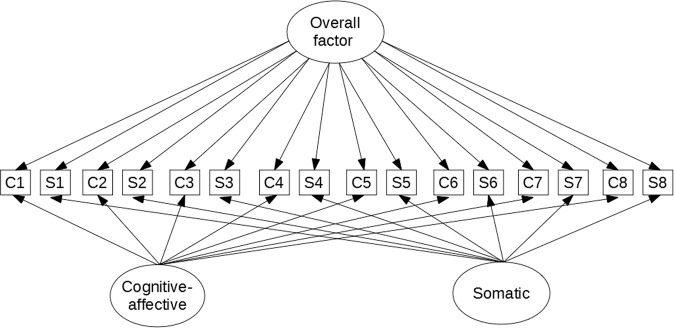
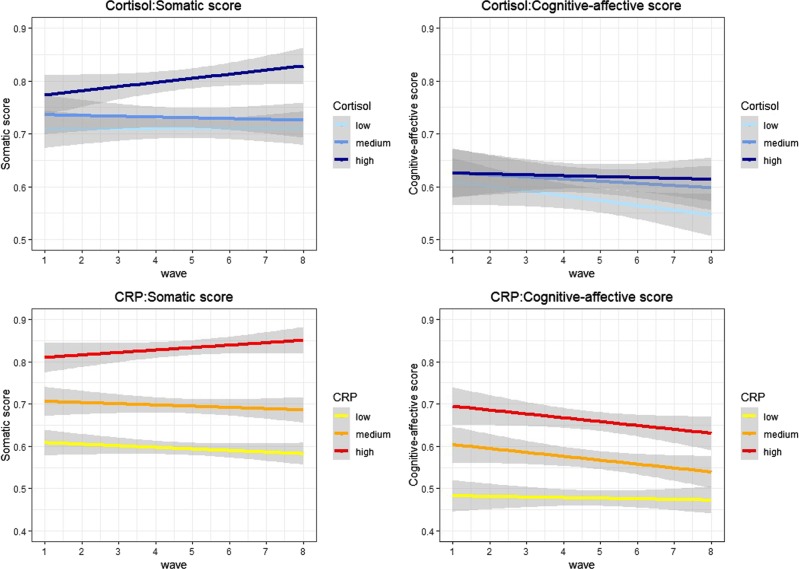
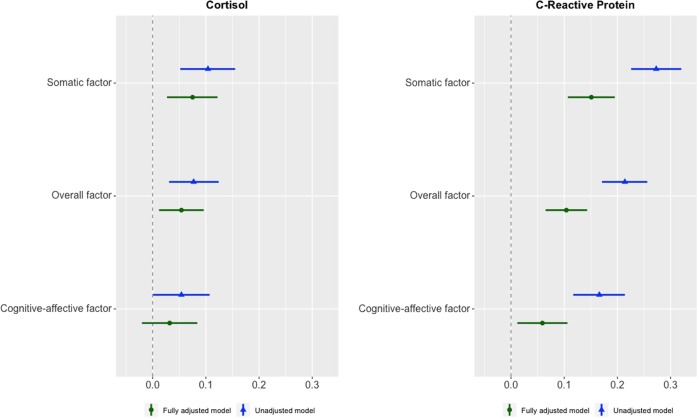
Hypothalamic-pituitary-adrenal (HPA)-axis hyperactivity and inflammation are thought to be prominent in the aetiology of depression. Although meta-analyses have confirmed this relationship, there is considerable variability in the effect sizes across studies. This could be attributed to a differential role of such biological systems in somatic versus cognitive-affective depressive symptoms which remains largely unexplored. Furthermore, most longitudinal research to date has focused on transient rather than persistent depressive symptoms. In the current study, we investigated the associations of hair cortisol and plasma C-reactive protein (CRP) with the longitudinal persistence and dimensions (cognitive-affective versus somatic) of depressive symptoms over a 14-year period using Trait‐State‐Occasion (TSO) structural equation modelling. The data came from a large sample of older adults from the English Longitudinal Study of Ageing. Depressive symptoms were assessed from wave 1 (2002–03) to wave 8 (2016–17). Hair cortisol (N = 4761) and plasma CRP (N = 5784) were measured in wave 6 (2012–13). Covariates included demographic, socioeconomic, lifestyle, chronic disease, and medication data. Our results revealed that higher cortisol and CRP levels were significantly associated with persistent depressive symptoms across the study period. Notably, both biomarkers exhibited stronger relationships with somatic than with cognitive-affective symptoms. The associations with somatic symptoms were also independent of relevant confounding factors. In contrast, their associations with cognitive-affective symptoms were weak after adjustment for all covariates. These distinct associations reveal the importance of considering symptom-specific effects in future studies on pathophysiological mechanisms. Ultimately, this will have the potential to advance the search for biomarkers of depression and facilitate more targeted treatments.
Overview
The claims and statistics of this paper haven’t been checked yet.
Run the check — free, no account needed. It reads the open-access text and checks the sources it cites.
Integrity signals
Registry
Cites
Statistics
Figures
Verification
Claims the paper makes
The claims and statistics of this paper haven’t been checked yet.
Run the check — free, no account needed. It reads the open-access text and checks the sources it cites.
Claims other papers make about this one
Each is checked against this paper’s own text: does it say what the citing paper says it does?
The cited source says what the claim attributes to it.
In the citing paper
“increased levels of hair cortisol were predictive of MDD somatic symptoms.”
From Comorbidity between major depressive disorder and physical diseases: a comprehensive review of epidemiology, mechanisms and management (2023) · cites this paper as [200]
Self-check
Percentages, sums and reported differences re-computed from the paper’s own numbers.
The self-check needs the paper’s full text.
Citations
Cites
Diagnostic and Statistical Manual of Mental Disorders
American Psychiatric Association (2013) · doi:10.1176/appi.books.9780890425596 · Cited by 116,369
The CES-D Scale: A Self-Report Depression Scale for Research in the General Population
Radloff, L. S. (1977) · Applied Psychological Measurement · doi:10.1177/014662167700100306 · Cited by 53,267
Molecular Mechanisms of Depression: Perspectives on New Treatment Strategies
Lang, U. E., & Borgwardt, S. (2013) · Cellular Physiology and Biochemistry · doi:10.1159/000350094 · Cited by 8,526
From inflammation to sickness and depression: when the immune system subjugates the brain
Dantzer, R., O'Connor, J. C., Freund, G. G., Johnson, R. W., & Kelley, K. W. (2008) · Nature Reviews Neuroscience · doi:10.1038/nrn2297 · Cited by 7,395
Physiology and neurobiology of stress and adaptation: central role of the brain
McEwen, B. S. (2007) · Physiological Reviews · doi:10.1152/physrev.00041.2006 · Cited by 5,429
Screening for Depression in Well Older Adults: Evaluation of a Short Form of the CES-D
Andresen, E. M., Malmgren, J. A., Carter, W. B., & Patrick, D. L. (1994) · American Journal of Preventive Medicine · doi:10.1016/s0749-3797(18)30622-6 · Cited by 5,403
A Meta-Analysis of Cytokines in Major Depression
Dowlati, Y., Herrmann, N., Swardfager, W., Liu, H., Sham, L., Reim, E. K., & Lanctôt, K. L. (2010) · Biological Psychiatry · doi:10.1016/j.biopsych.2009.09.033 · Cited by 4,729
Andresen, E. M., Malmgren, J. A., Carter, W. B., & Patrick, D. L. (1994) · PubMed · Cited by 4,426
Malhi, G. S., & Mann, J. J. (2018) · The Lancet · doi:10.1016/s0140-6736(18)31948-2 · Cited by 4,099
Inflammation and Its Discontents: The Role of Cytokines in the Pathophysiology of Major Depression
Miller, A. H., Maletic, V., & Raison, C. L. (2009) · Biological Psychiatry · doi:10.1016/j.biopsych.2008.11.029 · Cited by 3,848
Research works printed but not linked: 2
- Radloff LS. The CES-D scale: a self-report depression scale for research in the general population. Appl Psychol Meas. 1977;1:385–401. · DOI · Paper page
- NatCen Social Research. English longitudinal study of ageing (ELSA): user guide to the nurse visit datasets. Waves 2, 4, 6, 8. 2018.
Cited by
Sorted by citations
Berk, M., Köhler‐Forsberg, O., Turner, M., Penninx, B. W. J. H., Wrobel, A., Firth, J., Loughman, A., Reavley, N. J., McGrath, J. J., Momen, N. C., et al. (2023) · World Psychiatry · doi:10.1002/wps.21110 · Cited by 336
Psychological comorbidity in gastrointestinal diseases: Update on the brain-gut-microbiome axis
Person, H., & Keefer, L. (2021) · Progress in Neuro-Psychopharmacology and Biological Psychiatry · doi:10.1016/j.pnpbp.2020.110209 · Cited by 158
The social ecology of childhood and early life adversity
Lopez, M., Ruiz, M. O., Rovnaghi, C. R., Tam, G. K.-Y., Hiscox, J., Gotlib, I. H., Barr, D. A., Carrión, V. G., & Anand, K. J. S. (2021) · Pediatric Research · doi:10.1038/s41390-020-01264-x · Cited by 200
Johnson, D., Thurairajasingam, S., Letchumanan, V., Chan, K., & Lee, L. (2021) · Nutrients · doi:10.3390/nu13051728 · Cited by 117
Biomarkers of post-covid depression
Lorkiewicz, P., & Waszkiewicz, N. (2021) · Journal of Clinical Medicine · doi:10.3390/jcm10184142 · Cited by 102
Metadata
- Authors
- Iob, E., Kirschbaum, C., & Steptoe, A.
- Affiliations
- University College London (GB)
- Technische Universität Dresden (DE)
- Corresponding author
- Iob, Eleonora
- Venue
- Molecular Psychiatry
- Published
- 2019-08-21
- Volume
- 25
- Issue
- 5
- Pages
- 1130-1140
- ISSN
- 1359-4184 (ISSN-L)
- 1476-5578
- PMC
- PMC7192852
- OpenAlex
- W2969829094
- Cited by
- 305
- References
- 68
- Citations by year
- 2026: 47 · 2025: 65 · 2024: 44 · 2023: 37 · 2022: 45 · 2021: 37 · 2020: 29 · 2019: 1
- FWCI
- 18.29
- Type
- journal article
- Language
- en
- Open access
- hybrid
- doi.org
- Locations
- Molecular Psychiatry (publishedVersion, cc-by)
- PubMed Central (publishedVersion, cc-by)
- PubMed (publishedVersion)
- Research Portal (King's College London) (publishedVersion, other-oa)
- UCL Discovery (University College London) (submittedVersion)
- Funders
- RCUK | Economic and Social Research Council (ES/P000347/1)
- Topics
- Life Sciences › Neuroscience › Behavioral Neuroscience › Stress Responses and Cortisol
- Life Sciences › Neuroscience › Biological Psychiatry › Tryptophan and brain disorders
- Social Sciences › Psychology › Experimental and Cognitive Psychology › Anxiety, Depression, Psychometrics, Treatment, Cognitive Processes
- Keywords
- persistent depressive symptoms, HPA axis hyperactivity, inflammation, hair cortisol, C-reactive protein, somatic depressive symptoms, older adults, depression pathophysiology, depression biomarkers, chronic stress
- MeSH terms
- Affect, Aged, C-Reactive Protein, Cognition, Depression, Female, Hair, Humans, Hydrocortisone, Hypothalamo-Hypophyseal System, Inflammation, Longitudinal Studies, Male
About these checks
Registry, retraction, Cites and statistics results are computed, not judged, with one exception: a printed reference that no index lists is read once by a model before it counts as a citation error. Claims are extracted by a model and kept only when their quote appears verbatim in the text; each cited source is then checked, with a model’s help, for whether it says what the claim relies on. Those verdicts can be wrong — read the claim’s quote and the cited source before relying on one.
Statistics and arithmetic are recomputed, not judged.
Confidence bands are shown only for fields calibrated on our annotated test set. None is calibrated yet, so no band is shown.
What counts as a claim ›How we measure confidence ›How we check this ›
Are you an author, or do you see a problem with this page? Request a review
