

Multi-ancestry meta-analysis and fine-mapping in Alzheimer’s disease
Open accessPublished version of a preprint
The DOI matches its Crossref record; 92 of the 92 references it cites were found in a registry or an index; 2 of the 93 sources its claims cite were checked for support.
Abstract
Genome-wide association studies (GWAS) of Alzheimer’s disease are predominantly carried out in European ancestry individuals despite the known variation in genetic architecture and disease prevalence across global populations. We leveraged published GWAS summary statistics from European, East Asian, and African American populations, and an additional GWAS from a Caribbean Hispanic population using previously reported genotype data to perform the largest multi-ancestry GWAS meta-analysis of Alzheimer’s disease and related dementias to date. This method allowed us to identify two independent novel disease-associated loci on chromosome 3. We also leveraged diverse haplotype structures to fine-map nine loci with a posterior probability >0.8 and globally assessed the heterogeneity of known risk factors across populations. Additionally, we compared the generalizability of multi-ancestry- and single-ancestry-derived polygenic risk scores in a three-way admixed Colombian population. Our findings highlight the importance of multi-ancestry representation in uncovering and understanding putative factors that contribute to risk of Alzheimer’s disease and related dementias.
Overview
CoChat Summary
TL;DR
This multi-ancestry GWAS meta-analysis of Alzheimer’s disease and related dementias combined European, East Asian, African American, and Caribbean Hispanic datasets and identified two novel chromosome 3 loci while improving fine-mapping at known loci. It also showed that multi-ancestry-derived polygenic risk scores outperformed European-derived scores in an admixed Colombian cohort.
Key findings
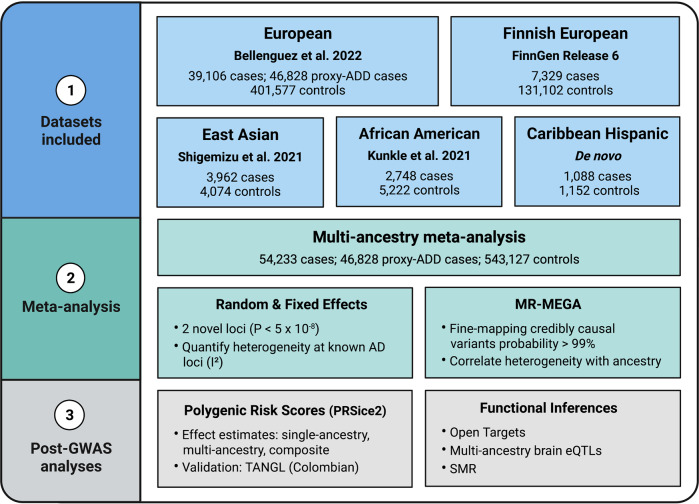
- The meta-analysis included 54,233 AD cases, 46,828 proxy-ADD cases, and 543,127 controls across five datasets representing four super-populations.
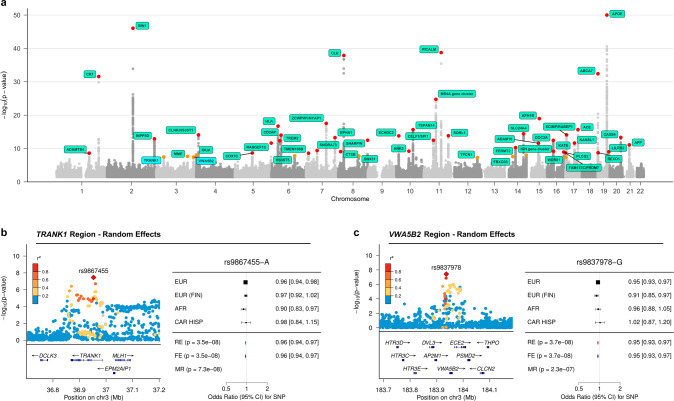
- Two novel ADD risk loci were identified on chromosome 3: TRANK1 (rs9867455; random-effects P = 3.49 × 10⁻⁸, β = −0.0424, I2 = 0) and VWA5B2 (rs9837978; random-effects P = 3.75 × 10⁻⁸, β = −0.0526, I2 = 0).
- A total of 68 loci reached genome-wide significance across fixed-effect, random-effects, or MR-MEGA analyses; 66 overlapped previously established ADD regions.
- Nine loci outside APOE, MAPT, and MHC were fine-mapped to a credible set of ≤2 SNPs with combined posterior probability of 99%; four were newly fine-mapped (RHOH-rs2245466, CTSB-rs1065712, FAM157C/PRDM7-rs56407236, GRN-rs5848).
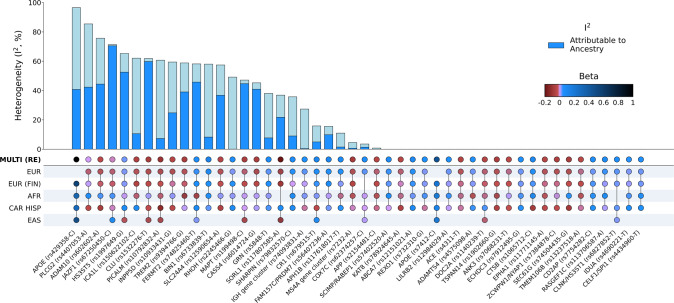
- Significant heterogeneity (I2 > 30%) was observed at 19 of 48 loci significant in MR-MEGA; at least 50% of heterogeneity was attributable to genetic ancestry at 10 of these loci. APOE-rs429358 had the highest heterogeneity (I2 = 96.54), with ~42% attributable to genetic ancestry.
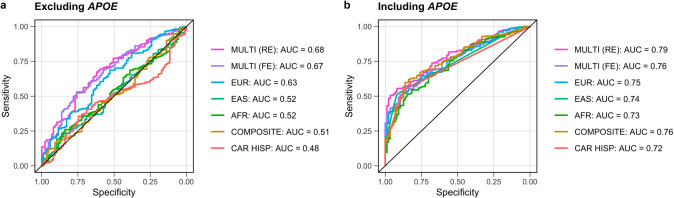
- In a Colombian cohort of 281 AD cases and 87 controls, multi-ancestry random-effects PRS achieved maximal AUCs of 79% including APOE and 68% excluding APOE, compared with 75% and 63% for European-derived PRS.
Methods
- Design: multi-ancestry genome-wide meta-analysis using published GWAS summary statistics from European, East Asian, and African American populations, plus an additional Caribbean Hispanic GWAS generated from previously reported genotype data.
- Analysis: fixed-effect and random-effects models in PLINK v1.9 and multi-ancestry meta-regression in MR-MEGA; fine-mapping used approximate Bayes factors and 99% credible sets; functional follow-up used eQTL data, summary-based Mendelian randomization (SMR), and colocalization.
- PRS evaluation: polygenic risk scores derived from multi-ancestry and single-ancestry models were tested in the three-way admixed Colombian TANGL cohort, with receiver operating characteristic curves used to compare performance.
Limitations
- The paper states that clinicopathological heterogeneity and diagnostic inaccuracy likely differ across studies and populations, and that inclusion of proxy-ADD cases in the Bellenguez et al. European data may introduce variability.
- The paper states that MR-MEGA requires population overlap (K > 3), which reduced variant sets after quality control; analyses were restricted to common (MAF > 1%), biallelic SNVs, so rare variants, indels, and structural variants may contribute but were not captured.
- The paper states that the East Asian GWAS tested fewer SNPs, limiting MR-MEGA to a single axis of genetic variation (PC0) at overlapping SNPs, and that European-ancestry individuals make up approximately 85% of cases, maintaining Eurocentric bias.
- The text makes evident that the two novel loci were primarily driven by the European-focused Bellenguez et al. study, where they were sub-significant, and that the VWA5B2 replication in the GARD East Asian cohort showed an opposite direction of effect and was underpowered.
Model-written summary. Check it against the paper before relying on it.
Integrity signals
Registry
Cites
Statistics
Figures
Verification
Claims the paper makes
1 Valid · 0 Not valid · 53 Not checked · 103 Own results and interpretations
The cited sources support only part of this claim — read each source’s verdict below.
In the paper
“Notably, our fine-mapping analysis did not replicate SORL1-rs11218343, which has been previously fine-mapped with a PP > 0.999 in two large European studies [31, 32]”
§ Multi-ancestry meta-analysis and fine-mapping in Alzheimer’s disease > Results > Fine-mapping
What the sources say
- Partly supportedcites [31] Wightman DP Jansen IE Savage JE Shadrin AA Bahrami S Holland D A genome-wide association study with 1,126,563 individuals identifies new risk loci for Alzheimer’s disease Nat Genet 2021 53 1276 82 10.1038/s41588-021-00921-z 34493870 PMC10243600 sourceExperimental — accuracy not yet measured
Our copy supports that Wightman et al. is a large European-ancestry meta-analysis (90,338 cases / 1,036,225 controls) in which the SORL1 locus (locus 22, lead variant rs11218343, P = 1.33e-13, N = 1,125,100; Table 1, 'Functional enrichment'/results section) was subjected to susieR statistical fine-mapping ('Fine-mapping' section: susieR v.0.9.1 applied to all variants within 1.5 Mb of each locus lead variant, excluding only APOE and HLA-DRB1, UKB reference panel). However, no passage of our copy states that rs11218343 reached a posterior probability/PIP > 0.999: the credible sets are reported only in Supplementary Table 12, which we do not hold, and the main text explicitly defers fine-mapping evidence for previously identified loci (SORL1 is not one of the seven new loci) to the Supplementary Information ('Gene prioritization' section). The only high-PIP variant named in our copy is a different locus entirely (TNIP1 rs871269, 'the only variant with high PIP (>0.99)'). So the magnitude qualifier attributed to this source is unverified here. (LLM, conf=0.65)
- Could not verifycites [32] Schwartzentruber J Cooper S Liu JZ Barrio-Hernandez I Bello E Kumasaka N Genome-wide meta-analysis, fine-mapping and integrative prioritization implicate new Alzheimer’s disease risk genes Nat Genet 2021 53 392 402 10.1038/s41588-020-00776-w 33589840 PMC7610386 sourceExperimental — accuracy not yet measured
Our copy of Schwartzentruber et al. (2021) describes its fine-mapping in detail (Results 'Fine-mapping identifies credibly causal variants'; Online Methods 'Conditional analysis and statistical fine-mapping' and 'Annotation-based fine-mapping'), listing variants with high causal probabilities such as NCK2 rs143080277 (>99%) and APH1B rs117618017 (90%), but nowhere mentions SORL1 or rs11218343, nor any posterior probability >0.999 from two European studies. SORL1 appears only as a cited review in the reference list (ref. 64, Andersen, Rudolph & Willnow, Acta Neuropathol 2016), and SORL1 is not among the 37 loci carried into conditional analysis and fine-mapping (Results, 'Meta-analysis discovers 37 loci'). Searches for 'rs11218343', 'SORL1 fine-mapping credible set posterior probability' and 'previously reported locus not confirmed' returned no passage addressing the claim, so neither support nor contradiction can be established from this paper. (LLM, conf=0.68)
plain- Asserted: passes — The authors put it forward as true.
- Checkable: passes — It can be checked against evidence.
- Load-bearing: passes — The paper’s conclusions depend on it.
- Based: passes — The paper gives a reason why it holds.
- Partly supported
A result the paper reports from its own data — it cites no other source for it, so there is none to check. The quote shows it is in the paper.
In the paper
“Non-European AUCs tended to improve with increasing sample size (Fig. 4)”
§ Multi-ancestry meta-analysis and fine-mapping in Alzheimer’s disease > Results > Polygenic risk scoring
hedgedstates an associationn = 281- Asserted: passes — The authors put it forward as true.
- Checkable: passes — It can be checked against evidence.
- Load-bearing: passes — The paper’s conclusions depend on it.
- Based: passes — The paper gives a reason why it holds.
- Rests on an assumption not shown here.
A result the paper reports from its own data — it cites no other source for it, so there is none to check. The quote shows it is in the paper.
In the paper
“We observed an association at P < 0.05 at VWA5B2-rs9837978 (P = 0.048, β = 0.204) in the GARD cohort (n = 2,291).”
§ Multi-ancestry meta-analysis and fine-mapping in Alzheimer’s disease > Results > Meta-GWAS
plainstates an associationn = 2,291 ·- Asserted: passes — The authors put it forward as true.
- Checkable: passes — It can be checked against evidence.
- Load-bearing: passes — The paper’s conclusions depend on it.
- Based: passes — The paper gives a reason why it holds.
A result the paper reports from its own data — it cites no other source for it, so there is none to check. The quote shows it is in the paper.
In the paper
“although colocalization between the GWAS signal and these eQTLS were not very strong (R2 < 0.5; Fig. S4)”
§ Multi-ancestry meta-analysis and fine-mapping in Alzheimer’s disease > Results > Gene prioritization for novel loci
plainstates an association- Asserted: passes — The authors put it forward as true.
- Checkable: passes — It can be checked against evidence.
- Load-bearing: unclear — It is unclear whether the paper’s conclusions depend on it.
- Based: passes — The paper gives a reason why it holds.
A result the paper reports from its own data — it cites no other source for it, so there is none to check. The quote shows it is in the paper.
In the paper
“Using a meta-regression approach implemented in MR-MEGA, we demonstrate improved fine-mapping at several known ADD loci and estimate the extent to which heterogeneity at these loci is attributable to genetic ancestry.”
§ Multi-ancestry meta-analysis and fine-mapping in Alzheimer’s disease > Introduction
boostedstates a cause- Asserted: passes — The authors put it forward as true.
- Checkable: passes — It can be checked against evidence.
- Load-bearing: passes — The paper’s conclusions depend on it.
- Based: passes — The paper gives a reason why it holds.
87 more claims
Create a free account to see all 157 claims and to verify the 91 references still open.
- It may state two separate claims as one. 48
- Probably not a substantial claim. 25
- The quote only partly states this claim. 1
Self-check
Percentages, sums and reported differences re-computed from the paper’s own numbers.
Each contradiction between two passages listed here was confirmed by an independent check.
Rated minor: it would not touch a result — a value no result rests on, a p-value that stays on the same side of the significance level, or a conflict that is clerical, resolved elsewhere in the paper, or outside its own findings.
In the paper
§ Multi-ancestry meta-analysis and fine-mapping in Alzheimer’s disease > Results > Fine-mapping
“MS4A6A-rs7232, PP = 0.54, n = 4 in 99% credible set”
§ Multi-ancestry meta-analysis and fine-mapping in Alzheimer’s disease > Discussion
“At the MS4A gene cluster, multi-ancestry fine-mapping resolved the signal to a credible set of five variants”
Citations
Cites
Second-generation PLINK: rising to the challenge of larger and richer datasets
Chang, C. C., Chow, C. C., Tellier, L. C., Vattikuti, S., Purcell, S. M., & Lee, J. J. (2015) · Gigascience · doi:10.1186/s13742-015-0047-8 · Cited by 12,709 · cited 2×
“1; ANC: ancestry, RESID: residual).”
BackgroundThe Human Genome Browser at UCSC
Kent, W. J., Sugnet, C. W., Furey, T. S., Roskin, K. M., Pringle, T. H., Zahler, A. M., & Haussler, A. D. (2002) · Genome Research · doi:10.1101/gr.229102 · Cited by 10,400
Biological insights from 108 schizophrenia-associated genetic loci
Schizophrenia Working Group of the Psychiatric Genomics Consortium (2014) · Nature · doi:10.1038/nature13595 · Cited by 7,577
Integration of summary data from GWAS and eQTL studies predicts complex trait gene targets
Zhu, Z., Zhang, F., Hu, H., Bakshi, A., Robinson, M. R., Powell, J. E., Montgomery, G. W., Goddard, M. E., Wray, N. R., Visscher, P. M., et al. (2016) · Nature Genetics · doi:10.1038/ng.3538 · Cited by 3,352
Mapping genomic loci implicates genes and synaptic biology in schizophrenia
Trubetskoy, V., Pardiñas, A. F., Qi, T., Panagiotaropoulou, G., Awasthi, S., Bigdeli, T. B., Bryois, J., Chen, C.-Y., Dennison, C. A., Hall, L. S., et al. (2022) · Nature · doi:10.1038/s41586-022-04434-5 · Cited by 2,964
Self-citationAnalysing data and undertaking meta‐analyses
Deeks, J. J., Higgins, J. P., Altman, D. G., & on behalf of the Cochrane Statistical Methods Group (2019) · Cochrane Handbook for Systematic Reviews of Interventions · doi:10.1002/9781119536604.ch10 · Cited by 2,672
New insights into the genetic etiology of Alzheimer’s disease and related dementias
Bellenguez, C., Küçükali, F., Jansen, I. E., Kleineidam, L., Moreno-Grau, S., Amin, N., Naj, A. C., Campos-Martin, R., Grenier-Boley, B., Andrade, V., et al. (2022) · Nature Genetics · doi:10.1038/s41588-022-01024-z · Cited by 2,498
Nalls, M. A., Blauwendraat, C., Vallerga, C. L., Heilbron, K., Bandres-Ciga, S., Chang, D., Tan, M., Kia, D. A., Noyce, A. J., Xue, A., et al. (2019) · The Lancet Neurology · doi:10.1016/s1474-4422(19)30320-5 · Cited by 2,454
Self-citationJansen, I. E., Savage, J. E., Watanabe, K., Bryois, J., Williams, D. M., Steinberg, S., Sealock, J., Karlsson, I. K., Hägg, S., Athanasiu, L., et al. (2019) · Nature Genetics · doi:10.1038/s41588-018-0311-9 · Cited by 2,277
A mutation in APP protects against Alzheimer’s disease and age-related cognitive decline
Jonsson, T., Atwal, J. K., Steinberg, S., Snaedal, J., Jonsson, P. V., Bjornsson, S., Stefansson, H., Sulem, P., Gudbjartsson, D., Maloney, J., et al. (2012) · Nature · doi:10.1038/nature11283 · Cited by 1,738 · cited 1×
“All SNPs in the 99% credible sets were annotated with VEP (http:// grch37.ensembl.org/Homo_sapiens/Tools/VEP) using default criteria to select one block of annotation per variant (Table S4).”
Method
Cited by
Rizig, M., Bandres-Ciga, S., Makarious, M. B., Ojo, O. O., Crea, P. W., Abiodun, O. V., Levine, K. S., Abubakar, S. A., Achoru, C. O., Vitale, D., et al. (2023) · The Lancet Neurology · doi:10.1016/s1474-4422(23)00283-1 · Cited by 159
Self-citationNovel Parkinson’s Disease Genetic Risk Factors Within and Across European PopulationsPreprint
(GP2), T. G. P. G. P., & Leonard, H. L. (2025) · medRxiv · doi:10.1101/2025.03.14.24319455 · Cited by 113
Self-citationA neurodegenerative cellular stress response linked to dark microglia and toxic lipid secretion
Flury, A. G., Aljayousi, L., Park, H.-J., Khakpour, M., Mechler, J., Aziz, S., McGrath, J. D., Deme, P., Sandberg, C., Ibáñez, F. G., et al. (2024) · Neuron · doi:10.1016/j.neuron.2024.11.018 · Cited by 111
Bandrés‐Ciga, S., Faghri, F., Majounie, E., Koretsky, M. J., Kim, J., Levine, K. S., Leonard, H. L., Makarious, M. B., Iwaki, H., Crea, P. W., et al. (2024) · Movement Disorders · doi:10.1002/mds.29902 · Cited by 64
Self-citationLarge‐scale deep proteomic analysis in Alzheimer's disease brain regions across race and ethnicity
Seifar, F., Fox, E. J., Shantaraman, A., Liu, Y., Dammer, E. B., Modeste, E., Duong, D. M., Yin, L., Trautwig, A. N., Guo, Q., et al. (2024) · Alzheimer's & Dementia · doi:10.1002/alz.14360 · Cited by 52
Metadata
- Authors
- Lake, J., Warly Solsberg, C., Kim, J. J., Acosta-Uribe, J., Makarious, M. B., Li, Z., Levine, K., Heutink, P., Alvarado, C. X., Vitale, D., Kang, S., Gim, J., Lee, K. H., Pina-Escudero, S. D., Ferrucci, L., Singleton, A. B., Blauwendraat, C., Nalls, M. A., Yokoyama, J. S., & Leonard, H. L.
- Affiliations
- National Institutes of Health (US)
- University of California, San Francisco (US)
- Alector (United States) (US)
- Chosun University (KR)
- Corresponding author
- Leonard, Hampton L.
- ORCID
- Lake, Julie
- Warly Solsberg, Caroline
- Kim, Jonggeol Jeffrey
- Acosta-Uribe, Juliana
- Makarious, Mary B.
- Li, Zizheng
- Levine, Kristin
- Heutink, Peter
- Alvarado, Chelsea X.
- Vitale, Dan
- Kang, Sarang
- Gim, Jungsoo
- Lee, Kun Ho
- Ferrucci, Luigi
- Singleton, Andrew B.
- Blauwendraat, Cornelis
- Nalls, Mike A.
- Yokoyama, Jennifer S.
- Leonard, Hampton L.
- Venue
- Molecular Psychiatry
- Published
- 2023-05-18
- Volume
- 28
- Issue
- 7
- Pages
- 3121-3132
- ISSN
- 1359-4184 (ISSN-L)
- 1476-5578
- PMC
- PMC10615750
- OpenAlex
- W4376866169
- Semantic Scholar
- 047888460277b679ea3f443b9b504a277f64e090
- Cited by
- 90
- References
- 92
- Citations by year
- 2026: 36 · 2025: 23 · 2024: 22 · 2023: 8
- FWCI
- 2.70
- Type
- journal article
- Language
- en
- Open access
- hybrid
- doi.org
- Licence
- cc-by
- creativecommons.org/licenses/by/4.0 (tdm)
- creativecommons.org/licenses/by/4.0 (vor)
- Locations
- Molecular Psychiatry (publishedVersion, cc-by)
- medRxiv (submittedVersion)
- PubMed Central (publishedVersion, cc-by)
- PubMed (publishedVersion)
- eScholarship (California Digital Library) (submittedVersion, cc-by)
- DZNE Pub (submittedVersion, cc-by)
- Funders
- U.S. Department of Health & Human Services | NIH | National Institute on Aging (1ZIA-NS003154, Z01-AG000949-02, ZO1-AG000535 and Z01-ES101986, 1ZIA-NS003154, Z01-AG000949-02, ZO1-AG000535, Z01-ES101986, R01 AG062588, R01 AG057234, P30 AG062422)
- U.S. Department of Health & Human Services | NIH | National Institute of Neurological Disorders and Stroke (U54 NS123985)
- Alzheimer&rsqu;s Association
- Topics
- Life Sciences › Biochemistry, Genetics and Molecular Biology › Genetics › Genetic Associations and Epidemiology
- Life Sciences › Neuroscience › Cellular and Molecular Neuroscience › Alzheimer's disease research and treatments
- Health Sciences › Medicine › Psychiatry and Mental health › Dementia and Cognitive Impairment Research
- Keywords
- Alzheimer's disease, Alzheimer's disease and related dementias, fine mapping, chromosome 3, haplotype structure, polygenic risk score, admixed populations, East Asian populations, African American population
- MeSH terms
- European People, Caribbean People, South American People, East Asian People, Alzheimer Disease, Black or African American, Genotype, Hispanic or Latino, Humans, Genetic Predisposition to Disease, Polymorphism, Single Nucleotide, Genome-Wide Association Study
About these checks
Registry, retraction, Cites and statistics results are computed, not judged, with one exception: a printed reference that no index lists is read once by a model before it counts as a citation error. Claims are extracted by a model and kept only when their quote appears verbatim in the text; each cited source is then checked, with a model’s help, for whether it says what the claim relies on. Those verdicts can be wrong — read the claim’s quote and the cited source before relying on one.
The claim verdicts this report counts are experimental: their accuracy is not yet measured.
A language model drew the claims from the paper on 2026-11-24, under version 3 of the claim definition (model deepseek-v4.1-flash, prompt extract-v3).
A second model labelled each claim on 2026-11-24 (model jev-1.13-20260917, definition revision gold-guideline-v0.2).
Cited sources are checked with a language model’s help (qwen3.8-omni-flash).
Statistics and arithmetic are recomputed, not judged.
Confidence bands are shown only for fields calibrated on our annotated test set. None is calibrated yet, so no band is shown.
What counts as a claim ›How we measure confidence ›How we check this ›
Are you an author, or do you see a problem with this page? Request a review
How to cite
Cite CoChat for the checks on this page, and the paper for its own findings.
- This page
- CoChat. (2026). Citation check: Multi-ancestry meta-analysis and fine-mapping in Alzheimer’s disease. https://app.cochat.ai/papers/10.1038/s41380-023-02089-w
- The paper
- Lake, J., Warly Solsberg, C., Kim, J. J., Acosta-Uribe, J., Makarious, M. B., Li, Z., Levine, K., Heutink, P., Alvarado, C. X., Vitale, D., Kang, S., Gim, J., Lee, K. H., Pina-Escudero, S. D., Ferrucci, L., Singleton, A. B., Blauwendraat, C., Nalls, M. A., Yokoyama, J. S., & Leonard, H. L. (2023). Multi-ancestry meta-analysis and fine-mapping in Alzheimer’s disease. Molecular Psychiatry. https://doi.org/10.1038/s41380-023-02089-w
Data sources
Bibliographic data: Semantic Scholar, OpenAlex, Crossref.
Contains information from the Semantic Scholar Academic Graph Datasets, made available under the ODC Attribution License (ODC-BY 1.0).
Semantic Scholar’s data is described in: Kinney, R., et al. (2023). The Semantic Scholar Open Data Platform. arXiv:2301.10140.
