

Multi-ancestry meta-analysis and fine-mapping in Alzheimer’s disease
Open accessPublished version of a preprint
The DOI matches its Crossref record; 92 of the 92 references it cites were found in a registry or an index; 4 of the 93 sources its claims cite were checked for support.
Abstract
Genome-wide association studies (GWAS) of Alzheimer’s disease are predominantly carried out in European ancestry individuals despite the known variation in genetic architecture and disease prevalence across global populations. We leveraged published GWAS summary statistics from European, East Asian, and African American populations, and an additional GWAS from a Caribbean Hispanic population using previously reported genotype data to perform the largest multi-ancestry GWAS meta-analysis of Alzheimer’s disease and related dementias to date. This method allowed us to identify two independent novel disease-associated loci on chromosome 3. We also leveraged diverse haplotype structures to fine-map nine loci with a posterior probability >0.8 and globally assessed the heterogeneity of known risk factors across populations. Additionally, we compared the generalizability of multi-ancestry- and single-ancestry-derived polygenic risk scores in a three-way admixed Colombian population. Our findings highlight the importance of multi-ancestry representation in uncovering and understanding putative factors that contribute to risk of Alzheimer’s disease and related dementias.
Overview
CoChat Summary
TL;DR
This multi-ancestry GWAS meta-analysis of Alzheimer’s disease and related dementias combined European, East Asian, African American, and Caribbean Hispanic datasets and identified two novel chromosome 3 loci while improving fine-mapping at known loci. It also showed that multi-ancestry-derived polygenic risk scores outperformed European-derived scores in an admixed Colombian cohort.
Key findings
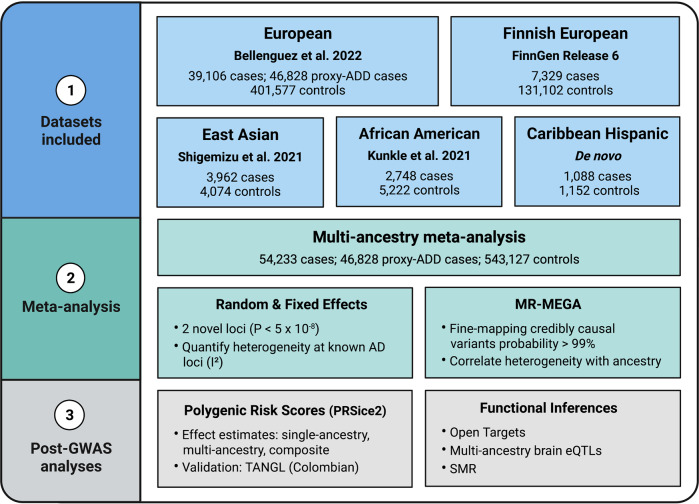
- The meta-analysis included 54,233 AD cases, 46,828 proxy-ADD cases, and 543,127 controls across five datasets representing four super-populations.
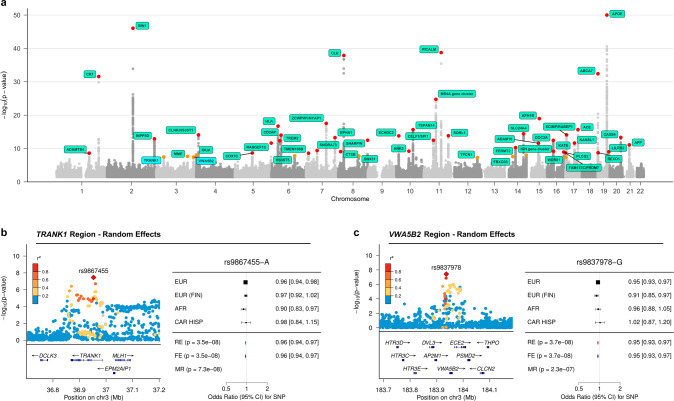
- Two novel ADD risk loci were identified on chromosome 3: TRANK1 (rs9867455; random-effects P = 3.49 × 10⁻⁸, β = −0.0424, I2 = 0) and VWA5B2 (rs9837978; random-effects P = 3.75 × 10⁻⁸, β = −0.0526, I2 = 0).
- A total of 68 loci reached genome-wide significance across fixed-effect, random-effects, or MR-MEGA analyses; 66 overlapped previously established ADD regions.
- Nine loci outside APOE, MAPT, and MHC were fine-mapped to a credible set of ≤2 SNPs with combined posterior probability of 99%; four were newly fine-mapped (RHOH-rs2245466, CTSB-rs1065712, FAM157C/PRDM7-rs56407236, GRN-rs5848).
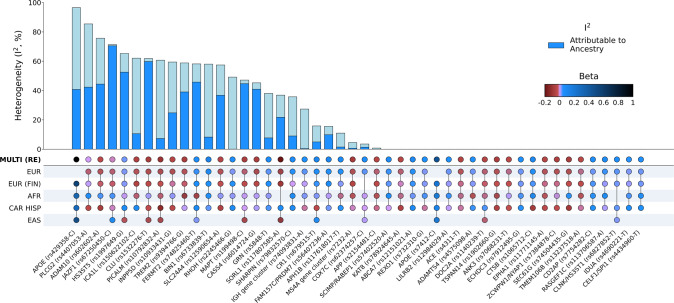
- Significant heterogeneity (I2 > 30%) was observed at 19 of 48 loci significant in MR-MEGA; at least 50% of heterogeneity was attributable to genetic ancestry at 10 of these loci. APOE-rs429358 had the highest heterogeneity (I2 = 96.54), with ~42% attributable to genetic ancestry.
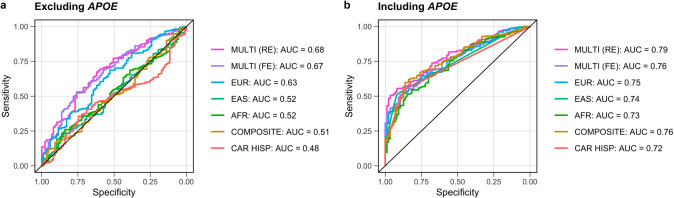
- In a Colombian cohort of 281 AD cases and 87 controls, multi-ancestry random-effects PRS achieved maximal AUCs of 79% including APOE and 68% excluding APOE, compared with 75% and 63% for European-derived PRS.
Methods
- Design: multi-ancestry genome-wide meta-analysis using published GWAS summary statistics from European, East Asian, and African American populations, plus an additional Caribbean Hispanic GWAS generated from previously reported genotype data.
- Analysis: fixed-effect and random-effects models in PLINK v1.9 and multi-ancestry meta-regression in MR-MEGA; fine-mapping used approximate Bayes factors and 99% credible sets; functional follow-up used eQTL data, summary-based Mendelian randomization (SMR), and colocalization.
- PRS evaluation: polygenic risk scores derived from multi-ancestry and single-ancestry models were tested in the three-way admixed Colombian TANGL cohort, with receiver operating characteristic curves used to compare performance.
Limitations
- The paper states that clinicopathological heterogeneity and diagnostic inaccuracy likely differ across studies and populations, and that inclusion of proxy-ADD cases in the Bellenguez et al. European data may introduce variability.
- The paper states that MR-MEGA requires population overlap (K > 3), which reduced variant sets after quality control; analyses were restricted to common (MAF > 1%), biallelic SNVs, so rare variants, indels, and structural variants may contribute but were not captured.
- The paper states that the East Asian GWAS tested fewer SNPs, limiting MR-MEGA to a single axis of genetic variation (PC0) at overlapping SNPs, and that European-ancestry individuals make up approximately 85% of cases, maintaining Eurocentric bias.
- The text makes evident that the two novel loci were primarily driven by the European-focused Bellenguez et al. study, where they were sub-significant, and that the VWA5B2 replication in the GARD East Asian cohort showed an opposite direction of effect and was underpowered.
Model-written summary. Check it against the paper before relying on it.
Integrity signals
Registry
Cites
Statistics
Figures
Verification
Claims the paper makes
2 Valid · 1 Not valid · 51 Not checked · 103 Own results and interpretations
The cited sources support only part of this claim — read each source’s verdict below.
In the paper
“Notably, our fine-mapping analysis did not replicate SORL1-rs11218343, which has been previously fine-mapped with a PP > 0.999 in two large European studies [31, 32]”
§ Multi-ancestry meta-analysis and fine-mapping in Alzheimer’s disease > Results > Fine-mapping
What the sources say
- Partly supportedcites [31] Wightman DP Jansen IE Savage JE Shadrin AA Bahrami S Holland D A genome-wide association study with 1,126,563 individuals identifies new risk loci for Alzheimer’s disease Nat Genet 2021 53 1276 82 10.1038/s41588-021-00921-z 34493870 PMC10243600 sourceExperimental — accuracy not yet measured
Our copy supports that Wightman et al. is a large European-ancestry meta-analysis (90,338 cases / 1,036,225 controls) in which the SORL1 locus (locus 22, lead variant rs11218343, P = 1.33e-13, N = 1,125,100; Table 1, 'Functional enrichment'/results section) was subjected to susieR statistical fine-mapping ('Fine-mapping' section: susieR v.0.9.1 applied to all variants within 1.5 Mb of each locus lead variant, excluding only APOE and HLA-DRB1, UKB reference panel). However, no passage of our copy states that rs11218343 reached a posterior probability/PIP > 0.999: the credible sets are reported only in Supplementary Table 12, which we do not hold, and the main text explicitly defers fine-mapping evidence for previously identified loci (SORL1 is not one of the seven new loci) to the Supplementary Information ('Gene prioritization' section). The only high-PIP variant named in our copy is a different locus entirely (TNIP1 rs871269, 'the only variant with high PIP (>0.99)'). So the magnitude qualifier attributed to this source is unverified here. (LLM, conf=0.65)
- Could not verifycites [32] Schwartzentruber J Cooper S Liu JZ Barrio-Hernandez I Bello E Kumasaka N Genome-wide meta-analysis, fine-mapping and integrative prioritization implicate new Alzheimer’s disease risk genes Nat Genet 2021 53 392 402 10.1038/s41588-020-00776-w 33589840 PMC7610386 sourceExperimental — accuracy not yet measured
Our copy of Schwartzentruber et al. (2021) describes its fine-mapping in detail (Results 'Fine-mapping identifies credibly causal variants'; Online Methods 'Conditional analysis and statistical fine-mapping' and 'Annotation-based fine-mapping'), listing variants with high causal probabilities such as NCK2 rs143080277 (>99%) and APH1B rs117618017 (90%), but nowhere mentions SORL1 or rs11218343, nor any posterior probability >0.999 from two European studies. SORL1 appears only as a cited review in the reference list (ref. 64, Andersen, Rudolph & Willnow, Acta Neuropathol 2016), and SORL1 is not among the 37 loci carried into conditional analysis and fine-mapping (Results, 'Meta-analysis discovers 37 loci'). Searches for 'rs11218343', 'SORL1 fine-mapping credible set posterior probability' and 'previously reported locus not confirmed' returned no passage addressing the claim, so neither support nor contradiction can be established from this paper. (LLM, conf=0.68)
plain- Asserted: passes — The authors put it forward as true.
- Checkable: passes — It can be checked against evidence.
- Load-bearing: passes — The paper’s conclusions depend on it.
- Based: passes — The paper gives a reason why it holds.
- Partly supported
The cited sources support only part of this claim — read each source’s verdict below.
In the paper
“Consistent with previous studies [7, 37], we observed an attenuated signal at APOE-rs429358, which determines the APOE-e4 allele, among the cohorts of African Americans and Caribbean Hispanics (Fig. S11a).”
§ Multi-ancestry meta-analysis and fine-mapping in Alzheimer’s disease > Results > Heterogeneity analysis
What the sources say
- Not checked yetcites [7] Blue EE Arvr H Mukherjee S Wijsman EM Thornton TA Local ancestry at APOE modifies Alzheimer’s disease risk in Caribbean Hispanics Alzheimers Dement 2019 15 1524 32 10.1016/j.jalz.2019.07.016 31606368 PMC6925639 source
Checked before — its earlier verdict is held back until a new check runs.
- Partly supportedcites [37] Rajabli F Feliciano BE Celis K Hamilton-Nelson KL Whitehead PL Adams LD Ancestral origin of ApoE ε4 Alzheimer disease risk in Puerto Rican and African American populations PLoS Genet 2018 14 e1007791 10.1371/journal.pgen.1007791 30517106 PMC6281216 sourceExperimental — accuracy not yet measured
The Abstract and Results (Table 1) of Rajabli et al. 2018 do report a weakened ε4 effect in African American and Puerto Rican (i.e. Caribbean Hispanic) cohorts — OR = 1.26, p = 0.67 on an African ancestral background versus OR = 4.49, p = 3.7e-05 on a European background in PR, and OR = 2.34 versus 3.05 in AA — and the Introduction states an ancestry-specific region around ApoE contributes to "the lower risk of AD in AA and PR ε4 carriers". However, the paper never reports an attenuated association at the rs429358 SNP itself in these cohorts: its attenuation is stratified by haplotype local ancestry, and the ε4 effect remained significant across ancestral haplotypes in AA (p = 9.2e-45). The general population-level attenuation of ε4 risk in African Americans and Caribbean Hispanics is itself credited by this paper to earlier reports [6,8–13] (e.g. Tang et al., JAMA 1998; Neurology 2001, 'Caribbean Hispanics … northern Manhattan'), so the citing sentence's single-SNP, cohort-level framing overstates what this source shows. (LLM, conf=0.72)
plainstates an association- Asserted: passes — The authors put it forward as true.
- Checkable: passes — It can be checked against evidence.
- Load-bearing: unclear — It is unclear whether the paper’s conclusions depend on it.
- Based: passes — The paper gives a reason why it holds.
- Not checked yet
The cited sources that could be checked couldn’t confirm or dispute this claim.
In the paper
“β estimates for the APOE polymorphisms were not available in the Bellenguez et al. summary statistics [4]”
§ Multi-ancestry meta-analysis and fine-mapping in Alzheimer’s disease > Online methods > Polygenic risk scoring
What the sources say
- Could not verifycites [4] Bellenguez C Küçükali F Jansen IE Kleineidam L Moreno-Grau S Amin N New insights into the genetic etiology of Alzheimer’s disease and related dementias Nat Genet 2022 54 412 36 10.1038/s41588-022-01024-z 35379992 PMC9005347 sourceExperimental — accuracy not yet measured
Our copy never states what the released/deposited Bellenguez et al. summary statistics contain for the APOE polymorphisms; I searched for 'summary statistics availability APOE region excluded', 'rs429358 rs7412 APOE epsilon allele dosage odds ratio', 'Data availability … EGA accession' and 'APOE effect estimates not reported beta coefficients'. The closest passages concern analytic exclusions only — the APOE region (chr19 44–46 Mb GRCh38) was excluded from the genomic-inflation and LD-score-regression computations (Methods, Stage I analyses), from the locus-definition/clumping procedure (Methods, Definition of associated loci) and from the GRS variant set ('n = 83, excluding APOE', GRS section) — and the APOE-ε4/ε2 effects the paper reports are hazard ratios from Cox models in the progression analyses (GRS section), not per-SNP β's from the case-control summary file. Whether the summary statistics themselves lack β estimates for APOE variants is therefore not addressed by our copy, so the claim can be neither confirmed nor contradicted. (LLM, conf=0.68)
plain- Asserted: passes — The authors put it forward as true.
- Checkable: passes — It can be checked against evidence.
- Load-bearing: unclear — It is unclear whether the paper’s conclusions depend on it.
- Based: passes — The paper gives a reason why it holds.
- Could not verify
A result the paper reports from its own data — it cites no other source for it, so there is none to check. The quote shows it is in the paper.
In the paper
“Non-European AUCs tended to improve with increasing sample size (Fig. 4)”
§ Multi-ancestry meta-analysis and fine-mapping in Alzheimer’s disease > Results > Polygenic risk scoring
hedgedstates an associationn = 281- Asserted: passes — The authors put it forward as true.
- Checkable: passes — It can be checked against evidence.
- Load-bearing: passes — The paper’s conclusions depend on it.
- Based: passes — The paper gives a reason why it holds.
- Rests on an assumption not shown here.
A result the paper reports from its own data — it cites no other source for it, so there is none to check. The quote shows it is in the paper.
In the paper
“We observed an association at P < 0.05 at VWA5B2-rs9837978 (P = 0.048, β = 0.204) in the GARD cohort (n = 2,291).”
§ Multi-ancestry meta-analysis and fine-mapping in Alzheimer’s disease > Results > Meta-GWAS
plainstates an associationn = 2,291 ·- Asserted: passes — The authors put it forward as true.
- Checkable: passes — It can be checked against evidence.
- Load-bearing: passes — The paper’s conclusions depend on it.
- Based: passes — The paper gives a reason why it holds.
87 more claims
Create a free account to see all 157 claims and to verify the 89 references still open.
- It may state two separate claims as one. 48
- Probably not a substantial claim. 25
- The quote only partly states this claim. 1
Claims other papers make about this one
Each is checked against this paper’s own text: does it say what the citing paper says it does?
In the citing paper
“Among the more than 90 identified genetic risk loci for late-onset Alzheimer’s disease (AD) and related dementias, the apolipoprotein E (APOE) gene ɛ2/ɛ3/ɛ4 polymorphisms remain the longstanding benchmark for genetic disease risk with a consistently large effect across studies1–10.”
From APOE-stratified genome-wide association analyses provide insights into the genetic etiology of Alzheimers’s disease (2026) · cites this paper as [9]
In the citing paper
“In fact, there are significant differences in AD genetic variants across different populations [29–34].”
From Interpretation of 10 years of Alzheimer’s disease genetic findings in the perspective of statistical heterogeneity (2024) · cites this paper as [33]
In the citing paper
“In Alzheimer's disease, 47 loci and 51 loci were identified using MR-MEGA and the random effect model, respectively, based on summary statistics from Lake, J. 2023 [24].”
From Multi-ancestry multi-trait analysis reveals shared genetics across major psychiatric disorders and Alzheimer’s disease (2026) · cites this paper as [24]
Self-check
Percentages, sums and reported differences re-computed from the paper’s own numbers.
Each contradiction between two passages listed here was confirmed by an independent check.
Rated minor: it would not touch a result — a value no result rests on, a p-value that stays on the same side of the significance level, or a conflict that is clerical, resolved elsewhere in the paper, or outside its own findings.
In the paper
§ Multi-ancestry meta-analysis and fine-mapping in Alzheimer’s disease > Results > Fine-mapping
“MS4A6A-rs7232, PP = 0.54, n = 4 in 99% credible set”
§ Multi-ancestry meta-analysis and fine-mapping in Alzheimer’s disease > Discussion
“At the MS4A gene cluster, multi-ancestry fine-mapping resolved the signal to a credible set of five variants”
Citations
Cites
Second-generation PLINK: rising to the challenge of larger and richer datasets
Chang, C. C., Chow, C. C., Tellier, L. C., Vattikuti, S., Purcell, S. M., & Lee, J. J. (2015) · Gigascience · doi:10.1186/s13742-015-0047-8 · Cited by 12,709 · cited 2×
“1; ANC: ancestry, RESID: residual).”
BackgroundThe Human Genome Browser at UCSC
Kent, W. J., Sugnet, C. W., Furey, T. S., Roskin, K. M., Pringle, T. H., Zahler, A. M., & Haussler, A. D. (2002) · Genome Research · doi:10.1101/gr.229102 · Cited by 10,400
Biological insights from 108 schizophrenia-associated genetic loci
Schizophrenia Working Group of the Psychiatric Genomics Consortium (2014) · Nature · doi:10.1038/nature13595 · Cited by 7,577
Integration of summary data from GWAS and eQTL studies predicts complex trait gene targets
Zhu, Z., Zhang, F., Hu, H., Bakshi, A., Robinson, M. R., Powell, J. E., Montgomery, G. W., Goddard, M. E., Wray, N. R., Visscher, P. M., et al. (2016) · Nature Genetics · doi:10.1038/ng.3538 · Cited by 3,352
Mapping genomic loci implicates genes and synaptic biology in schizophrenia
Trubetskoy, V., Pardiñas, A. F., Qi, T., Panagiotaropoulou, G., Awasthi, S., Bigdeli, T. B., Bryois, J., Chen, C.-Y., Dennison, C. A., Hall, L. S., et al. (2022) · Nature · doi:10.1038/s41586-022-04434-5 · Cited by 2,964
Self-citationAnalysing data and undertaking meta‐analyses
Deeks, J. J., Higgins, J. P., Altman, D. G., & on behalf of the Cochrane Statistical Methods Group (2019) · Cochrane Handbook for Systematic Reviews of Interventions · doi:10.1002/9781119536604.ch10 · Cited by 2,672
New insights into the genetic etiology of Alzheimer’s disease and related dementias
Bellenguez, C., Küçükali, F., Jansen, I. E., Kleineidam, L., Moreno-Grau, S., Amin, N., Naj, A. C., Campos-Martin, R., Grenier-Boley, B., Andrade, V., et al. (2022) · Nature Genetics · doi:10.1038/s41588-022-01024-z · Cited by 2,498
Nalls, M. A., Blauwendraat, C., Vallerga, C. L., Heilbron, K., Bandres-Ciga, S., Chang, D., Tan, M., Kia, D. A., Noyce, A. J., Xue, A., et al. (2019) · The Lancet Neurology · doi:10.1016/s1474-4422(19)30320-5 · Cited by 2,454
Self-citationJansen, I. E., Savage, J. E., Watanabe, K., Bryois, J., Williams, D. M., Steinberg, S., Sealock, J., Karlsson, I. K., Hägg, S., Athanasiu, L., et al. (2019) · Nature Genetics · doi:10.1038/s41588-018-0311-9 · Cited by 2,277
A mutation in APP protects against Alzheimer’s disease and age-related cognitive decline
Jonsson, T., Atwal, J. K., Steinberg, S., Snaedal, J., Jonsson, P. V., Bjornsson, S., Stefansson, H., Sulem, P., Gudbjartsson, D., Maloney, J., et al. (2012) · Nature · doi:10.1038/nature11283 · Cited by 1,738 · cited 1×
“All SNPs in the 99% credible sets were annotated with VEP (http:// grch37.ensembl.org/Homo_sapiens/Tools/VEP) using default criteria to select one block of annotation per variant (Table S4).”
MethodMullins, N., Forstner, A. J., O’Connell, K. S., Coombes, B., Coleman, J. R. I., Qiao, Z., Als, T. D., Bigdeli, T. B., Børte, S., Bryois, J., et al. (2021) · Nature Genetics · doi:10.1038/s41588-021-00857-4 · Cited by 1,517 · cited 1×
“Caribbean Hispanic GWAS Data from the Columbia University Study of Caribbean Hispanics and Late Onset Alzheimer ’ s disease were accessed via application to dbGaP accession number phs000496.v1.p1 in April of 2022.”
MethodSkol, A. D., Scott, L. J., Abecasis, G. R., & Boehnke, M. (2006) · Nature Genetics · doi:10.1038/ng1706 · Cited by 1,286 · cited 1×
“All SNPs in the 99% credible sets were annotated with VEP (http:// grch37.ensembl.org/Homo_sapiens/Tools/VEP) using default criteria to select one block of annotation per variant (Table S4).”
MethodThe Human ATP-Binding Cassette (ABC) Transporter Superfamily
Dean, M. (2001) · Genome Research · doi:10.1101/gr.gr-1649r · Cited by 1,113
Beach, T. G., Monsell, S. E., Phillips, L. E., & Kukull, W. (2012) · Journal of Neuropathology & Experimental Neurology · doi:10.1097/nen.0b013e31824b211b · Cited by 1,103
Wightman, D. P., Jansen, I. E., Savage, J. E., Shadrin, A. A., Bahrami, S., Holland, D., Rongve, A., Børte, S., Winsvold, B. S., Drange, O. K., et al. (2021) · Nature Genetics · doi:10.1038/s41588-021-00921-z · Cited by 1,011
The power of genetic diversity in genome-wide association studies of lipids
Graham, S. E., Clarke, S. L., Wu, K.-H. H., Kanoni, S., Zajac, G. J. M., Ramdas, S., Surakka, I., Ntalla, I., Vedantam, S., Winkler, T. W., et al. (2021) · Nature · doi:10.1038/s41586-021-04064-3 · Cited by 972
Quorum sensing triggers the stochastic escape of individual cells from Pseudomonas putida biofilms
Cárcamo-Oyarce, G., Lumjiaktase, P., Kümmerli, R., & Eberl, L. (2015) · Nature Communications · doi:10.1038/ncomms6945 · Cited by 958
A catalog of genetic loci associated with kidney function from analyses of a million individuals
Study, L. C., Wuttke, M., Program, V. A. M. V., Li, Y., Li, M., Sieber, K. B., Feitosa, M. F., Gorski, M., Tin, A., Wang, L., et al. (2019) · Nature Genetics · doi:10.1038/s41588-019-0407-x · Cited by 846
Mahajan, A., Spracklen, C. N., Zhang, W., Ng, M. C. Y., Petty, L. E., Kitajima, H., Yu, G. Z., Rüeger, S., Speidel, L., Kim, Y. J., et al. (2022) · Nature Genetics · doi:10.1038/s41588-022-01058-3 · Cited by 704
Chen, M.-H., Raffield, L. M., Mousas, A., Sakaue, S., Huffman, J. E., Moscati, A., Trivedi, B., Jiang, T., Akbari, P., Vuckovic, D., et al. (2020) · Cell · doi:10.1016/j.cell.2020.06.045 · Cited by 661
Comparative genetic architectures of schizophrenia in East Asian and European populations
Schizophrenia Working Group of the Psychiatric Genomics Consortium, Lam, M., Indonesia Schizophrenia Consortium, Genetic REsearch on schizophreniA neTwork-China and the Netherlands (GREAT-CN), Chen, C.-Y., Li, Z., Martin, A. R., Bryois, J., Ma, X., Gaspar, H., et al. (2019) · Nature Genetics · doi:10.1038/s41588-019-0512-x · Cited by 655
Self-citationKing, E. A., Davis, J. W., & Degner, J. F. (2019) · PLOS Genetics · doi:10.1371/journal.pgen.1008489 · Cited by 649
Schwartzentruber, J., Cooper, S., Liu, J. Z., Barrio-Hernandez, I., Bello, E., Kumasaka, N., Young, A. M. H., Franklin, R. J. M., Johnson, T., Estrada, K., et al. (2021) · Nature Genetics · doi:10.1038/s41588-020-00776-w · Cited by 532
Open Targets Platform: supporting systematic drug–target identification and prioritisation
Ochoa, D., Hercules, A., Carmona, M., Suveges, D., Gonzalez-Uriarte, A., Malangone, C., Miranda, A., Fumis, L., Carvalho-Silva, D., Spitzer, M., et al. (2021) · Nucleic Acids Research · doi:10.1093/nar/gkaa1027 · Cited by 495
New Frontiers in Alzheimer's Disease Genetics
Tanzi, R. E., & Bertram, L. (2001) · Neuron · doi:10.1016/s0896-6273(01)00476-7 · Cited by 463
Conti, D. V., Darst, B. F., Moss, L. C., Saunders, E. J., Sheng, X., Chou, A., Schumacher, F. R., Olama, A. A. A., Benlloch, S., Dadaev, T., et al. (2021) · Nature Genetics · doi:10.1038/s41588-020-00748-0 · Cited by 462
Reitz, C., Jun, G., Naj, A., Rajbhandary, R., Vardarajan, B. N., Wang, L.-S., Valladares, O., Lin, C.-F., Larson, E. B., Graff-Radford, N. R., et al. (2013) · JAMA · doi:10.1001/jama.2013.2973 · Cited by 431 · cited 1×
“All SNPs in the 99% credible sets were annotated with VEP (http:// grch37.ensembl.org/Homo_sapiens/Tools/VEP) using default criteria to select one block of annotation per variant (Table S4).”
MethodTarget genes, variants, tissues and transcriptional pathways influencing human serum urate levels
Study, G. C. K. D., Tin, A., Study, L. C., Program, V. A. M. V., Marten, J., Halperin Kuhns, V. L., Li, Y., Wuttke, M., Kirsten, H., Sieber, K. B., et al. (2019) · Nature Genetics · doi:10.1038/s41588-019-0504-x · Cited by 399
Self-citationTraumatic Brain Injury and Alzheimer's Disease: The Cerebrovascular Link
Ramos-Cejudo, J., Wisniewski, T., Marmar, C., Zetterberg, H., Blennow, K., de Leon, M. J., & Fossati, S. (2018) · EBioMedicine · doi:10.1016/j.ebiom.2018.01.021 · Cited by 385
Abundant associations with gene expression complicate GWAS follow-up
Liu, B., Gloudemans, M. J., Rao, A. S., Ingelsson, E., & Montgomery, S. B. (2019) · Nature Genetics · doi:10.1038/s41588-019-0404-0 · Cited by 368
Polygenic dissection of diagnosis and clinical dimensions of bipolar disorder and schizophrenia
Ruderfer, D. M., Fanous, A. H., Ripke, S., McQuillin, A., Amdur, R. L., Schizophrenia Working Group of the Psychiatric Genomics Consortium, Bipolar Disorder Working Group of the Psychiatric Genomics Consortium, Cross-Disorder Working Group of the Psychiatric Genomics Consortium, Gejman, P. V., O'Donovan, M. C., et al. (2014) · Molecular Psychiatry · doi:10.1038/mp.2013.138 · Cited by 364
Genome-wide association study reveals two new risk loci for bipolar disorder
Mühleisen, T. W., Leber, M., Schulze, T. G., Strohmaier, J., Degenhardt, F., Treutlein, J., Mattheisen, M., Forstner, A. J., Schumacher, J., Breuer, R., et al. (2014) · Nature Communications · doi:10.1038/ncomms4339 · Cited by 346
Fast Principal Component Analysis of Large-Scale Genome-Wide Data
(2014) · doi:10.1371/journal.pone.0093766 · Cited by 305
Genome-wide association studies identify 137 genetic loci for DNA methylation biomarkers of aging
McCartney, D. L., Min, J. L., Richmond, R. C., Lu, A. T., Sobczyk, M. K., Davies, G., Broer, L., Guo, X., Jeong, A., Jung, J., et al. (2021) · Genome Biology · doi:10.1186/s13059-021-02398-9 · Cited by 292
Self-citationMägi, R., Horikoshi, M., Sofer, T., Mahajan, A., Kitajima, H., Franceschini, N., McCarthy, M. I., COGENT-Kidney Consortium, T.-G. C., & Morris, A. P. (2017) · Human Molecular Genetics · doi:10.1093/hmg/ddx280 · Cited by 279
Risk prediction of late-onset Alzheimer’s disease implies an oligogenic architecture
Zhang, Q., Sidorenko, J., Couvy-Duchesne, B., Marioni, R. E., Wright, M. J., Goate, A. M., Marcora, E., Huang, K.-L., Porter, T., Laws, S. M., et al. (2020) · Nature Communications · doi:10.1038/s41467-020-18534-1 · Cited by 272
The MS4A gene cluster is a key modulator of soluble TREM2 and Alzheimer’s disease risk
Deming, Y., Filipello, F., Cignarella, F., Cantoni, C., Hsu, S., Mikesell, R., Li, Z., Del-Aguila, J. L., Dube, U., Farias, F. G., et al. (2019) · Science Translational Medicine · doi:10.1126/scitranslmed.aau2291 · Cited by 271 · cited 1×
“All SNPs in the 99% credible sets were annotated with VEP (http:// grch37.ensembl.org/Homo_sapiens/Tools/VEP) using default criteria to select one block of annotation per variant (Table S4).”
MethodSelf-citationKunkle, B. W., Schmidt, M., Klein, H.-U., Naj, A. C., Hamilton-Nelson, K. L., Larson, E. B., Evans, D. A., De Jager, P. L., Crane, P. K., Buxbaum, J. D., et al. (2021) · JAMA Neurology · doi:10.1001/jamaneurol.2020.3536 · Cited by 257
Genome-wide association meta-analyses and fine-mapping elucidate pathways influencing albuminuria
Teumer, A., Li, Y., Ghasemi, S., Prins, B. P., Wuttke, M., Hermle, T., Giri, A., Sieber, K. B., Qiu, C., Kirsten, H., et al. (2019) · Nature Communications · doi:10.1038/s41467-019-11576-0 · Cited by 226
Hou, L., Bergen, S. E., Akula, N., Song, J., Hultman, C. M., Landén, M., Adli, M., Alda, M., Ardau, R., Arias, B., et al. (2016) · Human Molecular Genetics · doi:10.1093/hmg/ddw181 · Cited by 209
Chen, D. T., Jiang, X., Akula, N., Shugart, Y. Y., Wendland, J. R., Steele, C. J. M., Kassem, L., Park, J.-H., Chatterjee, N., Jamain, S., et al. (2013) · Molecular Psychiatry · doi:10.1038/mp.2011.157 · Cited by 208
Ancestral origin of ApoE ε4 Alzheimer disease risk in Puerto Rican and African American populations
Rajabli, F., Feliciano, B. E., Celis, K., Hamilton-Nelson, K. L., Whitehead, P. L., Adams, L. D., Bussies, P. L., Manrique, C. P., Rodriguez, A., Rodriguez, V., et al. (2018) · PLOS Genetics · doi:10.1371/journal.pgen.1007791 · Cited by 206 · cited 1×
“4), suggesting that the composite score, combining ancestry-speci fi c PRS by population weights, may have performed as well or better than the random-effects-derived PRS if the component GWASs from underrepresented populations were better powered.”
MethodMiyashita, A., Koike, A., Jun, G., Wang, L.-S., Takahashi, S., Matsubara, E., Kawarabayashi, T., Shoji, M., Tomita, N., Arai, H., et al. (2013) · PLoS ONE · doi:10.1371/journal.pone.0058618 · Cited by 196
Self-citationfor the advanced Collaborative Study of Mood Disorder (COSMO) team, Ikeda, M., Takahashi, A., Kamatani, Y., Okahisa, Y., Kunugi, H., Mori, N., Sasaki, T., Ohmori, T., Okamoto, Y., et al. (2018) · Molecular Psychiatry · doi:10.1038/mp.2016.259 · Cited by 196
Racial disparities and temporal trends in dementia misdiagnosis risk in the United States
Gianattasio, K. Z., Prather, C., Glymour, M. M., Ciarleglio, A., & Power, M. C. (2019) · Alzheimer's & Dementia: Translational Research & Clinical Interventions · doi:10.1016/j.trci.2019.11.008 · Cited by 168 · cited 1×
“All SNPs in the 99% credible sets were annotated with VEP (http:// grch37.ensembl.org/Homo_sapiens/Tools/VEP) using default criteria to select one block of annotation per variant (Table S4).”
MethodDissecting the clinical heterogeneity of early-onset Alzheimer’s disease
Sirkis, D. W., Bonham, L. W., Johnson, T. P., La Joie, R., & Yokoyama, J. S. (2022) · Molecular Psychiatry · doi:10.1038/s41380-022-01531-9 · Cited by 151
Self-citationIkeda, M., Takahashi, A., Kamatani, Y., Momozawa, Y., Saito, T., Kondo, K., Shimasaki, A., Kawase, K., Sakusabe, T., Iwayama, Y., et al. (2019) · Schizophrenia Bulletin · doi:10.1093/schbul/sby140 · Cited by 148
Morris, A. P., Le, T. H., Wu, H., Akbarov, A., van der Most, P. J., Hemani, G., Smith, G. D., Mahajan, A., Gaulton, K. J., Nadkarni, G. N., et al. (2019) · Nature Communications · doi:10.1038/s41467-018-07867-7 · Cited by 145
Toll-Like Receptors in Alzheimer’s Disease: A Therapeutic Perspective
Gambuzza, M., Sofo, V., Salmeri, F., Soraci, L., Marino, S., & Bramanti, P. (2014) · CNS & Neurological Disorders - Drug Targets · doi:10.2174/1871527313666140806124850 · Cited by 131
Murphy, A. E., Schilder, B. M., & Skene, N. G. (2021) · Bioinformatics · doi:10.1093/bioinformatics/btab665 · Cited by 131
An anemia of Alzheimer's disease
Faux, N. G., Rembach, A., Wiley, J., Ellis, K. A., Ames, D., Fowler, C. J., Martins, R. N., Pertile, K. K., Rumble, R. L., Trounson, B., et al. (2014) · Molecular Psychiatry · doi:10.1038/mp.2013.178 · Cited by 129
Hirata, J., Hosomichi, K., Sakaue, S., Kanai, M., Nakaoka, H., Ishigaki, K., Ken, S., Akiyama, M., Kishikawa, T., Ogawa, K., et al. (2019) · Nature Genetics · doi:10.1038/s41588-018-0336-0 · Cited by 129
Unravelling the hidden ancestry of American admixed populations
Montinaro, F., Busby, G. B. J., Pascali, V. L., Myers, S., Hellenthal, G., & Capelli, C. (2015) · Nature Communications · doi:10.1038/ncomms7596 · Cited by 128
COGENT-Kidney Consortium, Bentley, A. R., EPIC-InterAct Consortium, Understanding Society Scientific Group, Cohort, L., Sung, Y. J., Brown, M. R., Winkler, T. W., Kraja, A. T., Ntalla, I., et al. (2019) · Nature Genetics · doi:10.1038/s41588-019-0378-y · Cited by 123
Impact of admixture and ancestry on eQTL analysis and GWAS colocalization in GTEx
Gay, N. R., Gloudemans, M., Antonio, M. L., Abell, N. S., Balliu, B., Park, Y., Martin, A. R., Musharoff, S., Rao, A. S., Aguet, F., et al. (2020) · Genome Biology · doi:10.1186/s13059-020-02113-0 · Cited by 114
Local ancestry at APOE modifies Alzheimer's disease risk in Caribbean Hispanics
Blue, E. E., Horimoto, A. R. V. R., Mukherjee, S., Wijsman, E. M., & Thornton, T. A. (2019) · Alzheimer's & Dementia · doi:10.1016/j.jalz.2019.07.016 · Cited by 112
The genetic architecture of sporadic and multiple consecutive miscarriage
Laisk, T., Soares, A. L. G., Ferreira, T., Painter, J. N., Censin, J. C., Laber, S., Bacelis, J., Chen, C.-Y., Lepamets, M., Lin, K., et al. (2020) · Nature Communications · doi:10.1038/s41467-020-19742-5 · Cited by 111
Ntalla, I., Weng, L.-C., Cartwright, J. H., Hall, A. W., Sveinbjornsson, G., Tucker, N. R., Choi, S. H., Chaffin, M. D., Roselli, C., Barnes, M. R., et al. (2020) · Nature Communications · doi:10.1038/s41467-020-15706-x · Cited by 106
Inflammatory Cascade in Alzheimer’s Disease Pathogenesis: A Review of Experimental Findings
de Oliveira, J., Kucharska, E., Garcez, M. L., Rodrigues, M. S., Quevedo, J., Moreno-Gonzalez, I., & Budni, J. (2021) · Cells · doi:10.3390/cells10102581 · Cited by 102
Daya, M., Rafaels, N., Brunetti, T. M., Chavan, S., Levin, A. M., Shetty, A., Gignoux, C. R., Boorgula, M. P., Wojcik, G., Campbell, M., et al. (2019) · Nature Communications · doi:10.1038/s41467-019-08469-7 · Cited by 98
Zeng, B., Bendl, J., Kosoy, R., Fullard, J. F., Hoffman, G. E., & Roussos, P. (2022) · Nature Genetics · doi:10.1038/s41588-021-00987-9 · Cited by 96
Steele, N. Z. R., Carr, J. S., Bonham, L. W., Geier, E. G., Damotte, V., Miller, Z. A., Desikan, R. S., Boehme, K. L., Mukherjee, S., Crane, P. K., et al. (2017) · PLOS Medicine · doi:10.1371/journal.pmed.1002272 · Cited by 91 · cited 1×
“Additionally, we observed strong evidence of ancestry-related heterogeneity ( P HET 1e − 6) near SORL1 , as well as PAPOLG , AC026202.”
BackgroundSelf-citationComparative genetic architectures of schizophrenia in East Asian and European populations
Lam, M., Chen, C.-Y., Li, Z., Martin, A. R., Bryois, J., Ma, X., Gaspar, H. A., Ikeda, M., Benyamin, B., Brown, B. C., et al. (2019) · Lancaster EPrints (Lancaster University) · Cited by 83
Self-citationShigemizu, D., Mitsumori, R., Akiyama, S., Miyashita, A., Morizono, T., Higaki, S., Asanomi, Y., Hara, N., Tamiya, G., Kinoshita, K., et al. (2021) · Translational Psychiatry · doi:10.1038/s41398-021-01272-3 · Cited by 80 · cited 4×
“All 99% credible sets are provided in Table S4.”
BackgroundMethodInfluentialA catalog of genetic loci associated with kidney function from analyses of a million individuals
Wuttke, M., Li, Y., Li, M., Sieber, K., Feitosa, M. F., Gorski, M., Tin, A., Wang, L., Chu, A. Y., Hoppmann, A., et al. (2019) · doi:10.7892/boris.131296 · Cited by 79
Shu, X., Long, J., Cai, Q., Kweon, S.-S., Choi, J.-Y., Kubo, M., Park, S. K., Bolla, M. K., Dennis, J., Wang, Q., et al. (2020) · Nature Communications · doi:10.1038/s41467-020-15046-w · Cited by 77
F‐box/ LRR ‐repeat protein 7 is genetically associated with Alzheimer's disease
Tosto, G., Fu, H., Vardarajan, B. N., Lee, J. H., Cheng, R., Reyes‐Dumeyer, D., Lantigua, R., Medrano, M., Jimenez‐Velazquez, I. Z., Elkind, M. S. V., et al. (2015) · Annals of Clinical and Translational Neurology · doi:10.1002/acn3.223 · Cited by 71
Genetic link between Asians and native Americans: evidence from HLA genes and haplotypes
Tokunaga, K., Ohashi, J., Bannai, M., & Juji, T. (2001) · Human Immunology · doi:10.1016/s0198-8859(01)00301-9 · Cited by 70
The MAPT H1 Haplotype Is a Risk Factor for Alzheimer’s Disease in APOE ε4 Non-carriers
Sánchez‐Juan, P., Moreno–Grau, S., de Rojas, I., Hernández, I., Valero, S., Alegret, M., Montrreal, L., García‐González, P., Lage, C., López‐García, S., et al. (2019) · Frontiers in Aging Neuroscience · doi:10.3389/fnagi.2019.00327 · Cited by 69
Toll-like receptors in Alzheimer's disease
Momtazmanesh, S., Perry, G., & Rezaei, N. (2020) · Journal of Neuroimmunology · doi:10.1016/j.jneuroim.2020.577362 · Cited by 69
Recent Advances in the Genetics of Frontotemporal Dementia
Sirkis, D. W., Geier, E. G., Bonham, L. W., Karch, C. M., & Yokoyama, J. S. (2019) · Current Genetic Medicine Reports · doi:10.1007/s40142-019-0160-6 · Cited by 68
Self-citationJiao, B., Liu, X., Tang, B., Hou, L., Zhou, L., Zhang, F., Zhou, Y., Guo, J., Yan, X., & Shen, L. (2014) · Neurobiology of Aging · doi:10.1016/j.neurobiolaging.2014.04.025 · Cited by 66
Li, Q. S., & De Muynck, L. (2021) · Brain, Behavior, & Immunity - Health · doi:10.1016/j.bbih.2021.100227 · Cited by 58
Genome-wide association of mood-incongruent psychotic bipolar disorder
Goes, F. S., Hamshere, M. L., Seifuddin, F., Pirooznia, M., Belmonte-Mahon, P., Breuer, R., Schulze, T., Nöthen, M., Cichon, S., Rietschel, M., et al. (2012) · Translational Psychiatry · doi:10.1038/tp.2012.106 · Cited by 55
Drange, O. K., Smeland, O. B., Shadrin, A. A., Finseth, P. I., Witoelar, A., Frei, O., & Psychiatric Genomics Consortium Bipolar Disorder Working Group (2019) · Frontiers in Neuroscience · doi:10.3389/fnins.2019.00220 · Cited by 54
Jiang, X., Detera‐Wadleigh, S. D., Akula, N., Mallon, B. S., Hou, L., Xiao, T., Felsenfeld, G., Gu, X., & McMahon, F. J. (2018) · Molecular Psychiatry · doi:10.1038/s41380-018-0207-1 · Cited by 51
Courtney, S. C., Di, H., Stockman, B. M., Liu, H., Scherbik, S. V., & Brinton, M. A. (2012) · Journal of Virology · doi:10.1128/jvi.00333-12 · Cited by 49
Evidence for GRN connecting multiple neurodegenerative diseases
Nalls, M. A., Blauwendraat, C., Sargent, L., Vitale, D., Leonard, H., Iwaki, H., Song, Y., Bandres-Ciga, S., Menden, K., Faghri, F., et al. (2021) · Brain Communications · doi:10.1093/braincomms/fcab095 · Cited by 47
Self-citationHou, X.-H., Bi, Y.-L., Tan, M.-S., Xu, W., Li, J.-Q., Shen, X.-N., Dou, K.-X., Tan, C.-C., Tan, L., & Yu, J.-T. (2019) · Neurobiology of Aging · doi:10.1016/j.neurobiolaging.2019.05.008 · Cited by 40
On powerful GWAS in admixed populations
Hou, K., Bhattacharya, A., Mester, R., Burch, K. S., & Pasaniuc, B. (2021) · Nature Genetics · doi:10.1038/s41588-021-00953-5 · Cited by 39
A neurodegenerative disease landscape of rare mutations in Colombia due to founder effects
Acosta-Uribe, J., Aguillón, D., Cochran, J. N., Giraldo, M., Madrigal, L., Killingsworth, B. W., Singhal, R., Labib, S., Alzate, D., Velilla, L., et al. (2022) · Genome Medicine · doi:10.1186/s13073-022-01035-9 · Cited by 37
Self-citationLi, W., Cai, X. M., Li, H., Song, M., Zhang, C., Yang, Y., Zhang, L., Zhao, L., Liu, W., Wang, L., et al. (2020) · Neuropsychopharmacology · doi:10.1038/s41386-020-00788-4 · Cited by 37
Kang, S., Gim, J., Lee, J., Gunasekaran, T. I., Choi, K. Y., Lee, J. J., Seo, E. H., Ko, P.-W., Chung, J. Y., Choi, S.-M., et al. (2021) · Journal of Alzheimer's Disease · doi:10.3233/jad-210145 · Cited by 36 · cited 3×
“At the TRANK1-rs9867455 locus, TRANK1 , LRRFIP2 , GOLGA4 , and ITGA9 were signi fi cant in our SMR results for affecting AD risk via expression across multiple tissue types.”
BackgroundMethodSelf-citationWolters, F. J., Boender, J., de Vries, P. S., Sonneveld, M. A., Koudstaal, P. J., de Maat, M. P., Franco, O. H., Ikram, M. K., Leebeek, F. W., & Ikram, M. A. (2018) · Scientific Reports · doi:10.1038/s41598-018-23865-7 · Cited by 33
West Nile Virus-Induced Neurologic Sequelae—Relationship to Neurodegenerative Cascades and Dementias
Vittor, A. Y., Long, M., Chakrabarty, P., Aycock, L., Kollu, V., & DeKosky, S. T. (2020) · Current Tropical Medicine Reports · doi:10.1007/s40475-020-00200-7 · Cited by 33
Genome-Wide Association Studies for Cerebrospinal Fluid Soluble TREM2 in Alzheimer’s Disease
Liu, C., & Yu, J. (2019) · Frontiers in Aging Neuroscience · doi:10.3389/fnagi.2019.00297 · Cited by 27
Progranulin mutations in clinical and neuropathological Alzheimer's disease
Vardarajan, B. N., Reyes‐Dumeyer, D., Piriz, A. L., Lantigua, R. A., Medrano, M., Rivera, D., Jiménez‐Velázquez, I. Z., Martin, E., Pericak‐Vance, M. A., Bush, W., et al. (2022) · Alzheimer's & Dementia · doi:10.1002/alz.12567 · Cited by 27
Genome-wide meta-analysis identifies novel determinants of circulating serum progranulin
Tönjes, A., Scholz, M., Krüger, J., Krause, K., Schleinitz, D., Kirsten, H., Gebhardt, C., Marzi, C., Grallert, H., Ladenvall, C., et al. (2018) · Human Molecular Genetics · doi:10.1093/hmg/ddx413 · Cited by 18
ATP ‐Binding Cassette ( ABC ) Transporters
Dean, M. C. (2002) · Wiley eBooks · doi:10.1002/0471203076.emm0713 · Cited by 17
Holland, D., Frei, O., Desikan, R., Fan, C.-C., Shadrin, A. A., Smeland, O. B., Andreassen, O. A., & Dale, A. M. (2021) · Genetics · doi:10.1093/genetics/iyaa046 · Cited by 16
Daya, M., Rafaels, N. M., Brunetti, T. M., Chavan, S., Levin, A. M., Shetty, A., Cr, G., Boorgula, M. P., Wojcik, G. L., Campbell, M., et al. (2019) · Journal of Allergy and Clinical Immunology · doi:10.1016/j.jaci.2018.12.905 · Cited by 10
ABCF1 Regulates dsDNA-induced Immune Responses in Human Airway Epithelial Cells
Cao, Q. T., Aguiar, J. A., Tremblay, B. J.-M., Abbas, N., Tiessen, N., Revill, S., Makhdami, N., Ayoub, A., Cox, G., Ask, K., et al. (2020) · Frontiers in Cellular and Infection Microbiology · doi:10.3389/fcimb.2020.00487 · Cited by 10
Cited by
Rizig, M., Bandres-Ciga, S., Makarious, M. B., Ojo, O. O., Crea, P. W., Abiodun, O. V., Levine, K. S., Abubakar, S. A., Achoru, C. O., Vitale, D., et al. (2023) · The Lancet Neurology · doi:10.1016/s1474-4422(23)00283-1 · Cited by 159
Self-citationNovel Parkinson’s Disease Genetic Risk Factors Within and Across European PopulationsPreprint
(GP2), T. G. P. G. P., & Leonard, H. L. (2025) · medRxiv · doi:10.1101/2025.03.14.24319455 · Cited by 113
Self-citationA neurodegenerative cellular stress response linked to dark microglia and toxic lipid secretion
Flury, A. G., Aljayousi, L., Park, H.-J., Khakpour, M., Mechler, J., Aziz, S., McGrath, J. D., Deme, P., Sandberg, C., Ibáñez, F. G., et al. (2024) · Neuron · doi:10.1016/j.neuron.2024.11.018 · Cited by 112
Bandrés‐Ciga, S., Faghri, F., Majounie, E., Koretsky, M. J., Kim, J., Levine, K. S., Leonard, H. L., Makarious, M. B., Iwaki, H., Crea, P. W., et al. (2024) · Movement Disorders · doi:10.1002/mds.29902 · Cited by 64
Self-citationLarge‐scale deep proteomic analysis in Alzheimer's disease brain regions across race and ethnicity
Seifar, F., Fox, E. J., Shantaraman, A., Liu, Y., Dammer, E. B., Modeste, E., Duong, D. M., Yin, L., Trautwig, A. N., Guo, Q., et al. (2024) · Alzheimer's & Dementia · doi:10.1002/alz.14360 · Cited by 52
Metadata
- Authors
- Lake, J., Warly Solsberg, C., Kim, J. J., Acosta-Uribe, J., Makarious, M. B., Li, Z., Levine, K., Heutink, P., Alvarado, C. X., Vitale, D., Kang, S., Gim, J., Lee, K. H., Pina-Escudero, S. D., Ferrucci, L., Singleton, A. B., Blauwendraat, C., Nalls, M. A., Yokoyama, J. S., & Leonard, H. L.
- Affiliations
- National Institutes of Health (US)
- University of California, San Francisco (US)
- Alector (United States) (US)
- Chosun University (KR)
- Corresponding author
- Leonard, Hampton L.
- ORCID
- Lake, Julie
- Warly Solsberg, Caroline
- Kim, Jonggeol Jeffrey
- Acosta-Uribe, Juliana
- Makarious, Mary B.
- Li, Zizheng
- Levine, Kristin
- Heutink, Peter
- Alvarado, Chelsea X.
- Vitale, Dan
- Kang, Sarang
- Gim, Jungsoo
- Lee, Kun Ho
- Ferrucci, Luigi
- Singleton, Andrew B.
- Blauwendraat, Cornelis
- Nalls, Mike A.
- Yokoyama, Jennifer S.
- Leonard, Hampton L.
- Venue
- Molecular Psychiatry
- Published
- 2023-05-18
- Volume
- 28
- Issue
- 7
- Pages
- 3121-3132
- ISSN
- 1359-4184 (ISSN-L)
- 1476-5578
- PMC
- PMC10615750
- OpenAlex
- W4376866169
- Semantic Scholar
- 047888460277b679ea3f443b9b504a277f64e090
- Cited by
- 90
- References
- 92
- Citations by year
- 2026: 36 · 2025: 23 · 2024: 22 · 2023: 8
- FWCI
- 2.70
- Type
- journal article
- Language
- en
- Open access
- hybrid
- doi.org
- Licence
- cc-by
- creativecommons.org/licenses/by/4.0 (tdm)
- creativecommons.org/licenses/by/4.0 (vor)
- Locations
- Molecular Psychiatry (publishedVersion, cc-by)
- medRxiv (submittedVersion)
- PubMed Central (publishedVersion, cc-by)
- PubMed (publishedVersion)
- eScholarship (California Digital Library) (submittedVersion, cc-by)
- DZNE Pub (submittedVersion, cc-by)
- Funders
- U.S. Department of Health & Human Services | NIH | National Institute on Aging (1ZIA-NS003154, Z01-AG000949-02, ZO1-AG000535 and Z01-ES101986, 1ZIA-NS003154, Z01-AG000949-02, ZO1-AG000535, Z01-ES101986, R01 AG062588, R01 AG057234, P30 AG062422)
- U.S. Department of Health & Human Services | NIH | National Institute of Neurological Disorders and Stroke (U54 NS123985)
- Alzheimer&rsqu;s Association
- Topics
- Life Sciences › Biochemistry, Genetics and Molecular Biology › Genetics › Genetic Associations and Epidemiology
- Life Sciences › Neuroscience › Cellular and Molecular Neuroscience › Alzheimer's disease research and treatments
- Health Sciences › Medicine › Psychiatry and Mental health › Dementia and Cognitive Impairment Research
- Keywords
- Alzheimer's disease, Alzheimer's disease and related dementias, fine mapping, chromosome 3, haplotype structure, polygenic risk score, admixed populations, East Asian populations, African American population
- MeSH terms
- European People, Caribbean People, South American People, East Asian People, Alzheimer Disease, Black or African American, Genotype, Hispanic or Latino, Humans, Genetic Predisposition to Disease, Polymorphism, Single Nucleotide, Genome-Wide Association Study
About these checks
Registry, retraction, Cites and statistics results are computed, not judged, with one exception: a printed reference that no index lists is read once by a model before it counts as a citation error. Claims are extracted by a model and kept only when their quote appears verbatim in the text; each cited source is then checked, with a model’s help, for whether it says what the claim relies on. Those verdicts can be wrong — read the claim’s quote and the cited source before relying on one.
The claim verdicts this report counts are experimental: their accuracy is not yet measured.
A language model drew the claims from the paper on 2026-11-24, under version 3 of the claim definition (model deepseek-v4.1-flash, prompt extract-v3).
A second model labelled each claim on 2026-11-24 (model jev-1.13-20260917, definition revision gold-guideline-v0.2).
Cited sources are checked with a language model’s help (qwen3.8-omni-flash).
Statistics and arithmetic are recomputed, not judged.
Confidence bands are shown only for fields calibrated on our annotated test set. None is calibrated yet, so no band is shown.
What counts as a claim ›How we measure confidence ›How we check this ›
Are you an author, or do you see a problem with this page? Request a review
Data sources
Bibliographic data: Semantic Scholar, OpenAlex, Crossref.
Contains information from the Semantic Scholar Academic Graph Datasets, made available under the ODC Attribution License (ODC-BY 1.0).
Semantic Scholar’s data is described in: Kinney, R., et al. (2023). The Semantic Scholar Open Data Platform. arXiv:2301.10140.
