

Does modulation of tau hyperphosphorylation represent a reasonable therapeutic strategy for Alzheimer’s disease? From preclinical studies to the clinical trials
Open accessThe DOI matches its Crossref record; 220 of the 222 references it cites were found in a registry or an index.
Abstract
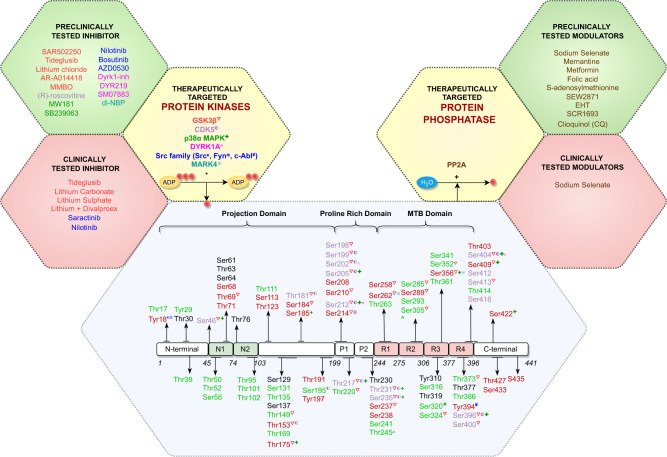
Protein kinases (PKs) have emerged as one of the most intensively investigated drug targets in current pharmacological research, with indications ranging from oncology to neurodegeneration. Tau protein hyperphosphorylation was the first pathological post-translational modification of tau protein described in Alzheimer’s disease (AD), highlighting the role of PKs in neurodegeneration. The therapeutic potential of protein kinase inhibitors (PKIs)) and protein phosphatase 2 A (PP2A) activators in AD has recently been explored in several preclinical and clinical studies with variable outcomes. Where a number of preclinical studies demonstrate a visible reduction in the levels of phospho-tau in transgenic tauopathy models, no reduction in neurofibrillary lesions is observed. Amongst the few PKIs and PP2A activators that progressed to clinical trials, most failed on the efficacy front, with only a few still unconfirmed and potential positive trends. This suggests that robust preclinical and clinical data is needed to unequivocally evaluate their efficacy. To this end, we take a systematic look at the results of preclinical and clinical studies of PKIs and PP2A activators, and the evidence they provide regarding the utility of this approach to evaluate the potential of targeting tau hyperphosphorylation as a disease modifying therapy.
Overview
The claims and statistics of this paper haven’t been checked yet.
Free: it reads the open-access text and checks the first 5 claims that cite a source we can check. Create a free account to check every claim.
Integrity signals
Registry
Cites
Statistics
Figures
Verification
Claims the paper makes
The claims and statistics of this paper haven’t been checked yet.
Free: it reads the open-access text and checks the first 5 claims that cite a source we can check. Create a free account to check every claim.
Claims other papers make about this one
Each is checked against this paper’s own text: does it say what the citing paper says it does?
The cited source says what the claim attributes to it.
In the citing paper
“Tideglusib (20), a non-ATP-competitive GSK-3β inhibitor, exhibits neuroprotective and anti-inflammatory properties.463”
From Recent advances in Alzheimer's disease: Mechanisms, clinical trials and new drug development strategies. (2024) · cites this paper as [463]
The check wasn’t confident either way, so it gives no verdict — never disputed.
In the citing paper
“Bepranemab is a humanised IgG4 monoclonal antibody that binds to the central region of the tau protein”
From Role of Tau Protein in Neurodegenerative Diseases and Development of Its Targeted Drugs: A Literature Review (2024) · cites this paper as [202]
Experimental — accuracy not yet measuredIn the citing paper
“semorinemab is an IgG4 antibody that targets extracellular tau to limit inflammatory microglial activation.”
From Role of Tau Protein in Neurodegenerative Diseases and Development of Its Targeted Drugs: A Literature Review (2024) · cites this paper as [202]
In the citing paper
“Various kinases that phosphorylate Tau protein have been documented, including GSK-3β, CDK5, MAPK (p38, ERK1/2 and JNK), casein kinase (CK), DYRK1A, MARK, PKA, PKB, PKC, CaMKII, and tyrosine kinases such as Src, Fyn, and c-Abl [153,154].”
In the citing paper
“However, no inhibitors have been established to effectively improve AD [154].”
Self-check
Percentages, sums and reported differences re-computed from the paper’s own numbers.
The self-check needs the paper’s full text.
Citations
Cites
1 retracted
Zaki, M. O., El-Desouky, S., Elsherbiny, D. A., Salama, M., & Azab, S. S. (2022) · Inflammopharmacology · doi:10.1007/s10787-022-01023-w · Cited by 12
RetractedNeuropathological stageing of Alzheimer-related changes.
Braak, H., & Braak, E. (1991) · Acta Neuropathologica · doi:10.1007/bf00308809 · Cited by 16,123
NIA‐AA Research Framework: Toward a biological definition of Alzheimer's disease
Jack, C. R., Bennett, D. A., Blennow, K., Carrillo, M. C., Dunn, B., Haeberlein, S. B., Holtzman, D. M., Jagust, W., Jessen, F., Karlawish, J., et al. (2018) · Alzheimer's & Dementia · doi:10.1016/j.jalz.2018.02.018 · Cited by 10,537
Amyloid oligomers exacerbate tau pathology in a mouse model of tauopathy
Selenica, M.-L. B., Brownlow, M., Jimenez, J. P., Lee, D. C., Pena, G., Dickey, C. A., Gordon, M. N., & Morgan, D. (2013) · Neurodegenerative Diseases · doi:10.1159/000337230 · Cited by 10,359
Triple-Transgenic Model of Alzheimer’s Disease with Plaques and Tangles
Oddo, S., Caccamo, A., Shepherd, J. D., Murphy, M. P., Golde, T. E., Kayed, R., Metherate, R., Mattson, M. P., Akbari, Y., & LaFerla, F. M. (2003) · Neuron · doi:10.1016/s0896-6273(03)00434-3 · Cited by 4,126 · cited 1×
“The commonly used triple mutant 3xTg-AD mouse model contains two mutations associated with familial AD, APP (KM670/671NL; Swedish), and PSEN1 (M146V), and one with fronto-temporal dementia (FTD), MAPT (P301L) [183].”
BackgroundGrundke-Iqbal, I., Iqbal, K., Tung, Y. C., Quinlan, M., Wisniewski, H. M., & Binder, L. I. (1986) · Proceedings of the National Academy of Sciences · doi:10.1073/pnas.83.13.4913 · Cited by 3,676
Self-citationNeurofibrillary tangles but not senile plaques parallel duration and severity of Alzheimer's disease
Arriagada, P. V., Growdon, J. H., Hedley-Whyte, E. T., & Hyman, B. T. (1992) · Neurology · doi:10.1212/wnl.42.3.631 · Cited by 2,668
Protein Misfolding, Amyloid Formation, and Human Disease: A Summary of Progress Over the Last Decade
Chiti, F., & Dobson, C. M. (2017) · Annual Review of Biochemistry · doi:10.1146/annurev-biochem-061516-045115 · Cited by 2,629 · cited 1×
“This creates conditions favourable for its unfolding, refolding, and misfolding into a tremendously large conformational ensemble that could potentially be capable of template-directed misfolding and aggregation [33, 34].”
BackgroundGoedert, M., Spillantini, M. G., Jakes, R., Rutherford, D., & Crowther, R. A. (1989) · Neuron · doi:10.1016/0896-6273(89)90210-9 · Cited by 2,492
Synapse Loss and Microglial Activation Precede Tangles in a P301S Tauopathy Mouse Model
Yoshiyama, Y., Higuchi, M., Zhang, B., Huang, S.-M., Iwata, N., Saido, T. C., Maeda, J., Suhara, T., Trojanowski, J. Q., & Lee, V. M.-Y. (2007) · Neuron · doi:10.1016/j.neuron.2007.01.010 · Cited by 2,208 · cited 2×
“It develops tangles in the neocortex, amygdala, hippocampus, brain stem and spinal cord at 6 months, with progressive accumulation thereafter [186].”
BackgroundInfluential
Research works printed but not linked: 1
- Serenó L Coma M Rodriguez M Sanchez-Ferrer P Sánchez MB Gich I A novel GSK-3β inhibitor reduces Alzheimer’s pathology and rescues neuronal loss in vivo Neurobiol Dis 2009 35 359 67 10.1016/j.nbd.2009.05.025 19523516 · DOI · Paper page
Cited by
Items 101–158 of 158
Blood-based biomarkers and early diagnosis of Alzheimer’s disease
Cui, Z., Li, G., Wei, S., Cheng, Q., Yu, Q., Zong, S., Zhang, P., Chen, H., Yu, S., Wu, S., et al. (2026) · Neural Regeneration Research · doi:10.4103/nrr.nrr-d-25-00759 · Cited by 1
“Elevated levels of phosphorylated tau181 (p-tau181) in CSF and plasma strongly correlate with tau pathology associated with AD (Basheer et al., 2023).”
Targeted Protein Degrader from Ginkgo to Mitigate Amyloid β-Induced Neurotoxicity
Dutta, B., Loo, S., Kam, A., Liu, C., & Tam, J. P. (2026) · Biochemistry · doi:10.1021/acs.biochem.5c00763 · Cited by 1
Zhong, P., Shaker, T., Li, P., & Yan, Z. (2026) · The Journal of Physiology · doi:10.1113/jp289018 · Cited by 1
“Targeting tau hyper-phosphorylation via kinase inhibition has been suggested as a strategy for AD treatment (Basheer et al., 2023; Turab Naqvi et al., 2020; Xia et al., 2021).”
Vijayalakshmi, A., & Vengadasamy, P. (2026) · CNS & Neurological Disorders - Drug Targets · doi:10.2174/0118715273448693251223103034 · Cited by 2
Hoffmann, D. B., Ahola, V., Huber, N., Natunen, T., Leskelä, S., Takalo, M., Martiskainen, H., Ballweg, S., Vorontsov, E. A., Selzer, S., et al. (2026) · Biomedicine & Pharmacotherapy · doi:10.1016/j.biopha.2026.119347 · Cited by 2
Gigant, B., Khodja, L. A., Campanacci, V., & Lippens, G. M. (2026) · Journal of Biological Chemistry · doi:10.1016/j.jbc.2026.113086 · Cited by 2
“…with both the � 300 N-terminal residues and the � 50 C-terminal residues of the 441-residue–long isoform being outside the MT. Interestingly, these regions of Tau comprise many phosphorylation sites associated with Alzheimer’s disease (92, 93) and targeted in particular by the Gsk3 β kinase (94).”
Setiawan, A. W., Choi, J. T., Park, S., Choi, M., Tjandrawinata, R. R., Hadinata, E., Park, M. N., Ikrar, T., Nurkolis, F., & Kim, B. (2026) · Pharmaceuticals · doi:10.3390/ph19050792 · Cited by 2
“These outcomes do not invalidate tau as a target; instead, they argue that tauopathy is a network pathology where upstream metabolic stress, inflammatory amplification, and impaired clearance can sustain tau dysfunction even if one molecular interaction is blocked [13].”
TogoPhosTAC as a delivery-ready platform for targeted protein dephosphorylation
Chen, Y.-Y., Ke, D.-T., Lee, Y., Chen, H., Lin, H.-Y., Yeh, C.-L., Ko, Y.-C., Tu, M., Yu, C., Hu, Z., et al. (2026) · Nature Communications · doi:10.1038/s41467-026-76725-8 · Cited by 2
“As multiple strategies are being pursued 79,89 – 92 , we propose that togoPhosTAC represents a mechanistically distinct strategy in this fi eld.”
Apolipoprotein E and Tau interaction in Alzheimer's disease
Chinnathambi, S., Adityan, A., Chidambaram, H., & Chandrashekar, M. (2024) · Advances in protein chemistry and structural biology · doi:10.1016/bs.apcsb.2024.10.003 · Cited by 13
Pradeepkiran, J. A., Kshirsagar, S., Alvir, R. V., Motakatla, P. I., & Reddy, P. H. (2025) · Biochimica et Biophysica Acta (BBA) - Molecular Basis of Disease · doi:10.1016/j.bbadis.2025.167850 · Cited by 1
Strategies for Neuroprotection in Alzheimer's Disease
Jasutkar, H. G. (2025) · Wiley eBooks · doi:10.1002/9783527844678.ch5 · Cited by 1
Joshi, M. D., van Falier, S. J. A., Tiggelaar, J., van Falier, S. J. A., & Sinnige, T. (2025) · bioRxiv (Cold Spring Harbor Laboratory) · doi:10.1101/2025.08.01.668095 · Cited by 1
“Post-translational modifications are known to play a key role in this pathological process, most notably phosphorylation (Alquezar et al., 2021; Basheer et al., 2023; Wegmann et al., 2021).”
Catestatin ameliorates tauopathy and amyloidogenesis via adrenergic inhibitionPreprint
Jati, S., Kal, S., Muñoz-Mayorga, D., Tang, K., Sahoo, D., Chen, X., & Mahata, S. K. (2026) · bioRxiv (Cold Spring Harbor Laboratory) · doi:10.64898/2026.01.04.697519 · Cited by 1
Frisch, C., Baker, L., Srinivasan, G., Mintah, A. E., Leyasi, S., Pedroza, M., Galyon, B., & Brafman, D. A. (2026) · Frontiers in Aging Neuroscience · doi:10.3389/fnagi.2026.1856154
“In particular, pTauS396 would be informative because phosphorylation at Ser396 is enriched in pathological tau isolated from AD brain, contributes to impaired microtubule binding, and is associated with paired helical filament tau (Basheer et al., 2023; Bramblett et al., 1993).”
Self-assembly of tau fragments as a key pathologic event in tauopathies
Le, L., Lee, J. H., & Lee, M. J. (2024) · Neural Regeneration Research · doi:10.4103/nrr.nrr-d-23-01720
“Tau phosphorylation, which weakens the electrostatic interactions between tau and axonal microtubules, has been a primary pharmacological target for AD treatment (Basheer et al., 2023).”
BackgroundVlasiou, M. C., Zacharia, L. C., Douni, E. K., & Papaneophytou, C. P. (2024) · Frontiers in Pharmacology · doi:10.3389/fphar.2024.1455646
Shahpasand, S., Khatami, S. H., Ehtiati, S., Salmani, F., Zarei, T., Shahpasand, K., Ghobeh, M., & Karima, S. (2024) · Biotechnology and Applied Biochemistry · doi:10.1002/bab.2660 · Cited by 1
Could Blood Transfusion Increase the Risk of Alzheimer’s Disease? A Narrative Review
Li, X., Pei, R., Fei, Z., Chen, Z., Lin, F., Sun, P., & Cao, H. (2025) · Healthcare · doi:10.3390/healthcare13050452
“Much evidence indicates that the pathological state of tau is closely related to the progression of cognitive impairment in patients with AD [16–18].”
Hu, Q., Xu, K. L., Ran, Q., Zhang, W., Gan, C., Fang, Q., & Hui, A. (2025) · SSRN Electronic Journal · doi:10.2139/ssrn.5186865
Hassan, M. I., & Sever, B. (2025) · Brain Research · doi:10.1016/j.brainres.2025.149956
Ishibashi, E., Araya, K., Nakamura, K., Shimamori, K., Uwai, K., Kuragano, M., & Tokuraku, K. (2025) · International Journal of Molecular Sciences · doi:10.3390/ijms262010122 · Cited by 2
“In vitro, tau serves as a substrate for numerous kinases, but only a very small number of kinases actually phosphorylate tau in vivo [12,13].”
Li, L.-J., Sun, X.-Y., Huang, Y., Lu, S., Xu, Y.-M., Yang, J., Xie, X.-X., Zhu, J., Niu, X.-Y., Wang, D., et al. (2024) · Figshare · doi:10.6084/m9.figshare.26488356
Therapeutics immunotargets for Tauopathy
Chinnathambi, S., & Rangappa, N. (2025) · Advances in protein chemistry and structural biology · doi:10.1016/bs.apcsb.2025.10.015
Khan, S., Choudhury, A., Shahid, M., Abuderman, A., Hassan, M. I., & Islam, A. (2025) · Journal of Molecular Liquids · doi:10.1016/j.molliq.2025.129124
Featherby, S. J., Faulkner, E. C., Gordon, A. D., & Ettelaie, C. (2026) · Cellular and Molecular Neurobiology · doi:10.1007/s10571-025-01658-7
“…al. 2019 ) and Tau expression, phosphorylation, diges - tion and aggregation have been implicated in the neuronal degeneration (Arai et al. 2005 ; Basheer et al. 2023 ; Fourest-Lieuvin et al. 2023 ; Kopke et al. 1993 ; Meredith et al. 2013; Neddens et al. 2018 ; Rawat et al. 2022 ; Santpere et…”
Reyna, A. A., & Panni, S. (2026) · Biomedicines · doi:10.3390/biomedicines14010147 · Cited by 1
“Since the accumulation of aberrantly hyperphosphorylated tau proteins is a hallmark of the disease [37], we analyzed the functional enrichment of Mapt interactors, which remarkably confirms a kinase-driven regulation for this protein, showing a significant enrichment of phosphorylation-related…”
Yakubu, A. O., Atafo, G. I., Nwaze, C. E., Bakare, T. Y., Adeniyi, T. O., Alare, K., Oladele, A. B., & Solagbade, O. S. (2026) · NeuroMarkers. · doi:10.1016/j.neumar.2026.100167 · Cited by 2
Drug Discovery for Alzheimer’s Disease: Current Status
Wolfe, M. S. (2026) · Topics in medicinal chemistry · doi:10.1007/7355_2026_186
Siddique, I. A., Hong, M., & Bitan, G. (2026) · Topics in medicinal chemistry · doi:10.1007/7355_2026_189
Choudhury, A., Saeed, M. U., Prabha, S., & Hassan, M. I. (2026) · ACS Chemical Neuroscience · doi:10.1021/acschemneuro.6c00097
Case Studies and Patents in Alzheimer’s Disease Research
Kumar, D., Anand, P., Tiwari, J., & Singh, S. N. (2026) · BENTHAM SCIENCE PUBLISHERS eBooks · doi:10.2174/9798898814953126010016
Recent Advances in Drug Development for the Management of Alzheimer’s Disease
Upadhyay, A., Singh, A. K., Jayaswal, N., Jaiswal, P., Singh, S. N., & Tewari, S. (2026) · BENTHAM SCIENCE PUBLISHERS eBooks · doi:10.2174/9798898814953126010014
Mathematical Modeling of Oxidative Stress in Alzheimer’s Disease: A Differential Equations Approach
Meteumba, L. G., & Yarahmadian, S. (2026) · Mathematics · doi:10.3390/math14081390 · Cited by 2
Lu, M. P., Rong, Y., Wang, J., Yu, X., Liu, H., Wu, Y., Zhang, M., Chen, Y., Li, Y., Yan, Y., et al. (2026) · Cells · doi:10.3390/cells15090793
“Given the central role of tau hyperphosphorylation in disease pathology, targeting tau phosphorylation has become an increasingly attractive therapeutic strategy for AD [14,15].”
Xu, Y., Yu, S., Wang, Y., Ke, J., Hong, Y., Wang, K., Song, G., Wang, Z., Chen, S., Yu, Y., et al. (2026) · Nano Research · doi:10.26599/nr.2026.94908783
Peptide Inhibitors of the Tau Protein Aggregation in Alzheimer’s Disease
Мартинович, В. П., & Gribovskaya, О. V. (2026) · Neurochemical Journal · doi:10.1134/s1819712426700029
Mokhtari, H., Ramazani, A., & Zarei, A. (2026) · Journal of Pharmaceutical Innovation · doi:10.1007/s12247-026-10818-1
“Owing to its contribution to tau protein phosphorylation, this protein was assumed to be an important piece of the puzzle in Alzheimer’s disease (AD) [2 ].”
Microtubule affinity-regulating kinases in neurodegenerative disorders
Shahwan, M. J., Anwar, S., Alrouji, M., AlOmeir, O., Dinislam, K., & Shamsi, A. (2026) · Elsevier eBooks · doi:10.1016/b978-0-443-44173-8.00014-0
Protein kinase C in neurodegenerative disorders
Hekmat, A., & Saboury, A. A. (2026) · Elsevier eBooks · doi:10.1016/b978-0-443-44173-8.00013-9
Small Molecules as Anti-Alzheimer’s Scaffolds
Hazra, R., Roy, S., Gayen, S., Parui, A., Arshad, A., Roy, N., & Sarkar, A. N. (2026) · BENTHAM SCIENCE PUBLISHERS eBooks · doi:10.2174/9798898815646126010013
New Insights into Drug Development and Immunotherapy for Alzheimer’s Disease
Gayen, S., Roy, S., Uddin, M. A., & Sukul, D. (2026) · BENTHAM SCIENCE PUBLISHERS eBooks · doi:10.2174/9798898815646126010014
Tau physiology and pathology: impacts on cellular structures and neurodegenerative diseases
Akbari, V., & Bahramikia, S. (2026) · Inflammopharmacology · doi:10.1007/s10787-026-02328-w
“Research into tau protein aggregation inhibitors is ongoing, and several potential drug candidates have been identified in preclinical studies (Khan et al. 2023; Shi and Zhao 2024 ; Basheer et al. 2023; Kam-mula et al. 2023).”
Cellular and molecular consequences of tau and amyloid-β in Alzheimers disease
Chinnathambi, S., & Prakash, L. E. (2026) · Advances in protein chemistry and structural biology · doi:10.1016/bs.apcsb.2026.07.003
The drug discovery landscape of Alzheimer’s disease
Chinnathambi, S., & Prakash, L. E. (2026) · Advances in protein chemistry and structural biology · doi:10.1016/bs.apcsb.2026.07.005
Aggarwal, P., & Sarkar, S. (2026) · Biochimica et Biophysica Acta (BBA) - Molecular Basis of Disease · doi:10.1016/j.bbadis.2026.168393
Concordance between plasma biomarkers of phosphorylated tau and tau-PET: A narrative review
van Houwelingen, A., Vernooij, M. W., Vermeiren, M. R., Ossenkoppele, R., van de Giessen, E., Seelaar, H., & Neitzel, J. (2026) · Journal of Alzheimer s Disease · doi:10.1177/13872877261468708
“40,55 While such differential kinase activation could contribute to a temporal ordering of tau phosphorylation, the extent to which this explains plasma p-tau biomarker dynamics remains to be explored.”
Raj, S. N., Natnan, M. E., Lou, W. P., Mediani, A., Tencomnao, T., & Baharum, S. N. (2026) · Molecular Biology Reports · doi:10.1007/s11033-026-12565-5
Gujral, J., Gandhi, O. H., Bhogale, T., Amanullah, A. A., Srivastava, A., Singh, S. B., Werner, T. J., Høilund‐Carlsen, P. F., & Alavi, A. A. (2026) · Journal of Imaging · doi:10.3390/jimaging12090423
“PP2A is a major serine/threonine phosphatase and the dominant tau phosphatase in human brain, and PPP2R2B encodes a B55 regulatory subunit that directs PP2A holoenzyme activity toward particular substrates, including tau [63,64].”
Liu, S., Ren, L., Liu, L., Chen, L., Zhang, Y., Wang, P., & Xie, G. (2026) · Journal of Ethnopharmacology · doi:10.1016/j.jep.2026.122380
Zhao, J., Zhang, S., Gao, D., Xie, L., Wang, Y., & Peng, D. (2026) · Brain Research Bulletin · doi:10.1016/j.brainresbull.2026.112116
Catestatin peptide ameliorates tauopathy and amyloidogenesis via adrenergic inhibition
Jati, S., Kal, S., Muñoz-Mayorga, D., Tang, K., Sahoo, D., Chen, X., & Mahata, S. K. (2026) · Molecular Therapy · doi:10.1016/j.ymthe.2026.09.022 · Cited by 1
Pereira, M. V. D. S., Alfredo, L. H. M., de Moraes, M. N., & de Jesus, J. R. (2026) · Advances in pharmacology · doi:10.1016/bs.apha.2026.08.004
Changjian, W., Furui, W., Yanyu, F., Yü, Y., & Wei, J. (2026) · Experimental Neurology · doi:10.1016/j.expneurol.2026.116058
Sharma, R., Kumar, G., & Thakur, A. (2026) · Inflammopharmacology · doi:10.1007/s10787-026-02433-w
Poonam, Rana, R., Thakur, M., Sharma, A., Pannu, S., Sharma, S., Naman, S., Rani, S., Devi, D., Kumar, V., et al. (2026) · Frontiers in Oncology · doi:10.3389/fonc.2026.1908830
“According to the study, using the medication by itself was generally safe and showed promise (108, 192, 193).”
Nadholta, P., Volety, I., & Shukla, D. (2026) · Virology · doi:10.1016/j.virol.2026.111113
Choi, J. H., Baek, W. J., Kim, S., & Shin, M. (2026) · Nutrients · doi:10.3390/nu18213517
Developing precision nanoparticle-based drug delivery systems for Alzheimer's disease therapy
Shan, Q., Zheng, W., Yao, W., Bai, Y., Ding, W., Wang, J., & Bai, F. (2026) · Materials Today Bio · doi:10.1016/j.mtbio.2026.103789
Metadata
- Authors
- Basheer, N., Smolek, T., Hassan, I., Liu, F., Iqbal, K., Zilka, N., & Novak, P.
- Affiliations
- Slovak Academy of Sciences (SK)
- Venue
- Molecular Psychiatry
- Published
- 2023-06
- Volume
- 28
- Issue
- 6
- Pages
- 2197-2214
- ISSN
- 1359-4184 (ISSN-L)
- 1476-5578
- PMC
- PMC10611587
- OpenAlex
- W4379093931
- Semantic Scholar
- 2523bf568d348c2febee9b9c90bdb39431bf1ae8
- Cited by
- 159
- References
- 222
- Citations by year
- 2026: 57 · 2025: 56 · 2024: 43 · 2023: 3
- FWCI
- 5.65
- Type
- journal article
- Language
- en
- Open access
- hybrid
- doi.org
- Licence
- cc-by
- creativecommons.org/licenses/by/4.0 (tdm)
- creativecommons.org/licenses/by/4.0 (vor, 1 d)
- Locations
- Molecular Psychiatry (publishedVersion, cc-by)
- PubMed Central (publishedVersion, cc-by)
- PubMed (publishedVersion)
- Funders
- Ministerstvo školstva, vedy, výskumu a športu Slovenskej republiky
- Agentúra na Podporu Výskumu a Vývoja (APVV-20-0447, APVV-20-)
- Topics
- Life Sciences › Neuroscience › Cellular and Molecular Neuroscience › Alzheimer's disease research and treatments
- Health Sciences › Medicine › Psychiatry and Mental health › Dementia and Cognitive Impairment Research
- Health Sciences › Medicine › Pharmacology (medical) › Cholinesterase and Neurodegenerative Diseases
- Keywords
- tau hyperphosphorylation, Alzheimer's disease, protein kinase inhibitors, PP2A activators, protein kinases, disease-modifying therapy, neurofibrillary tangles, clinical trial results, preclinical drug testing
- MeSH terms
- Alzheimer Disease, Humans, Phosphorylation, Protein Kinases, tau Proteins, Tauopathies, Protein Phosphatase 2
About these checks
Registry, retraction, Cites and statistics results are computed, not judged, with one exception: a printed reference that no index lists is read once by a model before it counts as a citation error. Claims are extracted by a model and kept only when their quote appears verbatim in the text; each cited source is then checked, with a model’s help, for whether it says what the claim relies on. Those verdicts can be wrong — read the claim’s quote and the cited source before relying on one.
Statistics and arithmetic are recomputed, not judged.
Confidence bands are shown only for fields calibrated on our annotated test set. None is calibrated yet, so no band is shown.
What counts as a claim ›How we measure confidence ›How we check this ›
Are you an author, or do you see a problem with this page? Request a review
Data sources
Bibliographic data: Semantic Scholar, OpenAlex, Crossref.
Contains information from the Semantic Scholar Academic Graph Datasets, made available under the ODC Attribution License (ODC-BY 1.0).
Semantic Scholar’s data is described in: Kinney, R., et al. (2023). The Semantic Scholar Open Data Platform. arXiv:2301.10140.
