

Chronic escitalopram in healthy volunteers has specific effects on reinforcement sensitivity: a double-blind, placebo-controlled semi-randomised study
Open accessThe DOI matches its Crossref record; 58 of the 64 references it cites were found in a registry or an index; 38 of the 73 sources its claims cite were checked for support.
Abstract
Several studies of the effects on cognition of selective serotonin reuptake inhibitors (SSRI), administered either acutely or sub-chronically in healthy volunteers, have found changes in learning and reinforcement outcomes. In contrast, to our knowledge, there have been no studies of chronic effects of escitalopram on cognition in healthy volunteers. This is important in view of its clinical use in major depressive disorder (MDD) and obsessive-compulsive disorder (OCD). Consequently, we aimed to investigate the chronic effect of the SSRI, escitalopram, on measures of 'cold' cognition (including inhibition, cognitive flexibility, memory) and 'hot cognition' including decision-making and particularly reinforcement learning. The study, conducted at the University of Copenhagen between May 2020 and October 2021, used a double-blind placebo-controlled design with 66 healthy volunteers, semi-randomised to receive either 20 mg of escitalopram (n = 32) or placebo (n = 34), balanced for age, sex and intelligence quotient (IQ) for at least 21 days. Questionnaires, neuropsychological tests and serum escitalopram measures were taken. We analysed group differences on the cognitive measures using linear regression models as well as innovative hierarchical Bayesian modelling of the Probabilistic Reversal Learning (PRL) task. The novel and important finding was that escitalopram reduced reinforcement sensitivity compared to placebo on both the Sequential Model-Based/Model-Free task and the PRL task. We found no other significant group differences on 'cold' or 'hot' cognition. These findings demonstrate that serotonin reuptake inhibition is involved in reinforcement learning in healthy individuals. Lower reinforcement sensitivity in response to chronic SSRI administration may reflect the 'blunting' effect often reported by patients with MDD treated with SSRIs. Trial Registration: NCT04239339 .
Overview
CoChat Summary
TL;DR
In healthy volunteers, chronic escitalopram (20 mg daily for at least 21 days) reduced reinforcement sensitivity on two independent reinforcement-learning tasks compared with placebo, without affecting other ‘cold’ or ‘hot’ cognitive measures. The authors suggest this may relate to the clinical ‘blunting’ effect reported by patients on chronic SSRIs.
Key findings
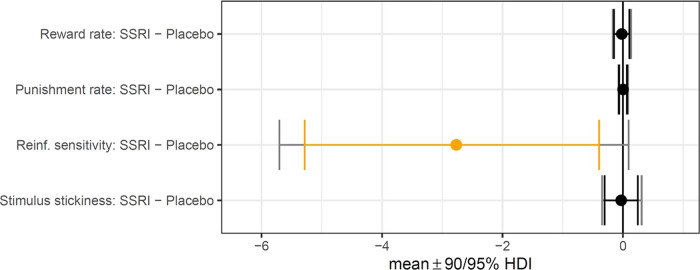
- Escitalopram reduced reinforcement sensitivity in hierarchical Bayesian modelling of the Probabilistic Reversal Learning task: mean difference = −2.77 [90% HDI, −5.29 to −0.40].
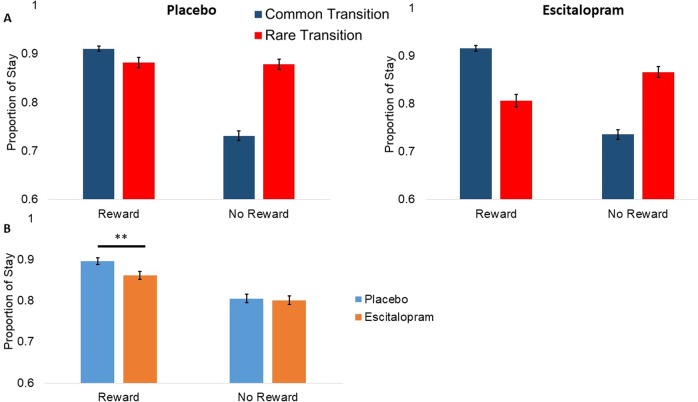
- Escitalopram also reduced reinforcement sensitivity on the Sequential Model-Based/Model-Free task: Reward × Group interaction estimated coefficient = −0.34, p < 0.01, 95% CI [−0.57 to −0.11].
- There were no significant group differences for reward learning rate, punishment learning rate, or stimulus stickiness in the PRL model, and no significant group differences on any ‘hot’ or ‘cold’ cognitive outcomes that survived multiple comparisons.
- The escitalopram group had significantly higher dysfunction on CSFQ-14 orgasm/ejaculation dimension 5 and phase 3: t(42.25) = 2.68, p = 0.01, Cohen’s d = 0.68; there was no sex difference for the change score.
Methods
- Double-blind, placebo-controlled, semi-randomised study with 66 healthy volunteers: 32 received escitalopram 20 mg daily and 34 received placebo for at least 21 days (escitalopram mean(s.d.) = 26.06(2.78) days; placebo = 26.09(3.29) days); participants were matched for age, sex, and IQ.
- Participants completed questionnaires and an extensive neuropsychological battery assessing ‘cold’ and ‘hot’ cognition, including Probabilistic Reversal Learning, Sequential Model-Based/Model-Free, stop-signal/go-no-go, set-shifting, memory, attention, decision-making, social cognition, and emotion tasks; serum escitalopram was measured by UPLC-MS/MS.
- Group comparisons used linear regression models with age, sex, IQ, and baseline reaction time as covariates, with Benjamini-Hochberg FDR q = 0.05; PRL data were analysed with hierarchical Bayesian reinforcement-learning models, and MBMF data with generalised linear mixed-effects regression.
Limitations
- The paper states there was a significant difference in guessing group allocation: 53% of the escitalopram group correctly guessed escitalopram, whereas 15.6% of the placebo group guessed escitalopram (χ2(1, N = 65) = 10.46, p = 0.01); the authors note the escitalopram group was at chance level and argue results are unlikely affected given the lack of cognitive changes and specificity of the effect.
- The authors state they cannot rule out that neuroplasticity effects might be greater with a longer duration of escitalopram, and that there is no reliable non-invasive way to determine interstitial serotonin concentrations in humans, making interpretation inferential.
- The authors note the sample was cognitively high-performing (average IQ > 110) healthy volunteers, so effects may differ from patients with MDD; they also report that exact sample sizes varied slightly across tasks due to technical issues and time constraints.
Model-written summary. Check it against the paper before relying on it.
Integrity signals
Registry
Cites
Statistics
Figures
Verification
Claims the paper makes
27 Valid · 1 Not valid · 12 Not checked · 32 Own results and interpretations
The cited sources support only part of this claim — read each source’s verdict below.
In the paper
“Lower reinforcement sensitivity in response to chronic SSRI administration may reflect the ‘blunting’ effect often reported by patients with MDD treated with SSRIs.”
§ Chronic escitalopram in healthy volunteers has specific effects on reinforcement sensitivity: a double-blind, placebo-controlled semi-randomised study > Abstract
What the sources say
- Not checked — no full text of the sourcecites [40] Barnhart WJ Makela EH Latocha MJ SSRI-induced apathy syndrome: a clinical review J Psychiatr Pract 2004 10 196 9 10.1097/00131746-200405000-00010 15330228 source
- Partly supportedcites [41] Price J Cole V Goodwin GM Emotional side-effects of selective serotonin reuptake inhibitors: qualitative study Br J Psychiatry 2009 195 211 7 10.1192/bjp.bp.108.051110 19721109 sourceExperimental — accuracy not yet measured
The Background and Discussion report that some people taking SSRIs describe emotional blunting, and that participants attributed reduced emotional intensity to their medication. The Discussion also says the study cannot establish how common these effects are or draw robust causal conclusions. It does not test whether lower reinforcement sensitivity reflects emotional blunting, so the proposed link and the word “often” go beyond this source. (LLM, conf=0.86)
- Not matchedcites [42] Marazziti D Mucci F Tripodi B Carbone MG Muscarella A Falaschi V Emotional blunting, cognitive impairment, bone fractures, and bleeding as possible side effects of long-term use of SSRIs Clin Neuropsychiatry 2019 16 75 34908941 PMC8650205
Its entry has no title and year that we can search by.
hedgedstates a possible cause- Asserted: passes — The authors put it forward as true.
- Checkable: passes — It can be checked against evidence.
- Load-bearing: passes — The paper’s conclusions depend on it.
- Based: passes — The paper gives a reason why it holds.
The sources with a verdict support this claim; the rest weren’t checked yet, have no full text we could read, or their verdicts aren’t rated yet.
In the paper
“Currently, only a few studies have examined SSRIs administered sub-chronically, over approximately 7 days [24, 25].”
§ Chronic escitalopram in healthy volunteers has specific effects on reinforcement sensitivity: a double-blind, placebo-controlled semi-randomised study > Introduction
What the sources say
- Not checked — no full text of the sourcecites [24] Harmer CJ Shelley NC Cowen PJ Goodwin GM Increased positive versus negative affective perception and memory in healthy volunteers following selective serotonin and norepinephrine reuptake inhibition Am J Psychiatry 2004 161 1256 63 10.1176/appi.ajp.161.7.1256 15229059 source
- Supportedcites [25] Michely J Eldar E Erdman A Martin IM Dolan RJ Serotonin modulates asymmetric learning from reward and punishment in healthy human volunteers Commun Biol 2022 5 1 9 10.1038/s42003-022-03690-5 35962142 PMC9374781 source
The Methods (Pharmacological procedure; page unavailable) describe daily administration of the SSRI citalopram for seven consecutive days, making this paper an example of the studies cited. The Introduction also says SSRI studies of learning asymmetries had mainly used single-dose administration or clinical populations, though that observation is specific to learning asymmetries. (LLM, conf=0.88)
plain- Asserted: passes — The authors put it forward as true.
- Checkable: passes — It can be checked against evidence.
- Load-bearing: passes — The paper’s conclusions depend on it.
- Based: passes — The paper gives a reason why it holds.
Every source the paper cites for this claim was checked and supports it.
In the paper
“Specifically, participants receiving 7 days of SSRI had lower neural processing of both rewarding and aversive stimuli [43].”
§ Chronic escitalopram in healthy volunteers has specific effects on reinforcement sensitivity: a double-blind, placebo-controlled semi-randomised study > Discussion > Reinforcement behaviour
What the sources say
- Supportedcites [43] McCabe C Mishor Z Cowen PJ Harmer CJ Diminished neural processing of aversive and rewarding stimuli during selective serotonin reuptake inhibitor treatment Biol Psychiatry 2010 67 439 45 10.1016/j.biopsych.2009.11.001 20034615 PMC2828549 source
The Discussion states that seven days of SSRI treatment diminished neural processing of both rewarding and aversive stimuli. The Methods identify the participants as healthy volunteers assigned to citalopram, reboxetine, or placebo. (LLM, conf=0.95)
plainstates a cause- Asserted: passes — The authors put it forward as true.
- Checkable: passes — It can be checked against evidence.
- Load-bearing: passes — The paper’s conclusions depend on it.
- Based: passes — The paper gives a reason why it holds.
- Supported
The cited sources support only part of this claim — read each source’s verdict below.
In the paper
“In addition, there is some evidence that the neuroplasticity effects of SSRIs emerge only after more chronic administration (14–21 days) [29, 30].”
§ Chronic escitalopram in healthy volunteers has specific effects on reinforcement sensitivity: a double-blind, placebo-controlled semi-randomised study > Introduction
What the sources say
- Partly supportedcites [29] Nibuya M Morinobu S Duman RS Regulation of BDNF and trkB mRNA in rat brain by chronic electroconvulsive seizure and antidepressant drug treatments J Neurosci 1995 15 7539 47 10.1523/JNEUROSCI.15-11-07539.1995 7472505 PMC6578063 sourceExperimental — accuracy not yet measured
In “Chronic antidepressant drug treatments increase the expression of BDNF and trkB mRNA” (page not provided), sertraline, an SSRI, increased these markers in rat hippocampus after 21 days, whereas acute treatment did not significantly increase BDNF mRNA. The paper does not test a 14-day course or establish when the effects first emerge, and its measured outcome is gene expression rather than neuroplasticity more broadly. (LLM, conf=0.84)
- Not checked — no full text of the sourcecites [30] De Foubert G Carney SL Robinson CS Destexhe EJ Tomlinson R Hicks CA Fluoxetine-induced change in rat brain expression of brain-derived neurotrophic factor varies depending on length of treatment Neuroscience. 2004 128 597 604 10.1016/j.neuroscience.2004.06.054 15381288 source
hedgedstates a possible cause- Asserted: passes — The authors put it forward as true.
- Checkable: passes — It can be checked against evidence.
- Load-bearing: passes — The paper’s conclusions depend on it.
- Based: passes — The paper gives a reason why it holds.
- Partly supported
The sources with a verdict support this claim; the rest weren’t checked yet, have no full text we could read, or their verdicts aren’t rated yet.
In the paper
“Patients’ often report experiencing a ‘blunting’ effect [40–42].”
§ Chronic escitalopram in healthy volunteers has specific effects on reinforcement sensitivity: a double-blind, placebo-controlled semi-randomised study > Discussion > Reinforcement behaviour
What the sources say
- Not checked — no full text of the sourcecites [40] Barnhart WJ Makela EH Latocha MJ SSRI-induced apathy syndrome: a clinical review J Psychiatr Pract 2004 10 196 9 10.1097/00131746-200405000-00010 15330228 source
- Supportedcites [41] Price J Cole V Goodwin GM Emotional side-effects of selective serotonin reuptake inhibitors: qualitative study Br J Psychiatry 2009 195 211 7 10.1192/bjp.bp.108.051110 19721109 source
The introduction says that some people taking SSRIs mention a ‘blunting of emotions.’ In ‘General effects on all emotions,’ most participants described their emotions as flattened or dulled, supporting the paraphrase for patients taking SSRIs. (LLM, conf=0.92)
- Not matchedcites [42] Marazziti D Mucci F Tripodi B Carbone MG Muscarella A Falaschi V Emotional blunting, cognitive impairment, bone fractures, and bleeding as possible side effects of long-term use of SSRIs Clin Neuropsychiatry 2019 16 75 34908941 PMC8650205
Its entry has no title and year that we can search by.
plain- Asserted: passes — The authors put it forward as true.
- Checkable: passes — It can be checked against evidence.
- Load-bearing: passes — The paper’s conclusions depend on it.
- Based: passes — The paper gives a reason why it holds.
17 more claims
Create a free account to see all 72 claims and to verify the 3 references still open.
- Probably not a substantial claim. 38
- It may state two separate claims as one. 25
Claims other papers make about this one
Each is checked against this paper’s own text: does it say what the citing paper says it does?
The source backs part of the claim, not all of it — or backs it for a different population, condition or comparison.
In the citing paper
“In contrast, escitalopram, while effective in alleviating depressive symptoms, has shown limited evidence of cognitive enhancement [9].”
From Efficacy of Vortioxetine Versus Escitalopram on the Cognitive Profile of Patients With Depressive Disorder: A Comparative Study (2025) · cites this paper as [9]
Experimental — accuracy not yet measured
Statistics recomputed
Every reported test result, recomputed from its test statistic and degrees of freedom. A result shows as not adding up only once an independent check has confirmed it.
- Consistentt(63) = 0.04reported p = .97 · recomputed p = .968
“t(63) = 0.04, p = .97”
- Consistentχ²(1) = 10.46reported p = .01 · recomputed p = .001
“χ2 (1, N = 65) = 10.46, p = .01”
The paper prints p at a floor (such as p < .001)
- Consistentt(42.25) = 2.68reported p = .01 · recomputed p = .010
“t (42.25) = 2.68, p = .01”
- Consistentt(42.25) = 2.68reported p = .01 · recomputed p = .010
“t(42.25) = 2.68, p = .01”
- Consistentt(64) = -1.15reported p = .25 · recomputed p = .254
“t(64) = −1.15, p = .25”
Self-check
Percentages, sums and reported differences re-computed from the paper’s own numbers.
Self-check results appear here once an independent check has confirmed them.
Citations
Cites
Controlling the False Discovery Rate: A Practical and Powerful Approach to Multiple Testing
Benjamini, Y., & Hochberg, Y. (1995) · Journal of the Royal Statistical Society Series B: Statistical Methodology · doi:10.1111/j.2517-6161.1995.tb02031.x · Cited by 109,482
(1998) · PubMed · Cited by 10,216
Nibuya, M., Morinobu, S., & Duman, R. (1995) · The Journal of Neuroscience · doi:10.1523/jneurosci.15-11-07539.1995 · Cited by 2,109 · cited 2×
“In addition, acute administration of SSRIs does not seem to affect neuroplasticity, which does occur when administered chronically [29, 30].”
BackgroundFu, C. H. Y., Williams, S. C. R., Cleare, A. J., Brammer, M. J., Walsh, N. D., Kim, J., Andrew, C. M., Pich, E. M., Williams, P. M., Reed, L. J., et al. (2004) · Archives of General Psychiatry · doi:10.1001/archpsyc.61.9.877 · Cited by 775
Serotoninergic regulation of emotional and behavioural control processes
Cools, R., Roberts, A. C., & Robbins, T. W. (2008) · Trends in Cognitive Sciences · doi:10.1016/j.tics.2007.10.011 · Cited by 656 · cited 1×
“INTRODUCTION Serotonin or 5-hydroxytryptamine (5-HT) is a monoamine neurotransmitter implicated in several cognitive and affective brain functions [1].”
BackgroundSelf-citationCognitive Inflexibility After Prefrontal Serotonin Depletion
Clarke, H. F., Dalley, J. W., Crofts, H. S., Robbins, T. W., & Roberts, A. C. (2004) · Science · doi:10.1126/science.1094987 · Cited by 632 · cited 1×
“In marmoset monkeys, targeted neurotoxic serotonin depletion of the orbito-frontal cortex, but not of the caudate nucleus, consistently produced reversal deficits [5, 6].”
BackgroundSelf-citationHow do antidepressants work? New perspectives for refining future treatment approaches
Harmer, C. J., Duman, R. S., & Cowen, P. J. (2017) · The Lancet Psychiatry · doi:10.1016/s2215-0366(17)30015-9 · Cited by 616
Neurochemical Modulation of Response Inhibition and Probabilistic Learning in Humans
Chamberlain, S. R., Müller, U., Blackwell, A. D., Clark, L., Robbins, T. W., & Sahakian, B. J. (2006) · Science · doi:10.1126/science.1121218 · Cited by 573 · cited 3×
“One study showed that response inhibition improved with SSRI administration [20], whereas another showed no effect [19].”
BackgroundSelf-citationHarmer, C. J., Shelley, N. C., Cowen, P. J., & Goodwin, G. M. (2004) · American Journal of Psychiatry · doi:10.1176/appi.ajp.161.7.1256 · Cited by 554
Harmer, C. J., Goodwin, G. M., & Cowen, P. J. (2009) · British Journal of Psychiatry · doi:10.1192/bjp.bp.108.051193 · Cited by 542
Cognitive Mechanisms of Treatment in Depression
Roiser, J. P., Elliott, R., & Sahakian, B. J. (2012) · Neuropsychopharmacology · doi:10.1038/npp.2011.183 · Cited by 535 · cited 1×
“Understanding the modulatory role of serotonin on cognition and reinforcement learning is particularly important [3].”
BackgroundSelf-citationSerotonin selectively influences moral judgment and behavior through effects on harm aversion
Crockett, M. J., Clark, L., Hauser, M. D., & Robbins, T. W. (2010) · Proceedings of the National Academy of Sciences · doi:10.1073/pnas.1009396107 · Cited by 526 · cited 2×
“probabilistic learning [19, 20], and impaired cognitive flexibility [20], but increased long-term memory recall [21], emotion recognition [22], and harm aversion for moral judgements [23].”
BackgroundResultSelf-citationMontejo-gonzàlez, A. L., Llorca, G., Izquierdo, J. A., Ledesma, A., Bousono, M., Calcedo, A., Carrasco, J. L., Ciudad, J., Daniel, E., De LA Gandara, J., et al. (1997) · Journal of Sex & Marital Therapy · doi:10.1080/00926239708403923 · Cited by 505
Stahl's Essential Psychopharmacology: Neuroscientific Basis and Practical Applications
Stahl, S. M. (2021) · doi:10.1017/9781108975292 · Cited by 480
Serotonin Modulates Behavioral Reactions to Unfairness
Crockett, M. J., Clark, L., Tabibnia, G., Lieberman, M. D., & Robbins, T. W. (2008) · Science · doi:10.1126/science.1155577 · Cited by 421
Self-citationAcute SSRI Administration Affects the Processing of Social Cues in Healthy Volunteers
Harmer, C. J., Bhagwagar, Z., Perrett, D. I., Völlm, B. A., Cowen, P. J., & Goodwin, G. M. (2003) · Neuropsychopharmacology · doi:10.1038/sj.npp.1300004 · Cited by 420 · cited 2×
“probabilistic learning [19, 20], and impaired cognitive flexibility [20], but increased long-term memory recall [21], emotion recognition [22], and harm aversion for moral judgements [23].”
BackgroundMcCabe, C., Mishor, Z., Cowen, P. J., & Harmer, C. J. (2010) · Biological Psychiatry · doi:10.1016/j.biopsych.2009.11.001 · Cited by 365 · cited 1×
“Specifically, participants receiving 7 days of SSRI had lower neural processing of both rewarding and aversive stimuli [43].”
Emotional side-effects of selective serotonin reuptake inhibitors: qualitative study
Price, J., Cole, V., & Goodwin, G. M. (2009) · British Journal of Psychiatry · doi:10.1192/bjp.bp.108.051110 · Cited by 362
Clarke, H., Walker, S., Dalley, J., Robbins, T., & Roberts, A. (2006) · Cerebral Cortex · doi:10.1093/cercor/bhj120 · Cited by 351
Self-citationBari, A., Theobald, D. E., Caprioli, D., Mar, A. C., Aidoo-Micah, A., Dalley, J. W., & Robbins, T. W. (2010) · Neuropsychopharmacology · doi:10.1038/npp.2009.233 · Cited by 325 · cited 1×
“In rats, impairing serotonin function disrupted reversal learning, whereas enhancing serotonin function improved reversal learning [4].”
BackgroundSelf-citationTryptophan depletion in normal volunteers produces selective impairments in learning and memory
Park, S. B., Coull, J. T., McShane, R. H., Young, A. H., Sahakian, B. J., Robbins, T. W., & Cowen, P. J. (1994) · Neuropharmacology · doi:10.1016/0028-3908(94)90089-2 · Cited by 310 · cited 1×
“Effects of ATD have also been seen on reinforcement behaviour [13], reversal learning [9, 14], learning and memory [15], affective and social cognition [9, 16, 17] and moral judgement [18].”
BackgroundSelf-citationNeural Responses to Happy Facial Expressions in Major Depression Following Antidepressant Treatment
Fu, C. H. Y., Williams, S. C. R., Brammer, M. J., Suckling, J., Kim, J., Cleare, A. J., Walsh, N. D., Mitterschiffthaler, M. T., Andrew, C. M., Pich, E. M., et al. (2007) · American Journal of Psychiatry · doi:10.1176/ajp.2007.164.4.599 · Cited by 288
Gronau, Q. F., Sarafoglou, A., Matzke, D., Ly, A., Boehm, U., Marsman, M., Leslie, D. S., Forster, J. J., Wagenmakers, E.-J., & Steingroever, H. (2017) · Journal of Mathematical Psychology · doi:10.1016/j.jmp.2017.09.005 · Cited by 284
Decker, J. H., Otto, A. R., Daw, N. D., & Hartley, C. A. (2016) · Psychological Science · doi:10.1177/0956797616639301 · Cited by 263
The effects of tryptophan depletion on cognitive and affective processing in healthy volunteers
Murphy, F., Smith, K., Cowen, P., Robbins, T., & Sahakian, B. (2002) · Psychopharmacology · doi:10.1007/s00213-002-1128-9 · Cited by 255 · cited 1×
“Effects of ATD have also been seen on reinforcement behaviour [13], reversal learning [9, 14], learning and memory [15], affective and social cognition [9, 16, 17] and moral judgement [18].”
BackgroundSelf-citationDissociable Effects of Dopamine and Serotonin on Reversal Learning
den Ouden, H. E. M., Daw, N. D., Fernandez, G., Elshout, J. A., Rijpkema, M., Hoogman, M., Franke, B., & Cools, R. (2013) · Neuron · doi:10.1016/j.neuron.2013.08.030 · Cited by 255
Serotonin Selectively Modulates Reward Value in Human Decision-Making
Seymour, B., Daw, N. D., Roiser, J. P., Dayan, P., & Dolan, R. (2012) · The Journal of Neuroscience · doi:10.1523/jneurosci.0053-12.2012 · Cited by 252 · cited 3×
“Effects of ATD have also been seen on reinforcement behaviour [13], reversal learning [9, 14], learning and memory [15], affective and social cognition [9, 16, 17] and moral judgement [18].”
Backgroundde Foubert, G., Carney, S. L., Robinson, C. S., Destexhe, E. J., Tomlinson, R., Hicks, C. A., Murray, T. K., Gaillard, J. P., Deville, C., Xhenseval, V., et al. (2004) · Neuroscience · doi:10.1016/j.neuroscience.2004.06.054 · Cited by 249
SSRI-induced apathy syndrome: a clinical review
BARNHART, W. J., MAKELA, E. H., & LATOCHA, M. J. (2004) · Journal of Psychiatric Practice · doi:10.1097/00131746-200405000-00010 · Cited by 170
Hayward, G., Goodwin, G. M., Cowen, P. J., & Harmer, C. J. (2005) · Biological Psychiatry · doi:10.1016/j.biopsych.2004.11.016 · Cited by 162 · cited 14×
“Lower reinforcement sensitivity in response to chronic SSRI administration may reflect the ‘blunting’ effect often reported by patients with MDD treated with SSRIs.”
BackgroundInfluentialSchaefer, H. S., Putnam, K. M., Benca, R. M., & Davidson, R. J. (2006) · Biological Psychiatry · doi:10.1016/j.biopsych.2006.03.024 · Cited by 158
Opbroek, A., Delgado, P. L., Laukes, C., McGahuey, C., Katsanis, J., Moreno, F. A., & Manber, R. (2002) · The International Journal of Neuropsychopharmacology · doi:10.1017/s1461145702002870 · Cited by 147 · cited 1×
“It is possible that participants taking escitalopram experience greater sexual dysfunction due to experiencing less pleasure, which has been supported by previous reports [44].”
ResultWorbe, Y., Savulich, G., Voon, V., Fernandez-Egea, E., & Robbins, T. W. (2014) · Neuropsychopharmacology · doi:10.1038/npp.2013.351 · Cited by 125
Self-citationAcute administration of citalopram facilitates memory consolidation in healthy volunteers
Harmer, C. J., Bhagwagar, Z., Cowen, P. J., & Goodwin, G. M. (2002) · Psychopharmacology · doi:10.1007/s00213-002-1151-x · Cited by 112 · cited 1×
“probabilistic learning [19, 20], and impaired cognitive flexibility [20], but increased long-term memory recall [21], emotion recognition [22], and harm aversion for moral judgements [23].”
BackgroundKanen, J. W., Ersche, K. D., Fineberg, N. A., Robbins, T. W., & Cardinal, R. N. (2019) · Psychopharmacology · doi:10.1007/s00213-019-05325-w · Cited by 101 · cited 2×
“Finally, for the Probabilistic Reversal Learning Task, we used an innovative computational modelling approach, by fitting families of hierarchical Bayesian reinforcement learning models to trial-by-trial task data [35, 36].”
BackgroundMethodSelf-citationSkandali, N., Rowe, J. B., Voon, V., Deakin, J. B., Cardinal, R. N., Cormack, F., Passamonti, L., Bevan-Jones, W. R., Regenthal, R., Chamberlain, S. R., et al. (2018) · Neuropsychopharmacology · doi:10.1038/s41386-018-0229-z · Cited by 89
Self-citationRygula, R., Clarke, H. F., Cardinal, R. N., Cockcroft, G. J., Xia, J., Dalley, J. W., Robbins, T. W., & Roberts, A. C. (2015) · Cerebral Cortex · doi:10.1093/cercor/bhu102 · Cited by 85 · cited 1×
“Marmosets have also shown reduced reinforcement sensitivity following serotonin depletion [7].”
BackgroundInfluentialSelf-citationClevenger, S. S., Malhotra, D., Dang, J., Vanle, B., & IsHak, W. W. (2018) · Therapeutic Advances in Psychopharmacology · doi:10.1177/2045125317737264 · Cited by 83 · cited 1×
“Drugs that target serotonin transmission, such as selective serotonin reuptake inhibitors (SSRIs) are the first-line pharmacological treatments for many neuropsychiatric disorders such as major depressive disorder (MDD), obsessive-compulsive disorder (OCD) and anxiety [2].”
BackgroundMohajeri, M. H., Wittwer, J., Vargas, K., Hogan, E., Holmes, A., Rogers, P. J., Goralczyk, R., & Gibson, E. L. (2015) · British Journal of Nutrition · doi:10.1017/s0007114514003754 · Cited by 81 · cited 1×
“One study gave a tryptophan-rich diet to middle-aged healthy volunteers for 19 days and showed that emotional bias to negative stimuli was reduced [27].”
BackgroundHerzallah, M. M., Moustafa, A. A., Natsheh, J. Y., Abdellatif, S. M., Taha, M. B., Tayem, Y. I., Sehwail, M. A., Amleh, I., Petrides, G., Myers, C. E., et al. (2013) · Frontiers in Integrative Neuroscience · doi:10.3389/fnint.2013.00067 · Cited by 77 · cited 1×
“In addition, studies with patients with MDD have shown that SSRIs impair learning from negative feedback, while having negligible effect on learning from positive feedback [26].”
BackgroundValence-dependent influence of serotonin depletion on model-based choice strategy
Worbe, Y., Palminteri, S., Savulich, G., Daw, N. D., Fernandez-Egea, E., Robbins, T. W., & Voon, V (2016) · Molecular Psychiatry · doi:10.1038/mp.2015.46 · Cited by 75
Self-citationRecurrence in major depressive disorder: a neurocognitive perspective
Robinson, O. J., & Sahakian, B. J. (2008) · Psychological Medicine · doi:10.1017/s0033291707001249 · Cited by 71
Self-citationEscitalopram: A Review of its Use in the Management of Major Depressive Disorder in Adults
Garnock-Jones, K. P., & McCormack, P. L. (2010) · CNS Drugs · doi:10.2165/11204760-000000000-00000 · Cited by 66
Tryptophan Depletion Promotes Habitual over Goal-Directed Control of Appetitive Responding in Humans
Worbe, Y., Savulich, G., de Wit, S., Fernandez-Egea, E., & Robbins, T. W. (2015) · International Journal of Neuropsychopharmacology · doi:10.1093/ijnp/pyv013 · Cited by 64
Self-citationScholl, J., Kolling, N., Nelissen, N., Browning, M., Rushworth, M. F. S., & Harmer, C. J. (2017) · PLOS Biology · doi:10.1371/journal.pbio.2000756 · Cited by 58 · cited 1×
“In the present study, we did not find any effects on reward or punishment learning rates, whereas one study showed increased reward learning neural signals, specifically related to prediction error, following 2 week SSRI administration [39].”
Cowen, P., Green, A., Grahame‐Smith, D., & Braddock, L. (1985) · British Journal of Clinical Pharmacology · doi:10.1111/j.1365-2125.1985.tb02717.x · Cited by 53 · cited 1×
“Previous literature has suggested that neuro-adaptive changes might represent homoeostatic mechanisms by which the brain regulates neurotransmission in response to the drug [46, 47].”
Background(2019) · doi:10.1101/789669 · Cited by 50
Self-citationKanen, J. W., Arntz, F. E., Yellowlees, R., Cardinal, R. N., Price, A., Christmas, D. M., Apergis-Schoute, A. M., Sahakian, B. J., & Robbins, T. W. (2021) · Translational Psychiatry · doi:10.1038/s41398-020-00880-9 · Cited by 50 · cited 1×
“Effects of ATD have also been seen on reinforcement behaviour [13], reversal learning [9, 14], learning and memory [15], affective and social cognition [9, 16, 17] and moral judgement [18].”
BackgroundSelf-citationMontejo-Gonzalez, Llorca, Izquierdo, M., & Ledesma (1997) · Journal of Sex & Marital Therapy · Cited by 44
Serotonin modulates asymmetric learning from reward and punishment in healthy human volunteers
Michely, J., Eldar, E., Erdman, A., Martin, I. M., & Dolan, R. J. (2022) · Communications Biology · doi:10.1038/s42003-022-03690-5 · Cited by 43 · cited 2×
“The results showed that acute administration did not affect reinforcement learning, but short-term administration resulted in increased learning from punishment, with reduced learning from reward [25].”
BackgroundFritze, S., Spanagel, R., & Noori, H. R. (2017) · Journal of Neurochemistry · doi:10.1111/jnc.14114 · Cited by 42 · cited 2×
“Moreover, the synaptic mechanism of action for acute and chronic SSRI administration differs [28, 48].”
Background(2019) · PubMed Central · Cited by 37
Serotonin depletion impairs both Pavlovian and instrumental reversal learning in healthy humans
(2020) · doi:10.1101/2020.04.26.062463 · Cited by 34
Self-citationSerotonin depletion impairs both Pavlovian and instrumental reversal learning in healthy humans
Kanen, J. W., Apergis-Schoute, A. M., Yellowlees, R., Arntz, F. E., van der Flier, F. E., Price, A., Cardinal, R. N., Christmas, D. M., Clark, L., Sahakian, B. J., et al. (2021) · Molecular Psychiatry · doi:10.1038/s41380-021-01240-9 · Cited by 34 · cited 1×
“Effects of ATD have also been seen on reinforcement behaviour [13], reversal learning [9, 14], learning and memory [15], affective and social cognition [9, 16, 17] and moral judgement [18].”
BackgroundSelf-citationMarzuki, A. A., Tomić, I., Ip, S. H. Y., Gottwald, J., Kanen, J. W., Kaser, M., Sule, A., Conway-Morris, A., Sahakian, B. J., & Robbins, T. W. (2021) · JAMA Network Open · doi:10.1001/jamanetworkopen.2021.36195 · Cited by 32 · cited 1×
“Finally, for the Probabilistic Reversal Learning Task, we used an innovative computational modelling approach, by fitting families of hierarchical Bayesian reinforcement learning models to trial-by-trial task data [35, 36].”
MethodSelf-citation(2020) · doi:10.1101/2020.04.26.062505 · Cited by 23
Self-citation(2021) · doi:10.1016/j.bpsc.2020.12.012 · Cited by 23
Self-citationDecker, J. H. (2016) · OSF Preprints (OSF Preprints) · doi:10.17605/osf.io/gq7z2 · Cited by 14
Cited by
The Serotonin 1A (5-HT1A) Receptor as a Pharmacological Target in Depression
Smith, A. L. W., Harmer, C. J., Cowen, P. J., & Murphy, S. E. (2023) · CNS Drugs · doi:10.1007/s40263-023-01014-7 · Cited by 78
Johansen, A., Armand, S., Plavén-Sigray, P., Nasser, A., Ozenne, B., Petersen, I. N., Keller, S. H., Madsen, J., Beliveau, V., Møller, K., et al. (2023) · Molecular Psychiatry · doi:10.1038/s41380-023-02285-8 · Cited by 53
Self-citationEscitalopram increases synaptic density in the human brain over weeks: A randomized controlled trial
(2023) · doi:10.21203/rs.3.rs-2989150/v1 · Cited by 53
Self-citationHung, L. Y., Alves, N. D., Colle, A. D., Talati, A., Najjar, S. A., Bouchard, V., Gillet, V., Tong, Y., Huang, Z., Browning, K. N., et al. (2024) · Gastroenterology · doi:10.1053/j.gastro.2024.11.012 · Cited by 57
Luo, Q., Kanen, J. W., Bari, A., Skandali, N., Langley, C., Knudsen, G. M., Alsiö, J., Phillips, B. U., Sahakian, B. J., Cardinal, R. N., et al. (2023) · Neuropsychopharmacology · doi:10.1038/s41386-023-01762-6 · Cited by 29
Self-citation
Metadata
- Authors
- Langley, C., Armand, S., Luo, Q., Savulich, G., Segerberg, T., Søndergaard, A., Pedersen, E. B., Svart, N., Overgaard-Hansen, O., Johansen, A., Borgsted, C., Cardinal, R. N., Robbins, T. W., Stenbæk, D. S., Knudsen, G. M., & Sahakian, B. J.
- Affiliations
- University of Cambridge (GB)
- University of Copenhagen (DK)
- Fudan University (CN)
- Corresponding author
- Langley, Christelle
- ORCID
- Venue
- Neuropsychopharmacology
- Published
- 2023-01-23
- Volume
- 48
- Issue
- 4
- Pages
- 664-670
- ISSN
- 0893-133X (ISSN-L)
- 1740-634X
- PMC
- PMC9938113
- OpenAlex
- W4317715429
- Cited by
- 58
- References
- 64
- Citations by year
- 2026: 16 · 2025: 19 · 2024: 16 · 2023: 7
- FWCI
- 7.02
- Type
- journal article
- Language
- en
- Open access
- hybrid
- doi.org
- Licence
- cc-by
- creativecommons.org/licenses/by/4.0 (tdm)
- creativecommons.org/licenses/by/4.0 (vor)
- Locations
- Neuropsychopharmacology (publishedVersion, cc-by)
- PubMed Central (publishedVersion, cc-by)
- PubMed (publishedVersion)
- Research at the University of Copenhagen (University of Copenhagen) (publishedVersion, cc-by)
- Apollo (University of Cambridge) (submittedVersion, cc-by)
- Apollo (cc-by)
- Apollo
- Funders
- Lundbeckfonden
- Topics
- Life Sciences › Neuroscience › Cellular and Molecular Neuroscience › Neurotransmitter Receptor Influence on Behavior
- Life Sciences › Neuroscience › Cognitive Neuroscience › Neural and Behavioral Psychology Studies
- Health Sciences › Medicine › Pharmacology (medical) › Treatment of Major Depression
- Keywords
- escitalopram, selective serotonin reuptake inhibitors, long-term drug effects, reinforcement learning, reinforcement sensitivity, probabilistic reversal learning, decision-making, cognitive flexibility, inhibition, memory, serotonin reuptake inhibition, major depressive disorder, obsessive-compulsive disorder
- MeSH terms
- Escitalopram, Bayes Theorem, Major Depressive Disorder, Double-Blind Method, Humans, Infant, Newborn, Citalopram, Selective Serotonin Reuptake Inhibitors, Healthy Volunteers
About these checks
Registry, retraction, Cites and statistics results are computed, not judged, with one exception: a printed reference that no index lists is read once by a model before it counts as a citation error. Claims are extracted by a model and kept only when their quote appears verbatim in the text; each cited source is then checked, with a model’s help, for whether it says what the claim relies on. Those verdicts can be wrong — read the claim’s quote and the cited source before relying on one.
The claim verdicts this report counts are experimental: their accuracy is not yet measured.
A language model drew the claims from the paper on 2026-10-10, under version 3 of the claim definition (model deepseek-v4.1-flash, prompt extract-v3).
A second model labelled each claim on 2026-10-10 (model jev-1.13-20260917, definition revision gold-guideline-v0.2).
Cited sources are checked with a language model’s help (gpt-6-sol).
Statistics and arithmetic are recomputed, not judged.
Confidence bands are shown only for fields calibrated on our annotated test set. None is calibrated yet, so no band is shown.
What counts as a claim ›How we measure confidence ›How we check this ›
Are you an author, or do you see a problem with this page? Request a review
Data sources
Bibliographic data: Semantic Scholar, OpenAlex, Crossref.
Contains information from the Semantic Scholar Academic Graph Datasets, made available under the ODC Attribution License (ODC-BY 1.0).
Semantic Scholar’s data is described in: Kinney, R., et al. (2023). The Semantic Scholar Open Data Platform. arXiv:2301.10140.
