

Combinatorial treatment with statins and niclosamide prevents CRC dissemination by unhinging the MACC1-β-catenin-S100A4 axis of metastasis
Open accessThe DOI matches its Crossref record; 64 of the 65 references it cites were found in a registry or an index.
Abstract
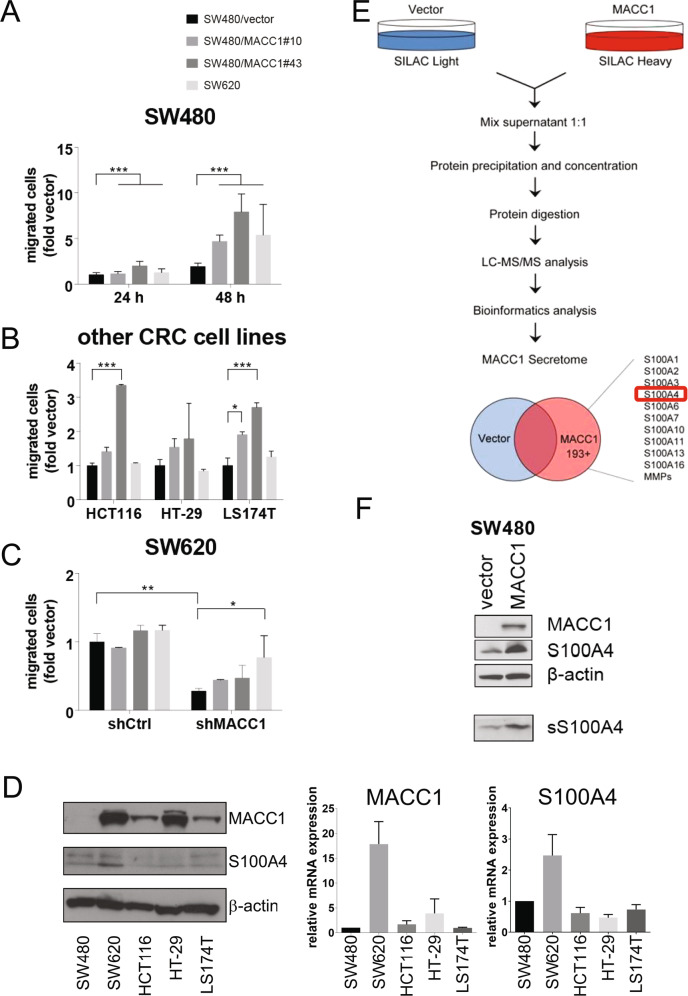
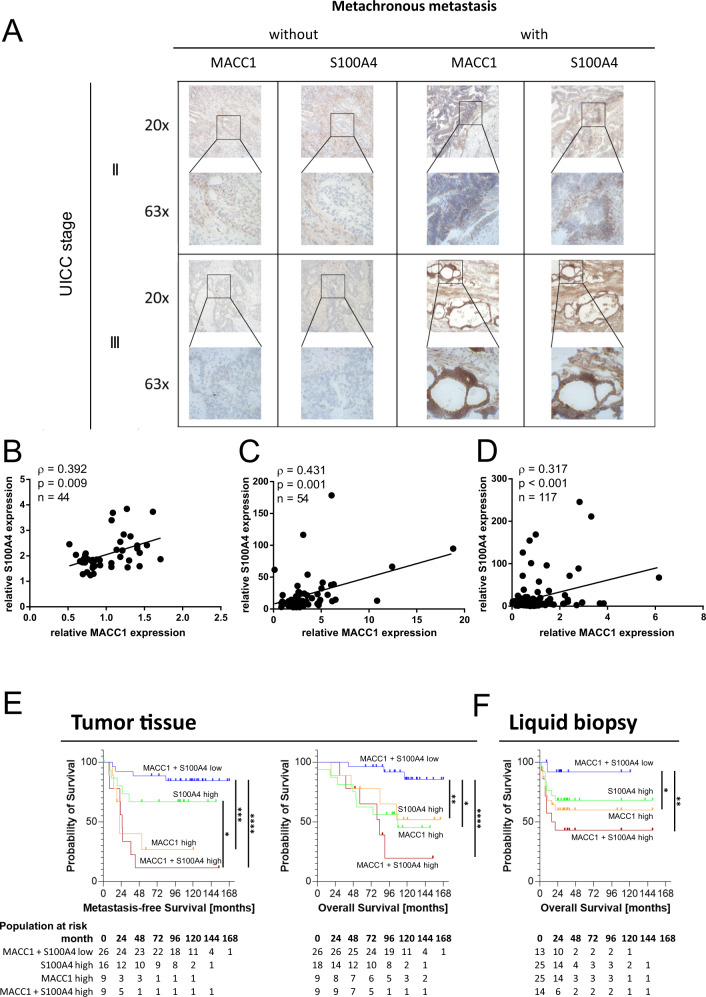
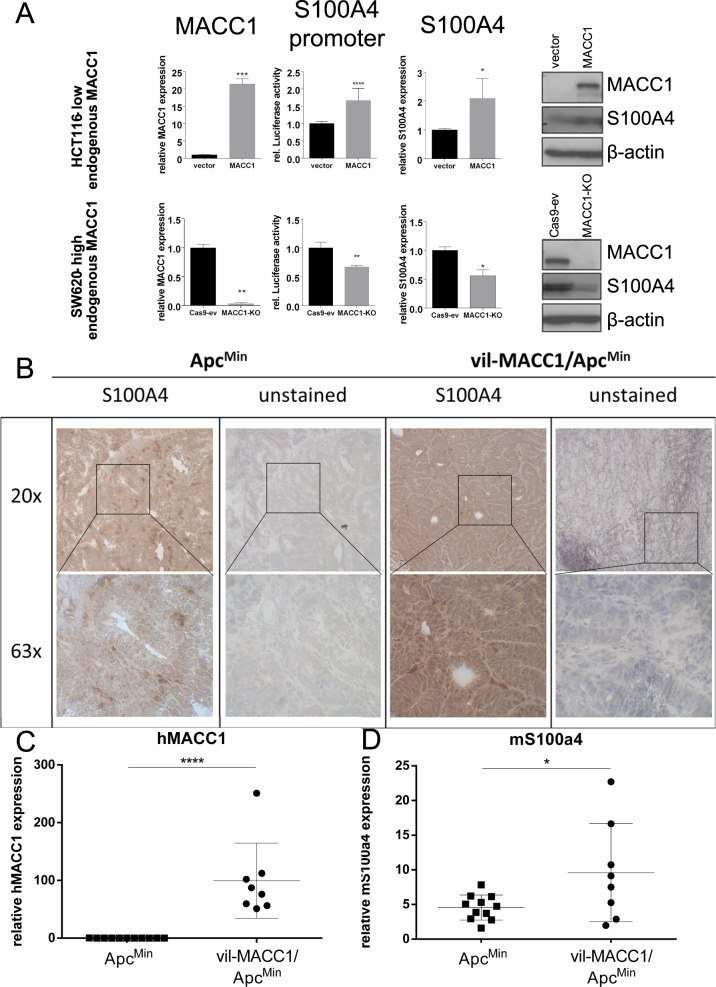
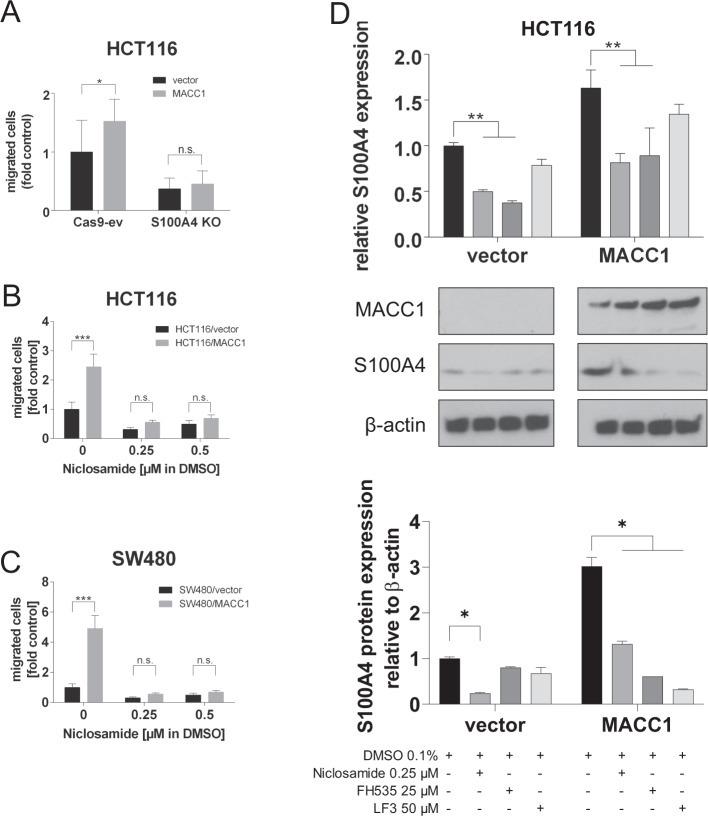
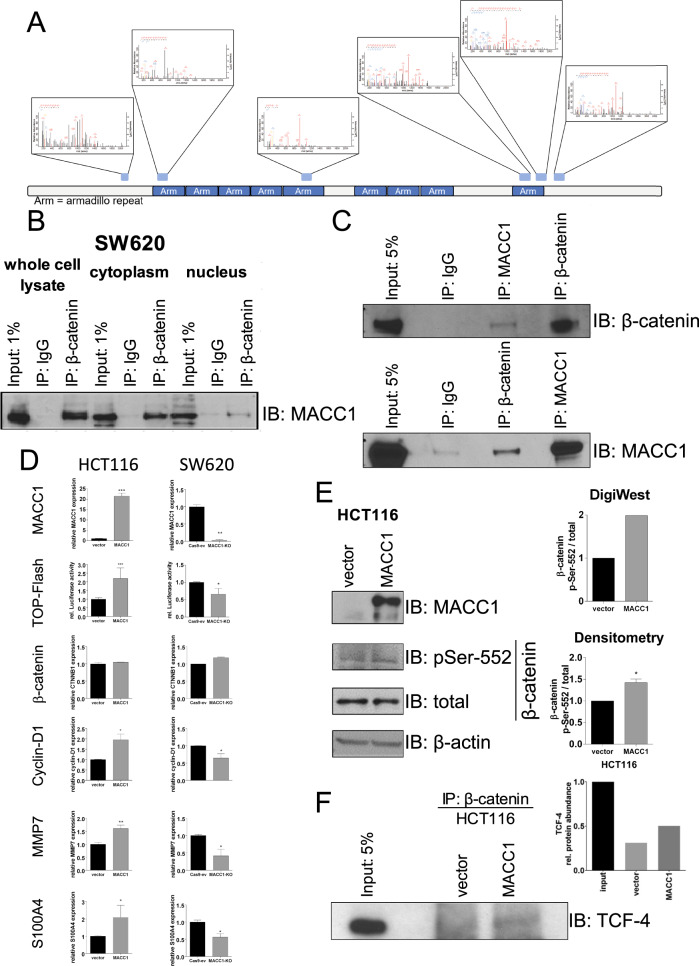
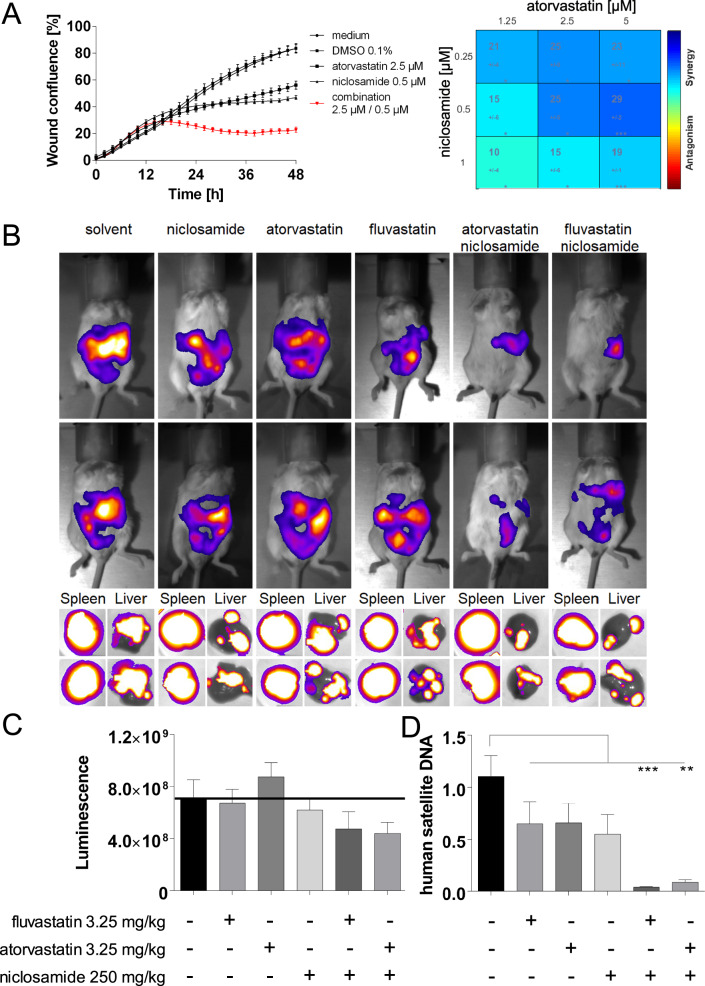
Colorectal cancer (CRC) is the second-most common malignant disease worldwide, and metastasis is the main culprit of CRC-related death. Metachronous metastases remain to be an unpredictable, unpreventable, and fatal complication, and tracing the molecular chain of events that lead to metastasis would provide mechanistically linked biomarkers for the maintenance of remission in CRC patients after curative treatment. We hypothesized, that Metastasis-associated in colorectal cancer-1 (MACC1) induces a secretory phenotype to enforce metastasis in a paracrine manner, and found, that the cell-free culture medium of MACC1-expressing CRC cells induces migration. Stable isotope labeling by amino acids in cell culture mass spectrometry (SILAC-MS) of the medium revealed, that S100A4 is significantly enriched in the MACC1-specific secretome. Remarkably, both biomarkers correlate in expression data of independent cohorts as well as within CRC tumor sections. Furthermore, combined elevated transcript levels of the metastasis genes MACC1 and S100A4 in primary tumors and in blood plasma robustly identifies CRC patients at high risk for poor metastasis-free (MFS) and overall survival (OS). Mechanistically, MACC1 strengthens the interaction of β-catenin with TCF4, thus inducing S100A4 synthesis transcriptionally, resulting in elevated secretion to enforce cell motility and metastasis. In cell motility assays, S100A4 was indispensable for MACC1-induced migration, as shown via knock-out and pharmacological inhibition of S100A4. The direct transcriptional and functional relationship of MACC1 and S100A4 was probed by combined targeting with repositioned drugs. In fact, the MACC1-β-catenin-S100A4 axis by statins (MACC1) and niclosamide (S100A4) synergized in inhibiting cancer cell motility in vitro and metastasis in vivo. The MACC1-β-catenin-S100A4 signaling axis is causal for CRC metastasis. Selectively repositioned drugs synergize in restricting MACC1/S100A4-driven metastasis with cross-entity potential.
Overview
The claims and statistics of this paper haven’t been checked yet.
Free: it reads the open-access text and checks the first 5 claims that cite a source we can check. Create a free account to check every claim.
Integrity signals
Registry
Cites
Statistics
Figures
Verification
Claims the paper makes
The claims and statistics of this paper haven’t been checked yet.
Free: it reads the open-access text and checks the first 5 claims that cite a source we can check. Create a free account to check every claim.
Claims other papers make about this one
Each is checked against this paper’s own text: does it say what the citing paper says it does?
In the citing paper
“Recently, niclosamide and two other β-catenin inhibitors (FH535 [116] and LF3 [117]) have been shown to downregulate MACC1-regulated S100A4 expression to decrease CRC propensity for metastatic progression [118].”
From Recent Advances in Therapeutic Strategies to Improve Colorectal Cancer Treatment (2024) · cites this paper as [118]
Self-check
Percentages, sums and reported differences re-computed from the paper’s own numbers.
The self-check needs the paper’s full text.
Citations
Cites
Siegel, R. L., Miller, K. D., & Jemal, A. (2020) · CA: A Cancer Journal for Clinicians · doi:10.3322/caac.21590 · Cited by 20,444
A Simple Practice Guide for Dose Conversion between Animals and Human
Nair, A., & Jacob, S. (2016) · Journal of Basic and Clinical Pharmacy · doi:10.4103/0976-0105.177703 · Cited by 6,174 · cited 1×
“The tested statins and niclosamide were orally administered at human equivalent dosages [44].”
BackgroundThe consensus molecular subtypes of colorectal cancer
Guinney, J., Dienstmann, R., Wang, X., de Reyniès, A., Schlicker, A., Soneson, C., Marisa, L., Roepman, P., Nyamundanda, G., Angelino, P., et al. (2015) · Nature Medicine · doi:10.1038/nm.3967 · Cited by 5,170 · cited 1×
“In light of this, several studies have identified molecular subtypes of CRC with distinct clinicopathological features impacting therapy response and survival [51, 52].”
BackgroundTumour exosome integrins determine organotropic metastasis
Hoshino, A., Costa-Silva, B., Shen, T.-L., Rodrigues, G., Hashimoto, A., Tesic Mark, M., Molina, H., Kohsaka, S., Di Giannatale, A., Ceder, S., et al. (2015) · Nature · doi:10.1038/nature15756 · Cited by 5,101
Colorectal cancer statistics, 2020
Siegel, R. L., Miller, K. D., Goding Sauer, A., Fedewa, S. A., Butterly, L. F., Anderson, J. C., Cercek, A., Smith, R. A., & Jemal, A. (2020) · CA: A Cancer Journal for Clinicians · doi:10.3322/caac.21601 · Cited by 4,880
Zhan, T., Rindtorff, N., & Boutros, M. (2017) · Oncogene · doi:10.1038/onc.2016.304 · Cited by 2,626 · cited 1×
“This allows β-catenin to accumulate in the cytoplasm and to translocate into the nucleus, where it activates Wnt target genes that sustain cell proliferation, motility, and stemness [19, 20].”
BackgroundWnt signalling and its impact on development and cancer
Klaus, A., & Birchmeier, W. (2008) · Nature Reviews Cancer · doi:10.1038/nrc2389 · Cited by 1,595 · cited 1×
“This allows β-catenin to accumulate in the cytoplasm and to translocate into the nucleus, where it activates Wnt target genes that sustain cell proliferation, motility, and stemness [19, 20].”
BackgroundStatin use and reduced cancer-related mortality
Nielsen, S. F., Nordestgaard, B. G., & Bojesen, S. E. (2012) · New England Journal of Medicine · doi:10.1056/nejmoa1201735 · Cited by 1,030 · cited 1×
“Long-term intake of statins, a mainstay of hypercholesterolemia management, has been associated with reduced cancer incidence in a variety of entities [59, 60].”
BackgroundPhosphorylation of β-Catenin by AKT Promotes β-Catenin Transcriptional Activity
Fang, D., Hawke, D., Zheng, Y., Xia, Y., Meisenhelder, J., Nika, H., Mills, G. B., Kobayashi, R., Hunter, T., & Lu, Z. (2007) · Journal of Biological Chemistry · doi:10.1074/jbc.m611871200 · Cited by 870
Combenefit: an interactive platform for the analysis and visualization of drug combinations
Di Veroli, G. Y., Fornari, C., Wang, D., Mollard, S., Bramhall, J. L., Richards, F. M., & Jodrell, D. I. (2016) · Bioinformatics · doi:10.1093/bioinformatics/btw230 · Cited by 736
Research works printed but not linked: 1
- Fang D Hawke D Zheng Y Xia Y Meisenhelder J Nika H Phosphorylation of beta-catenin by AKT promotes beta-catenin transcriptional activity J Biol Chem 2007 282 11221 9 17287208 PMC1850976 · DOI · Paper page
Cited by
AI-powered therapeutic target discovery
Pun, F. W., Ozerov, I. V., & Zhavoronkov, A. (2023) · Trends in Pharmacological Sciences · doi:10.1016/j.tips.2023.06.010 · Cited by 341
Allgayer, H., Mahapatra, S., Mishra, B., Swain, B., Saha, S., Khanra, S., Kumari, K., Panda, V. K., Malhotra, D., Patil, N. S., et al. (2025) · Molecular Cancer · doi:10.1186/s12943-025-02338-2 · Cited by 127
Recent Advances in Therapeutic Strategies to Improve Colorectal Cancer Treatment
Gmeiner, W. H. (2024) · Cancers · doi:10.3390/cancers16051029 · Cited by 78
“Recently, niclosamide and two other β -catenin inhibitors (FH535 [116] and LF3 [117]) have been shown to downregulate MACC1-regulated S100A4 expression to decrease CRC propensity for metastatic progression [118].”
BackgroundThe multi-faceted immune modulatory role of S100A4 in cancer and chronic inflammatory disease
Wong, T. K. S., Kang, R., & Yun, K. (2025) · Frontiers in Immunology · doi:10.3389/fimmu.2025.1525567 · Cited by 29
Clinical and pathogenic significance of S100A4 overexpression in systemic sclerosis
Denton, C. P., Xu, S., Zhang, F., Maclean, R., Clark, K. E. N., Borchert, S. V., Hussain, R. I., Klingelhöfer, J., Hallén, J., & Ong, V. H. (2023) · Annals of the Rheumatic Diseases · doi:10.1136/ard-2023-223862 · Cited by 18
Metadata
- Authors
- Kortüm, B., Radhakrishnan, H., Zincke, F., Sachse, C., Burock, S., Keilholz, U., Dahlmann, M., Walther, W., Dittmar, G., Kobelt, D., & Stein, U.
- Affiliations
- Max Delbrück Center (DE)
- Charité – Universitätsmedizin Berlin (DE)
- Corresponding author
- Stein, Ulrike
- ORCID
- Venue
- Oncogene
- Published
- 2022-08-25
- Volume
- 41
- Issue
- 39
- Pages
- 4446-4458
- ISSN
- 0950-9232 (ISSN-L)
- 1476-5594
- PMC
- PMC9507965
- OpenAlex
- W4293036731
- Cited by
- 26
- References
- 65
- Citations by year
- 2026: 5 · 2025: 9 · 2024: 8 · 2023: 4
- FWCI
- 1.71
- Type
- journal article
- Language
- en
- Open access
- hybrid
- doi.org
- Licence
- cc-by
- creativecommons.org/licenses/by/4.0 (tdm)
- creativecommons.org/licenses/by/4.0 (vor)
- Locations
- Oncogene (publishedVersion, cc-by)
- PubMed Central (publishedVersion, cc-by)
- PubMed (publishedVersion)
- MDC Repository (Max-Delbrueck-Center for Molecular Medicine) (acceptedVersion)
- Refubium (Universitätsbibliothek der Freien Universität Berlin) (submittedVersion, cc-by)
- Universitätsbibliothek der FU Berlin Hochschulschriftenstelle u. Dokumentenserver (cc-by)
- Funders
- Charité – Universitätsmedizin Berlin
- Deutsches Krebsforschungszentrum
- BIH Innovations & SPARK-BIH Validation Fund
- Berlin School of Integrative Oncology BSIO
- Topics
- Life Sciences › Biochemistry, Genetics and Molecular Biology › Molecular Biology › Mechanisms of cancer metastasis
- Health Sciences › Medicine › Oncology › Cancer Cells and Metastasis
- Life Sciences › Biochemistry, Genetics and Molecular Biology › Molecular Biology › S100 Proteins and Annexins
- Keywords
- colorectal cancer, metastasis, MACC1, S100A4, β-catenin, TCF4, secretome, paracrine signaling, cell migration, drug repurposing, statins, niclosamide, metastasis-free survival, prognostic factors, drug synergy
- MeSH terms
- S100 Calcium-Binding Protein A4, Amino Acids, Colonic Neoplasms, Humans, Niclosamide, Rectal Neoplasms, Colorectal Neoplasms, Trans-Activators, Gene Expression Regulation, Neoplastic, Hydroxymethylglutaryl-CoA Reductase Inhibitors, beta Catenin
About these checks
Registry, retraction, Cites and statistics results are computed, not judged, with one exception: a printed reference that no index lists is read once by a model before it counts as a citation error. Claims are extracted by a model and kept only when their quote appears verbatim in the text; each cited source is then checked, with a model’s help, for whether it says what the claim relies on. Those verdicts can be wrong — read the claim’s quote and the cited source before relying on one.
Statistics and arithmetic are recomputed, not judged.
Confidence bands are shown only for fields calibrated on our annotated test set. None is calibrated yet, so no band is shown.
What counts as a claim ›How we measure confidence ›How we check this ›
Are you an author, or do you see a problem with this page? Request a review
Data sources
Bibliographic data: Semantic Scholar, OpenAlex, Crossref.
Contains information from the Semantic Scholar Academic Graph Datasets, made available under the ODC Attribution License (ODC-BY 1.0).
Semantic Scholar’s data is described in: Kinney, R., et al. (2023). The Semantic Scholar Open Data Platform. arXiv:2301.10140.
