

Feedback activation of EGFR/wild-type RAS signaling axis limits KRASG12D inhibitor efficacy in KRASG12D-mutated colorectal cancer
Open accessThe DOI matches its Crossref record; 54 of the 61 references it cites were found in a registry or an index; 27 of the 36 sources its claims cite were checked for support.
Abstract
Abstract Colorectal cancer (CRC), which shows a high degree of heterogeneity, is the third most deadly cancer worldwide. Mutational activation of KRAS G12D occurs in approximately 10–12% of CRC cases, but the susceptibility of KRAS G12D -mutated CRC to the recently discovered KRAS G12D inhibitor MRTX1133 has not been fully defined. Here, we report that MRTX1133 treatment caused reversible growth arrest in KRAS G12D -mutated CRC cells, accompanied by partial reactivation of RAS effector signaling. Through a drug-anchored synthetic lethality screen, we discovered that epidermal growth factor receptor (EGFR) inhibition was synthetic lethal with MRTX1133. Mechanistically, MRTX1133 treatment downregulated the expression of ERBB receptor feedback inhibitor 1 (ERRFI1), a crucial negative regulator of EGFR, thereby causing EGFR feedback activation. Notably, wild-type isoforms of RAS, including H-RAS and N-RAS, but not oncogenic K-RAS, mediated signaling downstream of activated EGFR, leading to RAS effector signaling rebound and reduced MRTX1133 efficacy. Blockade of activated EGFR with clinically used antibodies or kinase inhibitors suppressed the EGFR/wild-type RAS signaling axis, sensitized MRTX1133 monotherapy, and caused the regression of KRAS G12D -mutant CRC organoids and cell line-derived xenografts. Overall, this study uncovers feedback activation of EGFR as a prominent molecular event that restricts KRAS G12D inhibitor efficacy and establishes a potential combination therapy consisting of KRAS G12D and EGFR inhibitors for patients with KRAS G12D -mutated CRC.
Overview
CoChat Summary
TL;DR
MRTX1133 causes reversible growth arrest in KRASG12D-mutated colorectal cancer cells and feedback activation of EGFR/wild-type RAS signaling, limiting its efficacy. Combining MRTX1133 with EGFR inhibitors is synthetic lethal and produces tumor regression in CRC models.
Key findings
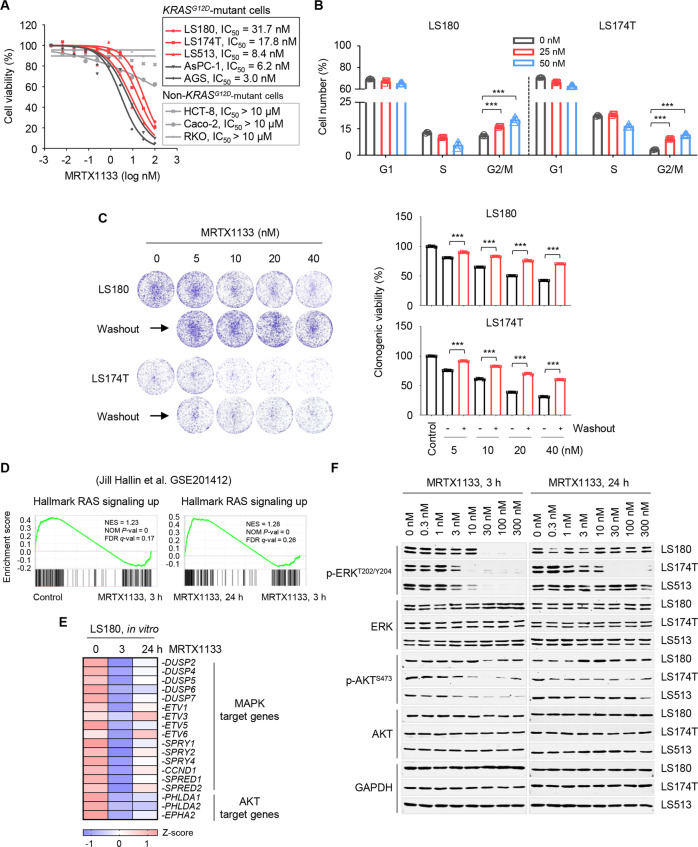
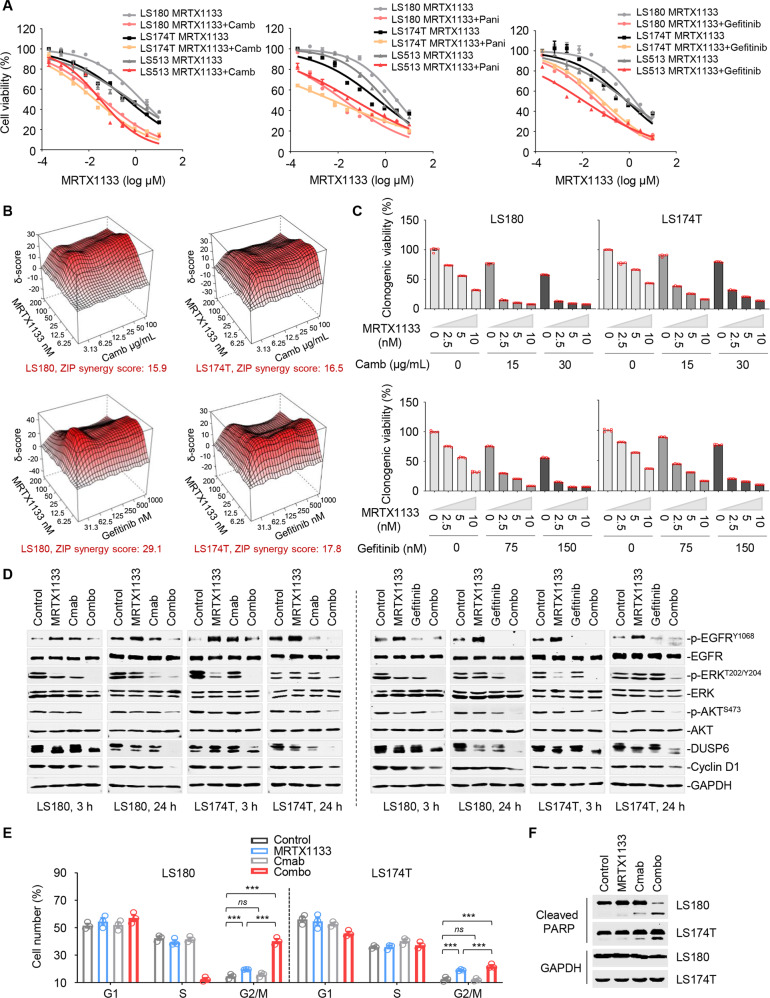
- MRTX1133 selectively impaired KRASG12D-mutant cancer cells, including LS180, LS174T, and LS513, with IC50 values of 5–40 nM, whereas non-KRASG12D-mutant cells had IC50 >10 μM; treatment caused G2/M arrest and reversible growth arrest after washout.
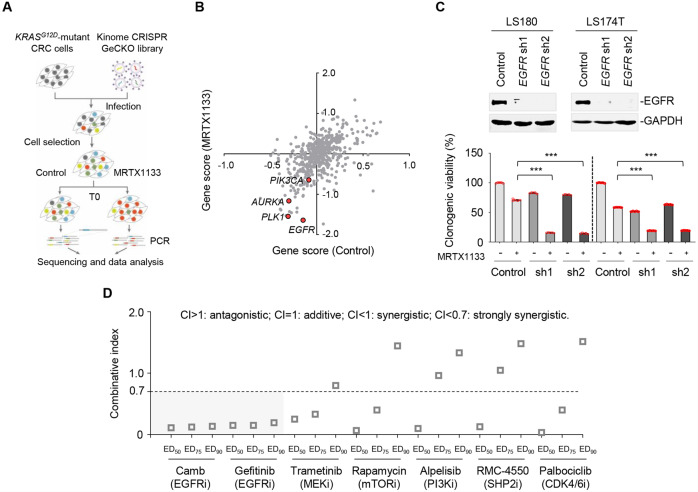
- A kinome CRISPR-Cas9 screen (5960 sgRNAs targeting 503 human kinases) identified EGFR as the top-ranked synthetic lethal candidate with MRTX1133; EGFR knockdown or EGFR inhibitors cetuximab/gefitinib synergized with MRTX1133, with CI values <0.7 at ED50, ED75, and ED90 and ZIP synergy scores of 15–30.
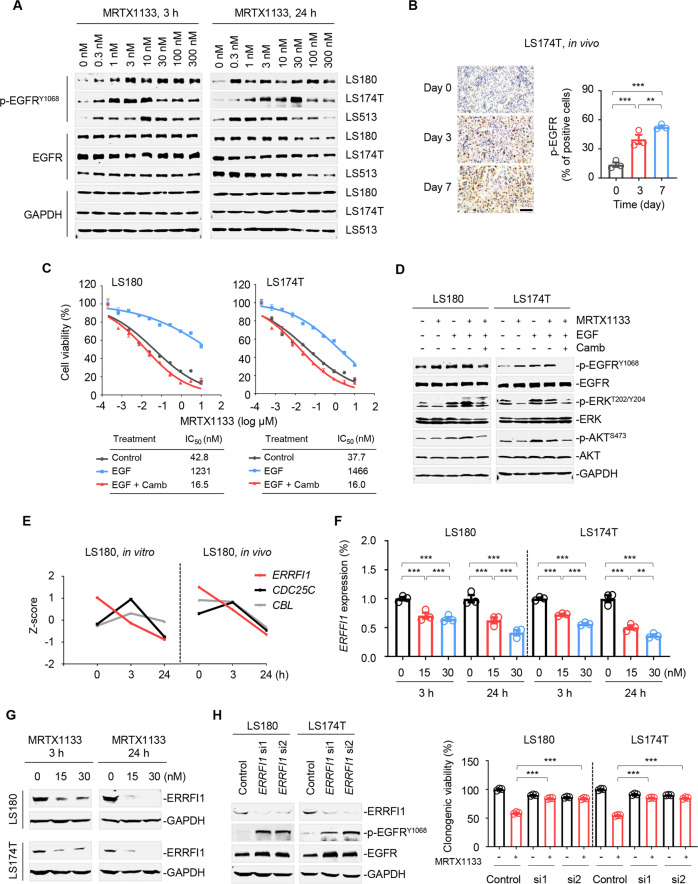
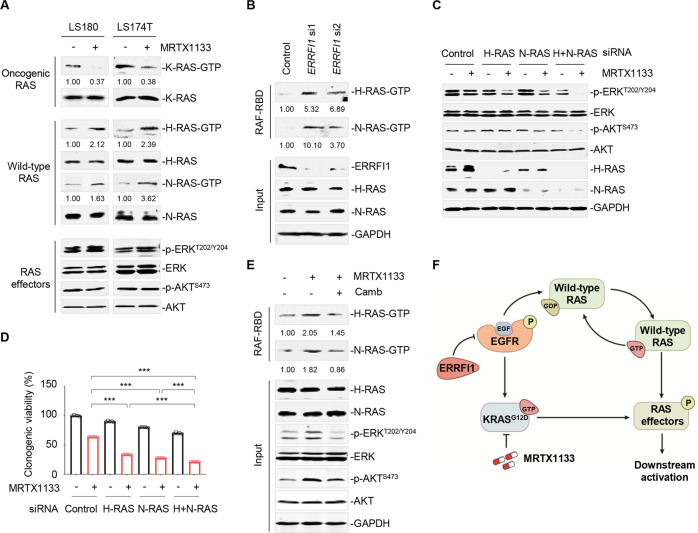
- Mechanistically, MRTX1133 downregulated ERRFI1, causing EGFR feedback activation; activated EGFR signaled through wild-type H-RAS and N-RAS, but not oncogenic K-RAS, leading to p-ERK/p-AKT rebound. EGFR blockade suppressed wild-type RAS-GTP and the RAS effector rebound.
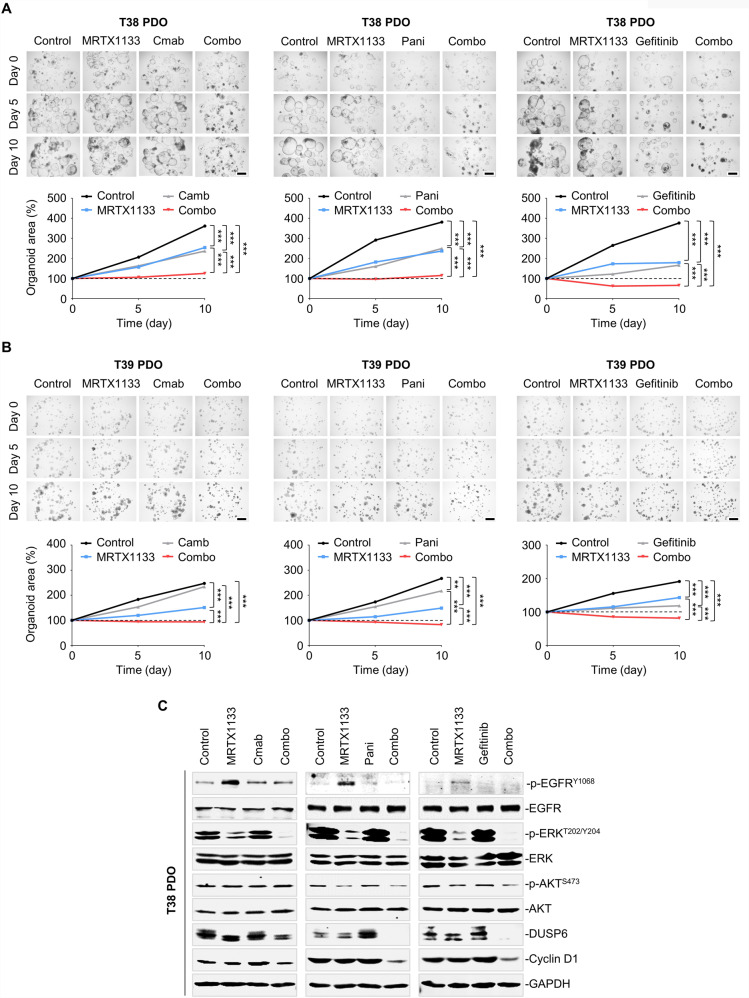
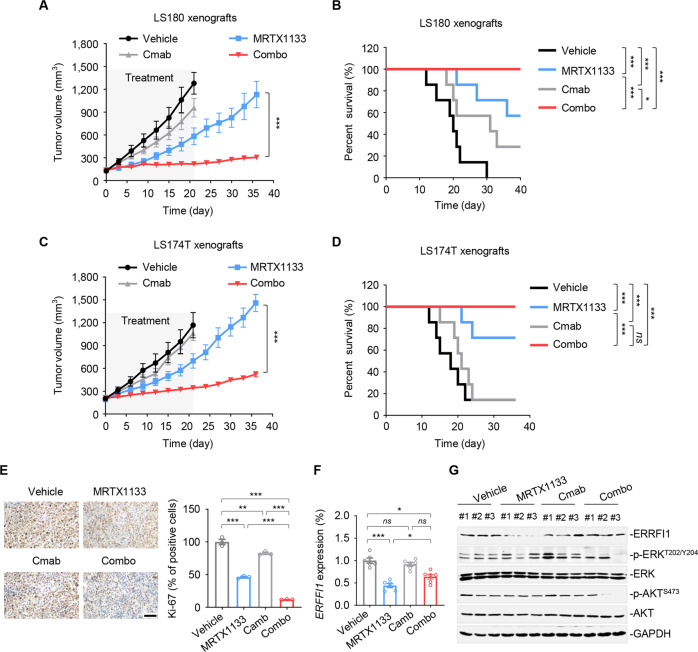
- In LS180 and LS174T xenografts (n = 7 per group; MRTX1133 20 mg/kg, cetuximab 50 mg/kg), combination treatment inhibited tumor growth, prolonged survival, reduced Ki67, and decreased ERRFI1/p-ERK/p-AKT; KRASG12D-mutant patient-derived organoids T38 and T39 also responded more potently to combination treatment.
Methods
- In vitro assays used KRASG12D-mutant and non-mutant CRC cell lines, patient-derived organoids (T38, T39), cell viability, colony formation, cell-cycle analysis, western blot, RT-qPCR, RAS-GTP pulldown, and immunohistochemistry.
- A CRISPR-Cas9 kinome loss-of-function screen was performed in LS174T cells treated with or without 25 nM MRTX1133, followed by a chemical mini-screen with EGFR, MEK, mTOR, PI3K, SHP2, and CDK4/6 inhibitors; synergy was assessed by CI and ZIP scores.
- In vivo studies used subcutaneous LS180 and LS174T xenografts in nude mice treated for 21 days with vehicle, MRTX1133, cetuximab, or combination; tumor volume and survival were measured, with two-tailed t-tests, one-way ANOVA with Tukey’s test, and log-rank tests.
Limitations
- The paper does not state limitations.
- Evident: the study relies on two KRASG12D-mutant CRC cell lines and two patient-derived organoid models, so broader CRC heterogeneity and other KRASG12D CRC contexts are not fully captured.
- Evident: in vivo efficacy was tested in immunodeficient xenograft models, not patient tumors; survival analysis used tumor-volume thresholds (1000 mm3 for death surrogate; 1500 mm3 for euthanasia), and no clinical trial data are reported.
Model-written summary. Check it against the paper before relying on it.
Integrity signals
Registry
Cites
Statistics
Figures
Verification
Claims the paper makes
17 Valid · 2 Not valid · 4 Not checked · 72 Own results and interpretations
Some cited sources support this claim and some don’t — read each source’s verdict below.
In the paper
“Furthermore, MRTX1133 treatment resulted in G2/M phase blockade in CRC cells (Fig. 1B), which is a typical consequence of KRAS mutant allele inhibition [17–19].”
§ Feedback activation of EGFR/wild-type RAS signaling axis limits KRASG12D inhibitor efficacy in KRASG12D-mutated colorectal cancer > Results > MRTX1133 provokes RAS effector signaling rebound in CRC cells
What the sources say
- Supportedcites [17] Li C Zhao N An L Dai Z Chen X Yang F Apoptosis-inducing activity of synthetic hydrocarbon-stapled peptides in H358 cancer cells expressing KRAS(G12C) Acta Pharm Sin B 2021 11 2670 84 10.1016/j.apsb.2021.06.013 34589388 PMC8463269 source
The citation is attached to the statement that G2/M arrest can follow inhibition of a mutant KRAS pathway, not to the citing authors’ Fig. 1B result for MRTX1133 in CRC cells. In the Results section (‘The stapled peptide 3 induced G2/M arrest in H358 cells’), the source reports G2/M arrest after treatment with a KRASG12C-targeting peptide in H358 lung cancer cells. The Discussion links that effect to disruption of KRAS-mediated signaling. (LLM, conf=0.87)
- Disputedcites [18] Zhang Z Miao L Lv C Sun H Wei S Wang B Wentilactone B induces G2/M phase arrest and apoptosis via the Ras/Raf/MAPK signaling pathway in human hepatoma SMMC-7721 cells Cell Death Dis 2013 4 e657 10.1038/cddis.2013.182 23744357 PMC3698549 sourceExperimental — accuracy not yet measured
The citation is attached to the claim that G2/M blockade is a typical consequence of KRAS mutant allele inhibition, not to the citing authors’ Fig. 1B result. In Results (‘WB activates MAPK through a Ras-dependent pathway’; page unavailable), the source instead reports that wentilactone B activated Ras and induced G2 arrest in hepatoma cells, while dominant-negative Ras suppressed that arrest. It does not study MRTX1133 or CRC cells. (LLM, conf=0.81)
Checked by a reasoning model — may be wrong.
- Partly supportedcites [19] Xie C Li Y Li LL Fan XX Wang YW Wei CL Identification of a new potent inhibitor targeting KRAS in non-small cell lung cancer cells Front Pharmacol 2017 8 823 10.3389/fphar.2017.00823 29184501 PMC5694459 sourceExperimental — accuracy not yet measured
The Results section ('Compound 0375-0604 Induced Cell Cycle Arrest and Apoptosis in NSCLC') reports G2/M arrest after treatment with a KRAS-targeting compound, supporting the cited clause's connection between KRAS inhibition and G2/M blockade. It does not establish that this is a typical consequence across KRAS mutant allele inhibitors; it studies compound 0375-0604 in NSCLC cells, not MRTX1133 in CRC cells. The MRTX1133 result is presented as the citing paper's own Figure 1B finding, rather than as a finding from this source. (LLM, conf=0.84)
plainstates a causen = 3- Asserted: passes — The authors put it forward as true.
- Checkable: passes — It can be checked against evidence.
- Load-bearing: unclear — It is unclear whether the paper’s conclusions depend on it.
- Based: passes — The paper gives a reason why it holds.
- Supported
Every source the paper cites for this claim was checked and supports it.
In the paper
“Recent work also suggested the importance of feedback reactivation of the MAPK pathway through wild-type H-RAS and N-RAS [49].”
§ Feedback activation of EGFR/wild-type RAS signaling axis limits KRASG12D inhibitor efficacy in KRASG12D-mutated colorectal cancer > Discussion
What the sources say
- Supportedcites [49] Ryan MB Coker O Sorokin A Fella K Barnes H Wong E KRAS(G12C)-independent feedback activation of wild-type RAS constrains KRAS(G12C) inhibitor efficacy Cell Rep 2022 39 110993 10.1016/j.celrep.2022.110993 35732135 PMC9809542 source
The Results section reports that knocking down wild-type NRAS and HRAS prevented the rebound in phospho-ERK after KRASG12C inhibitor treatment, supporting their role in MAPK feedback reactivation. The Discussion likewise identifies activation of these isoforms as a major driver of adaptive RAS-MAPK reactivation. The paper copy supplies section labels but no page numbers for these passages. (LLM, conf=0.94)
hedgedstates a cause- Asserted: passes — The authors put it forward as true.
- Checkable: passes — It can be checked against evidence.
- Load-bearing: passes — The paper’s conclusions depend on it.
- Based: passes — The paper gives a reason why it holds.
- Supported
Every source the paper cites for this claim was checked and supports it.
In the paper
“In contrast, patients with CRC have shown much lower susceptibility to the same treatment, suggesting a diverse dependency of KRAS-mutant cancers on specific KRAS mutant alleles [14].”
§ Feedback activation of EGFR/wild-type RAS signaling axis limits KRASG12D inhibitor efficacy in KRASG12D-mutated colorectal cancer > Introduction
What the sources say
- Supportedcites [14] Amodio V Yaeger R Arcella P Cancelliere C Lamba S Lorenzato A EGFR blockade reverts resistance to KRAS(G12C) inhibition in colorectal cancer Cancer Discov 2020 10 1129 39 10.1158/2159-8290.CD-20-0187 32430388 PMC7416460 source
The Introduction (p. 3) reports that clinical response rates to KRAS G12C inhibitors, including AMG510, were high in NSCLC patients but limited in CRC patients. The Discussion (p. 7) likewise describes substantial differences in response rates between the two patient groups. (LLM, conf=0.91)
hedgedstates an association- Asserted: passes — The authors put it forward as true.
- Checkable: passes — It can be checked against evidence.
- Load-bearing: passes — The paper’s conclusions depend on it.
- Based: passes — The paper gives a reason why it holds.
- Supported
The sources with a verdict support this claim; the rest weren’t checked yet, have no full text we could read, or their verdicts aren’t rated yet.
In the paper
“According to preclinical studies, CRC responds less to MRTX1133 than pancreatic cancer in tumor xenograft mouse models.”
§ Feedback activation of EGFR/wild-type RAS signaling axis limits KRASG12D inhibitor efficacy in KRASG12D-mutated colorectal cancer > Discussion
What the sources say
- Not checked — no full text of the sourcecites [15] Wang X Allen S Blake JF Bowcut V Briere DM Calinisan A Identification of MRTX1133, a Noncovalent, Potent, and Selective KRAS(G12D) Inhibitor J Med Chem 2022 65 3123 33 10.1021/acs.jmedchem.1c01688 34889605 source
- Supportedcites [16] Hallin J Bowcut V Calinisan A Briere DM Hargis L Engstrom LD Anti-tumor efficacy of a potent and selective non-covalent KRAS(G12D) inhibitor Nat Med 2022 28 2171 82 10.1038/s41591-022-02007-7 36216931 source
In the xenograft-model results section (Fig. 3A and Fig. S4A), 30% or greater tumor regression occurred in 8/11 pancreatic cancer models, compared with 2/8 colorectal cancer models. This supports the claimed difference in response to MRTX1133 in the tested mouse xenograft models. (LLM, conf=0.94)
plainstates an association- Asserted: passes — The authors put it forward as true.
- Checkable: passes — It can be checked against evidence.
- Load-bearing: passes — The paper’s conclusions depend on it.
- Based: passes — The paper gives a reason why it holds.
Every source the paper cites for this claim was checked and supports it.
In the paper
“Specifically, the extent of MRTX1133 anti-tumor activity was less notable in CRC than in pancreatic cancer [16].”
§ Feedback activation of EGFR/wild-type RAS signaling axis limits KRASG12D inhibitor efficacy in KRASG12D-mutated colorectal cancer > Introduction
What the sources say
- Supportedcites [16] Hallin J Bowcut V Calinisan A Briere DM Hargis L Engstrom LD Anti-tumor efficacy of a potent and selective non-covalent KRAS(G12D) inhibitor Nat Med 2022 28 2171 82 10.1038/s41591-022-02007-7 36216931 source
The section comparing KRAS G12D-mutant pancreatic and CRC xenograft models reports ≥30% tumor regression in 8/11 pancreatic models versus 2/8 CRC models. This directly supports the cited comparison of anti-tumor activity in the models tested. (LLM, conf=0.94)
plain- Asserted: passes — The authors put it forward as true.
- Checkable: passes — It can be checked against evidence.
- Load-bearing: passes — The paper’s conclusions depend on it.
- Based: passes — The paper gives a reason why it holds.
- Supported
51 more claims
Create a free account to see all 95 claims and to verify the 2 references still open.
- Probably not a substantial claim. 18
- It may state two separate claims as one. 25
Claims other papers make about this one
Each is checked against this paper’s own text: does it say what the citing paper says it does?
The cited source says what the claim attributes to it.
In the citing paper
“Notably, wild-type RAS isoforms, including HRAS and NRAS, but not the oncogenic KRAS, transmit downstream signaling from activated EGFR, resulting in rebound signaling of RAS effectors and reduced efficacy of MRTX1133.”
From KRAS, a New Target for Precision Medicine in Colorectal Cancer? (2024) · cites this paper as [31]
The cited source says what the claim attributes to it.
In the citing paper
“One study also reports that MRTX1133 induces reversible growth arrest of mutant KRASG12D CRC cells, accompanied by partial reactivation of RAS effector signaling [31]”
From KRAS, a New Target for Precision Medicine in Colorectal Cancer? (2024) · cites this paper as [31]
The cited source says what the claim attributes to it.
In the citing paper
“In addition to shifting oncogenic KRAS to the active GTP-bound state, feedback activation of RTKs can also activate wild-type RAS, leading to the bypass of oncogenic KRAS and resistance to KRAS-targeted therapy (Figure 1) [93, 94].”
From Differential Response and Resistance to KRAS-Targeted Therapy (2025) · cites this paper as [94]
The cited source says what the claim attributes to it.
In the citing paper
“While the recently developed MRTX1133 was effective in KRAS G12D preclinical models [36], its therapeutic effect in CRC was rendered by the feedback activation of EGFR via wild-type HRAS and NRAS [94], similar to KRAS G12C inhibitors.”
From Differential Response and Resistance to KRAS-Targeted Therapy (2025) · cites this paper as [94]
The check wasn’t confident either way, so it gives no verdict — never disputed.
In the citing paper
“Currently, G12D inhibitors differ from G12C inhibitors in that their low oral bioavailability necessitates intravenous administration [75,77].”
From The Role of KRAS Mutations in Colorectal Cancer: Biological Insights, Clinical Implications, and Future Therapeutic Perspectives (2025) · cites this paper as [77]
Experimental — accuracy not yet measured
3 more claims about this paper
Create a free account to see every claim other papers make about this one.
Self-check
Percentages, sums and reported differences re-computed from the paper’s own numbers.
Each contradiction between two passages listed here was confirmed by an independent check.
Rated major: it would touch a result — a value a result rests on, reported and recomputed p-values on opposite sides of the significance level, two passages that conflict with no sign which is right, or a cited work retracted before this paper was published.
In the paper
§ Feedback activation of EGFR/wild-type RAS signaling axis limits KRASG12D inhibitor efficacy in KRASG12D-mutated colorectal cancer > Results > EGFR inhibition improves the therapeutic efficacy of MRTX1133 in vivo
“As a surrogate of mouse survival, animals were counted as dead when the tumors reached 1000 mm3.”
§ Feedback activation of EGFR/wild-type RAS signaling axis limits KRASG12D inhibitor efficacy in KRASG12D-mutated colorectal cancer > Materials and Methods > Animal studies
“For survival curve analysis, treatment was prolonged until the tumor reached a total volume of 1500 mm3.”
Rated major: it would touch a result — a value a result rests on, reported and recomputed p-values on opposite sides of the significance level, two passages that conflict with no sign which is right, or a cited work retracted before this paper was published.
In the paper
§ Feedback activation of EGFR/wild-type RAS signaling axis limits KRASG12D inhibitor efficacy in KRASG12D-mutated colorectal cancer > Results > EGFR inhibition improves the therapeutic efficacy of MRTX1133 in vivo
“Athymic nude mice bearing LS180 xenografts were treated with vehicle, MRTX1133 (20 mg/kg, intraperitoneally once a day), cetuximab (50 mg/kg, intraperitoneally twice a week), or combination for 21 days.”
§ Feedback activation of EGFR/wild-type RAS signaling axis limits KRASG12D inhibitor efficacy in KRASG12D-mutated colorectal cancer > Materials and Methods > Animal studies
“Once the tumor volume reached 75–150 mm3, tumor-bearing mice were treated daily with vehicle (i.p., twice daily, 10% DMSO, 40% PEG300, 5% Tween-80, and 45% saline), MRTX1133 (20 mg/kg, i.p., twice daily, dissolved in 10% DMSO, 40% PEG300, 5% Tween-80, and 45% saline), cetuximab (50 mg/kg, i.p.), or a combination of MRTX1133 and cetuximab.”
Rated minor: it would not touch a result — a value no result rests on, a p-value that stays on the same side of the significance level, or a conflict that is clerical, resolved elsewhere in the paper, or outside its own findings.
In the paper
§ Feedback activation of EGFR/wild-type RAS signaling axis limits KRASG12D inhibitor efficacy in KRASG12D-mutated colorectal cancer > Abstract
“Colorectal cancer (CRC), which shows a high degree of heterogeneity, is the third most deadly cancer worldwide.”
§ Feedback activation of EGFR/wild-type RAS signaling axis limits KRASG12D inhibitor efficacy in KRASG12D-mutated colorectal cancer > Introduction
“Colorectal cancer (CRC) is an aggressive intestinal malignancy that is currently the second most lethal cancer and the third most prevalent malignant tumor worldwide [1].”
Rated minor: it would not touch a result — a value no result rests on, a p-value that stays on the same side of the significance level, or a conflict that is clerical, resolved elsewhere in the paper, or outside its own findings.
In the paper
§ Feedback activation of EGFR/wild-type RAS signaling axis limits KRASG12D inhibitor efficacy in KRASG12D-mutated colorectal cancer > Results > Identification of EGFR as a central component that confers MRTX1133 efficacy
“The gene score was the median log2 fold change in the abundance of all sgRNAs targeting that gene during the culture period.”
§ Feedback activation of EGFR/wild-type RAS signaling axis limits KRASG12D inhibitor efficacy in KRASG12D-mutated colorectal cancer > Materials and Methods > CRISPR-Cas9 functional genetic screen
“The CRISPR viability score was calculated as the mean of the Log2-transformed fold change of all sgRNAs.”
Rated minor: it would not touch a result — a value no result rests on, a p-value that stays on the same side of the significance level, or a conflict that is clerical, resolved elsewhere in the paper, or outside its own findings.
In the paper
§ Feedback activation of EGFR/wild-type RAS signaling axis limits KRASG12D inhibitor efficacy in KRASG12D-mutated colorectal cancer > Results > ERRFI1 downregulation by MRTX1133 causes EGFR reactivation
“Moreover, siRNA-mediated knockdown of ERRFI1 increased EGFR activation and conferred MRTX1133 sensitivity (Fig. 3H).”
§ Feedback activation of EGFR/wild-type RAS signaling axis limits KRASG12D inhibitor efficacy in KRASG12D-mutated colorectal cancer > Results > ERRFI1 downregulation by MRTX1133 causes EGFR reactivation
“Overall, these data indicate that ERRFI1 downregulation by MRTX1133 resulted in EGFR adaptive activation and MRTX1133 insensitivity.”
Citations
Cites
Sung, H., Ferlay, J., Siegel, R. L., Laversanne, M., Soerjomataram, I., Jemal, A., & Bray, F. (2021) · CA: A Cancer Journal for Clinicians · doi:10.3322/caac.21660 · Cited by 108,699 · cited 1×
“INTRODUCTION Colorectal cancer (CRC) is an aggressive intestinal malignancy that is currently the second most lethal cancer and the third most prevalent malignant tumor worldwide [1].”
BackgroundComprehensive molecular characterization of human colon and rectal cancer
The Cancer Genome Atlas Network (2012) · Nature · doi:10.1038/nature11252 · Cited by 8,499
Global burden of colorectal cancer: emerging trends, risk factors and prevention strategies
Keum, N., & Giovannucci, E. (2019) · Nature Reviews Gastroenterology & Hepatology · doi:10.1038/s41575-019-0189-8 · Cited by 2,661 · cited 1×
“Clinical treatments for CRC include laparoscopic surgery, radiotherapy, chemotherapy, and targeted therapy; however, owing to the extensive degree of heterogeneity of CRC, these treatment options still have a limited impact on the long-term survival of CRC patients [3, 4].”
BackgroundThe Clinical KRAS(G12C) Inhibitor AMG 510 Drives Anti-Tumour Immunity
Canon, J., Rex, K., Saiki, A. Y., Mohr, C., Cooke, K., Bagal, D., Gaida, K., Holt, T., Knutson, C. G., Koppada, N., et al. (2019) · Nature · doi:10.1038/s41586-019-1694-1 · Cited by 2,277 · cited 1×
“The approval of the covalent KRAS-specific inhibitor sotorasib has revitalized the promise of KRAS direct targeting [11].”
BackgroundUnresponsiveness of colon cancer to BRAF(V600E) inhibition through feedback activation of EGFR
Prahallad, A., Sun, C., Huang, S., Di Nicolantonio, F., Salazar, R., Zecchin, D., Beijersbergen, R. L., Bardelli, A., & Bernards, R. (2012) · Nature · doi:10.1038/nature10868 · Cited by 2,051 · cited 3×
“Oncogene (2023) 42:1620 – 1633 Notably, only ERRFI1 mRNA expression decreased in a timedependent manner, both in vitro and in vivo, unlike the inconsistent expression patterns of CDC25C and CBL (Fig.”
BackgroundSotorasib for Lung Cancers with KRAS p.G12C Mutation
Skoulidis, F., Li, B. T., Dy, G. K., Price, T. J., Falchook, G. S., Wolf, J., Italiano, A., Schuler, M., Borghaei, H., Barlesi, F., et al. (2021) · New England Journal of Medicine · doi:10.1056/nejmoa2103695 · Cited by 1,849 · cited 2×
“For example, patients with KRAS-mutated non–small cell lung cancer achieved a durable clinical benefit from sotorasib, the first approved KRAS mutant-selective inhibitor, whereas patients with CRC bearing the same mutation responded less to the same treatment [12].”
BackgroundDrost, J., & Clevers, H. (2018) · Nature Reviews Cancer · doi:10.1038/s41568-018-0007-6 · Cited by 1,790 · cited 1×
“Importantly, the ex vivo responses of PDOs to clinically relevant treatments correlate with the responses observed in patient tumors [43].”
BackgroundComprehensive review of targeted therapy for colorectal cancer
Xie, Y.-H., Chen, Y.-X., & Fang, J.-Y. (2020) · Signal Transduction and Targeted Therapy · doi:10.1038/s41392-020-0116-z · Cited by 1,687 · cited 1×
“EGFR inhibition sensitizes MRTX1133 treatment in vitro Given that KRAS inhibition reactivated EGFR/wild-type RAS signaling, we sought to test whether the current EGFR-specific monoclonal antibodies (cetuximab and panitumumab) [6] or kinase inhibitors (gefitinib) [42] were capable of eliminating reactivated RAS effecto…”
BackgroundKuipers, E. J., Grady, W. M., Lieberman, D., Seufferlein, T., Sung, J. J., Boelens, P. G., van de Velde, C. J. H., & Watanabe, T. (2015) · Nature Reviews Disease Primers · doi:10.1038/nrdp.2015.65 · Cited by 1,563 · cited 1×
“Clinical treatments for CRC include laparoscopic surgery, radiotherapy, chemotherapy, and targeted therapy; however, owing to the extensive degree of heterogeneity of CRC, these treatment options still have a limited impact on the long-term survival of CRC patients [3, 4].”
BackgroundAcquired Resistance to KRAS G12C Inhibition in Cancer
Awad, M. M., Liu, S., Rybkin, I. I., Arbour, K. C., Dilly, J., Zhu, V. W., Johnson, M. L., Heist, R. S., Patil, T., Riely, G. J., et al. (2021) · New England Journal of Medicine · doi:10.1056/nejmoa2105281 · Cited by 1,247
Cited by
A Small Molecule with Big Impact: MRTX1133 Targets the KRASG12D Mutation in Pancreatic Cancer
Wei, D., Wang, L., Zuo, X., Maitra, A., & Bresalier, R. S. (2023) · Clinical Cancer Research · doi:10.1158/1078-0432.ccr-23-2098 · Cited by 193
Self-citationTakeda, M., Yoshida, S., Inoue, T., Sekido, Y., Hata, T., Hamabe, A., Ogino, T., Miyoshi, N., Uemura, M., Yamamoto, H., et al. (2025) · Cancers · doi:10.3390/cancers17030428 · Cited by 82
“Currently, G12D inhibitors differ from G12C inhibitors in that their low oral bioavailability necessitates intravenous administration [75,77].”
Guo, H., Xu, X., Zhang, J., Du, Y., Yang, X., He, Z., Zhao, L., Liang, T., & Guo, L. (2024) · Pharmaceuticals · doi:10.3390/ph17081048 · Cited by 84
“Their use of a xenograft mouse model to block the EGFR/wild-type RAS signal transduction axis has significant implications for the treatment of the KRAS mutant CRC, while also highlighting the ongoing development of EGFR inhibitors [107].”
BackgroundDiscovery of KRAS(G12D) selective degrader ASP3082
Yoshinari, T., Nagashima, T., Ishioka, H., Inamura, K., Nishizono, Y., Tasaki, M., Iguchi, K., Suzuki, A., Sato, C., Nakayama, A., et al. (2025) · Communications Chemistry · doi:10.1038/s42004-025-01662-4 · Cited by 89
KRAS Mutation Subtypes and Their Association with Other Driver Mutations in Oncogenic Pathways
Mondal, K., Posa, M. K., Shenoy, R. P., & Roychoudhury, S. (2024) · Cells · doi:10.3390/cells13141221 · Cited by 69
“However, Feng et al. recently noticed that KRAS G12D -mutated CRC cells treated with MRTX1133 observed downregulated expression of a negative regulator of EGFR, which in turn caused EGFR-feedback activation [183].”
BackgroundFeng, J., Xiao, X., Xia, X., Min, J., Tang, W., Shi, X., Xu, K., Zhou, G., Li, K., Shen, P., et al. (2025) · Cancer Cell · doi:10.1016/j.ccell.2025.07.006 · Cited by 46
Self-citationMcDaid, W. J., Wilson, L., Adderley, H., Martinez-Lopez, A., Baker, M. J., Searle, J., GINN, L. H., Budden, T., Aldea, M. D., Marinello, A., et al. (2024) · Molecular Cancer · doi:10.1186/s12943-024-02157-x · Cited by 50
KRAS G12C-mutant driven non-small cell lung cancer (NSCLC)
Rosell, R., Codony‐Servat, J., González, J., Santarpía, M., Jain, A. S., Shivamallu, C., Wang, Y., Giménez-Capitán, A. A., Molina‐Vila, M. Á., Nilsson, J. A., et al. (2023) · Critical Reviews in Oncology/Hematology · doi:10.1016/j.critrevonc.2023.104228 · Cited by 47
Hajjafari, A., Sadr, S., Rahdar, A., Bayat, M., Lotfalizadeh, N., Dianaty, S., Rezaei, A., Moghaddam, S. P., Hajjafari, K., Simab, P. A., et al. (2024) · Inorganic Chemistry Communications · doi:10.1016/j.inoche.2024.112409 · Cited by 39
Chen, Y., Liu, S., Tan, S., Zheng, Y., Chen, Y., Yang, C., Lin, S., Mi, Y., & Li, W. (2024) · Gut Microbes · doi:10.1080/19490976.2024.2423043 · Cited by 39
“8 11 Based on the centrality of KRAS mutations in CRC, 12 a new therapeutic strategy needs to be developed.”
AI-powered liquid biopsy for early detection of gastrointestinal cancers
Hussain, M. S., Rejili, M. S., Khan, A., Alshammari, S. O., Tan, C. S., Haouala, F., Ashique, S., & Alshammari, Q. A. (2025) · Clinica Chimica Acta · doi:10.1016/j.cca.2025.120484 · Cited by 31
Nussinov, R. (2025) · Journal of Molecular Biology · doi:10.1016/j.jmb.2025.169044 · Cited by 42
Jiang, X., Wang, T., Zhao, B. X., Sun, H., Dong, Y., Ma, Y., Li, Z., Wu, Y., Wang, K., Guan, X., et al. (2025) · Cell Reports Medicine · doi:10.1016/j.xcrm.2025.101966 · Cited by 35
Paneth-like transition drives resistance to dual targeting of KRAS and EGFR in colorectal cancer
Zhang, Y., Chen, J., She, Y., Fang, Z., Zhang, Y., Ruan, D., Guo, W., Liao, J., Zhou, W., Lao, J., et al. (2026) · Cancer Cell · doi:10.1016/j.ccell.2025.10.010 · Cited by 23
“13,16 Thus, MRTX1133 serves as a valuable tool compound for studying KRAS G12D-driven biology and therapeutic vulnerabilities.”
Self-citationHuman Organoids and Their Application in Tumor Models, Disease Modeling, and Tissue Engineering
Song, S., Liu, Z., Wang, Y., & Gong, B. (2025) · Medicine Bulletin · doi:10.1002/mdb2.70001 · Cited by 33
PDP1 promotes KRAS mutant colorectal cancer progression by serving as a scaffold for BRAF and MEK1
Yuan, M., Zhang, C., Chen, S., Ye, S., Liu, H., Ke, H., Huang, J., Liang, G., Yu, R., Hu, T., et al. (2024) · Cancer Letters · doi:10.1016/j.canlet.2024.217007 · Cited by 23
Xiao, X., Feng, J., Ma, J., Xia, X., Liu, X., Zhang, J., Ding, C., Pang, X., & Zhang, A. (2023) · Journal of Medicinal Chemistry · doi:10.1021/acs.jmedchem.3c01724 · Cited by 23
Self-citationIntegration of proteomics in the molecular tumor board
Thiery, J., & Fahrner, M. (2023) · PROTEOMICS · doi:10.1002/pmic.202300002 · Cited by 23
Dutta, D., Ray, P., De, A., Ghosh, A., Hazra, R. S., Ghosh, P., Banerjee, S., Díaz, F. J., Upadhyay, S. P., Quadir, M., et al. (2024) · PLoS ONE · doi:10.1371/journal.pone.0297749 · Cited by 17
KRAS-mutant non-small cell lung cancer (NSCLC) therapy based on tepotinib and omeprazole combination
Rosell, R., Lewintre, E. J., Cao, P., Cai, X., Xing, B., Ito, M., Gomez-Vazquez, J. L., Marco-Jordán, M., Fariñas, S. C., Cardona, A. F., et al. (2024) · Cell Communication and Signaling · doi:10.1186/s12964-024-01667-x · Cited by 18
Strategic Insight into the Combination Therapies for Metastatic Colorectal Cancer
Kano, Y., Suenaga, M., & Uetake, H. (2023) · Current Oncology · doi:10.3390/curroncol30070480 · Cited by 18
Genetic Signature of Human Pancreatic Cancer and Personalized Targeting
Reshkin, S. J., Cardone, R. A., & Koltai, T. (2024) · Cells · doi:10.3390/cells13070602 · Cited by 14
“MRTX1133 showed synthetic lethality with EGFR inhibition in colorectal cancer [152] and synergistic anti-tumor effects in PDAC [153].”
BackgroundLiu, Z., Li, Y., Wang, S., Wang, Y., Sui, M., Liu, J., Chen, P., Wang, J., Zhang, Y., Dang, C., et al. (2025) · Journal of Experimental & Clinical Cancer Research · doi:10.1186/s13046-025-03338-2 · Cited by 19
Molnár, E., Baranyi, M., Szigeti, K. A., Hegedüs, L., Bordás, F., Gábriel, Z., Petényi, G., Tóvári, J., Hegedűs, B., & Tímár, J. (2024) · Pathology & Oncology Research · doi:10.3389/pore.2024.1611948 · Cited by 18
The shadow of cancer therapeutic resistance: Unveiling the role of S-palmitoylation
Yang, X., Xu, M., Deng, Z., & Xu, B. (2025) · Drug Resistance Updates · doi:10.1016/j.drup.2025.101264 · Cited by 14
Precision medicine in colorectal cancer: genomics profiling and targeted treatment
Muhar, A. M., Velaro, A. J., Prananda, A. T., Nugraha, S. E., Halim, P., & Syahputra, R. A. (2025) · Frontiers in Pharmacology · doi:10.3389/fphar.2025.1532971 · Cited by 15
Zheng, Y., Song, D., Guo, M. Z., Wang, C., Ma, M., Tao, G., Liu, L., He, X., Cao, F., Luo, D., et al. (2025) · Journal of Experimental & Clinical Cancer Research · doi:10.1186/s13046-025-03277-y · Cited by 19
Self-citationKRAS, a New Target for Precision Medicine in Colorectal Cancer?
Boilève, A., Smolenschi, C., Lambert, A., Boige, V., Delaye, M., Camilleri, G. M., Tarabay, A., Valéry, M., Fuerea, A., Pudlarz, T., et al. (2024) · Cancers · doi:10.3390/cancers16203455 · Cited by 11
Kale, R. R., Samant, C., Nandakumar, K., Pai, K. S. R., & Bhonde, M. (2025) · Biochemical and Biophysical Research Communications · doi:10.1016/j.bbrc.2025.151688 · Cited by 12
Zou, J., Shi, X., Wu, Z., Zuo, S., Tang, X., Zhou, H., & Huang, Y. (2024) · Translational Oncology · doi:10.1016/j.tranon.2024.102235 · Cited by 14
“…FBS and 1% P/S. Caco-2 cells were maintained in Ham ’ s F-12K medium (Gibco, 21127022) with 10% FBS and 1% P/S. RKO, LS174T and LS180 cells were maintained in MEM (Gibco, 11095080) containing 20% FBS and 1% P/S. KRAS G12D -mutated CRC cells were treated with MRTX1133 as previously described[17].”
Vazquez-Borrego, M. C., Granados-Rodríguez, M., Bura, F. I., Martínez-López, A., Rufián‐Andújar, B., Valenzuela-Molina, F., Rodríguez‐Ortiz, L., Haro-Yuste, S., Moreno-Serrano, A., Ortega-Salas, R. M., et al. (2023) · Experimental Hematology and Oncology · doi:10.1186/s40164-023-00465-4 · Cited by 12
“MRTX1133 has proven to be an effective treatment for animal models of KRAS G12D -mutated colorectal and pancreatic cancers [8, 9].”
BackgroundDifferential Response and Resistance to KRAS-Targeted Therapy
Liu, Z., Lenz, H., Yu, J., & Zhang, L. (2025) · Molecular Carcinogenesis · doi:10.1002/mc.23908 · Cited by 7
“In addition to shifting oncogenic KRAS to the active GTP ‐ bound state, feedback activation of RTKs can also activate wild ‐ type RAS, leading to the bypass of oncogenic KRAS and resistance to KRAS ‐ targeted therapy (Figure 1) [96, 97].”
Stahlhut, C. E., Maciag, A. E., Sullivan, K. A., Singh, K., Gitego, N., Zhang, Z., Chan, A. H., Sharma, A. K., Alexander, P., Shu, J., et al. (2026) · Cancer Discovery · doi:10.1158/2159-8290.cd-25-1280 · Cited by 12
“Mutant KRAS inhibition has been shown to lead to EGFR feedback activation and resistance to mutant KRAS inhibitors through activation of WT HRAS and NRAS in preclinical models (20, 21).”
Chen, T., Yu, H., Wang, K., Qin, G., Zhao, Y., Liang, X., Li, Y., Zou, T., Liu, J., Zhao, J., et al. (2025) · Journal of Clinical Investigation · doi:10.1172/jci195814 · Cited by 7
“Studies have demonstrated that not all PDAC cells harboring KRAS G12D mutations are sensitive to MRTX1133, and resistance often develops over time (5, 8, 9).”
Fang, Y., Chen, Y., Yu, X., Zhang, J., Zhu, W., Mou, C., Wang, D., Chen, A., Zhang, R., Liu, Q., et al. (2025) · Stem Cell Research & Therapy · doi:10.1186/s13287-025-04822-4 · Cited by 7
Pan‐ERBB Inhibitors Synergize With KRAS Inhibitors in Rectal Cancer
Buchloh, J., Spitzner, M., Zimmermann, H., Fang, X., Contreras, C. T., Schneider, C., de Oliveria, T., Küffer, S., Linnebacher, M., Rühlmann, F., et al. (2025) · United European Gastroenterology Journal · doi:10.1002/ueg2.70086 · Cited by 6
Enhancing KRAS G12D inhibitor sensitivity in pancreatic cancer through SHP2/PI3K pathway
Hao, M.-W., Zhang, T., Dong, D. F., Xin Min, Z. H. O. U., & Gao, H. (2025) · Medical Oncology · doi:10.1007/s12032-025-02683-8 · Cited by 7
KRas plays a negative role in regulating IDO1 expression
Peng, X., Lee, E., liang, J., Colon, T. M., Tran, F., Choi, B. H., & Dai, W. (2024) · Translational Oncology · doi:10.1016/j.tranon.2024.102167 · Cited by 5
Cui, J., Jiang, K., Li, W., Ni, S., Zong, H., Du, J., He, Y., Liu, Z., Kong, G., Zhang, Y., et al. (2026) · Nature Medicine · doi:10.1038/s41591-026-04538-9 · Cited by 16
“These findings are consistent with the emerging understanding that the efficacy of KRAS-G12D inhibitors is primarily determined by the presence or absence of the mutation rather than its quantitative abundance 33 .”
Self-citationTreating Pancreatic Ductal Adenocarcinoma: The Targeted Revolution is Here
May, M. S., Park, W., & O'Reilly, E. M. (2026) · Drugs · doi:10.1007/s40265-026-02295-0 · Cited by 7
Bonsor, D. A., Finci, L. I., Potter, J. R., Young, L. C., Wall, V. E., de Salazar, R. G., Geis, K. R., Stephens, T., Finney, J., Nissley, D. V., et al. (2026) · Nature Communications · doi:10.1038/s41467-026-68319-1 · Cited by 8
Targeting KRAS in colorectal cancer immunotherapy: rationale, challenges and future directions
Zhu, G., Pei, L., Ye, D., Tang, Q., Xu, H., & Bi, F. (2025) · Biochimica et Biophysica Acta (BBA) - Reviews on Cancer · doi:10.1016/j.bbcan.2025.189382 · Cited by 8
McAndrews, K. M., Mahadevan, K. K., Li, B., Sockwell, A. M., Morse, S. J., Kelly, P. J., Patel, S. I., Kirtley, M. L., Diaz, B. A. M., Lyu, H., et al. (2025) · bioRxiv (Cold Spring Harbor Laboratory) · doi:10.1101/2025.01.29.635543 · Cited by 4
Lin, C., Shen, M., Chen, W. T., & Yang, C. (2023) · Journal of Personalized Medicine · doi:10.3390/jpm13071051 · Cited by 4
“Recently, the therapeutic efficacy of an inhibitor against KRAS G12D mutated CRC was found to be increased by the combined use of anti-EGFR therapy, which blocked a feedback activation loop driven by EGFRmediated wild-type RAS signaling [29].”
BackgroundMcAndrews, K. M., Mahadevan, K. K., Li, B., Comptdaer, A. M., Sockwell, A. M., Morse, S. J., Kelly, P. J., Patel, S. I., Kirtley, M. L., Diaz, B. A. M., et al. (2026) · The EMBO Journal · doi:10.1038/s44318-026-00854-5 · Cited by 12
“Previous studies have identi fi ed feedback activation of EGFR as promoting MRTX1133 resistance in pancreatic and colorectal cancer (Feng et al, 2023; Gulay et al, 2023) similar to what has been reported with KRAS G12C inhibitors (Amodio et al, 2020); however, it is unclear whether resistance…”
GAP mimetic activity of pan-Ras TCI daraxonrasib synergizes with K-Ras Switch-II pocket inhibitionPreprint
Pfaff, P., & Shokat, K. M. (2026) · bioRxiv (Cold Spring Harbor Laboratory) · doi:10.64898/2026.03.11.711097 · Cited by 3
Olmo-González, D., Zhou, M., Oliveira, N. G., Zhou, F., Yan, F., González, J., València-Clua, K., Molina‐Vila, M. Á., Bertrán-Alamillo, J., Giménez-Capitán, A. A., et al. (2026) · Cell Death Discovery · doi:10.1038/s41420-026-02998-z · Cited by 4
Szigeti, K. A., Baranyi, M., Surguta, S. E., Hegedűs, B., Piurkó, V., Tóvári, J., & Tímár, J. (2026) · Scientific Reports · doi:10.1038/s41598-025-34204-y · Cited by 4
Absar, F., Novy, B., Nagy, E., Petrotchenko, E. V., Popov, K., Cross, J. B., Thapar, R., & Borchers, C. H. (2025) · Analytical Chemistry · doi:10.1021/acs.analchem.5c03103 · Cited by 6
Yokoi, R., Mori, T., Hirosawa, K. M., Kondo, R., Taguchi, T., Matsuhashi, N., & Suzuki, K. G. N. (2025) · iScience · doi:10.1016/j.isci.2025.113374 · Cited by 4
“19,71 Indeed, pull-down assays showed that GTP-bound KRAS G12D and G12C were nearly eliminated by KRAS inhibitor treatment alone (Figure S5E).”
Li, R., Liu, Y., Liu, Q., Guo, Z., Wang, B., Huang, S., Wang, Z., Liu, F., Zhou, Y., Wang, P., et al. (2025) · Cellular and Molecular Gastroenterology and Hepatology · doi:10.1016/j.jcmgh.2025.101528 · Cited by 4
Xue, G., Huang, H., Hua, L., Chen, B., Dong, H., Jia, H., Xue, C., & Xu, J. (2024) · Sensors and Actuators B Chemical · doi:10.1016/j.snb.2024.136513 · Cited by 3
MRTX1133’s promise for treating KRASG12D-mutant pancreatic cancer
Haidar, M., & Jacquemin, P. (2024) · Journal of Gastrointestinal Oncology · doi:10.21037/jgo-24-255 · Cited by 2
“Patients with highly pretreated advanced KRAS G12C colorectal cancer (CRC) showed an objective response rate of 7.1% and a disease control rate of 73.8%.”
InfluentialXue, S., Xu, H., Ma, J., Wang, Y., Lu, W., Cui, J., & Wang, L. (2026) · Cancer Letters · doi:10.1016/j.canlet.2026.218684 · Cited by 3
Self-citationGAP mimetic activity of pan-Ras TCI daraxonrasib synergizes with K-Ras Switch-II pocket inhibition
Pfaff, P., & Shokat, K. M. (2026) · Biological Chemistry · doi:10.1515/hsz-2025-0249 · Cited by 5
“A known adaptive mechanism is a lift of negative feedback on RTK expression including EGFR and HER2 resulting from rapid depletion of p -ERK upon acute mutant K-Ras inhibition (Feng et al. 2023; Ryan et al. 2020).”
KRAS inhibition is an effective therapy for appendiceal adenocarcinomaPreprint
Chowdhury, S., Ito, I., Pattalachinti, V. K., et al. (2026) · bioRxiv (Cold Spring Harbor Laboratory) · doi:10.64898/2026.04.07.717107 · Cited by 2
“Compared with KRASG12D mutant CRC or PDAC cell models, AAPDO-01 was more sensitive to MRTX1133, as indicated by comparison of previously reported IC50 values ( Figure 2E ) ( 19 ).”
Miyan, J., Vudatha, V., Cao, L., Zhang, P., Zheng, G., Zheng, L., Trevino, J., Zhou, D., & Khan, S. (2026) · Cancers · doi:10.3390/cancers18060920 · Cited by 3
“In addition, targeting a single RTK or MAPK effector in combination with KRASi causes short-lived responses due to redundancy in KRAS downstream signaling effectors [15–17].”
Patel, H. V., Smith, A. E., Chan, S., Gasendo, J. G., Jombik, A., Greer, J. E., Samantaray, T., Kessler, L. V., Mitra, A., Zhu, X., et al. (2026) · Cancer Research · doi:10.1158/0008-5472.can-25-2764 · Cited by 6
“Moreover, preclinical studies have outlined a mechanism of adaptive resistance to mutant-selective KRAS inhibitors, in which EGFR drives GTP loading of mutant KRAS and/or activation of WT RAS isoforms, restoring MAPK signaling (12, 13).”
The evolving landscape of KRAS-targeted therapy: mechanisms of resistance and emerging strategies
Pilco‐Janeta, D. F., & Puebla, M. D. L. C. (2025) · Anti-Cancer Drugs · doi:10.1097/cad.0000000000001801 · Cited by 2
Ma, Y., Sun, Y., Tu, Q., Lin, F., Feng, M., Chen, Q., Fu, T., Yang, L., Lai, X., Yang, M., et al. (2025) · Chemical Biology & Drug Design · doi:10.1111/cbdd.70125 · Cited by 3
KRAS inhibitors in drug resistance and potential for combination therapy
Rathod, L. S., Sakle, N. S., & Mokale, S. N. (2024) · Tumori Journal · doi:10.1177/03008916241289206 · Cited by 3
Guo, Y., Zhong, Y., Hu, P., Chen, Y., Guo, W., Chen, J., Guan, P., Zhou, Z., Zhu, F., Zeng, X., et al. (2026) · Nature Communications · doi:10.1038/s41467-026-73805-7 · Cited by 2
“In line with previous reports 20,29,30 , prolonged exposure to BI-2865 resulted in marked rebound activation of p-ERK, a compensatory effect that was particularly prominent in resistant CRCs (Fig.”
Self-citationGhosh, D., Kazi, A., Vasiyani, H. K. K., Vudatha, V., Lecomte, N., Iacobuzio–Donahue, C. A., Trevino, J., & Sebti, S. M. (2026) · European Journal of Cancer · doi:10.1016/j.ejca.2026.116255 · Cited by 2
Ibraheem, W., Alsheikh, F., Alzain, A. A., Bhongade, B. A., Ejaz, L., Baig, H., Robinson, R. C., & El‐Tanani, M. (2026) · PLoS ONE · doi:10.1371/journal.pone.0338123 · Cited by 1
“Fortunately, the inhibition of this pathway with kinase inhibitors such as erlotinib blocked EGFR/wild-type RAS signaling and sensitized cells to MRTX1133 [10].”
Ofuchi, T., Hirose, K., Hosoda, K., Ikehara, T., Higuchi, S., Tsujimoto, A., Wada, A., Tamaoka, Y., Tsuda, Y., Otsu, H., et al. (2025) · Surgery Today · doi:10.1007/s00595-025-03212-w · Cited by 1
Hybrid nanovesicles enhance antitumor efficacy in KRAS-mutant non-small cell lung cancer
Yang, H., Hu, L. T., Su, Z., Peng, F., Wang, Y., Chang, Q., Shen, W., Yang, K., Zhao, J., Guo, L., et al. (2025) · Journal of Controlled Release · doi:10.1016/j.jconrel.2025.114345 · Cited by 2
Leng, Q., Zhou, J., Wang, X., Zhang, P., Xu, H., & Cao, D. (2025) · Frontiers in Pharmacology · doi:10.3389/fphar.2025.1562481 · Cited by 3
Absar, F., Novy, B., Nagy, E., et al. (2025) · bioRxiv (Cold Spring Harbor Laboratory) · doi:10.1101/2025.04.22.650081 · Cited by 1
Co-targeting KRASG12D and the HER family is efficacious in colorectal cancer
Kilroy, M. K., Wischmeier, C., Park, B. S., Choi, D., Feroz, W., Mishra, R., & Garrett, J. T. (2025) · Carcinogenesis · doi:10.1093/carcin/bgaf036 · Cited by 3
The farnesyl transferase inhibitor KO-2806 re-sensitizes relapsing tumors to RAS inhibitionPreprint
Patel, H. V., Smith, A. E., Chan, S., Gasendo, J. G., Samantaray, T., Kessler, L. V., Mitra, A., Zhu, X., Liu, Y. A., Burrows, F. J., et al. (2024) · bioRxiv (Cold Spring Harbor Laboratory) · doi:10.1101/2024.12.20.629824 · Cited by 1
Mouse models for cancer research – current state and the perspective
Gercakova, K., Poturnajova, M., Tyčiaková, S., Režuchová, I., & Matúšková, M. (2024) · Neoplasma · doi:10.4149/neo_2024_240328n140 · Cited by 4
Integration of proteomics in the molecular tumor boardPreprint
Thiery, J., & Fahrner, M. (2023) · doi:10.22541/au.169029094.47413902/v1 · Cited by 1
Jeon, E., Song, J., & Sim, T. (2026) · Future Medicinal Chemistry · doi:10.1080/17568919.2026.2719780
Tarun, M. T. I., Ebrahim, H. Y., & Sayed, K. A. E. (2026) · Nutrients · doi:10.3390/nu18162623
“Combining the KRAS G12C inhibitor adagrasib with EGFR-directed cetuximab showed clinical success; however, effective KRAS G13D inhibitors are yet to be discovered [6,7].”
Caruso, A., Delvecchio, A., Memeo, R., Lanzino, M., & Martinotti, S. (2026) · Frontiers in Endocrinology · doi:10.3389/fendo.2026.1872361 · Cited by 4
Dorbin, D., Herrera, J., Davidson, R., Chandrashekar, N., Scheuber, G., Jayakrishnan, P., Rajesh, C., Johnson, G., Yuan, J., Sochor, M., et al. (2026) · bioRxiv (Cold Spring Harbor Laboratory) · doi:10.64898/2026.07.05.735339
“…explanation: KRAS inhibition relieves transcriptional EGFR suppression, partly via downregulating negative regulators like ERRFI1 (ERBB receptor feedback inhibitor 1), reactivating EGFR-driven MAPK/ERK output through wild-type HRAS and NRAS (45,46), consistent with our KRAS G12R -RR models.”
KRAS inhibition is an effective therapy for appendiceal adenocarcinoma
Chowdhury, S., Ito, I., Pattalachinti, V. K., Yousef, A. M. G., Yousef, M., Khoury, S. E., Hornstein, N. J., Seldomridge, A. N., Hong, D. S., Overman, M. J., et al. (2026) · Journal of Hematology & Oncology · doi:10.1186/s13045-026-01817-3 · Cited by 3
“Because the dominant clinical manifestation of AA is peritoneal carcinomatosis, and because primary localized AA is curable by surgery alone, we used intraperitoneal implantation models of [21].”
Leto, S. M., Sassi, F. P., Zanella, E. R., Vurchio, V., Cottino, F., Ferri, M., Damico, A., Grassi, E., Bertotti, A., & Trusolino, L. (2026) · Cell Death and Disease · doi:10.1038/s41419-026-08900-0 · Cited by 1
“response to single-agent KRAS pathway inhibition in KRAS G12D -mutant PDX-derived tumoroids Co-targeting KRAS G12D with either EGFR or PI3K α has been shown to be more effective than KRAS G12D inhibition alone in CRC models in vivo [17, 18].”
InfluentialRurka, P., Cieślik, W., Płaziński, W., et al. (2026) · Molecular Oncology · doi:10.1002/1878-0261.70274
Treatment of patients with R AS-mutated colorectal cancer with lung metastases
Murzakhanova, K. I., Кузнецова, О. А., Makiev, G. G., Олегович, Л. Д., Eroshin, Y. V., Khudoerov, D. K., & Tryakin, A. A. (2026) · Malignant tumours · doi:10.18027/2224-5057-2026-068
Liu, X., Nie, Q., Zhang, Y.-S., He, J., Sun, X.-R., Cao, W.-J., Zhang, H.-Y., Zhang, J., & Chen, S. (2026) · Bioorganic Chemistry · doi:10.1016/j.bioorg.2026.109875
Self-citationThielen, N., Wei, N., Nagai, E., Houston, M. A., Augenlicht, L. H., Shin, A. E., Gabre, J. T., Rustgi, A. K., Ha, G., LaFave, L. M., et al. (2026) · npj Precision Oncology · doi:10.1038/s41698-026-01384-3 · Cited by 1
“In addition to proteins identi fi ed from RPPA analysis, the resistant cell line exhibited upregulation of p-EGFR (p-Y1068) expression, aligning with previous studies that con fi rmed the EGFR feedback mechanism upon treatment with MRTX1133 26 .”
InfluentialFrom undruggable to actionable: advances in KRAS targeting in colorectal cancer
Chan, M., Shelke, M., Townsend, A. R., Roy, A. C., Broadbridge, V. T., Karapetis, C. S., & Price, T. J. (2026) · Academia oncology. · doi:10.20935/acadonco8216
Targeting cancer expressed EGFR with a humanized monoclonal antibody
Costa, T. G. F., Sarnovsky, R. J., Zhan, J., Maslanka, C., Obiorah, I., Xia, D., FitzGerald, D. J., & Antignani, A. (2026) · Scientific Reports · doi:10.1038/s41598-026-46245-y
“Moreover, BxPC3 are wild type Ras cells which mediates signaling downstream of EGFR kinase 31 .”
Huang, C., Xie, D., Lin, B., & Zhang, K. (2026) · Frontiers in Oncology · doi:10.3389/fonc.2026.1679360
How to efficiently establish animal models of cholangiocarcinoma: challenges and inspiration
Gou, R., Yue, P., Liu, P., Zhao, J., Huang, C., Tanaka, K., Wong, P. F., Rerknimitr, R., Moon, J. H., Cheung, T. T., et al. (2026) · Medical Review · doi:10.1515/mr-2025-0081
“This is a typical mutation in pancreatic cancer [214], colorectal cancer [215], and non-small-cell lung cancer (NSCLC) [216].”
Association of germline variants with KRAS-mutation status in colorectal cancer
Tjader, N. P., Ramroop, J. R., Gandhi, T., Dauch, C., Meadows, O., Stevens, P., Pearlman, R., Hampel, H. L., Aglago, E. K., Berndt, S. I., et al. (2026) · Scientific Reports · doi:10.1038/s41598-026-39644-8 · Cited by 1
Reprogramming paneth-like plasticity: FGFR3 as a key to overcoming KRAS-EGFR resistance in CRC
Yin, Z., Guo, X., Liu, X., & DeNardo, D. G. (2026) · Targetome · doi:10.48130/targetome-0026-0020
Self-citationTsuda, M., Keith, D. J., Daniel, C. J., Pelz, C., Blise, K. E., Ozmen, T. Y., Ozmen, F., Hawthone, K., Eng, J. R., Li, X., et al. (2025) · bioRxiv (Cold Spring Harbor Laboratory) · doi:10.64898/2025.12.12.693851
Li, X., Xue, G., Zhang, L., Wang, X., Chen, X., Zhao, W., Shen, Z., & Xue, C. (2025) · Talanta · doi:10.1016/j.talanta.2025.128870
Thielen, N., Wei, N., Nagai, E., Chu, E., Kitamura, S., & Kuang, C. (2025) · bioRxiv (Cold Spring Harbor Laboratory) · doi:10.1101/2025.06.27.662039
Nussinov, R. (2024) · SSRN Electronic Journal · doi:10.2139/ssrn.5034578
McDaid, W. J., Wilson, L., Adderley, H., et al. (2023) · bioRxiv (Cold Spring Harbor Laboratory) · doi:10.1101/2023.09.20.558592
Metadata
- Authors
- Feng, J., Hu, Z., Xia, X., Liu, X., Lian, Z., Wang, H., Wang, L., Wang, C., Zhang, X., & Pang, X.
- Affiliations
- Southern Medical University (CN)
- East China Normal University (CN)
- Shanghai Jiao Tong University (CN)
- Corresponding author
- Zhang, Xueli
- Pang, Xiufeng
- ORCID
- Venue
- Oncogene
- Published
- 2023-04-05
- Volume
- 42
- Issue
- 20
- Pages
- 1620-1633
- ISSN
- 0950-9232 (ISSN-L)
- 1476-5594
- PMC
- PMC10181928
- OpenAlex
- W4362638696
- Semantic Scholar
- d252c936a15b3ade4cd74546ee47bdc0f420004c
- Cited by
- 95
- References
- 61
- Citations by year
- 2026: 35 · 2025: 32 · 2024: 20 · 2023: 8
- FWCI
- 8.43
- Type
- journal article
- Language
- en
- Open access
- hybrid
- doi.org
- Licence
- cc-by
- creativecommons.org/licenses/by/4.0 (tdm)
- creativecommons.org/licenses/by/4.0 (vor)
- Locations
- Oncogene (publishedVersion, cc-by)
- PubMed Central (publishedVersion, cc-by)
- PubMed (publishedVersion)
- Funders
- National Natural Science Foundation of China (82122045, 82073073, 81874207)
- Topics
- Life Sciences › Biochemistry, Genetics and Molecular Biology › Molecular Biology › Protein Kinase Regulation and GTPase Signaling
- Health Sciences › Medicine › Oncology › Colorectal Cancer Treatments and Studies
- Life Sciences › Biochemistry, Genetics and Molecular Biology › Molecular Biology › Protein Tyrosine Phosphatases
- Keywords
- KRAS G12D, colorectal cancer, EGFR, Ras signaling, MRTX1133, KRAS inhibitor resistance, synthetic lethality, ERRFI1, H-Ras, NRAS, EGFR inhibitors, combination therapy, colorectal cancer organoids
- MeSH terms
- Heterocyclic Compounds, 2-Ring, Humans, Mutation, Naphthalenes, Colorectal Neoplasms, Proto-Oncogene Proteins p21(ras), Feedback, Physiological, ErbB Receptors
About these checks
Registry, retraction, Cites and statistics results are computed, not judged, with one exception: a printed reference that no index lists is read once by a model before it counts as a citation error. Claims are extracted by a model and kept only when their quote appears verbatim in the text; each cited source is then checked, with a model’s help, for whether it says what the claim relies on. Those verdicts can be wrong — read the claim’s quote and the cited source before relying on one.
The claim verdicts this report counts are experimental: their accuracy is not yet measured.
A language model drew the claims from the paper on 2026-10-10, under version 3 of the claim definition (model deepseek-v4.1-flash, prompt extract-v3).
A second model labelled each claim on 2026-10-10 (model jev-1.13-20260917, definition revision gold-guideline-v0.2).
Cited sources are checked with a language model’s help (gpt-6-sol).
Statistics and arithmetic are recomputed, not judged.
Confidence bands are shown only for fields calibrated on our annotated test set. None is calibrated yet, so no band is shown.
What counts as a claim ›How we measure confidence ›How we check this ›
Are you an author, or do you see a problem with this page? Request a review
Data sources
Bibliographic data: Semantic Scholar, OpenAlex, Crossref.
Contains information from the Semantic Scholar Academic Graph Datasets, made available under the ODC Attribution License (ODC-BY 1.0).
Semantic Scholar’s data is described in: Kinney, R., et al. (2023). The Semantic Scholar Open Data Platform. arXiv:2301.10140.
