Cited by 405Cancer, Hypoxia, and MetabolismMetabolism, Diabetes, and CancerCancer, Lipids, and Metabolism

The DOI matches its Crossref record; 120 of the 120 references it cites were found in a registry or an index.

Regulation of cancer cell metabolism: oncogenic MYC in the driver’s seat

Open access
Dong, Yang, Tu, Rongfu, Liu, Hudan, Qing, Guoliang·2020·Signal Transduction and Targeted Therapy

Abstract

Cancer cells must rewire cellular metabolism to satisfy the demands of unbridled growth and proliferation. As such, most human cancers differ from normal counterpart tissues by a plethora of energetic and metabolic reprogramming. Transcription factors of the MYC family are deregulated in up to 70% of all human cancers through a variety of mechanisms. Oncogenic levels of MYC regulates almost every aspect of cellular metabolism, a recently revisited hallmark of cancer development. Meanwhile, unrestrained growth in response to oncogenic MYC expression creates dependency on MYC-driven metabolic pathways, which in principle provides novel targets for development of effective cancer therapeutics. In the current review, we summarize the significant progress made toward understanding how MYC deregulation fuels metabolic rewiring in malignant transformation.

Overview

The claims and statistics of this paper haven’t been checked yet.

Run the check — free, no account needed. It reads the open-access text and checks the sources it cites.

A few free checks a day · papers already verified open instantly · results are public

Integrity signals

Registry

Crossref · 10.1038/s41392-020-00235-2

Cites

120 of 120 references verified0 citation errors · 0 not checkable

Statistics

Figures

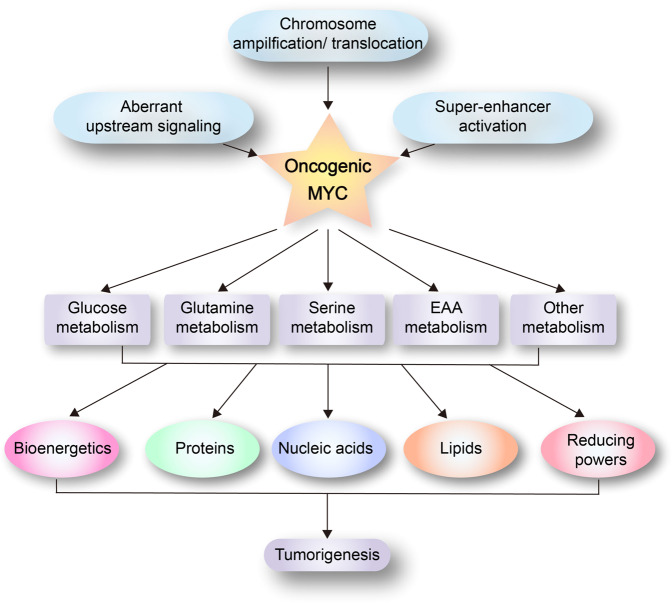
Fig. 1 MYC coordinates global metabolic reprogramming. Deregulation of MYC frequently occurs in human cancers through a variety of mechanisms, such as chromosome amplification/translocation, super-enhancer activation, and aberrant upstream signaling. MYC deregulation rewires multiple metabolic pathways to generate energy, building blocks, and reducing power for growing tumor cells. EAA essential amino acid
Fig. 1 MYC coordinates global metabolic reprogramming. Deregulation of MYC frequently occurs in human cancers through a variety of mechanisms, such as chromosome amplification/translocation, super-enhancer activation, and aberrant upstream signaling. MYC deregulation rewires multiple metabolic pathways to generate energy, building blocks, and reducing power for growing tumor cells. EAA essential amino acidCC BY · PubMed Central
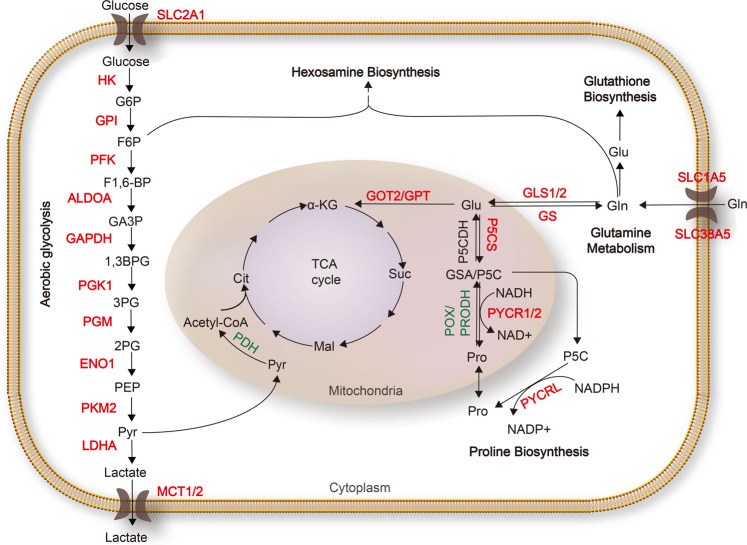
Fig. 2 MYC regulation of glucose, glutamine, and proline metabolism. MYC promotes glucose metabolism by upregulating glucose transporters and nearly all the glycolytic enzymes. MYC ellicts glutamine addiction by promoting glutamine uptake and glutaminolysis. MYC promotes proline anabolism and represses its catabolism. Enzymes labeled in red are upregulated by MYC, and those labeled in green are suppressed by MYC. α-KG α-ketoglutarate, ALDOA aldolase A, 1,3BPG 1,3-bisphosphoglycerate, Cit citrate, ENO enolase, F1,6-BP fructose 1,6-bisphosphate, F6P fructose 6-phosphate, GA3P glyceraldehyde-3-phosphate, GAPDH glyceraldehyde-3-phosphate dehydrogenase, Gln glutamine, GLS glutaminase, Glu glutamate, GOT2 glutamate oxaloacetate transaminase, G6P glucose-6-phosphate, GPI phosphoglucose isomerase, GPT glutamine pyruvate transaminase, GS glutamine synthetase, GSA glutamic-γ-semialdehyde, HK hexokinase, LDHA lactate dehydrogenase A, Mal malate, MCT monocarboxylate transporter, P5C Δ1-pyyroline-5-carboxylate, P5CDH P5C dehydrogenase, P5CS P5C synthase, PDH pyruvate dehydrogenase, PEP phosphoenolpyruvate, PFK phosphofructokinase, PG phosphoglycerate, PGK phosphoglycerate kinase, PGM phosphoglucomutase, PKM2 pyruvate kinase M2, POX/PRODH proline oxidase/dehydrogenase, Pro proline, PYCR P5C reductase, Pyr pyruvate, SLC solute carrier family, Suc succinate, TCA tricarboxylic acid
Fig. 2 MYC regulation of glucose, glutamine, and proline metabolism. MYC promotes glucose metabolism by upregulating glucose transporters and nearly all the glycolytic enzymes. MYC ellicts glutamine addiction by promoting glutamine uptake and glutaminolysis. MYC promotes proline anabolism and represses its catabolism. Enzymes labeled in red are upregulated by MYC, and those labeled in green are suppressed by MYC. α-KG α-ketoglutarate, ALDOA aldolase A, 1,3BPG 1,3-bisphosphoglycerate, Cit citrate, ENO enolase, F1,6-BP fructose 1,6-bisphosphate, F6P fructose 6-phosphate, GA3P glyceraldehyde-3-phosphate, GAPDH glyceraldehyde-3-phosphate dehydrogenase, Gln glutamine, GLS glutaminase, Glu glutamate, GOT2 glutamate oxaloacetate transaminase, G6P glucose-6-phosphate, GPI phosphoglucose isomerase, GPT glutamine pyruvate transaminase, GS glutamine synthetase, GSA glutamic-γ-semialdehyde, HK hexokinase, LDHA lactate dehydrogenase A, Mal malate, MCT monocarboxylate transporter, P5C Δ1-pyyroline-5-carboxylate, P5CDH P5C dehydrogenase, P5CS P5C synthase, PDH pyruvate dehydrogenase, PEP phosphoenolpyruvate, PFK phosphofructokinase, PG phosphoglycerate, PGK phosphoglycerate kinase, PGM phosphoglucomutase, PKM2 pyruvate kinase M2, POX/PRODH proline oxidase/dehydrogenase, Pro proline, PYCR P5C reductase, Pyr pyruvate, SLC solute carrier family, Suc succinate, TCA tricarboxylic acidCC BY · PubMed Central
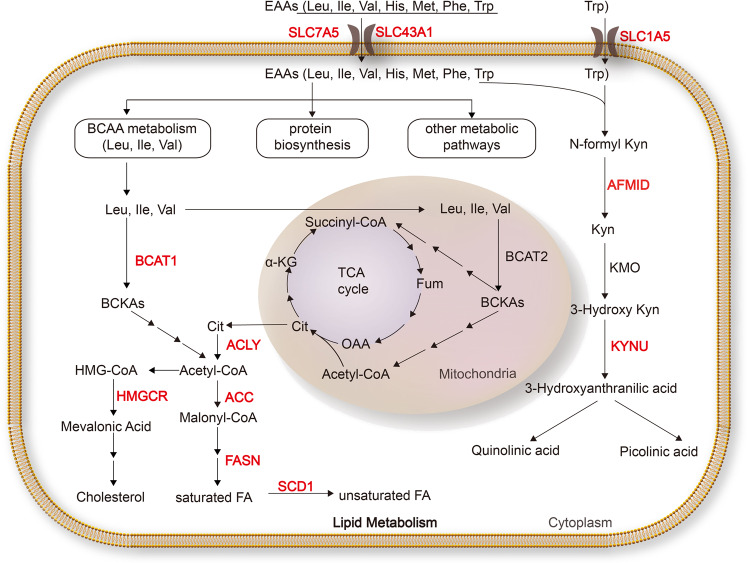
Fig. 3 MYC regulation of essential amino acid and lipid metabolism. MYC activates critical transporters, SLC7A5, SLC43A1, and SLC1A5, to promote essential amino acid transport. BCAT1, which catalyzes the decomposition of branched amino acids, is a downstream target of MYC. MYC promotes tryptophan uptake and metabolism by the kynurenine pathway. MYC coordinates glucose, glutamine, and essential amino acid metabolism to promote fatty acid biosynthesis. Enzymes labeled in red are upregulated by MYC. ACC acetyl-coA carboxylase, ACLY ATP citrate lyase, AFMID arylformamidase, BCAA branched-chain amino acid BCAT branched-chain aminotransferase, BCKA branched-chain α-keto acid, FA fatty acid, FASN fatty acid synthase, Fum fumarate, His histidine, HMG-CoA 3-hydroxy-3-methylglutaryl-CoA, HMGCR 3-hydroxy-3-methyl-glutaryl-coenzyme A reductase, Ile isoleucine, KMO kynurenine-3-monooxygenase, Kyn kynurenine, KYNU kynureninase, Leu leucine, Met methionine, OAA oxaloacetate, Phe phenylalanine, SCD stearoyl-CoA desaturase, Thr threonine, Trp tryptophan, Val valine
Fig. 3 MYC regulation of essential amino acid and lipid metabolism. MYC activates critical transporters, SLC7A5, SLC43A1, and SLC1A5, to promote essential amino acid transport. BCAT1, which catalyzes the decomposition of branched amino acids, is a downstream target of MYC. MYC promotes tryptophan uptake and metabolism by the kynurenine pathway. MYC coordinates glucose, glutamine, and essential amino acid metabolism to promote fatty acid biosynthesis. Enzymes labeled in red are upregulated by MYC. ACC acetyl-coA carboxylase, ACLY ATP citrate lyase, AFMID arylformamidase, BCAA branched-chain amino acid BCAT branched-chain aminotransferase, BCKA branched-chain α-keto acid, FA fatty acid, FASN fatty acid synthase, Fum fumarate, His histidine, HMG-CoA 3-hydroxy-3-methylglutaryl-CoA, HMGCR 3-hydroxy-3-methyl-glutaryl-coenzyme A reductase, Ile isoleucine, KMO kynurenine-3-monooxygenase, Kyn kynurenine, KYNU kynureninase, Leu leucine, Met methionine, OAA oxaloacetate, Phe phenylalanine, SCD stearoyl-CoA desaturase, Thr threonine, Trp tryptophan, Val valineCC BY · PubMed Central
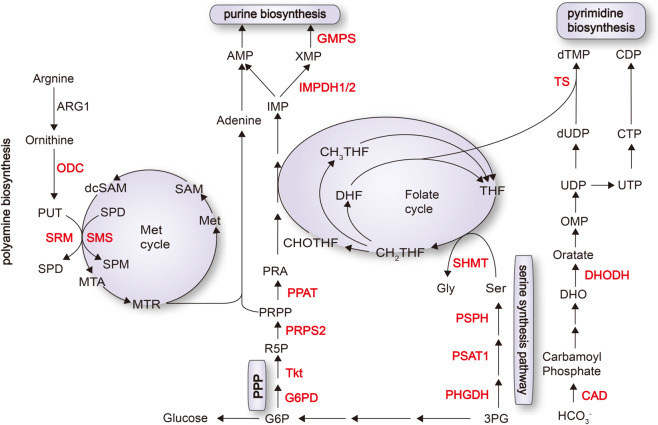
Fig. 4 MYC coordinates multiple metabolic events to activate nucleotide metabolism. MYC activates ODC, SMS, and SRM to promote polyamine biosynthesis. MYC drives nucleotide biosynthesis (1) by facilitating generation of PRPP, which offers skeleton for de novo purine and pyrimidine biosynthesis; (2) by facilitating generation of serine and glycine, which offers one-carbon unit for folate cycle; and (3) by directly inducing enzymes involved in de novo nucleotide biosynthesis. Enzymes labeled in red are upregulated by MYC. ARG1 arginase 1, AMP adenosine monophosphate, CAD carbamoyl-phosphate synthetase; CDP cytosine diphosphate; CHOTHF formyl tetrahydrofolate; CH2THF 5,10-methylene tetrahydrofolate; CH3THF methyl tetrahydrofolate, CTP cytosine triphosphate, dcSAM decarboxylated S-adenosyl-methionine, DHO dihydroorotate, DHODH dihydroorotate dehydrogenase, DHF dihydrofolate, dUDP deoxyuridine diphosphate, dTMP deoxythymidine monophosphate, Gly glycine, GMPS guanosine monophosphate synthetase, G6PD glucose-6-phosphate dehydrogenase, IMP inosine monophosphate, IMPDH inosine-5′-monophosphate dehydrogenase, MTA 5′-methylthioadenosine, MTR 5-methylthioribose-1-phosphate, ODC ornithine decarboxylase, OMP orotate monophosphate, PHGDH phosphoglycerate dehydrogenase, PPAT phosphoribosyl pyrophosphate amidotransferase, PPP pentose phosphate pathway, PRA 5-phosphoribosylamine, PRPP phosphoribosyl pyrophosphate, PRPS pyrophosphate synthetase, PSAT phosphoserine aminotransferase, PSPH phosphate ester hydrolysis, PUT putrescine, R5P ribose 5-phosphate, SAM S-adenosyl methionine, Ser serine, SHMT serine hydroxymethyltransferase, SMS spermine synthase, SPD spermidine, SPM spermine, SRM spermidine synthase, THF tetrahydrofolate, Tkt transketolase, TS thymidylate synthase, UDP uridine diphosphate, UTP uridine triphosphate
Fig. 4 MYC coordinates multiple metabolic events to activate nucleotide metabolism. MYC activates ODC, SMS, and SRM to promote polyamine biosynthesis. MYC drives nucleotide biosynthesis (1) by facilitating generation of PRPP, which offers skeleton for de novo purine and pyrimidine biosynthesis; (2) by facilitating generation of serine and glycine, which offers one-carbon unit for folate cycle; and (3) by directly inducing enzymes involved in de novo nucleotide biosynthesis. Enzymes labeled in red are upregulated by MYC. ARG1 arginase 1, AMP adenosine monophosphate, CAD carbamoyl-phosphate synthetase; CDP cytosine diphosphate; CHOTHF formyl tetrahydrofolate; CH2THF 5,10-methylene tetrahydrofolate; CH3THF methyl tetrahydrofolate, CTP cytosine triphosphate, dcSAM decarboxylated S-adenosyl-methionine, DHO dihydroorotate, DHODH dihydroorotate dehydrogenase, DHF dihydrofolate, dUDP deoxyuridine diphosphate, dTMP deoxythymidine monophosphate, Gly glycine, GMPS guanosine monophosphate synthetase, G6PD glucose-6-phosphate dehydrogenase, IMP inosine monophosphate, IMPDH inosine-5′-monophosphate dehydrogenase, MTA 5′-methylthioadenosine, MTR 5-methylthioribose-1-phosphate, ODC ornithine decarboxylase, OMP orotate monophosphate, PHGDH phosphoglycerate dehydrogenase, PPAT phosphoribosyl pyrophosphate amidotransferase, PPP pentose phosphate pathway, PRA 5-phosphoribosylamine, PRPP phosphoribosyl pyrophosphate, PRPS pyrophosphate synthetase, PSAT phosphoserine aminotransferase, PSPH phosphate ester hydrolysis, PUT putrescine, R5P ribose 5-phosphate, SAM S-adenosyl methionine, Ser serine, SHMT serine hydroxymethyltransferase, SMS spermine synthase, SPD spermidine, SPM spermine, SRM spermidine synthase, THF tetrahydrofolate, Tkt transketolase, TS thymidylate synthase, UDP uridine diphosphate, UTP uridine triphosphateCC BY · PubMed Central
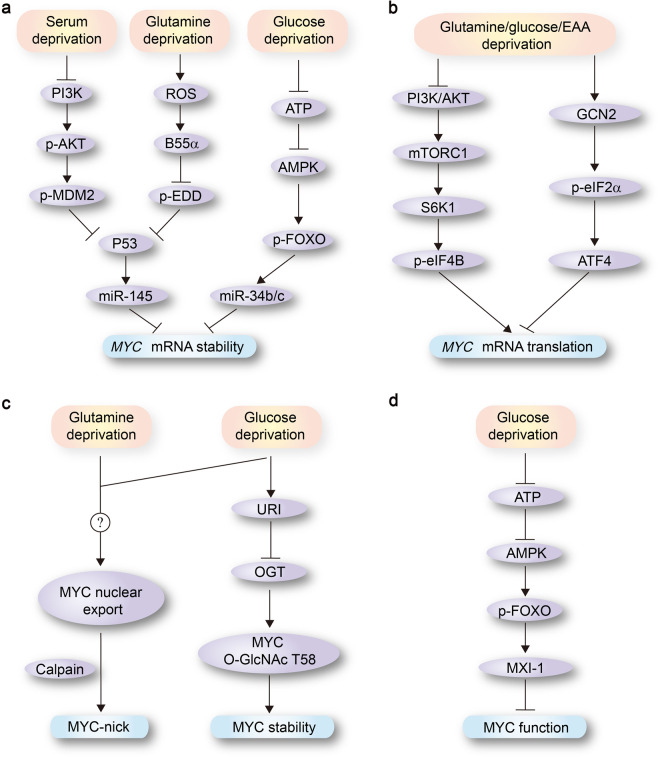
Fig. 5 Metabolic regulation of MYC expression and transcriptional activity. Expression of MYC is downstream of multiple control mechanisms, as shown in a–d, which are regulated by nutrient levels and respond to metabolic stress. See text for more details. AMPK AMP-activated protein kinase, B55α also termed Ppp2r2a, a specific B subunit of PP2A, EDD E3 identified by differential display, eIF eukaryotic initiation factor, FOXOs forkhead transcription factors of the O class, GCN2 general control non-derepressible-2, OGT O-linked N-acetylglucosamine transferase, PI3K phosphatidylinositol 3-kinase, S6K1 effector S6 kinase 1, URI unconventional prefoldin RPB5 interactor
Fig. 5 Metabolic regulation of MYC expression and transcriptional activity. Expression of MYC is downstream of multiple control mechanisms, as shown in a–d, which are regulated by nutrient levels and respond to metabolic stress. See text for more details. AMPK AMP-activated protein kinase, B55α also termed Ppp2r2a, a specific B subunit of PP2A, EDD E3 identified by differential display, eIF eukaryotic initiation factor, FOXOs forkhead transcription factors of the O class, GCN2 general control non-derepressible-2, OGT O-linked N-acetylglucosamine transferase, PI3K phosphatidylinositol 3-kinase, S6K1 effector S6 kinase 1, URI unconventional prefoldin RPB5 interactorCC BY · PubMed Central

Verification

Claims the paper makes

The claims and statistics of this paper haven’t been checked yet.

Run the check — free, no account needed. It reads the open-access text and checks the sources it cites.

A few free checks a day · papers already verified open instantly · results are public

Claims other papers make about this one

Each is checked against this paper’s own text: does it say what the citing paper says it does?

Self-check

Percentages, sums and reported differences re-computed from the paper’s own numbers.

The self-check needs the paper’s full text.

Citations

Cites

1 retracted

Show all 120 references

Cited by

Sorted by citations

Items 401–405 of 405

Metadata

Authors
Dong, Y., Tu, R., Liu, H., & Qing, G.
Affiliations
Wuhan University (CN)
Corresponding author
Qing, Guoliang
Venue
Signal Transduction and Targeted Therapy
Published
2020-07-10
Volume
5
Issue
1
Pages
124-124
ISSN
2059-3635 (ISSN-L)
OpenAlex
W3041824636
Cited by
405
References
120
Citations by year
2026: 84 · 2025: 87 · 2024: 71 · 2023: 48 · 2022: 58 · 2021: 51 · 2020: 6
FWCI
4.15
Type
journal article
Language
en
Open access
Locations
  • Signal Transduction and Targeted Therapy (publishedVersion, cc-by)
  • PubMed Central (publishedVersion, cc-by)
  • PubMed (publishedVersion)
Funders
  • National Natural Science Foundation of China (81830084, 81725013)
  • Wuhan University (TFJC2018005)
  • Fundamental Research Funds for the Central Universities (2042020kf0215)
  • National Science Fund for Distinguished Young Scholars (81725013)
Topics
  • Life Sciences › Biochemistry, Genetics and Molecular Biology › Cancer Research › Cancer, Hypoxia, and Metabolism
  • Life Sciences › Biochemistry, Genetics and Molecular Biology › Molecular Biology › Metabolism, Diabetes, and Cancer
  • Life Sciences › Biochemistry, Genetics and Molecular Biology › Cancer Research › Cancer, Lipids, and Metabolism
Keywords
c-Myc, cancer metabolism, metabolic reprogramming, malignant transformation, cancer therapeutics, metabolic dependencies
MeSH terms
Animals, Cell Transformation, Neoplastic, Humans, Neoplasms, Gene Expression Regulation, Neoplastic, Proto-Oncogene Proteins c-myc

About these checks

Registry, retraction, Cites and statistics results are computed, not judged, with one exception: a printed reference that no index lists is read once by a model before it counts as a citation error. Claims are extracted by a model and kept only when their quote appears verbatim in the text; each cited source is then checked, with a model’s help, for whether it says what the claim relies on. Those verdicts can be wrong — read the claim’s quote and the cited source before relying on one.

Statistics and arithmetic are recomputed, not judged.

Confidence bands are shown only for fields calibrated on our annotated test set. None is calibrated yet, so no band is shown.

What counts as a claim ›How we measure confidence ›How we check this ›

Are you an author, or do you see a problem with this page? Request a review